The Profession of Arms: A Guide for Young Army Officers
It takes courage, especially for a young officer, to check a man met on the road for not saluting properly or for slovenly appearance, but, every time he does, it adds to his stock of moral courage, and whatever the soldier may say, he has respect for the officer who does pull him up.
Read Document →The Dragon's Teeth: Assessing China's Military Modernization
PLA has focused on modernising its capabilities across all warfare domains to achieve these goals. This includes land, air, and maritime operations, nuclear, space, counter-space, electronic warfare and cyberspace operations, aiming to become a fully integrated joint force.
Read Document →Transforming the PLA: A Decade of reorganisation from SSF to ISF
PRC has engaged in a sustained and broad effort to transform the PLA from an infantry-heavy, low-technology, ground forces-centric military into a high-technology, networked force with an increasing emphasis on joint operations and naval and air power projection.
Read Document →Eyes without Borders: Exploring the World of Open Source Intelligence (OSINT) in the Digital Age
Open Source Intelligence (OSINT) is gaining prominence with the rise of social media, the digital society and the vast growth of publicly and commercially available information (PAI and CAI).
Read Document →
The PLA’s Developing Cyber Warfare Capabilities and India's Options
Informationised warfare blurs the lines between peacetime and wartime. A nation in the information age cannot wait for the hostilities to break out to collect intelligence, carryout influence operations, develop antisatellite systems or design computer software weapons.
Read Document →
Galwan and After
Why did China did this when he is under tremendous pressure in all fronts, is this China's salami slice tactics being progressed rigorously, what will be new Rules of Engagement, what will be escalatory control mechanism, who has taken this decision, will there be some pressure put by China in India's North-East through insurgency.
Read Document →
India’s Joint Doctrine for Cyberspace Operations: A Critical Review
Chief of Defence Staff (CDS) General Anil Chauhan and Secretary, Department of Military Affairs, formally released declassified versions of the Joint Doctrines for Cyberspace Operations during the Chiefs of Staff Committee meeting in New Delhi.
Read Document →
Know your Enemy General(now Field Marshal) Syed Aseem Munir
Gen SA Munir's position in the hierarchy of Pakistan was not very comfortable. The state of economy, insurgency in Pakhtoonistan and Balochistan, attack on the Jaffar Express, constant protests by supporters of Imran Khan's supporters inside and outside of parliament.
Read Document →
Decoding Operation SINDOOR: Key Aspects and Implications
Precision strikes were carried out on nine sites—four in Pakistan and five in PoK—linked to anti-India terrorist groups such as the LeT, JeM and the Hizbul Mujahideen. The targeted sites included Muridke (LeT headquarters) and Bahawalpur (JeM headquarters).
Read Document →
Chinese Cyber Exploitation in India's Power Grid - Is There a linkage to Mumbai Power Outage?
The New York Times (NYT), based on analysis by a U.S. based private intelligence firm Recorded Future, reported that a Chinese entity penetrated India’s power grid at multiple load dispatch points. Chinese malware intruded into the control systems that manage electric supply across India, along with a high-voltage transmission substation and a coal-fired power plant
Read Document →19 January 2018
PM, Def Min Missing Army Day Event Sends Wrong Signal Before R-Day
US renews call for steps against ‘externally focused terrorists’
The Islamic Republic of Hysteria
To the extent the Trump administration has a discernible Middle East strategy, it is to contain and confront Iran. Secretary of State Rex Tillerson, Secretary of Defense James Mattis, U.N. Ambassador Nikki Haley, and President Donald Trump himself have all denounced Iran’s regional activities. (In February, after Iranian ballistic missile tests, Trump tweeted that the country was “playing with fire.”) In October, the White House announced that moving forward, the official U.S. policy is aimed at “neutralizing Iran’s destabilizing influence and constraining its aggression.”Top U.S. General says ‘not giving up’ on Pakistan ties
Beware Iran: The Current Middle East Lull Is Transient
THE CHINESE DREAM AND BEIJING’S GRAND STRATEGY
What Xi Jinping’s New Year’s Speech Means for America
A Year in Review: More Problems, More Reforms, More Cooperation for Central Asia in 2017
Shock and Awe: Surprises That Could Stun Asia in 2018
Asia is expected to enjoy stronger economic growth in 2018 as the world economy picks up speed. But there are still plenty of potential surprises that could rattle financial markets in the Year of the Dog, according to analysts.China has already followed the U.S. lead in tightening monetary policy, but the rest of Asia’s central banks are far from willing to follow the U.S. Federal Reserve in hiking interest rates given their diverging economic outlooks. Should the Fed increase rates more than the anticipated three or four times this year, Asia could suffer the fallout, particularly if a strengthening dollar drains capital from emerging economies. India, Indonesia, and the Philippines are considered the most exposed, based on their current account balances and levels of net foreign direct investment. Yet the eruption of private debt levels, which has reached more than 200 percent of gross domestic product (GDP) in China and nearly as high in South Korea, poses a high risk also, particularly for those companies with dollar-denominated loans.Terrorists Stalk Dark Web for Deadlier Weaponry
Bottom line: Terrorists are turning to the dark web’s crypto-bazaars, social media channels and e-commerce sites to buy more coveted military equipment than the usual rocket launchers and AK-47s in the traditional black market. These digital black markets are also allowing terrorist organizations from Iraq, Syria, Libya and Yemen, as well as self-radicalized individuals in the West, to access a larger assortment of arms, explosives material and expertise from the comfort and anonymity of their home computers. Turkish president vows to ‘drown’ US-backed Syrian Kurdish force
In 2018, Chavismo’s Time May Finally Run Out
Venezuelan President Nicolรกs Maduro’s embattled regime ended a tumultuous 2017 by having to suppress renewed food riots resulting from the government’s failure to import sufficient supplies of pork leg, a traditional holiday staple. In one disturbance, a pregnant woman was shot dead by security forces on Christmas Eve. Yet if 2017 ended poorly for Venezuela, 2018 is shaping up to be even worse. Already, there have been new outbreaks of looting in the face of rampant shortages of food and basic goods. Inflation, which hit a reported 2,616 percent last year — the highest in the world — will continue to surge in 2018. And, worst of all, due to bad management and corruption, oil production has fallen to one of its lowest points in three decades, “further depriving the cash-strapped country of its only major source of revenue and adding to the suffering of its people,” according to CNN.Russia Revisits an Old Cold War Battleground
Moscow looms large in sub-Saharan Africa's Cold War history. Across the continent, the Soviet Union competed with the United States and its Western allies for influence in a series of long-running proxy battles. Russia's interest in sub-Saharan Africa waned, however, after the Soviet Union's collapse in 1991. The region may have lost much of its geopolitical significance in the intervening time, but as the Kremlin asserts its influence in more and more conflicts abroad, sub-Saharan Africa presents Russia another opportunity to extend its global reach — should it so desire.North Korea meeting to stress importance of sanctions: Canada
A U.S.-Ukraine Weapons Deal Has Russia Up in Arms
Since the war in Ukraine began in 2014, the United States has considered sending arms to the country. Now Washington is ready to follow through with the idea. U.S. President Donald Trump approved the sale of lethal weapons to Ukraine on Dec. 22, signing a $47 million deal that includes 35 FGM-148 Javelin command launch units and 210 anti-tank missiles, along with smaller arms. Wary of provoking Russia, the United States has been careful to frame the recent decision as a purely defensive measure, and not a means to encourage military action against separatist forces in eastern Ukraine. But Moscow, viewing the move as an act of escalation, will doubtless respond in one way or another.In the EU, East and West Are Falling Out of Tune
In its mission to bring peace and prosperity to a landmass wracked by war, the European Union has always been a marriage of convenience. Between 2004 and 2007, the union incorporated several countries from Central and Eastern Europe into its expanding bloc. EU governments and institutions viewed enlargement as a path toward fostering the emergence of prosperous, democratic and stable nations on its eastern border after the collapse of the Soviet Union. In turn, the new member states regarded EU membership as a gateway to funds, investment, modernization and protection. In exchange for Brussels' financial largesse, new members introduced deep economic, political and institutional reforms to comply with EU standards. Now, however, the increasing unwillingness of eastern members to heed the EU's demands threatens to deepen the divide between the bloc's west and east.What the Hell Happened in Hawaii?
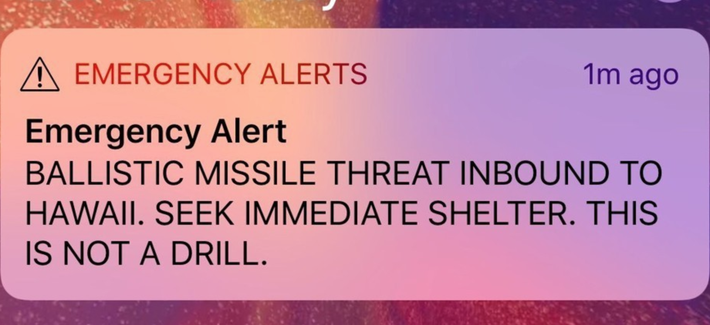
Early this morning, residents of Hawaii received an emergency alert on their cell phones and on their television screens: “BALLISTIC MISSILE THREAT INBOUND TO HAWAII. SEEKIMMEDIATE SHELTER.” If that wasn’t enough to spark panic in a state where Cold War-era nuclear-attack alert sirens have been undergoing testing, the warning ended with those five dreaded words: “THIS IS NOT A DRILL.” Following several minutes of panic and confusion, various authoritative sources confirmed that the alert had been sent in error. Hawaii Congresswoman Tulsi Gabbard took to Twitter to say that she had “confirmed with officials” that there was no ballistic missile threat. U.S. Pacific Command (PACOM) issued a statement noting that the “Earlier message was sent in error,” and that the State of Hawaii would issue a correction. Thirty-eight minutes after the original alert, a second followed: “There is no missile threat or danger to the State of Hawaii. Repeat. False Alarm.” Russian, Chinese, or North Korean intercontinental ballistic missiles (ICBMs) could make it to Hawaii in less than 38 minutes, mind you.EU names China and Russia as top hackers
What 2018 has in store for the markets
WHAT is in store for economies and markets in 2018? Around this time of year, a large number of analysts and fund managers are giving their views. Among the most interesting and thoughtful approaches can be found at Absolute Strategy Research (ASR), an independent group founded by David Bowers and Ian Harnett. ASR adds extra depth to its analysis by contrasting its own views with those of the consensus. To do so, the group polled 229 asset allocators, managing around $6trn of assets, for their views on the outlook for economies and markets. They found a groundswell of optimism; the probability of equities being higher by the end of 2018 was 61%, and that shares will beat bonds is 70%. The allocators think there is only a 27% chance of a global recession. And they are not worried about the prospect of the Federal Reserve pushing up interest rates.A Year in Review: Ukraine Faced Mixed Fortunes, Missed Opportunities in 2017
Telecom to lose more jobs; on course to cull 90,000 more: Report
TRUST WAR: DANGEROUS TRENDS IN CYBER CONFLICT
This test was an example of the “bytes and blood” scenario that national security analysts generally predict when they talk about “cyber war” or conflict in cyberspace. For most of cyberspace’s short history, defense analysts, policymakers, and many computer experts have been focused on cyber-attacks that cause physical destruction and death. In 2012, for example, then-Secretary of Defense Leon Panetta cautioned Americans that they someday could face a “cyber Pearl Harbor” as a terrorist group or enemy state gained control of “critical switches,” to “derail passenger trains, or even more dangerous, derail trains loaded with lethal chemicals.”CONTRASTING CHINA’S AND RUSSIA’S INFLUENCE OPERATIONS
A series of scandals from Russian meddling in the U.S. elections to China’s influence over Western politicians, like Australian Sen. Sam Dastyari and U.S. Sen. Steve Daines, has brought American attention back to the Cold War-style fight for influence and narratives. Congress has started to act, incorporating counter-propaganda funding into the FY2017 National Defense Authorization Act and proposing reforms to the Foreign Agent Registration Act and the Committee on Foreign Investment in the United States. The United States finally may be waking up to the challenge that its NATO allies and Taiwan have been facing for years. As Americans try to make sense of modern political warfare, the struggle to polish the rust off of the Cold War toolkit for countering foreign influence has run into the problem of insufficient to explain the challenges now faced by the United States and its allies.