The Profession of Arms: A Guide for Young Army Officers
It takes courage, especially for a young officer, to check a man met on the road for not saluting properly or for slovenly appearance, but, every time he does, it adds to his stock of moral courage, and whatever the soldier may say, he has respect for the officer who does pull him up.
Read Document →The Dragon's Teeth: Assessing China's Military Modernization
PLA has focused on modernising its capabilities across all warfare domains to achieve these goals. This includes land, air, and maritime operations, nuclear, space, counter-space, electronic warfare and cyberspace operations, aiming to become a fully integrated joint force.
Read Document →Transforming the PLA: A Decade of reorganisation from SSF to ISF
PRC has engaged in a sustained and broad effort to transform the PLA from an infantry-heavy, low-technology, ground forces-centric military into a high-technology, networked force with an increasing emphasis on joint operations and naval and air power projection.
Read Document →Eyes without Borders: Exploring the World of Open Source Intelligence (OSINT) in the Digital Age
Open Source Intelligence (OSINT) is gaining prominence with the rise of social media, the digital society and the vast growth of publicly and commercially available information (PAI and CAI).
Read Document →
The PLA’s Developing Cyber Warfare Capabilities and India's Options
Informationised warfare blurs the lines between peacetime and wartime. A nation in the information age cannot wait for the hostilities to break out to collect intelligence, carryout influence operations, develop antisatellite systems or design computer software weapons.
Read Document →
Galwan and After
Why did China did this when he is under tremendous pressure in all fronts, is this China's salami slice tactics being progressed rigorously, what will be new Rules of Engagement, what will be escalatory control mechanism, who has taken this decision, will there be some pressure put by China in India's North-East through insurgency.
Read Document →
India’s Joint Doctrine for Cyberspace Operations: A Critical Review
Chief of Defence Staff (CDS) General Anil Chauhan and Secretary, Department of Military Affairs, formally released declassified versions of the Joint Doctrines for Cyberspace Operations during the Chiefs of Staff Committee meeting in New Delhi.
Read Document →
Know your Enemy General(now Field Marshal) Syed Aseem Munir
Gen SA Munir's position in the hierarchy of Pakistan was not very comfortable. The state of economy, insurgency in Pakhtoonistan and Balochistan, attack on the Jaffar Express, constant protests by supporters of Imran Khan's supporters inside and outside of parliament.
Read Document →
Decoding Operation SINDOOR: Key Aspects and Implications
Precision strikes were carried out on nine sites—four in Pakistan and five in PoK—linked to anti-India terrorist groups such as the LeT, JeM and the Hizbul Mujahideen. The targeted sites included Muridke (LeT headquarters) and Bahawalpur (JeM headquarters).
Read Document →
Chinese Cyber Exploitation in India's Power Grid - Is There a linkage to Mumbai Power Outage?
The New York Times (NYT), based on analysis by a U.S. based private intelligence firm Recorded Future, reported that a Chinese entity penetrated India’s power grid at multiple load dispatch points. Chinese malware intruded into the control systems that manage electric supply across India, along with a high-voltage transmission substation and a coal-fired power plant
Read Document →9 April 2016
BrahMos Block-III is India's answer to China's DF-21D Anti-Aircraft Carrier Missile
*** The dirty bomb
China launches new attack on the Dalai Lama
Expanding US-Japan-India Cooperation in the Indian Ocean
The Indian Ocean is featuring more prominently in discussions among the three Asian giants.
By Jessie Daniels, April 08, 2016
One of the focus areas within the growing trilateral cooperation between the United States, Japan and India is the Indian Ocean.
Covering one-fifth of the water on the Earth’s surface, the Indian Ocean generates vital long-term trade flows and energy interests, particularly for Asia. However, tensions between China and India in their waters are increasing as New Delhi grows concerned about the expansion of PLA Navy submarine deployments in what it considers its backyard.
These Chinese submarine deployments have ramped up since a 2013 Indian Defense Ministry report warned that they constituted a “grave threat.” In the past three years, developments like the docking of Chinese submarines in Colombo and Karachi and Air Independent Propulsion technology upgrades to the Yuan-class of submarines have sparked continued questions about China’s ulterior motives in the Indian Ocean. Despite China’s claims that its submarine deployments are part of its counter-piracy missions, many of its actions suggest a desire to establish an expanded undersea presence in the Indian Ocean.
India, in turn, is responding with a stronger hand in the space, emerging from its so-called “maritime blindness” with hopes of being more than just a continental power. On a trip to the Seychelles and Mauritius in March 2015, prime minister Narendra Modi fashioned a far-reaching vision for the space, in which he put the Indian Ocean at “the top of our [India’s] policy priorities” and promised to defend India’s maritime interests.
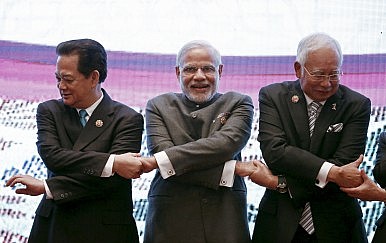
India’s ASEAN Approach: Acting East
The Association of Southeast Asian Nations (ASEAN) has a population (600 million) larger than North America or the European Union; its total merchandise exports stand at $1.2 trillion. Stephen Groff, vice president of the Asian Development Bank (ADB), noted in a 2014 speech in Berlin that if ASEAN were one economy, with a combined gross domestic product of $2.3 trillion, it would have ranked as the seventh largest economy in the world by 2013. He added that it would become the fourth largest economy by 2050 if the existing level of growth continues. Fittingly, ASEAN is considered to be a growing hub for consumer demand and occupies a significant position in global trade flows.
Presently, ASEAN is taking the process of economic integration into serious consideration, though with some limitations and constraints. No other regional trading bloc in Asia is talking about a single currency at this moment, which sets ASEAN apart. Plus, ASEAN already has six trade agreements with its neighbors, which includes China, South Korea, Japan, Australia, New Zealand, and India.
India is one of the strategic partners of ASEAN. With a total population of 1.8 billion and a combined GDP of $3.8 trillion, ASEAN and India together form an important economic space in the world. Besides an economic partnership, India expects to benefit geopolitically as well from its rejuvenated affinity with ASEAN and other regional countries. In order for India to gain a substantial position in East Asia, New Delhi has moved to an Act East Policy (AEP) now, an update to the 25-year-old Look East Policy (LEP). As ASEAN remains central to India’s AEP, India’s achievements from this strategy are worth watching. It is crucial to observe whether the Modi government will be able to overcome the challenges and give the Act East Policy a much-needed push.
Steering into troubled seas with eyes wide open
Modi’s Visit to Saudi Arabia
Prasanta Kumar Pradhan, April 06, 2016
Prime Minister Narendra Modi’s two day visit to Saudi Arabia on April 2-3, 2016 further bolsters India’s engagement with the Kingdom. Saudi Arabia has remained an important partner for India in the Gulf region. Modi’s visit brings the India-Saudi relationship further closer from where it stood when the Delhi Declaration of 2006 and Riyadh Declaration of 2010 were issued. The visit of King Abdullah to India in 2006 and the visit of Prime Minister Manmohan Singh to Saudi Arabia in 2010 had laid strong foundations for the India-Saudi relationship. Modi’s visit, while intending to take the relationship to a new level, has laid emphasis on important issues such as trade, investment, terrorism and strengthening strategic ties. Saudi Minister for Foreign Affairs Adel bin Ahmed Al Jubeir, while visiting India on March 7-8, 2016, had stated that India is a “very important partner” for Saudi Arabia and expressed his desire to broaden bilateral engagement, indicating a growing commonality in how each country perceives the other including as key players in their respective regions.
In the past, the relationship has been inhibited by a number of historical factors such as the Kashmir issue, Pakistan factor, regional and global politics. In recent decades, with India’s rise as a major player in world politics and economy, Saudi Arabia came to realise the importance of maintaining strong ties with India. India has been a natural choice for an economic and developmental partnership in Saudi Arabia’s efforts to diversify its relationships by engaging various Asian countries.
Saudi Arabia’s ties with Pakistan and India’s links with Iran have remained two important factors affecting the India-Saudi Arabia relationship.During his recent visit to India, Saudi Foreign Minister Al Jubeir stated that while “India is a strategic partner, Pakistan is a strategic ally and will remain so.” While Riyadh feels uncomfortable with India’s growing relationship with Iran, India expects the Kingdom to restrain its ally, Pakistan, from allowing its territory being used by terrorists targeting India.
* Surveillance In The Information Age
-- this post authored by Fred Burton
Those who conduct surveillance - either for nefarious or protective security reasons - frequently have used available technology to aid them in their efforts. In earlier times, employing such technology might have meant simply using a telescope, but in more recent years, surveillants have used photographic and video gear, night vision aids and electronic equipment such as covert listening devices, beacons and programmable scanners. These efforts have been greatly enhanced by the advent of personal computers, which can be used to database and analyze information, and the Internet, which has revolutionized information gathering.
Doubtlessly, modern technology has radically altered the surveillance process. What it has not done, however, is render physical pre-operational surveillance obsolete. Despite innovative Internet tools, a person sitting in an Internet cafรฉ in Quetta, Pakistan, cannot get everything he or she needs to plan and execute a terrorist attack in New York. There are still many things that can only be seen in person, making eyes-on surveillance vital to pre-operational planning. And, as long as actual physical surveillance is required, countersurveillance will remain a key tool for proactively preventing terrorist attacks.
The Internet as a Tool
The Internet has proven to be an important asset for those preparing a surveillance operation. If the target is a person, open-source Internet searches can provide vital biographical information, such as the target's full name, address, occupation, hobbies, membership in organizations, upcoming speaking engagements and participation in charity events. It also can provide the same information on the target's spouse and children, while image searches can be used to find photos of the target and related people.
In most instances, public records checks performed on the Internet also can provide a vast amount of personal information about a potential target, including property, vehicle and watercraft ownership, voter registration data, driver's license information, criminal history, professional license information and property tax data. The property tax data can be especially revealing because it not only tells the surveillant which property the target owns, but in some jurisdictions can even include photographs of the front of the home and even copies of the floor plan. In addition, many commercial services will, for a fee, provide an extremely detailed public records dossier on a desired subject - often with little regard for how the information will be used.
World military spending up in 2015, India in sixth position
BIMSTEC, BCIM, BBIN - & ‘BCIN’ A fresh look at the map will show how Bangladesh-China-India-Nepal could now be connected
Imagining a neighbour’s turbulence
http://www.thehindu.com/opinion/lead/imagining-a-neighbours-turbulence/article8447591.ece?homepage=true
Rakesh Sood
Given the strained civil-military ties in Pakistan, Prime Minister Modi needs to develop a more centred policy before heading out for Islamabad later this year for the SAARC summit. Scenario-building could be a start.
The following op-ed appeared on December 31, 2016 under the title ‘Political uncertainty in Pakistan’.
Looking back, it is clear that 2016 will be remembered as a year marked by political turbulence in Pakistan; these processes of change are still churning and will further unfold in 2017. In hindsight, the catalysing event for the changes was the suicide attack in Lahore in March on Easter Sunday in the park Gulshan-e-Iqbal which claimed more than 70 lives. It strained the rather fragile civil-military balance that had been established after the Azadi March in 2014 led by Imran Khan (Pakistan Tehreek-e-Insaf) and Muhammad Tahir-ul-Qadri (Pakistan Awami Tehreek). Allegations of widespread corruption against the Sharif brothers and behind-the-scenes political manoeuvrings led to their eventual exit. A technocratic government was sworn as an interim measure and Chief of the Army Staff General Raheel Sharif’s term was extended by a year in November. The National Security Council (NSC) assumed greater responsibilities for governance. Elections are likely to be held in 2017 once law and order is restored though no time frame has been set.
Since Operation Zarb-e-Azb was launched in June 2014 in North Waziristan against elements of the Tehreek-e-Taliban Pakistan (TTP), more than 3,500 militants are reported to have been killed but terrorist attacks have not ceased. Strikes against military installations have come down though there was an audacious attempt to hijack a Pakistani naval vessel from the base at Karachi in 2014 and a terrorist attack at the Peshawar airbase in 2015 claimed 29 casualties. However, the majority of the strikes have been against minorities and soft targets — Shia mosques and buses carrying Shia pilgrims, churches, and educational institutions.
Infographic Of The Day: Reported Cases Of Zika Virus Worldwide
Dr. Carlos Pardo-Villamizar, a neurologist at Johns Hopkins University School of Medicine, is studying Zika complications with colleagues in five Colombian research centres. They have seen cases of encephalitis, myelitis and facial paralysis associated with Zika and want to understand what is triggering these complications.
They also want to study whether prior infection with dengue or chikungunya - two related viruses - are contributing to neurological disorders seen in patients with Zika.
Scientists are turning their attention next to Puerto Rico, where Zika is expected to infect hundreds of thousands of residents by year-end.
More cases hold the potential for "a better sense of the full spectrum of disease that Zika is capable of causing," said Dr. Amesh Adalja of the Center for Health Security at the University of Pittsburgh Medical Center.
[click here to enlarge infographic]
Source: http://www.livescience.com/53541-reported-cases-of-zika-virus-worldwide-infographic.html
** Lincoln, Brexit and Geopolitics
One Belt, One Road, One Singapore
Going Global? Indian Businesses Must First Learn From Tata Steel
Panama Papers Signal Beginning Of End Of Tax Havens
China Puts an Emergency Stop on Coal Power Construction
China’s energy sector is lumbering under the weight of a coal power glut, prompting the central government to step in.
By Feng Hao, April 07, 2016
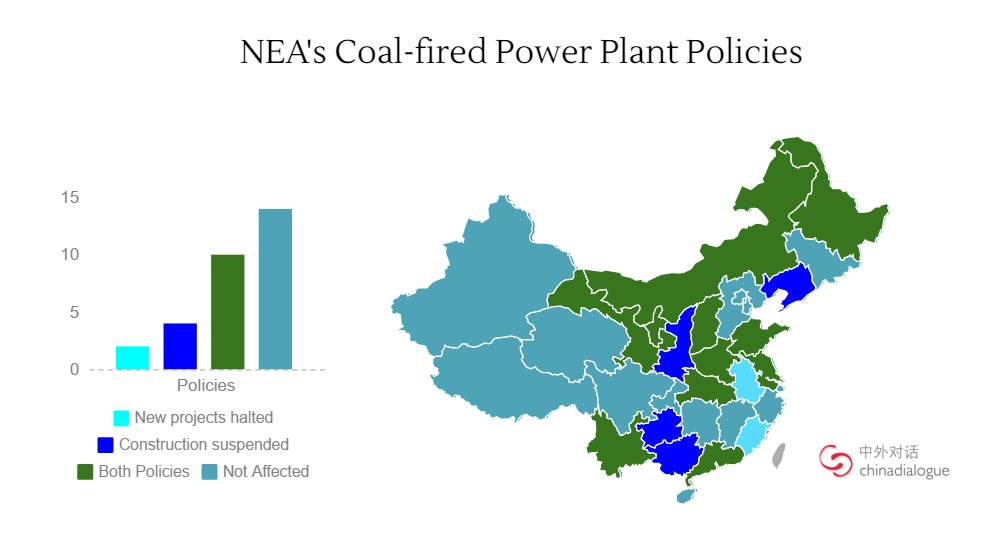
China’s central government has ordered local authorities to delay or cancel construction of new coal-fired power plants as regulators attempt to reduce a glut in capacity, just one year after decisions were delegated to the provinces.
The National Development and Reform Commission (NDRC) and the National Energy Administration (NEA) have ordered a halt to construction of coal-fired plants in 13 provinces where capacity is already in surplus, including major coal producers such as Inner Mongolia, Shanxi, and Shaanxi. A further 15 provinces will be required to delay construction of already-approved plants.
Harsh punishments have been threatened for construction that goes ahead in breach of the new regulations. Operating licenses will be denied, connection to the power grid blocked, and financial institutions will halt lending to transgressors.
The curbs come as Chinese government departments are asked to make rapid policy adjustments in response to slowing electricity demand, as the country shifts toward a less wasteful and less energy-intensive economy and aims to reduce the amount of coal power generation.
Data source: Energy Observer / China Southern Power Grid Company. Graphic by chinadialogue.
How Mao Zedong Benefited From the Cuban Missile Crisis
The Chinese role in Cuba during the Cold War paid dividends domestically for Mao Zedong.
By Robert Farley, April 08, 2016
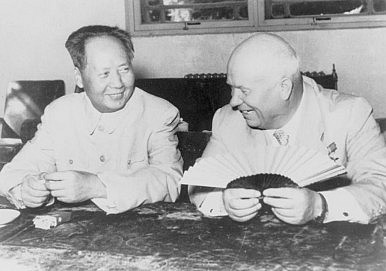
Though they might not appear to be connected at first glance, the Cuban Missile Crisis coincided with the end of the long Sino-Soviet break during the early years of the Cold War. China and the Soviet Union had sparred ideologically since the mid-1950s, and the Soviets had broken off much technical, military, and economic support by the early 1960s. Chinese and Soviet proxies waged a brutal ideological war for the soul of the international Communist movement.
Under the leadership of Mao Zedong, China developed a critique of Soviet foreign policy that suggested the unfitness of Moscow for leadership of the socialist sphere. The Russians, enjoying the security and comfort of their position atop the Communist bloc, would not take the risks necessary to winning the war against the capitalist West. Soviet caution in Europe and in the developing world tended to support this critique. In particular, the Soviets showed little interest in stirring up genuine revolution in European colonial possessions and third world client states, whereas China could play a key leadership role in this area.
New research in the Chinese archives by Enrico Fardella tends to confirm that fractures in the Chinese leadership helped drive the Maoist critique of the Soviet Union. The apparent failure of the Great Leap Forward, coming at the same time as the withdrawal of Soviet economic and technological experts from China, drove a wedge between Mao Zedong and practical-minded leaders such as Liu Shaoqi and Deng Xiaoping. Mao sought to associate the practical faction with the Soviet revisionism of Nikita Khrushchev, especially on the foreign policy front. The more practical factions sought to avoid confrontation with either Washington or Moscow, especially during China’s period of acute weakness.
China’s One Belt One Road Initiative Gathers Momentum
Snapshot
The new silk road connectivity to West Asia would help China take forward its economic and commercial interests while helping strengthen its geopolitical influence in this oil rich part of the world.
The end goal of One Belt and One Road initiative is to efficiently link the commercially vibrant Eurasian and African markets that would, in turn, serve to reinforce Chinese quest to emerge as the manufacturing hub of the world.
India has neither the resources nor the political commitment to undertake a connectivity project on par with One Road One Belt initiative.
Economic imperatives in China as much as the keenness of the Chinese political leadership to strengthen its geopolitical influence across Asia and Europe seem to be the engine that drives the mammoth “One Belt One Road” Initiative.
By Radhakrishna Rao
In a major boost to China’s overambitious One Belt One Road Initiative, a train from the traditional hub of Yiwu was fagged off to Tehran earlier this year. This container train covered a distance of more than 10,000 km in fourteen days across the New Silk Road Economic Belt forming a part of the multi billion dollar One Belt One Road initiative.
As envisaged now, the new silk road connectivity to West Asia would help China take forward its economic and commercial interests while helping strengthen its geopolitical influence in this oil rich part of the world. As it is, China has already inked a strategic partnership pact with the sanction free Iran to take care of military and security cooperation as well as intelligence sharing.
According to Chinese media reports, more than 4,000 businessmen and entrepreneurs of West Asian origin are now located in the city of Yiwu, which, last year, set a record of exporting goods and commodities worth more than $8-billion to West Asia.
By all means, the striking advantage for China is that it has deep insight into the dynamics of Iranian market as a consequence of its association with many of the Iranian development and infrastructure projects during the days Iran was under sanction.
As pointed out by Li Shaoxian, an expert on West Asian studies at Ningxia University, the reopening of the Iranian market would boost competition between China and West in a big way.
Alawite Identity in Syria
http://www.atlanticcouncil.org/blogs/syriasource/alawite-identity-in-syria?utm_source=Sailthru&utm_medium=email&utm_campaign=New%20Campaign&utm_term=*Mideast%20Brief#.VwVSTJIobi0.twitter
By H.A. Hellyer
Since the beginning of Hafez al-Assad’s rule in 1970, the Alawite community, to which the family belongs, has dominated leadership of the Syrian state. The top brass in the Syrian army, intelligence services, and security establishment were also drawn from the Alawite community. As the Syrian uprising gained momentum in 2011, Bashar al-Assad’s regime was content to fan the flames of sectarianism, changing the narrative around the revolutionary uprising (which included Alawite figures) against a tyrannical dictatorship, into one that was a sectarian war between different religious sects. In 2016, one of the fundamental fears of many in and out of Syria is that the victory of anti-Assad rebels could spell the end of the Alawite community more generally, as Sunni Syrians have at least perceived the Alawite community as uniformly lining up behind Assad’s brutality.
* How French Secularism Became Fundamentalist
A militant form of laรฏcitรฉ has taken hold in France, backed by everyone from intellectuals to government officials. Is this what the republic’s founding fathers envisioned? By Robert Zaretsky, April 7, 2016
Last week, the headline of an editorial in the French satirical weekly Charlie Hebdo asked a provocative question: “How did we end up here?” it read. By “here,” the weekly meant, of course, staring at the blood-stained rubble of airport terminals and metro stations. But by the end of the piece, “here” had also broadened into something bigger: “How the hell did I end up having to wander the streets all day with a big veil on my head?” they asked rhetorically. “How the hell did I end up having to say prayers five times a day?” “Here,” in other words, was some kind of unrecognizable, Islamized vision of France, where “the very notion of the secular” had been “forced into retreat.”
Seeking the reasons behind the Brussels terrorist attacks, the paper, which was itself the target last year of Islamic terrorists, offered an answer. It was neither the Keystone Cop antics of the Belgian police; nor the barriers, linguistic and territorial, which prevented European governments from sharing vital intelligence; nor the festering despair in places like Molenbeek, the Brussels neighborhood that is home to scores of unemployed youths of mostly North African background.
Instead, Charlie Hebdo declared, we must look at the role played by liberal societies. Does not France’s passivity when faced with attacks on French culture — and specifically on laรฏcitรฉ, or secularism — pave the way for the extremists? Does not one’s acceptance of, say, the local Muslim baker — a very nice and fully integrated fellow, who nevertheless refuses to sell ham sandwiches — comprise a form of collusion with Islamism? In the end, Charlie Hebdo warns, the only defense against terrorism, the only defense against ending up in a France of veiled women and daily prayer, is a form of militant secularism: one that doesn’t flinch at making the leap from pious baker to radical bomb-maker.
The Europe Harakiri
Snapshot
After the ISIS attacks in Brussels, it is high time Europe introspects on its political correctness. Maybe it should read a bit of history also, especially about Cordoba and the Battle of Tours.
FOR MILLIONS AROUND the globe whose ancestors have been subjected to the unspeakable horrors and cruelty of Western European colonialism, imperialism, exploitation and genocide for the last 700 years or so, it would be quite appropriate to watch the recent events in the northern continent with a certain amount of glee and satisfaction. The one word that comes nearest to describing these feelings is appropriately a German one, schadenfreude, that has wormed its way into common English parlance in the last 70-odd years, as humankind came to grips with the conduct of the Germanic people. This is a word that sums up an entire mindset and needs two to three lines to spell out its ramifications. The most acceptable rendering would be “deriving pleasure from the misery, sorrow, pain or unhappiness of others”.
More on the German connection later.
The queries that rise in our minds are the following. Is it divine retribution that is striking the sahibs after so many centuries ? The gods in heaven are finally dispensing justice? Neither of these explanations, of course, even gets to the basics. A certain historical backdrop may give us more insight.
For centuries, the world of Islam has suffered from the Cordoba syndrome, a nostalgia for the good old days when the Moors ruled the Andalusian city of Cordoba and its surrounding regions. From its initial capture in 711 by the Moors who made it the capital of the Islamic Caliphate, till its recapture in 1236 by the Spaniards during the Reconquista, the city marked the northernmost extension of the Islamic world. The loss of Cordoba was symbolised by the conversion of the Great Mosque into a cathedral, although the artwork of the original mosque is still preserved. In the world of Islam, there is a mystique about Cordoba that always resonates in the minds of Muslims everywhere.
The other two events that have similar significance in the Muslim psyche are the Battle of Tours (between the two towns of Poitiers and Tours in southern France) in 732, when the Frankish king Charles Martel put paid to the ambitions of the Moors to invade France. We are in the good company of eminent historians like Gibbon (of The History of the Decline and Fall of the Roman Empire fame) and Creasy who have asserted that a defeat of the Franks in Tours would have permitted Islam to capture the whole of Gaul (present-day France) and possibly the remainder of Western Europe.
Gibbon went so far as to say that the Umayyad armies would have even captured England, had not Charles Martel won. Creasy was even more eloquent: “The great victory won by Charles Martel decisively checked the career of Arab conquest in Western Europe, rescued Christendom from Islam, and preserved the relics of ancient and the germs of modern civilization.”
Britain plans to build cybersecurity center
Michael Peck, C4ISR & Networks April 6, 2016
Britain plans to build a cybersecurity center, tentatively located at a British military base in Corsham, England.
The Cyber Security Operations Center (CSOC) will cost £40 million (US $56.6 million), according to a Ministry of Defence news release.
"The CSOC will be a dedicated facility staffed by experts that utilizes state-of-the-art defensive cyber capabilities to protect the MOD’s cyberspace from malicious actors," the Ministry of Defence said. "It will enhance our ability to secure defense networks and systems against cyber threats and bring together our defensive cyber activity which will enable us to continue to operate safely and securely."
The British government plans to spend £1.9 billion over the next five years on cyber defense.
''Britain is a world leader in cybersecurity, but with growing threats this new Operations Center will ensure that our armed forces continue to operate securely," Defence Secretary Michael Fallon said. "Our increasing defense budget means that we can stay ahead of our adversaries in cyberspace while also investing in conventional capabilities.''