Indian Prime Minister Narendra Modi and the right-wing Bharatiya Janata Party have won a powerful mandate in India’s 2019 general elections.The Profession of Arms: A Guide for Young Army Officers
It takes courage, especially for a young officer, to check a man met on the road for not saluting properly or for slovenly appearance, but, every time he does, it adds to his stock of moral courage, and whatever the soldier may say, he has respect for the officer who does pull him up.
Read Document →The Dragon's Teeth: Assessing China's Military Modernization
PLA has focused on modernising its capabilities across all warfare domains to achieve these goals. This includes land, air, and maritime operations, nuclear, space, counter-space, electronic warfare and cyberspace operations, aiming to become a fully integrated joint force.
Read Document →Transforming the PLA: A Decade of reorganisation from SSF to ISF
PRC has engaged in a sustained and broad effort to transform the PLA from an infantry-heavy, low-technology, ground forces-centric military into a high-technology, networked force with an increasing emphasis on joint operations and naval and air power projection.
Read Document →Eyes without Borders: Exploring the World of Open Source Intelligence (OSINT) in the Digital Age
Open Source Intelligence (OSINT) is gaining prominence with the rise of social media, the digital society and the vast growth of publicly and commercially available information (PAI and CAI).
Read Document →
The PLA’s Developing Cyber Warfare Capabilities and India's Options
Informationised warfare blurs the lines between peacetime and wartime. A nation in the information age cannot wait for the hostilities to break out to collect intelligence, carryout influence operations, develop antisatellite systems or design computer software weapons.
Read Document →
Galwan and After
Why did China did this when he is under tremendous pressure in all fronts, is this China's salami slice tactics being progressed rigorously, what will be new Rules of Engagement, what will be escalatory control mechanism, who has taken this decision, will there be some pressure put by China in India's North-East through insurgency.
Read Document →
India’s Joint Doctrine for Cyberspace Operations: A Critical Review
Chief of Defence Staff (CDS) General Anil Chauhan and Secretary, Department of Military Affairs, formally released declassified versions of the Joint Doctrines for Cyberspace Operations during the Chiefs of Staff Committee meeting in New Delhi.
Read Document →
Know your Enemy General(now Field Marshal) Syed Aseem Munir
Gen SA Munir's position in the hierarchy of Pakistan was not very comfortable. The state of economy, insurgency in Pakhtoonistan and Balochistan, attack on the Jaffar Express, constant protests by supporters of Imran Khan's supporters inside and outside of parliament.
Read Document →
Decoding Operation SINDOOR: Key Aspects and Implications
Precision strikes were carried out on nine sites—four in Pakistan and five in PoK—linked to anti-India terrorist groups such as the LeT, JeM and the Hizbul Mujahideen. The targeted sites included Muridke (LeT headquarters) and Bahawalpur (JeM headquarters).
Read Document →
Chinese Cyber Exploitation in India's Power Grid - Is There a linkage to Mumbai Power Outage?
The New York Times (NYT), based on analysis by a U.S. based private intelligence firm Recorded Future, reported that a Chinese entity penetrated India’s power grid at multiple load dispatch points. Chinese malware intruded into the control systems that manage electric supply across India, along with a high-voltage transmission substation and a coal-fired power plant
Read Document →8 June 2019
Modi 2.0 and India’s Complex Relationship With China
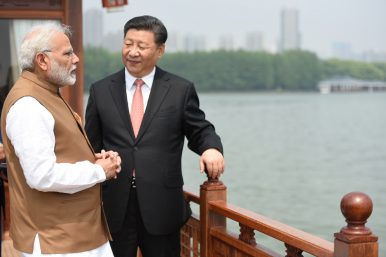
Indian Prime Minister Narendra Modi and the right-wing Bharatiya Janata Party have won a powerful mandate in India’s 2019 general elections.Modi Reimagines India’s Role in the World
A week into Narendra Modi’s second term as India’s prime minister, he has already signaled his foreign-policy vision for the next several years. On May 30, he named Subrahmanyam Jaishankar to his cabinet. Jaishankar will serve as the powerful minister of external affairs. Typically, the post would go to a high-ranking party member or political ally. But Jaishankar, a former foreign secretary, is a technocrat. One of the most respected foreign service officers in recent times—he was India’s longest-serving envoy to Beijing, an ambassador to the United States, and a key player in the successful conclusion of the U.S-India civil nuclear deal under Modi’s predecessor, Manmohan Singh—he is not even a member of Modi’s Bharatiya Janata Party (BJP). His appointment underscores Modi’s penchant for boldness, especially when the stakes are high.The Dollar Underpins American Power. Rivals Are Building Workarounds.
THE REAL ORIGINS OF THE U.S.-CHINA COLD WAR
How should Washington deal with an authoritarian regime that is expanding its influence abroad and repressing its citizens at home? That is the question the United States faces today in dealing with Xi Jinping’s China. But it is not a new challenge. After World War II, the United States faced another authoritarian state intent on expanding its borders, intimidating its neighbors, undermining democratic institutions, exporting its authoritarian model, and stealing U.S. technology and know-how. The result, after a period of initial debate and uncertainty in U.S. policy, was the Cold War: a 40-year competition over power, influence, and the contours of global order.China’s US Travel Alert: Weaponizing Tourism Amid the Trade War?
On the Anniversary of Tiananmen Square, What Is Xi Jinping Thinking?
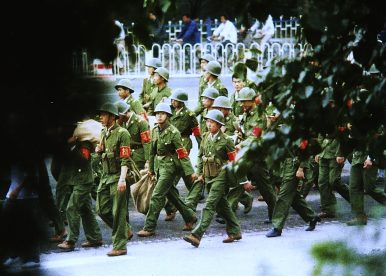
When soldiers of the People’s Liberation Army opened fire on protestors at Tiananmen Square thirty years ago today, Western observers were quick to predict that the regime of the Chinese Communist Party would soon implode.Beijing After Tiananmen, Part 2: Life Under Martial Law
The US Must Build Saudi Arabia’s First Nuclear Reactors
For all the attention on Iran’s atomic ambitions and the U.S.withdrawal from a deal meant to hold them in check, there is another nuclear story unfolding in the Middle East. Saudi Arabia intends to award the contracts to build its first two nuclear reactors next year, en route to building 16 of them by 2040. It is a matter of national security that the United States re-establish its leading position in the global nuclear trade by successfully pursuing this and similar projects.What a War With Iran Would Look Like
The U.S.A. Unmasked!
Why Are Right-Wingers So Obsessed With Electromagnetic Pulses?
On March 26, Donald Trump issued an executive order to ward off the apocalypse. The “Executive Order on Coordinating National Resilience to Electromagnetic Pulses” instructs the Department of Homeland Security, the Department of Defense, and other federal agencies to evaluate the potential damage of a catastrophic electromagnetic pulse attack and implement measures to protect the U.S. should such an event occur.Undeterred Cyber Adversaries Require a More Aggressive American Response
Trade War Becomes Cold War
Buildings Can Be Designed to Withstand Earthquakes.
The American Cult of Bombing and Endless War
Rethinking US Grand Strategy
Confronting Iran: To What End?
Paul Rogers writes that during May, there was a marked increase in tensions between the US and Iran, increasing the potential for a potentially catastrophic new war in the Middle East. In this article, Rogers responds by exploring what’s motivating Washington, and key regional allies including Israel and Saudi Arabia, to run the risk of such destruction. He also argues that, given the risk of war, it is essential for the remaining members of the Joint Comprehensive Plan of Action (JCPOA) to ensure that this agreement survives.McMaster's Poison Pill Advice on North Korea
Shaping U.S. Strategy to Meet America's Real-World Needs
Data Governance Principles for the Global Digital Economy
Disruptive Technologies for Defence Transformation: 2018 Post Show Report
We’re Running Out of Spectrum for Both New and Old Technologies
Cyber Warfare And The Future Of Cyber Security
House committee pushes for a window into cyberwar
Members of the House Armed Services Committee want Congress to be kept in the loop when the executive branch launches offensive operations in cyberspace.Public Attribution of Cyber Incidents
Florian Egloff and Andreas Wenger write that cyber incidents are increasingly being publicly attributed to specific perpetrators. However, the public attributions issued by states and cybersecurity companies often lack both transparency and verifiability. Our authors contends that strengthening trust in public attributions requires institutional mechanisms at the international level as well as the engagement of the state, the corporate sector and civil society.The GCHQ’s Vulnerabilities Equities Process
Tactics, Tech and Work of Close Combat Experts is Turning Warfare ‘Upside Down’
Tactics, tech and work of close combat experts is turning warfare ‘upside down’
FREDERICKSBURG, Va. — The days are coming when a squad leader on a battlefield, far from headquarters and large supporting units, will pull out something that looks like a smartphone, open an app and push a button and something in front of his squad will explode.