The Profession of Arms: A Guide for Young Army Officers
It takes courage, especially for a young officer, to check a man met on the road for not saluting properly or for slovenly appearance, but, every time he does, it adds to his stock of moral courage, and whatever the soldier may say, he has respect for the officer who does pull him up.
Read Document →The Dragon's Teeth: Assessing China's Military Modernization
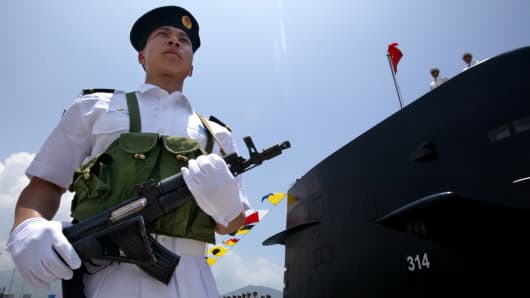
PLA has focused on modernising its capabilities across all warfare domains to achieve these goals. This includes land, air, and maritime operations, nuclear, space, counter-space, electronic warfare and cyberspace operations, aiming to become a fully integrated joint force.
Read Document →Transforming the PLA: A Decade of reorganisation from SSF to ISF
PRC has engaged in a sustained and broad effort to transform the PLA from an infantry-heavy, low-technology, ground forces-centric military into a high-technology, networked force with an increasing emphasis on joint operations and naval and air power projection.
Read Document →Eyes without Borders: Exploring the World of Open Source Intelligence (OSINT) in the Digital Age
Open Source Intelligence (OSINT) is gaining prominence with the rise of social media, the digital society and the vast growth of publicly and commercially available information (PAI and CAI).
Read Document →
The PLA’s Developing Cyber Warfare Capabilities and India's Options
Informationised warfare blurs the lines between peacetime and wartime. A nation in the information age cannot wait for the hostilities to break out to collect intelligence, carryout influence operations, develop antisatellite systems or design computer software weapons.
Read Document →
Galwan and After
Why did China did this when he is under tremendous pressure in all fronts, is this China's salami slice tactics being progressed rigorously, what will be new Rules of Engagement, what will be escalatory control mechanism, who has taken this decision, will there be some pressure put by China in India's North-East through insurgency.
Read Document →
India’s Joint Doctrine for Cyberspace Operations: A Critical Review
Chief of Defence Staff (CDS) General Anil Chauhan and Secretary, Department of Military Affairs, formally released declassified versions of the Joint Doctrines for Cyberspace Operations during the Chiefs of Staff Committee meeting in New Delhi.
Read Document →
Know your Enemy General(now Field Marshal) Syed Aseem Munir
Gen SA Munir's position in the hierarchy of Pakistan was not very comfortable. The state of economy, insurgency in Pakhtoonistan and Balochistan, attack on the Jaffar Express, constant protests by supporters of Imran Khan's supporters inside and outside of parliament.
Read Document →
Decoding Operation SINDOOR: Key Aspects and Implications
Precision strikes were carried out on nine sites—four in Pakistan and five in PoK—linked to anti-India terrorist groups such as the LeT, JeM and the Hizbul Mujahideen. The targeted sites included Muridke (LeT headquarters) and Bahawalpur (JeM headquarters).
Read Document →
Chinese Cyber Exploitation in India's Power Grid - Is There a linkage to Mumbai Power Outage?
The New York Times (NYT), based on analysis by a U.S. based private intelligence firm Recorded Future, reported that a Chinese entity penetrated India’s power grid at multiple load dispatch points. Chinese malware intruded into the control systems that manage electric supply across India, along with a high-voltage transmission substation and a coal-fired power plant
Read Document →14 July 2018
India’s evolving response to China’s ‘stealth threat’
Is India shifting the goalposts in Indo-Pacific debate?
China Thinks It Can Defeat America in Battle
CHINA’S RISE AND INDIAN OCEAN AMBITIONS
China's Unlikely Weapon: Tourists
China will increasingly play gatekeeper to the country's growing middle-class market for luxury goods, manufactures and food products. This consumer class will only gain more clout in the coming decades. Flows of Chinese tourists will be an unexpected tool of statecraft, raising the potential for sharp disruptions to the travel and aviation sectors. These risks are particularly high in South Korea, Japan and Taiwan, but extend across Southeast Asia and into the islands of the Indian Ocean and the South Pacific.Daily Memo: A Conversation on NATO, a Bubble in China, Oil in Russia
China is quietly conducting electronic warfare tests in the South China Sea
China is quietly testing electronic warfare assets recently installed at fortified outposts in the South China Sea, according to sources who have seen U.S. intelligence reports. Intelligence assessments, which were curated less than a month ago, say this is the first known use of the equipment since its deployment earlier this year to outposts in the Spratly Islands, said the sources, who spoke on the condition of anonymity. A Pentagon spokesperson declined to comment on intelligence matters.How Much Does OPEC Disagree On Oil Prices?
Can Energy Close America’s Trade Deficit?
July 3, 1863: The Birth of a Nation
In Search of a Third German Economic Miracle
Germany Imports Gas From Russia. But Is It a ‘Captive’?
LONDON — President Trump ripped into Germany, a NATO ally, even before this year’s summit meeting started in Brussels on Wednesday, using a longstanding disagreement on commercial and strategic relations with Russia. Departing from diplomatic protocol, Mr. Trump attacked Germany’s relations with Russia over breakfast with NATO’s secretary general, Jens Stoltenberg. “Germany, as far as I’m concerned, is captive to Russia because it’s getting so much of its energy from Russia,” he said. “So we’re supposed to protect Germany but they’re getting their energy from Russia.” In a polite but firm response, Chancellor Angela Merkel said that Germany “can make our own policies and make our own decisions.”How Trump’s Trade War Went From 18 Products to 10,000
Jan. 22 The war began when the United States imposed tariffs on solar panels and washing machines. Each circle above represents a product on which a tariff has been placed and is sized according to how much was imported last year. March 8 The United States then put tariffs on steel and aluminum, arguing that unfair trade practices threatened American manufacturers — and thus national security. The European Union, Canada and Mexico were initially exempted. April 2 A focus of the tariffs was China, which has been accused of flooding the world with cheap metal. China retaliated with duties on about $3 billion in American products.The NATO Summit Spotlights Its Defense Spending Standard
The United States will pressure its NATO allies during the military bloc's July 11-12 summit in Brussels to spend more on their own defense. Although it is NATO's most powerful member state, the United States still derives great benefits from the alliance. The commitment from each NATO member to spend at least 2 percent of gross domestic product on defense does not adequately account for the different security priorities of the alliance's disparate states. Fed up with what it perceives as an unequal burden sharing, the United States is preparing to put considerable pressure on its NATO allies during a summit in Brussels on July 11 and 12. U.S. President Donald Trump already has foreshadowed this pressure, which could include threats to withdraw U.S. forces from Europe or to cancel major NATO exercises, by sending strongly worded letters to the leaders of several NATO allies, including Germany, Belgium, Norway and Canada. While the United States has a case to make that the alliance's member states are not living up to their commitment to spend at least 2 percent of their gross domestic product on their own defense, NATO remains a critical component of the United States' global dominance.Trump, Putin and a Contentious State of Affairs on the Continent
U.S. President Donald Trump's return to the NATO summit will bring with it a repeat of a set of familiar negotiating tactics, which are more likely to deepen the chasm between the White House and some security allies. While U.S. relations with the Western European powers will remain strained, Eastern European allies will try to deepen their energy and security ties with Washington in hopes of muddying a potential U.S.-Russia rapprochement. While negotiations with Moscow on a host of issues could serve a strategic purpose, that strategy would be greatly undermined if the White House inadvertently plays to the Kremlin on dividing the West.NATO Must Revamp Wartime Command Structure
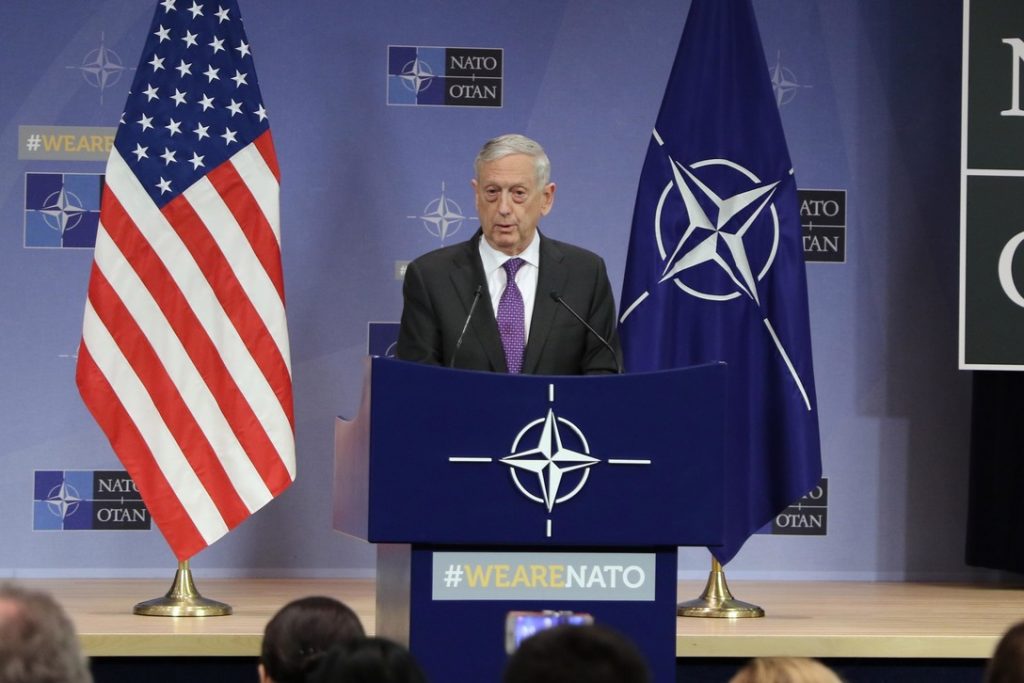
Our Paul McLeary is traveling with Defense Secretary Jim Mattis to the NATO Summit in Brussels this week so we’ll be providing in-depth alliance coverage leading up to RIAT and Farnborough and during President Trump’s European visit. Tomorrow, we’re publishing another NATO piece by Michael Matlaga of CSIS. In keeping with all that, we offer this intriguing call for changes to NATO’s command and control system. Sen. John McCain identified this as a key effort for the summit in a statement Tuesday. He also reminded us of what really matters in the current atmosphere: “I hope that during the upcoming summit we will continue to see progress on command structure reforms, new initiatives aimed at countering terrorism and enhancing readiness, and renewed support for the Open Door policy through accession talks with Macedonia. These developments will send a stronger message of NATO’s commitment to collective defense than any tweet.” Read on to relish author Lucja Swiatkowski Cannon’s arguments on NATO C2. The Editor.A Strategic Reset for NATO
Thailand cave rescue: how did the boys get out?
NATO Has A Good Story To Tell, But Is Its Audience Of One Listening?
BRUSSELS: Despite the headlines predicting disaster in Brussels, there is some good news for NATO allies to promote during their annual summit that kicks off here on Wednesday. But how much of that story will filter out of the gleaming new NATO headquarters after President Donald Trump airs his grievances over the alliance’s defense spending? That’s the question that officials are grappling with in the final hours before the summit kicks off.AI, automation, and the future of work: Ten things to solve for
Blockchain beyond the hype: What is the strategic business value?
National Security Concerns Over Hackers Commandeering Satellites
The number of satellites transmitting GPS locations, cellphone signals and other sensitive information has been rapidly increasing, which has resulted in the creation of favorable circumstances for hackers. Even with all the advances in satellite technology, much of the US military’s satellite technology remains vulnerable. Earlier in the month, Bleeping Computer reported on a cyber-espionage group believed to be operating out of China who hacked companies who develop satellite communications and geospatial imaging. They also targeted defense contractors from the US and Southeast Asia:Tomorrow’s Quantum Computers Are Already Threatening Today’s Data
It may seem like the plot of a new Terminator movie, but quantum computers from the future are threatening government data today. But before you accuse me of wearing my tinfoil hat a little too tightly, consider the fact that the future we are talking about may not be that far off. IBM perfected a 50-qbit quantum computer last year and recently opened up its older 20-qbit model for anyone to play with on the web. They estimate that large-scale quantum computers are a mere five years, or less, away.