The Profession of Arms: A Guide for Young Army Officers
It takes courage, especially for a young officer, to check a man met on the road for not saluting properly or for slovenly appearance, but, every time he does, it adds to his stock of moral courage, and whatever the soldier may say, he has respect for the officer who does pull him up.
Read Document →The Dragon's Teeth: Assessing China's Military Modernization
PLA has focused on modernising its capabilities across all warfare domains to achieve these goals. This includes land, air, and maritime operations, nuclear, space, counter-space, electronic warfare and cyberspace operations, aiming to become a fully integrated joint force.
Read Document →Transforming the PLA: A Decade of reorganisation from SSF to ISF
PRC has engaged in a sustained and broad effort to transform the PLA from an infantry-heavy, low-technology, ground forces-centric military into a high-technology, networked force with an increasing emphasis on joint operations and naval and air power projection.
Read Document →Eyes without Borders: Exploring the World of Open Source Intelligence (OSINT) in the Digital Age
Open Source Intelligence (OSINT) is gaining prominence with the rise of social media, the digital society and the vast growth of publicly and commercially available information (PAI and CAI).
Read Document →
The PLA’s Developing Cyber Warfare Capabilities and India's Options
Informationised warfare blurs the lines between peacetime and wartime. A nation in the information age cannot wait for the hostilities to break out to collect intelligence, carryout influence operations, develop antisatellite systems or design computer software weapons.
Read Document →
Galwan and After
Why did China did this when he is under tremendous pressure in all fronts, is this China's salami slice tactics being progressed rigorously, what will be new Rules of Engagement, what will be escalatory control mechanism, who has taken this decision, will there be some pressure put by China in India's North-East through insurgency.
Read Document →
India’s Joint Doctrine for Cyberspace Operations: A Critical Review
Chief of Defence Staff (CDS) General Anil Chauhan and Secretary, Department of Military Affairs, formally released declassified versions of the Joint Doctrines for Cyberspace Operations during the Chiefs of Staff Committee meeting in New Delhi.
Read Document →
Know your Enemy General(now Field Marshal) Syed Aseem Munir
Gen SA Munir's position in the hierarchy of Pakistan was not very comfortable. The state of economy, insurgency in Pakhtoonistan and Balochistan, attack on the Jaffar Express, constant protests by supporters of Imran Khan's supporters inside and outside of parliament.
Read Document →
Decoding Operation SINDOOR: Key Aspects and Implications
Precision strikes were carried out on nine sites—four in Pakistan and five in PoK—linked to anti-India terrorist groups such as the LeT, JeM and the Hizbul Mujahideen. The targeted sites included Muridke (LeT headquarters) and Bahawalpur (JeM headquarters).
Read Document →
Chinese Cyber Exploitation in India's Power Grid - Is There a linkage to Mumbai Power Outage?
The New York Times (NYT), based on analysis by a U.S. based private intelligence firm Recorded Future, reported that a Chinese entity penetrated India’s power grid at multiple load dispatch points. Chinese malware intruded into the control systems that manage electric supply across India, along with a high-voltage transmission substation and a coal-fired power plant
Read Document →30 September 2014
Is the World at the Cusp of a New Dark Age?
UKRAINE IS AT THE MERCY OF MOSCOW NOW, THE WEST IS WATCHING HELPLESSLY
The Mysterious Disappearance of the Graves of 39 Russian Paratroopers Killed in the Ukraine
9 Ukrainian Soldiers Killed in New Round of Bloody Fighting Around Donetsk Airport in the Eastern Ukraine
Terrorism & semantics
Sep 30, 2014
It was a clichรฉ of the 1960s, the great age of decolonisation, that one man’s freedom fighter was another man’s terrorist. That duality had earlier produced the possibly apocryphal story of Franklin Delano Roosevelt declaring in 1939 that Nicaragua’s dictator Anastasio Somoza “may be a son of a bitch, but he’s our son of a bitch!”
All that came to mind listening to Prime Minister Narendra Modi’s spirited demand at the United Nations for the Comprehensive Convention on International Terrorism drafted in 2002 to be finalised. As the victim of repeated attacks, India is understandably anxious for a global arrangement to criminalise all forms of international terrorism and deny terrorists, their financiers and supporters access to funds, arms, safe havens and political patronage. But Nawaz Sharif’s speech also recalled that 1960s contradiction. Despite claiming to suffer terrorist attacks, Pakistan’s Prime Minister left no one in doubt that he regards people who kill, bomb, maim and destroy in Jammu and Kashmir as freedom fighters.
Hyperbole enjoys a hallowed tradition. This year marks the 100th anniversary of the outbreak of World War I during which Britain exalted terrorism to an instrument of state policy, thereby setting a global precedent. The British foreign office’s Arab Bureau employed T.E. Lawrence to instigate and lead a secessionist revolt against the Ottoman Empire under cover of archaeological excavations. Lawrence’s guerrillas harried the Turkish Army, sabotaged the strategic Hejaz railway Ottoman troops used to control rebellious Arabs, captured Aqaba port and attacked Damascus and other Turkish garrisons.
Whatever pieties politicians of many hues might mouth in many tongues in New York, no government will surrender the right to mount similar campaigns against perceived adversaries. Indian allegations of Chinese abetment of Naga rebels were matched by China’s charges of Indian complicity in American-sponsored operations in Tibet. If Pakistanis suspect India’s Research and Analysis Wing is active in Balochistan, Indians are convinced the troubles in Jammu and Kashmir are the handiwork of Pakistan’s Inter-Services Intelligence.
Finally, a new govt in Afghanistan An impressive transition to democracy, made against great odds
http://www.tribuneindia.com/2014/20140930/edit.htm#5
For Afghanistan’s third presidential election since 2004 demonstrated that war and poverty are not barriers to the wish of people to determine their destiny. And the world should congratulate the Afghan voters who defied Taliban violence and took part in the two rounds of polling on April 5 and June 14. The high poll turnout — nearly 60 per cent in each round — in itself marks the continuation of a decade-old troubled, strife-riven yet impressive transition to democracy, made against great odds.
Hamid Karzai, the mercurial twice-elected President, also deserves credit for steering his country to a peaceful transfer of power. He completed two terms in office, making war-torn Afghanistan a pleasing contrast to neighbouring Pakistan — where only one president — Asif Ali Zadora — completed his constitutional tenure — since independence in 1947. And the leaders of China, Afghanistan's other, more prosperous neighbour, will have no truck with democracy and the elected rulers.
The good news is that both Ghani and Abdullah, who won the first round, are political moderates who seek to bridge ethnic divides, keep Afghanistan on democratic rails and sign a security deal with the US, whose diplomatic intervention facilitated a way out of the electoral impasse.
As the US retreats
Let the river take its course
Question USA's Pak Policy
29th September 2014
Source Link
Days before prime minister Narendra Modi’s arrival in Washington last week, the US announced its decision to give 160 Mine Resistant Ambush Protected (MRAPs) vehicles worth $198 million to Pakistan. According to a statement, the sale “will contribute to the foreign policy” of the US. The decision is part of a larger US plan to hand over military hardware from Afghanistan to Pakistan army. It also reveals the deceptive American argument that selling F-16s and other war-fighting weapons to Pakistan is meant to fight militants. Husain Haqqani, the former Pakistani ambassador and an astute thought leader of South Asia, has described this American thinking as delusional.
India should call this bluff for the following reason: the US foreign policy hampers India’s interests and its efforts to shape South Asia. Diplomacy is relevant when and where it matters the most. The move to sell the MRAPs is timed with Modi’s Washington visit. India must openly debate the US relationship with Pakistan. Also, the Indian media needs to sharpen its focus on how the US’s Pakistan policy undermines India in its neighbourhood. The US counterterror policy on Afghanistan has been flawed throughout by overlooking the Pakistani role, except for when George W Bush ordered the CIA to stop sharing intelligence with Islamabad in 2008 and develop a parallel network of human intelligence in the Pakistani tribal region.
Bush’s move followed the realisation that the Pakistani military’s ISI was protecting jihadists in Waziristan despite actionable intelligence. Soon after its creation in 1947, Pakistan began a policy of using jihadists from the Pashtun-dominated north-west region to advance its external policies. The north-west region had been a hotbed of jihadists from the colonial times. In 1947-48, the newly created Pakistan used jihadists to invade Jammu & Kashmir and Balochistan. The use of jihadists continued through all wars against India and in peace time, as well as against its own people in Bangladesh. Its use of jihadists in the Kargil war was comprehensive.
Tibet is the real source of Sino-Indian friction
September 26, 2014
Source Link
The sprawling, mountainous country of Tibet was annexed by China in the 1950s, eliminating a historical buffer with India. Today, the region remains at the heart of Sino-Indian problems, including territorial
So when Chinese President Xi Jinping traveled in mid-September to India -- home to Tibet's government in exile -- Tibet loomed large. The Tibetan plateau, and the military tensions the issue provokes, will also figure prominently in the Sept. 29-30 summit at the White House between Prime Minister Narendra Modi and U.S. President Barack Obama, who has urged Beijing to reopen talks with the Dalai Lama, the exiled religious leader revered as a god-king by Tibetans.
Xi's visit to New Delhi began with the visitor toasting Modi's birthday. But, underlining the deep divide regarding Tibet, the visit was overshadowed by a Chinese military incursion across the traditional Indo-Tibetan border. It was as if the incursion -- the biggest in terms of troop numbers in many years and the trigger for a military standoff in the Ladakh region -- was Xi's birthday gift for Modi.
Modi's government, for its part, allowed Tibetan exiles to stage street protests during the two days that Xi was in New Delhi, including some close to the summit venue. This reversed a pattern that had held since the early 1990s, in which police routinely prevented such protests during the visits of Chinese leaders. During the decade-long reign of Modi's predecessor, Manmohan Singh, police would impose a lockdown on the Indian capital's Tibetan quarter and beat up Tibetans who attempted to rally.
India and the art of riding two boats
STANLY JOHNY
It should play hard to get, as China and US seek to dominate the Asian stage. Both need India’s support
In his first television interview since taking office in May, Prime Minister Narendra Modi told CNN on September 21 that India has the diplomatic bandwidth to accommodate both the US and China.
The statement could not have been better timed. Chinese President Xi Jinping only recently concluded his three-day India visit, while Modi’s US tour has just begun. Modi said India doesn’t see rising China as a threat, and added that “India and the US are bound together, by history and by culture. These ties will deepen further”.
The Government seems to be preparing a roadmap for bilateral engagements with great powers based on mutual benefits, and trade and economic cooperation, while keeping itself away from geopolitical power games.
Earlier this month, the Prime Minister had visited Japan and signed agreements to deepen economic and defence ties. Economic cooperation was a major theme during Xi’s India visit as well, and is high on the agenda during Modi’s five-day US trip. From an economic point of view, relations with both China and the US — India’s largest and second largest trade partners — are equally vital, while Japan is a major investor in India’s infrastructure sector.
This multidirectional diplomacy driven by economic interests seems to be paying off, at least for now, with key global leaders showing keenness to win over India’s new leader.
During Modi’s visit to Japan, Prime Minister Shinzo Abe offered to invest $35 billion in India over five years, speed up talks on civil nuclear deals, and step up bilateral maritime security cooperation. The Japanese Prime Minister travelled from the capital Tokyo to the historic city of Kyoto to personally welcome his Indian counterpart, indicating the importance his government gives to the visit.
INDUSTRIAL POLICY REPAIR - Words are not enough, only action can dismantle the barriers
Obama, the serial interventionist
Brahma Chellaney
Barack Obama has been more at ease waging wars than in waging peace. He has proved to be one of America’s most militarily assertive Presidents since World War II
America’s Nobel Peace Prize laureate president, Barack Obama, who helped turn Libya into a failed state by toppling its ruler Muammar Qadhafi, has started a new war in Syria and Iraq even as the U.S. remains embroiled in the Afghanistan war. Mr. Obama’s air war in Syria — his presidency’s seventh military campaign in a Muslim nation and the one likely to consume his remaining term in office — raises troubling questions about its objectives and his own adherence to the rule of law.
While it has become imperative to contain the Islamic State (IS), a Sunni jihadist army that has imposed a despotic medieval order in the territories under its control, any fight against terrorism can be effectively waged only if it respects international law and reinforces global norms and does not become an instrument to pursue narrow, geopolitical interests.
Ever since America launched its “war on terror” in 2001 under Mr. Obama’s predecessor, George W. Bush, the scourge of international terrorism, ominously, has spread deeper and wider in the world. Jihadist forces extolling terror as a sanctified tool of religion have gained ground in a number of countries. Once stable nations such as Iraq, Syria and Libya have become anarchic, crumbling states and new hubs of transnational terrorism, even as the Afghanistan-Pakistan belt remains “ground zero” for the terrorist threat the world confronts.War on U.S. terms
Mr. Obama was supposed to be fundamentally different than Mr. Bush — an expectation that led the Nobel committee to award him the Peace Prize soon after he assumed office. Yet, underscoring the disconnect between his words and actions, Mr. Obama has been more at ease waging wars — that too in breach of international law — than in waging peace. He has proved to be one of America’s most militarily assertive Presidents since World War II, with his readiness to use force driven by a penchant to act as judge and executioner.
Putting people before politicians
PTIX-FACTOR: What commentators perhaps fail to appreciate is that Prime Minister Narendra Modi appears more interested in people than in politicians. Picture shows him speaking at Central Park, in New York.
At the U.N., in Central Park and at Madison Square Garden, Mr. Modi has reached a population as important as the one in Washington. The key now lies in nurturing this relationship.
In the summer of 1949, a few months before Jawaharlal Nehru was to make his maiden visit to the United States, American and British diplomats were nervous to say the least. As Sir Oliver Franks, the British ambassador to the United States wrote: “No one in Washington had apparently been considering Nehru’s visit as anything but one of courtesy.” After all, President Harry S. Truman found the then 59-year-old Prime Minister “irritating.” India was not important. It was, according to Truman, a nation more associated with people sitting on “hot coals” and found “bathing in the Ganges.”
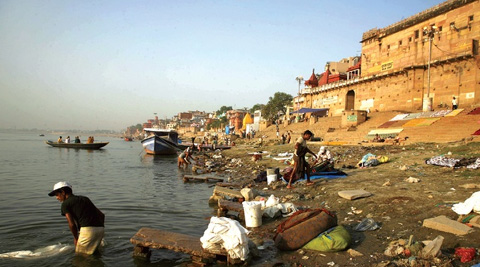
That an Indian Prime Minister such as Narendra Modi would one day address a crowd of at least 6,000 “global” citizens in the heart of New York was unthinkable, let alone plausible. That he would be compared to the likes of a rock star addressing thousands of Indian-Americans in Madison Square Gardens would be near heresy if suggested at the time of Truman for whom there was something distinctly “ancient” about the recently decolonised nation. Reflecting on the past may in part help frame our understanding of what visits such as this mean in the present. To be sure, the fact that Prime Minister Modi’s speech at Madison Square Gardens was accompanied by a film on the Ganges is a karmic reminder of an ancient civilisation that has a deeper place in America than the likes of Truman could have ever envisaged.Discovering the U.S.
India’s first Prime Minister did not make the journey to win over the likes of Truman, but to win the hearts of an American public that had supported Indian independence. He was soon dubbed the “hope of Asia.” This was, as Nehru told the U.S. House of Representatives, “a voyage of discovery.” Speaking to audiences at press clubs, universities, and America’s oversized financial organisations, the message was simple: “self help,” as he often argued, was the “first condition of success.” Indeed, Nehru’s Harrow and Cambridge schooling may have led him to wince in the company of bankers more than willing to talk about hard cash, but it was the empathy and enthusiasm of the people of America that remained with him for long.
**** The Perils of War From 30,000 Feet; Obama and the Road to Hell in the Middle East
New Delhi Has To Be Prepared For New Pakistan-Based Jihadi Threats
Ghani Sworn In as Afghan President
New Government Is Expected to Sign Security Agreement With U.S.
By
NATHAN HODGE And MARGHERITA STANCATI Sept. 29, 2014
Former World Bank official Ashraf Ghani was sworn in as Afghanistan's new president Monday. The inauguration marks the exit of Hamid Karzai, who ran the country since 2001.
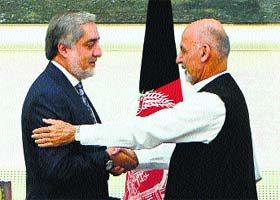
KABUL—Afghanistan's new President Ashraf Ghani took office Monday in the country's first democratic transfer of power, making a pledge to stamp out corruption and calling for peace with the Taliban insurgents who marked the day with a fresh attack in Kabul.
Mr. Ghani, who won the disputed June 14 presidential election, was sworn in at a ceremony in the heavily guarded presidential palace in Kabul, with foreign ambassadors, visiting dignitaries and Afghanistan's most prominent politicians in attendance.
In his first remarks as Afghanistan's leader, Mr. Ghani said his country was "besieged with problems," and called on the Taliban and other militant groups to come to the negotiating table with Kabul. "War is not the way to solve political issues," he said, adding: "Those who believe in the use of force will be dealt with the same way."
The new president inherits a country that faces a robust Taliban insurgency. Militants have seized on a period of protracted political instability to press an offensive around the country, and the withdrawal of foreign combat troops by the end of the year has raised concerns about the ability of Afghan security forces to hold their ground. The country also remains dependent on billions of dollars in U.S. and allied aid that funds the Afghan army and police and keeps the economy afloat.
Streets throughout the capital were closed to most traffic, and helicopters circled over the city as the Taliban sought to disrupt the historic event. A suicide bomber struck a checkpoint on a road that leads to Kabul International Airport, killing four Afghan troops and three civilians, according to Sediq Sediqqi, the spokesman of Afghanistan's ministry of interior. At least five others were injured in the blast.
Afghanistan's new President Ashraf Ghani, left, shakes hands with Afghanistan's Chief Justice Abdul Salam Azimi as he takes the oath during his inauguration as president in Kabul on Monday. Reuters
In the eastern province of Paktia, insurgents stormed a district headquarters office, local officials said, who said the casualties weren't immediately clear. The Taliban claimed responsibility for both attacks, and immediately turned down Mr. Ghani's peace overtures. "Ashraf Ghani was appointed by the Americans in the U.S. Embassy. He is a puppet and isn't entitled to invite us for peace talks," said Taliban spokesman Zabihullah Mujahid.
The Taliban Is Making A Major Offensive As US Troops Pull Out Of Afghanistan
http://www.businessinsider.com/major-taliban-offensive-kills-up-to-100-afghans-2014-9?IR=T
A major Taliban offensive in eastern Afghanistan over the past week has left up to 100 civilians and security personnel dead, 12 of them beheaded, officials said Friday, as violence worsens with the withdrawal of US-led troops.
This summer’s fighting season has seen Taliban militants advance in several provinces, exploiting a prolonged political deadlock in Kabul over disputed presidential election results.
The latest series of attacks have focused on Ajristan district in the strategically important province of Ghazni, after recent offensives in Kandahar, Helmand and Logar.
“The militants beheaded 12 civilians in four villages,” Mohammad Ali Ahmadi, deputy governor of Ghazni, told AFP.
“We do not have a precise figure, but we estimate 80 to 100 people were killed over the past one week.
“Heavy fighting has involved hundreds of Taliban against the security forces.
“The condition is very critical in this district. We have been informed by the central government that they have sent reinforcements.”
Ahmadi said Ajristan was at risk of falling into Taliban control, adding that 60 to 70 homes had been burnt down and that communication with security forces in the district was scarce.
Asadullah Ensafi, deputy police chief of Ghazni — which is located between the capital Kabul and the Taliban heartlands of the south — confirmed details of the offensive and said fierce fighting was ongoing Friday.
The interior ministry in Kabul was not immediately available for comment. The government has said that Afghan soldiers and police have successfully beaten back previous Taliban offensives in past months.
The 350,000-strong Afghan security forces have been trained from scratch since 2001 by the US-led NATO coalition, which is now winding down its war in Afghanistan.
All NATO combat operations will finish by the end of this year, with about 12,000 troops staying on into next year on a follow-up training and support mission.
The three-month election stand-off was finally broken Sunday when a “unity government” deal was agreed, with Ashraf Ghani serving as the next president and his rival Abdullah Abdullah taking up the new role of chief executive.
Ghani was declared winner of the fraud-tainted election, but the margin of victory and turnout was kept secret until Friday over concerns that fraud allegations could trigger violence from aggrieved Abdullah supporters.
At an Independent Election Commission (IEC) ceremony, Ghani was presented with a certificate that confirmed he was the clear winner with 55.27 percent of the ballot in the run-off vote on a turnout of 7.12 million voters.
The exact size of the electorate is unknown but estimated at between 12 million and 13.5 million.
The June 14 election was meant to cap the multi-billion-dollar military and civilian aid intervention in Afghanistan since the fall of the Taliban in 2001.
But it was marred by widespread fraud, repeating serious problems seen in previous elections since the introduction of a nascent democracy after the Taliban era.
The UN-supervised audit invalidated 1,206 of the 22,828 ballot boxes — meaning several hundred thousand votes were thrown out.
The UN mission in Afghanistan described fraud as “significant,” and accusations have been pointed at both campaign teams as well as outgoing President Hamid Karzai and the IEC itself.
Ghani said on Friday he would prioritize electoral reform to prevent future problems, and he vowed to unite the country after fears that the disputes had revived ethnic divisions of the 1990s civil war.
India, Vietnam and $100 Million in Defense Credit
China Launches Satellites Into Orbit
Taiwan, Asia’s Secret Air Power
China and India: Asia's Budding Partnership or Growing Rivalry?
September 28, 2014
Source Link
"Though China has raced ahead of India economically and militarily, it must approach its neighbor as an equal participant..."
In his September 17 op-ed in The Hindu, Xi Jinping proclaimed China and India “the two engines of the Asian economy.” He exhorted both countries to push forward on joint economic and strategic initiatives that would cement their leadership roles in an increasingly multipolar world. Through words and deeds, such as his recent signing of concrete bilateral agreements with Indian prime minister Narendra Modi, Xi has continued to chip away at the cautious faรงade that has characterized Chinese foreign policy over much of the past three decades.
Indeed, Deng Xiaoping’s strategy of “keeping a low profile” seems less central to China’s foreign affairs under its new leadership. Xi has taken a more proactive path. In recent years, while not shying from confrontation with adversaries to its east and southeast, Beijing has simultaneously sought to reinvigorate old friendships. Not since the era of Zhou Enlai, who joined with Jawaharlal Nehru to promote the nonaligned movement of the 1950s, has China so assertively built ties with its Himalayan neighbor. In his three-day visit to India this past week, Xi strove to bind up old wounds, promising to seek resolution of the two nations’ territorial disputes, and explored new avenues of economic and diplomatic cooperation that would encourage broader transfer of technology and intellectual capital and further align the two states behind a shared conception of “fair and reasonable” international governance.
Xi and Modi, who have both cultivated far more populist images than their predecessors, Hu Jintao and Manmohan Singh, seem to share a special rapport. Modi visited China four times as Chief Minister of Gujarat, and Xi said that his first meeting with the Indian leader, at the BRICS summit in Fortaleza, Brazil, was like being reunited with an old friend. Modi also seems to admire the Chinese model of economic development. He has called for India to pursue similar advancements in infrastructure and manufacturing—areas in which Xi has proven eager to assist. The dozen bilateral agreements signed by the two leaders during Xi’s visit include a pact promising Chinese involvement in a high-speed rail project linking Chennai, Bangalore and Mysore, and a memorandum of understanding that will facilitate development of major Chinese industrial parks in Gujarat. The leaders also pledged to begin talks on civil nuclear cooperation, as well as counterterrorism and other security issues.
The proposed Sino-Indian rail project comes just weeks after Modi and Japanese prime minister Shinzo Abe resolved to cooperate on a planned high-speed rail link between Ahmedabad, the largest city in Gujarat, and Mumbai. During Modi’s visit to Tokyo, Abe pledged his readiness to provide technical and operational support, which would allow India to build a system similar to its Shinkansen network of bullet trains. Rather than opening a new line, the Sino-Indian agreement provides a blueprint for Beijing’s role in modernizing an existing, ordinary line. Chinese experts will help upgrade tracks to create high-speed corridors, redevelop existing stations and train over 100 Indian Railway personnel in systems-monitoring and rail-traffic control.