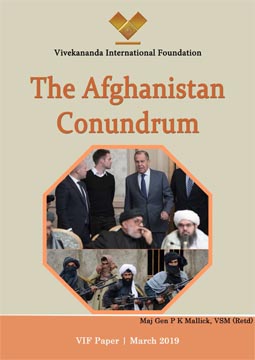
The location of Afghanistan is geostrategically critical. It is a land bridge that links China, Central Asia, South Asia and the Middle East. Geo-politically, Afghanistan is located conveniently close to “the soft underbelly” of Russia and China and its neighbor Iran. Will the Americans leave this geo-strategically important location? However the country is constantly at war for several decades. For the country to prosper Afghanistan must have some semblance of peace. For ending the 17 year old war the United States is pushing the Taliban to join peace talks with present Afghan Government. The problem is how to balance the Taliban's demand for a complete withdrawal of U.S. and allied forces with Kabul's desire for U.S. troops to stay.Download Pdf The Profession of Arms: A Guide for Young Army Officers
It takes courage, especially for a young officer, to check a man met on the road for not saluting properly or for slovenly appearance, but, every time he does, it adds to his stock of moral courage, and whatever the soldier may say, he has respect for the officer who does pull him up.
Read Document →The Dragon's Teeth: Assessing China's Military Modernization
PLA has focused on modernising its capabilities across all warfare domains to achieve these goals. This includes land, air, and maritime operations, nuclear, space, counter-space, electronic warfare and cyberspace operations, aiming to become a fully integrated joint force.
Read Document →Transforming the PLA: A Decade of reorganisation from SSF to ISF
PRC has engaged in a sustained and broad effort to transform the PLA from an infantry-heavy, low-technology, ground forces-centric military into a high-technology, networked force with an increasing emphasis on joint operations and naval and air power projection.
Read Document →Eyes without Borders: Exploring the World of Open Source Intelligence (OSINT) in the Digital Age
Open Source Intelligence (OSINT) is gaining prominence with the rise of social media, the digital society and the vast growth of publicly and commercially available information (PAI and CAI).
Read Document →
The PLA’s Developing Cyber Warfare Capabilities and India's Options
Informationised warfare blurs the lines between peacetime and wartime. A nation in the information age cannot wait for the hostilities to break out to collect intelligence, carryout influence operations, develop antisatellite systems or design computer software weapons.
Read Document →
Galwan and After
Why did China did this when he is under tremendous pressure in all fronts, is this China's salami slice tactics being progressed rigorously, what will be new Rules of Engagement, what will be escalatory control mechanism, who has taken this decision, will there be some pressure put by China in India's North-East through insurgency.
Read Document →
India’s Joint Doctrine for Cyberspace Operations: A Critical Review
Chief of Defence Staff (CDS) General Anil Chauhan and Secretary, Department of Military Affairs, formally released declassified versions of the Joint Doctrines for Cyberspace Operations during the Chiefs of Staff Committee meeting in New Delhi.
Read Document →
Know your Enemy General(now Field Marshal) Syed Aseem Munir
Gen SA Munir's position in the hierarchy of Pakistan was not very comfortable. The state of economy, insurgency in Pakhtoonistan and Balochistan, attack on the Jaffar Express, constant protests by supporters of Imran Khan's supporters inside and outside of parliament.
Read Document →
Decoding Operation SINDOOR: Key Aspects and Implications
Precision strikes were carried out on nine sites—four in Pakistan and five in PoK—linked to anti-India terrorist groups such as the LeT, JeM and the Hizbul Mujahideen. The targeted sites included Muridke (LeT headquarters) and Bahawalpur (JeM headquarters).
Read Document →
Chinese Cyber Exploitation in India's Power Grid - Is There a linkage to Mumbai Power Outage?
The New York Times (NYT), based on analysis by a U.S. based private intelligence firm Recorded Future, reported that a Chinese entity penetrated India’s power grid at multiple load dispatch points. Chinese malware intruded into the control systems that manage electric supply across India, along with a high-voltage transmission substation and a coal-fired power plant
Read Document →7 March 2019
The Afghanistan Conundrum
The location of Afghanistan is geostrategically critical. It is a land bridge that links China, Central Asia, South Asia and the Middle East. Geo-politically, Afghanistan is located conveniently close to “the soft underbelly” of Russia and China and its neighbor Iran. Will the Americans leave this geo-strategically important location? However the country is constantly at war for several decades. For the country to prosper Afghanistan must have some semblance of peace. For ending the 17 year old war the United States is pushing the Taliban to join peace talks with present Afghan Government. The problem is how to balance the Taliban's demand for a complete withdrawal of U.S. and allied forces with Kabul's desire for U.S. troops to stay.Download Pdf With Crown Prince's Visits, Saudi Arabia's Balancing Act in South Asia Continues
New Delhi: Saudi Crown Prince Mohammed Bin Salman’s visits to India and Pakistan in the immediate aftermath of a deadly suicide attack on Indian security personnel in Kashmir have been a test of Riyadh’s policy to keep its relations with the two neighbours in strictly separate silos.'Air strikes showed India will not tolerate terrorism'
Second track on Indo-Pacific and the Quad
The vast construct of the Indo-Pacific and the limited grouping of the Quad (the US, Japan, India and Australia) share a few significant traits.Jaish-e-Mohammed Leader’s ‘Global Terrorist’ Designation Is Overdue
As the worst crisis between India and Pakistan since 2002 continues to play out, the world is watching for New Delhi’s reaction to Islamabad’s decision on Friday to release the Indian pilot captured after being shot down.The Maldives: The New Kid on the Islamist Block
A December 2015 report by the Soufan Group – a private intelligence agency run by former FBI agent-turned contractor Ali Soufan – put out a count of foreign fighters who’d volunteered to fight for the Islamic State in Syria and Iraq.China keeps lid on military spending for fourth year in a row
How Does China Really Think About WTO Reform?
Can China Remake Its Image in the Middle East?
This article is the third in a serious of four that will explore the nature of China’s growing presence in the Middle East and what China’s increasing leadership means for the region’s economic, humanitarian, and security situation. Part 1 can be found here; part 2 here.Tanking economy, Belt and Road unraveling and Huawei: Why China’s Xi Jinping faces his toughest year yet
He Needed a Job. China Gave Him One: Locking Up His Fellow Muslims.
Democracy & Disorder: The struggle for influence in the new geopolitics
The biggest loser from the summit collapse? China
A China Wins Twice Proposition: The Belt And Road Initiative – Analysis
The Russians, The Chinese – A Deep Dive
It must be a very difficult job to be a Russian or Chinese intelligence officer these days. It’s not the strength of the opposition – though of course that’s always a consideration. The main reason is the lack of clear purpose. The world – the secret world that they deal in – is much more complicated these days. Sometimes the old enemy for these well-practiced operators is viewed differently by the officers’ own political superiors. Frankly, it must be very hard to keep up with the changing perceptions of the leader-class who themselves seem to be playing “outside the lines” of historical perceptions. Of course, there is a difference between the two countries, so we will discuss them separately. First, the Russians –The future of China-US military relations
The Hanoi Summit Failed Because the U.S. Doesn’t Understand How Kim Sees the World
The world was riveted this week by the meeting in Hanoi between U.S. President Donald Trump and North Korea’s Kim Jong Un. Last year’s initial summit between the two leaders in Singapore created nearly giddy hope for an end to the longstanding hostility between the United States and North Korea, particularly the resolution of the thorniest issue of all: North Korea’s nuclear weapons and ballistic missile program. But a true breakthrough in Vietnam was always unlikely for one pressing reason: Americans persistently fail to understand how Kim sees the world, instead treating him as they want him to be, rather than as he really is.What Would a No-Deal Brexit Look Like?
First off, some economists worry that the British economy would sharply contract. In November, the Bank of England predicted that the effects of a “hard Brexit” would rival those of the 2008 financial crisis. A no-deal Brexit could precipitate an 8 percent drop in gross domestic product (GDP), a 3.4 percent rise in unemployment, and a tripling of the inflation rate. Specific pain points include:A Better Populism
CHICAGO – The postwar economic success of liberal democracies was not simply the result of letting markets flourish. The United States and European countries also embedded markets in a structure that allowed people to take the fullest advantage of them. That structure is breaking down, energizing populist leaders of both the left and the right. While they pose the right questions, they rarely have the right answers. Perhaps, instead, they should make it easier for people to devise their own solutions.Russia’s Geopolitical Rivals Preparing for High-Tech Wars in Space – Gen Staff
Russian General Pitches ‘Information Operations’ as a Form of War
MOSCOW — The chief of Russia’s armed forces endorsed on Saturday the kind of tactics used by his country to intervene abroad, repeating a philosophy of so-called hybrid war that has earned him notoriety in the West, especially among American officials who have accused Russia of election meddling in 2016.Europe Isn’t Realistic. It’s Weak.
In Europe’s relations with its Arab neighbors and former colonial possessions, it is not just fraught history that is at stake. The unprecedented summit between the Arab League and the European Union in Sharm el-Sheikh, Egypt, on Feb. 24 and 25 was a clash of political regimes. The EU prides itself on a values-based foreign policy that affirms democracy, the rule of law, and human rights. Of the 30 Arab states it met in Egypt, only Tunisia comes close to meeting those criteria.Venezuela’s Suicide Lessons From a Failed State
Are The Russians Coming?: Russia’s Military Buildup Near Ukraine – Analysis
(FPRI) — Long before the Kerch Strait incident in October 2018, Russia had already begun to strengthen the forces in its Southern Military District, which spans from near Volgograd to Russia’s border with Georgia and Azerbaijan. Naturally, that has caused concern in Kiev, since the district also abuts the restive eastern Ukrainian region of Donbas and is responsible for Crimea, which Russia annexed from Ukraine in 2014. One of Ukraine’s biggest worries has been Russia’s reactivation of the 150th Motorized Rifle Division in late 2016. Posted only 50 km from the border between Russia and Ukraine, it is equipped with an unusually large number of tanks. Its force structure includes two tank regiments, rather than the standard one; and each of its two motorized rifle regiments has an attached tank battalion.[1] Russian media refers to the division as the “steel monster.”The Hanoi Summit Failed Because the U.S. Doesn’t Understand How Kim Sees the World
The world was riveted this week by the meeting in Hanoi between U.S. President Donald Trump and North Korea’s Kim Jong Un. Last year’s initial summit between the two leaders in Singapore created nearly giddy hope for an end to the longstanding hostility between the United States and North Korea, particularly the resolution of the thorniest issue of all: North Korea’s nuclear weapons and ballistic missile program. But a true breakthrough in Vietnam was always unlikely for one pressing reason: Americans persistently fail to understand how Kim sees the world, instead treating him as they want him to be, rather than as he really is.Securing AI – Four Areas to Focus on Right Now
This OODA Network Member Only content has been unlocked for unrestricted viewing by Cooley LLP through the OODA Unlockedprogram which lets community members promote thought leadership to a broader global audience.Researchers obtain a command server used by North Korean hacker group
In a rare move, government officials have handed security researchers a seized server believed to be used by North Korean hackers to launch dozens of targeted attacks last year.LESSONS NOT LEARNED: WHY OUR POST-9/11 COUNTERTERRORISM EXPERIENCES SHOULD INFORM OUR CYBERSECURITY STRATEGY
How do you turn an elephant into a mouse? Despite tremendous investments in personnel and resources, the cybersecurity elephant continues to grow larger. Network compromises, data breaches, and destructive attackscontinue to increase in size and frequency. Neither increased expenditures or cybersecurity research are making the information-technology ecosystem that sustains our digitally dependent way of life more secure. Deterrence and retaliation are not credible alternatives due to the anonymity of cyberattacks. A new approach is required to turn the cybersecurity elephant into a mouse.