Defence Minister Nirmala Sitharaman invited Japan to participate in the two defence industrial production corridors1 in Tamil Nadu and Uttar Pradesh during the Annual Defence Ministerial Dialogue held in August 2018. These corridors are aimed at boosting the defence ecosystem and reinforcing Prime Minister Narendra Modi’s signature Make in India initiative. The Make in India campaign intersects with the unfolding reorientation in Japan’s post-war security posture and its easing of the arms export policy exemplified by Prime Minister Shinzo Abe’s outlining of the Three Principles on Transfer of Defence Equipment and Technology2 in April 2014. Since then, India and Japan have engaged in complex deliberations on the prospects of sourcing Japanese defence technology, joint development and production of defence equipment.The Profession of Arms: A Guide for Young Army Officers
It takes courage, especially for a young officer, to check a man met on the road for not saluting properly or for slovenly appearance, but, every time he does, it adds to his stock of moral courage, and whatever the soldier may say, he has respect for the officer who does pull him up.
Read Document →The Dragon's Teeth: Assessing China's Military Modernization
PLA has focused on modernising its capabilities across all warfare domains to achieve these goals. This includes land, air, and maritime operations, nuclear, space, counter-space, electronic warfare and cyberspace operations, aiming to become a fully integrated joint force.
Read Document →Transforming the PLA: A Decade of reorganisation from SSF to ISF
PRC has engaged in a sustained and broad effort to transform the PLA from an infantry-heavy, low-technology, ground forces-centric military into a high-technology, networked force with an increasing emphasis on joint operations and naval and air power projection.
Read Document →Eyes without Borders: Exploring the World of Open Source Intelligence (OSINT) in the Digital Age
Open Source Intelligence (OSINT) is gaining prominence with the rise of social media, the digital society and the vast growth of publicly and commercially available information (PAI and CAI).
Read Document →
The PLA’s Developing Cyber Warfare Capabilities and India's Options
Informationised warfare blurs the lines between peacetime and wartime. A nation in the information age cannot wait for the hostilities to break out to collect intelligence, carryout influence operations, develop antisatellite systems or design computer software weapons.
Read Document →
Galwan and After
Why did China did this when he is under tremendous pressure in all fronts, is this China's salami slice tactics being progressed rigorously, what will be new Rules of Engagement, what will be escalatory control mechanism, who has taken this decision, will there be some pressure put by China in India's North-East through insurgency.
Read Document →
India’s Joint Doctrine for Cyberspace Operations: A Critical Review
Chief of Defence Staff (CDS) General Anil Chauhan and Secretary, Department of Military Affairs, formally released declassified versions of the Joint Doctrines for Cyberspace Operations during the Chiefs of Staff Committee meeting in New Delhi.
Read Document →
Know your Enemy General(now Field Marshal) Syed Aseem Munir
Gen SA Munir's position in the hierarchy of Pakistan was not very comfortable. The state of economy, insurgency in Pakhtoonistan and Balochistan, attack on the Jaffar Express, constant protests by supporters of Imran Khan's supporters inside and outside of parliament.
Read Document →
Decoding Operation SINDOOR: Key Aspects and Implications
Precision strikes were carried out on nine sites—four in Pakistan and five in PoK—linked to anti-India terrorist groups such as the LeT, JeM and the Hizbul Mujahideen. The targeted sites included Muridke (LeT headquarters) and Bahawalpur (JeM headquarters).
Read Document →
Chinese Cyber Exploitation in India's Power Grid - Is There a linkage to Mumbai Power Outage?
The New York Times (NYT), based on analysis by a U.S. based private intelligence firm Recorded Future, reported that a Chinese entity penetrated India’s power grid at multiple load dispatch points. Chinese malware intruded into the control systems that manage electric supply across India, along with a high-voltage transmission substation and a coal-fired power plant
Read Document →5 September 2018
Review Of India-Japan Defence Technology Cooperation – Analysis
Defence Minister Nirmala Sitharaman invited Japan to participate in the two defence industrial production corridors1 in Tamil Nadu and Uttar Pradesh during the Annual Defence Ministerial Dialogue held in August 2018. These corridors are aimed at boosting the defence ecosystem and reinforcing Prime Minister Narendra Modi’s signature Make in India initiative. The Make in India campaign intersects with the unfolding reorientation in Japan’s post-war security posture and its easing of the arms export policy exemplified by Prime Minister Shinzo Abe’s outlining of the Three Principles on Transfer of Defence Equipment and Technology2 in April 2014. Since then, India and Japan have engaged in complex deliberations on the prospects of sourcing Japanese defence technology, joint development and production of defence equipment.The Four Problems With Economic Data in India
Trump’s Rougher Edge Complicates Trip by Pompeo and Mattis to India
WASHINGTON — There have always been irritants in relations between India and the United States. But few have been as perplexing to New Delhi, or left as bitter a taste, as President Trump’s tendency to mock Prime Minister Narendra Modi’s accent in English. “There’s a general understanding here that Modi is not sure he can do business with Trump,” said Suhasini Haidar, foreign affairs editor of The Hindu. “India is just now coming to terms with the idea that Trump will not treat India with the same kind of benevolence that previous presidents have.” This is the diplomatic headache that Secretary of State Mike Pompeo will confront when he arrives in the Indian capital on Wednesday with Defense Secretary Jim Mattis. Tiptoeing around the president’s indiscretions is one in a suddenly long list of challenges to a relationship that, according to senior State Department officials, Mr. Pompeo would very much like to preserve — and even improve.If Washington wants to be New Delhi’s most ‘reliable strategic partner’, it must shun coercive approach
Why Not Show Pakistan The Same Consideration Shown To China?
The strikingly silly hoo-ha on Indian television over the non-event of the quip-a-second cricketer Navjot Singh Sidhu – a rank made-for-television entertainer and Punjab government minister, embracing the Pakistan Army Chief General Qamar Javed Bajwa at the swearing-in ceremony of a fellow cricketer, Imran Khan, as Prime Minister – only reveals how easily something so trivial can be transformed into jingoistic excess. Meanwhile, Prime Minister Narendra Modi, in a letter to his incoming Pakistani counterpart, has welcomed Khan’s assuming power as an opportunity to reset bilateral ties.Inflection point in US-India ties
The tight and flowing structure of the Maoists
Are Russia and China Sabotaging American Policy in Afghanistan?
Trade, War, and the South China Sea
When crossing the expanse of the Pearl River Delta, from Macau to Hong Kong, at one point you lose sight of the mainland; before you is nothing but the sea. On this day in August, during typhoon season, a veil of rain moves swiftly across the bay falsely suggesting a void, where in fact rests the most densely urbanized region in Asia – the industrial machine driving China’s rise, one of the globe’s great entrepรดts. Large container ships, modern day camels, pass by. From the starboard of the high-speed ferry, somewhere in the distance, lies a series of contested islands, islets, and reefs – guardians of the sea lanes connecting the world beyond.China's New Soft Power Showdown
The concept of soft power in international relations was put forward by theorist Joseph Nye in the heady days following the fall of the Berlin Wall. The concept was set against hard power—military might—and represented the ability of nations to guide international affairs through something less than force. In a recent article in Foreign Policy , Eric X. Li asserted that the concept of soft power has gone through decline, but that the emerging Chinese model may be poised to step into the vacuum created by the apparent faltering of the Western democratic-neoliberal paradigm.Taiwan Is Not a Bargaining Chip With China
I first visited Taiwan in the 1970s as a young officer serving in an American destroyer assigned to the Pacific Fleet. A small, dynamic nation at the northern edge of the strategically crucial South China Sea, the Republic of China (as Taiwan prefers to be known) was locked in a Cold War duel of geopolitics with its vastly larger cousin across the Taiwan Strait, the People’s Republic of China. I returned to Taiwan this week for meetings with senior officials — President Tsai Ing-wen, Foreign Minister Joseph Wu and the national security adviser, David Lee — and enjoyed seeing the extraordinary progress. At the time of my first visit, I had my doubts about how long the Taiwanese could hold out against the mainland Chinese. But I came away with a deep respect for the courage, ingenuity and independent spirit of the Republic of China.Rethinking Belt-And-Road Debt – Analysis
China has launched a new publicity drive to promote the benefits of its Belt and Road Initiative – and the surprise is that a publicity campaign is necessary at all. BRI was unveiled in late 2013 to build infrastructure in Asia, Africa and Europe, strengthening trade linkages via new versions of old land and sea routes between east and west, showing China as a strong global payer, financing viable projects and not projecting strategic power. Soon afterward, the initiative was widely seen as a propaganda masterstroke, providing badly needed investment in roads, railways, power and ports to countries in dire need of such infrastructure while showing China’s commitment to open trade.Sinicisation Under Xi Jinping: Key Features Of The Implementation Strategy
All is not well in China’s PLA
The atmosphere of suspicion in the People’s Liberation Army is an indicator of the troubles within. Whether these are serious issues or just to ‘scare the monkeys’, is another matter. India must be cautious An important event took place during the last week of August: India hosted China’s Defence Minister General Wei Fenghe for four days. The visit was important for several reasons. One, it was the first encounter at the highest level of the military after the Doklam episode; Gen Wei is also a State Councilor and a member of the all-powerful seven-member Central Military Commission (CMC), chaired by Chinese President Xi Jinping.ISIS Isn't Dead Yet In fact, they're planning attacks on the West.
'Sword and Scimitar' Offers In-Depth Study of Landmark Battles Between Islam and the West
The Complex Threat of Islamist Radicalism Around the World
Russia to buy frigates from China
How Russia Would Strike Back if America Launches "Dollar" Sanctions
Since Russia’s annexation of Crimea, the United States has instituted numerous sanctions on Moscow. Russia typically ignores or even mocks these American sanctions. That recently changed though. In response to proposed Senate legislation that would target Russia’s state-controlled banks by freezing their access to dollars—a step which could genuinely damage the Russian economy—Moscow issued a new threat. “If we end up we end up with something like a ban on banking activities or the use of certain currencies, we can clearly call this a declaration of economic war,” Russian Prime Minister Dmitry Medvedev stated , emphasizing that Moscow would “respond to this war. By economic means, by political means and if necessary by other means.”Examining the State of German Identity
In Nigeria, Politics and Militancy Go Hand in Hand
Labor Protests: A Visual Anthology
The Real Reasons Behind Russia’s Massive Military Exercises
The Strategic Thinking That Made America Great
Secular Stagnation
Those responsible for managing the 2008 recovery found the idea of secular stagnation attractive, because it explained their failures to achieve a quick, robust recovery. So, as the economy languished, a concept born during the Great Depression of the 1930s was revived. In the aftermath of the 2008 financial crisis, some economists argued that the United States, and perhaps the global economy, was suffering from “secular stagnation,” an idea first conceived in the aftermath of the Great Depression. Economies had always recovered from downturns. But the Great Depression had lasted an unprecedented length of time. Many believed that the economy recovered only because of government spending on World War II, and many feared that with the end of the war, the economy would return to its doldrums.Prevailing in Today’s Cyber Battlefield Requires Strategic Consensus
In 1953, the United States stood at a precipice. After the death that year of Soviet strongman Joseph Stalin, senior U.S. cabinet officials could not agree on how to contain and confront Soviet expansion and aggression. So President Eisenhower devised an exercise to “ analyze competing national strategies ” to check the Soviets where possible and roll back their advances where feasible. The White House convened three teams of leading scholars and practitioners to analyze and craft distinct strategies so that the president could review the strongest arguments, reach consensus among his advisors, and determine the direction of U.S. policy. The exercise, Project Solarium , influenced U.S. national security policy for decades.The rising importance of data as a weapon of war
Emoji: The World’s First Global Language
A Quantum Future
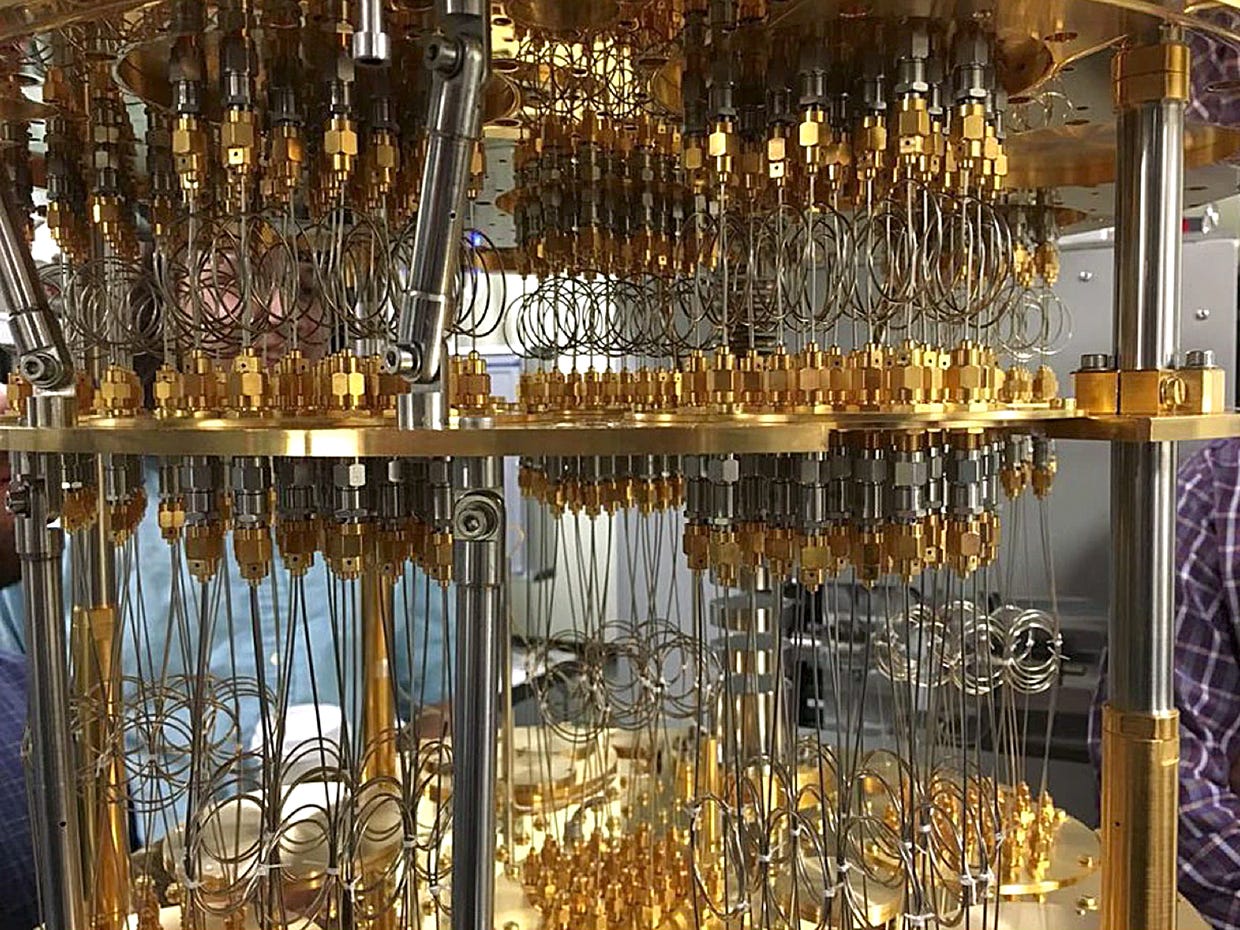
All we as humans had as tools for hundreds of thousands of years were sticks, stones, and our brains… and eventually fire. Arguably the greatest tool we’ve ever invented, though, is the computer. In the tiny span of time extending from the mid-20th century to now, we’ve entered a realm of exponential progress as processing power roughly doubles every few years. However, this rule, known as Moore’s Law, is getting close to its limit, since computer parts are getting closer and closer to atomic-size.
/arc-anglerfish-arc2-prod-mco.s3.amazonaws.com/public/QRIVGOPYJFB7NFNCJIMR4DRECQ.jpg)