The Profession of Arms: A Guide for Young Army Officers
It takes courage, especially for a young officer, to check a man met on the road for not saluting properly or for slovenly appearance, but, every time he does, it adds to his stock of moral courage, and whatever the soldier may say, he has respect for the officer who does pull him up.
Read Document →The Dragon's Teeth: Assessing China's Military Modernization
PLA has focused on modernising its capabilities across all warfare domains to achieve these goals. This includes land, air, and maritime operations, nuclear, space, counter-space, electronic warfare and cyberspace operations, aiming to become a fully integrated joint force.
Read Document →Transforming the PLA: A Decade of reorganisation from SSF to ISF
PRC has engaged in a sustained and broad effort to transform the PLA from an infantry-heavy, low-technology, ground forces-centric military into a high-technology, networked force with an increasing emphasis on joint operations and naval and air power projection.
Read Document →Eyes without Borders: Exploring the World of Open Source Intelligence (OSINT) in the Digital Age
Open Source Intelligence (OSINT) is gaining prominence with the rise of social media, the digital society and the vast growth of publicly and commercially available information (PAI and CAI).
Read Document →
The PLA’s Developing Cyber Warfare Capabilities and India's Options
Informationised warfare blurs the lines between peacetime and wartime. A nation in the information age cannot wait for the hostilities to break out to collect intelligence, carryout influence operations, develop antisatellite systems or design computer software weapons.
Read Document →
Galwan and After
Why did China did this when he is under tremendous pressure in all fronts, is this China's salami slice tactics being progressed rigorously, what will be new Rules of Engagement, what will be escalatory control mechanism, who has taken this decision, will there be some pressure put by China in India's North-East through insurgency.
Read Document →
India’s Joint Doctrine for Cyberspace Operations: A Critical Review
Chief of Defence Staff (CDS) General Anil Chauhan and Secretary, Department of Military Affairs, formally released declassified versions of the Joint Doctrines for Cyberspace Operations during the Chiefs of Staff Committee meeting in New Delhi.
Read Document →
Know your Enemy General(now Field Marshal) Syed Aseem Munir
Gen SA Munir's position in the hierarchy of Pakistan was not very comfortable. The state of economy, insurgency in Pakhtoonistan and Balochistan, attack on the Jaffar Express, constant protests by supporters of Imran Khan's supporters inside and outside of parliament.
Read Document →
Decoding Operation SINDOOR: Key Aspects and Implications
Precision strikes were carried out on nine sites—four in Pakistan and five in PoK—linked to anti-India terrorist groups such as the LeT, JeM and the Hizbul Mujahideen. The targeted sites included Muridke (LeT headquarters) and Bahawalpur (JeM headquarters).
Read Document →
Chinese Cyber Exploitation in India's Power Grid - Is There a linkage to Mumbai Power Outage?
The New York Times (NYT), based on analysis by a U.S. based private intelligence firm Recorded Future, reported that a Chinese entity penetrated India’s power grid at multiple load dispatch points. Chinese malware intruded into the control systems that manage electric supply across India, along with a high-voltage transmission substation and a coal-fired power plant
Read Document →20 August 2020
China’s Soft Power: Why Confucius Institutes Are Under Scrutiny in India and Across the Globe
Trade, Industrialisation, and British Colonial Rule in India
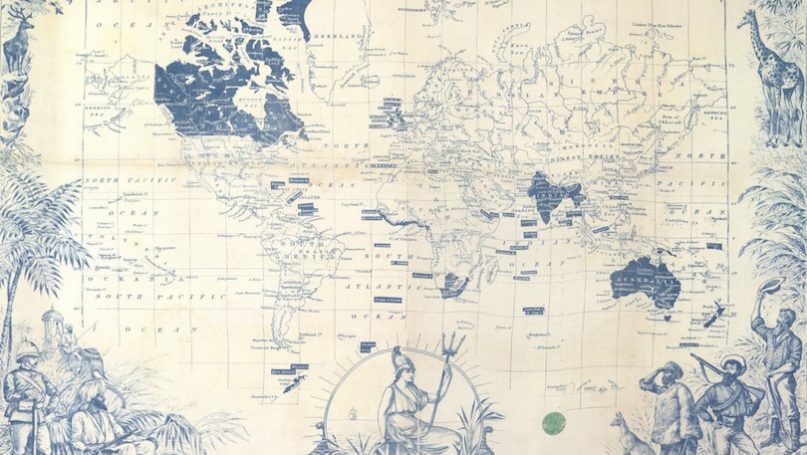
One common feature of European empires was the prominence of trade between the colonies and imperial power. This resulted in a pattern of specialisation whereby the colonies exported mainly primary products and imported mainly manufactures. The imperial powers encouraged this specialisation, which simultaneously benefited their consumers of primary products, producers of manufactures, and investors in colonial plantations and mines (see e.g. Findlay and O’Rourke, 2009). Accordingly, in the colony, this likely benefited consumers of manufactured products, and producers of primary products. From the colonies, however, two additional questions arise: did colonial trade limit industrial growth in the colonies? And did it reduce the colonies demand for independence, by making them dependent on trade with the imperial power?The Undertold, Undersold Story of Kamala Harris
When I saw on Wednesday morning that Kamala Harris had released a short video marking and celebrating her selection as Joe Biden’s running mate, I clicked — eagerly and instantly. I wanted to continue riding my wave of excitement about all the firsts: first woman of color on a major party’s presidential ticket, first Black woman specifically, first Asian-American.League of Nationalists
Under President Donald Trump, the United States’ relations with many of its closest friends have deteriorated drastically. Longtime allies and partners in Asia, Europe, and North America have been reeling from the president’s trade disputes, decisions to withdraw the United States from international treaties, allegations of free-riding, and “America first” approach to the world. German Chancellor Angela Merkel spoke for many spurned allies when she said in 2017, “We Europeans must really take our fate into our own hands.”Rightsizing the Afghanistan mission
Asian Security amid China’s Dominance
The tilt in the geography of power from a “unipolar moment”, characterised by American dominance in the global distribution of power, to the waning of American supremacy is not a unipolar illusion, but rather a reality. The United States (US) as a dominant actor has shaped and mapped global politics without being balanced by other great powers since the collapse of the erstwhile Soviet Union. Kenneth Waltz, the neo-realist thinker, argued that the balance of power will recur. However, this factor concerning the non-cognizance of temporality in relation to balancing strategies has been discounted by realist scholarship. The hegemonic positionality of the US, by virtue of its superiority in Command of Commons as well as its offshore balancing strategies, has been quite successful in deterring rising powers. While contextualising this in China’s case, Washington’s policies seem to be less effective.Here's What Must Change to Keep Asia's Rise Peaceful
China Is Getting Mired in the Middle East
What to expect from Biden-Harris on tech policy, platform regulation, and China
We Need to Reorganize More than the Military
Opinion – Making Sense of China’s ‘Wolf Warrior’ Diplomacy
Chinese diplomacy in the past decades is known for its blandness and use of long verbose statements. Recent years has witnessed the emergence of a new brand of Chinese diplomat. Unlike the older generation who used ‘conservative, passive, and low-key diplomacy’, these so-called ‘wolf warriors’ are known for their ‘aggressive, proactive and high-profile’ tactics. They are adept in using social media platforms like twitter to defend Chinese national interests. During the Covid-19 pandemic, these wolf warrior diplomats are seen to have used social media platforms to full effect to respond aggressively to US slander against China. Additionally, they were responsible for spreading misinformation about the origin of the coronavirus and the western response to the pandemic. In this manner, the pandemic season has seen heightened activism from Chinese diplomats in the global arena.Why the West Needs to Stop its Moralising against China
The great German philosopher Leibniz put it well over three centuries ago. Writing in his `Discourse on the Natural Theology of the Chinese’ he stated, `I did not want to examine to what extent the manner of worship of the Chinese could be condemned or justified… I only wanted to investigate their doctrines.’ These days, the issue of what to think, and in particular, what to feel about China has become entangled in the domestic politics of Europe and America to such an extent that attempts to do precisely as Leibniz did so long ago and simply describe and understand without being seen as validating and condoning become next to impossible. Finding a reasonable, critical space to look in all directions has seldom been harder.Opinion – US-China Rivalry: Moving Closer to the Brink
Former Australian Prime Minister, Kevin Rudd’s most recent article in Foreign Affairs, warns us to ‘beware the guns of August.’ His allusion to the early days of WWI is apt, but the world is by no means ‘sleepwalking’ to war but rather rushing, with eyes wide open, toward the precipice. Rudd portrays the USA and China as belligerent parties playing a dangerous game. They both rely on nationalist appeals to maintain support and legitimacy at home. Economic considerations are driving political responses and international politics are being used to serve domestic ends. Rudd presents the actions of the two states as opposite sides of a coin; on one side is the ‘wolf warrior’ and on the other are calls by US leaders to effectively ‘overthrow’ the Chinese Communist Party. He is right, up to a point and is right to ask, “where will this end?” Where it might end is in some form of armed confrontation that could easily lead to open war. Why this is so, is quite another question.Parag Khanna on China-centric Bias
An Answer to Aggression
The Chinese Communist Party’s initial mismanagement of the COVID-19 pandemic and its subsequent attempts to exploit the crisis have produced enduring problems for the rest of the world. But the CCP’s behavior has also helped clarify the threat that China poses to the security, prosperity, and well-being of other countries. Public opinion polls show that over 60 percent of Americans of both political parties now hold a negative view of Beijing’s leadership and intentions, and similar attitudes can be found across the democratic world. This heightened awareness of a shared danger creates an opportunity for the United States and its allies to formulate a new and more effective strategy for dealing with China.Following the Calamity in Beirut: Might the Situation in Lebanon Change?
Violent demonstrations, unprecedented public criticism of Hezbollah, and the resignation of the government – these developments, which followed the explosions in Beirut, are shaking Lebanon and opening up a possibility for change in this entangled country. However, change depends on the path that Nasrallah will choose and the willingness of Western countries to enlist in assisting Lebanon, and preventing it from falling into the Iran-led Shiite axisThis Cobalt-Free Battery Is Good for the Planet—and It Actually Works
Who Will Intervene in the World’s Hot Spots?
The Plan That Could Give Us Our Lives Back
Michael Mina is a professor of epidemiology at Harvard, where he studies the diagnostic testing of infectious diseases. He has watched, with disgust and disbelief, as the United States has struggled for months to obtain enough tests to fight the coronavirus. In January, he assured a newspaper reporter that he had “absolute faith” in the ability of the Centers for Disease Control and Prevention to contain the virus. By early March, that conviction was in crisis. “The incompetence has really exceeded what anyone would expect,” he told The New York Times. His astonishment has only intensified since.A Historian of Economic Crisis on the World After COVID-19
The World: A Brief Introduction
Spacepower Is ‘Catastrophically Decisive’ In War: New Space Force Doctrine
WASHINGTON: The Space Force’s long-awaited capstone doctrine sets out the new service’s raison d’etre, which includes providing decision-makers with potentially war-winning “spacepower” options for attacking enemy satellites in future conflicts.Infographic Of The Day: AIoT - When Artificial Intelligence Meets The Internet Of Things
As Military Cyber Policies Change, Should Others Do the Same?
The new strategic plan is available online here, and it includes many new changes in direction. In the foreword to the document, T.J. White, Vice Admiral, United States Navy Commander, U.S. Fleet Cyber Command / U.S. TENTH Fleet, wrote these words:Fake News Is Wreaking Havoc on the Battlefield. Here's What the Military's Doing About It
Texas-based soldiers were training in Poland last year when leaders at U.S. Army Europe spotted some alarming social media posts.