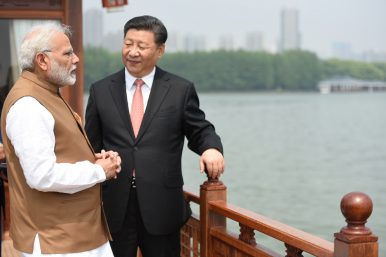
All eyes and ears will be tuned to India’s vision of the Indo-Pacific when Prime Minister Narendra Modi gives the keynote speech at the upcoming Shangri-La Dialogue next month in Singapore. The dialogue first convened in 2002 and soon became the flagship annual meeting for issues relating to security of the Asia-Pacific, later coinciding with the Obama-era Asia rebalancing strategy. However, the increasing salience of the Indo-Pacific as an emerging geopolitical construct, and the Trump administration’s embrace of the same, means that the Shangri-La Dialogue will also mirror this shift of focus from the Asia-Pacific to the larger Indo-Pacific.The Profession of Arms: A Guide for Young Army Officers
It takes courage, especially for a young officer, to check a man met on the road for not saluting properly or for slovenly appearance, but, every time he does, it adds to his stock of moral courage, and whatever the soldier may say, he has respect for the officer who does pull him up.
Read Document →The Dragon's Teeth: Assessing China's Military Modernization
PLA has focused on modernising its capabilities across all warfare domains to achieve these goals. This includes land, air, and maritime operations, nuclear, space, counter-space, electronic warfare and cyberspace operations, aiming to become a fully integrated joint force.
Read Document →Transforming the PLA: A Decade of reorganisation from SSF to ISF
PRC has engaged in a sustained and broad effort to transform the PLA from an infantry-heavy, low-technology, ground forces-centric military into a high-technology, networked force with an increasing emphasis on joint operations and naval and air power projection.
Read Document →Eyes without Borders: Exploring the World of Open Source Intelligence (OSINT) in the Digital Age
Open Source Intelligence (OSINT) is gaining prominence with the rise of social media, the digital society and the vast growth of publicly and commercially available information (PAI and CAI).
Read Document →
The PLA’s Developing Cyber Warfare Capabilities and India's Options
Informationised warfare blurs the lines between peacetime and wartime. A nation in the information age cannot wait for the hostilities to break out to collect intelligence, carryout influence operations, develop antisatellite systems or design computer software weapons.
Read Document →
Galwan and After
Why did China did this when he is under tremendous pressure in all fronts, is this China's salami slice tactics being progressed rigorously, what will be new Rules of Engagement, what will be escalatory control mechanism, who has taken this decision, will there be some pressure put by China in India's North-East through insurgency.
Read Document →
India’s Joint Doctrine for Cyberspace Operations: A Critical Review
Chief of Defence Staff (CDS) General Anil Chauhan and Secretary, Department of Military Affairs, formally released declassified versions of the Joint Doctrines for Cyberspace Operations during the Chiefs of Staff Committee meeting in New Delhi.
Read Document →
Know your Enemy General(now Field Marshal) Syed Aseem Munir
Gen SA Munir's position in the hierarchy of Pakistan was not very comfortable. The state of economy, insurgency in Pakhtoonistan and Balochistan, attack on the Jaffar Express, constant protests by supporters of Imran Khan's supporters inside and outside of parliament.
Read Document →
Decoding Operation SINDOOR: Key Aspects and Implications
Precision strikes were carried out on nine sites—four in Pakistan and five in PoK—linked to anti-India terrorist groups such as the LeT, JeM and the Hizbul Mujahideen. The targeted sites included Muridke (LeT headquarters) and Bahawalpur (JeM headquarters).
Read Document →
Chinese Cyber Exploitation in India's Power Grid - Is There a linkage to Mumbai Power Outage?
The New York Times (NYT), based on analysis by a U.S. based private intelligence firm Recorded Future, reported that a Chinese entity penetrated India’s power grid at multiple load dispatch points. Chinese malware intruded into the control systems that manage electric supply across India, along with a high-voltage transmission substation and a coal-fired power plant
Read Document →3 June 2018
India-US-China: Aligning Interests or Managing Threats?
All eyes and ears will be tuned to India’s vision of the Indo-Pacific when Prime Minister Narendra Modi gives the keynote speech at the upcoming Shangri-La Dialogue next month in Singapore. The dialogue first convened in 2002 and soon became the flagship annual meeting for issues relating to security of the Asia-Pacific, later coinciding with the Obama-era Asia rebalancing strategy. However, the increasing salience of the Indo-Pacific as an emerging geopolitical construct, and the Trump administration’s embrace of the same, means that the Shangri-La Dialogue will also mirror this shift of focus from the Asia-Pacific to the larger Indo-Pacific.From Cyber Warfare To Anti-Satellite Weapons, India Has All Capabilities: Defence Research Chief
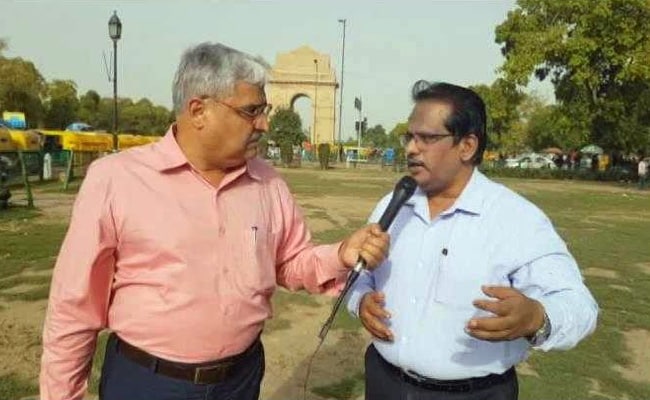
NEW DELHI: India's defence research chief Dr S Christopher has explained the various stages of development of the country's array of sophisticated weapons and where they stand currently. India already has anti-satellite capability. However, Dr Christopher says any ballistic missile that flies for a 1,000-plus km height can be designed in such a way that it becomes an anti-satellite weapon. "You do not necessarily need to specially use Agni-V (ballistic missile)," he told NDTV in an exclusive interview. The defence scientist says unmanned warfare is going to be the order of the day, with drone development taking centre stage.Thermal Power Plant at the Khushab Plutonium Complex is Nearly Complete
White House move raises trade tensions with China
China’s looming financial crisis
US Needs New Strategy Vs. Russian, Chinese ‘Political Warfare’: CSBA
WASHINGTON: Russia’s meddling in the 2016 elections is just the tip of an iceberg of ongoing, systematic subversion, argues a new report. From Beijing’s bullying of Chinese students abroad, forcing them to lobby for the regime on matters like Taiwan and Tibet, to Moscow’s online support for radicals in Italy, Spain, and the Netherlands, both Russia and China are waging political warfare worldwide in ways democracies are ill-equipped to deal with, says the Center for Strategic & Budgetary Assessments.CHINA/RUSSIA IN A ‘BEAR HUG:’ BEIJING VOWS TO DEEPEN TIES WITH MOSCOW, TAKES SWIPE AT U.S.
Was Merkel’s Visit to China Successful?
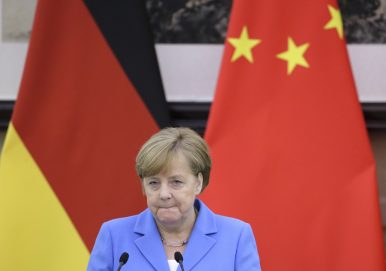
On May 25, German Chancellor Angela Merkel wrapped up her two-day visit to China. This visit — coming immediately after her visits to the United States and to Russia in recent weeks — was short yet fruitful for Merkel. As various media outlets noted earlier, the Iran nuclear deal (from which U.S. President Donald Trump just withdrew) and human rights issues (traditionally Beijing’s most hated topic) were the top two priorities on Merkel’s agenda. Merkel’s visit showed that she made a successful balance this time by achieving a united front with China on Iran deal on the one hand, and standing firm on human rights on the other.These Documents Reveal a Bizarre War Game Being Played by the Pentagon
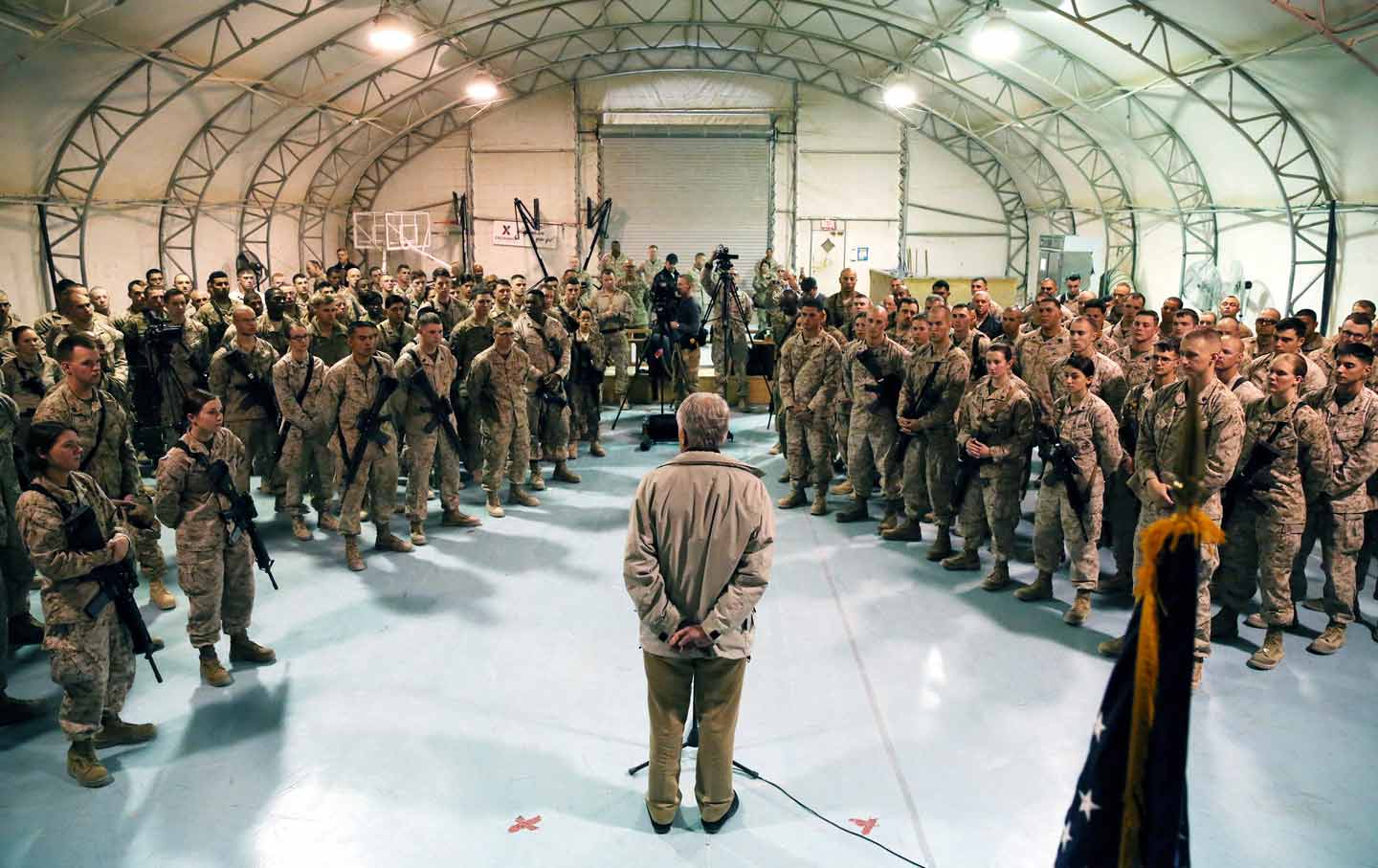
EDITOR’S NOTE: This article originally appeared at TomDispatch.com. To stay on top of important articles like these, sign up to receive the latest updates from TomDispatch.com. Ready To Join The Resistance?Sign up for Take Action Now and we’ll send you three actions every Tuesday. You will receive occasional promotional offers for programs that support The Nation’s journalism. You can read our Privacy Policy here. For almost 20 years, US drone warfare was largely one-sided. Unlike Afghans and Yemenis, Iraqis and Somalis, Americans never had to worry about lethal robots hovering overhead and raining down missiles. Until, that is, one appeared in the skies above Florida.The Complicated Geopolitics of U.S. Oil Sanctions on Iran
It is often said, perhaps with some hyperbole, that Iran’s nuclear deal with world powers was the best hope for conflict resolution in the Middle East. Its architect John Kerry argues instead that the 2015 deal’s limited parameter of closing Iran’s pathway to a nuclear weapon is sufficient on the merits. The Trump administration is taking a different view, focusing on Iran’s escalating threats to U.S. allies Israel, Saudi Arabia, and the United Arab Emirates. Those threats, which have included missile, drone, and cyberattacks on Saudi oil facilities, are looming large over the global economy because they are squarely influencing the volatility of the price of oil. One could argue that the U.S. decision to withdraw from the Iranian deal, referred to as the Joint Comprehensive Plan of Action (JCPOA), has injected an even higher degree of risk into oil markets, where traders now feel that the chances of Mideast conflict resolution are lower.With CAATSA, the U.S. is Trying to Make Russia Hurt
Russian Election Interference: Europe’s Counter to Fake News and Cyber Attacks
Threat Report 2018: Russia’s Military Doctrine of Deception and Deniability
Bottom Line: Moscow’s increasingly assertive military activity in Eastern Europe and the Middle East seeks to project the power of a resurgent Russia in relation to a retreating United States, while concealing its economic and political fragility at home. In doing so, the Kremlin walks a fine line between escalation with the West and the gradual growth of influence abroad. These realities have required the Kremlin to pursue unconventional and deniable means, sometimes complimented with a small overt military footprint to accomplish its political and military objectives.Israel’s Nuclear Strategy: Enhancing Deterrence in the New Cold War
Iran and Israel are Racing toward Confrontation in Syria
Israel has long been wary of Iran’s power projection in the Levant, particularly in Syria. Ties between Tehran and Damascus have been close since the 1979 revolution, but the relationship deepened after Syria’s civil war erupted in 2011. With the Assad regime’s survival at stake, Tehran doubled down on its support, providing critical military assistance—fighters and strategists—and economic aid estimated to be in the hundreds of millions of dollars. Syria and Iran now have a partnership with existential stakes—for the Assad regime’s longevity and Iran’s enduring position in Syria, the most strategic property in the Levant. USIP’s Mona Yacoubian looks at Iran and Israel’s goals and concerns in Syria and the potential of their shadow war spilling over into a regional conflagration.Thucydides in the Data Warfare Era
Here are the top 5 issues on the docket for NATO’s 2018 summit
WASHINGTON ― Following along the same vein as the 2016 Warsaw summit, this year’s meeting of NATO leadership in Brussels will focus on reinforcing the alliance’s military presence in Eastern Europe as part of its deterrence mission. NATO Secretary General Jens Stoltenberg outlined the five main topics for the July 2018 summit during a speech before the NATO Parliamentary Assembly on May 28.Here’s how the Navy is developing information warfare ‘Top Guns’
The Navy is looking to develop better information warfare personnel and improve doctrine such as intelligence experts in over the horizon targeting. The Navy recently celebrated the one-year mark of its development center aimed at growing more robust information warfare personnel for 21st century battlefronts. In order to meet evolving threats and challenges, the Navy is standing up a center to train warfighters.Lessons from Strengthening Capacity in Countering Violent Extremism
THUCYDIDES IN THE DATA WARFARE ERA
When Less is More: Cognition and the Outcome of Cyber Coercion
The rise of offensive interstate cyber interactions continues to fan interest in the coercive potential of cyber operations. However, empirical evidence from past cases suggests that such operations often perform poorly, with adversaries opting to resist rather than comply with an aggressor’s demands. Miguel Alberto Gomez contends that this does not necessarily mean the coercive potential of cyber operations can be dismissed. Instead, he argues for a shift in how we explain state behavior, suggesting a move away from prevailing normative interpretations and towards approaches that use cognitive heuristics.