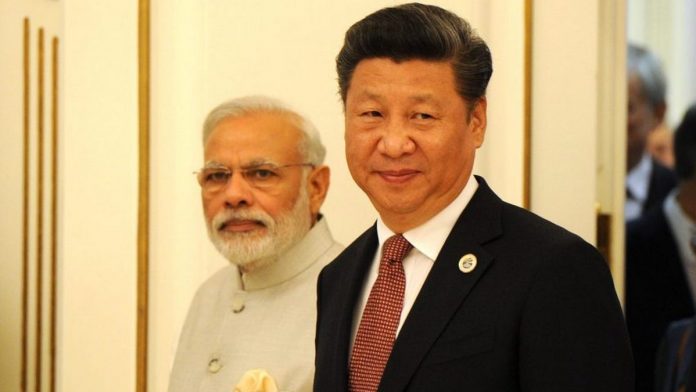
New Delhi: India has, for the second time, chosen to keep itself away from China’s mega Belt and Road Initiative summit which began in Beijing Friday, despite speculation that it may not be averse to a second Wuhan-type summit between Prime Minister Narendra Modi and Chinese President Xi Jinping if the Bharatiya Janata Party (BJP) returns to power.The Profession of Arms: A Guide for Young Army Officers
It takes courage, especially for a young officer, to check a man met on the road for not saluting properly or for slovenly appearance, but, every time he does, it adds to his stock of moral courage, and whatever the soldier may say, he has respect for the officer who does pull him up.
Read Document →The Dragon's Teeth: Assessing China's Military Modernization
PLA has focused on modernising its capabilities across all warfare domains to achieve these goals. This includes land, air, and maritime operations, nuclear, space, counter-space, electronic warfare and cyberspace operations, aiming to become a fully integrated joint force.
Read Document →Transforming the PLA: A Decade of reorganisation from SSF to ISF
PRC has engaged in a sustained and broad effort to transform the PLA from an infantry-heavy, low-technology, ground forces-centric military into a high-technology, networked force with an increasing emphasis on joint operations and naval and air power projection.
Read Document →Eyes without Borders: Exploring the World of Open Source Intelligence (OSINT) in the Digital Age
Open Source Intelligence (OSINT) is gaining prominence with the rise of social media, the digital society and the vast growth of publicly and commercially available information (PAI and CAI).
Read Document →
The PLA’s Developing Cyber Warfare Capabilities and India's Options
Informationised warfare blurs the lines between peacetime and wartime. A nation in the information age cannot wait for the hostilities to break out to collect intelligence, carryout influence operations, develop antisatellite systems or design computer software weapons.
Read Document →
Galwan and After
Why did China did this when he is under tremendous pressure in all fronts, is this China's salami slice tactics being progressed rigorously, what will be new Rules of Engagement, what will be escalatory control mechanism, who has taken this decision, will there be some pressure put by China in India's North-East through insurgency.
Read Document →
India’s Joint Doctrine for Cyberspace Operations: A Critical Review
Chief of Defence Staff (CDS) General Anil Chauhan and Secretary, Department of Military Affairs, formally released declassified versions of the Joint Doctrines for Cyberspace Operations during the Chiefs of Staff Committee meeting in New Delhi.
Read Document →
Know your Enemy General(now Field Marshal) Syed Aseem Munir
Gen SA Munir's position in the hierarchy of Pakistan was not very comfortable. The state of economy, insurgency in Pakhtoonistan and Balochistan, attack on the Jaffar Express, constant protests by supporters of Imran Khan's supporters inside and outside of parliament.
Read Document →
Decoding Operation SINDOOR: Key Aspects and Implications
Precision strikes were carried out on nine sites—four in Pakistan and five in PoK—linked to anti-India terrorist groups such as the LeT, JeM and the Hizbul Mujahideen. The targeted sites included Muridke (LeT headquarters) and Bahawalpur (JeM headquarters).
Read Document →
Chinese Cyber Exploitation in India's Power Grid - Is There a linkage to Mumbai Power Outage?
The New York Times (NYT), based on analysis by a U.S. based private intelligence firm Recorded Future, reported that a Chinese entity penetrated India’s power grid at multiple load dispatch points. Chinese malware intruded into the control systems that manage electric supply across India, along with a high-voltage transmission substation and a coal-fired power plant
Read Document →3 May 2019
What China’s Belt and Road Initiative is, and why India gave it a miss again
New Delhi: India has, for the second time, chosen to keep itself away from China’s mega Belt and Road Initiative summit which began in Beijing Friday, despite speculation that it may not be averse to a second Wuhan-type summit between Prime Minister Narendra Modi and Chinese President Xi Jinping if the Bharatiya Janata Party (BJP) returns to power.The Virtual Islamic State – OpEd
Just a few years ago the Islamic State (IS) was only too real. Spread across Syria and Iraq, It covered more than 34,000 square miles and controlled millions of people. Its revenues came from oil produced in the areas it had overrun, sold at bargain prices to dealers in Turkey and elsewhere, augmented by taxes levied on its population, the sale of stolen artifacts, ransoms from kidnappings, smuggling and extortion.What explains rich-kid terrorists
Peter Bergen is CNN's national security analyst, a vice president at New America and a professor of practice at Arizona State University. He is the author of "United States of Jihad: Investigating America's Homegrown Terrorists." The opinions expressed in this commentary are his own. View more opinion articles at CNN.‘We Will Come for You’: How Fear of Terrorism Spurs Online Mobs
Islamist Terrorism Remains the World’s Greatest Threat to Peace
After the horrific mass murder of 50 Muslim worshippers in Christchurch, New Zealand, there was widespread coverage and a torrent of mainstream news networks contemplating the threat of white supremacy.With Easter Bombings, a New Brand of Terrorism Arrives in Sri Lanka
As Christians around the world were flocking to churches for Easter services Sunday, Sri Lanka was already in mourning. A string of deadly, coordinated explosions early Sunday, which tore through churches and luxury hotels in Colombo and across the island nation, killed over 321 people, including some 38 foreigners, and injured around 500 others. Seven of the eight attacks were suicide bombings. A ninth explosion was prevented late Sunday when security personnel defused an improvised explosive device on the road to Colombo International Airport.The Attacks in Sri Lanka Highlight Another Missed Early Warning. How Does This Happen?
Sri Lanka is Already Drawing the Wrong Lessons from the Attacks
UN Regional Development Arm To Cooperate With China’s BRI
To speed up sustainable development in Asia and the Pacific, the United Nations’ regional development arm has committed to cooperating with the government of China on a wide range of areas at the Second Belt and Road Forum for International Cooperation held in Beijing this week.China 70 Years From Now – Analysis
In my opinion, after the 19thCPC National Congress, two changes characterize the new form of Communist China: the amendment to the Party’s Constitution, with the phrase “Xi Jinping Thought on Socialism with Chinese Characteristics for a New Era” introduced directly by current President Xi Jinping. The other change is the new autonomous dimension of the Party’s ideology and hence of its practice.China's Xi touts more than $64 billion in Belt and Road deals
Huawei is at the centre of political controversy
It is hard to think of a better reflection of the rise of China than the rise of Huawei. Like China, the firm, which was founded in 1987, began at the bottom of the value chain, reselling telephone-switching gear imported from Hong Kong. Also like China, it was not content to stay there. These days its products—from smartphones to solar panels—are sleek, high-tech and competitive with anything its rivals can produce. As a result its revenues have soared, hitting $105bn in 2018 (see chart 1). Huawei, and its mother country, have become technological pacesetters in their own right. The firm employs 80,000 people in research and development alone. China filed 53,345 patents in 2018, a hair behind America’s 56,142. Of China’s, around one in ten came from Huawei alone.Special Report: How China is replacing America as Asia's military titan
How Politically Influential Is China’s Military?
The Chinese naval parade in Qingdao on April 23, celebrating the 70th anniversary of the People’s Liberation Army Navy (PLAN), showcased multiple indigenously produced Chinese warships and submarines. Most prominent of these were an upgraded Type 094 Jin-class nuclear powered ballistic missile submarine and the new 10,000-13,000 ton Type 055 guided missile destroyer. This event is the latest example of China flexing its maritime muscles and demonstrating to the region, and the world, that the PLAN is quickly developing into a powerful force.A Necessary Voice: Small States, International Law, and the UN Security Council
Adam Lupel and Lauri Mรคlksoo argue that if the international rule-based order continues to deteriorate, small states—by definition vulnerable in a world where only might makes right—are most at risk. This might make such states natural defenders of the international order and international law, but how can they perform this role? Our authors explain that one way is through the part small states can play in the UN Security Council. Further, perhaps not since the founding of the UN has their voice been more necessary for all to hear.Mega Economies Of Tomorrow: Indonesia’s Way Up – Analysis
The World Bank analytically divides the world’s economies into four income groups: high, upper-middle, lower-middle and low. Countries that are categorized as upper-middle income are the ones with income per capita ranging from US$3,896 to $12,055.Is a new world order emerging to replace US hegemony?
China’s global rise and Russia’s renewed assertiveness are stimulating heated debate about the endurance of the so-called liberal world order, led by the United States. 5 Sustainable Solutions for Middle East Security
The United States is a global power with global interests and responsibilities. Protecting these interests hinges on access to the commons (sea, space, air, cyberspace) and stability in Europe, the Middle East and the Indo-Pacific region (the great trading centers).Don’t Panic: The Digital Revolution Isn’t as Unusual as You Think
The digital revolution has dramatically changed life on Earth, making it easy to think we’re living in the greatest time of innovation. But a new book by Tom Wheeler, former chairman of the Federal Communications Commission, is a reminder that remarkable change has happened many times before. The invention of the printing press in the 15thcentury created upheaval and reorganized everything in society, as did the subsequent inventions of the telegraph, telephone and railroad. From Gutenberg to Google: The History of Our Future is an insightful look at the development of networks, the physical links that bind people together. Wheeler, a visiting fellow at the Brookings Institution, recently joined the Knowledge@Wharton radio show on SiriusXM to talk about why history often repeats itself. (Listen to the podcast at the top of this page).