The Profession of Arms: A Guide for Young Army Officers
It takes courage, especially for a young officer, to check a man met on the road for not saluting properly or for slovenly appearance, but, every time he does, it adds to his stock of moral courage, and whatever the soldier may say, he has respect for the officer who does pull him up.
Read Document →The Dragon's Teeth: Assessing China's Military Modernization
PLA has focused on modernising its capabilities across all warfare domains to achieve these goals. This includes land, air, and maritime operations, nuclear, space, counter-space, electronic warfare and cyberspace operations, aiming to become a fully integrated joint force.
Read Document →Transforming the PLA: A Decade of reorganisation from SSF to ISF
PRC has engaged in a sustained and broad effort to transform the PLA from an infantry-heavy, low-technology, ground forces-centric military into a high-technology, networked force with an increasing emphasis on joint operations and naval and air power projection.
Read Document →Eyes without Borders: Exploring the World of Open Source Intelligence (OSINT) in the Digital Age
Open Source Intelligence (OSINT) is gaining prominence with the rise of social media, the digital society and the vast growth of publicly and commercially available information (PAI and CAI).
Read Document →
The PLA’s Developing Cyber Warfare Capabilities and India's Options
Informationised warfare blurs the lines between peacetime and wartime. A nation in the information age cannot wait for the hostilities to break out to collect intelligence, carryout influence operations, develop antisatellite systems or design computer software weapons.
Read Document →
Galwan and After
Why did China did this when he is under tremendous pressure in all fronts, is this China's salami slice tactics being progressed rigorously, what will be new Rules of Engagement, what will be escalatory control mechanism, who has taken this decision, will there be some pressure put by China in India's North-East through insurgency.
Read Document →
India’s Joint Doctrine for Cyberspace Operations: A Critical Review
Chief of Defence Staff (CDS) General Anil Chauhan and Secretary, Department of Military Affairs, formally released declassified versions of the Joint Doctrines for Cyberspace Operations during the Chiefs of Staff Committee meeting in New Delhi.
Read Document →
Know your Enemy General(now Field Marshal) Syed Aseem Munir
Gen SA Munir's position in the hierarchy of Pakistan was not very comfortable. The state of economy, insurgency in Pakhtoonistan and Balochistan, attack on the Jaffar Express, constant protests by supporters of Imran Khan's supporters inside and outside of parliament.
Read Document →
Decoding Operation SINDOOR: Key Aspects and Implications
Precision strikes were carried out on nine sites—four in Pakistan and five in PoK—linked to anti-India terrorist groups such as the LeT, JeM and the Hizbul Mujahideen. The targeted sites included Muridke (LeT headquarters) and Bahawalpur (JeM headquarters).
Read Document →
Chinese Cyber Exploitation in India's Power Grid - Is There a linkage to Mumbai Power Outage?
The New York Times (NYT), based on analysis by a U.S. based private intelligence firm Recorded Future, reported that a Chinese entity penetrated India’s power grid at multiple load dispatch points. Chinese malware intruded into the control systems that manage electric supply across India, along with a high-voltage transmission substation and a coal-fired power plant
Read Document →9 January 2016
The way forward in Nepal
* WHAT WASHINGTON SHOULD DO TO HELP INDIA–PAKISTAN TIES
'Drug-terror nexus' in Pathankot
SUJAN DUTTA
IF ONLY THIS WAS DONE ON JANUARY 1
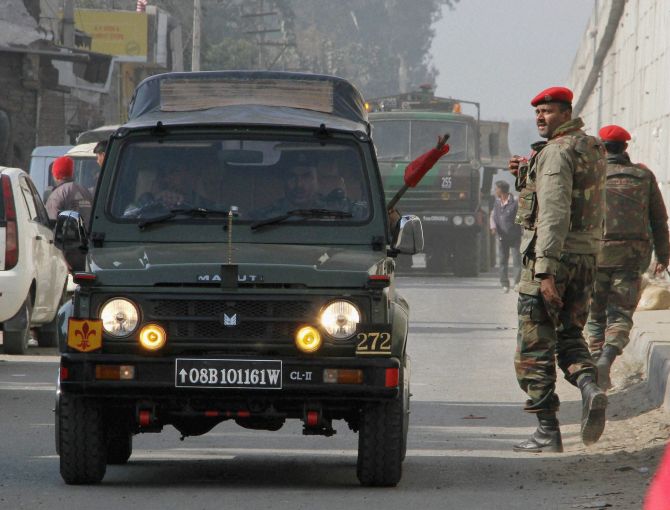
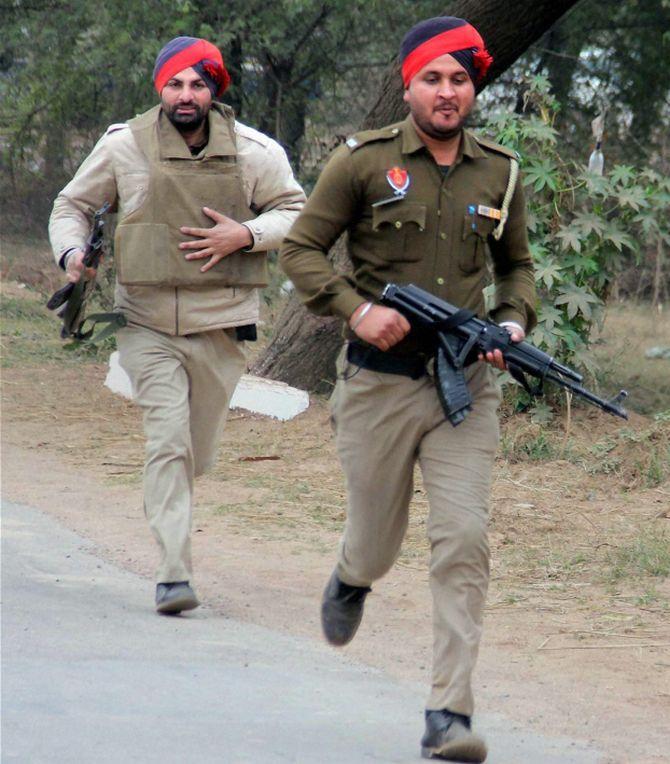
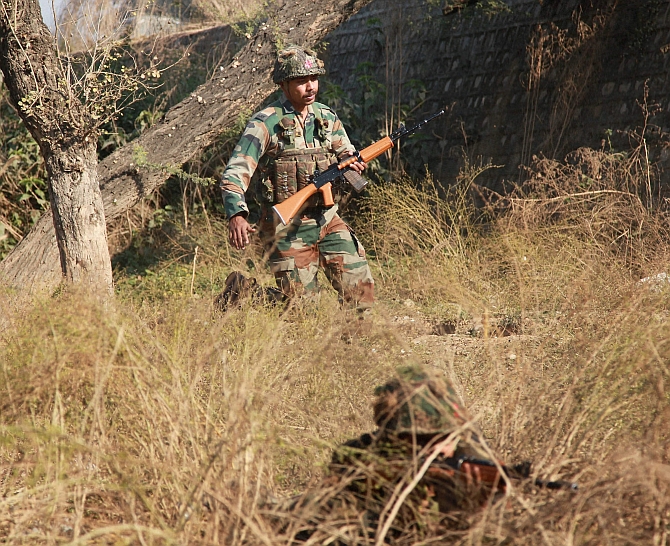
Security forces scour Bhullaechak Colony near Tibri Cantonment in Gurdaspur, less than 50km from Pathankot, on Thursday after a farmer said on Wednesday that he saw two men in army fatigues moving in a suspicious manner. The army and police are carrying out joint combing operations. “We are not taking any chance. All vehicles and people, in and around the area, are being physically checked,” Gurdaspur senior superintendent of police Gurpreet Singh Toor said. (PTI)
New Delhi, Jan. 7: The militants who attacked the Pathankot Air Force base tapped into drug-smuggling channels to carry out the raid, according to an assessment in the security establishment in New Delhi.
The security agencies are also probing an explosive element: whether one of the two squads of attackers, carrying heavy weapons, was "sheltered" inside the base, an executive familiar with the security assessment said.
The investigation is taking into account the nature of the terrain around the Shakargarh Bulge through which the Ravi river flows in and out of Pakistan bordering northern Punjab. Long stretches of the international boundary in the zone are not fenced.
The region has a history of being used to traffic contraband drugs. Local officials have been bribed by smugglers.
In the marriage of narcotics smuggling and terrorism, one line of investigation is probing whether a Punjab security official was lured into being an accomplice of the attackers.
He may have been lured by a combination of money and flesh but when he went to receive the consignment, the "package" turned out to be a gang of gun-wielding terrorists. That made him turn chicken and report to a superior with a half-truth, not the full story, the investigators suspect.
These disclosures were made when a security assessment was shared with a handful of journalists, including this correspondent, to challenge a perception that there was doubtful synergy in the chain of command during the Pathankot operation.
The alleged nexus between the drug mafia and politicians in Punjab has been a festering issue in the past few years. The Congress has consistently accused the Parkash Singh Badal government, which is partnering the BJP, of being hand in glove with drug cartels.
Last year Jagdish Singh Bhola, a former DSP, was booked in a Rs 600-crore synthetic drug scam. Bhola had named Bikram Singh Majithia, the state's revenue minister as well as the younger brother of Union minister Harsimrat Kaur Badal, the daughter-in-law of chief minister Badal.
Hours before attack IAF moved MiGs, choppers out of Pathankot
January 08, 2016
'As many as 29 explosions were recorded after the last terrorist was neutralised, giving an impression of continuing pitched battles!' reveals Rajeev Sharma.
Did India's counter-terrorism machinery bungle in tackling the Pathankot terror attack challenge?
My answer is a big 'No!'
Why? Here's why.
A prime question is why the Indian government could not neutralise the terrorists in a heavily fortified military establishment like the Pathankot airbase in a jiffy when France had done so in a matter of two hours in civilian areas?
Why did India take four long days to neutralise terrorists who were initially four and later turned out to be more?
The Pathankot terror attack was dealt with in a surgical manner. The operations were personally choreographed by National Security Advisor Ajit Doval who cancelled his strategically important China visit to be able to oversee the Pathankot counter-terror operations.
The success or failure of the Pathankot terror operation boiled down to just one question: Whether the NSA-led operations were able to deny the hardcore perpetrators meeting their single biggest objective of destroying the Pathankot airbase?
The question, in other words, is whether the Jaish-e-Mohammed terrorists were able to even remotely meet their mission objective.
The answer is NO because most of the assets like the MiG-21 fighter aircraft and the Mi-25 helicopters had already been removed hours before the terrorists wreaked mayhem.
Moreover, a contingent of National Security Guards commandos had been harnessed and the perpetrators were kept engaged in counter-terrorism operations. All these NSG officers belonged to the Indian Army and drew their strength from the Indian Army.
Pathankot was a different ball game in comparison to the recent Paris terror attacks where all the perpetrators had been neutralised within two hours.
Pathankot was much different as terrorists, armed to teeth, had sneaked inside the Pathankot airbase, one of the biggest in India with over 2,700 acres of total area and a periphery wall of over 24 kilometres.
The size of the Pathankot airbase made the operations all the more tricky as Indian security managers were not sure as to how many perpetrators were still at large and their locations.
'The information we had was pure gold'
January 06, 2016
'You seldom get information of this kind several hours in advance, exactly where they are going to strike. But we still couldn't act on this intelligence.'
'Had this been handled in a correct way, the only lives that would have been lost, presumably, were the lives of the terrorists and that would have been welcome.'
Colonel Ajai Shukla (retd) has been scathing about the manner in which India's national security team handled the Pathankot airbase terrorist attack.
Prasanna D Zore/Rediff.com spoke to Colonel Shukla to find out why despite advance intelligence the terrorists still attacked the airbase and took precious Indian lives.
In your column, you said National Security Adviser Ajit Doval handled the Pathankot airbase attacks 'ineptly' and it was a 'debacle.' What could he have done?
You also say in the column that the NSG (National Security Guard) is trained to handle pinpoint operations. Didn't the same NSG flush out terrorists during the 26/11 Mumbai siege?
You understand the difference between clearing a hotel and securing a large piece of land. When you have to secure an area and defend it against terrorists who are attacking it, you require a different operation, one that requires lot of manpower.
When you have to do an attack operation on terrorists holed up in a hotel and clear it room by room is a different operation. Now the Mumbai kind of room clearance operations, which are pinpoint type of attack operations, is what the NSG is geared and equipped and meant to handle.
On the other hand, what should have been done (at Pathankot) immediately upon receiving information about an impending terrorist attack is to secure the airbase, which means putting a large number of people at various pickets all around the airbase which means you dominate the area and don't give freedom of movement (to terrorists).
How could these six or so terrorists have entered the airbase? If there were intelligence inputs, why wasn't the perimeter of the Pathankot airbase secured?
Because it was such a handful of people who had to secure a very large premise, which meant there were large gaps in between the pickets and these terrorists ingressed through those gaps.
When you have a larger number of people deployed, these gaps get reduced and minimise the chances of terrorists taking advantage of these gaps.
The point that I am making about the larger presence of manpower is because the biggest problem, in securing a large area, is manpower. And when you have just 150 NSG commandos (to secure such a huge air base)... (it) is like using a heart surgeon to sort of put a band aid on a little wound.
Pathankot attack: Are India's nuclear sites really safe from Pakistan? Although these nuclear installations are quite far from the border areas, there is every possibility of infiltration.
The Pathankot Siege and its Lessons
Last updated on: January 07, 2016
'Jihadi outfits backed by the ISI are now prepared to attack targets not just in J&K, but also in Punjab. This signals an escalation in the range and scope of cross-border terrorism, which cannot be ignored,' says Ambassador G Parthasarthy, former high commissioner to Pakistan.
The entry of six well-armed Pakistani terrorists into the strategically located Pathankot military airfield and the subsequent siege that followed has several lessons for India in the conduct of foreign and defence policies. This is notably so, in its relations with Pakistan and in addressing its defence and internal security shortcomings. All these issues need to be addressed seriously and not glossed over.
Ever since the acquisition of longer-range military aircraft like the SU-27, Mirage 2000 and Jaguars, these strategic assets can now be positioned in mores distant locations from the borders with Pakistan. But Pathankot has always been a chosen target for Pakistani attacks, in both the 1965 and 1971 conflicts. It now houses relatively old MiG-21 aircraft and given its location, close to the border, attack helicopters.
The attack on the Pathankot airbase, which follows a similar attack on nearby Gurdaspur along the Pathankot-Jammu Highway in July, clearly indicates that jihadi outfits backed by the ISI are now prepared to attack targets not just in Jammu and Kashmir, but also in Punjab.
This signals an escalation in the range and scope of cross-border terrorism, which cannot be ignored.
The ease with which the terrorists slipped passed border defences appears to indicate a nexus between smugglers, particularly of narcotics, and elements in the local administration.
The Pakistan-based jihadi groups and the ISI are clearly plugged into this nexus and prepared to exploit it to their advantage. This is an issue that can no longer be wished away and needs to be tackled head on.
Pathankot attack: India-Pakistan peace talks derailed?
Does India have a Plan B? Better to be slow and steady with Pakistan than novel and theatrical
The Next Pathankot India's New Terrorism Battleground
January 6, 2016
By Sumit Ganguly
This was the second foreign terrorist attack in Punjab within a span of six months—though the first at a military base, which is uncommon. The last attack had taken place in Gurdaspur in July 2015 and had led to the deaths of seven policemen.
First and foremost, the attacks reveal the inadequacy of Indian security. On this occasion, Indian intelligence failed to utilize advanced warnings of a possible attack; these same men were believed to have hijacked a vehicle of a senior Punjab police official shortly before the onslaught. Further, Pathankot is a major military base, and barely 50 miles from the international border with Pakistan. Yet it lacked adequate protection to deter the attack.
In fact, after the hijacking, the air force authorities could apparently only deploy patrols from the Defense Security Corps, a security force composed of mostly retired military personnel, due to a failure to anticipate a carefully orchestrated terrorist attack. The DSC
Pakistan mulls elevating status of Gilgit-Baltistan on Chinese insistence
ISLAMABAD: Pakistan is mulling to elevate the constitutional status of northern Gilgit-Baltistan region in a bid to provide legal cover to the multi-billion-dollar Chinese investment plan, officials said on Thursday.
The move could signal a historic shift in the country's position on the future of the wider Kashmir region, observers have said.
The proposal would see the mountainous region mentioned by name for the first time in the country's Constitution, bringing it one step closer to being fully absorbed as an additional province.
Islamabad has historically insisted the parts of Kashmir it controls are semi-autonomous and has not formally integrated them into the country, in line with its position that a referendum should be carried out across the whole of the region.
Sajjad-ul-Haq, spokesman for the chief minister of Gilgit-Baltistan Hafiz Hafeez ur Rehman, told AFP: "A high level committee formed by the prime minister is working on the issue, you will hear good news soon."
Rehman, who arrived in Islamabad on Thursday, was working on the finishing touches to the agreement, a senior official said, adding the document could be unveiled "in a few days".
In addition to being named in the Constitution, Gilgit-Baltistan would also send two lawmakers to sit in the federal parliament — though they would be given observer status only.
A third top government official from Gilgit-Baltistan said the move was in response to concerns raised by Beijing about the China Pakistan Economic Corridor, the $46 billion infrastructure plan set to link China's western city of Kashgar to the Pakistani port of Gwadar on the Arabian Sea.
"China cannot afford to invest billions of dollars on a road that passes through a disputed territory claimed both by India and Pakistan," the official, speaking on condition of anonymity, said.
The corridor plans have been strongly criticised by New Delhi, with India's Foreign Minister Sushma Swaraj in June calling the project "unacceptable" for crossing through Indian-claimed territory.
India and Russia Fail to Resolve Dispute Over Fifth Generation Fighter Jet
GEN Keane on Afghanistan: Security Situation Deteriorating
China and Pakistan Join Forces Under the Sea
* WARS OF IDEAS: FROM THE TALIBAN TO THE ISLAMIC STATE
The Deceptive Debate Over What Causes Terrorism Against the West
https://theintercept.com/2016/01/06/the-deceptive-debate-over-what-causes-terrorism-against-the-west/Did Barack Obama and Hillary Clinton create ISIS?
http://edition.cnn.com/2016/01/04/opinions/bergen-trump-obama-clinton-creation-of-isis/
By Peter Bergen, CNN National Security Analyst, January 4, 2016
Story highlights
Peter Bergen: There's little factual support for Donald Trump's claim that the President and ex-secretary of state enabled rise of ISIS
He says four factors, largely outside of U.S. control, gave rise to ISIS
Peter Bergen is CNN's national security analyst, a vice president at New America and a professor of practice at Arizona State University. He is the author of the forthcoming book "United States of Jihad: Investigating America's Homegrown Terrorists."
(CNN)Donald Trump said on Saturday that President Barack Obama and former Secretary of State Hillary Clinton "created ISIS."
Like many of Trump's charges this one doesn't hold much water. Clinton left the State Department in January 2013 and ISIS wasn't even founded until three months later.
But Trump's charge does raise an interesting question, which is how best to assign responsibility for the rise of ISIS, including the issue of how might the Obama administration's exit from Iraq at the end of 2011 have helped smooth the path for ISIS?
It began with a thug
The rise of ISIS starts with a Jordanian thug named Abu Musab al-Zarqawi who founded ISIS' parent organization, al Qaeda in Iraq.
It was Zarqawi who inaugurated al Qaeda in Iraq's televised beheadings with the killing of American businessman Nick Berg in 2004. And it was Zarqawi who ignited a civil war against the Shiites in Iraq the same year. These tactics and policies remain today at the core of ISIS.
What gave Zarqawi the opportunity to create al Qaeda in Iraq? It was, of course, George W. Bush's decision to invade Iraq in 2003. Iraqi dictator Saddam Hussein brutally repressed all forms of opposition to his regime and before the Iraq War al Qaeda had no presence in Iraq.
Al Qaeda in Iraq grew in strength in 2006 so that it controlled much of the massive Anbar province in western Iraq. At the beginning of 2007, Bush authorized a surge of new troops and brought in a new commander, David Petraeus. Allied with a movement of Sunni tribesmen angered by al Qaeda known as "the Awakening," U.S. troops had largely extirpated al Qaeda from Iraq by 2008.