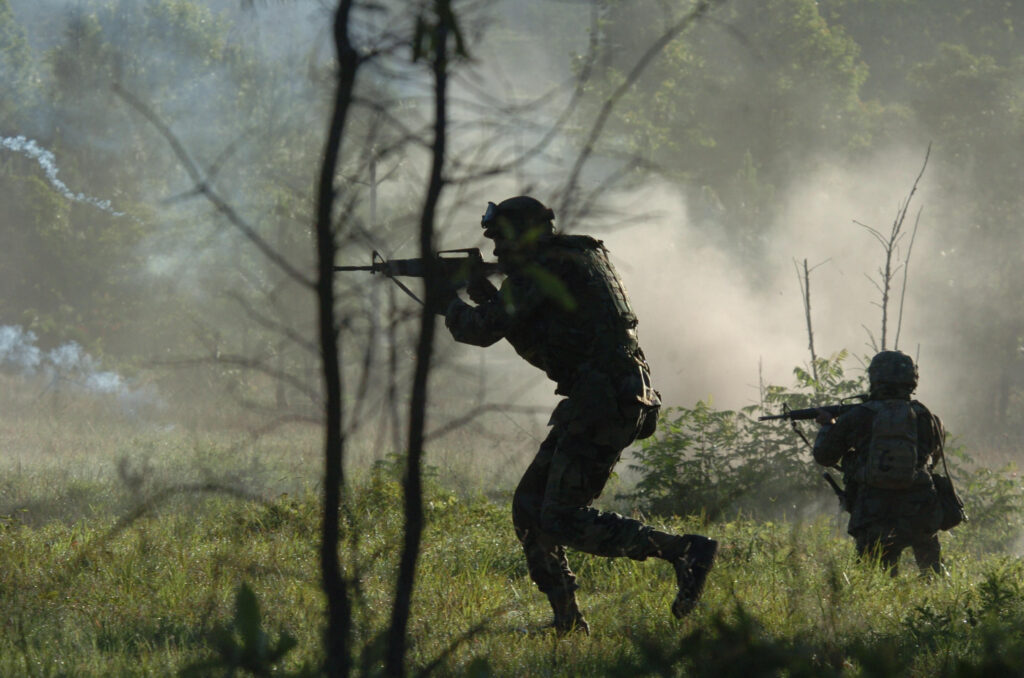
Beijing’s military advance into Bhutan-claimed territory leaves New Delhi floundering, raising concern over India’s own borders. Operating in the threshold between peace and war, China has pushed its borders far out into international waters in the South China Sea in a way no other power has done elsewhere. Less known is that China is using a similar strategy in the Himalayas to alter facts on the ground — meter by meter — without firing a single shot.The Profession of Arms: A Guide for Young Army Officers
It takes courage, especially for a young officer, to check a man met on the road for not saluting properly or for slovenly appearance, but, every time he does, it adds to his stock of moral courage, and whatever the soldier may say, he has respect for the officer who does pull him up.
Read Document →The Dragon's Teeth: Assessing China's Military Modernization
PLA has focused on modernising its capabilities across all warfare domains to achieve these goals. This includes land, air, and maritime operations, nuclear, space, counter-space, electronic warfare and cyberspace operations, aiming to become a fully integrated joint force.
Read Document →Transforming the PLA: A Decade of reorganisation from SSF to ISF
PRC has engaged in a sustained and broad effort to transform the PLA from an infantry-heavy, low-technology, ground forces-centric military into a high-technology, networked force with an increasing emphasis on joint operations and naval and air power projection.
Read Document →Eyes without Borders: Exploring the World of Open Source Intelligence (OSINT) in the Digital Age
Open Source Intelligence (OSINT) is gaining prominence with the rise of social media, the digital society and the vast growth of publicly and commercially available information (PAI and CAI).
Read Document →
The PLA’s Developing Cyber Warfare Capabilities and India's Options
Informationised warfare blurs the lines between peacetime and wartime. A nation in the information age cannot wait for the hostilities to break out to collect intelligence, carryout influence operations, develop antisatellite systems or design computer software weapons.
Read Document →
Galwan and After
Why did China did this when he is under tremendous pressure in all fronts, is this China's salami slice tactics being progressed rigorously, what will be new Rules of Engagement, what will be escalatory control mechanism, who has taken this decision, will there be some pressure put by China in India's North-East through insurgency.
Read Document →
India’s Joint Doctrine for Cyberspace Operations: A Critical Review
Chief of Defence Staff (CDS) General Anil Chauhan and Secretary, Department of Military Affairs, formally released declassified versions of the Joint Doctrines for Cyberspace Operations during the Chiefs of Staff Committee meeting in New Delhi.
Read Document →
Know your Enemy General(now Field Marshal) Syed Aseem Munir
Gen SA Munir's position in the hierarchy of Pakistan was not very comfortable. The state of economy, insurgency in Pakhtoonistan and Balochistan, attack on the Jaffar Express, constant protests by supporters of Imran Khan's supporters inside and outside of parliament.
Read Document →
Decoding Operation SINDOOR: Key Aspects and Implications
Precision strikes were carried out on nine sites—four in Pakistan and five in PoK—linked to anti-India terrorist groups such as the LeT, JeM and the Hizbul Mujahideen. The targeted sites included Muridke (LeT headquarters) and Bahawalpur (JeM headquarters).
Read Document →
Chinese Cyber Exploitation in India's Power Grid - Is There a linkage to Mumbai Power Outage?
The New York Times (NYT), based on analysis by a U.S. based private intelligence firm Recorded Future, reported that a Chinese entity penetrated India’s power grid at multiple load dispatch points. Chinese malware intruded into the control systems that manage electric supply across India, along with a high-voltage transmission substation and a coal-fired power plant
Read Document →19 April 2018
China’s stealth wars in the Himalayas
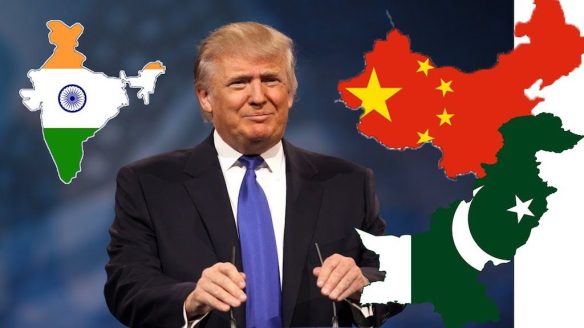
Beijing’s military advance into Bhutan-claimed territory leaves New Delhi floundering, raising concern over India’s own borders. Operating in the threshold between peace and war, China has pushed its borders far out into international waters in the South China Sea in a way no other power has done elsewhere. Less known is that China is using a similar strategy in the Himalayas to alter facts on the ground — meter by meter — without firing a single shot.The violently peaceful struggle for Tibet
Many years later, as he faced how the Dalai Lama became a political inconvenience for an increasing number of world leaders, the former emissary of the Dalai Lama, Gelek Rinpoche was to remember those distant afternoons when the poet Allen Ginsberg, the composer Philip Glass, the author Robert Thurman and the actor Richard Gere jointly planned fully-booked glamorous events for his Buddhist Jewel Heart organizations based in Ann Arbor, Chicago, and New York. At that time, the end of the Cold War was so recent that many notions lacked names, and in order to describe them, it was necessary to invent.India’s grand illusion of a ‘reset’ with China
The power corridors in New Delhi are abuzz with the prospects of a “reset” of India-China ties. It started with a missive from foreign secretary Vijay Gokhale on 22 February discouraging government functionaries from attending events organized by the Tibetan government in exile. A number of high-level visits have since taken place. Chinese foreign minister Wang Yi came to India in early March and Indian national security adviser Ajit Doval visited China last week. And there have been reports suggesting that India did not intervene in the Maldives despite grave provocation from the Abdulla Yameen government in deference to Chinese sensitivities.America’s Pakistan Problem
Debt-ridden Pakistan is very vulnerable to Western sanctions, yet it is unclear whether US President Donald Trump’s administration is willing to squeeze it financially in a way that could help reform its behaviour. Washington also seems reluctant to strip Pakistan of its status as a Major Non-NATO Ally (MNNA) or target its military for rearing transnational terrorists. The main driver of Pakistan’s nexus with terrorists is its powerful military, whose generals hold decisive power and dictate terms to a largely impotent government. With the military’s rogue Inter-Services Intelligence (ISI) rearing terrorists, Pakistan has long played a double game, pretending to be America’s ally while aiding its most deadly foes that have killed or maimed thousands of US soldiers in Afghanistan. Pakistani forces only target terrorists that fall out of line or threaten Pakistan itself.The West Is Wrong About China’s President
The billion-dollar, Alibaba-backed AI company that’s quietly watching people in China
If a person goes shopping at Suning, one of China’s largest electronics retailers, it’s possible that a camera in the store is tracking her behavior using SenseTime’s software. Later, if she opens Rong360, a peer-to-peer lending app, she’ll be asked to login using facial recognition—powered by SenseTime. She might send a video of herself to her friends on SNOW, a Snapchat-esque chat app, donning animated sunglasses built by SenseTime. And if she finds herself approached by police officers in the subway, it’s possible SenseTime helped identify her.U.S. bans American companies from selling to Chinese phone maker ZTE
The Real Next War in Syria: Iran vs. Israel
SYRIA-ISRAEL BORDER, Golan Heights — Stop me if you’ve heard this one before: Syria is going to explode. I know, you have heard that one before, but this time I mean really explode. Because the U.S., British and French attack on Syria to punish its regime for its vile use of chemical weapons — and Russia’s vow to respond — is actually just the second-most dangerous confrontation unfolding in that country. Even more dangerous is that Israel and Iran, at the exact same time, seem to be heading for a High Noon shootout in Syria over Iran’s attempts to turn Syria into a forward air base against Israel, something Israel is vowing to never let happen. This is not mere speculation. In the past few weeks — for the first time ever — Israel and Iran have begun quietly trading blows directly, not through proxies, in Syria.U.S. Seeks Arab Force and Funding for Syria
Russian military capabilities in event of Western strike on Syria
Relationships Between Highly Asymmetric Nuclear Powers
The West Rebukes Russia in Syria
The Future of the United States and Europe: An Irreplaceable Partnership
It Takes More Than Money to Make a Marshall Plan
The Marshall Plan, the historic U.S. aid initiative to speed western Europe’s recovery after World War II, is rightly legendary for its vision and accomplishments. The $13.2 billion the United States dedicated to the Plan from 1948 to 1952 would be worth a substantial $135 billion in today’s money. Although it is widely understood that the United States spent enormous sums fighting the recent wars in Afghanistan and Iraq, it is much less well known how much was spent on reconstruction. Through 2017, the total was $208 billion, in today’s dollars. This is over 50% more than the totality of Marshall aid, in today’s dollars. Yet the United States has tragically little to show for it.Alone in the desert? How France can lead Europe in the Middle East
The Other North Korea Question: How Important is the Korean Peninsula to the US?
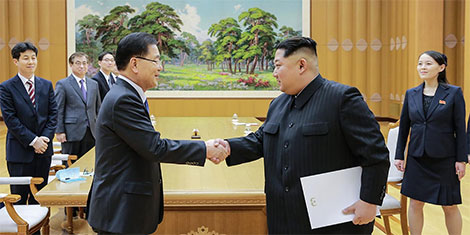
America’s leadership in the Asia Pacific was founded in the ashes of Hiroshima and Nagasaki, and on its status as the first atomic power. Nuclear weapons thereafter defined Asian geopolitics. Today, on the Korean Peninsula, nuclear technology is again set to feature in a dramatic shift in Asia’s power balance. With a summit meeting between President Trump and North Korean leader Kim Jong Un now in prospect, future historians may come to see North Korea’s nuclear-armed ballistic missiles as the trigger that unravels America’s strategic leadership of Asia.Orbรกn 3.0: What to expect next
The Global Battle for Digital Trade
Cyber Command has a role, but Pentagon leaders struggle to define it
What the Hoover Dam shows about hardening critical infrastructure
Cybersecurity is often discussed in terms of mission-critical information in far-off databases or personal information stored on handheld devices, but what about the cybersecurity of bridges, power plants and dams? Securing old-school infrastructure against cyber attacks is critical now that they rely on digital interfacing for day-to-day operations, experts and government officials say. Power plants, drinking water facilities and even oil pipelines rely on strong cybersecurity to prevent service outages. While experts say the U.S. has never had a significant incident as a result of a cyber breach at one of these facilities, the repercussions of a successful attack could range from merely inconvenient to deadly.Where Users' Facebook Data May Have Been Compromised
How can international law regulate autonomous weapons?
Two Decades of War Have Eroded the Morale of America’s Troops
If the courage of young men and women in battle truly does depend on the nature and quality of our civic society, we should be very worried. South of Fallujah’s Route Fran were hundreds of insurgents who’d spent months digging trench lines, emplacing roadside bombs, barricading streets, training with their weapons, reading the Koran, and watching videos of suicide bombers to inspire them for the fight to come. North of Route Fran were the roughly 1,000 men of 1st Battalion, 8th Marine Regiment, preparing themselves for the assault. Route Fran itself was a wide, four-lane highway. On November 9, 2004, the highway was wet—it’d rained the previous day—and the sky was gray and foreboding.Pentagon, Intel Agencies Set Up New AI Joint Office
WASHINGTON: The Pentagon will submit a report to Congress this summer outlining plans for a new office to lead the military and intel agencies’ work developing and acquiring artificial intelligence tools, a high priority for the national security wing of the federal government alarmed at the huge leaps China is making in the field. Michael Griffin, the Pentagon’s research and engineering chief, told a crowd at the Hudson Institute on Friday that his office is still hammering out the details, but the Joint Artificial Intelligence Center (JAIC) will tie together the military’s efforts with those of the Intelligence Community, allowing them to combine efforts in a breakneck push to move government’s AI initiatives forward.Stop Wasting Infantry’s Time: Mattis Task Force
“All too often when we bring things up inside the Beltway, it immediately devolves to material and programs and technology," said Scales. "What we hope comes out of this is not just new machines but new ways of thinking about warfare at the tactical level.” Infantry training at the Joint Readiness Training Center, Fort Polk, La. ARLINGTON: Finding $2.4 billion for new infantry equipment was just the start for Defense Secretary Jim Mattis’s Close Combat Lethality Task Force. Now they’re taking on the hard part:getting the military to stop wasting the troops’ time.