8 January 2015

A Nuclear Nightmare: If China and Japan Went to War

January 5, 2015 

Nothing so clearly signals Australia’s involvement in a more strategically competitive Asia as the writings of Australia’s leading strategic academics. In quieter times, our academics focused on the meaning of self-reliance, or the durability of American power in the Asia–Pacific. Gradually, China’s rise made its way onto the agenda. And by late last year academics were busily writing papers about whether intra-Asian conflict scenarios in North Asia might see Australia drawn in.

In a paper published by the Strategic and Defence Studies Centre at ANU, Rob Ayson and Des Ball outlined their concerns about possible escalation scenarios in North Asia. Their scenarios turn essentially upon a set of judgments that a minor armed clash between China and Japan could readily escalate; that the Americans would be drawn in quite quickly; and that China might be attracted towards early options for nuclear weapons use. Because of that possible progression, Rob and Des set out some guidance for Australian policy-makers that emphasizes the need to encourage both Japanese and Chinese counterparts to believe that they share common interests, and not merely competitive ones. Moreover, they caution that “any ideas of supporting Japan and/or the United States in a small North Asian conflict could involve Canberra in a catastrophically escalating war.”

The authors portray the US-Japan security alliance as reassuring in one context, but worrying in another. During peacetime, the alliance is “a barrier to war in Asia;” but during wartime it’s “fuel for [a Japan–China] conflict’s further intensification.” In particular they worry that US entry into the conflict would increase the possibility of that escalation having a nuclear dimension, even if the US itself remains committed to a conventional exchange.

I buy a limited version of this argument. Yes, a minor armed clash between the two regional powers is possible: not likely, I think, but possible. And yes, that clash might escalate—albeit not in an open-ended way. Yes, the Americans probably would be drawn in, because President Obama has said that the Senkakus are covered by the US-Japan alliance, and that’s the most likely trigger point. So far, so good. But that final judgment is especially alarming. It’s hard to see how a Chinese strategic planner might convince Xi Jinping that it’d be a good idea to cross the nuclear threshold in such a case.

Full of Gas, Full of Problems: The Eastern Mediterranean's Hydrocarbon Showdown


The discovery of natural gas is exacerbating tensions among various players in the Eastern Mediterranean. Is there a viable path forward where all can benefit? 

In October of last year, Russia, Israel and Cyprus conducted a joint naval exercise in waters of the Eastern Mediterranean. Though scheduled well in advance, the timing of the drill could not have been more opportune for Cyprus; the Barbaros, a Turkish seismic vessel dispatched by Ankara in order to survey the sea floor for hydrocarbons, had just entered the bitterly contested Exclusive Economic Zone (EEZ) between the two countries.

The affair triggered a flurry of diplomatic action. Israel called on Turkey to respect Cyprus’ right to explore for natural gas within its maritime boundaries, and Cyprus insisted that the vessel immediately withdraw. Not surprisingly, President Erdogan rebuffed these demands, and avowed that the Barbaroswould remain at sea until a distribution deal was reached for the riches beneath.

This tense affair is representative of the new developments that have caused a shift in traditional regional patterns of enmity and amity between the Eastern Mediterranean’s primary actors: Israel, Egypt, Cyprus, Greece and Turkey, which began with the rapid deterioration in Turkish-Israeli relations after the 2010 Mavi Marmara incident. Despite bilateral attempts (and limited American mediation) for reconciliation, the two countries are still far from realigned. Although Israel has demonstrated the willingness to normalize the relationship, Turkey’s foreign policy seems to systematically exacerbate the problem. Its blatant, emotional and nondiplomatic stance against any Israeli policy toward the Palestinians has left little room for a healthy reconciliation process. Anti-Semitic rhetoric coming out of the pro-AKP media has only made matters worse.

Another development was the collapse of Turkish-Egyptian relations, following the Egyptian military’s ouster of President Mohammed Morsi. For the AKP, which felt a political and ideological bond with the Muslim Brotherhood, the Egyptian military’s coup brought back painful memories of historical events in Turkey. As a result, Turkey adopted a contentious stance toward Egypt’s new president, General Abdel Fattah al-Sisi, leading to a severing of diplomatic ties.

U.S. Weighs Armor, Anti-Sniper Upgrades for Iraq’s Army Tanks

By Tony Capaccio 
Jan 5, 2015

An Iraqi M1 Abrams tank roles along the sand at the start of the Lion's Leap Operation,... 

The U.S. Army is considering equipping the Iraqi Army’s M1A1 tanks with upgrades to provide greater protection from land mines and roadside bombs and to add rotating, remotely operated machine guns to attack snipers.

Upgrades to the tanks built by General Dynamics Corp. (GD) also could include belly armor; lightweight reactive armor tiles; improved night-vision sensors made by Waltham, Massachusetts-basedRaytheon Co. (RTN) to provide 360-degree, all-weather views; and mine-clearing blades and rollers, according to an Army survey released in November.

A “counter sniper/anti-material gun mount,” for example, also would contain wide-area spotlights to detect roadside or suicide-bomb vehicles.

Islamic State extremists have captured Iraqi army tanks and anti-armor weapons not made in the U.S., and its fighters are using roadside bombs in northern Iraq to slow Iraqi attacks. Iraqi Prime Minister Haidar al-Abadi last month asked outgoing Defense Secretary Chuck Hagel for additional heavy weapons and air support to defeat Islamic State.

If the improvements are approved by Congress and funded by the Iraqi government, they could be made within 18 month after the first U.S. contractors arrive to install them, Ashley Givens, a U.S. Army spokeswoman, said in an e-mail.

“There is currently no sole-source request for General Dynamics to provide these items or services, so unless Iraq submits a sole-source request, the effort will be” open for competing bids, she said.

The Iraqi army has 140 tanks, with an additional six scheduled for delivery by Dec. 31, she said.

Training Time

5 Ways the US Can Boost its Rebalance to Southeast Asia in 2015

January 06, 2015


One of the central components of the Obama administration’s “pivot” or “rebalance” to the Asia-Pacific has been the increasing emphasis on Southeast Asia as a sub-region – what some officialscall the “rebalance within the rebalance.” While there is broad regional support in Southeast Asia for the administration’s rebalance, there are lingering concerns about its implementation and sustainability.

What, then, can the administration do in 2015 to boost the rebalance to Southeast Asia before people begin to turn their heads to focus on the 2016 U.S. presidential elections? While this could very easily have been a much longer piece, I’ve tried to discipline myself by limiting the list to just five recommendations. Here they are, in no particular order:

1. Conclude the Trans-Pacific Partnership: Starting with the most obvious, the Obama administration needs to conclude the 12-member Trans-Pacific Partnership (TPP) free trade agreement, which currently involves four Southeast Asian countries – Brunei, Malaysia, Singapore and Vietnam – but could potentially include others in the future as well. If history is any guide, passing TPP will require sustained, high-profile attention by the president as well as passage of Trade Promotion Authority by Congress. A completed agreement would no doubt be a huge victory for the United States in the ongoing economic game in the Asia-Pacific, which has a competitive edge to it even if it ideally should not. But more broadly, a finished TPP would be a tangible demonstration that the rebalance is not just military-centric (a regional concern), and a clear signal of Washington’s capacity and willingness to shape the future rules of the road for the region.

2. Adjust to China’s evolving regional strategy: China’s strategy for Southeast Asia – which I argued was outlined pretty clearly as early as October 2013 – essentially advocates strengthening economic engagement to bind ASEAN states closer to it and reducing strategic mistrust to stave off threats to China’s regional leadership. Some of the arrangements subsequently proposed are exclusive and marginalize the United States, while others are calibrated to limit Southeast Asian responses and American involvement. Yet the United States has often been on the back foot in responding to Beijing’s seemingly magnanimous displays of its soft power, such its Asia Infrastructure Investment Bank, or crude demonstrations of its hard power in the South China Sea. A goal of US policy for 2015, as respected China expert Robert Sutter has argued, should not just be to react to moves by Beijing, but to proactively put forth initiatives of its own that build on U.S. strengths and exploit Chinese weaknesses (and there are many).

3. Achieve balance in Myanmar policy: In 2015, the ongoing tug of war between those pushing for greater engagement in Myanmar and those cautioning against moving too quickly amid stalled reform efforts is likely to intensify as the country moves towards elections at the end of the year. In an ideal scenario, the Obama administration and the Republican Congress would successfully balance the need to confront the government in Naypyidaw on legitimate democracy and human rights concerns with the desire to deepen an important relationship. But striking that balance is easier to write about than to actually implement. If democracy icon Aung San Suu Kyi is not allowed to participate in the election, or if there is significant backsliding on key indicators of progress, such as constitutional reform, the peace process, or the Rohingya issue, we could see growing fissures in U.S. policy between the executive and legislative branches and a potentially deteriorating U.S.-Myanmar relationship.

Why 2015 Will Make or Break a Spate of Global Alliances

January 5, 2015


Last January this column nominated 2014 as “the Year of Political Economy,” and it proved to be so in spades. Greece’s latest confrontation with the European Union and the prospect of a similar crisis in Italy could hardly make the point any clearer. 

The prevailing theme in 2015 looks different. World leaders find themselves amid a complex series of fragile international relationships. Some of these are troublesome, some potentially costly for Americans, others run to dangerous. A few were inevitably going to be difficult, some could have been better managed, and the only word for one or two is bungled. 

There are more of these than a column can cover, but all will advance toward resolution this year. So let’s call this “the Year of Tenuous Ties.” Oxygen masks will drop when needed. 

Maybe no one in the White House could do much better than President Obama on the foreign side, given that the U.S. is midway in a fundamental shift in its global role. But an emerging reality a year ago is now starkly plain: Obama’s (1) inexperience in foreign affairs and (2) middling interest in them have landed America in pickles the match of any during the Cold War decades. 

This administration has set various goals—Mideast peace, a nuclear deal with Iran, now the opening to Cuba—to stand as a legacy success. But none of these is half as consequential as Washington’s relations with Moscow, and as 2015 gets under way these could hardly be worse. 

Whether Obama likes it or not, and he probably doesn’t, the U.S.-Russia relationship will be his lasting mark. America is strong enough to corner the Russians, fine. Is this administration smart enough to recognize that doing so is a very bad idea? 

The Fog of War Just Got Thicker: U.S. Warplanes Have Trouble Communicating with Each Other

January 6, 2015 

Even after years of war, America’s armed services field incompatible aviation technology that hinders battlefield communication between the Air Force, Navy and Marine Corps combat aircraft.

Even after over a decade of war in Iraq and Afghanistan, America’s armed services field incompatible aviation technology that hinders battlefield communication between U.S. Air Force, Navy and Marine Corps combat aircraft. The Pentagon is making an effort to fix the problem, but whether it will succeed is an open question.

The problem is the Link-16 datalink that is supposed to be standard across the North Atlantic Treaty Organization (NATO). However, while standardization is the aspiration, real-world execution falls short.

“Link-16 grew up as a kludge of different user inputs, which is how we ended up with a bunch of incompatible message sets,” said one senior Air Force official. “Fixing it would drive big OFP [operational flight program] bills to all the user platforms to change their implementations, so it'll probably stay the way it is for quite a while.”

One example of where integration between the Navy and the Air Force falls short is in suppressing or destroying enemy air defenses. That mission will only grow more important as the United States tries to extract itself from the wars in the Middle East and refocus on the Pacific theater, where countries such as Russia and China possess extremely formidable air defenses.

While the current integration effort between the Air Force’s Lockheed Martin F-16CM Fighting Falcon and the Navy’s Boeing EA-18G Growler electronic attack aircraft is quite good, this is mostly because air-crew training overcomes hardware limitations.

“EA-18G and F-16CM integration is awesome, but not nearly as awesome as it could be,” said another Air Force official. “They use different Link-16 messages, and therefore pass widely different information to one another. But if they were a part of the same family, they would be using the same requirement for sharing information, and that would improve their already impressive performance.”

ASH CARTER AND THE ROLLING STONES RULE OF LEADERSHIP

January 5, 2015


In 2015, the Department of Defense will have a new secretary. Assuming a successful confirmation process, Dr. Ash Carter will be taking that position. He will face a multitude of immediate challenges, some old and some new. Given his extensive background and experience, Dr. Carter will likely bring some ideas with him about how the department can be improved. As he plans his tenure, however, Dr. Carter might want to consider how his priorities will be affected by the realities of time and circumstance.

In the time that he will be Secretary of Defense, Dr. Carter might consider what I call the Rolling Stones Rule of Leadership. As Mick Jagger and Keith Richards have noted, “you can’t always get what you want, but if you try sometimes, you just might find you get what you need.” Paraphrasing this counsel, the Rolling Stones Rule of Leadership is, “you can’t always do what you want, but if you try sometimes, you can still do something important.”

This rule is a recognition that what you want to do is unavoidably affected by what you can do. In a perfect world, a leader’s only limitations are that there are only twenty-four hours in a day and that a person cannot be two places at the same time. Yet because we do not live in a perfect world, having the desire and ability to affect change are not always enough to overcome the reality of the context in which leaders find themselves. This concept can be further distilled into the consideration of three basic tenets: priorities, time, and circumstance.

Priorities are necessary for any leader, but achieving significant change is not just a matter of refining priorities. As in all aspects of life, good intentions are not enough, which is the difference between having a “to do” list and actually getting things done. While refining priorities is a necessary aspect of achieving change, it is not sufficient.

Reality dictates that all leaders are bound by the tyranny of time, particularly leaders of federal agencies. Steve Jobs, Jack Welch, and Bill Gates had decades at the top of their organizations, but this is not the case for a leader of a federal agency whose average time in charge is just over three years. Dr. Carter’s biggest national security challenges, such as implementing a new strategy in the Asia-Pacific region and dealing with a belligerent Vladimir Putin, will likely far outlast his tenure, and for these, Dr. Carter will succeed by helping to set a solid foundation on which his successors can build.

Africa in 2015: A New Year’s Guide

SIMON ALLISON 
05 JAN 2015


News and politics rest for no man, not even weary journalists or the birth of the Lord Jesus Christ, and while millions of Africans were celebrating the festive season, the continent continued on its merry way. If you were lucky enough to switch off the outside world for a week or two, here’s a round-up of what’s been making headlines to ensure you don’t start the new year on the back foot – and a peek at what’s waiting for Africa in 2015. By SIMON ALLISON.

Thank god that’s over. Despite the Daily Maverick’s valiant attempts to look on the bright side, 2014 was not a great year for Africa. For this, special thanks must go to Ebola, Boko Haram, and South Sudan’s egomaniacal leaders, which together (among plenty of other culprits) conspired to undo decades of good progress in regions that desperately need it.

But that’s all behind us now. It’s a new year, and a new dawn beckons. Surely, surely, we can do better.

Already, there’s been some good news. On 1 January, Egyptian authoritiesgranted a retrial to jailed Al Jazeera journalists Peter Greste and Mohamed Fadel Fahmy and Baher Mohamed, all of whom were jailed a year ago on spurious charges. The new trial should be fairer than the last, if only because the bar is not high: the prosecution’s “evidence” consisted largely of Greste’s family photographs and seemingly unrelated YouTube clips. There’s also an off chance that Greste and Fahmy, as foreign nationals, could be deported before the new trial begins.

There’s also new optimism on the Ebola front. The current epidemic, which has already taken more than 8,000 lives and counting, will be over by the end of 2015. This isn’t our prediction, but comes from someone who should know. “We are engaged in an epic battle,” said Anthony Banbury, head of the UN team fighting the epidemic. “Going forward it's going to be extremely hard for us to bring it down to zero [cases], but that is what we will do. I believe we will end Ebola in 2015.”

Will 2015 be the Year of the Second Falklands War?

01.05.2015

In 1982, Argentina, beset by its own economic woes and looking for a way to rally its people around the flag, launched a surprise attack on the Falkland Islands, a British crown colony since 1840 and occupied sporadically by British forces fordecades before. The invasion caught the British—and the world—bysurprise. Great Britain, which once controlled an empire upon which the sun never set and which once controlled the high seas, was caught flatfooted. Domestic entitlements had eroded Britain’s military budget for years, as did a false sense of security that the age of outright military aggression had ended. In short, British policymakers had allowed their military power to decline precipitously. The British military had to lease Cunard cruise line’s Queen Elizabeth II to transport troops to the islands. In the end, the British reconquered the islands, but took far greater casualties than it would have had it been militarily prepared. Then again, had the Argentine junta believed Britain was more than a paper tiger, it likely would not have invaded the Falklands in the first place.

Fast forward more than three decades. British military strength is now at a nadir, lower than it has been in decades if not centuries relative to the rest of the world. Meanwhile, Argentina is once again in a morass of its own making. The Argentine economy is again in the dumps; it defaulted on its loans last year for the second time in just 13 years, and the rich are fleeing the country.

Argentine President Cristina Fernรกndez de Kirchner has responded Hugo Chavez-style, by voicing outlandish plots that go from the ridiculous to the sublime. While Kirchner is term limited, there are ways around such legal obstacles when presidents put ego above the law. At the very least, Kirchner has been maneuvering to place her son in the presidency, continuing the family dynasty that started with Nรฉstor Carlos Kirchner, her late husband, in 2003.

Through it all, the Argentine government has begun making noises again with regard to its claim that the Falkland Islands, which it calls the Islas Malvinas, should return to it by any means necessary. In 2013, rhetoric in Argentina again reached a fever pitch. During the 1982 crisis, the Reagan administration briefly considered neutrality before siding with its British allies. In 2015, Argentina would be right to question whether there is any such resolve in the White House. President Obama has used (or tried to use) the Argentine name for the islands. Kirchner has interpreted Obama’s about-face on Cuba as evidence that such a reversal could be in store for the Falklands. “If the Yankees took 53 years to say that Fidel Castro is right, how would they not sit down to discuss something that everyone is calling for,” she asked. Add to this the New York Times, which uses its space to sponsor debates about whether to accede or compromise with Argentina’s demands. Regardless, even if Obama were to give his firmest red line against Argentine military adventurism, it is doubtful anyone in Argentina or back in America would believe him.

Then, of course, there is also oil and gas. There has long been suspicion that the Falklands sat above and in the midst of tremendous oil and gas reserves. No longer is this simply suspicion. The decline in the price of oil makes Falkland energy less economical to exploit, but what goes down does rise up and a desperate Argentina might do anything.

Is it likely that Argentina will again play the aggressor? No, but then again most everyone agreed it unlikely that Argentina would invade the first time in 1982 or that Iraq would invade Kuwait in 1990, or that Russia would invade Ukraine in 2014. The point is that the British navy has never been weaker, the United States doesn’t have its ally’s back, and weakness invites aggression whereas populism often invites it. What once seemed impossible is now in the realm of the possibility.

Cyber War, Free Speech, and National Security

By Jongsoo Lee
January 06, 2015


The recent hacking of Sony, allegedly perpetrated by North Korea, and its aftermath raise salient issues about the tension between free speech and national security in the new troubling era of cyber warfare. These issues should engender a debate about how this tension can resolved so as to protect free speech while forestalling a cyber Armageddon.

What is not in dispute, in a free society such as the U.S., is a film studio’s right to exercise its freedom of speech. Rather, the issue is the impact the exercise of this right can have on national security and what U.S. society as a whole should decide about the importance of protecting this right while also protecting U.S. national security.

What was troubling about the Sony hacking was how Sony’s provocation of North Korea with the planned release of The Interview had the net effect of forcing the U.S. government into a position of having to defend Sony’s right to release the film so as to forestall the impression that the U.S. as a nation had capitulated to foreign cyber terror and blackmail. Thus, what started as a private movie studio’s action and subsequent cyber attack on a private business escalated, in effect, into a cyber attack on the U.S. national security with the U.S. president weighing in on the matter and vowing to retaliate.

Unquestionably, Sony had the right of free speech to make a movie featuring the assassination of the sitting sovereign of a foreign state, though some may object to such a film. Rather, what is of import here is whether Sony’s exercise of this right was in the best interests of the U.S. national security. Although many in the U.S. make fun of and mock Kim Jong-un as if he were a “Dr. Evil” from the Austin Powers film franchise, the fact is that North Korea is a nuclear power with a significant and growing cyber attack capability. Pyongyang has been developing nuclear-tipped ICBMs and SLBMs that can reach the U.S. mainland and, according to some analysts, already possesses the ability to launch an EMP attack that can paralyze the US national power grid. In provoking Pyongyang, a fiercely nationalistic regime centered on the worship of the Kim dynasty, which, in all likelihood, is secretly paranoid about a U.S. attempt to force regime change through assassinating Kim Jong-un, Sony took on a potential risk of inviting a North Korean cyber reprisal without adequately shoring up its own shaky cyber defenses. In the resulting fallout, for which Sony was unprepared, the U.S. as a nation suffered a setback as Sony’s decision to cancel the film’s release was seen around the world as a U.S. national capitulation to foreign cyber terror and blackmail.

The U.S. Military's Next Big Reform Challenge is Here

January 5, 2015 


The Chief of Naval Personnel, Vice Admiral William Moran, visited the Council on Foreign Relations (CFR) last month to discuss his vision for reforming the current manpower system. Since assuming his position in 2013, VADM Moran has been pushing hard to implement programs that will better align the Navy’s manpower policies with the expectations and aspirations of its younger sailors—especially millennials, those individuals born between 1980 and the mid-2000s.

VADM Moran’s efforts come at a time when there is a growing awareness across the military that the services need to think hard about how to build more flexibility into the careers of service members than exists today. Manpower reform has become a high profile topic for defense commentators, prompting opinion pieces published by this and other military blogs, an essay contestsponsored by Tom Ricks, and a book by entrepreneur and Air Force veteran Tim Kane.

The reformers’ central argument—one that VADM Moran made during his talk—is that the management system created in 1947 to serve a draft military is falling behind the demands of the 21st century all-volunteer force. Critics cite problems throughout the services, including: lockstep promotions based almost entirely on a person’s time in service; an outdated method of matching personnel with assignments that does not sufficiently take into account individual preferences, special skills, or unique experiences; and narrowly defined career trajectories. Taken together, these issues are manifested in a manpower system that is inefficient, inflexible, andmay be struggling to retain the best and brightest service members.

Some of the current shortcomings were highlighted in two recent studiesconducted by Commander Guy M. Snodgrass, an F/A-18 pilot and former TOP GUN instructor who has become one of the most influential manpower reform advocates currently serving. In “Keep a Weather Eye on the Horizon,” CDR Snodgrass showed how a number of factors, including the Navy’s antiquated personnel system, are combining to push out some of its best mid-level officers–along with their decades of wartime experience. A follow-on survey of over 5,000 officers and sailors echoed CDR Snodgrass’s earlier findings and included a recommendation that “greater career path diversity will provide opportunities for talented sailors to accept challenging or desirable positions, increasing overall career satisfaction.”

AN OPEN LETTER ABOUT A DECISION EVERY JUNIOR OFFICER HAS TO MAKE

January 6, 2015

Anyone who has ever served in the military has inevitably been asked the question, “why did you join?” The normal responses include “because I wanted to serve my country;” “because I wanted to be a part of something greater than myself;” “because I needed money for college;” “to see the world…” Although I can identify with some, if not all, of these answers, I have had trouble answering the question for myself. I suppose I could validate my decision to join the Army with some deep intrinsic “call to service” that motivates me, but sometimes I still have trouble rationalizing that concept in my own mind. I am now faced with deciding to continue my service to the United States military or to start something new.

Almost nine years ago, as a confused high school senior, I was conducting a college visit when I came across a table for the Reserve Officer Training Corps (ROTC). Someone behind the table asked me if I had ever thought about joining ROTC. Not knowing anything about what it was, I promptly answered, “No thanks.”

My father brought it up later and I realized I had no better idea or plan, so I decided to see what it was about. I learned that ROTC would pay me to go to college for four years and then guarantee me a full-time job as an Army officer upon graduation. Needless to say, that offer didn’t seem like a bad one. Long story short, four years later I was handed a bachelor’s degree and had a couple of gold bars pinned to my shoulders as a newly commissioned second lieutenant. This accomplishment was the proudest moment in my life.

Throughout the Army officer accessions process there are numerous opportunities to incur Additional Service Obligations (ADSO). Essentially, this means adding time to a military contract in order to get a certain, job, school, post, etc. I was not keen on binding myself to additional service in an organization that I hadn’t even spent one day formally serving in. I know fellow ROTC graduates that, on their first day in the U.S. Army were signed up to serve ten or more years. I wanted to have the ability to walk away after my four years were up; it’s been 3 years and 6 months.

According to the Army Regulation for Officer Transfers and Discharges, if you would like to request a Release from Active Duty (REFRAD), you should do so between six and 12 months before the date you would like to exit the Army. It’s down to the wire, but I could turn my REFRAD packet in today. Six months from now, I could take my uniform off for the last time. The decision that I am faced with is the same as that of thousands of other junior officers that have completed their initial active duty obligation. I am no special case. I just figured that writing down some of my thoughts would help stimulate a better informed decision.

The past almost eight years of my life in the Army (including ROTC) have provided me with a whirlwind of experiences that I won’t ever forget. Geographically speaking, the Army has taken me to places that I would otherwise have never considered visiting — in Asia, the Middle East, and elsewhere. I will forever be thankful for these opportunities. The amount of practical work experience and the opportunities to lead American soldiers are things that I will always consider a great privilege.

The M-4 Carbine Is Here to Stay

by KYLE MIZOKAMI

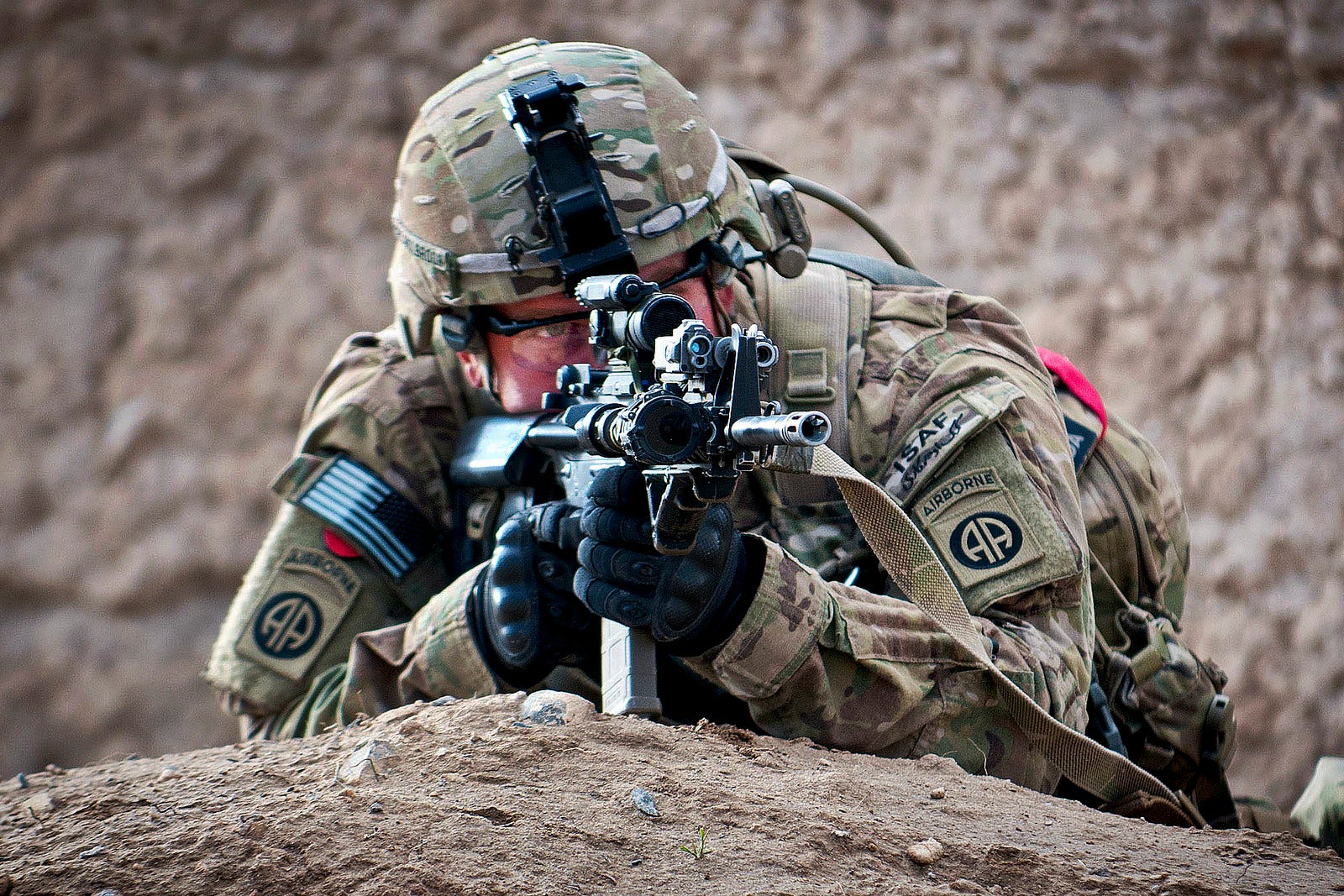
In the January issue of The Atlantic, retired Maj. Gen. Robert Scalesslammed the United States Army’s M-4 carbine, and called for an entirely new weapon in the hands of the modern American soldier.

Scales describes the 2008 Battle of Wanat—when the Taliban attacked a forward outpost defended by American troops—and his own experiences in Vietnam with faulty M-16 rifles.

In both instances, the M-16 and its descendant, the M-4 carbine, failed in battle and cost American lives.

As a historian and combat veteran, Scales makes valid points. His recommendation, that the Army replace the M-4 with a new weapon, is unnecessary. Much like the M-4 Sherman tank of World War II, the M-4 carbine is a compromise driven by the Army’s global responsibilities.

The M-4 carbine’s future replacement isn’t a new weapon.

The replacement for the M-4 carbine is an upgraded M-4 carbine.

Scales recites the long and tortured history of the AR-15 and M-16 series of rifles, of which the M-4 is a shorter, more compact version. Among other features, the M-4 features a shorter barrel for easier handling in tight spaces, such as inside vehicles and urban environments.

He cites a change in the gunpowder sent with the original M-16 during the Vietnam War as the cause of frequent jamming. Thin barrels also made the M-4 carbine prone to overheating in Afghanistan, particularly during the Battle of Wanat, in which several M-4s became unusable.

In the past, Scales has described the M-4 as “virtually useless” against enemies wearing body armor.

Finally, Scales faults the basic design of the M-16 family. Gas from the gunpowder explosion circulates back into the rifle, which cycles the weapon. But this also injects residue into the guts of the rifle, fouling the weapon at critical moments.

Scales also cites the need for a rifle that can shoot further—to improve an infantryman’s ability to engage the enemy at long ranges.

Such a weapon will need a heavier bullet and longer barrel. The rifle should also have a different operating system, ideally one in which gases push a piston that cycles the weapon, keeping most gunpowder residue out of the rifle’s internals.

Scales even suggests adding a ballistic computer to the rifle—to aid in long-distance aiming.

U.S. and Russian Militaries Have Returned to Gung Ho Cold War Nuclear Rivalry

Julian Borger
January 5, 2014 


A widening rift between Moscow and Washington over cruise missiles and increasingly daring patrols by nuclear-capable Russian submarines threatens to end an era of arms control and bring back a dangerous rivalry between the world’s two dominant nuclear arsenals.

Tensions have been taken to a new level by US threats of retaliatory action for Russian development of a new cruise missile. Washington alleges it violates one of the key arms control treaties of the cold war, and has raised the prospect of redeploying its own cruise missiles in Europe after a 23-year absence.

On Boxing Day, in one of the more visible signs of the unease, the US military launched the first of two experimental “blimps” over Washington. The system, known as JLENS, is designed to detect incoming cruise missiles. The North American Aerospace Command (Norad) did not specify the nature of the threat, but the deployment comes nine months after the Norad commander, General Charles Jacoby, admitted the Pentagon faced “some significant challenges” in countering cruise missiles, referring in particular to the threat of Russian attack submarines.

Those submarines, which have been making forays across the Atlantic, routinely carry nuclear-capable cruise missiles. In the light of aggressive rhetoric from Moscow and the expiry of treaty-based restrictions, there is uncertainty over whether those missiles are now carrying nuclear warheads.

The rise in tension comes at a time when the arms control efforts of the post-cold-war era are losing momentum. The number of strategic nuclear warheads deployed by the US and Russia actually increased last year, and both countries are spending many billions of dollars a year modernising their arsenals. Against the backdrop of the war in Ukraine and a failing economy, Vladimir Putin is putting increasing emphasis on nuclear weapons as guarantors and symbols of Russian influence. In a speech primarily about the Ukrainian conflict last summer, Putin pointedly referred to his country’s nuclear arsenal and declared other countries “should understand it’s best not to mess with us”.

EMPOWER JAWANS TO FIGHT FREELY

06 January 2015

Procurement of hi-tech gadgets for the Army is not enough. The soldier has to be given operational autonomy on the field and must be assured that, as long as he plays by the book, he will be shielded from even the most horrific consequences of his actions

Irrespective of the vigour of the new Defence Minister and an emphasis on Make in India, several developments over the last few months have made clear that the Army modernisation programme, at least, is turning into a train wreck. This is not to say that all is well with the modernisation of the Air Force and the Navy, but just that the Army modernisation programme stands on far shakier ground, with minimal scope for results.

This modernisation effort ostensibly foresees our World War II-style Army morphing into an ultra-flexible ultra-networked force that can act rapidly as opposed to the two-week-long build-up that became Operation Parakram. Much of this is based on acquiring new technologies — night vision goggles, new bull-pup rifles, software-defined radios and the list of such long-winded techno-mumbo-jumbo goes on.

Essentially, it feeds into a concept called the ‘revolution in military affairs’ which saw technology improve the precision targeting of North Atlantic Treaty Organisation countries so significantly, that it eliminated the need for tactical nuclear weapons (which, as simulation after simulation showed, were completely ineffective anyway). The belief in India is that the adoption of these technologies will rectify the massive conventional imbalance that exists between India and China, or worse still, against a China-Pakistan pincer movement.

The problem is that the Nato revolution in military affairs was based on three factors that seem to have completely eluded our leadership. First, rule of law; second, operational autonomy; and third, doctrine and mindset. Rule of law is probably the thorniest question here, given India’s societal norms. As a simple example, has anyone come across a fatal motor accident in India, where someone is not charged and sentenced, unless, like the BMW hit-and-run-case, one has crores of money to bribe witnesses and supposedly bump-off the non-cooperative ones? Another example — the simple measure of guilt on Delhi roads is that the fault in an accident (irrespective of who violated the rules) lies with the larger vehicle (unless, of course, you’re blessed with CD plates). The culmination of this dysfunction came a few weeks back, when the Prime Minister, speaking at an election rally, claimed that the Army had finally admitted its mistakes.

French Warships in Doldrums


France signed a contract with Russia in 2011 to build and deliver two warships. Since then, Russia wrested control of Crimea and intervened in Eastern Ukraine. France dearly wanted to complete the deal, but faces intense scrutiny for supplying military hardware and technology to Russia while criticizing actions in Ukraine. “France’s lingering plan to deliver military hardware to Russia while decrying Russian military action is the epitome of hypocrisy,” explains Andreas Kuersten, legal fellow with the Office of General Counsel of the National Oceanic and Atmospheric Administration. He notes that France’s real problem is offsetting costs, including penalties for failing to complete a contract. Kuersten suggests France’s allies could help in finding alternative ports for the warships. Possible buyers could include NATO, the European Union, Canada or Japan. Defense contractors could also be required to overhaul contracts inserting conditions to avoid embarrassing, hypocritical or dangerous deals. – YaleGlobal

As France shelves contract with Russia for two warships, allies could help find new ports for Mistrals

WASHINGTON: Over the past nine months, as Europe was shaken by Russian adventurism, France’s contract to build and deliver two Mistral-class helicopter carriers to Russia underwent from routine to intense scrutiny. The pressure on the French government to scrub the deal, however, could be unfair and even counterproductive. Rather, the United States and European Union should focus on practical solutions to the problem because of the cost incurred by France in building the vessels and possible penalties for breach of contract.

In 2011, France signed the contract with Russia. Three years later, Russia backed Crimean and eastern Ukrainian separatists, annexed Crimea, and now supplies militants in East Ukraine. The West responded with ever-increasing sanctions. France initially stated that this would have no impact on the Mistral deal. As pressure mounted, France offered that it might withhold the second carrier, and then put the contract on hold. France subsequently stated that it would not hand over the completed carrier until Russia met newly imposed conditions: a permanent ceasefire in Ukraine and roadmap for the permanent settlement of the dispute. Russia responded by setting adeadline: the end of November for the first ship’s delivery, or it would initiate legal proceedings. Rebuffing this move, France indefinitely suspended the agreement. 

France’s continued refusal to cancel the contract reveals its struggle to complete it without offending its allies. Yet France’s true warship problem is offsetting costs, not completion of the contract. It cannot supply the Russian military while simultaneously denouncing its actions. In this vein, the US and its allies should take a much more serious and active role in finding alternative destinations for the Mistrals. While it is hypocritical of France to maintain the viability of its warship contract, it is also unfair for the US and others to demand cancellation without concerted efforts to mitigate resulting costs. This situation is made vivid by showing the weakness of every argument for contract completion. 

7 January 2015

The great Game Folio

Written by C Raja Mohan
January 7, 2015 

King Abdullah, 90, has been hospitalised with pneumonia, setting off speculation about the kingdom’s stability.

At a moment when the world is marvelling at the bold Saudi strategy of driving down oil prices — this week they dipped for a moment below $50 a barrel — King Abdullah, 90, has been hospitalised with pneumonia, setting off speculation about the kingdom’s stability and the international consequences of a political transition in Riyadh.

Abdullah acceded to the Saudi throne in 2005, when his half-brother King Fahd passed away. But Abdullah had been the crown prince since 1982 and was in charge of the kingdom during Fahd’s prolonged illness in his final years.

The king of Saudi Arabia is more than a mere monarch. He is the custodian of the Muslim holy places in Mecca and Medina, and exercises great political influence in the Islamic world. Since the fall of Egypt’s Gamal Abdel Nasser in the late 1960s, Saudi Arabia has acquired a decisive influence in shaping the regional order in the Middle East. The kingdom has been a strong ally of the Anglo-Saxon powers and enjoyed great clout in shaping the world economy.

With nearly a fifth of the world’s proven oil reserves and the very low costs of exploiting them, some have described the king of Saudi Arabia as the “custodian of the world’s oil prices”. As has been demonstrated in the last few weeks, Saudi Arabia remains the swing producer that can unilaterally determine the international price of oil.

Unlike in other monarchies, the Saudi succession has moved horizontally from one brother to another among the 40-odd sons that the founder of the kingdom, Abdul Aziz, fathered. Abdullah’s designated crown prince, Salman, is 79 years old; but he is said to be ill. The deputy crown prince Muqrin, the youngest of the second generation, is 69.
Some analysts worry that Abdullah’s death might generate considerable internal jockeying for power in Riyadh.

Of conflicts, confrontation, currencies and cyber war

GJonathan Eyal
The Statesman
07 Jan 2015

overnment officials invariably plan for the worst, rather than the best. And journalists also have a tendency to look for the negative rather than the positive: It’s always more exciting to report on a country in trouble rather than write articles about places where things are going well.

So, any attempt to identify the major strategic events which will dominate this new year merits a healthy dose of scepticism. Nevertheless, some global political developments are already evident and, sadly, quite a few of these look like taking a turn for the worse.

From Arab spring to Arab storm

The Middle East is one region capable of supplying endless gloom. Five years after the popular uprisings once optimistically dubbed as the Arab Spring, the outcome is an Arab storm. Libya, Syria, Iraq and Yemen are melting down and, together with Lebanon, will spend most of this year just trying to survive.

The omens are not good: too much violence has taken place, too many weapons are circulating and too many militias are fighting each other for any likelihood of a return to the old order. At best, these countries will become loose federations controlled by a variety of warlords.

The chances are high that the Islamic State in Iraq and Syria (ISIS) terrorist organisation - or the Islamic State as it now likes to call itself - will be crushed: ISIS is already unpopular with many of its volunteer fighters and is facing a formidable US-led military coalition. It is also likely that Turkey will enter the fray, delivering a decisive blow against ISIS.

Yet none of this will prevent the old borders of the Middle East from melting down, almost precisely a century after they were traced in bold colour lines on a single sheet of paper by Mark Sykes and Francois Georges-Picot, two colonial officials representing Britain and France, respectively.

On a more positive note, odds are better than even for the conclusion of a deal with Iran over its nuclear weapons. And there is a possibility the general election in Israel, scheduled for March 17, will result in a defeat for Israeli Prime Minister Benjamin Netanyahu, ushering in a new government, more amenable to a dialogue with the Palestinians.

But even if the nuclear standoff between Iran and the West ends, the broader but equally thorny issue of Iran’s influence in the region and its championship of the Shi’ite Muslims against the Sunni majority will remain unanswered. Nor is it evident that there is anyone in the Palestinian camp willing or able to strike a permanent peace deal with Israel, even if an incoming Israeli government is ready for negotiations.

Meanwhile, although the kings of Morocco, Jordan and Saudi Arabia, as well as the sheikhs and emirs of Kuwait, Bahrain, Qatar, the United Arab Emirates and Oman look stable and secure, some of them are affected by infirmity or old age, and most are hurt by the low prices for oil and gas, which seem set to continue for most of 2015.

In short, the Middle East would be lucky to just mark time, to prevent an inherently bad situation from getting worse.

Europe goes back in time

Islamic difference and radicalisation

SUCHITRA VIJAYAN
January 7, 2015

APREPRESSIVE: “The Hindu nationalist discourse rallied around the claim that Muslims threatened Hindus.” Picture shows a man waiting for his turn to be heard by the Nanavati Commission after the Gujarat riots.

The radicalisation discourse in India has overwhelmingly contributed to normalising prejudice and dehumanising an entire community

“Radicalisation” has become the standard term used to describe “what goes on before the bomb goes off.” Radicalisation as a precursor to terrorism, and in certain cases even a root cause of terrorism and socio-political violence, is a mainstay among pundits, policymakers and journalists alike. However, the immense popularity of the concept represents no direct relationship to its actual explanatory power regarding what causes terrorism. Instead, aphorisms on radicalisation have emptied the term of its analytical value, so that the label of “radicalisation,” as concept and as an industry, has become an extremely powerful and destructive political label employed against Muslim communities in India and elsewhere. It allows for the stigmatisation of Muslims, their exclusion from political processes, and for the state and the media to engage in a process of differentiating ‘good Muslims’ from ‘bad Muslims’ — unless proved to be good, every Muslim is considered to be bad.

Judgements are increasingly being passed on entire communities based on acts of individuals; Muslim political identity has become increasingly linked to their religious faith.

The earlier discourse on terrorism focussed on the circumstances, the ideology, the group, and the individual. However, following the September 11, 2001 terror attacks, the term radicalisation privileged the individual and to some extent the ideology, but neglected to investigate the wider historical, social, and geopolitical circumstances. An analytical investigation of the root causes of terror became almost impossible post-9/11 in the face of growing Islamophobia and the rhetoric of ‘us’ and ‘them.’

The discourse reduced radicalisation largely to a sense of Islamic ‘difference.’ Often this ‘difference’ was explained in terms of ‘lack of integration,’ ‘lack of secularism,’ or ‘external Islamic influences’ from Saudi Arabia among Muslim communities. Following the logic of difference, it is still argued that the exploitation of these differences culminates in terrorism, either by passively rationalising violence or by explicitly abetting it.

Historicity of Islam

Where adventure and martyrdom beckon

TALMIZ AHMAD
January 7, 2015

ReutersEFFICACIOUS: “Most Islamic State fighters have been lured by powerful messages through social media.” Picture shows militants taking part in a parade in Syria, celebrating their declaration of an Islamic ‘caliphate’ after they captured territory in Iraq.

In both Afghanistan and Pakistan, a new generation of jihadis is emerging which is far more radical, better educated, and deeply committed to jihad

The tentacles of jihad continue to spread: from its base in the mountains at the Pakistan-Afghanistan border, the al-Qaeda now has centres in the Arabian Peninsula, the Horn of Africa, and then westwards — Algeria and Libya in the north and Mali and Nigeria in the south. The Islamic State (IS) is firmly established in the Arab heartland across Iraq and Syria; in the Syrian conflict, it is competing with the al-Qaeda-affiliated Jabhat Nusra for territory and supporters.

None of these transnational groups seems to have any difficulty in mobilising cadres to take up arms and perpetrating horrendous acts of violence against enemy soldiers, western hostages and ordinary civilians — acts which are broadcast on social media or elsewhere as a warning or an enticement to join the cause.

To participate in this violence, several thousand foreign jihadis have joined these groups. The cadres consist of three types of members: Muslim youth from across the Arab world and some Asian countries; second-generation Arab migrants from western countries, and non-Muslims or recent converts from Europe, the U.S., Australia and even New Zealand.

Lure of jihad