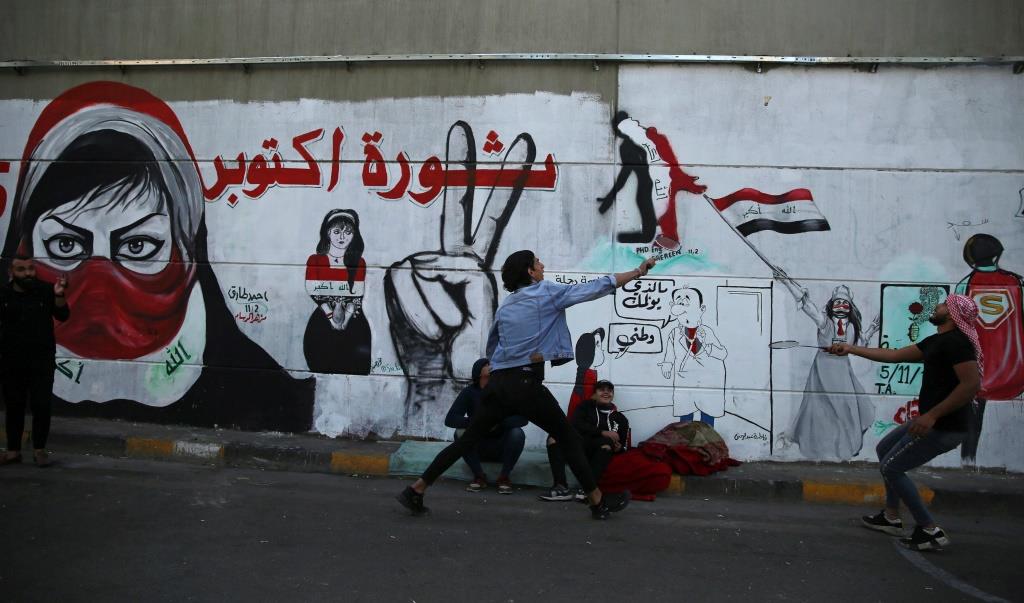
 The ongoing protests across Iraq and Lebanon have invited references to a second Arab Spring, nearly nine years after a young Tunisian man set himself on fire and triggered a region-wide upheaval. The unrest comes on the heels of protests in Egypt and Jordan earlier this fall, a mass mobilization in Sudan this year, and a protest movement in Algeria that has endured since February. Recently, mass demonstrations have also broken out across Iran, suggesting the current wave may not remain confined to the Arab Middle East. Each of these episodes has been triggered by local, discrete events. But collectively, they reflect a broader struggle underway in the region on two fronts: within each country, between the public and the political leadership over the basic contours of the social contract underpinning these societies; and between various camps wishing to see a regional order that will reflect their preferences on such core issues as Iran’s presence across the Middle East, the integrity of territorial states, relations with the West, sectarianism, and democracy. It remains too soon to tell where the current unrest is headed, but as in 2011, both the regimes’ responses, and the degree to which the protesters manage to translate their demands into actionable policies, will likely prove decisive.With the exception of Jordan’s teachers’ strike in September, which concerned the relatively circumscribed matter of low salaries, the protests rocking the Middle East in recent months have set their sights far beyond a single issue or piece of legislation. These protests have an “anti-system” quality to them, demanding not simply the dismissal of a ruling elite but the wholesale dismantlement of the governing structures and economic systems that have nurtured that elite. Even in instances where the proximate trigger of the protests was a single policy move – for example, the decision of Algeria’s Bouteflika to run for re-election in February, or the dismissal of Iraq’s popular counter-terrorism chief in September, or a tax on WhatsApp calls in Lebanon in October, or the hike in gasoline prices in Iran – the initial provocation quickly receded in importance (and in some cases was reversed anyway) as the protests morphed into larger movements demanding systemic change.
Fueling this demand is widespread frustration with the region’s endemic problems of unemployment and corruption, the dismal provision of government services, over-reliance on income from hydrocarbons or external aid, and a toxic politicization of identity. Perhaps because few segments of these societies have been spared the effects of these structural problems, the current protests have attracted a broad-based amalgam of citizens. The marchers in Algiers since February, and in Cairo in September, and more recently in Baghdad and Beirut, cannot be tagged easily as members of a particular social class or age cohort or even religious sect. And, crucially, they have been joined by their peers in various population centers beyond the capitals.
Moreover, the Algerian, Iraqi, and Lebanese protest movements have transcended the ethnic and sectarian cleavages characterizing these populations, invoking nationalist tropes to insist on a common identity. In the Berber-speaking regions of Algeria, no less than the Arab cities and towns, a common chant has been, “No Berbers, no Arabs, no ethnicity, no religion! We are all Algerians!” In Iraq and Lebanon, the political and legal systems were ostensibly designed to mitigate the most damaging effects of sectarian cleavages, which had propped up a decades-old system of despotic minority rule in the former and fueled a fifteen-year old civil war in the latter. But protesters today are conveying that these arrangements have run their course, demanding an end to the sectarianism embedded in their political systems and castigating leaders from their own sects for exacerbating the very tensions these systems were arguably designed to reduce.
2019 vs. 2011
It would be tempting to interpret the current wave of protests as simply “Round 2” of the 2011 uprisings, but the similarities and differences suggest more of an upgrading than a replay of the Arab Spring, with key lessons learned in the interim by both the protesters and the surviving regimes. As in the 2011 wave, today’s protest movements remain largely leaderless and the masses of citizens taking to the streets have mostly focused on articulating what they oppose rather than on outlining a concrete vision or plan for change. The insistence on maintaining this oppositional rhetoric likely stems from the assessment that protesters in 2011 were too quick to accept their leaders’ proposed compromises. On the other hand the leaderless nature of the movements may ultimately work against the protesters to the extent it precludes a clear roadmap out of the impasse.
In contrast to 2011, there is a near total absence of calls for democracy in today’s protests. This likely reflects the protesters’ efforts to avoid the disappointments of 2011. With the exception of Tunisia, the revolts nine years ago did not generate any serious political liberalization in the region, and the current focus on issues like corruption and service provision suggests protesters are prioritizing improvements in day-to-day living conditions over grander ideological goals. Ironically, in Lebanon and Iraq, the lack of overt references to democracy may reflect an assumption that these states already experienced a democratization (however flawed), so the problem has not been a lack of democracy as much as a perversion of its implementation and an inability of elected governments to provide for their populations.
Another difference from 2011 concerns the anti-Iran sentiment coloring today’s protests. The nationalist and anti-sectarian tones of the Iraqi and Lebanese demonstrations pose a test for Iran, insofar as the Islamic Republic’s growing influence in these countries - whether through Shia militias and affiliated political actors in Iraq or through Hezbollah in Lebanon - has been perceived by the protesters as an assault on the national interests. Iran’s leaders are also facing a serious challenge at home, where frustrated citizens have taken to the streets protesting a 50 percent rise in the price of fuel. That move came against the backdrop of a deepening economic crisis and a lack of progress in negotiations with the West over Iran’s nuclear program. The Islamic Republic has experienced several bouts of unrest since 2009, but the anti-establishment flavor of today’s demonstrations – as evidenced by protestors’ attacks against Basij and Islamic Revolutionary Guard Corps infrastructure, and calls in the street for citizens to “take back” their country from the political leadership – stands in contrast to earlier rounds.
A final difference between the two waves concerns the responses of the respective regimes. With the events of 2011 seared into their memories, regimes have become acutely concerned for their own survival. In their response to the current protests, leaders have been torn between quickly promoting reforms aimed at appeasing the protesters and employing the more familiar tactics of suppression, whether violently through their security apparatuses, or via softer totalitarian measures such as blocking social networks. With the exception of Egypt, where the el-Sisi regime’s heavy-handed response managed to subdue the unrest for the time being, none of these tactics so far has convinced the protesters to go home.
Why Now?
Beyond the proximate triggers prompting the latest eruptions, recent regional and even international developments help to explain the timing of the current protests. The turmoil that followed the Arab Spring, and especially the emergence of the so-called Islamic State (ISIS), threatened the territorial integrity of states across the Middle East and North Africa, leading some to surmise that borders would soon be redrawn, if not erased altogether. But even the most damaged states - Yemen, Syria, Libya, and Iraq - survived, and the overall nation-state framework in place for just over a century has turned out to be more durable than many predicted. In the last two years, both the defeat of ISIS and the ebb, if not resolution, of the war in Syria restored a relative calm to the Fertile Crescent, and in that calm, populations could focus once again on the economic and social deterioration in their immediate vicinity.
Indeed, whereas in 2016 surveys were listing “the emergence of ISIS” and “terrorism” as the leading concerns among the region’s youth, the latest Arab Youth Survey from 2018-2019 indicated those priorities have been replaced by “the rising cost of living” and “unemployment.” It is precisely this inward turn that is reflected in the cross-ethnic, cross-sectarian, nationalist slogans animating the current demonstrations, as protesters insist on preserving and strengthening their sovereignty. For their part, Algeria and Sudan emerged from 2011 relatively unscathed, in large part because their regimes, heavily reliant on oil rents, managed to dole out hefty benefits and preempt unrest. But with the 2014 drop in oil prices, these countries’ economic predicaments further deteriorated, and today these states no longer have the luxury of staving off instability in such a manner.
Finally, there is an international element to the timing of the current protests, insofar as they come against the backdrop of a global uptick in protests. From France’s Yellow Vests movement beginning in October 2018, to the Hong Kong protests beginning in June of this year, to the anti-government demonstrations rocking Chile since last month, today’s uprisings across the Middle East evidently join a chorus of discontent around the world stemming from grievances over inequality, corruption, political disenfranchisement, and an acute sense that political elites have become increasingly disconnected from the populations they claim to serve. Tellingly, with the exception of Hong Kong, most of the world’s current protest movements have not featured prominent calls for democracy, suggesting the democratic “brand” may be declining as populations express disappointment and frustration with democracy’s perceived deficiencies, especially in the economic realm. And although the resort to nonviolent protests as a means of implementing political change has increased steadily around the world since 1940, the success rate of those protests has declined dramatically since 2010, suggesting the current wave of Middle Eastern uprisings faces formidable odds of success.
No comments:
Post a Comment