19 January 2015

Chickenhawk, No. 13: Vandergriff as Yoda?

JAN 16 2015,

Background: My piece on "The Tragedy of the American Military" is here, and for previous reader responses see No. 1, No. 2, No. 3, No. 4, No. 5, No. 6, No. 7,No. 8, No. 9, No. 10, No. 11, and No. 12. Also as background, last night Margaret Warner did a very good piece on the PBS News Hour about my argument and possible rebuttals.

Today, for a lucky-No. 13 installment, a thought-experiment solution. In previous episodes, I've quoted present and former officers on the perils of group-think and risk-avoidance as aspirants make their way up the military promotion ranks.

Suppose Barack Obama, still-SecDef Chuck Hagel, or his successor-designate Ashton Carter wanted to do something to shift this culture. There could be few clearer signs of an intention to shake things up than appointing Donald Vandergriff as the next Yoda.

Yoda? This very good review by Carlos Lozada in the Washington Post explains why the name has been attached to Andrew Marshall, who at age 93 is just now stepping down as director of the Pentagon's Office of Net Assessment and all-purpose eminence grise in the military world. I was going to compare Marshall's influence to that of Admiral Hyman Rickover, until I realized that Rickover was on active duty only until age 82 and died at 86. Lozada's article will tell you more about the ups and downs of Marshall's tenure.

Now the Pentagon is advertising for his successor—literally, there's a job description and application form online. Want to signal a change? My candidate, until someone has a better idea, is Donald Vandergriff, who has in fact applied for the job.

Vandergriff spent 24 years on active duty an enlisted member of the Marine Corps and an Army officer. When he retired ten years ago as a major, a relatively junior rank, he exemplified the tensions between an independent-thinking, irrepressible, let's-rock-the-boat reformer and the "don't make waves" normal promotion machine.

Terror War Comes to Europe

01.16.2015 

Many European countries decided they would have nothing to do with the war on terror. Of course, they made the argument for not intervening in the Middle East on moral and legal grounds, but no doubt they also wagered that they would be safer at home if they kept out of it and left the unpleasant work to others. Yet as the events of recent weeks have demonstrated, none of this has kept Europeans any safer, and now Europe is rapidly turning into a flashpoint in radical Islam’s war with the West.

Following last week’s four terror incidents in France (the shooting at the Charlie Hebdo offices, the shooting of a female police officer in Paris, the hostage taking at the printing works, and the attack on the kosher supermarket), there have now been a series of terror raids across Europe. Most dramatic were the events in the small Belgian town of Verviers. There the police intervened to prevent an imminent attack—what some have called a “second Paris”—and a gun battle ensued in which two of the terror suspects were killed and a third was injured and arrested.

Meanwhile in Germany a whole series of anti-terror raids took place. Already on Saturday night there had been the firebombing of the Hamburger Morgenpost, when once again Islamist extremists moved to shut down the free press. Now the German authorities have arrested several with alleged links to ISIS, with 250 police being involved in raids on eleven residences in Berlin, and a further unrelated raid and arrest of a man linked to ISIS in Wolfsburg, west of Berlin. Back in France, twelve people were detained by police for their association with Amedy Coulibaly, the kosher supermarket attacker. Additionally, French police also closed the Gare de l’Est station in Paris on account of a bomb scare there.

There can be little doubt that the terror war has come to Europe, in spite of—and perhaps even because of—Europe’s refusal to play a significant role in the war against radical Islam. For while most European countries have attempted to avoid getting involved in the wars of the Middle East, the turmoil currently rocking the Islamic world has come to the streets of Europe nonetheless. As Simon Gordon remarks in an important new piece for Mosaic, “rather than the West exporting liberal democracy to the Middle East, as many had fantasized during the late lamented ‘Arab Spring,’ it is the Middle East that is exporting Islamism to the free world.”

DARPA: A Glimpse Into the Future

By Michael Aiken 
14 January 2015

The Defense Advanced Research Projects Agency (DARPA) has offered a glimpse into its Z-Man Program, which is currently testing a material that allows humans to scale walls with the aid of climbing paddles. The project was inspired by the biological properties of geckos, whose toes allow the animal to hang by a single toe from nearly any surface. In the future, U.S. warfighters will be able to scale any wall while carrying a full combat load.

Given DARPA’s latest step toward the human Spider Man, it is the perfect time to look at other recent achievements and ongoing projects. The sections below on DARPA’s robots, neuroscience research, and future-tech gadgets provide a unique glimpse into the future of warfighting, medicine, and even daily life. Beyond The Incredible Spider Man, some ideas on the drawing board are reminiscent of the futuristic technologies seen in Christopher Nolan’s The Dark Knight and James Cameron’s Avatar.

Robots

Boston Dynamics, a robotics company purchased by Google in December 2013, is a key player in DARPA’s robotics initiatives. Boston Dynamics boasts an impressive lineup of robots, including WildCat (faster than the average human), BigDog (see also AlphaDog, a pack mule-type robot capable of throwing cinderblocks), and Atlas (everyone’s favorite humanoid). Other lesser-known robots in development include LS3 (a large rough-terrain robot), Sand Flea (a surveillance robot capable of jumping multiple stories), and RHex (a smaller rough-terrain robot that can jump, swim, and climb). These robots, each with their own niche purpose, will certainly change the landscape of modern warfare in the next decade.

Murphy's Law: China And The Dark Side Strategy To Computer Security

January 12, 2015: A recent survey of in American civilian and government organizations found that civilian firms short about 40 percent of the computer security staff they had jobs for. In the government it was worse, with government and military organizations having far more unfilled tech jobs. Worse, the government and military were more likely to put unqualified people into the Internet security jobs and hope for the best, just so they could show better stats on their Internet security staffing. One thing you cannot fake is that 2014 was, like 2013, record breaking in the number of Internet system breaches and quantities of data stolen.

The most common reason for the staffing problems was the unwillingness of senior management to pay competitive salaries. This means that the companies were not able to pay what qualified people demanded. The firms that were willing to pay, and got the people they needed, were usually banking and financial firms, who seemed to better appreciate the importance of Internet security. 

Meanwhile military and government outfits in general, cannot compete (in terms of pay and benefits) for the best people and are forced to hire temps. The top tech people can be hired temporarily as consultants, but the government has to pay the very high going rate. The consulting firms snap up a lot of the qualified people by paying them what they are worth and then renting these experts out to the government and military at a high profit.

Eventually, probably sooner rather than later, the military will have access to the expensive and capable talent they need on a regular (not an emergency, “call in the consultants” basis). That's because this sort of thing has happened before. The Internet is but the latest new technology to arrive and upset the traditional way of doing things. This sort of thing got going in a big way during the 19th century, when telegraph, steam powered ships and railroads quickly became key military technologies. The military was almost entirely dependent on civilian experts to use these technologies and it took decades before the military was able to establish its own supply of experts.

Counting Nigeria’s Dead From 480 Miles Up

January 15, 2015 


When unconfirmed reports circulated last week about the mass killing of potentially up to 2,000 Nigerians by terrorists from Boko Haram, human rights organizations used a high-tech tool — stunningly vivid imagery from satellites hovering hundreds of miles above the killing zone — to find evidence backing eyewitness reports of entire villages being burned to the ground.

Satellites weren’t only used to document the extent of the destruction and estimate the number of civilians killed in the massacres. In addition, the rights groups have further used the information to rebut any Nigerian government attempts to minimize the scope of the attack and claim that only 150 died. The administration of President Goodluck Jonathan has faced mounting international criticism over its inability to contain or defeat Boko Haram, which has killed thousands as part of a bloody campaign to impose Islamic law in swaths of Nigeria. United Nations Secretary-General Ban Ki-moon has repeatedly warned that Boko Haram could pose a threat to regional stability.

On Thursday, Jonathan, who has remained relatively silent on the recent attacks, made a surprise visit to Maiduguri, in the country’s north, where he visited with troops at a military base.

“What you’re doing is not easy,” he told them. “We’re working day and night, trying to curtail this madness.”

In recent years, human rights groups have increasingly turned to satellites to document atrocities in areas too dangerous or difficult to visit on the ground.

4 U.S. Weapons of War That Need to Be Retired Now

January 17, 2015

America's military sports some of the finest weapons imaginable. However, there are a few exceptions...

The United States boasts some of the most modern weapons on Earth, but there are also many systems in the American arsenal that are well past their prime.

While some older weapons are worth their weight in gold—the long-serving Boeing B-52 and Fairchild Republic A-10 Warthog come to mind—and continue to prove their worth time and again, there are other systems that have proven to be less than stellar. Other systems have proven to be valuable in the past, but may no longer be needed or affordable in an era when money is tight.

Listed here are four weapons systems that America should consign to the scrap heap.

LGM-30G Minuteman III

The long-serving 1960s-era LGM-30G Minuteman III forms the land-based component of America’s strategic nuclear deterrence. The Minuteman III is the last American land-based intercontinental ballistic missile to remain in service—the newer, and much more capable LGM-118 Peacekeeper having long since been retired. Even after the 1991 demise of the Soviet Union and the end of the Cold War, these long-range Minuteman III ICBMs missiles have kept up a silent vigil for the event of a third world war.

Hendrix vs. McGrath: A heavyweight bout on the future of the aircraft carrier

By John T. Kuehn
January 15, 2015 


Last Friday night in the very appropriate Mahan Hall on the grounds of the frigid US Naval Academy two “think-tankers”—retired Navy Captain Jerry Hendrix of the Center for New American Security and retired Commander Bryan McGrath of the Hudson Center for American Seapower—went mano a mano over the issue of the “future of aircraft carriers.” Perhaps it is best to let Best Defense readers first know the precise nature of the resolution being debated:

Resolved: The big deck aircraft carrier with its air wing is the most cost effective and efficient platform to project power in the maritime and littoral realm and support US national security interest in current and future security environments.

Ironically, Bryan McGrath, a surface warfare officer, supported the resolution and Hendrix, a naval flight officer (NFO) with much experience flying E-2C Hawkeyes from aircraft carriers, took the opposing position. So the surface guy—or “shoe” as we call them in the Navy—was ‘for,’ and the aviator ‘against.’ Familiarity breeds contempt, perhaps? As an E-2 NFO with hundreds of hours of putting together a fused real-time picture around the carriers, primarily to defend it, it seemed to me Hendrix’s career provided him the more valuable perspective as to the efficacy of the aircraft carrier. However, the bulk of the debate came down to cost, although it did offer one very interesting and even entertaining sidebar, at which we soon will arrive.

18 January 2015

How use turned to abuse in Punjab

Jupinderjit Singh
Jan 18 2015 

The scale of the problem can be disputed in Punjab, not its existence. Drug use in the state has since long taken the shape of drug misuse, then abuse and increasingly, the worst form: addiction. That is classified as a disease, calling for medical treatment. The World Health Organisation prefers an over-arching term: drug dependence. The body politic has not stopped sparring over the issue, but the body’s rotting. It needs help, a forceful and forced correction.


Drug addiction is not a Punjab-specific problem, though social, cultural and economic patterns over several years encouraged its proliferation because of lack of discouragement. It is an affliction that’s been allowed a firm footing in the border state, becoming almost an accepted way of life as those who could make a difference looked the other way. Now that the political class does seem to be looking at the mess, is it the right way?

Drug use — primarily the intake of opium — had been part of the social and cultural compass long before Punjab was partitioned and then divided. That said, drug abuse was always considered an exception, not the rule — it was lampooned in comic characterisation and looked down upon. “In folk literature, songs and movies, we always had a drug addict in the plot. But he was never the hero. He was always made fun of. Those who took even liquor avoided meeting the parents and even one’s spouse,” says Dr Gurbhajan Gill, former head of the Punjabi Sahit Akademi. “It was even considered healthy, and people in the Malwa belt still feel small doses of opium are good for health,” he points out. “The influence also comes from the prevailing culture in neighbouring Rajasthan where opium was, and still is, served like paan in weddings.”

The use increased with the advent of the Green Revolution in the state. More work in the fields brought more labourers and the demand of poppy husk and opium increased manifold. Dr Gill recalls how it was common for big farmers to supply opium and poppy husk to labourers, “since it served like machine oil”. Similarly, industrialisation in the country opened more routes for Punjabi truck drivers and they took to poppy husk and opium as they felt it helped them in driving for longer hours.

‘Real’ inclusion necessary for internal security

Dr Shubhashis Gangopadhyay
Jan 16 2015

Dr Shubhashis Gangopadhyay Professor and Head, Department of Economics, School of Humanities and Social Sciences, Shiv Nadar University

People live in a society because it is better than living like Robinson Crusoe, alone on an island. And the reason we do that is because we believe that if we are addressing some problems collectively, it is more effective as well as less expensive. The big advantage we have by being in a society is the protection of life and property, and these are very basic to people coming together. When society fails to ensure either of those, it begins to crumble.

Imagine there is an external threat and we are trying to decide what to do. And the first meeting we have is among economists, who are deciding on who can afford to protect themselves and who cannot. We do not think like that when it comes to an external threat. We think that regardless of whether we are rich or poor, the nation as a whole will protect you. When you take this concept to internal security, somehow the economists come back and we never think along these terms. Since security is a collective concern, an immediate corollary is that it has to be provided to all citizens. It is irrelevant who can afford it and who cannot.

Cover for all

In a rule of law, these issues of internal security do not become significant simply because a large proportion of people face this problem. Even if a small proportion of people are facing these problems, we are not internally secure. We are not going to give up small portions of the country just because you cannot afford it. Similarly, we cannot keep small portions of the population internally insecure. There is no point talking about an all-encompassing national security concept if we do not carry through the same philosophy for all. So, internal security is not a threat to those in Maoist or conflict-ridden regions, it is for us, wherever we might be in India.

From the discomfort zone: Dream a weaponless world

January 18, 2015

“If the world had no weapons, what would have been positive and negative today?”, I asked a few close friends. A Swiss friend, Herve Luquiens, replied, “Your question reminds me of my youth! My grandfather was a socialist leader in Switzerland — the mayor of Lausanne. He insisted I never play with military dinky toys. I was unhappy, but that was his political belief. I’m not comfortable with your idea. Talking about the real world, I’m scared about bad guys holding weapons and good guys not. In France, many military weapons were left after World War II. At some stage they were asked to declare them, to give them to the police. You did that or you could go to prison. But today, whoever wants to rob a bank or kill innocent people can get a Kalashnikov on the Internet for as little as 1,500 Euros. Also, the Nazis had weapons when the Jews were unarmed… So I love your dream, but I don’t believe it works in real life. Too bad!”

Just imagine, 70 million Kalashnikovs sold to date, plus millions of other weapons to destroy people. To what purpose? A Parisian friend responded: “It’s a trap question! But a great wish.”

Clearly a Utopian dream, yet for a few hours last Sunday, January 11, it became a reality in Paris. Amazingly, state leaders from 44 countries were queuing to catch a bus from the Élysée Palace to Place de la République to attend the unity rally. This call by the French President made people forget their divisions. An ocean of humanity, over 1.5 million, inched silently through Paris streets. Simultaneously, another 2.5 million marched in different parts of France, Europe, the Americas and Australia. Such solidarity to condemn senseless killings has no parallel.

CONTRA VIEW: Financial inclusion is the key

16 January 2015

For the last two decades India has not only accepted but actually revelled in being labelled an “emerging market”. India felt pleased and privileged by this tag, which seemed to signify that it had somehow 'arrived'. 

Strangely enough, the country’s sense of pride came not from being an industrial powerhouse, financial centre, or innovation capital. It was perversely derived from being seen as a ‘market’. 

The problem is that markets fluctuate and can be a haven for merely temporary investments. As just a ‘market’, India was consigned to remain the chosen destination for everything the rest of the world produced in excess. Therein lay a deep disconnect — consumption can only go hand in hand with production. Surely India could not have hoped to emerge as a global power on the back of being a mere market, one that ran a trade deficit with over 100 countries! 

Clearly, India’s self-image needed a re-boot. This rebooting of India’s 1.3 billion aspirations was conducted by the Prime Minister on the 15th of August last year. He did it with characteristic simplicity, by a simple call for “Make in India”. A call he hoped, would catalyse a seismic shift in India’s image of itself. 

The world has changed since the Financial Crisis. Economic growth cannot be taken for granted. According to the IMF, global growth will continue to be under four per cent for some years. Even this nominal growth will not come without innovation to increase productivity, enhance quality and cut costs. And importantly, the race to be at the forefront of global innovation has intensified. India’s economy and enterprises must be prepared to face increasing global competition. “Make in India” must therefore attempt pushing Indian industry through global competition into a tsunami of innovation. It must not be misappropriated for primitive protectionism or misunderstood to imply insular industrialisation. 

Diplomatic Warfare?

by Mark Safranski
January 12, 2015

Warrior Diplomat takes the reader from corridors of power in the White House and the Pentagon to mud brick qalats and bullet-scarred abandoned schoolhouses in Afghanistan and back again. 
There is an old and now mostly forgotten American tradition in time of war of politicians and government officials abandoning their civilian posts to serve in the military and if possible, get into the fight. Theodore Roosevelt, resigning as Assistant Secretary of the Navy to form his own unit, “The Rough Riders”, to fight in the Spanish-American War, is only the most famous example. This was common practice during the 19th century and fell into disuse only in WWII when the Roosevelt administration, alarmed by the numerous headaches created by sitting Congressmen and state government officials fighting in Europe and the Pacific in all ranks, instituted a rule that required resignation of political offices while in uniform, after which the practice faded away. Author Michael G Waltz, a lieutenant colonel in the elite Green Beret Special Forces (Res.), is the rare exception; During America’s long wars in Iraq and Afghanistan, he moved repeatedly from shaping war policy to deployment leading soldiers in combat and back again. This makes Warrior Diplomat a memoir of unique insight into the hope and tragedy of America’s war in Afghanistan.

Waltz, now the president of Metis Solutions, brings to the table a powerful juxtaposition of perspectives on the Afghan war. As a Department of Defense civilian official, he served variously as an Interagency Counter narcotics Coordinator in the Office of the Secretary of Defense (OSD) developing strategies to combat opium trafficking in Pashtun regions, as the Pentagon’s Afghanistan Country Director, as the Special Adviser to Vice President Dick Cheney on South Asia and Counterterrorism and finally, as an adviser on negotiations with the Taliban to the deputy assistant secretary of defense in the Obama administration.

This is “making policy at 50,000 feet”, briefing and advising senior administration officials on national policy formulation and implementation. No contrast could be more dramatic with Waltz’s alternate role as a Green Beret company commander living among Pashtun tribal villagers, drinking tea with tribal elders, working with village police chiefs, engaging in brutal firefights with Haqqani network insurgents, disarming IEDs and delivering medical care to remote Afghan districts. Like few other officers, Waltz could see the life or death impact of policy he had helped craft on his own soldiers, Afghan farmers, and the Taliban enemy; but at other times, the blindness of policy or its complete irrelevance to the often ugly ground truth of counterinsurgency warfare.

Though the story of Waltz’s gritty experience in combat looms large in Warrior Diplomat, he also lays out a hard analysis regarding the self-created problems that impaired the American war in Afghanistan, including a paucity of resources, the incapacity of NATO partners, a muddled strategy, bureaucratic and political risk aversion and micromanagement of military operations down to the smallest units, a stubborn refusal to confront Pakistan over Taliban sanctuaries and announcing an early withdrawal date from Afghanistan. There is an additional subtext to Waltz’s story; the transformation of the legendary Green Beret Special Forces, intended to work autonomously in small groups training and fighting with indigenous forces, to ‘conventionalised’ units of ‘door-kickers’ who spend enormous amounts of time on powerpoint slides, making fruitless requests for helicopters or artillery support and fighting the timidity and capriciousness of Waltz’s own chain of command.

Pakistan’s Motives for Escalation of Border Clashes on India’s Jammu International Border

By Dr Subhash Kapila
12-Jan-2015

Pakistan seems to have gone on an overdrive in conflict-escalation since about August 2014 and more from October 2014 in terms of border clashes along the International Border stretch of India’s Jammu & Kashmir State.

Border clashes along the Line of Control in Jammu and Kashmir have been a part of Pakistan Army’s regular strategy ever since the ceasefire understanding of 2004 was broken in 2007. It would be recalled that India’s boundaries with Pakistan in Jammu & Kashmir State can be divided into three distinct sectors. The International Border sector in the South extends for nearly 200 kilometres from Kathua westwards to Sangam, West of Akhnoor. From Sangam the Line of Control runs for nearly 800 kilometres northwards to NJ 9842 and thereafter runs the Actual Ground Position Line along the glacial heights of the Sia Chin sector.

India mans the International Border sector in Jammu with its Border Security Force holding a line of border police outposts. The Line of Control sector is highly fortified and manned by regular Army formations of the Indian Army. The same pattern of manning also applies to the Actual Ground Position Line in the Sia Chin sector.

In earlier years too Pakistan indulged in border clashes along the Jammu International Border which Pakistan recently has started terming it as the Working Boundary betraying its coming intentions. However the intensity and magnitude of its provocative border clashes has considerably increased.

Significantly, Pakistan Army earlier targeted India’s Border Security Force posts to facilitate the infiltration of its Islamic Jihadi terrorists but now the focus has shifted to also shelling Indian border villages inflicting casualties on innocent civilian lives as well as material damage on rural population centres. This is a nasty escalation by Pakistan.

Many reasons can be attributed for Pakistan Army’s new switch to escalating conflict on Jammu’s International Border with Pakistan besides elsewhere along the Line of Control.

The first reason that comes to mind is that Pakistan does not seem to be comfortable with the idea that a sizeable section of the Indian State of Jammu, Kashmir &Ladakh is outside the purview of a “disputed border” as it ii stands established and recognised as an International Border. This carries serious implications for Pakistan’s dubious claims over the whole of Jammu, Kashmir & Ladakh State.

Ceasefire violations: Hostile Pakistan is facing international isolation

16 Jan , 2015

The cross border firing by Pakistan along the International Border (IB) in Jammu and Kashmir is attaining unacceptable proportions. The Indian Army Chief, General Dalbir Singh, in the course of his annual press conference as a prelude to the Army Day on January, 15, has made a specific mention to the militarily sensitive state of affairs. He expressed apprehension over the situation and said, “Threats and challenges are growing, both in intensity as well as commitment, because of active borders that we have.”

Pakistani Rangers have traditionally maintained a close relation with the terror leaders in Pakistan and the mayhem unleashed along the IB is definitely the result of a joint plan and joint effort.

There are voices of concern emanating from other quarters also. US Secretary of State, John Kerry, has met with Pakistan’s advisor to the Prime Minister, Sartaj Aziz, and has bluntly told him to act against all terrorist groups including India centric ones like Lashkar-e-Toiba and also to put an end to cross border firing.

The statements of the Indian government make it very clear that India will not pursue talks with Pakistan till such time that the export of terror into the country and the ceasefire violations do not stop. This is a righteous and justified stand for any government to take and is well appreciated by the international community.

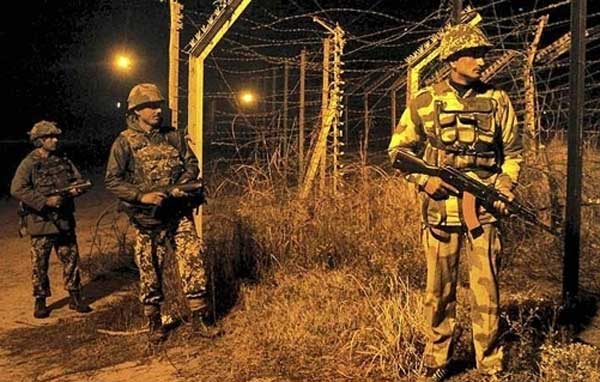
The IB in the Jammu region constitutes the border belt from Samba to Akhnoor; the area next to the border fencing is called the “Zero Line.” There are many villages in the zero line that are situated near enough to the IB fencing for the Pakistani troops to engage with small arms as well as mortar fire. Areas slightly in depth are being engaged by Mortar fire. The area between the zero line and the main line of defence based on a Ditch-cum-Bandh (DCB) is approximately two to five kms in breadth. The villages on the zero line own a major portion of this very fertile land, a smaller portion is also owned by villages located behind the DCB.

Exploring a New Role: Peacemaker in Afghanistan

JAN. 14, 2015 

President Xi Jinping of China, right, with Afghanistan’s president, Ashraf Ghani, at a ceremony in October outside the Great Hall of the People in Beijing. 

BEIJING — No stranger to engaging in power politics with its Asian neighbors, China’s diplomatic corps has in recent months been trying on a new role: talking with the Afghan Taliban in an effort to play peacemaker.

Late last year, two Afghan Taliban officials traveled with Pakistani officials to Beijing to discuss a potential peace process among Afghanistan’s warring parties, according to three current and former Afghan officials. And that may not have been the first such meeting. Though his account could not be independently confirmed, one Pakistani journalist said that China’s special envoy to Afghanistan, Sun Yuxi, had traveled to Peshawar, Pakistan, to meet with Afghan Taliban representatives weeks earlier.

Despite years of war and turmoil in Afghanistan, China had long seemed reluctant to become directly involved. So what has changed to move it to try to mediate with Islamist militants now? According to Chinese and foreign analysts, the answer lies in three factors: China’s growing worries about aUighur uprising on its own frontier; concern about more instability on its western border after the main American troop withdrawal from Afghanistan; and urgency to secure access to Afghan mineral and oil deposits where Chinese companies have already made large investments.

“Under the new situation, China is more willing to take on greater responsibility and more willing to proactively promote conciliation,” said Zhao Huasheng, a professor and director of the Center for Russian and Central Asian Studies at Fudan University in Shanghai.

He added that China was in a good position to help shepherd a peace process, now only in the proposal stage, “because China is not involved in Afghanistan’s domestic fights and, comparatively speaking, is pretty broadly accepted.”

Is India losing the tech race to China?


BY Ji Xianbai and Ying Pei 
16 JANUARY 2015

Economic development and increments in scientific knowledge and technology, which in turn rest on R&D, are interconnected. India is falling behind and must allocate a greater share to R&D, while China must elevate the efficiency of its research expenditure—this focus will allow the two countries to continue to grow 

On 18 December 2014, India launched its largest rocket to date, the GSLV Mk III; China will launch its Long March 5 rocket sometime in 2015. In both countries, competing to unveil the next-generation heavy-lift launch system, the progress made on space technology draws much public attention. It impacts national pride, reflects the overall technological advancements in the two fast-developing economies, and foretells their long-term economic development prospects.

Increments in scientific knowledge and technology, and economic development, are positively co-related. Technological advancement can bring about more efficient use of resources, which can help reduce poverty and expand economic output by shifting the production possibility curve outwards.

China today is no longer technologically frail in comparison to developed economies. In 2006, China surpassed Japan as the world’s second largest investor in research and development (R&D) across all sectors. China’s spending on R&D is ramping up at an unprecedented annual growth rate of 19% since 1991, [1] reaching 1.97% of GDP in 2012. [2] According to the OECD, the majority of the spending stemmed from the business sector (93%), followed by the government (5%) and foreign funding (1%). [3]

The R&D expenditure for India was approximately $40 billion in 2014, or 0.9% of GDP. [4] This still falls short of the Indian government’s target of 2 % of GDP, a figure that was first announced in 2010 and then reaffirmed in 2012. India’s R&D spending, according to the World Bank database, as a share of GDP has never exceeded 1% for almost two decades despite several official declarations of doubling that amount.

The China Question: Great Power or Great Crash?

January 16, 2015 

The Black Swan, by Nassim Nicholas Taleb, is a parable for unanticipated risk: the possibility of 'unknown unknown' events that no-one sees coming.

In a new essay, The Calm Before the Storm, Taleb further posits that perceptions of risk are distorted by “fragile stability.” Some countries (eg. Saudi Arabia) are inherently more vulnerable to exploding one day in spite of – or likely because of – their continuity, concentration and monolithism. The flip-side of this concept, less intuitively, is that “anti-fragility” can be borne out of the very experience of crisis. The likes of Italy may be resilient precisely because they continually face chaos and flux.

Taleb's idea isn't a new one – the economist Hyman Minsky noted “the instability of stability” decades ago – but his anecdotal depth and topical understanding of current affairs makes the essay a riveting read.

Even to the formidable Taleb, though, one country is sui generis and escapes easy identification. At the very end of the essay, he acknowledges “the China puzzle.”

Another superbrain, historian Niall Ferguson, also concedes that “China is the country hardest to categorize” as a political-economic risk. China is difficult for Westerners to understand because its singular pursuit of economic development tempts excesses and imbalances. Yet the farther, faster and longer it gallops,when a bust would typically loom more probable, China looks ever more invincible and assured. As Ferguson admits, “there is unlikely to be a Lehman moment.”

China may end up with something different, however: a prolonged correction.

China has just banned the burqa in its biggest Muslim city


January 12, 2015

Chinese authorities have banned women in Urumqi, the capital city of Xinjiang—an autonomous western region where Muslims account for almost half of the population—from wearing burqas in public, according to a brief article on a government-run website, Tianshan News. Local legislators for Urumqi proposed the ban in December, and now the regional legislature has approved it.

It’s not clear when the ban on 蒙面罩袍, literally “face-masking robes” will go into effect. State media said only that it will be implemented after being modified to meet comments proposed in a meeting over the weekend.

A blogger posts a photo of a sign in Kashgar discouraging Uighur from wearing Islamic dress. It says, “Advocate transforming outdated customs.”(Weibo)


What is clear, though, is that moves like these are likely to further alienate an already disenchanted minority group—the Uighurs, who feel their culture and economy is being overrun by Han Chinese. Ever since a group of Uighur Muslims went on a killing spree in a train station in Kunming last March, Chinese officials have ratcheted up restrictions on a group they see as potential extremists. Xinjiang officials later banned students and civil servants from fasting for Ramadan, and authorities in the Xinjiang city of Karamy barred anyone wearing burqas, niqabs, hijabs or simply “large beards” from taking public buses.

One Week After the Charlie Hebdo Attack: Refuse to Sign Up for the Clash of Civilizations


15/01/2015

What happens after a group of Muslim fundamentalist thugs in Paris slaughter unarmed cartoonists, and shoppers at a Kosher grocery, then invoke God and claim to be avenging the Prophet on video for all the world to see? Where do we go from here?

In considering this question, I have thought a lot about things my Algerian father taught me. He was an anthropologist named Mahfoud Bennoune, who like many Algerian intellectuals during the 1990s "dark decade" of fundamentalist terrorism that claimed as many as 200,000 lives, wondered every time he went out if he would come home again, or if he would be killed that day for opposing Islamist terrorists.

As I worried for him, he always admonished me not to do the work of the terrorists for them. Be smart, but try not to be terrified. Don't stop teaching evolution even though the head of the Islamic Salvation Front shows up in your classroom to denounce you as an advocate of "biologism." Don't cover your head because they say they will kill you if you don't. His consistent defiance reflected the spirit expressed by slain Charlie Hebdo editor Charb: "I would rather die on my feet than live on my knees." My father survived the "dark decade," while many of his compatriots did not, and as we all know, Charb did not survive this dark January, but was killed by radicalized brothers of Algerian descent - the infamous Kouachis.

To honor those who have stood up to fundamentalism, and those who have fallen to it - from Algiers to Paris and beyond - defenders of human rights and humanism have to carefully consider our strategy in the days ahead. Here are six ideas we must remember.

1) Denounce communitarian analysis

This is a political struggle against an extreme right wing political movement - Islamism and its expression in jihadist terrorism. It is not a war between Islam and the West. There are many Westerners - both on the left and the right - who have either justified or come close to justifying the attack, and there are countless people of Muslim heritage who have decried it.

For example, an eloquent, terse statement entitled, "We will not give in to fear" issued by Manifeste de Liberté (Manifesto of Liberty) in France, a grouping of progressive people of Muslim heritage, signed by everyone from the president of the Muslim scouts to writer Tahar Ben Jelloun, simply says: "To the families and friends of Charb, Cabu, Wolinksi, Tignous, Bernard Maris, Honoré, Elsa Cayat, Mustapha Ourad, Frédéric Boisseau, Michel Renaud, and the police officers Franck Brinsolaro and Ahmed Merabet, and to the team at Charlie Hebdo, we express our horror, our solidarity, our grief. To their killers, we say that you will find us blocking your path, and on the side of liberty." (The statement was published rapidly following the January 7 attack, and so did not include those killed later, including at the Kosher grocery store. Its originators later updated online: "Of course, we also share the grief of the families of the victims of the anti-Semitic killings in Vincennes: Philippe Braham, Yohan Cohen, Yoav Hattab, François-Michel Saada, as well as the friends and family of the policewoman killed in Montrouge, Clarissa Jean-Philippe.")

Such voices defy the hatred purveyed by people like Rupert Murdoch, who recently tweeted: "Maybe most Moslems peaceful but until they recognize and destroy their growing jihadist cancer they must be held responsible." Mr. Murdoch- many of us recognized it long before the West did, many of us have been trying to destroy it - at risk of our lives - for many years, and your divisive rhetoric only makes it harder to do just that. Your worldview is akin to that of terrorists who target all Westerners because they are Westerners.

Instead, we must refuse to sign up for the clash of civilizations that both the Islamist terrorists and the Western far right have in mind, and cling to our principles: liberty, equality, brother-and-sisterhood, dignity, and universal human rights.

2) Defend secularism

Terror in Paris, Answers from RAND Experts

January 7, 2015
Candles and a placard that reads 'I am Charlie' at the French embassy in Berlin, January 7, 2015, tributes to victims of a shooting at the offices of satirical magazine Charlie Hebdo in Paris

The attack by a pair of gunmen that claimed the lives of 12 people in the offices of a Paris-based satirical magazine sent waves of terror and disbelief across France today. Carrying assault weapons and shouting Islamic slogans, the masked killers struck the offices of Charlie Hebdo, a magazine long targeted by Islamic militants for publishing cartoons depicting the Prophet Muhammad. Among the dead: cartoonists, members of the magazine's editorial staff and two police officers.

RAND experts Andrew Liepman, senior policy analyst; Brian Jenkins, senior adviser to the RAND president; and Stephanie Pezard, political scientist, participated in a question-and-answer-session just hours after the attack, as the gunmen remained at large.

How does this attack compare to previous attacks in France?

Jenkins: This is not just the worst terrorist attack in 20 years. The number of fatalities surpasses the 1995 attack at the subway station, indeed the fatalities of the 1995-96 terrorist campaign. (The 1995 bomb attack killed eight people and wounded dozens more in a Paris Metro station. It was one of a series of attacks alleged to have been carried out by the Armed Islamic Group in 1995 and 1996.) It surpasses the violence of the mid-80s campaign and the terrorist attacks of the 1970s. It takes us all the way back to the bloody terrorist campaign in Paris during the Algerian War. (In 1961, a terrorist bomb, planted by extremists who wanted to keep Algeria French, killed 28 people aboard a Paris train.) It will deeply affect all French people.

Pezard: The most recent terrorist attacks that come to mind in France are the killing of seven people (including three children at a Jewish school) in three separate attacks, perpetrated by Mohammed Merah in 2012. Unlike Merah's attacks, the one against Charlie Hebdo seems to have been organized by a group and to have required more elaborate planning. It was also preceded by threats against the victims. Both attacks, however, were shootings, which is a marked difference from the bombings that France experienced in the 1990s.

Why would terrorists strike a magazine?

Liepman: This publication has been near the top of the list of targets—perhaps second only to Jyllands-Posten in Denmark—for insulting the Prophet Muhammad.

Pezard: Charlie Hebdo is a satirical magazine that routinely publishes cartoons that poke fun at religions. This magazine and its staff had been under threat since they published the caricatures from the Jyllands-Posten in 2006. In 2011, a firebomb was thrown into the magazine's offices and destroyed them entirely.

Strong Dollar Clouds Forecast at Davos


As the financial world’s elite gathers to discuss what’s in store for 2015’s global economy, a problem could be festering in emerging markets
Jamila Trindle is a senior reporter who covers finance, economics and business where they intersect with national security and foreign policy. Her beat spans everything from the economic underpinnings of conflict to sanctions, corruption and terror finance. Before coming to Foreign Policy magazine, Jamila reported for the Wall Street Journal’s Washington bureau, covering financial regulation and economics. She has also worked as a foreign correspondent in China, Indonesia and Turkey as a freelancer for NPR, Marketplace, The Guardian and others. She moved back to the U.S. to cover the post-crisis economy for PBS in 2009. 

Good news for the U.S. economy could turn out to be bad news for the rest of the world in 2015, a growing number of economists are warning. While the U.S. economic recovery is a boon for Americans and the countries from which they import, the dollar’s rising strength could also bring out lurking problems in less-developed countries.

Growth in the United States while other parts of the world are faltering could squeeze people in emerging markets who borrowed in dollars when times were good. Now, they have to pay back in dollars that have been bolstered in value as their own local currencies have plunged.

That’s one of several looming economic clouds likely to follow world leaders, top economists, titans of business, and other 1-percenters as they helicopter into the annual World Economic Forum in secluded Davos, Switzerland. European growth is stagnant, and Greece is again flirting with exiting the European Union, while falling oil prices are proving a boost for some countries and a liability for others.

The United States is the one bright spot: Unemployment is down, consumer spending is up, and GDP expanded at a 5 percent annual rate in the third quarter of 2014, the biggest jump since 2003. But for emerging markets, which attracted a lot of investment while the United State was in the doldrums, the upturn stateside could signal rough times ahead.

While American growth can lead to a pickup in countries that export to the United States, the World Bank this week said it’s not enough to keep the rest of the global economy expanding. The bank tempered expectations for worldwide growth in 2015, lowering its forecast to 3 percent from 3.4 percent. It also lowered the growth outlook for emerging markets to 4.8 percent, as well as lowered the outlook for China, Brazil, and Russia individually.

“The fragmentation of power is irreversible”


The end of the nation-state as we know it: Parag Khanna discusses the path towards global connectivity and why we have to shift from Western history to global history.

The European: Mr. Khanna, especially in Europe, we’re witnessing a resurgence of regionalist or nationalist thinking that seems to cast doubt upon the aspirations of the last several decades. Is the post-crisis frustration in Europe foreshadowing a larger turn away from the project of globalization?

Parag Khanna: No conversation about the future of Europe should be seen as indicative of the future of globalization. That’s the worst kind of Eurocentrism. Globalization has long eclipsed its North American and European anchors – we no longer live in the world of 19th century colonialism. There are very important Western foundations to globalization, from international financial institutions that grew out of postwar attempts at regulating economies at the international level to Western multinational corporations that began to pursue globalization in the 1960s and 1970s. We can give adequate recognition to the role that the West has played in integrating the world economy, but it would be crudely anachronistic to see European trends – whether they are characterized by fragmentation or unification – as reflective of global trends. From a macro-historical perspective, you have to shift from Western history to global history. That’s the initial point of departure for any assessment of globalization.

The European: Last year, the “Guardian” published an article series on global borders that noted the construction of more than 6000 miles of border fences during the last decade, from Morocco to Korea. Isn’t that a pretty clear sign of the global affirmation of demarcation and fortification?

Khanna: Let me make a philosophical point first: There’s a notion that more independence movements and struggles for autonomy are somehow the antithesis of globalization – what Samuel Huntington would have called post-national globalism, or what we might describe as a Davos-inspired conception of globalization. I believe that the reality is very different.

The European: In what way?

Khanna: First, most of those borders are physical rather than economic: Many important forces aren’t constrained by them. Second, secessionist movements are part of the natural evolutionary path towards a connected global civilization. The reason is this: When regions or cities seek an alternative future, it speaks to their perceived need and capacity to escape from the imposed prison of nationhood. Third, those sentiments aren’t a new phenomenon but were present in Great Britain or Spain throughout history. In Italy, too: Right in the middle of the Crimean crisis, the city of Venice held an unofficial referendum to secede from Italy. Finally, it’s important to point out that for every mile of border fence that we put up in the world, we put up multiple miles of cross-border infrastructure: railways, pipelines, cables, bridges, tunnels, et cetera.
“The world is spending more money on infrastructure than on military”

The European: In other words: As long as our conception of the world is focused on political borders, we’re bound to under-estimate the extent of cross-border dynamics?

What’s causing the crash in oil prices? What happens next?

13 JANUARY 2015

Summary: Again, as so many times since 2000, oil prices dominate the news and shake the financial system. As usual, the news mixes fact and conjecture, wisdom and nonsense. Here’s an introduction to the basic facts, and a strong forecast about the future of oil prices.

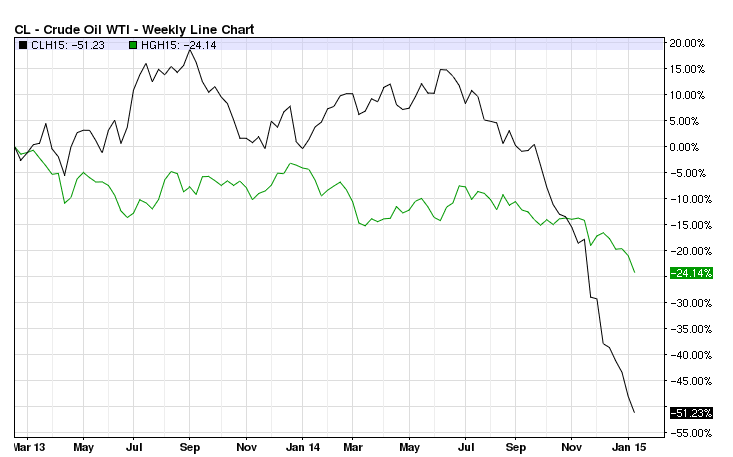
Oil is the most economically sensitive of the industrial minerals, for many reasons (e.g., it’s easier to throw tons of copper into a warehouse than tons of oil). But Dr. Copper also signals a slowing global economy. During the past year the price of copper (green line) has dropped 20% while oil (WTI, black line) has fallen 50%. Commodity prices don’t provide a crystal ball’s vision of the future, but their movements deserve attention. {Update: Copper is catching up. Spot now down 36% from June peak.}
March 2015 futures: NYMEX Oil vs COMEX Copper. From CommodityCharts.com

Heading for parity


Jan 17th 2015

A tumbling currency reflects Europe’s dismal prospects; it is a second-best route to curing them 

THIS week marked a milestone in the history of Europe’s single currency. On January 14th the value of the euro slipped to $1.17, the rate at which it was introduced on January 1st 1999. BackQ then, the fledgling currency weakened fast, hitting parity with the dollar in early 2000 and plunging to $0.83 by October of the same year. The slump in the euro’s value suited no one: the European Central Bank (ECB) worried about inflation from rising import prices; other countries fretted about declining competitiveness. So the world’s big central banks undertook a programme of co-ordinated intervention to stem the euro’s fall.


This time round the euro’s slide has been more gradual, but it is likely to prove more persistent. Parity with the dollar is quite plausible this year. Both politics and economics are undermining the currency.

The immediate threat is from the political side—and uncertainty about the consequences of the Greek elections on January 25th. The damage of Grexit, though lower than in 2012, would still be huge (see article). At the moment, such an event seems unlikely. Syriza, the far-left party that looks like winning the largest number of seats, insists it wants to stay in the currency (as do the vast majority of Greeks). Germany’s government, too, is full of soothing noises about the inviolability of the euro. Nonetheless, the risks of an accidental exit are uncomfortably real. From a higher minimum wage to a halt to privatisation, the policies that Alexis Tsipras, Syriza’s leader, is proposing will worsen Greece’s public finances—and require more sleights of hand to keep Greece in conformity with the rescue packages that determine its ability to stay in the euro (see article). Even if Greece stays in, wary investors may decide to ditch their euro exposure, pushing the single currency down further.

More important are the economic fundamentals and the plausible European policy responses. Deflation has set in (prices across the single-currency area fell by 0.2% in the year to December) and, with Germany’s economy wobbling, the region’s growth prospects look ever feebler. Yet despite the darkening picture there is no sign of boldness from politicians. There are no big ideas to kickstart the single market or to boost investment. Instead, all eyes are on the ECB and its willingness to create money to buy sovereign bonds.

On January 14th a preliminary decision by the European Court of Justice declared the buying of sovereign bonds by the ECB to be legal. This should make it easier for the central bank to begin a programme of large-scale bond purchases. Such quantitative easing (QE) could start before the end of the month. In America QE helped boost share prices and drove down borrowing costs for companies. Given the underdeveloped state of Europe’s capital markets, the main way QE is likely to banish deflation is through a weaker euro. Imports will cost more while exporters—and the economy—will get a boost.

Parable of weakness past