19 May 2014

**** FM 3-24/MCWP 3-33.5 Insurgencies and Countering Insurgencies Now Posted

FM 3-24/MCWP 3-33.5 Insurgencies and Countering Insurgencies Now Posted 

SWJ Blog Post | May 16, 2014 

Login or register to post comments 

*** This Profession of Arms A military officer breaking the silence after war

On April 17, 2014, William S. Lind wrote that “the most curious thing about our four defeats in Fourth Generation War—Lebanon, Somalia, Iraq, and Afghanistan—is the utter silence in the American officer corps.” I suppose Mr Lind’s point was that the US military was being too complacent in its critique of itself as well as Washington’s management of the wars in Afghanistan and Iraq. Yet, I am not writing to debate the “defeat” of the US in 4GW but rather to break the silence that he says is prevalent in the US military. This is my humble contribution.

Recently I read an interview in which David Maxwell, a former USA Special Forces officer now at Georgetown University, offered his thoughts about writing and learning for junior officers in this profession of arms. Personally, I received this as a challenge as well as an exhortation to contribute. There are plenty of other military professionals that write and publish. I am now far enough removed from my deployments in the Long War that I felt that it is now my time to offer my thoughts to the discussion about the nature of war and its future.

This debate is pertinent to the future of the US military as well as to the future of our nation’s national security. Questions must be asked by those who put their lives on the line for their nation and each other, such as: Where have we come from? Where are we going? What have we learned? We must apply ourselves to understand the mistakes of the past as well as the successes. Likewise, officers and leaders should ponder these questions. They owe it to those men and women they lead in their organizations who also put their lives at risk.

For starters, why should a reader follow anything I write? I am an officer in the US Army. I was formerly of the Field Artillery branch but am now serving in another capacity. I have a masters degree in European Security Studies and I speak French. I have three operational deployments: two to Afghanistan and one to Iraq. I participated in both of the US “troop surges” to both Iraq and Afghanistan. Of note — during my last deployment, apart from battery command, I was responsible for the training of an Afghan National Army D-30 122mm artillery battery. This was by far the most interesting experience during my time in the Army. My experiences in the Long War in both theaters were at the tactical and operational levels. I remained distant yet intrigued by the strategic level of war.

Upon reflecting about my experiences in the military, I think it is important for those who follow this profession of arms to debate the nature of war because it is where our interests lie. If it is not one of us, then it will be someone you know grappling with problems on the ground. Problems that so many others have dealt with before and that could have been better understood before embarking on a deployment or as a nation in armed conflict.

But this is not just about experiences. It is about what they have taught us about what war is; what it does to people, countries, and cultures; and what should be considered before entering into war. These are the beginnings of my reflections on the Long War. To be honest, I am somewhat hesitant to pen any writings or articles but think that it is the right time to do so.

This writing and any future offerings do not represent an official DoD or USG position. All opinions are my own.

Our Asymmetric World Optimizing the Force

This article was provided by Aaron Haubert, a former U.S. Marine Corps sergeant, veteran of the Iraq and Afghanistan wars, and graduate of King’s College London.

The future of American military power is up for grabs. Between the myriad military strategies being debated and the ever-present uncertainty over the future budget, no one in the Department of Defense has any idea what our military will look like five years from now, much less ten. Every school of thought has its champion and listening to him or her will lead us to a finely tuned military — a world class institution that is unbeatable, within a set of finely marked boundaries. This would be an acceptable position if our country knew what our armed forces would be up to next. But we don’t.

A nation with a clear military threat or objective has the luxury of examining its opponent and planning a campaign to exploit weaknesses and vulnerabilities in their pursuit of victory. America’s view is global and our goal is largely to maintain the status quo. This means that while potential adversaries only have to be right once we have to be right all the time. If this sounds like a lecture on defending against terrorism there’s a reason for that. It is called asymmetry; since the fall of the Berlin Wall the world has been asymmetric. We cannot optimize to fight insurgencies because it leaves us vulnerable to large conventional fights. If we optimize against conventional fights, which type do we optimize for? Tank battles through the Fulda Gap? Naval battles off the coast of China? Regardless of which we choose, we then become vulnerable to unconventional tactics. We think that just because we aren’t planning on fighting an insurgency we are done fighting asymmetrically. This is a mistake. Asymmetry is what leads to innovations like Anti-Access/Area Denial. Why build a massive fleet to take on ours when you can just mine the waters? IEDs are not going to disappear when we leave Afghanistan; every military in the world has watched and learned our vulnerabilities for the last 13 years. Asymmetry is here to stay and we need to embrace it, because it is the only certainty we have.

What we need is to be competitive in a variety of events. We need our military to be a decathlete.

What then does a military geared towards asymmetry look like? To indulge in the often overly-used “military as sports” analogy, peer on peer conflict is like the shot-put. To be competitive, an athlete needs to be strong and capable of throwing large weight around with the potential to do a tremendous amount of damage. Insurgents would be 1,500 meter runners, fast and agile but still a grueling distance requiring endurance. A 1,500 meter runner would get crushed in a shot-put competition, but would run circles around a shot-putter in his own race. Each school of thought bouncing around the military establishment today would have us winning the world championship in any number of events. But we don’t need that, what we need is to be competitive in a variety of events. We need our military to be a decathlete.

The US military is faced with the need to balance several sports at once. Simultaneously heavy enough that other shot putters don’t come gunning for us, but nimble enough to pursue medium-distance runners. We have to be able to be competitive in the 100m sprint of special operations raids, good enough at the long jump to conduct amphibious assaults, maintain our nuclear javelin throw, perfect our anti-submarine discus technique, and preserve our pole vaulting air assault capabilities. In short, we need to be just as versatile and adaptive, just as flexible and creative as the millions of different ways other nations can try to defeat us. Invest too much in one “sport” and we will create vulnerabilities in another.

Land power


This article was provided by Matthew Cavanaugh, a US Army Strategist and editor of the WarCouncil.org, where this blog was originally posted. The views expressed belong to the author alone and do not represent the US Army or the Department of Defense.

The US Army will not be very successful in the coming operating environment unless it develops a sense of strategic understanding in its officers (and senior noncommissioned officers). For the purposes of this essay, strategic understanding is defined here as: awareness, comprehension, and ability to communicate broad purpose for the use of force and the relationship between tactical action and national policy. Trends tell us two things that demand this characteristic: first, landpower is inherently attributional; second, the Regionally Aligned Forces model ensures that the American Army will go to more places, faster, in smaller numbers, than ever before. Inadequately preparing for these landpower trends will lead to both institutional and individual epic fail.

THE PROBLEM

Rosa Brooks recently conducted interviews at Camp Arifjan in Kuwait for the latest edition of Foreign Policy magazine (May/June 2014, p. 44). Ironically, it was raining while she was there, but that wasn’t the only striking thing about the discussions. Here’s a short selection from her experience:

“So what are you guys doing here?” I [Rosa Brooks] ask the young private next to me in line at the camp’s spacious Starbucks. “I mean, in Kuwait. What’s your mission here?”

He offers a sheepish shrug. “Got me, ma’am. That’s above my pay grade. I’m just trying to stay dry.”

“Ours not to wonder why, ours but to try and stay dry,” quips the lieutenant standing nearby, carefully maneuvering a lid onto his overflowing caramel latte.

This lieutenant’s response is a favorite in the officer corps, most likely due to its use by the infamous Corporal Oppum in Saving Private Ryan. I’ve actually heard it several times from cadets in the Military Strategy class I teach. In this case, the paraphrase of Tennyson’s “The Charge of the Light Brigade” was just a bit off — a more exact quotation would have been: “Theirs not to reason why, Theirs but to do and die.” Unfortunately, this line is often employed to propagate a great lie — that “the reason why” does not (or should not) matter to the uniformed military. Nothing could be further from the truth.

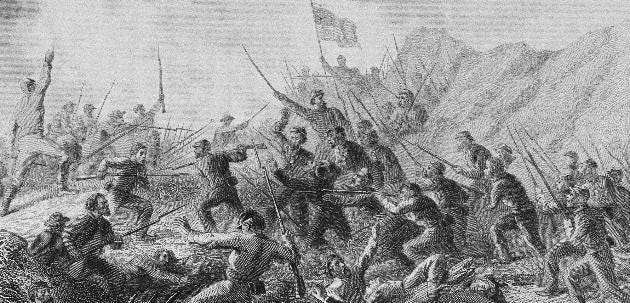
A depiction of bitter hand-to-hand fighting at Vicksburg, Miss., in 1861. Soldiers of the Fourth Minnesota Volunteer Infantry Regiment later played a crucial role in giving Union forces control of the war’s Western Theater / AP.


Internal U.N. Report Finds That U.N. Peacekeepers Rarely Use Force to Protect Civilians From Attack

U.N. Study Finds Peacekeepers Avoid Using Force to Protect Civilians

Reuters
May 16, 2014

UNITED NATIONS — United Nations peacekeeping missions routinely avoid using force to protect civilians who are under attack, intervening in only 20 percent of cases despite being authorized to do so by the U.N. Security Council, an internal U.N. study found.

"There is a persistent pattern of peacekeeping operations not intervening with force when civilians are under attack," the report by the Office of Internal Oversight Services said.

"Peacekeepers are absent from many locations when civilians come under attack, and when they are present, are unable or unwilling to prevent serious physical harm from being inflicted," the 26-page report said.

Of 507 incidents involving civilians that were included in U.N. reports between 2010 and 2013, 101 sparked immediate response from peacekeepers, the report said.

Presented this week to the U.N. General Assembly Fifth Committee, which deals with the U.N. budget, the report focused on eight of 10 U.N. peacekeeping missions with a Security Council mandate to protect civilians: Lebanon, Liberia, Ivory Coast, Haiti, Democratic Republic of Congo, Darfur, Abyei and South Sudan. It excluded the newest operations in Mali and Central African Republic.

"While no mission can be expected to protect all civilians all the time, each can reasonably be expected to provide protection in areas of highest risk," the report said.

"Force was mostly likely to be used to protect civilians when troops were engaged in self-defense or defense of U.N. personnel and property."

The top 10 contributors to the U.N.’s almost $8 billion a year peacekeeping budget are the United States, which contributes 28 percent of the budget, Japan, France, Germany, United Kingdom, China, Italy, Russia, Canada and Spain.

Countries interviewed for the report that provide peacekeepers for U.N. operations said the risk to their troops was higher than they would accept. Some of them have entirely ruled out the use of force. The biggest troop contributors are India, Bangladesh, Pakistan, Ethiopia, and Rwanda.

Ths scary NASA map shows how the world’s forests are going up in smoke

Hey, weren’t those the same trees that produce our oxygen? 

LIMA, Peru — The world’s forests are in trouble. If you think we’re joking, then just take a look at this frightening NASA image.

Forest fires around the world from May 1-10. (Jacques Descloitres/NASA

Based on satellite data, it shows how much forest around the world was on fire during the first 10 days of May.

Experts that GlobalPost spoke with believe forest fires are likely now burning at record levels — at least since human beings first began walking the Earth.

No one really knows this for sure. Some nations, such as the United States and Brazil, publish detailed data, while others, such as Congo or Russia, do not.

What scientists are certain about is this: Wildfires are getting worse with climate change, in the United States and much of the world.

To be clear, the dots on the NASA map are not to scale — otherwise most of Central America (seen below) would just have burned down, and you probably would have heard about that if it were true.

Although most wildfires are caused by people, some also start naturally, by lightning. Some will even lead to new, healthier forests springing up from the ashes.

But, overall, the news could hardly be worse. A slow-burn catastrophe, if you will.

Forests provide humans with a long list of critical services, not the least of which is making oxygen. According to one conservation group, each tree exhales about 120 pounds of the life-giving gas per year.

“The rainfall patterns that are so important to the agriculture that sustains the human race around the world depend largely on forests,” says Steve Schwartzman, director of tropical forests at the Environmental Defense Fund.

It would be a “safe bet,” he adds, that without forests there would be famine.

As if that weren’t clear enough, he cites a recent study that shows that Californian agriculture would be hit by drought if the Amazon, which generates precipitation that falls in many distant corners of the globe, disappeared.

18 May 2014

Challenging Stereotypes: Reinventing National Discourse In India’s North East – Analysis

By Shruti Pandalai

A view across the Brahmaputra near Sukleswar Ghat, Guwahati, Assam, India. Photo by Deepraj, Wikipedia Commons 

Ethnic clashes between Bodos (Assam’s biggest tribal group) and Muslims in lower Assam in early May, forced media attention once again to the myriad conflicts stemming from contested identities in the North East. Election rhetoric around issues of illegal migration into north eastern states, targeted at specific vote banks seems to have further fuelled the reportage. A fortnight on, perhaps understandably, the region has faded from the media’s radar, since action has now shifted to New Delhi with the country ushering in political change.

Typically, issues from the North East despite making headlines, are often lost in translation. The gravity and historic context of the conflict is often lost en masse in the national public consciousness. Mass media’s access to the lowest common denominator makes it a crucial player in building national narratives and breaking stereotypes. These narratives can come handy for the state to make sure the message is clear in areas prone to conflict, where citizens are often victims of misinformation and agenda driven campaigns.

This is not to say that bridging perception gaps will resolve the conflicts in the North East, but the case has to be made to at least inform and build common frames of reference and initiate larger public interest in the region. If attempts have been made already, then we need to investigate their limited presence in influencing opinions and debates in the larger national consciousness. It’s paradoxical that despite the rise in rich academic research on the various problems plaguing the North East, their play in mass public discourse is negligible and incident oriented.

Insurgencies have been raging on is the North East for decades, yet unlike Kashmir – which has become ingrained in public consciousness and the national discourse – one could argue that the North East has not received the same attention. Apart from spot reports on violence, which is definitely a step forward from the early days of complete ignorance; there is little effort to understand the contested narratives of the various conflicts. Images of the Manipuri women protest against the rape of Manorama Devi in 2004, anti-AFSPA activist Irom Sharmila, and shots of training camps of the ULFA are regurgitated time and again in the mass media. While these are powerful and symbolic, they have stereotyped a complex region with a flattened idea of homogeneity.

India's Nuclear Imposture

By ABHIJIT IYER-MITRA
MAY 11, 2014 

ALBUQUERQUE — When the Bharatiya Janata Party announced it would “revise and update” India’s nuclear doctrine if elected this month, the proposal was widely interpreted to mean that the party would renege on India’s 1998 pledge never to use nuclear weapons in a first strike. The party has since backtracked, ostensibly because of the media backlash. That’s unfortunate. Although the “no first use” doctrine, known as N.F.U., may seem prudent in theory, India has diluted the concept to the point of absurdity, with dangerous consequences: a buildup of its conventional forces, which has caused Pakistan to harden its nuclear stance.

In August 1999 a panel of independent experts convened by Prime Minister Atal Bihari Vajpayee issued a draft nuclear doctrine containing a commitment to N.F.U. That inclusion seemed designed to assuage the international community, which India had rattled the previous year by conducting nuclear tests. Yet the government started backpedaling almost immediately, presumably because it realized that the N.F.U. pledge undermined the rationale for conducting the tests in the first place: to deter an attack from China, with which India had fought a crushing war in 1962.

On Nov. 29, 1999, Jaswant Singh, a member of Parliament, dismissed the draft doctrine, saying it was “not a policy document of the Government of India” because the panel that put it together had legally nebulous authority. (Within a week, Mr. Singh was made foreign minister.) By 2003, when India issued an official nuclear doctrine, its N.F.U. pledge had been watered down to authorize a nuclear retaliation after a chemical or biological strike. Then, on Oct. 21, 2010, Shivshankar Menon, the national security adviser, stated that India would apply N.F.U. only with respect to non-nuclear weapons states.

But even as India’s civilian authorities have, in effect, authorized a nuclear first strike against nuclear states like China and Pakistan, they have not given the military control of operational nuclear weapons. (In established nuclear states, the weapons are in the hands of the military, subject to civilian oversight, and launch codes remain with the government.) Nor does India’s military appear to have conducted war games simulating the first use of nuclear weapons.

Instead, the government has authorized a massive increase in its conventional forces. A 2012 article in Time magazine estimated that India would spend $80 billion on “military modernization” over the following three years. The navy plans to expand its current fleet of more than 130 vessels to about 200, including submarines and aircraft carriers, over the next decade. During the same period, the army expects to supplement its 1.1 million strong force with another 100,000 troops, and the air force will acquire some 350-odd fighter jets.

These efforts are intended to deter China. But China seems basically unfazed, and has responded simply by expanding roads, railways and airfields in Tibet. On the other hand, Pakistan, which does not have the resources to match India’s buildup of conventional forces, is compensating — overcompensating — in the nuclear arena.

A 2011 Bulletin of the Atomic Scientists projected that within a decade Pakistan would have enough fissile material to make between 160 and 240 nuclear bombs, more than double the expected capacity of India and possibly more even than that of Britain. Pakistan has started deploying tactical nuclear devices on short-range rockets along its border with India. Brigadier Feroz Khan, the former director of Arms Control and Disarmament Affairs in the Strategic Plans Division, the ultimate overseer of Pakistan’s nuclear arsenal and activities, has argued that this move makes sense only if launch authority is pre-delegated to field commanders — suggesting that it has been.

In short, India’s diluted version of the N.F.U. doctrine makes an already dangerous security situation in South Asia more dangerous still. Everyone would be better off if the government did away with it.

U.S. policy on India, and Modi, needs to change

May 16 ,2014 

Barack Obama’s pivot to Asia has been widely praised. But many critics wish that he would infuse the policy with greater substance and energy. In fact, the administration has the opportunity to fill in one of the great missing pieces of that policy — a strategic relationship with the continent’s second most populous country, India — once a new government is formed in New Delhi. But both countries will have to make some major changes.
The immediate obstacle for the United States is that the man who will become India’s next prime minister, Narendra Modi, was placed on a blacklist of sorts by the George W. Bush administration, was denied a visa to enter the United States and has been shunned by U.S. officials for a decade. This ostracism should stop. This manner of singling out Modi has been selective, arbitrary and excessive. 

Modi, a Hindu nationalist politician, is (until he becomes the prime minister) head of the government in the Indian state of Gujarat. He held that job in 2002 when fierce rioting between Hindus and Muslims broke out. In that capacity, it is alleged, he encouraged — or did nothing to stop — vigilante violence against Muslims and police complicit with the violence. More than one thousand people, most of them Muslims, died. Prosecutions of those accused in the killings have been minimal.

It is a dark episode in India’s history, and Modi comes out of it tainted. But his actual role in it remains unclear. Three Indian investigations have cleared him of specific culpability, although the probes have been criticized by human rights groups with credible concerns.

This is an important challenge for Indian democracy — one that many vocal groups in civil society are taking up — but the question for U.S. officials is: Does Modi’s behavior trump concerns of U.S. national interest? He is the only person ever to have been denied a visa on grounds of “severe violations of religious freedom,” which makes the decision look utterly arbitrary.

Consider, for example, the case of Nouri al-Maliki, prime minister of Iraq. He heads a government that is deeply sectarian and has been accused of involvement with death squads, reprisal killings and the systematic persecution of Sunnis in his country. And yet, far from being shunned, Maliki has been received in Washington as an honored guest on many occasions by two White House administrations.

Consider a report from the U.S. Commission on International Religious Freedom (USCIRF), the very body that singled out Modi. It lists countries that are of “particular concern” for their “systematic, ongoing and egregious” oppression of religious minorities. Saudi Arabia, whose leaders are paid enormous respect by Washington, is in that top tier. The report recommends that Pakistan be added to that list because of its persistent violence against minorities, which, the report says, is at an all-time high. The report also says that Iraq should be in this group. Not a single government official from any of these countries — or any other country anywhere — has ever been placed on a blacklist or been denied a visa for violating religious freedom. When human rights issues are used in a blatantly selective manner, they rightly invite charges of hypocrisy.

*** India's Destiny Dilemma

As India's elections draw to a close, one thing is clear: its potential is undeniable—and so are its problems.

May 15, 2014 

On August 15, India will mark the sixty-seventh year of its independence. The results of its national parliamentary elections will be official well before then. This country of kaleidoscopic diversity will have again transferred political power democratically and peacefully.

This may not strike Americans as exceptional, even if they’re reminded that elections have become routine at all levels of India’s polity and that turnout often exceeds what it is in the United States. So it’s worth recalling that in India’s early years there was much skepticism in the West about whether it would hang together, let alone build democracy.

India, a congeries of cultures, languages, and religions covers 3.2 million square kilometers. Only six countries encompass more terrain. Its population, now 1.2 billion, is poised to overtake China’s. Beijing’s draconian population-control program would be a nonstarter in democratic India.

There were other reasons to doubt that India’s experiment with democracy would succeed. The country was desperately poor, and what passed for a middle class was miniscule. Indians were largely illiterate, and their experience with democracy was brief and uneven. India lacked the characteristics scholars identify as preconditions for consolidating democracy. Its decision to adopt this form of politics, nonetheless, was as audacious as it was admirable.

So India has passed two fundamental tests it wasn’t expected to: it has stayed whole and preserved liberty and stability. Has it done well enough? No. India’s politics are marked—to a growing degree—by corruption; the power of money; political dynasties; and appeals to parochial loyalties, whether of caste, subcaste, religion, or language. Elected bodies contain knaves and criminals or those, whose qualifications are limited to good looks (Bollywood is deep into the political game) or athletic prowess.

Milan Vaishnav has discussed these dismaying realities in a recent op-ed; and you needn’t spend much time in India to see that he’s right. Yet such assessments lack comparative perspective. Indian democracy’s deficiencies may be doubly deplorable because India has many massive problems, particularly large-scale poverty. But the role of money, privilege, corruption, family connections, special interests and divisive appeals to subnational loyalties in politics is scarcely peculiar to India, and it is evident in the United States and other democracies. Americans’ dismay over this is clear from opinion polls showing that a majority of our citizens believe that we’re on the wrong track and that the coming generation won’t be as fortunate as we have been. Besides, Western democracies have had far more time to fix these problems. Yet they seem to be getting worse.

Why India Must Put Any Overtures To Pakistan On Hold – Analysis

By Vikram Sood

Every change of government in New Delhi rekindles hope in the hearts of many that peace between India and Pakistan is about to break out. It is necessary to have a reality check on this. Successive Indian prime ministers have walked down this road, offering concessions to Pakistan, only to be disappointed.

Today Pakistan may play the injured innocent and claim that it is a victim of terrorism but the reality is that Pakistan is a victim of the policies of its leadership. Having invested so much in this policy of violent interference in its neighbourhood, having raised the rhetoric so high and despite having boxed above its weight all these years, the Pakistani military and intelligence establishment is unable to change the way it thinks much less make a U-turn in its policies towards India.

It is time we accept that Pakistan will not change its policies towards India and may even become worse as it Islamises and radicalises showing signs of becoming a Sharia state.

Since Pakistan will not change its attitude it is time we also thought of different approaches. So far, gestures have been interpreted to mean appeasement by the Pakistan deep state and a vindication of their confrontationist policy. Pakistan’s DNA will not allow a change of policy, only a change of tactics. It will retain its terror option under a nuclear umbrella that today consists of 200 nuclear weapons all aimed at India and based on a close military and nuclear relationship with China.

Our policy towards Pakistan has been based on three misconceptions. One, the assumption that the civilian politicians favour a normal relationship with India but it is the army alone that is the impediment. Facts speak otherwise. It was then prime minister Zulfiqar Bhutto who said that Pakistan would make the Islamic bomb even if Pakistanis had to eat grass. It was Zulfiqar who dabbled with assisting the Islamic Afghans who had taken shelter in Pakistan having been pushed out by the Mohammad Daud Khan regime from Afghanistan.

It was his daughter, Benazir, who launched the Kashmir jihad and later propped up the Taliban. It was Nawaz Sharif who supported both the Taliban and anti-India groups, most of them fostered in Punjab, his stronghold.

Mumbai 1993 and later Kargil happened during Sharif’s terms in office. Likewise, the Mumbai attacks of November 2008 happened during Asif Ali Zardari’s presidency. There would be no significant change in the threats faced by us from Pakistan regardless of whether there was a dictator in command or an ostensibly civilian rule.

Two, if we engage Pakistan in a sustained dialogue and grant some concessions, this will strengthen the hands of Pakistan’s politicians and weaken the military’s stranglehold which is disliked by the people of Pakistan. Not quite so. Pakistanis may not be too fond of their generals as presidents but the military is seen as the only institution which is keeping the country together. Its political, economic and military’s role in Pakistan cannot be undermined or contained by any civilian dispensation.

The third flaw in this argument is the misplaced belief that we can bring about changes in the manner in which Pakistanis want to be governed. We do not have the ability to bring about political changes in Pakistan. It would be dangerous to tread into pastures where others have ventured and failed. Pakistan’s political process is an internal matter between its people and leadership.

The Post-Election Challenges to Afghan Transition: 2014-2015

May 18, 2014 

Note: This report was revised and corrected on May 18, 2014

The final outcome of the election in Afghanistan and Afghanistan’s willingness to sign a workable Bilateral Security Agreement with the US are essential preconditions to any hope of a successful Transition. It is the quality of leadership and governance that follows the election, however, that will determine actual success. Similarly, how Afghan forces evolve, and the quality of US and other outside support to Afghan forces, will determine whether Afghanistan is secure enough for a Transition to work.

The Burke Chair at CSIS has prepared a detailed briefing on these and the other challenges the new Afghan government, the US and its allies, and aid donors must meet during the remainder of 2014 and over the course of 2015. The actual process of a stable Transition may take more than half a decade and extend beyond 2018. It is the first two years, however, which are likely to present the most serious challenges.

This presentation is entitled The Post-Election Challenges to Afghan Transition: 2014-2015. It is available on the Burke Chair web site at http://csis.org/files/publication/140518_Transition_in_Afghanistan_Rev.pdf
The introduction lists the mix of key post election challenges (p. 2)

The first section in the report focuses on the lack of US leadership, planning, budgeting, and public support. 

It lists the areas where the US government – as well as the Afghan government and other powers – have failed to provide leadership, planning, and transparency, and create the institutions necessary for success. (p. 5) 

It warns that past failures to sustain successful transitions have been the rule and not the exception. (p. 6) 

It shows the need for leadership that can win congressional and popular US support, and that goes far beyond empty rhetoric about terrorism. That provides a clear strategic justification for US action, and provides a credible path forward (pp. 7-9) 

It shows the rate at which US spending has already been cut, and the lacking of any meaningful budget panning and details in the President’s FY2015 budget request. (pp. 10-14) 

The second section focuses on the Challenge of Security and the fact that Afghanistan is still a nation at war. 

There is some hope that an adequately resourced ANSF layered defense and US “four quarter” advisory strategy could succeed in providing the necessary security in key populated areas and along key lines of communication, even if Pakistan continues to provide Taliban sanctuaries and comes to dominate less populated areas in the east and South. (pp. 19-21) 

Afghanistan is, however, very much a nation at war and success is uncertain. (p. 22) 

ISAF and the US government have stopped detailed public reporting on actual success in war for more than a year. ISAF no longer reports maps or metrics, and the semi-annual Department of Defense 1230 report stopped most such reporting in late 2012. Although DoD issued a new 1230 report in November 2013 in most such data have not been updated since August 2013. (p. 22) 

The Afghan Civil Transition Crisis: Afghanistan's Status and the Warnings from Iraq's Failure

May 18, 2014 

For more than a decade, the U.S. and its allies have been issuing claims about the progress being made in Afghanistan, and have tended to focus on success as measured in holding elections rather than the quality of governance and real world economic progress.

It is now a matter of months before the U.S. and its allies withdraw virtually all of their combat troops from Afghanistan. As yet, the U.S. has no meaningful public plan for transition, has not proposed any public plan for either the civil or military aspects of transition, and remains focused on the quality of the Afghan election rather than the quality of the leadership, governance, and conditions of Afghan life that will follow.

The United Nations Assistance Mission in Afghanistan (UNAMA) – the organization theoretically in charge of assessing and coordinating all international aid in Afghanistan - has never written a single report on the overall structure and progress of aid. USAID and DoD have failed to demonstrate they have reliable methods of accountability for aid spending, and neither have developed overall plans for Afghan development or any reliable measures of effectiveness.

It is unclear that any other donor nations have done better, or that the Afghan government has made serious progress in their ability to handle the civil problems of Transition or carry out the key reforms they pledged at the Tokyo Conference.

The Burke chair has expanded past reports to provide a summary overview of the civil challenges Afghanistan faces. This report provides a graphic assessment of UN, World Bank, CIA, SIGAR, Transparency International and other data that show the seriousness of the problems in Afghan governance and economics entitled Afghanistan’s Civil Transition Challenges: Governance and Development Indicators. This report is available on the CSIS web site at http://csis.org/files/publication/140518_Afghan_Civil_Transition_Rev.pdf.

China’s New Silk Road Vision: Lessons for India

Chinese diplomacy towards Central Asia has been effective. India should take note.

By Tridivesh Singh Maini
May 17, 2014

There have been a number of events to revive the storied Silk Road over the past two decades. Regional bodies as well as individual countries have touted plans that involved the ancient trade route, which linked Europe with Central Asia and China over a distance of around 7,000 kilometers.

The talk began in the early 1990s, with a European call for a New Silk Road that would connect Europe with Central Asia via the International Transport Corridor Europe-Caucasus-Asia (TRACECA). The U.S. got in on the act in the late 1990s, first with the aim of bolstering its influence in Central Asia, evident in the Silk Road Strategy Act of 1999, which died in the Senate, and then with the intention of stabilizing Afghanistan, with the Silk Road Strategy Act of 2006, which also failed to pass. Under then Secretary of State Hillary Clinton, efforts were made to get India involved, for instance with the Turkmenistan Afghanistan, Pakistan, India (TAPI) pipeline project. During visits to Central Asian and India in 2011, Clinton spoke in favor of the Silk Road, while making India one of the pivots of the project. A ministerial-level meeting was held in September 2011 in New York to give the project a nudge.

Meanwhile, China has its own New Silk Road vision, an ambitious plan that seeks to connect China with Europe via Kazakhstan with a transcontinental railway connection. While the origins of this plan go back more than a decade, China has recently unveiled details of the latest version of its land and maritime versions. The land version begins at Xian in China and ends at Venice, traversing Central Asia, Iran the Middle East, Eastern Europe and Germany and the Netherlands. The maritime Silk Road begins at Quanzhou in Fujian, and also ends at Venice, where it converges with the land route.

China’s ‘Peaceful Rise’ and the South China Sea

To Beijing, its conduct in the South China Sea does not contradict promises of a “peaceful rise” for China.

May 17, 2014

With tensions in the South China showing no signs of abating, some foreign analysts are scratching their heads at recent reassurances by Chinese President Xi Jinping. In a speech celebrating the sixtieth anniversary of the Chinese People’s Association for Friendship with Foreign Countries, Xi promised that China will “firmly stick to the path of peaceful development.” Xi’s words echoed the usual Chinese argument that history is proof of Beijing’s benign intentions. “There’s no gene for invasion in Chinese people’s blood, and Chinese people won’t follow the logic that ‘might is right,’” Xinhua quoted Xi as saying.

The New York Times’ Sinosphere blog argued there was a contradiction between Xi’s remarks and Chinese General Fang Fenghui’s statements during a recent press conference in Washington, DC. Fang insisted that China “cannot afford to lose an inch” of its historical territory, and promised that China would continue its drilling operations in the South China Sea, despite strong protests in Vietnam. Writing for Sinosphere, Michael Forsythe said that Xi and Fang had “presented starkly different views of their country’s foreign policy.”

On the surface, there’s some truth to this. Xi, speaking at a conference celebrating “friendship with foreign countries,” would naturally seek to highlight China’s peaceful intentions. Meanwhile, General Fang, as a high-ranking Chinese military leader on foreign soil, was obligated to defend China’s policies in the face of direct questions from reporters. These different contexts obviously produced a different emphasis.

However, it’s a mistake to conclude that these are actually different foreign policy visions. In fact, Xi’s statement and Fang’s are merely two sides of the same coin: China’s rise is peaceful, but China will not hesitate to use whatever means necessary to defend itself. Or, to quote Fang Fenghui, “We do not make trouble. We do not create trouble. But we are not afraid of trouble.”

Five American Weapons of War China Should Fear

While Beijing's military power is growing, Washington still retains advantages that make it worthy of the title "superpower."

May 15, 2014 

Last week, I discussed on these pages the five Chinese weapons Washington fears most. Some of the weapons, such as the Type 071 amphibious ship and Chinese cyber weapons were unfamiliar to many readers. This week we’re turning the list around and discussing the five American weapons that China likely fears most.

As a superpower, the United States has maintained a formidable, technologically advanced military for decades. While the Chinese weapons highlighted last week were often designed with the United States in mind, none of the weapons this week were explicitly designed to fight China. In fact, many of the weapons featured here were first designed during the Cold War and predate China’s military rise.

Again, it’s important to point out that the chances of war between the United States and China are remote. There is too much advantage for both countries in maintaining the status quo of a strong economic relationship (roughly $500 billion in bilateral trade) and cordial—if stiff—diplomatic ties. A war would be a political, economic, and military disaster for both sides.

Ford-class Aircraft Carriers

Since the end of the Second World War, the aircraft carrier has been the symbol of American power projection. American carriers typically displace up to 100,000 tons fully loaded. The embarked carrier air wing typically includes four squadrons of F/A-18C Hornet or F/A-18 E/F Super Hornet strike fighters (up to fifty-two aircraft total), four or five EA-6B Prowler or EA-18G Growler electronic warfare aircraft, approximately a dozen MH-60 Seahawks, and a pair of C-2 Greyhound carrier onboard delivery aircraft.

The Ford-class, America’s latest class of aircraft carriers (the first of which is set to the join the U.S. Navy in 2016), is the weapons system China fears most. The mix of aircraft onboard a carrier makes it capable of a wide variety of missions, including air superiority, land attack, anti-ship and anti-submarine warfare. Modern aircraft carriers represent a threat not only to Chinese naval and air forces away from China, but could strike China itself. 

Aircraft carriers such as the USS Ford are also visible reminders of Chinese technological inferiority. From the nuclear reactors to electromagnetic catapults systems designed to hurl aircraft into the air to the integrated anti-air warfare system, American carriers represent a showcase of technologies that China hasn’t mastered. Last summer, while China was proudly certifying its first pilots and deck crew to operate from the carrier Liaoning, the historic event was undercut by news of an American X-47B unmanned drone landing for the first time on the carrier USS George Bush.

American aircraft carriers are symbols to China of American intrusion into its sphere of influence. In 1996, in response to Chinese missile launches near Taiwan, the USS Nimitz and USS Independence carrier battle groups were sent into the Taiwan Strait. There was nothing the Chinese military could have done to prevent the carriers from entering the strait. This humiliation deeply affected Chinese thinking, and was almost certainly the impetus for the development of weapons such as the DF-21D Anti-Ship Ballistic Missile or ASBM.

ASEAN’s Tepid Response to the Vietnam-China Faceoff

The bloc’s inability to craft a united response to Chinese aggression signals a further decline in its regional clout.

May 17, 2014

As ASEAN wound up its annual meeting in Naypyidaw with the usual round of backslapping and handshakes, Thailand was again close to political implosion while Vietnam’s navy faced another Chinese incursion in waters not far from Danang.

Sadly, both threats to regional stability elicited only a tepid response from ASEAN leaders gathering for the first time ever in Myanmar, a country whose human rights record could end a global attempt to coax its regime out of a North Korean-like status.

Not much was said about Brunei’s introduction of Sharia law and punishments that range from the stoning of adulterers, gays and apostates to lopping the limbs off thieves. Hard-line Muslims are pushing for something similar in Malaysia, which has been embarrassed by its fumbled response to the disappearance of Flight MH370.

Neither a ruthless crackdown on dissent in Cambodia nor a massive borrowing binge in Laos rated much of a mention among ASEAN leaders. Little mention was made of a serious economic crunch in Vietnam, which alongside the Philippines is providing the international bulwark against China’s extraordinary nine-dash line declaration.

Enthusiasm for ASEAN, and in particular the launch of the ASEAN Economic Community (AEC) at the end of 2015, has been waning, particularly among heavyweight members like Indonesia. This lack of interest in ASEAN affairs, and a willfully blind attitude to the more weighty issues of state, could not have come at a worse time.

The Thais had been tasked with negotiating a code of conduct between China and ASEAN over Beijing’s “ancient claims” in the South China Sea – also known as the West Philippines Sea and East Sea in Vietnam – as gunboat diplomacy between Hanoi and Beijing reaches its most dangerous levels since 1979.

Ancient claims have no basis in international courts, but Beijing is relentless in its territorial ambitions. It is also using its own rules in maritime disputes with Brunei, Malaysia, Taiwan – and possibly Indonesia over the Natuna Sea.

Attack Of The Super Hackers; Cracking Safes, Picking Locks, And Stealing Data; All In The Name Of Corporate Security

May 17, 2014

Attack Of The Super Hackers: A Group Of Ex-Soldiers Crack Safes, Pick Locks, And Steal Data — All In The Name Of Corporate Security


Kenneth Rosen published an online article yesterday, May 16, 2014, on the website — Narratively, with the title above. He begins by outlining a scenario we witness almost everyday. “On a balmy spring afternoon, Ian Amit stands at the counter of Starbucks in Midtown Manhattan. As customers check FaceBook, Twitter, and Gmail, through the free and open AT&T Network, Amit monitors it all. One keystroke could activate a script that would capture all the information passing through the network. He could, but he refrains.” It is not ethical, and in his words, just “less legal.” 

“As Director of Security Services for IOActive, a firm that offers comprehensive computer security services, Amit is a problem solver,” writes Mr. Rosen. “Today’s demonstration at Stsrbucks,” he notes, “is a look at Open Source intelligence, or OSINT, and how the trail of data, left by the most innocuous of tasks carried out on SmartPhones, map out day-to-day activities coalesce into vivid portrait of everyone’s lives. As a corporate security specialist, it makes for an easy day’s work.”

“Don’t check your email,” Mr. Amit says, “plugging an external wireless antenna

into his laptop. “He shields his antenna,” says Mr. Rosen, “in his black backpack on the ground. To anyone watching, it looks as if he’s charging his phone and connecting to an external device, as his penetration and security tools boot onscreen in small command windows.” “It’s not about the tool. The tool is irrelevant,” he says once code begins streaming across the screen like out of the 1995 film “Hackers.” “The data is already out there.”

“But, the coffee shop is child’s play compared to his real work,” writes Mr. Rosen, “the clandestine operations known as “red teaming.” “A red team is a group of security specialists, usually with military experience, that functions without much regulation in the private intelligence sector. They challenge organizations to improve effectiveness in security by, among other things, breaking into systems to expose vulnerabilities. While the technique is rooted in military operations, it is frequently used in real world and civilian operations — some of which happen every day, right before our eyes.”

“Though he has the capability to steal a Starbuck’s customer’s identity while they’re waiting for their latte,” notes Mr. Rosen, “Amit is one of the security professionals whose life’s work is keeping data safe. As Amit explains it, most of what we see as security — the two-step passwords, the ID cards — is the idea of security, not security itself. In that way, security efforts rarely focus on the one or two outliers. Rather, they choose to manifest as long lines and security checkpoints, providing a sense of security through large signs and heavily armed guards.” “Security theater,” as it’s called in the business: the TSA agents and Paul Blart mall cops of the world. Red teams, on the other hand, are practitioners in the art of security, attacking from every direction, beyond the metal detectors and security patrols, until they expose weaknesses, and propose fixes to fortify them.”

Although economies around Europe may be on the mend, voters’ disillusion could cause a new crisis

The European Union 
Europe goes to the polls 

May 17th 2014

AFTER five gruelling years, many of Europe’s citizens must wish they could dispatch the entire political class to hellfire and torment. As it happens, the ballot for elections to the European Parliament from May 22nd to 25th does not include that option, so a record number will probably not bother to turn out. Many of those who do will back populists and extremists. Broadly anti-European parties may take well over a quarter of the seats. The French National Front, the Dutch Party of Freedom and the UK Independence Party are likely to win their highest vote ever. This will cause domestic political ructions, but it is also an indictment of the European Union, a project that millions of voters have come to associate with hardship and failure.

Europe’s political leaders will be tempted to pay little heed. Economies are improving. After a grinding recession and years of battling the euro crisis, growth is returning and bond yields are sharply down. The danger that financial markets might blow up the euro (and the EU) has disappeared, at least for now. A new Pew Research poll this week even suggests that trust in the EU may be reviving a little. If the politicians can just hang on, won’t a slow but steady recovery win back all those disgruntled citizens?
 No. The last crisis may be over, but it has exacerbated a deep contradiction at the heart of Europe—between euro-zone economies’ need for integration and the voters’ rejection of it. If populism continues to rise, a euro-zone member could elect a government set on tearing up the rules and quitting the single currency. That would reignite the euro crisis—and political upsets can be harder to put right than economic ones.

Repair and reform

European leaders’ wishful thinking starts with the economy. Growth may be back, but it is anaemic. Unemployment remains horrific: as many as 26m people in Europe are now out of work. Almost everywhere debt is dangerously high. With banks fragile, credit is hard to come by, and parts of Europe are on the verge of deflation. The euro zone may be heading into a lost decade similar to Japan’s in the 1990s. Japan is a socially cohesive nation-state; the diverse EU is far less likely to survive such an experience.

The EU could help bolster growth. The European Central Bank could ease monetary policy, including by unconventional means. The European Commission could make a renewed push at completing the single market in services, digital technology and energy, for instance, or could press ahead with a free-trade deal with America.