27 July 2014

Lies, Damned Lies and Maps

July 24, 2014

Cartography helps set the parameters within which debates over policy and strategy unfold. 

We mathematicians often stand accused of skullduggery, but we’ve got nothing on cartographers. Mark Twain jested that there were lies, damned lies, and statistics. An old book from the 1950s instructs readers How to Lie with Statistics. So fraught is the situation that University of Wisconsin math professor Jordan Ellenberg wrote an entire book — and a laugh-out-loud funny one at that — to debunk faulty mathematical thinking and the misadventures to which it gives rise. Such are the consequences of our dark art.

But if numbers inform — and sometimes misinform — think about maps. A map or nautical chart is a picture. It’s a visual medium that conveys lots of seemingly factual information at a glance. One vignette. Europeans, and Europeanists, fret constantly that the United States must turn its back on Europe to pivot to Asia. You have to blame the Mercator map of the world for such claims. If Washington, D.C. is America’s geopolitical pivot point, and if we assume U.S. leaders can only gaze in one direction, then pivoting to the Far East does indeed mean doing an about-face.

When I discuss the rebalance with various audiences, consequently, I’ve taken to showing the pivot on a Mercator map … and then showing it on a polar azimuthal equidistant projection a spaceman’s-eye view down on the North Pole. When you do so, behold! Forces based on the U.S. west coast and Hawaii surge across the Pacific Ocean, sweeping around one side of the Eurasian periphery. But forces based on the east coast reach Asia through the Mediterranean and Red seas, their closest route to the western Indian Ocean and Persian Gulf. That pathway takes them around Eurasia’s other side.

Bottom line: naval task forces may steam past rather than to Europe, but they’re hardly vacating Atlantic and European waters. Indeed, when you plot the Pacific and Atlantic/Mediterranean/Red Sea/Indian Ocean pathways on the map, it appears as though North America is hugging Eurasia. That’s a kinder, gentler mental image than someone turning a cold shoulder, n’est-ce pas?

It’s also more accurate. Maps, then, can mislead. Or they can signal how someone or some group of people looks at the world. And in the hands of clever cartographers, they can shape how various audiences look at the world.Mapmakers like Richard Edes Harrison, for instance, drew up projections during World War II that make the North Atlantic look like an inland sea — and North America and Western Europe like the halves of a grand North Atlantic community. That helped coalesce transatlantic unity for war and, subsequently, for cold war.
The U.S. Army Once Created a Whole Alternate History For Its War Games

Fake military blended World War II and early Cold War fears

The ground combat branch also clearly was worried about other enemies besides resurgent fascists. Still, early versions of the Trigonist back story didn’t mention the word “communist” at all.

But the Circle Trigon’s three-man triumvirate government could describe a Soviet-style “people’s committee” just as well as it did the Germany-Italy-Japan axis. The movement’s ideology also “freely used the terms ‘democracy,’ ‘the people’ and other similar terms”—something that was also true of Marxist-Leninist groups.

Later editions of the aggressor manuals eventually spelled out the connection, defining communists as Trigonist sympathizers and potential collaborators.

This communist connection—first implied and then explicit—neatly played into the public fear of Soviet expansion. From the very beginning, the Army’s alternate history included an invasion of the continental United States.
The fictional background information explained that the Trigonists and their allies were in complete control of New England and Florida by 1947. Secret agents also fomented a rebellion along the Kentucky-Tennessee border and tried to invade California.

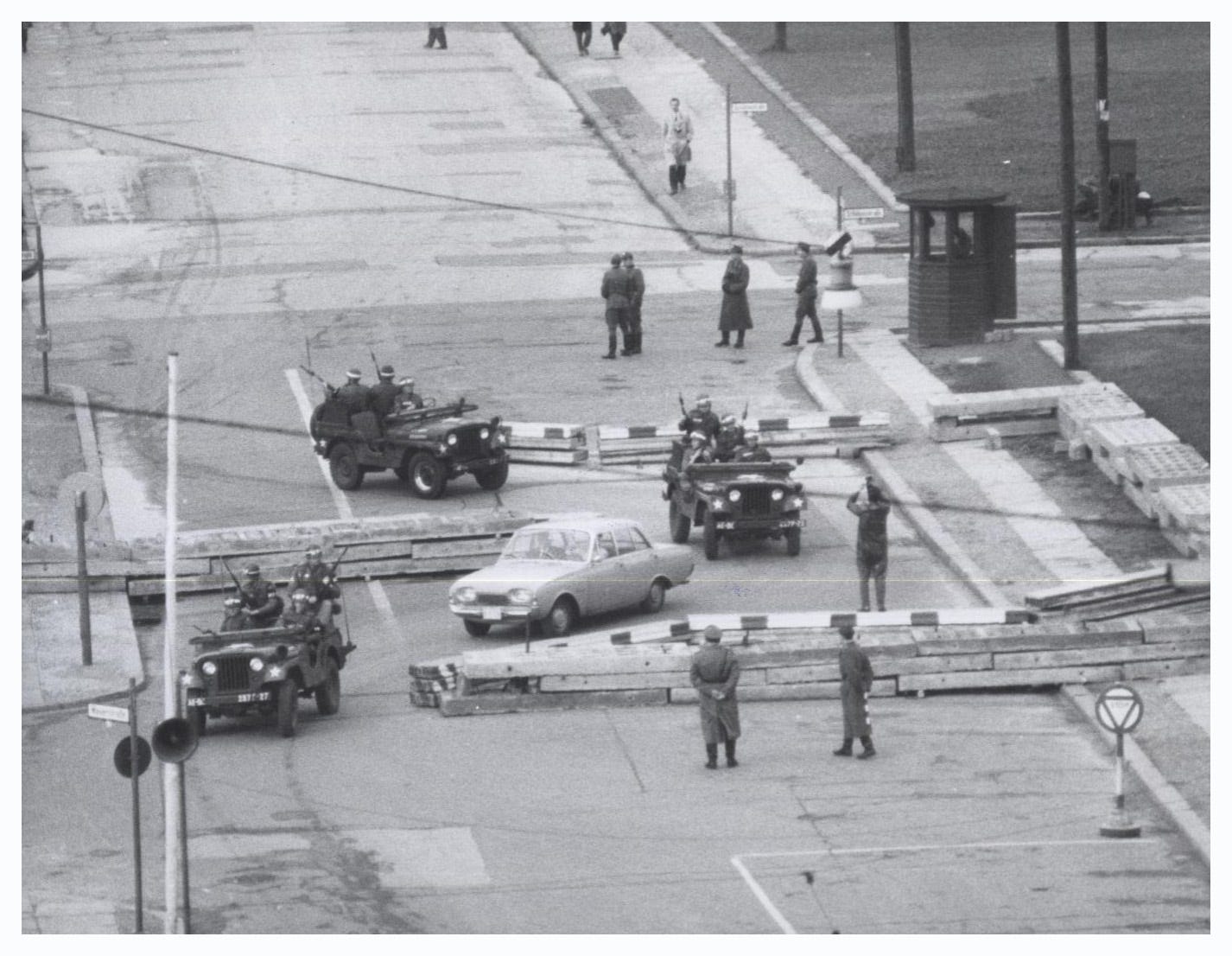
Central Intelligence Agency photo

The main rationale for this fiction was to give the Army an excuse to train in these areas. But the Aggressor documentation also specifically named the real American Communist Party as a possible ally of the fake adversary.

In addition, the training exercises against this trumped-up enemy sometimes included civilian populations. In 1952 the military turned Lampasas County in Texas into a virtual battleground between a Trigonist invader and liberating Army units.

82nd Airborne Division soldiers role-played the enemy forces wearing special uniforms and insignias. Troops set up the kind of checkpointsthe world had seen in occupied Germany right after World War II—and which still existed in 1961, as seen in the picture above from the Berlin Crisis.

US Can’t ‘Stick Our Heads In The Sand’ On Space Threats: Gen. Shelt

July 22, 2014 

Gen. William Shelton, commander of US Air Force Space Command.

WASHINGTON: Watch the skies. While they’re far from falling, the head of Air Force Space Command said today, the heavens aren’t the “peaceful sanctuary” they once were, either. Nothing short of a nuclear missile could pull the plug on a satellite constellation as robust as the Global Positioning System (GPS), Gen. William Shelton said, semi-reassuringly. But American policymakers, commanders, and citizens need to stop relying blithely on 100 percent performance from space systems, he went on, because potential adversaries packan increasingly sophisticated arsenal that ranges from computer viruses to jamming tolasers to anti-satellite missiles.

“Space has really become a utility. You plug in, take it for granted, and don’t even think about where the services came from,” Shelton said this morning at the Atlantic Council. Smart bombs, cell phones, and high finance all rely on GPS, for example. (The financial transactions use the GPS signal for precision timing, not location). Spy satellites are playing a role — Shelton wouldn’t say what — in figuring out who really shot down Malaysian Airlines Flight MH17 over the Ukraine. Even ground troops have come to depend on satellite bandwidth to communicate, track each others’ locations, and watch video from drones.

“Space is foundational capability for all military operations, yet we don’t really plan for anything but success,” said Shelton. Space assets are expensive but reliable, with 72 successful launches in a row and satellites routinely lasting longer than planned, so the Pentagon buys the bare minimum to cover the need. “We build just enough capability and we build it just in time,” he said, which, while attractive in a tight budget, leaves no margin for losses to accident or hostile action.

One veteran of both current space operations and futuristic wargames put it this way: “It’s not about how the Chinese can launch an anti-satellite weapon and take out any satellite in Low Earth Orbit [LEO],” Col. Alan “Rebel” Rebholz said at a recent Air Force Association breakfast. “It’s about how we prevent them from doing that. Whether it’s through physical action or State Department demarches, I don’t care, [but] we can’t afford to put a new LEOISR satellite into orbit because we just don’t have the cash.”

As an extreme example of what Shelton called “a big target,” the Advanced Extremely High Frequency (AEHF) satellites provide secure communications to commanders from the tactical level to the President. They’re also so expensive there are only four of them, Shelton said: “If an adversary were to take out one, just one satellite in the constellation, a geographic hole is opened and we potentially have a situation where the president can’t communicate with forces in that part of the world.”

“Now, we have a clear and present danger, [and] our satellites were not built with such threats in mind,” Shelton said, his words perhaps sharpened by his impending retirement in September. “I don’t believe we can just continue the status quo, stick our heads in the sand, and just hope for the best. I don’t think that’s a good strategy at all.”
Threats: From Hackers To Nukes

So what threats does Shelton worry about? “There’s a whole host of these things from the reversible to irreversible,” the general said. At the low end are cyber attacks, which he thinks are easy for enemies but try but unlikely to do actual damage. At the high end are electromagnetic pulse attacks that require the resources of a nuclear-armed nation-state but could fry satellites wholesale.

Admiral Mike Mullen on US Energy Security and the Shale Boom

By EDWARD DODGE
July 24, 2014

Photo Credit: Foreign Policy Initiative and Securing America’s Future Energy

Admiral Mike Mullen, retired Chairman of the Joint Chiefs of Staff, spoke on U.S. energy security last Wednesday in Washington DC at an event hosted by the groups Securing America’s Future Energy and the Foreign Policy Initiative.

Mullen was asked whether the US can take advantage of the surge in domestic energy production as a foreign policy tool.

Mullen answered, “Like it or not, sometimes it just isn’t stated this bluntly, but our interests, the United States interests [in the Middle East] are directly tied to energy security… That’s why we’ve been there, it’s why we’ll be there, and we’re going to be there, I think, for some time.”

Mullen said that the energy abundance that has emerged in the last four or five years, which was completely unpredictable, has given us leverage to improve our own energy security. “We need to take advantage of that, quite frankly, as rapidly as possible.”

“Five or six years ago, none of us would have been talking about any of this… and we are not sure where we will be in five years from now.”

Mullen went on to say that we must take care of our own country and our own people first, security policy, jobs, and the welfare of our own people. But we are still interconnected to the rest of the world and must help support stability globally and particularly in the Middle East, which is not going well right now. “This is core to our interests.”

“It’s not about energy independence because we’re not going to control the price of a barrel of oil, and while we might have a lot more of it ourselves, in the end we’re still going to be dependent on that price.”

The shale boom gives us an opportunity, a reprieve, to improve global security while determining how to reduce dependence on oil. The boom has provided the flexibility to manage shortfalls in production from Libya, Iraq and Nigeria that have constrained global supplies while also enabling the ability to leverage sanctions against Iran. US oil production enabled us to take 1.5 million barrels of Iranian oil off the market with sanctions without seeing a price spike. Over the longer term, US natural gas and potential oil exports could provide European companies with some alternatives to Russian energy supplies.

The U.S. Army Once Created a Whole Alternate History For Its War Games

Joe Trevithick 
23Jul 2014

Fake military blended World War II and early Cold War fears

In the late 1940s, the U.S. Army created an entire fake military that it could use for realistic training. The ground combat branch developed a deep and complex history for this “aggressor” that reflected concerns from World War II and the emerging Cold War.

The basic premise, as described in a series of official field manuals, was that a “totalitarian state … [had] established a fascist-type of organization called the Circle Trigon Party” in a devastated post-war Western Europe. These “Circle Trigonists” clearly were aping the Nazis.

The “official” history stated that the party formed in Bavaria, Germany before spreading into Tyrol in Austria, southern France, northern Italy and Spain. Washington feared that many Nazis had fled to these locales after World War II.

The Trigonist emblem also seemed to take its cue from the simplicity of many fascist symbols. The national insignia consisted of just a white circle with a green triangle in the center.

“Aggressor” military campaigns in the United States from the Army’s alternate 1940s history. Army map

The ground combat branch also clearly was worried about other enemies besides resurgent fascists. Still, early versions of the Trigonist back story didn’t mention the word “communist” at all.

But the Circle Trigon’s three-man triumvirate government could describe a Soviet-style “people’s committee” just as well as it did the Germany-Italy-Japan axis. The movement’s ideology also “freely used the terms ‘democracy,’ ‘the people’ and other similar terms”—something that was also true of Marxist-Leninist groups.

Later editions of the aggressor manuals eventually spelled out the connection, defining communists as Trigonist sympathizers and potential collaborators.

This communist connection—first implied and then explicit—neatly played into the public fear of Soviet expansion. From the very beginning, the Army’s alternate history included an invasion of the continental United States.

America’s Flight 17 6.8k 446 The time the United States blew up a passenger plane—and tried to cover it up


Secretary of Defense Frank Carlucci answers questions from the press regarding the downing of Iran Air Flight 655 at the Pentagon on Aug. 19, 1988.

Photo by Josn Oscar Sosa/U.S. Federal Government 

Fury and frustration still mount over the downing of Malaysia Airlines Flight 17, and justly so. But before accusing Russian President Vladimir Putin of war crimes or dismissing the entire episode as a tragic fluke, it’s worth looking back at another doomed passenger plane—Iran Air Flight 655—shot down on July 3, 1988, not by some scruffy rebel on contested soil but by a U.S. Navy captain in command of an Aegis-class cruiser called the Vincennes.

A quarter-century later, the Vincennesis almost completely forgotten, but it still ranks as the world’s seventh deadliest air disaster (Malaysia Airlines Flight 17 is the sixth) and one of the Pentagon’s most inexcusable disgraces.

In several ways, the two calamities are similar. The Malaysian Boeing 777 wandered into a messy civil war in eastern Ukraine, near the Russian border; the Iranian Airbus A300 wandered into a naval skirmish—one of many clashes in the ongoing “Tanker War” (another forgotten conflict)—in the Strait of Hormuz. The likely pro-Russia rebel thought that he was shooting at a Ukrainian military-transport plane; the U.S. Navy captain, Will Rogers III, mistook the Airbus for an F-14 fighter jet. The Russian SA-11 surface-to-air missile that downed the Malaysian plane killed 298 passengers, including 80 children; the American SM-2 surface-to-air missile that downed the Iranian plane killed 290 passengers, including 66 children. After last week’s incident, Russian officials told various lies to cover up their culpability and blamed the Ukrainian government; after the 1988 incident, American officials told various lies and blamed the Iranian pilot. Not until eight years later did the U.S. government compensate the victims’ families, and even then expressed “deep regret,” not an apology.


The USS Vincennes returns from deployment on Oct. 24, 1988, just months after shooting down Iran Air Flight 655 over the Strait of Hormuz.

Photo by Ronald W. Erdrich/U.S. Navy 

As the Boston Globe’s defense correspondent at the time, I reported on theVincennes shoot-down, and I have gone back over my clips, chronicling the official lies and misstatements as they unraveled. Here’s the truly dismaying part of the story. On Aug. 19, 1988, nearly seven weeks after the event, the Pentagon issued a 53-page report on the incident. Though the text didn’t say so directly, it found that nearly all the initial details about the shoot-down—the “facts” that senior officials cited to put all the blame on Iran Air’s pilot—were wrong. And yet the August report still concluded that the captain and all the other Vincennes officers acted properly.

The 12 Best Books The Marine Corps Wants Its Leaders To Read


"The Red Badge Of Courage" by Stephen Crane

"The Red Badge Of Courage" by Stephen Crane is considered a classic of American literature.

This book is recommended for new recruits and is a great selection as the book follows a man who enlists full of bravado and then flees in cowardice during the Civil War.

War is easy to romanticize until you're in the middle of it, as Crane's work makes clear. While the battle scenes in the book received high praise for realism, the author never experienced war firsthand.

"Making The Corps" by Tom Ricks

In "Making The Corps," journalist Tom Ricks follows a platoon of recruits through the rigorous training of Marine Corps boot camp. Many Marine recruits are fresh out of high school, and this book chronicles the process that transforms young men and women from civilians into Marines.

This book is recommended for midshipmen and officer candidates whose initial training is different from the enlisted Marines they hope to one day lead. If you've ever wondered what life is like in Marine Corps boot camp, this book gives one of the best accounts.

"Blink: The Power Of Thinking Without Thinking" by Malcolm Gladwell

Malcolm Gladwell's book "Blink" is one of two books by the author on the Commandant's Reading List, the other being "Outliers." Military leaders are often required to make quick decisions with limited information and "Blink" addresses the ability of the mind to make snap decisions and the influences that corrupt the decision-making process.

"Blink" also has a fascinating chapter on the Millennium Challenge 2002 exercise where the military brought Lt. Gen. Paul Van Riper out of retirement to lead enemy forces in a wargame against the United States. As the book notes, Van Riper thought outside the box in countering his U.S. military foe, and obliterated their forces in the exercise.

Is War Really on the Decline? And if so, Why?

July 24, 2014

Courtesy of Jayel Aheram.

AlexAK, who commented on our “Would Someone Please Explain This to Me?” post, asked this question:

Do you agree that the recent decline in inter-state warfare (and as some claim all kinds of warfare) (aka Pinker/Goldstein…) is a result of the transformation of war (as argue Shaw, Kaldor, etc.)? (and not a result of democratic peace, nuclear weapons, unipolarity, etc. –> theories that view war as a constant).- If so, is the main culprit that opened up these new spaces of violence really found in the economic sphere (aka economic globalization –> weakening of the state) as Kaldor, etc. claim? Could one not make an equal claim that this is the result of technological, political, judicial, moral, religious, changes?

A good question that might require a dissertation-length answer. Lemme try to square the circle that has Dick Cheney telling Politico that, “The world’s not getting safer, it’s getting far more dangerous,” at the same time that there is a cottage industry of new books proclaiming “peace in our time” and that war is over. So which is it?

Let’s review: Incidents of terrorism are thought to be on the increase, but Pape and others challenge the validity of the government-sponsored data. Looking at war, the overwhelming bulk of conflicts remain internal or irregular, which explains the renewed attention among academics and policymakers to civil war studies (and blogs like this one). Last year, for instance, there were zero interstate conflicts but 24 intrastate conflicts, according to Uppsala Conflict Data Program data. A few analysts have pointed to a new kind of warfare. Call it what you will: John Schindler refers to it as “special war,” Mary Kaldor calls them “new wars,” and John Nagl has dubbed them “knife fights.” Most observers describe it as a kind of “hybrid warfare” that is asymmetric, legally messy, involving targeted killings, Special Force units, chemical weapons, terrorism, cyber warfare, and other indirect means to achieve ends that are anything but clear-cut. Regardless, we can expect such types of conflicts to be more frequent in the future (see here and here). Of the 41 lethal uses of force – or what Micah Zenko calls a discrete militarized operation (DMO) – by the US between 1990 and 2010, all but five were against nonstate actors.

So what do IR theorists have to say about all these trends, if anything? Many scholars have struggled to account for, much less code, these new types of war. From a social scientist’s perspective, many of these so-called “new wars” can get lost in the data, given the unconventional style in which they’re fought. As James Fearon asked last year in the Monkey Cage, “Is the US fighting one war, or four?” It’s made murkier by the fact that states no longer formally declare war, for reasons Tanisha Fazal outlines here. The prevailing wisdom points to the distribution of power within the system as accounting for the decline of interstate violence (Wolhforth and Monteiro outline these contrasting views nicely). A few chalk up the decline to the spread of democracies or the presence of Golden Arches. John Mueller has pointed to the public’s revulsion of war as an “idea” of settling disputes, much as slavery and dueling became seen as abhorrent and outdated (a notion Christopher Coker, among others, has challenged).

Moreover, there is widespread skepticism within the field of some of the theories advanced by Pinker et al., about the decline of violence throughout history (Pinker more or less chalks it up to a “pacification process”; Goldstein points to the success of peacekeeping, whereas Gat says peace has just gotten more profitable; Fry says that war is an aberration; Morris argues just the opposite). At least one prominent political scientist/anthropologist I know called Pinker’s theories complete bunk!

Lessons from the Cold War

July 2014

Mackubin “Mac” Owens is Editor of Orbis, FPRI's quarterly journal of international affairs, and Senior Fellow at itsProgram on National Security. He is also Professor of National Security Affairs at the Naval War College in Newport, Rhode Island. He served as a Marine infantry platoon commander in Vietnam (1968-69), where he was twice wounded and awarded the Silver Star medal. He retired from the Marine Corps Reserve as a Colonel in 1994. This E-Note is excerpted from his editorial column in the Summer 2014 issue of Orbis.

“Reputation of power is power, because it draweth with it the adherence of those that need protection,” writes Thomas Hobbes, in Leviathan.

Does American “credibility” in foreign policy matter? Many commentators answer in the negative. For instance, Peter Beinart, of The Atlantic, has contended that what he calls the “credibility fallacy” is an excuse to avoid complex discussions of America’s global interests. It is all too true that foreign policy posturing is unhelpful, but as recent global event have illustrated, both America’s adversaries and friends pay attention to what the United States says and does. The perception of American weakness emboldens the former and disheartens the latter.

Russia, China, Syria, and Iran all seem to act in accordance with their perceptions of U.S. resolve. Our adversaries are always probing for weakness, timidity, and uncertainty. When they encounter strength, they tend to be deterred. When they encounter weakness, they often push harder. This behavior is a logical form of geopolitical net assessment.

For instance, during the Cold War, the Soviets based their policy on an assessment of the “correlation of forces” (COF). When Soviet leaders believed that the COF was shifting in favor of the USSR, they tended to act more aggressively.

During the 1970s, the usually cautious Soviet Union began to pursue an uncharacteristically aggressive foreign policy. The Soviets sought nuclear superiority at both the strategic and theater levels, in the first case deploying the SS-18 inter-continental ballistic missile and in the second, deploying the SS-20 intermediate range ballistic missile. The Soviets also invaded Afghanistan and pursued an increasingly activist policy in Africa and Central America.

A number of analysts attributed this adventurism to the apparent belief that the trends during this decade indicated a favorable shift in the COF. Indeed, the Soviet military press during this decade was filled with numerous references to the COF. For instance in 1975, General Yevdokim Yeogovich Mal’Tsev wrote that “the correlation of world forces has changed fundamentally in favor of socialism and to the detriment of capitalism.”

Soviet analysts have long disagreed about the importance of COF as a practical guide to action. In 1951 Raymond Garthoff, a prominent Soviet policy observer, summarized the concept: “The calculation of the relation of forces is a most convenient means for internally and externally rationalizing the interpretation of Marxian ideology in pure power terms.” As “scientific socialists,” the Soviets believed that history led inexorably to a revolutionary communist future. But following the lead of Vladimir Lenin, they believed that the Party was necessary to sustain the momentum of revolution by orchestrating actions appropriate to the historical situation. COF was an attempt to assess correctly the historical situation.

Many of those Soviet observers, who took COF seriously, attributed Soviet adventurism in the 1970s to Soviet perceptions of U.S. weaknesses—perceptions that mirror the situation today. According to this analysis, the Watergate crisis that ended the presidency of Richard Nixon, the U.S. defeat in Vietnam, the incredibly weak administration of Jimmy Carter, the decline of the U.S. defense budget, the contraction of U.S. naval force structure and the reduction of land force readiness, the abandonment of Taiwan, negotiations intended to give up control of the Panama Canal, and the Iran hostage crisis, indicated to Soviet leaders that the position of the United States relative to the USSR was weakening and that an assessment of the COF indicated that the time had come to exploit the situation. One result was the articulation of the Brezhnev Doctrine, which essentially declared that no country could leave the socialist camp—there would be no counterrevolution permitted here—limiting the struggle with capitalism to the zone of the latter. The Soviet Union seemed poised to win the Cold War.

Yet a decade later, the Soviet Union was in retreat: This retreat initially may have been the sort of tactical retrenchment that characterized, say, the Brest Litovsk treaty, understood as a temporary defensive measure making it possible for the Soviet Union to fight another day. But the setbacks soon constituted a strategic retreat of a kind that Lenin or Joseph Stalin never could have imagined, culminating in the collapse of the Soviet Union itself.

Army Needs Balance, Interoperability, Odierno Says

By Claudette Roulo
DoD News, Defense Media Activity

ASPEN, Colo., July 24, 2014 – In the debate about how large the Army should be as the Defense Department faces the return of sequestration spending cuts in fiscal year 2016, it's more important than ever to build a balanced force, Army Chief of Staff Gen. Ray Odierno said last night.

David Sanger, chief Washington correspondent for the New York Times, listens as Army Chief of Staff Gen. Ray Odierno responds to a question at the Aspen Security Forum in Aspen Colo., July 23, 2014. U.S. Army photo by Staff Sgt. Mikki L. Sprenkle 
(Click photo for screen-resolution image);high-resolution image available.

"I've been very clear … the president's strategy, that he built and we all signed up for in 2012, is a strategy that we think is sound," he said.

Under that strategy, the Army would shrink to about 490,000 soldiers, the general told the audience at the first day of the Aspen Security Forum.

"We believed that that size and the capabilities that come with that would allow us to execute that strategy,” Odierno said. “Since then, we've had some things come in the way, such as sequestration."

Based on the current budget, the Army will instead go down to about 440,000 or 450,000 soldiers by 2016, he said.

"What we don't know is what's going to happen after '16," Odierno said.

"If it goes to full sequestration, we're going to go to 420,000,” he added. “And I've been very clear that at 420,000, we cannot execute the current strategy. We will not have the capacity or capability to do it."

If full sequestration returns as scheduled, the general said, the national defense strategy would have to be rewritten. "For me, that is something that is somewhat concerning, because since 2012, the world has not become a safer place," Odierno said.

The Army must remain a balanced force as it downsizes, he said. Drones and special operations forces provide the capability to go after just one kind of threat -- terrorists, the general said.

"So if you believe that's the only threat we have, that's the way to build your force,” he added. “I personally believe we have much more diverse threats that we're going to face."

Declining budgets and unstable security situations also put greater importance on interoperability with U.S. partners and allies, he said.

U.S. Must Rethink Unsustainable Counterterrorism Strategy


By Steven Metz
July 23, 2014

While the world's attention this week was focused on Gaza and Ukraine, security remained precarious in Iraq and Afghanistan, the two lynchpins of America's conflict with transnational terrorism. The recent elections in Afghanistan offered a glimmer of optimism, but neither the Taliban's ability nor its willingness to launch terrorist attacks has abated. There is no sign that the Afghan security forces will someday be able to defeat the movement. Meanwhile, the Iraqi military cannot reverse the advances of ISIS extremists, and there is no sign that a competent, inclusive government will emerge in Baghdad. Iraq and Afghanistan remain stark reminders that America's counterterrorism strategy, developed by the Bush administration after the 9/11 attacks and largely adopted by the Obama administration, is increasingly ineffective and unsustainable. 

In a nutshell, this strategy sought the ultimate eradication of transnational terrorism, with the lead role played by national governments in the parts of the world where such terrorist groups arose. The United States would help these governments with assistance and training, and use the American military as a temporary backup when local security forces couldn't handle the job. Unfortunately, the strategy was born with deep flaws that become more and more evident over time. It incorrectly assumed that the states at the front line of the struggle shared America's priorities and goals. It overestimated the willingness of the American public to tolerate grinding military operations in far-flung places. And it did not accurately reflect the nature of the threat. ...

26 July 2014

15 years after the Kargil war, the Army hasn’t forgotten anything. It’s now better prepared with its men, machine & surveillance War or peace, Army has learnt its tough lessons

http://www.tribuneindia.com/2014/20140726/main7.htm
Azhar Qadri

Dras (Kargil), July 25
At the icy height of 10,760 ft, Dras welcomes its few visitors with a rusting, faded signboard: second coldest inhabited place in the world (temp: -60C on 09 Jan ’95). It is a place caught in a time warp which is slowly getting introduced to modern civilisation. The freezing winter, with mercury nose-diving to minus 45 degrees Celsius this year, is not the only highlight of “The Gateway to Ladakh”.


A soldier walks at a war memorial ahead of the Vijay Diwas celebrations in Dras, about 160 km east of Srinagar. Tribune Photo: Yawar Kabli

Army Chief General Bikram Singh addresses a gathering at the Kargil War Memorial in Dras on Friday. PTI

The Dras valley, which starts eastwards from the base of Zoji La and located 150 km from Srinagar city, was the epicentre of the 1999 Kargil war. Lost in the wilderness of its rugged surroundings , Dras is a tough place to live and a hard-to-imagine site of India's fourth war with Pakistan when a massive military mobilisation of infantry and artillery units snaked over an arduous mountainous track, crawling to an altitude of 11,649 feet to cross the Zoji La — a pass of blizzards.

The people here —believed to be of Central Asian ancestry who speak Balti and Dardi — live a simple life, which has remained unchanged with the changing times.

The fight is for survival, to live through a winter which cuts off this region from the entire world and restricts its residents to their thick-walled mud and stone houses.

The place is now witnessing the first glimpses of development. It has got macadam roads, a poor cellular network provided by only one service-provider and some slow speed Internet cafes frequented mostly by tourists.

Dras has become a transit point for bikers on way to Leh and its handful of motels and eateries serve visitors very basic cuisines.

There’s a tourist reception centre with no one at the counter. The only noticeable feature in the town is a signpost which points towards Tiger Hill, the famed souvenir of Kargil war, and eight minarets of four mosques.

Nearly 12 km from Dras town is Mushkoh - a narrow valley of wild yellow flowers with a strong enchanting fragrance. Mushkoh valley, also a battle site during the 1999 war, is less than a km wide and nearly 20 km long before the road ends at a forward artillery camp and becomes a no-go zone for civilians.

CAPTIVE IDEOLOGUES - History beyond Marxism and Hindutva

http://www.telegraphindia.com/1140726/jsp/opinion/story_18640785.jsp#.U9L6r_mSxIM

Politics and Play - Ramachandra Guha

In October 1984, I got my first academic job at the Centre for Studies in Social Sciences in Kolkata (then Calcutta). A week after I joined, a friend from Chennai (then Madras) sent me a petition on the plight of Tamils in Sri Lanka, which he hoped some of my colleagues would sign. The first person I asked was a senior historian of Northeast India, whose work I knew but with whom I had not yet spoken. He read the petition, and said: “As Marxists, the question you and I should be asking is whether taking up ethnic issues would deviate attention from the ongoing class struggle in Sri Lanka.”

My colleague was known to be a member of the Communist Party of India (Marxist). Yet I was struck by the way in which he took it for granted that I must be a party man too. Although this was our first meeting, he immediately assumed that any new entrant to the Centre must, like him and almost all the other members of the faculty, be a Marxist as well.

In the 1980s, Marxism occupied a dominant place in the best institutes of historical research in India. There were three reasons for this. One was intellectual, the fact that Marxism had challenged the conventional emphasis on kings, empires and wars by writing well-researched histories of peasants and workers instead. Indian history-writing was shaped by British exemplars, among them such great names as E.P. Thompson and Eric Hobsbawm, Marxist pioneers of what was known as ‘history from below’.

The second reason for Marxism’s pre-eminence was ideological. In the 1960s and 1970s, anti-colonial movements in Asia and Africa were led by Communist parties. Figures such as Ho Chi Minh and Samora Machel were icons in India (as in much of the Third World). These fighters for national freedom were supported by Soviet Russia and Communist China, but opposed by the United States of America and the capitalist world more generally. To be a Marxist while the Cold War raged, therefore, was to be seen as identifying with poor and oppressed people everywhere.

The third reason why there were so many Marxist historians in India was that they had access to State patronage. In 1969, the Congress split, and was reduced to a minority in the Lok Sabha. To continue in office, Prime Minister Indira Gandhi sought, and got, the support of MPs of the Communist Party of India. At the same time, several former Communists joined the Congress and were rewarded with cabinet positions. Now the ruling party began leaning strongly to the left in economic policy — as in the nationalization of banks, mines and oil companies —and in foreign policy, as in India’s ‘Treaty of Friendship’ with the Soviet Union.

Why Rafale is a Big Mistake

http://www.newindianexpress.com/columns/Why-Rafale-is-a-Big-Mistake/2014/07/25/article2346825.ece
By Bharat Karnad

Published: 25th July 2014

Why would India buy the Rafale combat aircraft rejected by every other interested country—Brazil, Canada, the Netherlands, Norway, South Korea, Singapore, and even the cash-rich but not particularly discriminating Saudi Arabia and Morocco?

The French foreign minister Laurent Fabius’s one-point agenda when he visited New Delhi was to seal the deal for Rafale, a warplane apparently fitting IAF’s idea of a Medium Multi-role Combat Aircraft (MMRCA) in the service’s unique typology, which includes “light” and “heavy” fighter planes as well, used by no other air force in the world. Alas, the first whiff of corruption led the previous defence minister, A K Antony, to seize up and shut shop, stranding the deal at the price negotiation committee stage. It is this stoppage Fabius sought to unclog.

France’s desperation is understandable. Absent the India deal, the Rafale production line will close down, the future of its aerospace sector will dim, and the entire edifice of French industrial R&D sector based on small and medium-sized firms—a version of the enormously successful German “Mittelstand” model—engaged in producing cutting-edge technologies could unravel, and grease France’s slide to second-rate technology power-status.

More immediately, it will lead to a marked increase in the unit cost of the aircraft—reportedly of as much as $5-$10 million dollars to the French Air Force, compelling it to limit the number it inducts. With no international customers and France itself unable to afford the pricey Rafale, the French military aviation industry will be at a crossroads. So, for Paris a lot is at stake and in India the French have found an easy mark, a country willing to pay excessively for an aircraft the IAF can well do without.

Consider the monies at stake. Let’s take the example of Brazil, our BRICS partner. For 36 Rafales the acquisition cost, according to Brazilian media, was $8.2 billion plus an additional $4 billion for short-period maintenance contracts, amounting to nearly $340 million per aircraft in this package and roughly $209 million as the price tag for a single Rafale without maintenance support. Brazil insisted on transfer of technology (ToT) and was told it had to pay a whole lot extra for it, as also for the weapons for its Rafales. But the Brazilian air force had doubts about the quality of the AESA (active electronically scanned array) radar enabling the aircraft to switch quickly from air-to-air to air-to-ground mode in flight, and about the helmet-mounted heads-up-display. Too high a price and too many problems convinced the government of president Dilma Rousseff that the Rafale was not worth the trouble or the money and junked the deal, opting for the Swedish Gripen NG instead.

India puts foot down at WTO

http://www.telegraphindia.com/1140726/jsp/business/story_18655596.jsp#.U9L6nfmSxIM

New Delhi, July 25: India told the World Trade Organisation (WTO) on Friday it would only back a world-wide reform of customs rules if its demands on food security were implemented in the same time frame.
“India is of the view that the Trade Facilitation Agreement must be implemented only as part of a single undertaking, including the permanent solution on food security,” Indian ambassador Anjali Prasad told a WTO meeting.

“My delegation is of the view that the adoption of the trade facilitation protocol be postponed till a permanent solution on public stockholding for food security is found.”
South Africa and Argentina supported India’s stand. The WTO was supposed to finalise the protocol by July 31 under an agreement reached among trade ministers in Bali last December.
Some estimates say the reforms in customs rules can add $1 trillion to the world economy and create 21 million jobs.

US ambassador to the WTO, Michael Punke, said Delhi’s stance could derail the whole process of world trade liberalisation. “Today we are extremely discouraged that a small handful of members in this organisation are ready to walk away from their commitments at Bali, to kill the Bali agreement.”
India, however, said, “The country’s expectations have been belied by the developments after the Bali ministerial. A clear will to engage in areas of interest to developing countries is conspicuously absent. To make matters worse, persistent efforts are being made to subvert the mandate by divesting it of its core elements.”

In a statement made in Geneva, where the 160 members of the WTO are meeting, India emphasised that a solution to the food subsidy issue was “important so that millions of farmers and poor families do not have to live in constant fear. To jeopardise the food security of millions at the altar of a mere anomaly of rules is unacceptable”.
“India is suggesting that let us start work in the right earnest on these issues and review the progress in October. The Committee on Agriculture can do back-to-back meetings for this,” a senior commerce ministry official said.
India feels a permanent deal on food stockpiling must be in place by the end of 2014, not by 2017 as previously agreed.

“While there has been progress on Trade Facilitation Agreement, other decisions, including a decision on public stockholding have been sidelined,” commerce minister Nirmala Sitharaman informed Parliament in a written reply today.
“Till there is an assurance and visible outcomes... India would find it difficult to join the consensus on the trade protocol,” she added.

On missing the deadline of July 31, the ministry official said: “We can defer the time... We are not saying that we want to postpone it to eternity.”
On the allegations that India was blocking the WTO’s Bali deal, the official said: “We have not blocked the deal. If that will be the interpretation, God knows how many times WTO has been blocked.”
“No body said the WTO was blocked in 2005, 2006, 2008, 2009, or in 2013. Every time some country — a developed one — put its foot down and said no,” the official added.
India is concerned that no movement has taken place on finding a permanent solution and developed countries could run away with an agreement on trade facilitation if the two are not linked.

The current WTO norms limit the value of food subsidies at 10 per cent of the total value of foodgrain production. However, the support is calculated at the prices that are over two-decade old.
“The developed nations must be told in clear terms that the issue of farmers’ security and welfare of the poor is not negotiable,” Assocham said.

India’s neighbours fare better on key human development indicators

Published: July 26, 2014 00 

Ajai Sreevatsan

India also has the worst gender inequality in the region

In the two decades since the early 1990s when India liberalised its economy, countries like Nepal and Bangladesh have improved their human development indicators at a faster clip than India.
Though India ranks marginally higher than many of its South Asian neighbours in the 2014 UNDP Human Development Report released on Thursday, the country has fallen behind most of its immediate neighbours on key health and quality of life indicators, an analysis of health indices from nearly two decades of HDI numbers reveal.
Regional record
For example, in 1995, Bangladesh, Nepal, Bhutan and Pakistan were languishing far behind India in infant mortality. However, by 2010, all of them except Pakistan had caught up and surpassed India’s figure of 48 deaths per 1,000 live births.
Every other country in the region (except Pakistan) also spends a higher proportion of its national income on public health care. After Bangladesh surpassed India on a range of health indicators in 2003, India’s public expenditure on health actually fell. The UPA-I government kept health allocation at or less than one per cent of the GDP for the next five years.
In the meantime, private expenditure on healthcare shot up. A 2011 analysis by the medical journal The Lancet found that out of pocket expenditure on health in India is close to 78 per cent — in stark contrast with the Maldives (14%), Bhutan (29), and Sri Lanka (53%).
Among the seven SAARC nations (data for Afghanistan is unavailable), an average Indian is least likely to be vaccinated as a child, most likely to suffer from malnutrition (nearly half of those under 5), and has the lowest life expectancy.
Gender inequality
Somewhat unsurprisingly, India also has the worst gender inequality in the region (sharing the 127th place with Pakistan). The gulf between workforce participation of men and women is one of the widest in India among the seven countries.
What the human development reports show in essence is India’s failure to properly utilise the wealth created by its expanding economy, which doubled twice in the last two decades.
This is reflected in the supplementary surveys carried in the 2014 report, which indicates that among SAARC nations Indians are least satisfied with the standard of living (only 47% are satisfied).
However, their trust in the national government is quite healthy (with 54% answering yes).
 Printable version | Jul 26, 2014 6:46:50 AM | http://www.thehindu.com/news/national/indias-neighbours-fare-better-on-key-human-development-indicators/article6250277.ece

FDI Options: 49 percent or less versus 51 percent and more

09/07/2014 


The issue of FDI in defence has attracted much attention and serious debate since the Department of Industrial Policy and Promotion proposed 49 percent FDI in cases where there is no technology transfer, 74 percent with technology transfer and 100 percent when it came to state of-the-art technology. The prominent voices on the subject can be grouped into two camps. The conservatives want the cap to be at 49 percent and no more in view of the security concerns related to the sector. The realists, on the other hand, believe that the real funds will come in only if investors get to control their investments. The government’s decision on the subject will be influenced by many a stakeholders who are affected by the extent to which FDI is permitted, apart from the quest for self-reliance. 

The conservatives broadly include the trade unions, Defence Public Sector Undertakings and the Ordnance Factories Board, and surprisingly even certain sections of the domestic private sector. The Government Employees National Confederation, which claims to represent government employees working in the central and state government including local bodies, have submitted a memorandum to the Raksha Mantri on June 16, 2014 regarding their concerns on hike in FDI[i]. The Confederation in its letter to the Raksha Mantri have stated that “the major reason for reluctance in encouraging the Private Sector into defence production and welcome FDI in the sector is on account of concern for the Defence PSUs and the Ordnance Factories… it is clear that ... the role of the Defence PSUs and the Ordnance Factories would only be further marginalised”. 

Federation of Indian Chambers of Commerce and Industry(FICCI), which includes innovation majors Larsen & Toubro and Tata Power (strategic electronics division), has rejected the notion that raising FDI will stimulate domestic manufacturing. The FICCI believes that control should always remain in Indian hands (or cap at 49 percent), the foreign OEM must bring in "key technologies as required in the priority list of the Ministry of Defence", the foreign company's home government must provide "in-principle permission to share technology with Indian partner"; intellectual property rights generated by the joint venture must reside in India, amongst other conditions[ii]. While the idea of retaining control stands to reason, but foreign companies need to be really desperate to yield to such stated requirements. 

CII in past has vociferously demanded for increase in FDI, even up to 100 percent. One of its reports, “Creating a Vibrant Domestic Defence Manufacturing Sector” has projected that defence and aerospace sector has the potential of creating one million new jobs in the country and increased FDI will only expedite this process[iii]. However, recently they too have chosen to be guarded in their recommendations and have issued a statement that, "CII is hopeful that the present government is going to roll out a forward looking FDI policy in the defence sector at the earliest."[iv]. The industry which has since long complained regarding the inadequacy of the extent to which FDI is permitted, is apparently divided and almost conservative in the final moments of reckoning. However, at the same time there are strong domestic players with sound order books, who have urged the government to consider 51 to even 100percent FDI. 

The realists on the other hand reason that the present limit of 26 percent FDI has barely attracted FDI worth only $4.94 million in the sector in past 14 years. This is despite the fact that in the year 2013 India was the seventh most popular FDI destination in the world and it attracted $25.5 billion in FDI inflows in the year 2012 alone[v]. Therefore, while India clearly emerges as an attractive destination for FDI, the scanty FDI in defence is obviously as a consequence of restrictive policies in the sector. FDI Confidence Index of the country is very high but that of defence as a sector is extremely low. 

Moreover, arguments from the national security perspective also need to be seen in the correct perspective. The interesting reality is that for a foreign firm, refusal to accept 26 percent stake, can lead to retaining of 100 percent stake. An arms producer, who refuses to accept the current restrictive FDI terms and conditions, stands a chance to bag the complete order to supply the required weapons when imported.