11 August 2014

Know Thy Enemy: Cultural Intelligence and the Study of Causes of Terrorism

August 10, 2014

Islamic Terrorism Is The Result

strategypage.com , August 10, 2014

Ever since World War II there have been a growing number of advocates for CI (Cultural Intelligence, also known as “cultural topography”) within the U.S. military. This sort of thing involves the study, analysis and understanding of the cultural traditions, habits and beliefs of opponents, allies, and even the U.S. This is all part of an effort to seek better insight into what all concerned are capable of and who is likely to do what next.

In the United States the cultural intelligence found a home in the U.S. Army Special Forces, an organization that grew out of the World War II OSS (Office of Strategic Services). The CIA also evolved out of the OSS. Despite the success of the OSS that organization created a lot of enemies within the U.S. and was deactivated soon after the World War II ended in 1945. It did not take long for the OSS to be missed and thus the CIA and Special Forces were created by 1950.

Until the arrival of cheap and powerful computers, huge amounts of data available from all over the world and analysis software to mine (not just data mining) all this is was difficult to get people (especially military and government bureaucrats) to appreciate how important and useful CI actually was. During World War II the OSS used CI successfully a lot as have many others have throughout history. Same with the Special Forces during Vietnam and in subsequent conflicts. Gradually the senior military and intelligence officials began to accept the importance and usefulness of CI. After the 1990s the data mining and other analysis of large quantities of data from different cultures made it difficult to dismiss CI as irrelevant and not useful.

Case in point is the use in CI in determining the causes of the current outbreak of Islamic terrorism and possible solutions. That effort has encountered problems because CI frankly discusses firmly held myths. Take for example the fact that most Moslem victims of war and terrorism are killed by other Moslems and despite over half a century of animosity towards Israel by a larger, and because of oil income, quite wealthy Arab coalition, Israel not only still exists but thrives compared to its Arab opponents. By every measure the much reviled Jews have done better than the Arabs. To explain away this Israeli success it is accepted fact (by most Arab leaders, journalists and so on) that all this was only possible because of vast conspiracy engineered by the United States and the West in general. This is considered absurd in the West but is still widely accepted in the Arab world. Unfortunately this key cultural difference is rarely mentioned in Western media. Yet any Western diplomat or businessman working in the Arab world quickly becomes aware of this different attitude and adjusts their own behavior to survive (or at least get the job done)/

Russian Defense Ministry Denies That 12 GRU Spetsnaz Commandos Have Been Killed in Ukraine Fighting

August 10, 2014

Russian Defence Ministry denies reports about its commandoes killed in Ukraine

ITAR-TASS , August 9, 2014

"As Winston Churchill once said, if the truth is multifaceted, a lie is always polyphonic”, Major General Igor Konashenkov said


© ITAR-TASS/Sergei Karpov
MOSCOW, August 09. /ITAR-TASS/. The Russian Defence Ministry on Saturday denied Western media reports alleging that 12 Russian Army Main Intelligence Directorate (GRU) commandos had been killed in Ukraine and described them as “a fake”.

It said the same allegations had already been carried by Ukrainian mass media several weeks ago. Now they were reported by The Financial Times.

“Sam Jones [the author of the article], who specialises in Russian affairs and who has numerous sources in the MI-6 [British intelligence service] has deeply swallowed the fake that was played out several weeks ago by Ukrainian mass media. But he barely digested it as can be seen from his article,” Defence Ministry spokesperson, Major General Igor Konashenkov said.

He said the whole text was riddled with “cliches and copied passages from Wikipedia.”

“There is nothing concrete, only some obscure ‘information’ from social networks and far-fetched ambiguous comments by anonymous sources from British intelligence services. As a result, he made a whole essay. But as Winston Churchill once said, if the truth is multifaceted, a lie is always polyphonic,” Konashenkov said, adding that The Financial Times has a serious business audience which “as a rule does not appreciate sapless propaganda tricks”.

Every time the U.S. touches the Middle East, it makes things worse. It's time to walk away and not look back.

AUGUST 7, 2014

In case you hadn't noticed, the Middle East is going from bad to worse these days. 

The Syrian civil war grinds on. Israel and the Palestinians spent the last month in another pointless bloodletting (most of the blood being Palestinian). ISIS keeps expanding its control in parts of Iraq, placing thousands of members of the Yazidi religious sect in peril and leading the Obama administration to consider airstrikes or some form of airborne humanitarian aid. Meanwhile, officials back in Baghdad snipe mostly at each other. Libya continues to unravel, belying the high-fives that liberal hawks gave themselves back when Qaddafi fell. A U.S. general was shot and killed in Afghanistan, and another disputed election threatens democracy there and may give the Taliban new opportunities to make gains at Kabul's expense. Turkey's Prime Minister Recip Erdogan has been calling Egyptian President Abdul Fattah al-Sisi a "tyrant," an irony given Erdogan's own authoritarian tendencies. A diplomatic spat between Saudi Arabia, the United Arab Emirates, and Qatar remains unsettled. Nature even seems to be against us: the MERS virus on the Arabian Peninsula may be transmissible by airborne contact. I'm sure you could find some good news if you tried, but you'd have to squint pretty hard.

A string of events like this attracts critics and Cassandras like yellow jackets to a backyard picnic. In the Washington Post, neoconservativeEliot Cohen laments the "wreckage" of U.S. Middle East policy, blaming everything on Barack Obama's failure to recognize "war is war" and his reluctance to rally the nation to wage more of them. (Never mind that the last war Cohen helped get the United States into -- the invasion of Iraq in 2003 -- did far more damage than anything Obama has done.) A far more convincing perspective comes from former Ambassador Chas Freemanwho surveys several decades of America's meddling in the region and comes to a depressing conclusion: "It's hard to think of any American project in the Middle East that is not now at or near a dead end."

Is there a silver lining in this disheartening tableaux? Perhaps. After all, when things are this bad, the need to rethink the entire U.S. approach to the region is hard to escape. If we cast aside familiar shibboleths and taboos and took a fresh look, what might we see?

Since World War II, the meddling that Freeman recounts has been conducted in partnership with various regional allies. These alignments may have been a strategic necessity during the Cold War (though even that could be debated), but the sad fact is that the United States has no appealing partners left today. Egypt is a corrupt military dictatorship with grim prospects, and Erdogan's AKP regime in Turkey is trending toward one-party rule, while its ambitious "zero problems" foreign policy has gone badly off the rails. Working with the Assad regime in Syria is out of the question -- for good reason -- but most of Bashar al-Assad's opponents are no prize either. Saudi Arabia is a geriatric, theocratic monarchy that treats half its population -- i.e., its women -- like second-class citizens (at best). Iran is a different sort of theocratic state: it has some quasi-democratic features, but also an abysmal human rights record and worrisome regional ambitions.

The view doesn't get much better no matter where one looks. The Hashemite monarchy in Jordan has been an ally for decades, but it remains heavily dependent on outside support and is too weak and fragile to be the linchpin of U.S. engagement. The same is true for Lebanon. Libya doesn't even have a government, let alone one the United States would want to be close to. Israel is wrapping up its latest outrage against the Palestinians-to no lasting strategic purpose--and its march to the right now includes open advocacy of eliminationist policies by prominent political figures. The "special relationship" with Israel also fuels anti-Americanism and makes Washington look both hypocritical and ineffectual in the eyes of much of the world. But Palestinian political groups are no more appealing: the Palestinian Authority is corrupt and ineffectual and elements of Hamas still proclaim the worst sort of toxic anti-Semitism. States like Qatar and Bahrain do provide valuable real estate for U.S. bases, and many of these governments cooperate with the United States out of their own self-interest, but it's hard to find anyone in the region that looks like a genuine strategic or moral asset these days.

Faced with this unpromising environment, what would be the sensible -- or dare I say realistic -- thing for the United States to do?Faced with this unpromising environment, what would be the sensible -- or dare I say realistic -- thing for the United States to do? The familiar answer is to say that it's an imperfect world and that we have no choice but to work with what we've got. We hold our noses, and cut deals with the least objectionable parties in the region. As Michael Corleone would say, it's not personal; it's strictly business.

New Iraq mission’s tough question: What does U.S. do if Islamic State survives?

BY NANCY A. YOUSSEF 
McClatchy Washington BureauAugust 8, 2014 

This image made from AP video shows smoke rising from airstrikes targeting Islamic State militants near the Khazer checkpoint outside of the city of Irbil in northern Iraq, Friday, Aug. 8, 2014. (AP Photo via AP video)UNCREDITED — AP 

WASHINGTON — As the United States announced its first airstrikes inside Iraq nearly three years after the military had furled its colors in Baghdad and declared the war complete, it sought to minimize fears that the latest effort could lead to “mission creep.”

The Pentagon used Twitter to announced the opening salvo of the U.S. re-involvement in Iraq, a strike on an Islamic State-operated 155mm howitzer and truck. It announced the second and third U.S. strikes later Friday in a five-sentence statement. No generals were made available to discuss the details of the actions because, the Pentagon said, the strikes were so small. Officials at the White House and the Pentagon alike stressed that the latest U.S. effort was limited, designed in part to deter the Islamic State. And, they said, strikes would only happen in instances where U.S. forces or personnel could be in jeopardy.

But the new U.S. Iraq engagement already had ballooned from the previous day, when President Barack Obama used more than 1,100 words of his 1,332-word speech to the nation to portray the effort as primarily a humanitarian mission to help prevent the genocide of trapped religious minorities forced to leave their homes by an Islamic State onslaught. Fewer than 200 words were devoted to the other mission, protecting American personnel.

Less than 12 hours after he finished speaking, the United States had already struck twice and a third bombing run was just a few hours away. The quick series of airstrikes raised fears among some of mission creep _ a term coined during the Vietnam War to describe a growing commitment of men and materiel after initial steps failed to produce the desired result.

But there were also a number of analysts who feared that the Obama administration wasn't being ambitious enough.

Islamic State in Iraq and Syria

Authors: Zachary Laub, Online Writer/Editor, and Jonathan Masters, Deputy Editor 
Updated: August 8, 2014 


Introduction

Islamic State in Iraq and Syria (ISIS), a predominantly Sunni jihadist group, seeks to sow civil unrest in Iraq and the Levant with the aim of establishing a caliphate—a single, transnational Islamic state based on sharia. The group emerged in the ashes of the U.S.-led invasion to oust Saddam Hussein as al-Qaeda in Iraq (AQI), and the insurgency that followed provided it with fertile ground to wage a guerrilla war against coalition forces and their domestic allies.

After a U.S. counterterrorism campaign and Sunni efforts to maintain local security in what was known as the Tribal Awakening, AQI violence diminished from its peak in 2006–2007. But since the withdrawal of U.S. forces in late 2011, the group has increased attacks on mainly Shiite targets in what is seen as an attempt to reignite conflict between Iraq's Sunni minority and the Shiite-dominated government of Prime Minister Nouri al-Maliki. Burgeoning violence in 2013 left nearly eight thousand civilians dead, making it Iraq's bloodiest year since 2008, according to the United Nations. Meanwhile, in 2012 the group adopted its new moniker, ISIS (sometimes translated as Islamic State of Iraq and the Levant, or ISIL) as an expression of its broadened ambitions as its fighters have crossed into neighboring Syria to challenge both the Assad regime and secular and Islamist opposition groups there. By June 2014, the group's fighters had routed the Iraqi military in the major cities of Fallujah and Mosul and established territorial control and administrative structures on both sides of the Iraqi-Syrian border.

Origins

The insurgent group was launched by Abu Musab al-Zarqawi, an Arab of Jordanian descent, and flourished in the sectarian tensions that followed the U.S.-led invasion of Iraq in 2003. Zarqawi had commanded volunteers in Herat, Afghanistan, before fleeing to northern Iraq in 2001. There he joined with Ansar al-Islam (Partisans of Islam), a militant Kurdish separatist movement, for whom he led the group's Arab contingent. Analysts say this group, not al-Qaeda, was the precursor to AQI.

Ahead of the 2003 invasion, U.S. officials made a case before the UN Security Council linking Zarqawi's group with Osama bin Laden, though some experts say it wasn't until October 2004 that Zarqawi vowed obedience to the al-Qaeda leader. The U.S. State Department designated AQI a foreign terrorist organization that same month. "For al-Qaeda, attaching its name to Zarqawi's activities enabled it to maintain relevance even as its core forces were destroyed [in Afghanistan] or on the run," wrote Brian Fishman, a counterterrorism fellow at the New America Foundation.

According to a 2011 report by the Center for Strategic and International Studies, Zarqawi developed a four-pronged strategy [PDF] to defeat the coalition: isolate U.S. forces by targeting its allies; discourage Iraqi collaboration by targeting government infrastructure and personnel; target reconstruction efforts through high-profile attacks on civilian contractors and aid workers; and draw the U.S. military into a Sunni-Shiite civil war by targeting Shiites.

Who are the Yazidis?

August 7, 2014

Yazidi women who fled the violence in the northern Iraqi town of Sinjar, take shelter in a school in the Kurdish city of Dohuk (Safin Hamed/Agence France-Presse via Getty Images) 

It's tragic that the world pays attention to largely forgotten communities only in their moments of greatest peril. This week, we've watched as tens of thousands of Yazidis — a mostly Kurdish-speaking people who practice a unique, syncretic faith — fled the advance through northern Iraq of the Islamic State's Sunni jihadists, who have set about abducting and killing hundreds of members of this religious minority. As The Washington Post's Loveday Morris reports, as many as 40,000 remain stranded on "the craggy peaks of Mount Sinjar," dying of hunger and thirst and devoid of much support from a faltering Iraqi government. (Days after the Yazidis' plight became known, the Obama administration authorized air strikes in northern Iraq against the Islamist rebels.) 

Ever since seizing Mosul, Iraq's main urban center in the north, the forces of the Islamic State have embarked on a gruesome mission to transform their domain into an idealized Caliphate — on the way, they've forced the conversion of religious minorities, destroyed the shrines of rival sects and butchered those they consider apostates. Yesterday, a distraught Yazidi member of parliament in Baghdad made an impassioned appeal on behalf of her people: "An entire religion is being exterminated from the face of the Earth," she said. 

The Yazidis, globally, number about 700,000 people, but the vast majority of the community — about half a million to 600,000 — live concentrated in Iraq's north. The city of Sinjar was their heartland. Now, it's in the possession of extremists who seem bent on ethnic cleansing. 

The Yazidi faith is a fascinating mix of ancient religions. Its reputed founder was an 11th-century Umayyad sheik whose lineage connected him to the first great Islamic political dynasty. His tomb in the Iraqi city of Lalish is a site of Yazidi pilgrimage, mirroring the Sufi practices of millions of Muslims elsewhere; now, there are reports of the town being turned into a refugee camp for the displaced. 

Despite its connections to Islam, the faith remains distinctly apart. It was one of the non-Abrahamic creeds left in the Middle East, drawing on various pre-Islamic and Persian traditions. Yazidis believe in a form of reincarnation and adhere to a strict caste system. Yazidism borrows from Zoroastrianism, which held sway in what's now Iran and its environs before the advent of Islam, and even the mysteries of Mithraism, a quasi-monotheistic religion that was popular for centuries in the Roman Empire, particularly among soldiers. Not unlike the rituals of India's Parsis — latter-day Zoroastrians — Yazidis light candles in religious ceremonies as a sign of the triumph of light over darkness. 

Daily Iraq Situation Summary

Iraq Situation Report
Institute for the Study of War

August 8, 2014

U.S. Airstrikes in Northern Iraq Are All About Oil

AUGUST 8, 2014

Last night, President Barack Obama announced that he was authorizing American airtstrikes in Iraq. He described his intervention as a “humanitarian effort to help save thousands of Iraqi civilians who are trapped on a mountain” and as an effort “to protect our American personnel.” One word that he didn’t mention is “oil,” but it lies near the center of American motives for intervention.

The United States is conducting airdrops to aid the Yazidis who have fled the advance of Islamic State militants, but it is conducting airstrikes around Erbil, which is to the west. There are American consular personnel in Erbil, but they could be evacuated if necessary. What Obama left unsaid was that Erbil, a city of 1.5 million, is the capital of the Kurdish regional government and the administrative center of its oil industry, which accounts for about a quarter of Iraq’s oil. The Kurds claim that if they were to become an independent state, they would have the ninth-largest oil reserves in the world. And oil wells are near Erbil.

If the Islamic State were to take over Erbil, they would endanger Iraq’s oil production and, by extension, global access to oil. Prices would surge at a time when Europe, which buys oil from Iraq, has still not escaped the global recession. Oil prices have already risen in response to the Islamic State’s threat to Erbil, and on Thursday, American oil companies Chevron and Exxon Mobile began evacuating their personnel from Kurdistan. But oil traders are predicting that American intervention could halt the rise. “In essence we find U.S. air strikes more bearish than bullish for oil as the act finally draws a line for IS and reinforces both the stability in south Iraq and in Kurdistan,” Oliver Jakob, a Swiss oil analyst, told Reuters.

In portraying American intervention in Iraq as a purely humanitarian effort, Obama is following the script he read from in Libya, when he justified American intervention as an effort to prevent a massacre in Benghazi. In a March 28, 2011 address to the nation, Obama painted the American intervention as a response to “brutal repression and a looming humanitarian crisis.” Oil was not mentioned, even though Libya was the world’s sixteenth-largest oil producer in 2009 and a major supplier to Europe. But oil was most likely involved, as became clear when, after preventing a massacre in Benghazi, the United States and its coalition partners stuck around to topple the regime of Muammar Qaddafi. If the Obama administration wanted to prevent the world’s peoples from brutal dictators and repressive regimes or from takeovers by terrorist groups, there are other countries besides Libya and Iraq where it could intervene. What distinguishes these two countries is that they are major oil producers.

The United States should worry about the global oil supply. It is important for global economic and political stability. And having a significant chunk of it fall into the hands of a group like the Islamic State should certainly be a concern. But if Obama is worried about the world’s oil supply, then he should say so forthrightly and not leave himself in a position where he will be unable to justify or explain further intervention after the airdrops to the Yazidis are completed. And the administration should also have a plan for making sure that in sending out the Air Force, it will actually end a dire threat to Iraq’s oil production and put Iraq back on its feet. In Libya, the U.S. and its partners succeeded in getting rid of Muammar Qaddafi, but not in resolving the country’s humanitarian crisis or in keeping its oil flowing. Oil production has plummeted as Libya has been plunged into anarchy after Qaddafi’s fall. The challenge in Erbil and Iraq is even more daunting.

Why Obama's campaign in Iraq could require 15,000 troops

By Andrew Tilghman
Aug. 8, 2014 

Airman 1st Class Matthew Perry, right, and Army Sgt. 1st Class Darryl Honick, left, walk back to the Mine-Resistant, Ambush-Protected, All-Terrain Vehicle after supporting Operation Spartan Shield on Sept. 11, 2012, in Southwest Asia. Perry is a radio operator maintainer and driver with the 82nd Expeditionary Air Support Operations Squadron, and Honick is a joint fire observer, 3rd Battalion, 159th Attack Reconnaissance Battalion. (SSgt Jonathan Snyder/AFCENT Combat Camera)

President Obama says it all the time – no combat troops will return to Iraq.

But many experts believe it will be extremely hard to achieve Obama’s newly expanded military mission there without more Americans on the ground.

“I think the slippery slope analogy is the right one for Iraq right now,” said Barry Posen, director of the Security Studies program at the Massachusetts Institute of Technology.

On Thursday, Obama authorized a new open-ended operation in response to gains by the Islamic State militants in northern Iraq.

For now, the new mission relies on aircraft based outside Iraq. The U.S. will help defend the Kurdish city of Erbil from Islamic State fighters using “targeted air strikes,” Obama said. Those air strikes began Friday morning and included at least three separate bombings before noon, defense officials said.

The second mission is a commitment to protect some 40,000 Iraqi Yazidis who are trapped on a mountain surrounded by the militants. That began Thursday night with air drops of food and water for at least 8,000 people.

Military experts say tactical commanders will want more ground forces. Forward air controllers could provide more precise targeting information. U.S. advisers could support the Kurdish forces fighting the militants. And U.S. commanders may need to expand their intelligence effort on the ground.

In turn, U.S. forces might need a forward operating base with a security perimeter, more force protection and a logistical supply line. Medevac capabilities may require a helicopter detachment and a small aviation maintenance shed.

The Islamic State's Strategy Was Years in the Making


"Iwonder if Abu Bakr al-Baghdadi, the leader of the Islamic State, reads Mao?" That’s what I was thinking in my Istanbul flat yesterday as a series of disturbing reports arrived from next door in northern Iraq. With the Islamic State seizing the Mosul Dam, threatening thousands of Yazidi families with extermination in the Sinjar Mountains, and poised to advance on the Kurdish capital of Erbil, it seemed Abu Bakr had ripped a page out of Mao’s classic 1937 treatise On Guerilla Warfare.

Mao Zedong wrote the book at the outset of the Second Sino-Japanese War, when Japan invaded the Chinese mainland. It was an argument for a new type of struggle, one which he and the Chinese Communists successfully waged for the next eight years. It lays out what has since become widely accepted as the three-phase Maoist model, the gold standard of insurgency.

In phase one, the guerillas earn the population’s support by distributing propaganda and attacking the organs of government. In phase two, escalating attacks are launched against the government’s military forces and vital institutions. And in phase three, conventional warfare and fighting are used to seize cities, overthrow the government, and assume control of the country.

In Thursday night’s address to the nation, President Obama made frequent reference to the Islamic State, calling them “terrorists.” No doubt, their tactics over the past decade have been barbaric—mass executions and beheadings posted on YouTube—but to refer to them simply as “terrorists” negates their very serious political goals: The establishment of a Caliphate straddling present day Iraq and Syria, stretching to the Mediterranean Sea.

If America is serious about disrupting the Islamic State’s agenda, we must first understand it. A less than nuanced understanding of the adversary was one of our great strategic blunders during Vietnam, when the Maoist three-phase model was used effectively against us, culminating in the 1972 Easter Offensive when columns of North Vietnamese regulars invaded South Vietnam, leading to the eventual 1975 fall of Saigon. While American policy makers spoke about “domino theory” and “rolling back communism,” their North Vietnamese counterparts spoke largely in terms of national unity and a long history of intervention and oppression by foreign powers—the Chinese included, despite Mao’s intellectual influence on Ho Chi Minh.

Events are unfolding quickly across Iraq and Syria as the Islamic State asserts itself. A year ago, how many people even knew about the Islamic State, or its link to America’s war in Iraq? Until April 2013, the Islamic State was simply the Islamic State of Iraq, then it became the Islamic State of Iraq and Syria (ISIS), and it was only a few weeks ago, on June 29, when it reorganized once again, announcing itself as a Caliphate simply known as the Islamic State. This is also when Abu Bakr al-Baghdadi made his first video appearance as Caliph Ibrahim Amir al-Mu’minin, Leader of the Faithful.

It seems phase three, conventional warfare, is well underway as the Islamic State’s heavily armed and armored columns sweep through northern Iraq, seizing major cities like Tikrit and significant infrastructure like the Mosul Dam. With Erbil under threat from these columns, as well as Baghdad, it’s not hard to imagine the Islamic State spearheading an offensive similar in scope to North Vietnam’s Easter Offensive of 1972. 

Five Points from a Brookings Event on the Israel-Hamas Conflict in Gaza


“We saw how the conflict exploded and yet even though the status quo is obviously unsustainable, we are headed back to the status quo, and that is the pathology of this conflict, the chronic nature of it that makes this whole situation even more depressing,” explained Martin Indyk, vice president and director of Foreign Policy at Brookings, at an event earlier this week on the policy options and regional implications of the recent round of violence between Israel and Hamas in Gaza.

The event was introduced by Tamara Coffman Wittes, senior fellow and director of the Center for Middle East Policy at Brookings, who stressed that the “primary obstacles to a peace agreement lie in the domestic politics of the two sides.” In looking at the future implications of the current round of violence, she suggested that “we’re at a moment where I think we can hope that each of the parties involved in this conflict and interested in this conflict will engage in some self-criticism and some internal reflection.”

In addition to Indyk and Wittes, the event included Fellows Khaled Elgindy and Natan Sachs. During the event, the panelists offered their insight on a variety of topics related to the conflict. Visit the event’s web page to get full video and audio of the discussion or watch below.

A few highlights appear below.
Effect of the Conflict on U.S.-Israel Relations

Indyk, who recently returned to Brookings after serving as the U.S. special envoy for the Israeli-Palestinian negotiations, commented on whether there has been a structural shift in U.S.-Israeli relations due to this conflict. “On the one hand,” he said, there is “[the critical] language used by both sides”:

The United States [is] on the record criticizing Israel in language that we have not heard before that I can remember; and [senior Israeli officials] backgrounding the Israeli press with vitriolic language about the efforts of the United States to achieve a cease fire that also I think were unprecedented …

So that’s on the one side. On the other side … the president signs a bill for $225 million more in security assistance to pay for additional Iron Dome capabilities for Israel. And both the prime minister on the one side and the secretary of state and the president on the other singing each other’s praises as we come out of this conflict.

“So, take your pick,” Indyk said. Reflecting on the way the U.S.-Israel relationship rebounded after the Israeli war in Lebanon in 1982, he added, “We’ve seen this movie before.”

The U.S. needs a more ambitious role in Ukraine and Gaza

By Richard Haass 
August 7

A man inspects wreckage inside a damaged building following what locals say was shelling by Ukrainian forces in Donetsk August 7, 2014. The Ukrainian government said on Thursday it was suspending a ceasefire with separatist rebels at the crash site of the Malaysian airliner after an international recovery mission had been halted. (Sergei Karpukhin/Reuters)


The author is president of the Council on Foreign Relations. 

The United States is working to increase sanctions against Russia for its destabilization of Ukraine and is trying to extend a cease-fire between Israel and Hamas in Gaza. But activity in and of itself is not a strategy. In both instances, the question arises: activity toward what end? 

The answers are not obvious. In Ukraine, the United States seeks an outcome that may not be achievable; in Gaza, U.S. policy needs to transcend the immediate crisis and recast the basic dynamics of the conflict. 

The goal of U.S. policy vis-a-vis Russia appears to be to increase the economic pain until President Vladi­mir Putin backs down. But Putin is too invested in what he has done to simply give up; if he did so, he could well put his own future in jeopardy. There is, too, the fact that what he is doing enjoys wide support throughout Russia; this could change, but change will come slowly. In the meantime, Russia’s increased involvement in Ukraine — and what looks to be preparations for a possible invasion — raises the threat of that country’s further dismemberment, a wider war or both. 

All of which is to say is that sanctions are an instrument of policy, not an objective. They are at best a means to an end. But what end? If Russian capitulation is unlikely and escalation a real danger, the challenge is to find an outcome that would leave the United States, its European allies and Ukraine better off — and preserve a relationship with Russia that, for all its problems, could still serve a range of U.S. interests, including reducing nuclear arsenals and stabilizing Afghanistan, Iran, Syria and North Korea. 

The goal of policy should be to calm the situation. Moscow, for its part, would have to end its support of separatists within Ukraine and forswear military intervention. In return, it would receive assurances that Ukraine would not join either NATO or the European Union for an extended period. Sanctions would be eased but not removed entirely, given the likelihood that nothing could be done to dislodge Russia from Crimea. 

Some would say that Ukraine should have the right to join NATO and the E.U. Yes, Ukraine has the right to petition to join both organizations, but NATO and E.U. members have the right to determine whether allowing it would be in their interest. It would not, given Ukraine’s significant internal weaknesses and the consequences (and obligations) of taking it on. 

The North Atlantic Treaty Organization (NATO)

Author: Jonathan Masters, Deputy Editor Updated: August 5, 2014

Introduction

The North Atlantic Treaty Organization, a Cold War cornerstone of transatlantic security, has significantly recast its role in the past twenty years. Founded in 1949 as a bulwark against Soviet aggression, NATO has evolved to confront global threats ranging from piracy off the Horn of Africa to Taliban insurgents in Afghanistan. But while the modern NATO is generally more recognized for its role beyond rather than within Europe, Russian actions in recent years, particularly its 2014 intervention in Ukraine, have refocused the alliance's attention on the continent. Recent developments have also exposed unresolved tensions over NATO's expansion into the former Soviet sphere.

A Post-Cold War Pivot

After the demise of the Soviet Union in 1991, Western leaders intensely debated the future direction of the transatlantic alliance. The Clinton administration favored expanding NATO to both extend its security umbrella to the east and consolidate democratic gains in the former Warsaw Pact. Others wished to peel back the Pentagon's commitments in Europe with the fading of the Soviet threat.

Across the Atlantic, NATO allies were also split on the issue. London feared enlargement would dilute the alliance, while Paris believed it would give NATO too much influence. Many in France hoped to integrate former Soviet states via European institutions. There was also concern about alienating Russia.

For the White House, the decision held larger meaning. "[President Clinton] considered NATO enlargement a litmus test of whether the U.S. would remain internationally engaged and defeat the isolationist and unilateralist sentiments that were emerging," wrote Ronald D. Asmus, one of the intellectual architects of NATO expansion, in Opening NATO's Door (2002).

In his first trip to Europe as president (January 1994), Clinton announced that NATO enlargement was "no longer a question of whether but when and how." Just days before, alliance leaders approved the launch of the Partnership for Peace, a program designed to strengthen ties with Central and Eastern European countries, including many former Soviet republics like Russia, Ukraine, and Georgia.

Headquartered in Brussels, NATO is a consensus-based alliance, where decisions reflect the membership's collective will. But individual states or subgroups of allies may initiate action outside NATO auspices.

Beyond Collective Defense

Many defense planners also felt that a post-Cold War vision for NATO needed to look beyond collective defense—Article V of the North Atlantic Treaty states that "an armed attack against one or more [member states] in Europe or North America shall be considered an attack against them all"—and focus on confronting acute instability outside its membership. "The common denominator of all the new security problems in Europe is that they all lie beyond NATO's current borders," said Sen. Richard Lugar (R-IN) in a1993 speech titled "NATO: Out of Area or Out of Business."

The breakup of Yugoslavia in the early 1990s and the onset of bloody ethnic conflict tested the alliance on this point almost immediately. What began as a mission to impose a UN-sanctioned no-fly zone over Bosnia and Herzegovina evolved into a bombing campaign on Bosnian Serb forces that military experts say was essential in ending the conflict. It was during Operation Deny Flight (April 1994) that NATO conducted its first combat operations in its forty-year history, shooting down four Bosnian Serb aircraft.

NATO Operations

As of 2014, NATO pursues five missions: peacekeeping operations in Kosovo; anti-terrorism patrols in the Mediterranean Sea; anti-piracy in the Gulf of Aden and off the Horn of Africa; assistance to the African Union in Somalia; and the top alliance priority, the International Security Assistance Force (ISAF) mission in Afghanistan.

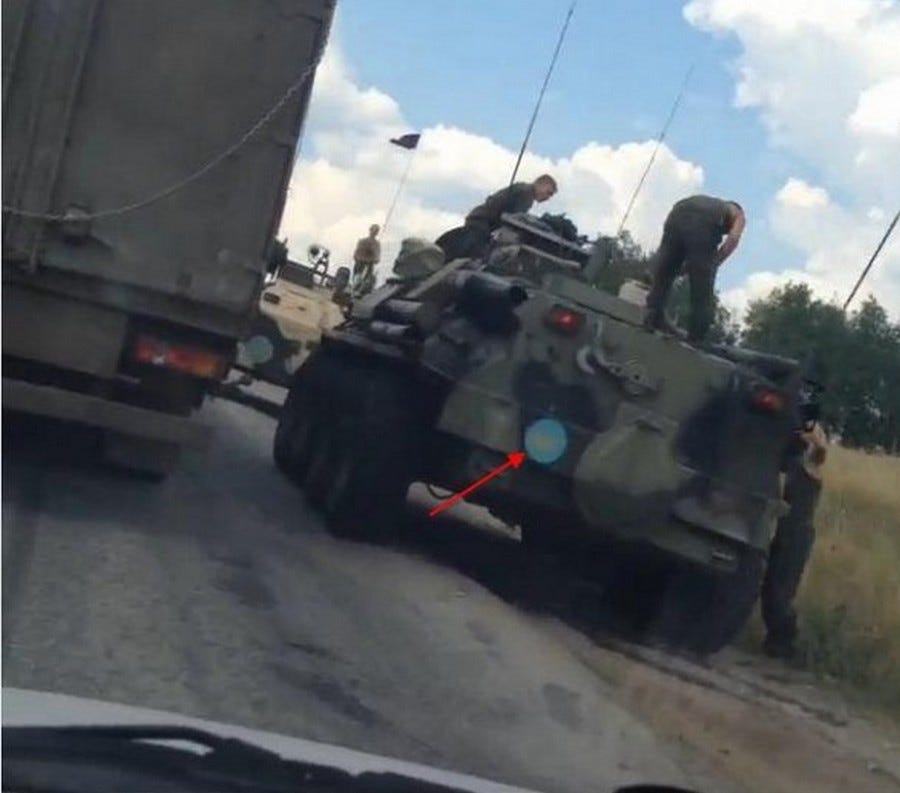
Oh No—Russian Troops Near Ukraine Are Painting ‘Peacekeeper‘ on Their Tanks Peacekeeper guise is a possible sign of impending invasion


We don’t know what’s going to happen in eastern Ukraine, where for five months government forces have battled Russian-backed separatists while Russian troops, having already seized Crimea, mass on the border. But there’s some frightening evidence that Moscow intends to invade mainland Ukraine.

“The probability of invasion is much, much higher than it has ever been,” James Miller, managing editor of The Interpreter, told War is Boring in an e-mail. The Interpreter translates media from the Russian press and blogosphere into English for use by analysts and policymakers.

The Russians reportedly have moved military vehicles with “peacekeeping” insignia to the border—a first since the crisis in the Ukraine began. Earlier this month, NATO warned that the Russians could mount an incursion into Ukrainian territory under the guise of a peacekeeping mission.

The Interpreter reports that it has found several pictures and a video reportedly showing Russian armored vehicles bearing the insignia “MC,” an abbreviation of the Russian words Mirotvorcheskiye Sily or “Peacekeeping Force.”

The video mysteriously disappeared from Youtube on or before Aug. 8, but the Interpreter managed to grab at least one screenshot, below.

Screenshot via The Interpreter

Tweets accompanying the photos claim the vehicles are moving toward the border with Ukrain or are already nearby.

The insignia on the vehicles are similar to markings used by the Russians engaged in “peacekeeping operations” in Transnistria, a pro-Russian breakaway region between Moldova and the Ukraine.

Furthermore, a larger contingent of troops and vehicles is forming behind this reported mobilization—the possible main invasion force. If Russia does attack, it will enjoy a military advantage over the Ukrainian military. Ukrainian troops can be seen in the above photo by the AP’s Evgeniy Maloletka.

Putin is under pressure to act, Miller added, and time is not on his side.

Russia Sanctions Itself


AUG. 7, 2014 

The sad truth of the tit-for-tat sanctions that Russia has imposed against the West is that they will hurt Russians far more than they will hurt Westerners.

Acting on President Vladimir Putin’s orders, Prime Minister Dmitri Medvedev on Thursday ordered a ban on a wide range of food and agricultural products from the European Union, the United States, Canada, Australia and Norway. No doubt many producers in these countries will feel the loss of $30 billion in food exports to Russia, but the overall effect on their large and diversified economies will be marginal. Russia, by contrast, imports about 40 percent of its food needs in terms of value, and the Russian agriculture minister has acknowledged that the sanctions would cause a spike in inflation.

In effect, Russians will be getting another hefty bill for their president’s arrogant efforts to batter Ukraine, and they will become more estranged from the global economy they need to develop their vast country.

Mr. Putin’s readiness to impose hardships on his own people rather than back down in Ukraine is, unfortunately, not surprising. His entire adventure in Ukraine, from the annexation of Crimea to the active military support for secessionists in eastern Ukraine, reflects his view of a zero-sum contest between Russia and the West in which Ukraine is the central battlefield. Even as Russia ordered the retaliatory sanctions, NATO reported that Russian troops were again massing on the Ukrainian border, once again raising the dangerous possibility of a direct intervention in support of the rebels, who are under attack by Ukrainian troops.

Further, in addition to the ban on food imports, Mr. Medvedev indicated that Russia was also considering a ban on flights over Siberia, a measure that would add to the cost of Europe-Asia travel, but would also cost Russia millions in transit fees.

Polls show that Mr. Putin is hugely popular with Russians, and no doubt his latest show of defiance against the West will find applause. But that could begin to change once prices for basic needs begin to rise and jobs begin to vanish in a contracting economy. The new economic elite, already funneling their money abroad at high rates, will not welcome the loss of the fine European foods that fill Moscow supermarkets. Many in the middle class are already wondering what it is they’re paying so huge a price for, and that question is bound to spread as Russians lower on the economic scale begin to feel the pain.

It is critical at this juncture for the Western allies to remain united, even if the cost of the sanctions — their own and Russia’s — are not equally borne. The European Union has a fund to compensate farmers for lost production in times of crisis, and this is just such a time. Sanctions are a painful weapon, and Russia has been a lucrative market for Europe. But the alternatives to sanctions — military action on one side, or doing nothing in the face of Mr. Putin’s brazen challenge to the post-Soviet order — are not really options.

The Ebola Outbreak

Moderator: Robert McMahon, Editor, CFR.org
August 5, 2014

Speakers: John Campbell, Ralph Bunche Senior Fellow for Africa Policy Studies, Council on Foreign Relations, and Laurie Garrett, Senior Fellow for Global Health, Council on Foreign Relations

MCMAHON: Hello, everyone, and welcome to this Council on Foreign Relations on-the-record conference call on West Africa's Ebola outbreak. I'm Robert McMahon, editor of CFR.org, and I will be moderating today's call on an outbreak that has now killed close to 900 people in Liberia, Guinea, and Sierra Leone. 

We are very fortunate to have on hand CFR's senior fellow for global health, Laurie Garrett, and CFR senior fellow for Africa policy studies, John Campbell, to help us navigate the issues involved in confronting this outbreak both medically and in terms of African governance and capabilities. 

Laurie's coverage of Ebola in Africa dates back nearly 20 years to the country then known as Zaire. John Campbell, former U.S. ambassador to Nigeria, tracks developments throughout sub-Saharan Africa on his blog, Africa in Transition, with particular attention to Nigeria, where reports say a case of Ebola has recently been reported. I will begin with a 20-minute or so conversation with both Laurie and John before opening up the call to broader questions. It'll be an hour-long in total. 

And, Laurie, I wanted to kick off with you. The health professionals on the ground in West Africa are saying, you know, the outbreak is out of control. What is the latest state of play on efforts to bring it under control or at least to try to contain it? 

GARRETT: Thank you. It is, indeed, out of control. It has been for quite some time. I don't think it's clear that it ever was in control at any given moment since it first broke out in March in Guinea. 

The problem now is that we have burned-out health care workers, 550 from the largest contingent from Medecins Sans Frontieres, or Doctors Without Borders, which has issued plea after plea in recent days to the international community saying, "We are exhausted. We are terrified. We want to leave. Can somebody else please come in and take over?" 

You've had more than 60 health care workers succumb to the disease, including the most famous physicians in the battle against Ebola from Uganda, from Liberia, and from Sierra Leone. And we have seen resistance from the populations all over these three countries, but especially in Sierra Leone and Liberia, against all sorts of quarantine measures, efforts to remove the ailing from their households so that they don't infect household members and place them in quarantine, efforts to enforce quarantine, and efforts to deal with safe burials or cremations, rather than the traditional approaches of families preparing the bodies for burial and thereby getting exposed to the contaminating fluids. 

And at this point, you know, the military has been brought into help try to maintain some semblance of control, but every report I'm getting from the ground has health care workers describing themselves as in a state of fear, even of siege, feeling that the populations despise and loathe them, and that rumors are rife that they are actually deliberately infecting people, cutting off people's arms, and selling them on some alleged international market and even claims that there are health care workers who are foreign cannibals. 

"[T]he WHO is essentially bankrupt and has only the power of rhetoric … and … international health regulations … to try and move the ball forward."—Laurie Garrett 

MCMAHON: So you mentioned the appeal for help from MSF, among others, and they're one of the lead agencies on the ground there. There isn't any kind of international yet sort of rapid response team that gets called into play, but there are international organizations or large national organizations that are getting mobilized, isn't that right at this point? 

GARRETT: Well, it's true. There are a number of different groups. The CDC, our Centers for Disease Control and Prevention, is sending some time in the next couple of days 50 individuals on site to assist. But we don't have -- I know that there's a myth out there, and people believe that there's some kind of giant WHO office in Geneva stock full of specialized response equipment, skilled, talented health care workers, and they have their own special jet and they go swooping into epidemics. This is absolutely ludicrous. 

Not only do we not have any such thing, the WHO is essentially bankrupt and has only the power of rhetoric in order to try -- and of the international health regulations in order to try and move the ball forward. And that's going to be the big news this week. 

WHO is convening under its international health regulations process a special summit starting tomorrow in Geneva of scientific outside experts that will assess the current situation and decide if it constitutes an international public health emergency. If they so designate it, then a whole set of things are meant to mobilize in place. The international community is meant to go on full tilt to try and develop drugs and vaccines. There's meant to be border checks and perhaps some instructions to international flight carriers and travel agencies and so on, and the whole thing should rev up. 

But let's keep in mind, WHO has been running on a budget deficit. The World Health Assembly voted in their last session to cut the emergency epidemic response capacity of WHO. And if it weren't for this morning's announcement from the World Bank that it will put $200 million into the effort, we basically would have an effort on the ground in Guinea, Sierra Leone, and Liberia funded on fumes, volunteer donations, and, you know, a few hundred people who are being unpaid to risk their lives in the middle of this outbreak. 

MCMAHON: So it has gotten a great deal of renewed attention in the United States with the arrival a few days ago of an American infected with the virus, and another American is due to arrive, I believe, today. There is a report of a possible Ebola case in New York City. To what extent do you see in America, you know, the United States seized of the issue, playing a bigger role and -- and also, what do we know about the treatment of these two Americans that may actually end up, you know, surviving and not dying from Ebola? 

GARRETT: Well, first of all, this epidemic has been boiling since March, but only garnered enormous public attention in the United States until there were Americans infected. I suppose that kind of speaks normally to how the United States views our foreign policy; it's only a matter of concern until one of us -- one of our citizens is affected. That's most unfortunate. 

The two individuals that were both volunteers for Samaritan's Purse and were on the ground and infected in their work have been airlifted to Atlanta, Georgia, where they are in a special isolation unit at Emory University's Medical Center. I think everybody knows that. They have both received an experimental treatment. One of them appears to be doing well. 

Cybersecurity as Realpolitik

[ nominal delivery draft, 6 August 2014 ] 

Cybersecurity as Realpolitik Dan Geer Good morning and thank you for the invitation to speak with you today. The plaintext of this talk has been made available to the organizers. While I will not be taking questions today, you are welcome to contact me later and I will do what I can to reply. For simple clarity, let me repeat the abstract for this talk: Power exists to be used. Some wish for cyber safety, which they will not get. Others wish for cyber order, which they will not get. 

Some have the eye to discern cyber policies that are "the least worst thing;" may they fill the vacuum of wishful thinking. There are three professions that beat their practitioners into a state of humility: farming, weather forecasting, and cyber security. I practice two of those, and, as such, let me assure you that the recommendations which follow are presented in all humility. 

Humility does not mean timidity. Rather, it means that when a strongly held belief is proven wrong, that the humble person changes their mind. I expect that my proposals will result in considerable push-back, and changing my mind may well follow. Though I will say it again later, this speech is me talking for myself. As if it needed saying, cyber security is now a riveting concern, a top issue in many venues more important than this one. This is not to insult Black Hat; rather it is to note that every speaker, every writer, every practitioner in the field of cyber security who has wished that its topic, and us with it, were taken seriously has gotten their wish. 

Cyber security *is* being taken seriously, which, as you well know is not the same as being taken usefully, coherently, or lastingly. Whether we are talking about laws like the Digital Millenium Copyright Act or the Computer Fraud and Abuse Act, or the non-lawmaking but perhaps even more significant actions that the Executive agencies are undertaking, "we" and the cyber security issue have never been more at the forefront of policy. And you ain't seen nothing yet. 

I wish that I could tell you that it is still possible for one person to hold the big picture firmly in their mind's eye, to track everything important that is going on in our field, to make few if any sins of omission. It is not possible; that phase passed sometime in the last six years. I have certainly tried to keep up but I would be less than candid if I were not to say that I know that I am not keeping up, not even keeping up with what is going on in my own country much less all countries. 

Not only has cybersecurity reached the highest levels of attention, it has spread into nearly every corner. If area is the product of height and width, then the footprint of cybersecurity has surpassed the grasp of any one of us. The rate of technological change is certainly a part of it. When younger people ask my advice on what they should do or study to make a career in cyber security, I can only advise specialization. Those of us who were in the game early enough and who have managed to retain an over-arching generalist knowledge can't be replaced very easily because while absorbing most new information most of the time may have been possible when we began practice, no person starting from scratch can do that now. 

Serial specialization is now all that can be done in any practical way. Just looking at the Black Hat program will confirm that being really good at any one of the many topics presented here all but requires shutting out the demands of being good at any others. Why does that matter? Speaking for myself, I am not interested in the advantages or disadvantages of some bit of technology unless I can grasp how it is that that technology works. Whenever I see marketing material that tells me all the good things that adopting this or that technology makes possible, 

I remember what George Santayana said, that "Scepticism is the chastity of the intellect; it is shameful to give it up too soon, or to the first comer." I suspect that a majority of you have similar skepticism -- "It's magic!" is not the answer a security person will ever accept. By and large, I can tell *what* something is good for once I know *how* it works. Tell me how it works and then, but only then, tell me why you have chosen to use those particular mechanisms for the things you have chosen to use them for. 

Emerging Cyber Capabilities in the Asia Pacific: Potential Military Impact


11 JULY, 2014 DOWNLOAD

CENS / RSIS / Commentaries / Cybersecurity, Biosecurity and Nuclear Safety / East Asia and Asia Pacific / Global / International Political Economy 

RSIS Commentary 136/2014

Synopsis The Asia Pacific comprises diverse countries with conflicting ideologies and different states of development. Given the variety of challenges and tensions over territorial disputes and geopolitical uncertainties across the region, a careful analysis of cyber capabilities and their possible impact would be valuable.

Commentary The Asia Pacific is a diverse region comprising countries with conflicting ideologies that are at very different stages in terms of cyber technologies and both strategy development and implementation. Capabilities considered as new and emerging technologies in one state or a number of states are not always new throughout the region; although the current speed of technological change means most countries are still challenged.

This often means that timely and effective implementation of policy and legislation is made more difficult, especially when it can be difficult to fully and quickly understand the implications of these new technologies.

Implications for the Asia Pacific There are four implications for the Asia Pacific. First, acquiring offensive cyber capabilities can often seem financially attractive, in particular for less wealthy states in the region, relative to the higher costs of other weapons. Moreover, by contrast, bolstering defences might be considered more difficult, more expensive and take longer to implement. In many cases, strong defence infrastructures are not even in place within these countries.

This is particularly significant for this region where many states are spending increasing amounts on arms capabilities and the military compared to the U.S. and EU where military budgets are being considerably reduced. Although, in relative terms, the overall U.S. budget still far outweighs that of other countries and the U.S. has not decreased the cyber defence budget to the same extent as other fields, this balance could eventually shift over the medium term. If defence reports are correct in their analysis, China’s defence spending may be three times as much as the U.S within 20 years if China maintains its current levels of defence spending as its economy continues to grow.

Second, accurately attributing responsibility for cyber incidents can be difficult. This means that misunderstandings could arise between states, tensions could possibly escalate, or it might be harder to ensure effective deterrence. These apparent difficulties in appropriating blame on top of the advantages of once-off or lower costs are therefore attractive, particularly for states with limited financial resources, capabilities and expertise. This is especially relevant where weaker entities might avoid open confrontation and instead exploit vulnerabilities. Although in light of more recent statements claiming that anonymity is not necessarily guaranteed, they could seriously risk reputation damage and physical retaliation if found responsible.

Third, most countries in the region are challenged in the near term by a skills shortage in this domain. Although China and India are exceptional since they not only have excellent ICT sectors and financial resources, they also have large growing pools of manpower. For now, they are continuing to invest in this domain as well as cultivating indigenous ICT to reduce supply chain security concerns and reliance on imports. Likewise, defence reports suggest that the scale and pace of their innovative and industrial capacity will outpace many Western nations in a matter of years and China is likely to attain and sustain global leadership in a number of technical areas including computer science.

Fourth, non-state actors further complicate this space. Cyber criminals, terrorists, hackers, hacktivists, and proxy actors must equally be considered. Moreover, some argue that growing cybercrime in this region could cause further instability because of connections to espionage and military activities. These points align with projections that the character of war is likely to continue to be shaped not only by a system of rival states but by forces outside the state-centric systems.