26 August 2014

When to be in Syria was to be in a grandly different kind of Arabia


 August 23, 2014

I saw Syria last before most of those causing the turmoil there were probably even born. Considering what the country has come to today, 31 years was a lifetime ago. Going there as a schoolgirl — albeit a highschooler — inured me to some of the undercurrents that were already eddying and promising later chaos. But even so, it was hard to think of unpleasant things like minority rule and majoritarian angst when the riches of an ancient civilisation beckoned. 

Damascus, in particular, was such a genteel city. Of course, the security police were hated. But there was not much visible discontent about the authoritarianism of President Hafez al-Assad. The stirrings of rebellion had already begun when we were there in the early 1980s. But it would have been hard to foretell today’s situation then. In fact, though Damascus was not as European as Beirut in its heyday, its grandeur made it seem above quotidian squabbles, at least to an Indian teen. 

After all, this was a city that was traditionally so close-knit that streets did not have names but were known by the prominent families that lived on them. I was told that addresses would read like “fourth house from the residence of the XXX family” and postmen would have no problem identifying the area. The Indian ambassador’s residence at that time, incidentally, would therefore have been traditionally marked as, “Down the road from Assad’s palace”. 

Everything in Syria seemed to stretch effortlessly back to antiquity. Aleppo was a great trading city even before Mesopotamia arose and Alexander captured it en route to India. And then there was Crac de Chevalier complete with a round stone table, the 4,000-year-old Aramaic city of Palmyra in the desert and the magnificent Omayyad mosque in Damascus that some say contains the remains of John the Baptist and was also the site of Greek-era temple.… 

It was apparent that great civilisational strands that go back to earliest recorded history and then some, met and intertwined right there in the Syrian region. Even the relatively recent Indian connection was unmistakable, with more adherents of the various Syrian Christian doctrines — with further localised offshoots — living in this country than there: many ornate churches are full of desi mementos left behind by Indian pilgrims. 

Though they were officially supposed to be ‘Syrian Arab’, very little except the tenets of Islam seemed to connect the Syrians I met — or their immediate neighbours in Lebanon, Jordan, Israel-Palestine and, at a stretch, Eqypt — culturally to other Arabs in the Gulf or North Africa. Their food was different (more Mediterranean) and their manners far more sophisticated. Even the language they spoke, though nominally also Arabic, was more mellifluous rather than Gulf-guttural. 

But Syria’s melting-pot nature was most emphatically visible in its people, who are clearly drawn from many races. Our drivers, for instance, were uncle-and-nephew. But one was olive-skinned and black-eyed, the other red-haired and blue-eyed. There were traces of many other ethnicities too, right in our tiny embassy staff. But one thing was very apparent: Syrians were also acutely conscious of — and proud of — their very old and very rich pre-Islamic, cosmopolitan heritage. 

That is why it is so hard to imagine that a brutal and medieval force that calls itself the Islamic State of Iraq and Syria (ISIS) — and now simply the Islamic State (IS) — would coalesce and grow in that region. Would the great monuments that people marvelled at for centuries go the way of the Bamiyan Buddhas and remnants of Nineveh? Beheadings of infidels, forced conversions —all these would have been abhorrent to the Syrians I met and interacted with. 

Could so much have changed in three decades in a civilisation that had matured over millennia?

Is Islamic State the best possible enemy?


DOUG SAUNDERS
Aug. 23 2014

It has become popular, in some circles, to refer to them as “the Orcs.” And not just because it’s easier than using their frequently changing English titles – ISIS, ISIL, or simply the Islamic State – but also because their swarms of black-flagged militants, in their campaign of territorial conquest driven by mass ethnic murder, rape, crucifixion, and beheading, resemble not so much anything in modern human history as some spectacle out of J.R.R. Tolkien’s Gothic bestiary.

You don’t see a lot of people objecting to the term. They are, in an Orc-like way, almost the perfect enemy: So extreme in their methods and coldly ascetic in their vision that even fellow Islamic extremist organizations and authoritarian regimes have turned against them in revulsion. While their military success has been impressive, they have united a surprisingly wide variety of nations, factions, faiths and forces against them.

We are now witnessing the spectacle of a Coalition of the Begrudgingly Willing that has brought together the United States, Hezbollah, Iran, Iraq, Europe, Canada, Turkey and the Kurdish People’s Party in an extremely awkward but very real alliance against the black flag.

So, as distasteful as this may sound during a week in which the group decapitated a journalist and pledged genocidal murder, it is worth asking whether the Islamic State is the best possible enemy that could have emerged from the chaos of the post-Iraq war, post-Arab Spring Middle East. Unlike other potential threats, this one has transformed the politics of the region in profound ways. While still posing a terrible threat to thousands of lives, by attempting to form a grotesque Caliphate, the IS fighters have provoked many changes that were long overdue:

Is the United States About to Ramp Up Its Fight Against ISIS?


In the wake of James Foley’s execution, Obama announced no plans to widen his air campaign against the group. Military officials hint it’s expanding—but not to a ground offensive. 

Since U.S. airstrikes began targeting ISIS on August 7, the group, which had been steadily expanding its territory, has been losing ground in Iraq. Now there are signs indicating that the air campaign could be expanding. If it does, the model for what has worked in northern Iraq—U.S. airpower backing local ground forces—gives a preview of what future operations could look like if they spread to other parts of Iraq. 

Kurdish fighters stand guard at the Mosul Dam in Mosul in northern Iraq, August 19, 2014. (Reuters)

“What we saw at Mosul,” where U.S. airstrikes allowed Kurdish and Iraqi security forces to push ISIS back, “was essentially our proof of concept,” said Douglas Ollivant, a former Army officer and one of the architects of the “surge” in Iraq who later served on the National Security Council.

What makes some British Muslims become jihadis?

August 22nd, 2014

They're not glamorous rebels; they're narcissistic saddoes

"The experience of many ages proves that men may be ready to fight to the death, and to persecute without pity, for a religion whose creed they do not understand, and whose precepts they habitually disobey."

So wrote Thomas Babbington Macaulay, the Whig MP, historian and poet, in 1848; and, as usual, he was spot on. A leaked MI5 report on the profile of British jihadis made the same observation in more pedestrian prose. "Far from being religious zealots, a large number of those involved in terrorism do not practise their faith regularly."

Mehdi Hassan has a fascinating piece in the Huffington Post, in which he reveals the books that two Brummie Muslims had ordered from Amazon before heading out to join the insurgents in Syria. Yusuf Sarwar and Mohammed Ahmed, who pleaded guilty to terrorism offences last month, had not bought works on politics or advanced theology, but Islam for Dummies and The Koran for Dummies. Dummies indeed.

An alarming number of our young men – boys born and brought up in the United Kingdom – are involved with extremist paramilitaries in Syria, Iraq and Afghanistan. There are credible estimates that more British Muslims are fighting with Islamic State (formerly ISIS) than serving in the Armed Forces. As Douglas Murray writes in the current Spectator, this isn't even the first time that a British Muslim has arranged for the beheading of an American journalist.

What is pushing these youths into violence? Is it something in their religion, something in their socio-economic circumstances, something in their character, or something else entirely?

There are evidently several factors at work, and we should be wary of oversimplifying, but one observation made by almost all the experts who have studied Western-born Islamic militants is that they fit the classic profile of the terrorist down the ages: male, typically in their twenties or early thirties, with some education, narcissistic, lacking in empathy, lonely, unsuccessful with women, often with a history of petty crime.

What makes a terrorist different from other bellicose young men is that he has found a cause that validates his anti-social tendencies – a doctrine that teaches him that he is angry, not because there's something wrong with him, but because there's something wrong with everyone else. Islamic State thugs, like Baader-Meinhof gangsters, IRA gunmen, Red Brigaders or nineteenth century anarchists, are convinced that they can see things more keenly than others, and that this clarity of vision elevates and ennobles their aggression.

Consider Michael Adebolajo, who carried out the sickening murder of Lee Rigby in Woolwich. He matched the profile in almost every respect: a history of petty crime, drug abuse and anti-social behaviour, a conviction that he was better than everyone else, an obsession with violent video games, a streak of raw belligerence (neighbours recall that he once punched a girl in the face when she came to retrieve a ball). Whatever else we call such a lifestyle, it's hardly pious.

The Real Winner of America’s War on ISIS: Bashar al-Assad


Gen. Martin Dempsey, the chairman of the Joint Chiefs of Staff, made the fairly obvious point yesterday that it will be impossible to deal a definitive blow to ISIS by attacking it on only one side of the increasingly irrelevant Syrian-Iraqi border. Here’s the New York Times:

“This is an organization that has an apocalyptic end-of-days strategic vision that will eventually have to be defeated,” said the chairman … in his most expansive public remarks on the crisis since American airstrikes began in Iraq. “Can they be defeated without addressing that part of the organization that resides in Syria? The answer is no.”…

“It requires a variety of instruments, only one small part of which is airstrikes,” he said. “I’m not predicting those will occur in Syria, at least not by the United States of America. But it requires the application of all of the tools of national power—diplomatic, economic, information, military.”

Despite Dempsey’s remarks, it’s not really clear that “defeating” ISIS is actually President Obama’s goal in this conflict. But that could change. Assuming that the U.S. does reluctantly take on the project of defeating ISIS, or at least substantially degrading it, that decision will inevitably deepen America’s even-more-reluctant involvement in the conflict in Syria.


In that case, there’s a pretty big elephant in the room. Up until now, the ostensible goal of the U.S. strategy in Syria—to the extent that the U.S. has had a definable strategy at all—has been to give “moderate” rebel groups a fighting chance against Bashar al-Assad’s forces. If the focus has now shifted to defeating ISIS, where does that leave Assad?

WHO ARE THE KURDS? – ANALYSIS


By James M. Quirk

Whatever language you use – observers, air support, trainers – President Obama is sending the American military back to Iraq.

But the Kurdistan Region of Iraq (KRI) is not like the rest of Iraq. Kurds are their own ethnicity – not Arab or Persian or Turk. Kurds expected to establish their own country with the 1920 Treaty of Sรจvres, but ultimately were denied. Today, more than 30 million Kurds live in Turkey, Syria, Iran, and Iraq. Officially, more than 5 million live in Iraq’s northern provinces, although the real number may be significantly higher.

Iraqi Kurds were violently suppressed under Saddam Hussein. In the Al-Anfal genocide of the late 1980s, Saddam’s forces destroyed over 4,000 villages and killed more than 100,000 Kurds; scholars and parliaments increasingly agree on calling it genocide. On March 16, 1988, Saddam’s cousin “Chemical Ali” killed thousands of Kurds with chemical weapons in the town of Halabja.

After the Persian Gulf War and United Nations Security Council Resolution 688 (1991), the United States and its allies imposed a no-fly zone over northern Iraq to protect the people of Iraqi Kurdistan, giving the Kurdistan Region considerable autonomy from the central government. Political and economic development among the Kurds was slow until the 1998 Washington Agreement.

But when much of Iraq collapsed into violence after the US-led overthrow of Saddam Hussein in 2003, the Kurdistan Region chose security, development, and tolerance. The 2005 Iraqi constitution made several special mentions of the Kurds and the Kurdistan Region, including a history of their oppression, Kurdish as an official language of Iraq, and certain regional governing authorities. Article 140, though, which provides for the resolution of certain disputed territories by the end of 2007, was never fulfilled. These disputed regions include the areas near Mosul that have been in the news this summer, and near Kirkuk – central to Kurdish identity and rich in oil.

Meanwhile, the Kurdistan Regional Government (KRG) rebuilt Christian villages, schools, and churches that had been destroyed by Saddam, and helped preserve monasteries as old as the 4th century CE. The KRG’s treatment of its various minority groups, including the now-famous Yazidis, made it a destination for minorities fleeing from violence in the rest of Iraq, and more recently from the violence in Syria.

Cardinal Theodore McCarrick, a former Archbishop of Washington, led a delegation of American religious leaders to the Kurdistan Region in late 2012. It met with both local and prominent clerics, and visited a school led by a Chaldean Catholic, Bishop Rabban, near the purported hometown of the Three Wise Men. The school is attended by Muslim, Christian, and Yazidi students, Kurds and Arabs, locals and refugees – all being taught in English.

The delegation also met with mayors, cabinet ministers, and President Masoud Barzani. Each official began with a message of thanks to the men and women of the American military. Each vowed that he would do his best to build a Kurdistan Region they would be proud of. And each reminded the delegation that no American soldier had ever been killed in Kurdistan. In fact, it was a place where American fighters went on leave during their deployments.

The KRG was not without obstacles as it began to build for a future inside or outside of Iraq. Against Baghdad’s wishes, it began to truck small amounts of oil over the mountains into Turkey while it built pipelines for much greater exports. Oil rights and unresolved border disputes led Baghdad to cut all funding to the region last winter. Unspoken dreams of Kurdish independence gained a loud voice this past June when the Iraqi Army fled Mosul, Iraq’s second largest city.

GENOCIDE IN IRAQ? A POLITICAL HISTORY OF THE YAZIDIS AND MANDAEANS – ANALYSIS


By Renรฉ Wadlow,Eurasia Review

A mix of US humanitarian air drops of food and water to the stranded displaced people on Mount Sinjar as well as US military air strikes against some of the positions of the Islamic State in Iraq and Syria (ISIS) has focused international attention on the area. The Christian Peacemaker Teams have had a group working toward human rights protection and reconciliation in the Iraq Kurdistan for some years and are now posting daily updates on their website and Facebook page. (1)

I will not deal here with the broader issues of the impact of the ISIS on the possible geographic fragmentation and re-structuring of Iraq and Syria. As an NGO representative to the United Nations, Geneva, and active on human rights issues, I had already raised the issues of two major religious minorities in Iraq at the UN Commission on Human Rights: the Yazidis and the Mandaeans.

Here I ask if their fate can be identified as genocide under the 1948 Convention for the Prevention and Punishment of the Crime of Genocide. My concern with the Yazidi (also written as Yezidi) dates from the early 1990s and the creation of the Kurdish Autonomous Region. Many of the Yazidis are ethnic Kurds, and the government of Saddam Hussein was opposed to them not so much for their religious beliefs but rather that some Yazidis played important roles in the Kurdish community, which was seen as largely opposed to the government. The Yazidis also had some old ownership claims on land on which oil reserves are found in northern Iraq.

My concern with the Mandaeans (also written as Sabean-Mandeans) came in the early 2000s after the US invasion when the Mandaeans were persecuted as being supporters of Saddam Hussein and most fled to Syria. A word about the faiths of the two groups which helps to explain their special status: although both are called “sects” and are closed religious communities which one can only enter by birth, they are faiths even if the number of the faithful is small.

The Mandaeans are a religious group formed in the first centuries of the Common Era in what is now Israel-Palestine-Jordan. Over time, they migrated to southern Iraq in the area of Basra as well as to what is now the Islamic Republic of Iran. One of their distinctive signs is the frequent purification by running water−baptism. They honor John the Baptist, described in the Christian Gospel of Luke, but are probably not direct descendants of his followers. At the time of John and Jesus, there were a good number of movements which had purification by water as one of their rituals.

The Mandaean scripture is The Book of Johnis, probably a third-century collection. The Book of Johnis was used in Mandaean rituals and services but was never published to be read by others. Given intellectual and historic interest in the Mandaeans, the Mandaean leadership authorized the publication of their scriptures. As a sign of respect, the first printed copy was given to Saddam Hussein as President of the country.

In the confused situation after the US occupation of Iraq, the book presentation was enough to have some accuse the Mandaeans of being Saddam Hussein supporters. Under increasing pressure, the vast majority of Mandaeans left Iraq for Syria, from the frying pan into the fire. Now they are caught in the Syrian civil war, unable or unwilling to return to Iraq. A small number of Mandaeans have been granted refugee status in the US and Western Europe.

There has been some intellectual mutual interplay among the Mandaeans and the Yazidis, but they are separate faiths and located in different parts of Iraq. The structure of the Yazidi worldview is Zoroastrian, a faith born in Persia proclaiming that two great cosmic forces, that of light and good, and that of darkness and evil are in constant battle. Man is called upon to help light overcome evil.

However, the strict dualistic thinking of Zoroastrianism was modified by another Persian prophet, Mani of Ctesiphon in the third century CE who had to deal with a situation very close of that of ours today. Mani tried to create a synthesis of religious teachings that were increasingly coming into contact through travel and trade: Buddhism and Hinduism from India, Jewish and Christian thought, Helenistic Gnostic philosophy from Egypt and Greece as well as many smaller, traditional and “animist” beliefs.

Time to Stop ISIS

By Charles Krauthammer
AUGUST 2014
The Islamic State has grown because it seemed unstoppable. Our air strikes have changed that.


Baghdad called President Obama’s bluff and he came through. He had refused to provide air support to Iraqi government forces until the Iraqis got rid of their divisive sectarian prime minister.

They did. He responded.

With the support of U.S. air strikes, Iraqi and Kurdish forces have retaken the Mosul dam. Previous strikes had relieved the siege of Mount Sinjar and helped the Kurds retake two strategic towns that had opened the road to a possible Islamic State assault on Irbil, the capital of Kurdistan.

In following through, Obama demonstrated three things: the effectiveness of even limited U.S. power, the vulnerability of the Islamic State, and, crucially, his own seriousness, however tentative.

The last of these is the most important. Obama had said that there was no American military solution to the conflict. This may be true, but there is a localmilitary solution. And that solution requires U.S. air support.

It can work. The Islamic State is overstretched. It’s a thin force of perhaps 15,000 trying to control a territory four times the size of Israel. Its supply lines are not just extended but exposed and highly vulnerable to air power.

Stopping the Islamic State’s momentum creates a major shift in psychology. Guerrilla armies thrive on a sense of inevitability. The Islamic State has grown in size, demoralized its enemies, and attracted recruits from all over the world because it seemed unstoppable, a real caliphate in the making.

People follow the strong horse over the weak horse, taught Osama bin Laden. These jihadists came out of nowhere and shocked the world by capturing Mosul, Tikrit, and the approaches to Kurdistan, heretofore assumed to be impregnable.

Now that’s begun to be reversed.

Obama was slow to bring American power to bear. And slower still to arm the Kurds. But he was right to wait until Baghdad had gotten rid of Nouri al-Maliki, lest the U.S. serve as a Shiite air force. We don’t know how successful Haider al-Abadi will be in forming a more national government. But Obama has for now wisely taken advantage of the Abadi opening.

The problem is that the new policy has outgrown the rationale. Our reason for returning to Iraq, explained Obama, is twofold: preventing genocide and protecting U.S. personnel.

Hackers Got Personal Information of Sensitive Personnel in Breach of Computers Belonging to Background Check Company

U.S. undercover investigators among those exposed in data breach
Reuters
August 22, 2014

A man types on a computer keyboard in Warsaw in this February 28, 2013 illustration file picture.

(Reuters) - A cyber attack at a firm that performs background checks for U.S. government employees compromised data of at least 25,000 workers, including some undercover investigators, and that number could rise, agency officials said on Friday.

The breach at Falls Church, Virginia-based US Investigations Services (USIS) exposed highly personal information of workers at the Department of Homeland Security’s headquarters as well as its U.S. Immigration and Customs Enforcement and U.S. Customs and Border Protection units, two officials familiar with the investigation into the breach told Reuters.

Some employees have already received letters warning them about the breach that say compromised information includes Social Security numbers, education and criminal history, birth dates along with information about spouses, other relatives and friends including their names and addresses.

"Records including this data were exposed to unauthorized users during the cybersecurity intrusion,” according to a notification letter obtained by Reuters. “We do not yet know whether the data was actually taken.”

One DHS official told Reuters the agency has identified some 25,000 employees whose information it believes were exposed in the breach.

Casualties of Cyber Warfare

By Cameron Stevens
August 25, 2014
American and Chinese companies are getting caught in the crossfire of the brewing cyber war. 

That the United States and China have engaged in skirmishes in the cyber domain is no secret. Since the beginning of the 21st century, targeted cyberattacks, often with signs of Chinese origin, have attempted to penetrate the computer networks of U.S. corporations and government agencies in search of potentially valuable information. In response to this new strategic threat, the U.S. Military’s Strategic Command commissioned the creation of a sub-unified Cyber Command in 2009, with one of its stated objectives being the “defense of specified Department of Defense information networks.”

U.S. President Barack Obama very clearly defined the threat that cyberattacks pose to the economy, in both the public and private sectors, when he said that the “cyber threat is one of the most serious economic and national security challenges we face as a nation.” Indeed, conflict in the cyber domain is still having some serious repercussions for the business world.

Civilian Involvement in Cyber Warfare

The characteristic of cyber warfare that makes it so uniquely dangerous to the corporate sector is that military power in the cyber domain must be extended through computer networks provided and maintained by non-governmental bodies. The use of these networks for cyberattacks or defense requires the conscription or cooperation of civilian resources. This creates extreme liabilities for the corporations that provide these networks, as they will quickly become the targets of suspicion and possible retaliation from the enemy state. In recent years, both Chinese and American companies have been caught in just this situation.

On October 8, 2012, the U.S. House of Representatives’ intelligence committee released a report that warned of potential national security threats posed by Chinese telecommunication giants Huawei and ZTE. After conducting a year-long investigation of the suspect companies, the intelligence committee found serious vulnerabilities caused by hidden “backdoors” worked into the companies’ technologies that would allow access to U.S. government and business networks. The report advised against the purchase of products manufactured by Huawei or ZTE, and suggested that policymakers block any mergers between either of the two companies and U.S. telecommunication corporations. These accusations have seriously hurt consumer confidence in the two companies, to the extent that in December of 2013, Huawei’s executive vice president dramatically declared “we are not interested in the U.S. market anymore.” While Huawei has managed to hold on to a small market share in America, the company’s association with Chinese state-sponsored cyberattacks has devastated its ability to operate in the United States.

The Army goes to sea with its navy

By Amanda Dolasinski Staff writer
August 20, 2014 
Soldiers from the 7th Transportation Brigade load and unload cargo from a temporary pier constructed at Fort Story, Virginia, on Thursday, August 14, 2014.

The crew of the Logistics Support Vessels (LSV), the General Frank S. Besson, prepare to dock at the temporary pier set up at Fort Story, Virginia, on Thursday, August 14, 2014.
      
VIRGINIA BEACH, VA. - Waves became choppy in the Atlantic Ocean as a massive cargo ship approached a floating steel pier under the watchful eyes of soldiers monitoring radar maps and live-feed cameras from inside a command tent on the beach. 

The ship, undeterred by the rising waves, slowly reached the pier, and lines were thrown to soldiers who quickly tied it down. 

Shortly after, a ramp was secured to the pier and cargo boxes and 10,000-pound machinery were rolled off the ship as soldiers directed traffic across the 1,200-foot pier to waiting soldiers on the beach at Joint Expeditionary Base Little Creek-Fort Story, Virginia.

Over a week, nearly 500 soldiers from units of the 7th Transportation Brigade (Expeditionary) worked together during a Logistics Over-the-Shore training exercise, demonstrating that the Army can quickly access bare beaches to unload cargo from ships. The training showcased a cohesive operation woven together from separate missions - monitoring maritime traffic at the command center on the beach, constructing and managing the flow of supplies on the pier, and navigating ships in the ocean as they make approaches.

"I think the average person would be surprised at how busy Army watercraft is," said Col. Randal Nelson, commander of the 7th Transportation Brigade.

The brigade, known as the "Army's navy," is tasked with commanding ports and watercraft unit functions in support of land operations. It was transformed into the Army's first and only brigade of its kind earlier this year after increasing demands for Army watercraft across combatant commands.

The brigade is unique because of its ability to operate seaports, travel coastal and inland waterway supply routes, and conduct ship-to-shore operations in hostile environments. It has participated in World War II, the Korean War and Operation Iraqi Freedom, among other conflicts.

25 August 2014

ISIS offered to swap Pak scientist for slain US journalist Foley

Shyam Bhatia in London

A highly educated Pakistan-born woman has emerged as the jewel in the crown of Islamic State (IS) terrorists who seek world domination by creating their version of a caliphate that stretches from South Asia to the borders of Rome.

Before his barbaric beheading, IS offered to free James Foley and other Western hostages still in captivity if Washington sanctioned the release of Dr Aafia Siddiqui, who was arrested in Afghanistan in 2008.

A mother of three, known in Pakistan as the "Grey Lady of Bagram", she is currently serving an 86-year prison sentence in a Texas jail for attempting to kill American soldiers in Afghanistan. When she was being questioned back in 2008, she tried to shoot her interrogators and was shot and wounded in return.

At the time of her arrest she was also caught with plans for a 'mass casualty attack' against key US targets, including such New York landmarks such as the New York Metro, Statue of Liberty and Empire State Building. Her plans also involved infecting innocent citizens with Ebola and a dirty bomb.

Siddiqui's expertise dates back to her time at Brandeis University in the US where she obtained a Ph.D in biology before training as a neuro-scientist at the Massachusets Institute of Technology (MIT).

Karachi-born Siddiqui, who has a PhD from Brandeis University, before training as a neuro-scientist at MIT, is married to a nephew of 9/11 mastermind Khalid Sheikh Mohammed. It was he who first mentioned her name to US interrogators.

The irony of Siddiqui's significance is that her gender marks her out as part of a lesser breed in the Islamic caliphate where women must be veiled and banned from driving and where goats grazing in the fields are required to have their genitals covered.

The Pakistani authorities usually try to distance themselves from suspected terrorists, but when Siddiqui was arrested Pakistani Prime Minister Yousef Raza Gilani called her the "daughter of the nation" and begged the US to let her go. Violent protests also took place outside the US consulate in Karachi.

Former CIA analyst John Kiriakou commented about Siddiqui in 2008, "Her education troubled us. We know that she's extremely bright. She's radicalised. We know that she had been planning, or at least involved in the planning, of a variety of operations, whether they involved weapons of mass destruction or research into chemical or biological weapons, whether it was a possible attempt on the life of the President."

Deborah Scroggins, author of 'Wanted Women: Faith Lies and the War on terror" describes Siddiqui as "the poster child for jihadists around the world."

She was sentenced at a time when US legislators had approved new rules saying anyone trying to kill US personnel would get special, strict sentencing.

The attempts to free Siddiqui in exchange for Foley highlight the perils facing other hostages held by IS which seeks to extract maximum benefits from their governments before they are released.

The hostages include some 90 Indian, Turkish, American and British nationals who are being held at various locations in Northern Iraq and Syria.

Washington and London have said that where their nationals are concerned, they never negotiate with terrorists, but that is a policy that is selectively implemented.

When US soldier Bowe Bergdahl was kidnapped earlier this year by the Afghan Haqqani network, the Americans released five Taliban prisoners held in Guantanamo Bay in exchange for his release. When British hostages Paul and Rachel Chandler and Judith Tebbutt were taken hostage in Somalia in the past four years, London allowed millions to be paid to secure their freedom.

Earlier this year, the governments of France, Spain, Italy and Denmark are each alleged to have paid lucrative sums to secure the release of their own hostages held in Syria. Small wonder then that hostage taking is now classified as one of the world's most lucrative professions.

According to some estimates ransom taking in recent years has generated more than $1560 million for hostage takers. But money remains only one element when it comes to saving lives. When British IT consultant Peter Moore was kidnapped in Iraq in 2009 by an extremists Shia group, London agreed to release the group's leader from prison in exchange for Moore's own freedom.

Knowing Dr Aafia Siddiqui — ‘The Grey Lady of Bagram’

Omar Abdullah to Centre: Hold talks to end Pak firing

Aug 25, 2014

SRINAGAR: J&K chief minister Omar Abdullah on Sunday controversially linked the shelling of border villages by Pakistan to the calling off of the foreign secretary-level talks between the two countries by the Narendra Modi government. 

A desperate Omar, perhaps trying to offset anti-incumbency in state elections later this year, appeared to bat for the separatists while telling reporters here soon after returning from a holiday in London, "I hope there is some rethink on this (calling off of talks with Pakistan)."

He added, "The cancellation of talks was a result of 'cup of tea' that has continued every year since 1994. It is part of Pakistan's, what they call, moral support. To expect that Pakistan would stop this before an overall settlement of the Kashmir issue, is I think to expect too much of Pakistan." 

BJP reacted sharply to Omar's comment with senior leader Mukhtar Abbas Naqvi telling TOI in New Delhi, "Abdullah has been soft on the separatists despite their pro-Pakistan stand, and despite their being against the election process, which they refuse to join... With assembly polls coming up in the state, the CM is taking a soft stand on the separatists and (has) said the border firing is a result of India-Pakistan talks being called off." 

Omar said he doesn't see talks with Pakistan resuming soon because of the Centre's unwillingness to engage with Islamabad as long as it accords primacy to meeting the separatists. 

On ceasefire violations, Omar said, "The violations are increasing in intensity. They are no longer confined to BSF posts. By design now, civilian areas are being targeted and civilians are being killed and injured. People are being forced to migrate from border areas."

Women walk past a residential building with bullet marks allegedly fired from the Pakistan side at the India-Pakistan international border area of RS Pura on August 22, 2014. (AP photo)
Until Sunday, 150 instances of ceasefire violations were reported by Pakistani troops this year. A total of 195 violations were reported in 2013 but this year's breaches are learnt to be the highest in the last eight years till August, a government reports says. 

Naqvi added, "Pakistan is walking with the separatists and talking with the government in India. This does not work with the Narendra Modi government. As for the firing at the border by the Pakistanis, it's in all probability because of Pakistan's domestic compulsion given its internal situation. The firing that has killed people in the border villages must stop, otherwise Pakistan will have to face the consequences."


A jawan keeps watch near NHPC's hydropower project LoC at Uri in Jammu & Kashmir 

Nawaz Sharif won’t quit, deadlock still on

Aug 25, 2014
Pakistan Muslim League-Nawaz (PML-N) march during a demonstration in support of Prime Minister Nawaz Sharif in Karachi. AFP

With Pakistan government rejecting the protesters’ demand that Prime Minister Nawaz Sharif step down for 30 days to allow an independent probe into the alleged rigging in 2013’s polls, the political deadlock entered the 11th day on Sunday with no breakthrough in sight.

On Sunday, minister for planning and development Ahsan Iqbal said the government has accepted basic demands of the PTI for electoral reforms and transparent investigation into 2013 general elections.

He however said the PTI’s demand for resignation of the Prime Minister is not acceptable.

He said the judicial commission will probe into allegations of rigging and if these accusations were proven, the government will not only step down but also fresh elections will be announced.

Earlier, on Sunday, federal minister for railways Khawaja Saad Rafique held a meeting with Pakistan Awami Tehrik (PAT) chief Tahir-ul-Qadri to discuss end of the sit-in.

“During the meeting, Saad Rafique forwarded the message of PM Nawaz Sharif”, said an official.

The PAT chief said that he is ready for dialogue even if it is with the Prime Minister Sharif and Punjab chief minister Shahbaz Sharif, adding that no power in the world, including United States’ President Barrack Obama, can stop him from his mission.

Addressing the “Inqilab March” participants in Islamabad, he said, “Our foremost demand has been the investigation over the Model Town tragedy and justice for the martyrs.”

US journalist freed by Syria militants

A US journalist abducted in October 2012 was released Sunday in Syria to UN representatives.

Peter Theo Curtis, 45, who appeared in a video on June 30 reading a prepared script saying that he was a journalist from Boston, was initially abducted in Antakya, Turkey.

Curtis was handed over to UN peacekeepers Sunday evening in al-Rafid village in the Quneitra area of the Golan Heights, the UN said. He received a medical check-up and was delivered to US government representatives.

Curtis’ handover was arranged through Qatari mediation, according to a report by broadcaster Al Jazeera.

“We join his family and loved ones in welcoming his freedom,” said Susan Rice, national security advisor to US President Barack Obama.

“Theo is now safe outside of Syria, and we expect he will be reunited with his family shortly. Just as we celebrate Theo’s freedom, we hold in our thoughts and prayers the Americans who remain in captivity in Syria.” She said the US “will continue to use all of the tools at our disposal to see that the remaining American hostages are freed.” Curtis’ release follows Wednesday’s publication of a video showing the beheading of US photojournalist James Foley by Islamist militants calling themselves the Islamic State. Foley went missing in November 2012 in Syria.

US officials believe three US citizens remain captive in the hands of Islamic State, which operates in Syria and Iraq.

Curtis’ family said Sunday that they believed he was held by al-Qaeda affiliate Jabhat al-Nusra or allied splinter groups. Jabhat al-Nusra, the al-Nusra Front, was previously allied with the Islamic State militants before a bitter split.

Curtis’ mother, Nancy, said she was “eternally grateful” to the US and Qatari governments and “incredible people” both public and private who helped gain her son’s release.

“While the family is not privy to the exact terms that were negotiated, we were repeatedly told by representatives of the Qatari government that they were mediating for Theo’s release on a humanitarian basis without the payment of money,” she said.

Theo Curtis studied Arabic years ago in Damascus and returned to Syria during the civil war out of “deep concern and regard for the people of Syria,” his mother said.

“He wanted to help others and to give meaning and to bear witness to their struggles,” she said. “I am very fortunate that I do not have to tell his whole story. He eventually will be able to do so himself.” Nancy Curtis said her “entire focus” was now on caring for her son and “helping the other families of those still being held in Syria.” International press freedom group Reporters Without Borders has said that three foreign journalists are still being held hostage in Syria, alongside some 50 Syrian professional or citizen journalists, either by armed groups or President Bashar al-Assad’s regime.

The New York—based Committee to Protect Journalists welcomed Curtis’ return from “harrowing captivity” but remained “deeply concerned for the safety of all the journalists who remain hostages in Syria,” said Sherif Mansour, Middle East and North Africa programme coordinator for the group.

CPJ said that at least 70 journalists have been killed covering the Syrian conflict, including some who died over the border in Lebanon and Turkey. The group estimated that more than 80 journalists have been kidnapped in Syria with about 20 currently missing in Syria, the majority of whom are Syrian.

“Syria has been the most dangerous country in the world for journalists for more than two years,” CPJ said.

ISIS Is No Longer a “Junior Varsity” Terrorist Organization; But Is It a Threat to the U.S.?

Mark Mazzetti and Helene Cooper 
New York Times 
August 23, 2014 
U.S. Isn’t Sure Just How Much to Fear ISIS 

WASHINGTON — Earlier this year, President Obama likened the Islamic State in Iraq and Syria to a junior varsity basketball squad, a group that posed little of the threat once presented by Osama bin Laden and Al Qaeda. 

But on Thursday, Defense Secretary Chuck Hagel called ISIS an “imminent threat to every interest we have,” adding, “This is beyond anything that we’ve seen.” 

With the rapid advance of ISIS across northern Iraq, and the release this week of a video showing one of the group’s operatives beheading an American journalist, the language Obama administration officials are using to describe the danger the terrorist group poses to the United States has become steadily more pointed. But some American officials and terrorism experts said that the ominous words overstated the group’s ability to attack the United States and its interests abroad, and that ISIS could be undone by its own brutality and nihilism. 

“They have a lot of attributes that should scare us: money, people, weapons and a huge swath of territory,” said Andrew Liepman, a senior fellow at the RAND Corporation and former deputy head of the National Counterterrorism Center. “But when we’re surprised by a group, as we have been in this case, we tend to overreact.” 
Defense Secretary Chuck Hagel called the Islamic State in Iraq and Syria an “imminent threat.” Credit Saul Loeb/Agence France-Presse — Getty Images 

These notes of caution from inside the government and from terrorism watchers come as the White House considers expanding military action against ISIS, including possibly striking across the border in Syria. 

American intelligence agencies are working on a thorough assessment of the group’s strength, and they believe that its ability to gain and hold territory could make it a long-term menace in the Middle East. Intelligence officials said there were indications that ISIS’ battlefield successes had attracted defectors from Qaeda affiliates in Yemen and Africa, who are eager to join a group with momentum. 

But experts say ISIS differs from traditional terrorist groups like Al Qaeda and its affiliates, primarily because it prefers enlarging what it calls its caliphate over discrete acts of terrorism. It has captured dams and oil fields, and has seized spoils of war like armored personnel carriers and tanks. 

Bin Laden’s goal was also to create an Islamic caliphate, but he often said that it was years away and could be achieved only under the proper conditions. ISIS, on the other hand, has renamed itself “Islamic State” and declared that the caliphate has arrived. 

“This is a full-blown insurgent group, and talking about it as a terrorist group is not particularly helpful,” said William McCants, a fellow at the Brookings Institution. 

Iran Sends Tanks Into Iraq to Fight Islamists M-60s could devastate militants’ trucks

As American jets flew top cover, in mid-August Kurdish Peshmerga militia and Iraqi special forces troops recaptured the strategic Mosul Dam from Islamic State militants. Meanwhile Iraqi Golden Brigade commandos liberated parts of Tikrit from the Islamists.

But the militants counterattacked—and that drew Iran into the fighting. In a move that could have far-reaching consequences, Tehran has sent tanks into northern Iraq.

As the Kurds and Iraqi commandos gained ground in the north, Islamic State fighters launched a surprise counterattack toward Baghdad. Local fighters resisted the militants north of Balad air base, formerly the center of the American occupational force.

On Aug. 12, Islamic State also recaptured Jalawla, just 20 miles from the Iranian border. In its initial rampage through northwestern Iraq in June, the militants had taken Jalawla for the first time—and even had struck a nearby Iranian border post. The Kurds quickly took back the town and held it until the Islamists’ mid-August counterattack.

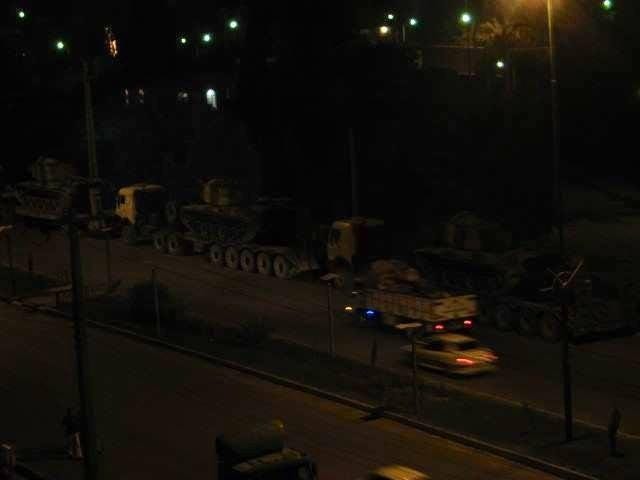
Now the Peshmerga have launched yet another effort to liberate Jalawla. And this time the Iranians are helping them. On Aug. 21, Kurdish social media activists published pictures that appear to depict elements of the Iranian 81st Armored Division entering southern Kurdistan via Khaneghein, north of Jalawla.

This photo reportedly depicts an 81st Division M-60A1 in Khaneghein. Via social media

The 81st is a battle-hardened division that fought hard during the Iran-Iraq War in the 1980s. And before that, it had fought Kurdish insurgents in Iran’s restive northern provinces. Today the 81st Division is fighting alongsidethe Kurds.

After the Iran-Iraq War, the division reorganized and re-armed. As other units gained Russian T-72 tanks, the 81st gathered up all the leftover, American-made M-60s, M-48s and M-47s. More recently, the 81st broke into three largely independent brigades—the 181st and 281st Armored Brigades plus a mechanized brigade.

The units the activists spotted in Kurdistan most likely are elements of the 181st, as it’s responsible for defending the Sar-e-Pole Zahab border town near Khaneghein. Previously, there had been a build-up of armored units on the Iranian side of the border.

Could Social Media Blow Special Operations Like the Failed Foley Rescue?


08.22.14 

Journalists didn’t report on the mission to save James Foley and more ISIS hostages, but Syrian social media did—in July. Is it just a matter of time before an operation is compromised? 

It’s getting harder to do anything these days without someone tweeting out the details. More than a month before the unsuccessful top-secret mission to rescue American hostages held by ISIS was revealed by the White House, the operation appears to have leaked on Syrian social media accounts. 

Going back at least to the raid on Osama bin Laden, which was live tweeted at the time by a curious neighbor, social media users have been publicizing details of top secret U.S. military operations. So far, there’s no evidence of a mission being compromised by social media, but the possibility exists. And though the military has developed techniques to monitor and counter cellphones during active operations, it’s not clear what strategy exists to deal with the newer communications technologies. 

In the case of the bin Laden raid, the tweeter knew only that something involving helicopters and explosions was happening in his suburban Pakistani neighborhood, not that it had anything to do with the al Qaeda leader or a U.S. special operations mission. But those tweets drew early attention to a highly classified mission and revealed details, including a timeline of events, that may never otherwise have gone public. 

Something similar may have happened in early July, when accounts of the secret military operation to free hostages in Syria began spreading on social media. Those early reports describe an American-led raid on an ISIS compound in Syria. They can’t conclusively be said to refer to the U.S. mission, but the description seems to broadly match, and they surfaced months before the government acknowledged that any such mission had taken place. 

The covert mission to rescue James Foley, a photojournalist reporting on the war in Syria who was captured in November 2012 and imprisoned along with other hostages, had failed, and Foley’s ISIS captors killed him this week and released a video of his execution. But the U.S. government managed to keep the existence of the rescue mission a secret—at least from the American public. Some members of the Western press, tipped off by Syrian witnesses or military sources, may have known about it before the White House made it public the day after the video’s release, but they chose not to report on the story given the sensitivity of the situation. 

Inside Syria, however, there was no blackout on reporting the mission. 

US Hitting ISIS Forces in Iraq, But Studiously Ignoring More Dangerous ISIS Forces In Syria

Hannah Allam and Jonathan S. Landay
Obama’s approach in confronting Islamic State overlooks Syria
August 22, 2014

WASHINGTON — Despite two weeks of U.S. airstrikes in northern Iraq, the Islamic State retains its bloody grip on roughly half of the country and is rolling up new conquests in Syria, piling pressure on President Barack Obama to develop a comprehensive, cross-border strategy to crush the group.

The lack of such a response to the Islamic State’s use of Syria as a springboard for attacking Iraq is the most glaring omission of Obama’s approach to the current crisis. Hitting the group in Syria carries huge risks, not the least being aiding the Assad regime in its war with the Islamic State and other insurgents. Yet not quickly eradicating what senior U.S. officials concede is a terrorist threat without precedent means the danger to international security likely will metastasize.

“There is no policy,” said a senior U.S. defense official, who requested anonymity because of the sensitivity of the issue.

The absence of a comprehensive approach that includes Syria reflects the White House’s desire to extricate the United States from 14 years of foreign wars. It also underscores the administration’s tardy response to numerous U.S. intelligence warnings about the Islamic State, dismissed by Obama as recently as January as a “J.V. team.”

Yet Obama’s top military advisers implicitly acknowledged this week that trying to hold the line against the Islamic State in Iraq won’t work, and that only by eliminating the group’s Syrian strongholds can it be eliminated.

“They can be contained, not in perpetuity,” Army Gen. Martin Dempsey, the chairman of the Joint Chiefs of Staff, said Thursday. “Can they be defeated without addressing that part of their organization which resides in Syria? The answer is no.”

Following the gruesome slaying by the Islamic State of American journalist James Foley, the White House opened the door to targeted airstrikes _ possibly using missile-firing drones _ against the group in Syria.

“We’re actively considering what’s going to be necessary to deal with that threat, and we’re not going to be restricted by borders,” Deputy National Security Adviser Ben Rhodes said Friday.

At the same time, Rhodes said, the Pentagon hasn’t given Obama “specific military options.”

For now, the administration’s military plans don’t go beyond giving air support and advice to Iraq’s problem-plagued army and the militia of the autonomous Kurdish region as they fight to blunt the offensive that has swept the al Qaida spinoff from the northern city of Mosul to the suburbs of Baghdad.

Instead, Obama appears to be gambling that Iraq’s incoming prime minister, Haider al Abadi, can rebuild the mostly defunct Iraqi military, reconcile with the aggrieved Sunni Muslim and Kurdish minorities, and convince Sunni tribal leaders to drive the Islamic State from their territories.