15 October 2014

Spotted—Al Assad’s Brutal Mine-Clearing Tank in Syria

Robert Beckhusen
12 Oct 2014

UR-77 Meteorit appears on the front line

Syrian president Bashar Al Assad’s forces have a new tank on the front line—one they haven’t used in the civil war until now. Like most Syrian military hardware, it probably comes from Russia.

It’s the mine-destroying UR-77 Meteorit, recently photographed leaving the heavily-guarded Mezzeh Military Airport after arriving by air, according to a local opposition journalist. It’s destination was the rebel-held, Damascus suburb of Jobar.

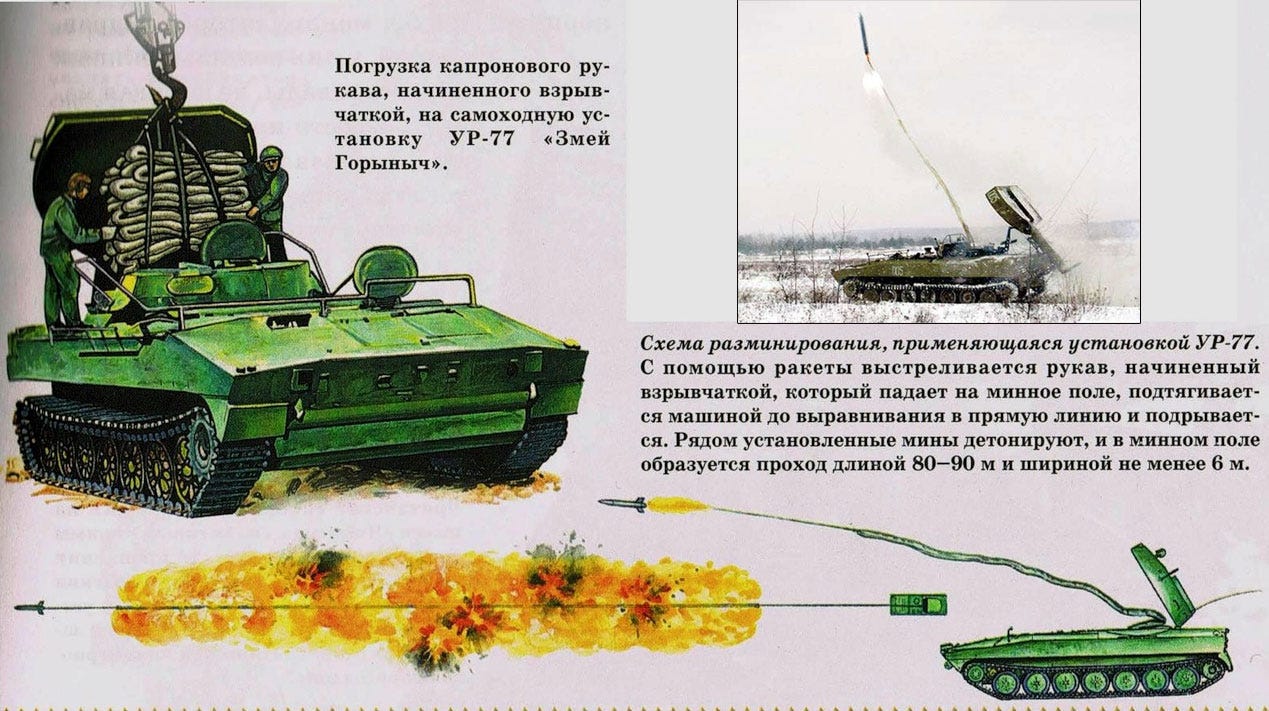
The UR-77 is a variant of the 2S1 Gvozdika, a Russian-made tracked artillery piece. But the only real similarity between the UR-77 and the 2S1 is the chassis. Instead of a howitzer, the UR-77 has a turret capable of shooting out a rocket-propelled rope fitted with explosive charges.

It’s an extremely nasty weapon. Known in the U.S. military as a “mick lick,” the line charge is a crude but effective means to clear mines.


Fire the rope down a city street and blow it up, and the expanding pressure wave should destroy most mines planted in the way. It’ll destroy most of the road and buildings as well.

Pro-regime YouTube channels also showed the tank engaged in fighting in Jobar on Oct. 1.

It’s another sign of Russia’s continuing support to the Syrian military. Assad’s military largely uses Russian weapons, and the Syrian air force has long been dependent on Russian-produced spare parts to keep its planes in the air.

The Kremlin’s Main Intelligence Directorate, or GRU, has also provided advisers to help intercept and gather radio signals—which the Free Syrian Army recently discovered after overrunning a spy base near Damascus.

There’s no evidence the Russians have provided training on how to operate the UR-77. But if so, Russian doctrine calls for the vehicle to move with escorts—ground troops and BTR armored vehicles. The escorts’ job is to prevent anti-tank teams from getting close enough to destroy the vehicle before the UR-77 can launch its payload.

But in practice, the vehicle is just as much as a weapon as it is a counter to one, owing to the tremendous blast radius of its explosives at more than 300 feet long and 20 feet wide. The explosion is big enough to blow out a city street and kill anyone in the way.

The Russian army used the UR-77 to lethal effect during the second Chechen war, launching line charges at houses during the fighting for the village of Komsomolskoye. For its part, U.S. Marines heavily used line charges during the 2005 battle for Fallujah.

“The weight of a charge exceeds one ton and the power of the explosion is such that houses in Komsomolskoye were simply wiped off from the face of the earth,” Moscow Defense Brief observed in a history of Russian weapons used in Chechnya.

The UR-77, illustrated. Art via bayanay.info. At top—a mick lick explosion in Iraq in 2003. Photo via Wikimedia

Booby traps are an excellent weapon for insurgents. To use a convoluted military term, landmines and improvised explosives are force multipliers. This means a few mines—and the fear of mines—has a profound and outsized effect on the behavior of a larger foe.

Why the Bombing Campaign in Syria Isn't Working Well

October 13, 2014

The U.S. air war in Syria has not gotten off to an encouraging start. For many observers the principal indicator of that is a lack of setbacks for ISIS, as the group continues to besiege a Kurdish-held town near the Turkish border. We ought to be at least as discouraged, however, by the negative reactions to the airstrikes from the “moderate” Syrian opposition groups that the strikes are supposed to help and in whom so much hope is being placed if U.S. policy toward the Syrian conflict is to begin to make any sense. Harakat Hazm, a group considered sufficiently moderate and effective to have received the first shipments of U.S.-made anti-tank weapons, called the U.S. campaign “a sign of failure whose devastation will spread to the whole region.”

It is early in that campaign, of course, and if searching hard enough one can also find some more encouraging signs. The airstrikes in Iraq still have more support. And ISIS in Syria at least seems to have seen the necessity of lowering its visibility in places it controls such as Raqqa—although its blending even more closely into the civilian population will make future airstrikes that much harder to do.

Despite administration statements about having to think in long-haul terms, patience in Washington will wear thin amid meager results. Pressures for escalation will increasingly be felt. In response to comments from opposition groups about how the airstrikes are insufficiently coordinated with, and have not aided, their operations on the ground, expect to hear more talk in Washington about a need for putting U.S. personnel on that ground.

That sort of talk ought to be met with a reminder of the fundamental reasons—the inconvenient facts of the Syrian situation that constitute a still-unsquared circle—that will continue to make for poor results.

One reason is the multidimensional nature of the Syrian conflict, in which in the absence of a credible Syrian political alternative the United States has in effect taken the side of a Syrian regime that it supposedly still wants to oust, and in which the opposition groups in which the United States has placed its faith have significantly different priorities from Washington. Opposition groups have been particularly critical of the United States targeting of the Al-Nusra Front, which is an understandable target for the United States given that group's status as an affiliate of Al-Qaeda, but which many of the other groups have seen as an effective ally in the fight against the Assad regime.

Another reason is the inevitable damage and resulting anger and resentment from airstrikes, even though high-tech U.S. weapons are far more discriminating than the Syrian regime's barrel bombs. Some of the resentment-generating impact of the US. strikes so far has been indirect and economic rather than direct and kinetic. Attacks on targets such as oil refineries, power plants, and granaries have caused shortages and price rises that have hurt civilians at least as much as they have impeded ISIS.

And related to that is the potential for the United States to make itself a bigger issue in Syria than either ISIS or the regime. There already are worrisome signsthat Al-Nusra and ISIS are repairing their breach from last year and campaigning in tandem against the U.S. intervention by portraying it as a war against Islam.

Ukraine Fires Its Third Defense Minister This Year

Agence France-Presse
October 13, 2014

Ukraine leader sacks third defence minister this year

President Petro Poroshenko dismissed Ukraine’s third defence minister of the year Sunday in a surprise decision ahead of high-level talks with Moscow on bringing peace to the Western-backed former Soviet republic.

Poroshenko’s official website said he would nominate a new defence chief on Monday after “accepting the resignation” of Valeriy Geletey.

But the sacking also highlighted a sense of failure that has enveloped the once-proud force as the six-month conflict with pro-Russian rebels drags on and the death toll from fighting approaches 3,400.

The military’s performance has humiliated Ukrainians who had been celebrating the success of a bloody popular uprising that ousted the then Kremlin-backed leader in February and propelled Kiev on its westward course.

Ukraine’s Defence Minister Valeriy Geletey pictured in Zhytomyr, September 23, 2014

Geletey’s removal threatened to undermine Poroshenko’s position ahead of a crunch meeting with Russian President Vladimir Putin in Milan on Friday, only the third time the two have met since Poroshenko came to power in May.

"I have no illusions. These will not be easy negotiations, but I am ready for them," Poroshenko told the nation in a television address.

"My goal (is to achieve) our country’s unshakable independence, its territorial integrity, the inviolability of its borders, and the return of peace," he said.

Putin appeared to strengthen his hand with the order Saturday for 17,600 Russian troops deployed near Ukraine to return to their bases — a decision analysts linked to his desire to see biting Western sanctions suspended or at least rolled back.

- Eastern bloodbath -

There had been speculation for days about Poroshenko’s displeasure with Geletey’s ability to organise a decisive assault on the insurgents since his appointment on July 3.

Russia: Between Empire and Modernity

October 09, 2014

As it bullies its neighbors, Russia seems to have chosen a short-sighted approach to power. 

Russian President Vladimir Putin’s annexation of the Crimea and the shadow war in Ukraine is the most important geopolitical event in Europe since the end of the Cold War. Putin is widely seen in the West now as a gangster-like figure, obsessed with Cold War-era grudges, and unwilling to allow the ex-Soviet Union’s “near abroad” to find their own post-Cold War path. Putin would seem to prefer the countries around him be failed states, whose weakness opens them to Russian manipulation, rather than modernizers, moving, however haltingly, to democracy, non-corrupt capitalism, and association with Western governments and values. Were Russia’s immediate neighbors to move toward the European norm, as much of Eastern Europe has since 1990, it would be harder for Russia to bully them, and that bullying would attract global attention.

This is not to suggest that Russia is a great enemy or threat to the West. Supporters of Mitt Romney have recently claimed justification for Romney’s 2012 statement that Russia is America’s “greatest geopolitical foe.” This is not true. (If one must apply that needlessly belligerent moniker, it is probably either Islamic jihadism or North Korea, both of which are openly and aggressively anti-American.) Russia’s assets of national power aredramatically diminished since the Cold War. Its GDP today is just $2 trillion, where the combined GDP of the U.S. and EU exceeds $35 trillion. Russia’s military suffers from corruption, morale issues due to harsh conscription treatment, and a general lack of funds to compete with high-tech U.S., European, and Chinese militaries. For this reason, Russia has emphasized nuclear weapons and deterrence in its doctrine. Like North Korea, Russian WMD (weapons of mass destruction) are a pillar of its claim to relevance. Russia under Putin may seek to be a spoiler along its western and southern tier (and in resolving North Korean issues), but the likelihood of a genuine western-Russian clash is low. That is not a conflict Russia can win in the medium-term, and in the long-term, a complete breach with the West would destabilize the Russian economy so much that it would endanger Putin’s position.

The more important question is “grand strategic”: will Russia choose “neo-imperial” meddling along its frontier, an age-old Russian practice that, in turn, fosters czarist authoritarianism and corruption at home, and bad blood and resentment among its neighbors? Or will it embrace some form of modernity, as it partially tried in the 1990s, with reasonable governance at home, and some kind of modus vivendi, including respect for sovereignty, abroad? If it chooses the former, as Putin has done, what is the end-game? Where does Putinism lead in ten or twenty years? Semi-permanent isolation from the West? Boundless corruption? Dependence on China?

UKRAINE AND THE ART OF LIMITED WAR

October 8, 2014

“You Can’t Always Get What You Want”

-Rolling Stones, Let it Bleed album 1969

In a piece published in War on the Rocks last March, and in an extended version by the journal Survival in May, I considered Ukraine and the art of crisis management. My aim was to explore the relevance of the strategic concepts of the Cold War in relation to the unfolding drama of Ukraine, particularly the challenge of securing essential interests without triggering a wider war. I judged the crisis to have been badly managed by Russia, not particularly well by the West and with great difficulty by Ukraine. The consequences of the failure of crisis management lay not so much in expanding the area of conflict but instead in continuing and unsettling violence within Ukraine and a sharp deterioration in relations between Russia and the West. The death toll is now in the region of 3,500 and still rising.

The role of Russian forces within Ukraine was evident from the start of the crisis but gradually became even more overt as indigenous separatist forces were unable to cope. This resulted in a shift in the character of the crisis over the course of 2014. It moved from an externally sponsored insurgency in eastern Ukraine to a limited war between Ukraine and Russia, albeit one with some unique features. This was not a total war: Vast armies did not move against each other. Most capabilities were held in reserve. Diplomatic communications continued throughout the fighting.. A shaky cease-fire was announced on 5 September. This was perhaps better described as a de-escalation, because the fighting did not stop. It was, however, sufficient for attention to be given to the consequential political steps.

In this essay I take up the story from early May to the start of October and consider what, if any, strategic lessons might be drawn from this most recent stage in the conflict. Like my last essay on the subject, I will expand this into a longer reflection in Survival. The next stage in the conflict over the political future of Ukraine will depend on how the issue of the governance of territory currently occupied by separatists is handled. If the conflict bursts out of its current limits then the next essay in this series will have an even more alarming topic.

Commentary on the most recent stage of the conflict has stressed the originality of Russian tactics, with regular reference to “hybrid war” – combining overt and covert operations. My argument in this essay is that once Ukraine was able to put regular forces into its “anti-terrorist operation” in East Ukraine, this approach failed. This obliged President Putin to introduce superior Russian regular forces (albeit with their status denied).

Until more is revealed about Russian decision-making during the courses of this crisis, any analysis relies on inferences about Putin’s objectives and calculations. My view is that the wider conflict with the European Union and NATO had reached an uncomfortable stage for Putin. So while he could have taken more Ukrainian territory, he chose to accept a cease-fire that enabled him to retrieve some political advantage. At the same time, by exuding menace towards Ukraine and Western Europe he sought to resist further pressure. Russia’s position depended on the possibility that it was prepared to continue escalation. The West’s response was shaped by an evident reluctance to escalate and anxiety about moving into a less contained conflict. This was despite the fact that in the end the power balances were still in the West’s favor. In terms of the theory of limited war, the case of Ukraine confirms the observation that in disputes over territory, the most effective forms of control involve regular armed forces and superior firepower. Control, however, does not ensure a functioning economy and society.

II
The concept of limited war has an even longer history than that of crisis management. It requires that the belligerents choose not to fight at full capacity, and so prevent a conflict gaining in intensity and expanding in both space and time. This is different from the need to accept natural limits imposed by resources and geography. Nor is it relevant when a strong state employs only limited forces to deal with opponents with inferior capabilities. Against such opponents complete victories can still be achieved, as the rise of colonialism demonstrated. The concept comes into play only when the limits have been chosen and accepted by both parties.

As a distinctive concept, limited war depended on a contrast with total war, a term popularized by the First World War, when the parties would push war to its extremes. This appeared as the logical conclusion of the transformation of war begun during the Napoleonic period with the departure from the inherently limited conflicts of the eighteenth century. The old routines became obsolete with the expectation that the full resources of states would be pitted against each other in Darwinian struggles for survival. Once nuclear weapons were introduced, total war pointed to an absurd and tragic result: mutual destruction. If both sides could accept that whatever was at stake was not worth an all-out confrontation then any effort to protect interests through the use of armed force would be governed by some sense of how far they were really prepared to go.

Eastern Europeans are bowing to Putin’s power

By Jackson Diehl 
October 12 

To grasp how Vladi­mir Putin is progressing in his campaign to overturn the post-Cold War order in Europe, it’s worth looking beyond eastern Ukraine, where the Kremlin is busy consolidating a breakaway puppet state. After all, Ukraine, as President Obama likes to point out, is not a member of NATO — which has extended Western security and democratic governance to a dozen nations that had been dominated by Soviet dictatorship.

So let’s consider Hungary, a NATO member whose prime minister recently named Putin’s Russia as a political model to be emulated. Or NATO member Slovakia, whose leftist prime minister likened the possible deployment of NATO troops in his country to the Soviet invasion of 1968. Or NATO member Czech Republic, where the defense minister made a similar comparison and where the government joined Slovakia and Hungary in fighting the European Union’s sanctions against Russia. Or Serbia, a member of NATO’s “partnership for peace” that has invited Putin to visit Belgrade this month for a military parade to celebrate the 70th anniversary of the Red Army’s “liberation” of the city.

Jackson Diehl is deputy editorial page editor of The Post. He is an editorial writer specializing in foreign affairs and writes a biweekly column that appears on Mondays.

Then there is Poland, which until recently was leading the effort within NATO and the European Union to support Ukraine’s beleaguered pro-Western government and punish Putin’s aggression. This month its new prime minister, Ewa Kopacz, ordered her new foreign minister to urgently revise its policy.As the Wall Street Journal reported, she told parliament she was concerned about “an isolation of Poland” within Europe that could come from setting “unrealistic goals” in Ukraine.

Obama has been congratulating himself on leading a “unified response” by the West that, he claims, has isolated Putin. In reality, a big chunk of the NATO alliance has quietly begun to lean toward Moscow. These governments do so in part for economic reasons: Dependent on Russia for energy as well as export markets, they fear the consequences of escalating sanctions.

But some also seem to be hedging their security and ideological bets. They figure it’s not worth testing whether Putin’s reported threat to invadeformer Soviet-bloc countries was really in jest — or whether a NATO led by Obama would really come to their defense. Why else preemptively announce, as did the Czech prime minister Bohuslav Sobotka, that his country did not want the troops NATO dispatched to Poland and the Baltic States as a deterrent to Russia?

Sobotka was trumped by Slovakia’s Roberto Fico, a former Communist, who followed up his rejection of NATO troops by dismissing Obama's appeal for increased defense spending and calling sanctions against Russia “suicidal” and “nonsensical.” Fico’s pandering, in turn, looked weak compared with the speech delivered in late July by Hungary’s Viktor Orban, who described Russia as an exemplar of how “we have to abandon liberal methods and principles of organizing a society . . . because liberal values [in the United States] today incorporate corruption, sex and violence.”

If this is a “unified response,” it looks orchestrated more by Putin than by Obama. “Some Central European politicians are angling either to remain below the radar screen — don’t speak up and make your nation the target of Putin’s ire — or to ingratiate themselves with Putin and therefore fare better than other allies when the waters get even choppier,” Damon Wilson, the executive vice president of the Atlantic Council, told me. “The issue for many politicians will be how to survive when the Russians are back, nastier than ever . . . and the Americans are remote, available only for genuine 911 calls.”

China, Russia seek 'international justice', agree currency swap line

by Staff WritersMoscow (AFP) 
Oct 13, 2014

Lithuania creates response force to prevent Ukraine scenarioVilnius (AFP) Oct 13, 2014 - Lithuania on Monday announced a new rapid reaction force designed to meet what it termed new unconventional security threats highlighted by the Ukraine crisis.The Baltic nation's top general said 2,500 troops will be on high alert as of November to counteract so-called "hybrid warfare" involving unconventional attacks by unmarked combatants, like those in eastern Ukraine.

The move comes after NATO last month approved a rapid-response force in the wake of Russia deploying new combat tactics in Ukraine amid its March takeover of Crimea.
"We must immediately increase our readiness for unplanned military actions during peacetime," Major General Jonas Vytautas Zukas told reporters.

New threats include "manipulating national minorities, provocations, attacks by non-state armed groups, illegal border crossing, breach of military transit procedures," Zukas said.
The force, which accounts for about a third of Lithuania's 7,000-strong military personnel, will take from two to 24 hours to be fully mobilised.

The defence ministry on Monday also tabled legislation that would allow the president to authorise the use of military force in a defined territory without first declaring martial law.
So-called "little green men" -- armed soldiers without any identifying insignia -- played a key role in seizing Ukrainian military bases in Crimea after a hastily organised referendum led to its annexation by Russia in March.

Like Ukraine, Lithuania was part of the Soviet Union until 1990, but unlike it, joined the European Union and NATO in 2004 and gained protection under the alliance's Article Five collective defence guarantee.

Lithuania, along with Baltic partners Latvia and Estonia, has had rocky ties with Moscow since independence. Tensions have spiralled over Russia's role in the Ukraine crisis.

Russia and China on Monday pledged to ramp up efforts to promote a just world order as they signed dozens of deals ranging from energy to finance.

Visiting Chinese Prime Minister Li Keqiang and his Russian counterpart Dmitry Medvedev oversaw the signing of 38 agreements, including a deal to open a yuan-ruble swap line worth 150 billion yuan ($24.5 billion) in an apparent bid to reduce dependence on the US dollar.

Li's first visit to Russia as prime minister comes at a sensitive time, with the Kremlin locked in a battle of wills with Washington and Brussels over Ukraine.

How Russia Sees the Ukraine Crisis

October 13, 2014

Can a compromise be found?

Though Ukraine’s not-quite cease-fire is far preferable to the summer’s heavier fighting, it is far from clear that it will lead to a sustainable settlement between Kiev and eastern Ukrainian separatists, Moscow and Kiev, or the United States and Russia. A recent presentation at the Center for the National Interest by Andranik Migranyan, a well-informed analyst and writer who runs the Kremlin-connected Institute for Democracy and cooperation in New York, provides useful insight into Moscow’s view of what would be required to get there—and illustrates the wide gap between prevailing Western and Russian outlooks and expectations. His assessment—based on a recent trip to Russia during which he discussed the crisis with a number of senior officials—offers little basis for optimism. (See his 15-minute presentation, plus about an hour of discussion, on the Center’s YouTube page here.)

Migranyan’s perspective on Ukraine and on U.S.-Russia relations, like most mainstream Russian perspectives and indeed Russian official statements, is unpleasant for many Americans and Europeans to hear. (In Migranyan’s case, his views were apparently so unpleasant for one European diplomat present during his remarks that the diplomat decided to complain loudly and walk out.) Unfortunately, the fact that something is unpleasant—or worse—does not make it unimportant.

Ukraine is a case in point. Russia has annexed Crimea and has encouraged and supported armed rebellion in eastern Ukraine, both of which go well beyond unpleasant. Thankfully, the fighting in Ukraine has subsided for the time being, though it could return to pre-cease fire levels very quickly if Moscow and the separatists choose that path.

Why did all of this happen? Migranyan explained the origins of the Ukraine crisis in terms radically different from those commonly accepted in the United States and much of Europe. For example, he insisted, the crisis was not “Russia’s initiative,” arguing instead that Moscow was forced to respond to U.S. conduct. Specifically, he asserted that Russia would not have had the idea to “grab Crimea” and would have felt safe and secure, had the George W. Bush administration not pursued NATO membership for Ukraine and Georgia, which “started this process.” In fact, Migranyan noted, Crimea’s ethnically Russian majority—and its elected leaders and parliament—have called repeatedly for annexation by Russia since Russia and Ukraine became independent countries. He correctly added that Moscow previously ignored these requests many times, in his view because Russia’s leaders saw Ukraine as a “friendly, non-bloc country,” and argued that Russia chose to take over Crimea earlier this year only after Viktor Yanukovych’s ouster.

Ukraine was more stable in the past, Migranyan said, because earlier presidents like Leonid Kravchuk and Leonid Kuchma understood that their country was divided and fragile and, as a result, pursued cautious policies that maintained relations with both Russia and the West. He explained Ukraine’s current turmoil by adding that the “radicals in Kiev” have abandoned this approach and will “destroy” Ukraine if they continue. Migranyan singled out Ukraine’s Prime Minister, Arkady Yatseniuk, as a representative of the faction seeking to end Ukraine’s neutrality by joining NATO.

Migranyan described Russia’s objectives in Ukraine as ensuring the rights of Russian-speakers to use the Russian language, establishing a federal Ukraine with devolution of power to the country’s regions, and ensuring Ukraine’s continued “non-bloc” status. When pressed to define what federalization would mean in practice, he referred to direct election of regional governors, independent regional budgets, and the ability for Ukraine’s regions to pursue trade and economic ties with Russia and other countries. He added that those who argue that federalization would lead to Ukraine’s “collapse” actually prove Russian President Vladimir Putin’s controversial statement that Ukraine is not a “real” country, which Migranyan interpreted to mean that it is not a unified nation.

Strengthening Australian-Vietnam Ties… In Cyberspace

By Jessica Woodall
October 12, 2014

Cybersecurity can help Australia take its existing engagement with Vietnam to the next level. 

Historically, Vietnam’s relationship with China has been complex. Stretching from 111 BC and early Chinese cultural domination of Vietnam, to the 1979 border conflict and more recent disputes over competing claims in the South China Sea, the relationship’s had its challenges.

Earlier this year hostility flared when the Chinese government deployed an oil rig within Vietnam’s Economic Exclusion Zone. That led to public protests and targeted violence towards Chinese nationals in 22 of Vietnam’s 63 provinces.

Tip-toeing around the edges of that tension are several countries—including the U.S., Japan, Russia and India—seeking to step up their engagement with Hanoi. All seek a stronger relationship with a partner in a geographically important location and a warmer friendship with ASEAN’s main players—and some probably hope to counter China’s expanding sphere of influence.

Tangible engagement has, for the most part, centred on arms and natural-resource sales. Vietnam took deliveryof the second of six Kilo-class submarines from Russia in March. And India’s said to be close to concluding a dealto sell BrahMos supersonic cruise missiles to the Vietnamese, further boosting their defense capabilities. Earlier this month, the U.S. also partially lifted its 30-year-old embargo on sales of lethal arms to Vietnam, which will facilitate the sale of weapons for maritime purposes for the first time.

Australia should also seek to expand its engagement with Vietnam: it’s too politically and geographically important to ignore. But we need to be careful not to ruffle Beijing’s feathers while doing so. So we must be subtle in our cooperation with Hanoi, proceeding with a softly-softly approach.

Non-traditional security issues such as cybersecurity provide an opportunity to take our existing engagement, which primarily revolves around transnational crime, to the next level.

That’s by no means an easy task. Vietnam, like many other countries in the region, has dabbled with internet censorship, blocking access to certain platforms and arresting a handful of online activists.

But instead of throwing our hands up and deciding it’s all too difficult, Australian government departments and agencies should develop strategies and policies on what information, skills and knowledge can be safely shared amongst countries with an imperfect record of online practices.

Vietnam is by no means as restrictive as other countries in the region when it comes to freedom of expression online and has shown positive signs of reform, albeit not yet in legislative form. Earlier this year the government yielded to international pressure and released several high-profile dissidents including blogger Nguyen Tien Trung.

PREVENTING THE OIL AND GAS RESOURCE CURSE IN EAST AFRICA

By Namakula Evelyn Mayanja

Emerging oil and gas countries in East Africa. Source EIA. 

East African countries (Kenya, Tanzania and Uganda) have joined the list of oil and gas producing nations in Africa. The region is brought into spotlight with International Companies, such as Tullow, that explore the resources and many more companies are making all possible efforts to ensure that they become part of the oil and gas boom. It is the ‘new scramble’ for Africa’s resources, with China and the United States taking the upper hand in competing for Africa’s gas and oil. China is offering aid and has constructed the African Union Chinese funded headquarters in Ethiopia, worth $200 million The United States is intensifying its diplomatic, military and economic attention leading to the first ever African leaders’ summit at the White House in August 2014. Frequent summits on the exploration of oil and gas in East Africa draw international representation, and the summit of June 10-12, 2014 in UK drew delegates from 200 regional and international companies from 30 countries. The third summit is scheduled for October 15-17, 2014 in Nairobi and the fourth for February 9-10, 2015 in Dar es Salaam.

Precedents of African nations that own oil and gas resources allude to the ‘resource curse’ phenomenon where resource abundance is characterized by political and economic setbacks that undermine progress and development. Whereas abundance could be advantageous, in reality it inhibits good governance and democracy, empowers dictatorial regimes to entrench their power and reinforces political repression. The more the regime is able to finance its budget from the quick oil and gas money, the less accountable it becomes, and the greater the incentive to stay in power illegitimately, and the more the population resorts to violence to demand economic and political rights. Civil armed conflicts and wars based on resource mismanagement characterize African nations with abundant resources. Rebel groups engage in civil wars to benefit from the resources especially where the benefits outweigh the rebellion costs and will prolong the wars to maintain their earnings. According to Alao (2007, p.20) resource conflicts are fought at five levels: 1) between and among groups within a state; 2) between communities across national borders; 3) between citizens and the central governments; 4) between communities and multinational corporations and 5) between governments. Corruption is engraved in institutions, coupled with lack of transparency and accountability.

Resource dependence is also associated with revenue volatility and the ‘Dutch disease’, an economic pathology whereby with the booming oil sector, growth of other industries is neglected. Capital and revenues are allocated to the oil industry that shifts the labour force away from other industries (including agriculture) to oil and gas alone, a phenomenon that leads to a devaluation of locally produced goods and foodstuff. Resource dependency and failure to invest in other industries and human capital poses a bleak future. Oil-rentier economies also suffer from the shock of price surges in the global market, causing a decline in manufacturing and overvaluation of the local currency. Considering the examples of other African nations where oil, gas and mineral resources are causing havoc, what is needed to avoid the oil and gas curses in East Africa? What is required to ensure that oil and gas resources foster national and regional development? Do the East African nations have structures and institutions capable of managing their resources, especially in relation to providing opportunities, fiscal management, transparent revenue collection and allocation, protection of human rights and social justice, ensuring land rights, and environmental protection? To what extent are the resource wars associated with Africa’s leadership crisis and governance struggles going to be avoided in East Africa? How will the citizens of East Africa benefit from the exploration of their resources?

ISIS, Foreign Terrorist Fighters, and the Value of the Visa Waiver Program

OCT 8, 2014

According to a September 2014Washington Post–ABC News poll, 90 percent of Americans view the Islamic State of Iraq and Syria (ISIS) as a serious threat to vital U.S. interests. Headlines discussing the possibility of an imminent attack on U.S. soil by homegrown ISIS fighters or those possessing “Western” passports have recently dominated the news cycle.

Prompted by the evolving ISIS issue, in late September, the UN Security Council unanimously passed Resolution 2178 on policies and security measures to better track and deter terrorist travel activity. It requires member countries to take certain steps to address the foreign terrorist fighters (FTF) threat, preventing suspected FTFs from entering or transiting through their territories, and implementing legislation to prosecute FTFs. It also calls on member countries to take steps to improve international cooperation by sharing information on criminal investigations, interdictions, and prosecutions.

Specifically, Resolution 2178 calls for:

• Implementation of effective border controls and controls on issuance of identity papers and travel documents and thorough measures for preventing counterfeiting, forgery or fraudulent use of identity papers and travel documents;

• Use of evidence-based traveler risk assessment and screening procedures, including the collection and analysis of travel data;

• Intensification/acceleration of the exchange of operational information through bilateral or multilateral mechanisms;

• Disruption/prevention of financial support to FTFs and implementation of prosecution, rehabilitation, and reintegration strategies for radicalized individuals;

• Requirements for airlines to provide advance passenger information to the appropriate national security authorities in order to detect FTF departure, attempted entry into, or transit through their territories, as well as sharing this information with the state of residence or nationality;

• Improved international cooperation through bilateral agreements, including increased sharing of information for the purpose of identifying FTFs, sharing and adoption of best practices, and improved understanding of the patterns of travel by FTFs;

• Assistance with criminal investigations or proceedings relating to the financing or support of terrorist acts, including assistance in obtaining evidence necessary for the proceedings; and
• Intensified efforts to employ INTERPOL resources, including the use of INTERPOL databases to track stolen or forged identity papers and travel documents.
These are all sensible measures. In fact, the United States has been enforcing such measures since 2008 through the Visa Waiver Program (VWP).

The U.S. Intelligence Community's Creativity Challenge

October 13, 2014

"Why isn’t the IC clamoring—like so many other organizations—to think creatively about the increasingly complex world it is supposed to understand?"

The ability to think creatively, it seems, is today's Holy Grail. Businesses claim to want more of it. A growing number of schools concentrate on it. Countlessbooks and magazines are dedicated to it. Myriad conferences build their themes around it.

Why does creativity increasingly seem so important? What does it actually mean to think creatively? Moreover, why doesn’t the intelligence community (IC)—especially its analysts—seem to covet this ability the way so many other organizations and industries do?

Well, the answer to the first question comes down to the fundamentally different nature of today’s world: highly complex (interconnected and interdependent) and growing more so by the second. Sure, many people—including many intelligence analysts—dismissively say that the world has always been complex, as if that somehow refutes the notion that things have changed. However, the fact of the matter is that the past thirty years have seen complexity increase on a scale—globalization anyone?—and at a clip that far exceeds what came before. In sum, the world has indeed changed—a lot.

More specifically, during this period, both China and the remnants of the Soviet Union—a huge chunk of the world by any measure—went from being thoroughly disconnected entities to fully integrated members of the international order. Moreover, and perhaps more important, the information technology revolution—personal computers, cell phones, internet—has permitted people down to an individual level to not just “be reached” but “to reach” unprecedented numbers of others. In fact, Sir Tim Berners-Lee—the inventor of the web—asserted on Google’s official blog on the occasion of the web’s 25th anniversary this past March, that 40 percent of the world’s population is now online. By extension, it is reasonable to expect that global complexity will continue its spike as the IT revolution continues to roll along.

It’s precisely this new level of complexity that explains why creative thinking is now so highly valued. The essence of a highly complex situation is rooted in the dynamic nature of the relationships, interconnections and interdependencies between the parts—not merely the parts themselves. And in order to discern those interconnections, to see those relationships, to perceive those interdependencies, and to understand what they might mean for emerging circumstances, it is fundamentally necessary to think creatively.

This, of course, begs the question of what exactly it means to think creatively. In this context, it means thinking that considers a broad array of possibilities by mentally synthesizing multiple—extant and potential—connections. Or, to be more concise, it is thinking that is: wide-aperture, holistic, big-picture, synthetic, divergent or lateral. Indeed, the MacArthur Foundation, which awards its eponymous fellowships to individuals who exemplify this type of creativity, provides some usefully elaborative language on its website: “…to connect the seemingly unconnected…fusing ideas from different disciplines into wholly new constructions…producing works that broaden the horizons of the imagination…to transcend traditional boundaries…to synthesize disparate ideas and approaches.”

Interview With Outgoing Head of GCHQ

Charles Moore
Daily Telegraph
October 12, 2014

GCHQ: ‘This is not Blitz Britain. We sure as hell can’t lick terrorism on our own’

On the outskirts of Cheltenham stands a huge circular building known as The Doughnut. This is the Government Communications Headquarters (GCHQ), the heir of the war-winning codebreakers in those little huts in Bletchley Park. The 5,500 employees monitor the communications of the world – in the interests, says the relevant Act, of national security, “economic well-being’’ and combating serious crime – but they do not communicate with us.

I pass through multiple security, traverse “the Street’’ that circles inside the edifice, and sit down to wait. I am the first print journalist ever to interview GCHQ’s director, Sir Iain Lobban. He is about to leave after six years in the top job and 31 in the organisation.

He is bursting to speak. Young Iain, a Southport boy fresh with a languages degree from Leeds University, began here in 1983. At that time, GCHQ was the dingy provincial sister of the big boys in Whitehall – MI5 (the Security Service) and MI6 (the Secret Intelligence Service). Today, thanks to the march of technology, it dominates. Foreign heads of government come on pilgrimages here. The director has a seat on the National Security Council (NSC). GCHQ is our most important global intelligence asset.

Yet just as everything got good for the boys in Cheltenham – this being the techie world, most still are boys – it also got bad. Last year, The Guardian published the information Edward Snowden had purloined from the US National Security Agency (NSA). Some of what he revealed compromised GCHQ: “He made my job a thousand times more difficult,’’ one man charged with cracking terrorists’ internet games tells me. At a time when Isil, also known as Islamic State, is a clear and present threat, the imperative is greater than ever. In the eyes of GCHQ’s critics, Snowden also revealed unacceptable levels of intrusion into the personal data of British citizens.

Sir Iain Lobban, left, shows Charles Moore around GCHQ

“When I heard the news,’’ says Iain Lobban, “I lay awake saying to myself: ‘I hope this isn’t a Brit.’” He asked colleagues if they suspected anyone in their departments (“Anyone on a protracted holiday?’’), but he doubted it because “We would have noticed something a lot earlier – red tags on the security file.”

Snowden was a contracted systems administrator without personal commitment to the NSA. Lobban believes that GCHQ “treats our contractors as if they are people. We wouldn’t ‘body-shop’ them,’’ so such profound disaffection is unlikely here. But if the leak had been British, he admits, “That would have been the end of me.’’ As it was, senior NSA officials came to Cheltenham and apologised to staff: “This happened on our watch.’’

14 October 2014

The soft power war

Oct 14, 2014

Whether in the UN or at the Madison Square Garden, Mr Modi’s speeches had to be designed and structured to reverberate with the TV audiences back home, who would be casting their votes

Information warfare is both offensive and defensive the first, to dominate the mind of an opponent population and shape their perceptions to our own advantage; the second, to prevent similar efforts by an opponent from influencing the collective psyche of own population. To put it simply, information warfare is a blend of psychological operations (“psyops”) and electronic warfare (“EW”).

The former creates the theme and the message, i.e. the “idea” (heard that one before?) to be projected to the target population; the latter disseminates it by the most appropriate means of projection, whether through an upmarket electronic medium, or the more humble but highly effective medium of the poster, the placard, or the handbill. Whatever the process, information warfare is an essential requirement for strategic projection of soft power, to achieve specific national agenda and objectives. Information warfare is a highly sophisticated and above all imaginative process. It has never been amongst the strong points of India’s institutions controlled by India’s official bureaucracy. In fact, India’s attempts at so-called psychological warfare(s) have generally been hidebound and sometimes downright ridiculous. Yet, ironically enough, though in a connected but different context, India has some of the “best brains and minds” in the business (a variation on the “hearts and minds” analogy) right here in India, most of them in the world of media and advertising in the private corporate sector, where some of the most ferocious battles rage for the “hearts, minds and market space” of the Indian customer. Suitably reset and realigned, these resources can be utilised to achieve strategic objectives even at the national level, as also to achieve these for even relatively minor objectives at strategic, operational, and somet-imes even tactical objectives. Military history is replete with such narratives. The Indian military could well interact with profit with the wizards of advertising in the media private sector.

It is in the context of information warfare, that the Indian establishment requires to carefully examine and analyse the recent visit of their own Prime Minister to the United Nations, in particular his address to the 69th session of the United Nations General Assembly, as also to members of the Indian American community at the iconic Madison Square Garden.

Narendra Modi, now coming to the United States in his own right as the democratically elected Prime Minister of India, still remains something of a controversial love-hate figure to many in the United States, particularly its prosperous Indian-American community, which has been quite divided on the issue. He had been declared persona non grata by an earlier US administration, specifically at the urgings of a section of the Indian community. The George W. Bush administration had proscribed his entry into the country under the somewhat simple-mindedly framed Freedom of Religion Act, on grounds of condoning (or committing — the two are virtually synonymous) atrocities against religious minorities in the state of Gujarat during his tenure as chief minister. The fact that the former chief minister of Gujarat state had been let off by the Supreme Court of India, due to lack of evidence was passionately dismissed out of hand as irrelevant by vigilante opinion of some in the Indian community. On his part, the Prime Minister was fully aware at all times throughout his visit that though he was physically in the United States, whether in the United Nations or at the Madison Square Garden, his speeches had to be designed and structured to reverberate with the television audiences back home, who would be casting their votes in the elections to state Assemblies approaching in 2015 and to the Lok Sabha elections a little further down the road. The Prime Minister’s performance before the world body under these circumstances would be a text-book case study on information warfare, and a demonstration of a sophisticated campaign to influence hearts and minds on a mass scale, in this case not of the United Nations, but of the Indian electorate back home watching him on television, who would be voting in the forthcoming elections to several state Assemblies. To begin with the Prime Minister’s choice of Hindi in which he is an eloquent and powerful orator, as the language of choice for his maiden speech in the United Nations and which was also understood by the electorate back home, could be construed as a step in this direction, even though it was totally unfamiliar to the very large majority amongst the national delegations present at the United Nations General Assembly. The very latest language translation facilities were of course available, but then the impact on its recipients of even the best translated speech is of necessity diffused. Also, as in some perceptions, the choice of Hindi by Mr Modi might even be interpreted almost as an in-your-face gesture to the rest of the General Assembly, because his own primary concerns remained more the pre-electoral situation developing back home, rather than the one ongoing at the United Nations, whose public relations impact, if any, in India would in any case be almost non-existent. The cheering Indian-American audiences in Madison Square in New York, primarily “Overseas Friends of the BJP”, represented the money-machine feeding the Bharatiya Janata Party’s political war-chests in India. But the “Indian-Indians” attending political rallies back home, would actually fill the ballot boxes come election time. It was they who constituted the “vital ground” of the campaign.

The public addresses, delivered in forceful, passionate Hindi, (again, a payload for home consumption) whether at the UN General Assembly, or the iconic Madison Square Garden, largely dwelt on India’s international concerns; his interactions with President Barack Obama as also to corporate America, were more businesslike and private. Both meshed together and complemented each other. The visit to the United States was almost an old-style whistle stop campaign tour, throughout which his objectives remained focused and unambiguous to get the American manufacturing industry to invest in India. He promised a positive and business friendly atmosphere in this country, something which the hard-boiled American corporate heads in the audience, bruised from earlier encounters with the Indian political system and its bureaucracy, could be forgiven for regarding with a degree of skeptic déjà vu. Would matters be different this time around?

The writer is a former Chief of Army Staff and a former member of Parliament
Relentless ceasefire violations

India should be prepared for cross-border terrorism
Gen V P Malik (retd)

THE India-Pakistan ceasefire along the 1,050-km international border, Line of Control (LoC), and the Siachen Glacier area, came about on November 26, 2003. The then Pakistani Prime Minister, Mir Zafarullah Khan Jamali, had announced it as a commemoration of Eid al-Fitr, marking the end of prayer and fasting during the holy month of Ramadan that year. This year's Eid al-Zuha saw its worst violation by Pakistan since 2003. During the heavy firefight, the annual tradition of exchanging sweets on Eid was done away with. And so was the practice of holding a flag meeting by the BSF and Pakistan Rangers deployed along the international border.

A historical analysis of the ceasefire violations since November 2003 shows that the escalation in the number of violations has no correlation with the new NDA government coming into power in India. The escalation picked up gradually in January 2013 and then very steeply after Prime Minister Nawaz Sharif assumed office in Pakistan in June 2013. According to reports, 347 violations were recorded in 2013, compared to 114 incidents in 2012. This year 334 incidents have already occurred till date. Despite much improved vigilance on the LoC, the number of cross-border infiltration attempts has also gone up in the last one year.

Many Indian journalists, who have been feted by Nawaz Sharif, believe him to be the messiah of peace. But Nawaz Sharif's rhetoric on improving relations with India fails to match up with the developments on the ground. Apart from the Kargil misadventure in 1999, his tacit approval — willingly or unwillingly — to keep the LoC alive and maintain terrorist pressure in J&K cannot be missed. He and the Pakistan army have always been together on this page.

According to intelligence reports, soon after taking over as Prime Minister in 2013, the Nawaz Sharif government cleared a new ‘Kashmir strategy’ and set up a ‘Kashmir cell’ in his office. The purpose of the cell was to keep track of developments in J&K. The other related fact in his current tenure is that as his political position weakens, he comes more and more under pressure from the Pakistan army, the ISI and the terror outfits of Punjab and Pakistan Occupied Kashmir.

After the Modi government came into power, the last week of August 2014 saw the first major ceasefire violation in which Pakistani troops resorted to small arms fire and 82 mm mortar shelling (such mortars have never been used on this stretch ever since the India-Pakistan war in 1971) of nearly 35 Border Security Force posts, from Samba to Akhnoor along the international border. This was responded to in the usual manner. After four days of firefight, para-military commanders of both sides met and agreed to maintain the ceasefire.

This incident was followed by the Pakistani High Commissioner meeting J&K secessionists despite being warned by the Indian government not to do so. The Indian government reacted sharply. It cancelled the Foreign Secretaries' meeting. Soon after, Pakistan Prime Minister Nawaz Sharif raised the J&K issue in the United Nation General Assembly on September 26, 2014. He earned a sharp rebuke from Prime Minister Modi at the same forum the next day. Modi made it clear that “Raising it at the UN won't resolve bilateral issues.”

This is where Pakistan and its army went wrong. Without taking into consideration the Indian government's revised J&K policy and resolve, it continued with its attempt to increase pressure on the new Indian regime. In a major skirmish this time, the Pakistan army and Rangers targeted the entire LoC south of the Pir Panjal Range and the civilian population and towns along the international border. This engagement of soft Indian targets after October 2, 2014, left no choice with India except to retaliate with force. The Modi government could neither afford dilution of its policy nor be seen giving in to pressure of violence. After analysing earlier incidents of ceasefire violation, it had already given greater autonomy and escalation dominance/control to local military commanders. The forceful response was evident on the ground as well as in the political rhetoric. Pakistan was shocked by the massive retaliation. It had failed to appreciate the new Indian government's strength in public and Parliament, and that of its armed forces. Even more importantly, the change in its leadership! Such failures can be a fatal flaw in any armed conflict. The important lesson from Kargil had been forgotten.

Two steps back


Pakistan takes Kashmir issue to the UN

GUNFIRE recently punctuated cross-border encounters in Jammu and Kashmir. Many civilians lost lives in the heavy shelling along the Line of Control and the international border. The ceasefire that had been in effect since 2003 has been repeatedly violated. Now another long-standing understanding between India and Pakistan to settle contentious issues bilaterally, has been wilfully ignored. Sartaj Aziz, Adviser to the Pakistan Prime Minister on National Security and Foreign Affairs, has written to UN chief Ban Ki-moon, to protest what he calls unprovoked Indian shelling. He has also asked for a plebiscite in the region. Aziz’s letter is consistent with the stand taken by Prime Minister Nawaz Sharif, who had, during his recent visit to New York, raised the “core issue” of Kashmir at the UN General Assembly. These actions represent a new, and more strident diplomatic offensive against India.

Islamabad has been systematically fermenting trouble in Kashmir by sending in terrorists and thus violating the first condition under which any possible plebiscite could be held. It has also used the Kashmir bogey to often successfully turn the focus away from its own internal failures. India, on the other hand, has rightly maintained that the vitiated atmosphere that comes in the wake of infiltrating terrorists and sponsoring terrorism is the opposite of what ought to be done.

Peaceful relations between India and Pakistan would result in a spurt in economic growth in both countries something that would certainly improve the life of their citizens. Promises of better trade and commerce have often been voiced and even the limited trade that takes place now highlights its potential. However, for all this, the prerequisite is peace, which Pakistan has been unable to deliver. Prime Minister Narendra Modi seemed keen to start with a new slate soon after his swearing in, but the situation deteriorated thereafter, with jingoistic statements of political leaders on both sides accelerating the process. Given the circumstances, and Pakistani diplomatic offensive, any improvement in relations is unlikely to happen in a hurry, which is a pity.

Wanted: dogma-free models of inflation

October 14, 2014 

The target of inflation experts at the RBI is 8 per cent for December.

Inflation data for September 2014 was released yesterday and came in at 6.5 per cent, making it the best reading since February 2008, when it was 6 per cent. Last October, the inflation gauge measured 10.2 per cent. That is close to a 4 percentage point decline in one year. But I guarantee you that my brethren in the profession, and experts at the RBI, will still be talking about how this declining inflation estimate is distorted, like many others this year, and how base effects, seasonals, etc explain the entire reduction. And how, just you wait, inflation is going to shoot back up.

In a recent note, monetary experts at the IMF argued that India needs to increase the repo rate in order to successfully reduce double-digit inflation. The target of inflation experts at the RBI is 8 per cent for December. We all get our forecasts wrong every now and then, but less than three months ago, RBI experts were talking about the dangers of inflation not slipping below 8 per cent. And just 10 days ago, RBI Governor Raghuram Rajan talked about the dangers of inflation being above 6 per cent 15 months from now, in January 2016.

If the RBI knows best about inflation, why is it consistently missing near-term forecasts, and by a large margin? One explanation is that it does not have a correct model of inflation or growth, or a model relating the two. If this is true, why should the RBI be trusted with its present model of inflation? It could be that the RBI policy of substantially high repo rates is working to reduce inflation; however, the model needs to communicate the correct trend. A miss by such a magnitude is a structural miss — remember, the “informed’ RBI target for December is 8 per cent. Three months from now, inflation is likely to be closer to 6, not 8 per cent.

But what is the “correct” model of inflation? In several articles since July 2011, including (‘Where monetary policy is irrelevant’, IE, September 13), I have argued the following: that a primary determinant of Indian inflation is the policy variable of minimum support price (MSP) inflation set by the agriculture ministry. In addition, I have argued, indeed challenged, the monetary authorities and/ or researchers to empirically document a relationship between any non-MSP variable and inflation.

So far, this challenge has not been met. However, in an article written by a consultant to RBI (CAFRAL division), senior economist Amartya Lahiri, without offering an alternative model of inflation, claims that MSP inflation was just mirroring lagged CPI inflation. Technically, Lahiri does this by purging MSP inflation of past CPI inflation; interestingly, he does not do the counter-purge. If he did, as discussed below, he would not have obtained the result he did. (‘Don’t blame MSP for inflation’, IE, October 7).

There are two major problems with Lahiri’s conclusion. First, at a conceptual and/ or policy level, how can one argue that the politically and Sonia Gandhi-inspired change in the terms of trade in favour of agriculture were all due to the fact that the UPA experts were just making up for past CPI inflation? Just a simple check of the numbers would have shown Lahiri that he was following the wrong “garden” path. Second, I have argued, and still argue, that MSP affects inflation with a one-year lag. CPI inflation was averaging 4.5 per cent for the nine years from 1999 to 2007 and MSP inflation averaged 5.2 per cent. In 2008, MSP was increased by 27 per cent; and CPI inflation averaged 12.4 and 10.4 per cent in the subsequent two years, and in double digits for each of the next three years. He should also note that CPI inflation is down in 2014 and likely to go down further, because MSP inflation has averaged less than 5 per cent in 2013 and 2014.