16 October 2014

Why America's Navy Is So Concerned About These Russian Missiles

Andrew Tarantola

EXPAND

Some folks question why the U.S. Navy would need such exotic weapons as the Phalanx andSeaRAM systems, or even electromagnetic rail guns. These Russian-made, radar-guided anti-ship missiles are two such reasons.

The P-270 Moskit and P-800 Oniks have caused so much consternation that the Navy has begun developing a helicopter-based electronic warfare system—the Advanced Offboard Electronic Warfare (AOEW)—to defend against the threat. Both are ramjet-propelled cruise missiles, both carry 550 to 710 pounds of high explosive in their warheads, and neither is one you want to see streaking towards your ship.

EXPAND

The P-270 Moskit was developed by the Raduga Design Bureau and first debuted in the 1970s as a sea-launched anti-ship weapon, though extensive upgrades in the subsequent decades have seen it adapted for ground, air, and even underwater launches. It measures just over 30 feet long and is tipped with 700 pounds of either high-explosive or nuclear material (equivalent to 120 kt of TNT). Its quartet of ramjet engines only provide a range of 75 miles though the missile can hit mach 3 during its high-altitude flight.

The P-800 Oniks is very much like the Moskit that it replaced, albeit slightly smaller, but no less terrifying. The Oniks, designed by NPO Mashinostroyeniya, entered service in the 1980s and remains so with the Russian military today. Though the Oniks is about 2 feet shorter than its predecessor, only carries a 550-pound warhead, and tops out at just mach 2.6, it flies twice as far and incorporates a number of technological advancements that were not available for the Moskit.

These improvements include an inertial, active-passive radar seeker head (the Moskit was strictly an active seeker) which makes the missile essentially autonomous once it's launched; an over-the-horizon firing range (up to 186 miles) with the ability to skim along less than 30 feet above the ocean's surface; and potentially even onboard EW countermeasures (nobody's quite sure as it is still an active military system—state secrets and all that).

Russian Military Modernization: Rogozin Promises a ‘Nuclear Surprise’

October 7, 2014 
Eurasia Daily Monitor 

(Source: NVO)

In late September, Russia’s Deputy Prime Minister Dmitry Rogozin, who oversees the defense industry, promised that the ongoing military modernization will contain a “nuclear surprise” for the country’s potential adversaries. It seems that in large measure this “surprise” relates to a major readjustment to the target for the upgrade and modernization of Moscow’s nuclear arsenal: from a target of 70 percent by 2020 to 100 percent. Rogozin’s statement aroused critical comment even from Russian defense experts, who questioned the capacity within the defense industry to deliver on such targets within the next six years (Nezavisimoye Voyennoye Obozreniye, September 26).

Rogozin’s remarks, however, find support in earlier statements from the top brass as well as during President Vladimir Putin’s address to Duma representatives in Yalta in August 2014. Indeed, Deputy Defense Minister Yury Borisov suggested in June that such modernization targets are within reach for the Strategic Rocket Forces (Raketnye Voyska Strategicheskogo Naznacheniya—RVSN). The level of confidence expressed by the political-military leadership in nuclear modernization may not be entirely realistic, given existing problems in modernizing other parts of the nuclear triad, yet it also suggests some shift in emphasis to favor a new heavy liquid rocket development. The development of the heavy liquid rocket was entrusted to the Makeev State Rocket Center, which has not received the same level of investment as the Moscow Institute of Thermal Technology associated with strategic nuclear systems including Poplar, Topol-M and Yars (Nezavisimoye Voyennoye Obozreniye, September 26).

There are clear signs of technical developments and increased confidence within the RVSN. Its leadership always anticipated benefiting from military modernization, and some signs of the areas in which this is impacting are becoming apparent during RVSN exercises. A recent RVSN exercise in Central Military District (MD), for example, provided indications of these advances as well as areas to which attention is devoted for testing and improvement. These military drills featured raising forces to the highest degree of combat readiness as well as conducting maneuvers on road routes, including patrols, anti-sabotage units, the assessment of the impact of enemy precision weapons, and using radio-electronic warfare in deployment areas. Mobile strategic missile systems were disguised during transit, and air units rehearsed countering enemy air attacks (Nezavisimoye Voyennoye Obozreniye, October 1).

The exercise was also important in the ongoing State testing of the new fifth-generation integrated automated command and control system for the RVSN (integrirovannaia avtomatizirovannaia sistema boyevogo upravleniya—IASBU). Testing of the IASBU is planned to conclude by the end of the year permitting further refinements with systems arriving in larger numbers in the RVSN by 2016: this will become the command and control system for the Rocket Forces over the next several decades. Its introduction will facilitate information exchange and the digital transmission of combat orders as well as allow for the rapid re-targeting of missiles. “IASBU links command and control together with wired, radio and satellite communication channels, which have the necessary durability and noise immunity, and will ensure bringing orders to the command and control as a command and control of various ranks, as well as directly to the launchers, including conditions of nuclear exposure and jamming,” explained RVSN Major Dmitry Andreev. Moreover, sources within the Russian Ministry of Defense suggest the IASBU is designed using an exclusively Russian electronic-component base, which is a significant achievement (Nezavisimoye Voyennoye Obozreniye, October 1).

Turkey Denies Reports of Deal for Use of Its Bases in Fight Against Islamic State

OCT. 13, 2014

A Syrian border town was hit by airstrikes Monday. Turkey said it was still in talks to allow its bases to be used for strikes. CreditAris Messinis/Agence France-Presse — Getty Images

ISTANBUL — A day after American officials said Turkey had agreed to allow its air bases to be used for operations against the Islamic State, which they described as a deal that represented a breakthrough in tense negotiations, Turkish officials said on Monday that there was no deal yet, and that talks were still underway.

The Turkish comments represented another miscommunication between the United States and its longtime ally Turkey, as President Obama pushes to strengthen an international coalition against the militants that control a large area of both Syria and Iraq, by securing a greater role for Turkey.

The Turks have insisted that any broad support to the coalition is dependent on the mission going beyond the Islamic State, also called ISIS or ISIL, to also target the Syrian government of Bashar al-Assad, which Turkey has long opposed and blames for creating the conditions that led to the rise of the extremists within Syria and Iraq.

“We approach this issue from a comprehensive perspective, including safe havens and a no-fly zone to be established in the region,” said an official in the office of Prime Minister Ahmet Davutoglu, speaking on the condition of anonymity because he was not authorized to speak to the press.Photo

Secretary of State John Kerry with Prime Minister Ahmet Davutoglu of Turkey last month in Ankara.CreditPool photo by Brendan Smialowski

The official, who said that no deal over the use of air bases had been completed, added, “Talks, therefore, continue as we look into things we can do together while covering all these aspects.”

A senior Defense Department official insisted on Monday that Turkey had agreed in principle to the use of its bases. The official also sought to tamp down reports of a rupture between the two allies.

“They have agreed to some base usage, but the details of how it will be executed are still being worked out,” said the official, who spoke on the condition of anonymity because of pending negotiations.

As part of an effort against Mr. Assad’s government, the Turks have insisted on a no-fly zone in northern Syria, near the border with Turkey, that would create a safe haven in which to arm and train moderate rebels fighting against Mr. Assad and where an opposition government could take root. The United States has largely opposed this — although some within the government, especially at the State Department, believe the idea should be given serious consideration — because it would broaden Mr. Obama’s stated objective of focusing only on the destruction of the Islamic State.

The Drones of the World Wars

Steve Weintz

Combat robots go back nearly 100 years

We think of drones as uniquely modern weapons of war. But they’re not. The first combat drone appeared during World War I. And the next world war saw even more flying robots on the front lines.

In 1917, American inventor Charles Kettering, later chief scientist for General Motors, created the Aerial Torpedo, an ingenious guided missile. It soon earned the nickname “Bug.”

A ground crew mechanically programmed a Bug and launched it from a railroad-like track. The small pilotless biplane steered itself via gyroscope and logged its flight time by counting engine revolutions.

Near its target, the Bug’s engine stopped, its wings fell off and the primitive cruise missile fell to Earth with its 180-pound explosive warhead.

Though the Bug achieved moderate success during testing, it never saw combat. It arrived too late to enter war service and Allied commanders worried about cranky explosive-laden drones flying over the heads of their troops.

The Bug remained a classified military secret until World War II, by which time whole new classes of drones were buzzing into battle.

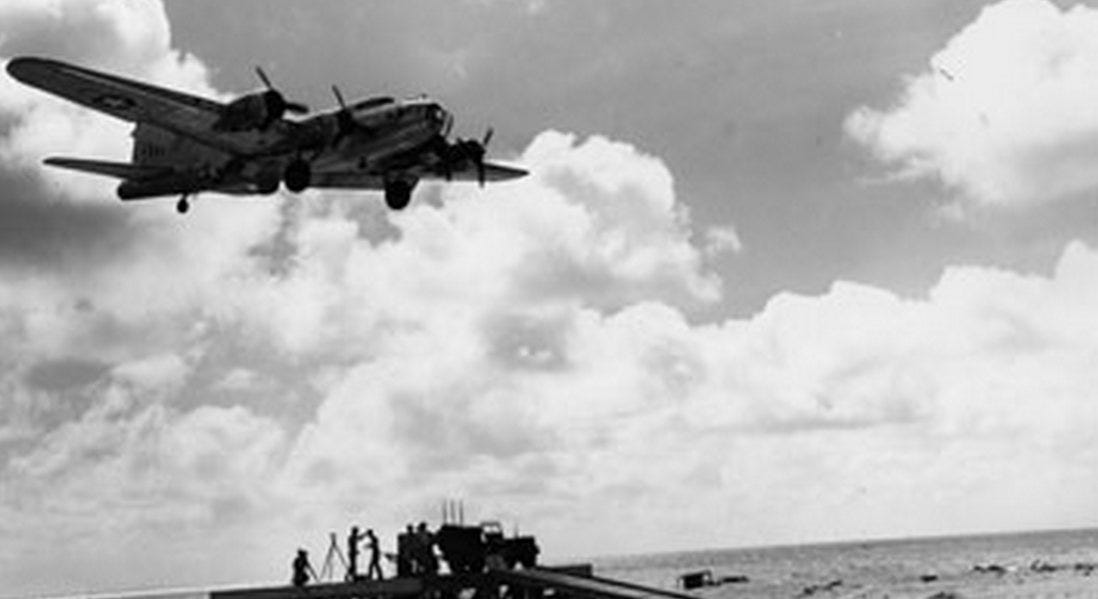
A robotic B-17 takes off. All photos on this page via Wikipedia

Buzz bombs & beat bombers

The German V-1 buzz-bomb, a jet-powered cruise missile, was World War II’s most famous drone. Like the Kettering Bug and some modern drones, most V-1s lifted off from a rail launcher and guided themselves using gyroscopes.

The V-1’s simple pulse-jet engine sounded like a flying fart machine and pushed it along at 400 miles per hour.

Although its one-ton warhead could cause serious damage on impact, the slow- and low-flying V-1 soon fell prey to British defenses, including fighter pilots’ improbable but effective technique of flipping the V-1s over in mid-flight using their planes’ wingtips.

Nazi engineers investigated more advanced weapons including drone-mothership designs and prototype missiles with infrared and television sensors … but none of them arrived in time to save the Third Reich.

The Allies also developed war-drones. Under programs with code names like Operations Aphrodite and Operation Anvil, Allied scientists in the European theater fitted war-weary B-17 and B-24 bombers and PB4Y patrol planes with radio controls, TV cameras and up to 10 tons of explosives.
Controllers aboard a guide plane flew these giant flying bombs by way of simple joysticks while watching a TV view of the drones’ cockpit instruments.

But the remote system was incapable of handling takeoff and arming the warhead, so courageous volunteers piloted the drones from the ground to 10,000 feet before bailing out.

With such crude technology most Aphrodite/Anvil missions ended in failure or disaster. Controllers either lost control of the drones or the pilots died in mishaps.

Probe of silencers leads to web of Pentagon secrets

October 12

This December 26, 2011, file photo shows the Pentagon in Arlington County, Va. (AFP/GETTY IMAGES)

The mysterious workings of a Pentagon office that oversees clandestine operations are unraveling in federal court, where a criminal investigation has exposed a secret weapons program entwined with allegations of a sweetheart contract, fake badges and trails of destroyed evidence.

Capping an investigation that began almost two years ago, separate trials are scheduled this month in U.S. District Court in Alexandria, Va., for a civilian Navy intelligence official and a hot-rod auto mechanic from California who prosecutors allege conspired to manufacture an untraceable batch of automatic-rifle silencers.

The exact purpose of the silencers remains hazy, but court filings and pretrial testimony suggest they were part of a top-secret operation that would help arm guerrillas or commandos overseas.

The silencers — 349 of them — were ordered by a little-known Navy intelligence office at the Pentagon known as the Directorate for Plans, Policy, Oversight and Integration, according to charging documents. The directorate is composed of fewer than 10 civilian employees, most of them retired military personnel.

Court records filed by prosecutors allege that the Navy paid the auto mechanic — the brother of the directorate’s boss — $1.6 million for the silencers, even though they cost only $10,000 in parts and labor to manufacture.

Much of the documentation in the investigation has been filed under seal on national security grounds. According to the records that have been made public, the crux of the case is whether the silencers were properly purchased for an authorized secret mission or were assembled for a rogue operation.

A former senior Navy official familiar with the investigation described directorate officials as “wanna-be spook-cops.” Speaking on the condition of anonymity because the case is still unfolding, he added, “I know it sounds goofy, but it was like they were building their own mini law enforcement and intelligence agency.”

The directorate is a civilian-run office that is supposed to provide back-office support and oversight for Navy and Marine intelligence operations. But some of its activities have fallen into a gray area, crossing into more active involvement with secret missions, according to a former senior Defense Department official familiar with the directorate’s work.

“By design, that office is supposed to do a little more than policy and programmatic oversight,” the former defense official said, speaking on the condition of anonymity because much of the directorate’s work is classified. “But something happened and it lost its way. It became a case of the fox guarding the henhouse, and I suspect deeper issues might be in play.”

The Pentagon’s Secret Space Drone Is Finally Coming Home

10.13.14

After a spy mission nearly two years long, America’s robotic space plane is coming back to Earth.

The U.S. Air Force’s mysterious X-37B robotic space plane is expected to return to Earth on Tuesday after nearly two years in space. But while it is no secret that the Air Force has sent the unmanned spacecraft into orbit at least three times, the service refuses to say what the machine has been doing up there.

While most Air Force and industry officials refuse to talk about the program at all, sources familiar with the program indicated to The Daily Beast that the X-37B is designed to carry experimental payloads of sensors—like various high-tech cameras of various types, electronic sensors and ground-mapping radars.

The idea is that the X-37B carries “specialized” sensors packages that can be reconfigured as needed for each mission when the aircraft returns to Earth. That ability to reconfigure the robotic spacecraft makes the X-37B cheaper and more flexible than a satellite—which goes up once with one package of sensors and is eventually discarded. Satellites can often cost billions of dollars and cannot reconfigured or reused, unlike the X-37B.

Further, the X-37B can maneuver more freely once it is in space. Unlike a satellite, which is placed into orbit with a finite amount of fuel, the X-37B can be topped with more fuel for its thrusters when it returns to Earth. It can even change orbits. That ability gives the spacecraft much more flexibility than a traditional satellite.
Ever since the X-37B made its first flight back in 2010, outlandish rumors and bizarre conspiracy theories have dogged the Boeing-built space drone.

The X-37B will return to Vandenburg Air Force Base in California, according to the Air Force. It will be the space-plane’s third such landing—assuming the weather holds up and nothing technical goes wrong.

“Team Vandenberg stands ready to implement safe landing operations for the X-37B Orbital Test Vehicle, the third time for this unique mission,” Col. Keith Baits, 30th Space Wing commander said in a statement on Oct. 10.

The spaceship was launched on Dec. 11, 2012, from Cape Canaveral Air Force Station in Florida.

Ever since the X-37B made its first flight back in 2010, outlandish rumors and bizarre conspiracy theories have dogged the Boeing-built space drone. Some wags suggested in the past that the X-37B would be used to tap into the communications of foreign satellites, however the Pentagon has other easier and more effective means to listen in on those spacecraft. 

An even more outlandish theory was that the X-37B would be used to physically interfere with foreign satellites—perhaps even abducting those machines from orbit. However, the possibility that Air Force would have designed the X-37B for that kind of mission was extremely remote. It would be very easy to trace that sort of activity back to the U.S. government since governments and amateurs alike can easily track the X-37B.

Is The Guardian Holding The New York Times’ Snowden Stories Back?

10.14.14

A source at the Times tells The Daily Beast the paper feels ‘shackled’ over The Guardian’s total control over the cache of Edward Snowden NSA documents—and how they are used.

The Brits and the Yanks have long enjoyed a “special relationship,” and the bond between The Guardian and The New York Times is certainly special.

But when it comes to printing stories based on top secret documents supplied by Edward Snowden, the relationship between the British and American media outlets occasionally seems frayed as well.

In the summer of 2013, as the British government moved to destroy The Guardian’s classified cache provided by the National Security Agency whistleblower who fled to Russia--going so far as to dispatch a wrecking crew to the paper’s London offices to shatter computer hard drives with drills and chisels--Guardian editor in chief Alan Rusbridger arranged for the tens of thousands of documents to be shared with and protected by The Times in New York, beyond the reach of British authorities.

The cooperative arrangement initially resulted in several eye-popping stories for both newspapers, including The Times’s Snowden-based expose’ of how American and British intelligence operatives were data-mining the popular Angry Birds smartphone app to reveal all sorts of personal information about users.

The spies had also figured out, The Times reported, how to squeeze personal data from Flickr, Facebook, and Twitter accounts, among other social media.

That was in January.

But nine months later, according to Times newsroom employees who spoke on condition of anonymity, some reporters and editors at the U.S. newspaper are unhappy because of the agreement that Times editors struck with Rusbridger in 2013. It gives The Guardian total control over the Snowden cache, including how and when it can be used to develop, pursue and publish investigations.

They say The Guardian has been dragging its feet on the pursuit of NSA-related stories while keeping the Times on a short leash. “People feel shackled,” a Timesstaffer told The Daily Beast. 

On Monday, responding to the report of grumbling in his newsroom, Times executive editor Dean Baquet was at pains to downplay the tensions.

“Are there disagreements? Of course there are,” Baquet said in an interview. “In the case of Snowden, we’re talking about two big independent newspapers in separate countries, with very different laws and also with a little bit of a different story sense…But have there been fights? No. I don’t feel held captive by The Guardian, because I wouldn’t have access to these particular documents withoutThe Guardian.”

Baquet--who, as Washington bureau chief in 2007, worked cooperatively withThe Guardian on the Wikileaks revelations--denied that The Times would have been ready to publish certain Snowden-based stories but for The Guardian’s veto.

He was vague on whether The Times, with The Guardian’s assent, has planned any specifically Snowden-related reports. But he said that in a meeting two weeks ago in New York with Rusbridger and Katharine Viner, the recently named editor in chief of The Guardian’s U.S. edition, they discussed “a couple of areas” of potentially promising Snowden-related reporting. 

Rusbridger, meanwhile, said by phone from London: “I feel we’ve worked cordially, according to the agreement that we discussed in the summer of last year. And we continue to work cordially.” 

Russian hackers target NATO, Ukraine and others: iSight

Oct 14, 2014 


A lock icon, signifying an encrypted Internet connection, is seen on an Internet Explorer browser in a photo illustration in Paris April 15, 2014.

(Reuters) - Russian hackers exploited a bug in MicrosoftWindows and other software to spy on computers used by NATO, the European Union, Ukraine and companies in the energy and telecommunications sectors, according to cyber intelligence firm iSight Partners.

ISight said it did not know what data had been found by the hackers, though it suspected they were seeking information on the Ukraine crisis, as well as diplomatic, energy and telecom issues, based on the targets and the contents of phishing emails used to infect computers with tainted files.

The five-year cyber espionage campaign is still going on, according to iSight, which dubbed the operation "Sandworm Team" because it found references to the "Dune" science fiction series in the software code used by the hackers.

The operation used a variety of ways to attack the targets over the years, iSight said, adding that the hackers began only in August to exploit a vulnerability found in most versions of Windows.

ISight said it told Microsoft Corp about the bug and held off on disclosing the problem so the software maker had time to fix it.

A Microsoft spokesman said the company plans to roll out an automatic update to affected versions of Windows on Tuesday.

There was no immediate comment from the Russian government, NATO, the EU or the Ukraine government.

Researchers with Dallas-based iSight said they believed the hackers are Russian because of language clues in the software code and because of their choice of targets.

"Your targets almost certainly have to do with your interests. We see strong ties to Russian origins here," said John Hulquist, head of iSight's cyber espionage practice. The firm plans to release a 16-page report on Sandworm Team to its clients on Tuesday.

While technical indicators do not indicate whether the hackers have ties to the Russian government, Hulquist said he believed they were supported by a nation state because they were engaging in espionage, not cyber crime.

For example, in December 2013, NATO was targeted with a malicious document on European diplomacy. Several regional governments in the Ukraine and an academic working on Russian issues in the United States were sent tainted emails that claimed to contain a list of pro-Russian extremist activities, according to iSight.

The firm said its researchers uncovered evidence that some Ukrainian government computer systems were infected, but they were unable to remotely confirm specific victims among those systems that had been targeted.

Still, researchers believe a large percentage of those targeted systems were infected because the malicious software used was very sophisticated, using a previously unknown attack method that enabled it to get past virtually all known security protections, said Drew Robinson, a senior technical analyst with iSight Partners.

ISight said it had alerted some victims of Sandworm Team, but declined to elaborate.

South Korea Seeks Offensive Cyber Capabilities

October 11, 2014

With North Korean cyber attacks on the rise, South Korea is acquiring preemptive cyber strike capabilities.

South Korea is developing offensive cyber capabilities to counter the growing number of cyber attacks it faces from North Korea, the ROK Defense Ministry announced earlier this week.

To date, South Korea has relied on passive and defensive cyber operations to counter cyber attacks from North Korea. However, as Tae-jun Kang notes over at the Koreas blog, North Korea has been stepping up its cyber operations against the South in recent years. Cyber attacks originating in the North were up over 35 percent in the first nine months of this year, and South Korea’s Defense Ministry estimates that North Korea has nearly doubled the size of its cyber command over the last two years.

The Korea Herald reports that during a parliamentary audit on Wednesday, a Defense Ministry official told lawmakers that the North’s growing cyber capabilities have forced it to abandon its previously defensive cyber doctrine.

“We will change what has so far been a passive-defensive policy into a proactive one. Taking advantage of the enemy’s vulnerabilities, we will take preemptive action to fend off cyberinfiltrations,” the unnamed Defense Ministry official was quoted as telling lawmakers.

Another anonymous military source elaborated on the nature of the changes. “[To date] The military had focused on monitoring-based operations to deter enemies’ hacking attempts, but now we will proactively detect hosts of such attacks online and launch preemptive strikes to prevent them from victimizing us from the outset,”the source was quoted by Yonhap News Agency as saying.

To beef up its capabilities, South Korea plans to train 400 new cyber troops to bring its total number of cyber warriors to around a 1,000. The 400 new cyber warriors will operate as part of the Cyber Command South Korea’s Ministry of National Defense created back in 2010 as the sophistication and frequency of North Korea’s cyber attacks began increasing.

As The Diplomat has pointed out in the past, cyberwarfare presents an opportunity for the North Korean military. To begin with, the plausible deniability of cyber attacks also suits North Korea’s desire to constantly provoke South Korea without sparking a war that it would surely lose. Cyber capabilities also play into North Korea’s larger military doctrine of acquiring asymmetric capabilities that can help compensate for the vast inferiority of its conventional military forces compared to South Korea and the United States.

Furthermore, cyberwarfare suits North Korea because of the huge asymmetry between the two Koreas’ vulnerabilities to cyber attacks. On the one hand, as one of the most wired nations on earth, all parts of South Korean society are highly vulnerable to cyberattacks. This stands in sharp contrast to North Korea which, despite growth of its national intranet system in recent years, doesn’t rely on the internet to same degree as most nations in the world, particularly modern ones like South Korea.

Russian Hackers Used Bug in Microsoft Windows for Spying, Report Says

By MARK SCOTT
OCT. 14, 2014

LONDON — Russian hackers used a bug in Microsoft Windows to spy on several Western governments, NATO and the Ukrainian government, according to a report released Tuesday by iSight Partners, a computer security firm in Dallas.

The targets also included European energy and telecommunications companies and an undisclosed academic organization in the United States, the cybersecurity report said.

While it is unclear what type of information may have been retrieved, iSightsaid that the targets of the attacks were often linked to the continuing standoff in Ukraine between Russia and the West.

That included the NATO summit meeting in Wales in early September regarding the Ukrainian conflict, in which the Russian hackers targeted the Eastern European country’s government and at least one American organization, the report said.

The illegal activities started as early as 2009 and used a variety of techniques to gain access to delicate information. ISight said the Russian hackers started using the vulnerability in Windows known as zero day only in the late summer.

The bug affected versions from Windows Vista to the company’s latest software, Windows 8.1, though Microsoft is expected to release an update on Tuesday to resolve the potential vulnerability.

Despite efforts to thwart the Russian hackers’ attacks, iSight said using the Microsoft zero-day bug and other illegal tactics almost certainly allowed the hackers to gain some access to their targets.

“The use of this zero-day vulnerability virtually guarantees that all of those entities targeted fell victim to some degree,” the computer security company said in a statement.

While the vulnerability affected many versions of Windows, iSight said the Russian hackers appeared to be the only group to use the bug. The company added, however, that other companies and organizations may also have been affected by the attacks.

Representatives for Microsoft and the Russian government were not immediately available for comment.

The discovery of the suspected Russian hackers is the latest in a series of worldwide cyberattacks that have affected individuals, government agencies and companies.

Many of these attacks have originated in Russia and other Eastern European countries, though the purpose of the hackers’ efforts has often varied.

Last year, for example, Eastern European hackers gained access to the dataof up to 110 million customers of the retailer Target.

In August, security researchers discovered that a separate Russian crime ring had amassed a huge collection of stolen online information, including roughly 1.2 billion user names and passwords and more than 500 million email addresses.

And this month, JPMorgan Chase also revealed that another cyberattack​, which experts believe originated in Russia,​ had compromised the banking accounts of roughly 76 million households and seven million small businesses.

ISight said it had called the most recent Russian hackers the Sandworm team because they used encoded references to the science fiction series “Dune” in their attacks.

ISight said the group often used so-called spear-phishing techniques in its attacks against Western government and commercial targets. That involved sending emails to prospective targets with documents attached that, when opened, could allow the attacker to gain control of the computer.

Many of the emails used were specifically related to the Ukrainian conflict and to wider issues linked to Russia, the company said.

An Iran Nuclear Deal Is There for the Taking


"Both sides know that failure to reach a comprehensive agreement after the collaborative atmosphere that has developed would result in a renewed downward spiral in the relationship." 

Iranian and American nuclear negotiators moved closer to a comprehensive agreement in their recent round of talks. To meet the November 24 deadline, the P5+1 and Iran must hammer out solutions where serious differences remain. Both sides are warning that if the other side does not make more concessions soon, the negotiations will fail. This is to be expected in the final phase of tough diplomacy. The time is rapidly approaching when the leaders in Tehran and Washington must decide on the deal.

Ensuring that Iran will not acquire a nuclear weapon has far-reaching significance for nonproliferation policy and the security of the Middle East. The issues being addressed are complex, technical and scientific and have not been addressed before. The diplomats also have had to overcome thirty-five years of U.S.-Iranian separation and mutual hostility. The long shadow over the talks—cast by the powerful domestic opposition in each nation that is party to the talks—is made even darker by the strenuous opposition of Israel to any deal.


Meanwhile, the mounting turmoil and violence in the Middle East adds urgency to the nuclear negotiations. Iran and the United States are considering whether and how they might cooperate in resolving the common challenges each faces in the region. With ISIS, the United States and Iran must think about whether to take parallel, or even joint, action. Each government has refrained from talking about regional issues until a nuclear agreement can be reached. A nuclear agreement would help build trust and cooperation on the pressing issues in Iran’s neighborhood.

A recent report by The Iran Project, “Iran and Its Neighbors: Regional Implications for U.S. Policy of a Nuclear Agreement,” examines Iran’s relations with its neighbors. It concludes that “there is a strong link between settling the nuclear standoff and America’s ability to play an effective role in the rapidly changing Middle East.” The report does not argue that to make regional talks possible with Iran, the United States should accept a less-than-satisfactory nuclear agreement. It does hold that an acceptable nuclear deal will help unlock U.S. options in dealing with ISIS, Iraq, Syria and Afghanistan, where the United States and Iran need to support the new government in Kabul.

We believe that such an agreement is in sight. Iran has fully complied with the interim agreement of last November. It has stopped enriching uranium to 20 percent and stayed at 5 percent, reduced or converted large stockpiles of enriched uranium, not installed or operated additional centrifuges, refrained from further advances in the Arak nuclear facilities and allowed unprecedented daily access to International Atomic Energy Agency (IAEA) inspectors.

The negotiators are now close to agreeing on the underground Fordow facility. The size and scope of Iran’s uranium-enrichment program presents a domestic political challenge to each side. The Iranian opposition wants more centrifuges and the American opposition wants virtually none. The two sides are working on a plan that would relate the size of the enrichment program to Iran’s practical energy needs. Should the implementation period be ten years or more and neither side violates the agreement, then confidence could be built that Iran does plan to size its enrichment program to its energy needs. The P5+1 and Iran negotiators have proposed creative ways to do this.

Another issue is whether Iran engaged in illicit nuclear-weapons work prior to 2003. Many, including the U.S. intelligence community, believe that it did. The IAEA has been given responsibility for investigating that question. The international community has had experience with this kind of problem before, and there is reason to believe that a satisfactory arrangement can be worked out where Iran privately discloses its previous nuclear work.

Transcript: Address to the Nation on ISIL

September 10, 2014


Remarks as Prepared for Delivery

My fellow Americans – tonight, I want to speak to you about what the United States will do with our friends and allies to degrade and ultimately destroy the terrorist group known as ISIL. 

As Commander-in-Chief, my highest priority is the security of the American people. Over the last several years, we have consistently taken the fight to terrorists who threaten our country. We took out Osama bin Laden and much of al Qaeda’s leadership in Afghanistan and Pakistan. We’ve targeted al Qaeda’s affiliate in Yemen, and recently eliminated the top commander of its affiliate in Somalia. We’ve done so while bringing more than 140,000 American troops home from Iraq, and drawing down our forces in Afghanistan, where our combat mission will end later this year. Thanks to our military and counterterrorism professionals, America is safer. 


Still, we continue to face a terrorist threat. We cannot erase every trace of evil from the world, and small groups of killers have the capacity to do great harm. That was the case before 9/11, and that remains true today. That’s why we must remain vigilant as threats emerge. At this moment, the greatest threats come from the Middle East and North Africa, where radical groups exploit grievances for their own gain. And one of those groups is ISIL – which calls itself the “Islamic State.”

Now let’s make two things clear: ISIL is not “Islamic.” No religion condones the killing of innocents, and the vast majority of ISIL’s victims have been Muslim. And ISIL is certainly not a state. It was formerly al Qaeda’s affiliate in Iraq, and has taken advantage of sectarian strife and Syria’s civil war to gain territory on both sides of the Iraq-Syrian border. It is recognized by no government, nor the people it subjugates. ISIL is a terrorist organization, pure and simple. And it has no vision other than the slaughter of all who stand in its way.

In a region that has known so much bloodshed, these terrorists are unique in their brutality. They execute captured prisoners. They kill children. They enslave, rape, and force women into marriage. They threatened a religious minority with genocide. In acts of barbarism, they took the lives of two American journalists – Jim Foley and Steven Sotloff.

So ISIL poses a threat to the people of Iraq and Syria, and the broader Middle East – including American citizens, personnel and facilities. If left unchecked, these terrorists could pose a growing threat beyond that region – including to the United States. While we have not yet detected specific plotting against our homeland, ISIL leaders have threatened America and our allies. Our intelligence community believes that thousands of foreigners – including Europeans and some Americans – have joined them in Syria and Iraq. Trained and battle-hardened, these fighters could try to return to their home countries and carry out deadly attacks.

I know many Americans are concerned about these threats. Tonight, I want you to know that the United States of America is meeting them with strength and resolve. Last month, I ordered our military to take targeted action against ISIL to stop its advances. Since then, we have conducted more than 150 successful airstrikes in Iraq. These strikes have protected American personnel and facilities, killed ISIL fighters, destroyed weapons, and given space for Iraqi and Kurdish forces to reclaim key territory. These strikes have helped save the lives of thousands of innocent men, women and children. 

But this is not our fight alone. American power can make a decisive difference, but we cannot do for Iraqis what they must do for themselves, nor can we take the place of Arab partners in securing their region. That’s why I’ve insisted that additional U.S. action depended upon Iraqis forming an inclusive government, which they have now done in recent days. So tonight, with a new Iraqi government in place, and following consultations with allies abroad and Congress at home, I can announce that America will lead a broad coalition to roll back this terrorist threat.

The World War II Sten Gun Was Cheap and Dirty

Paul Huard 
Oct 14

But it worked—most of the time

You wicked piece of vicious tin!/Call you a gun? Don’t make me grin./You’re just a bloated piece of pipe./You couldn’t hit a hunk of tripe./But when you’re with me in the night,/I’ll tell you, pal, you’re just alright!

—“Ode to a Sten Gun,” by S.N. Teed

Few weapons in the modern era ever had a poem penned its honor. But few weapons were ever like the Sten gun.

Hastily contrived in the early, desperate days of World War II, it looked like a last-ditch effort to arm British troops—and it was.

Terrified Britons knew they did not have enough weapons to repel a German invasion force. The British lost thousands of small arms that were destroyed or simply abandoned after the devastating rout at Dunkirk.

Bolt-action rifles from the Great War and hunting guns were often the only firearms available for some units. The British Army purchased every Thompson submachine gun it could acquire from the United States, but demand soon outpaced supply once the U.S. entered the war.

But two British weapons designers—Maj. Reginald Shepherd and Harold Turpin—worked together to create a simple, blowback-operated submachine gun that could be quickly and cheaply made from machined steel.

The Royal Small Arms Factory at Enfield produced a prototype—take the “S” from Shepherd, the “T” from Turpin and the “EN” from Enfield and you have the weapon’s name.

Produced in both Great Britain and Canada starting in 1941, the Sten was often quickly welded together, the slag filed off and the completed gun then thrown in a pile with others of its kind. However, the Canadian weapons often had better production quality, with smoother edges and better tolerances.

It took about five man-hours to make one weapon and the Sten cost about $10 to produce—about $130 a weapon today when you account for inflation.

The Thompson, which was the gold standard of submachine guns at the time, was beautifully made but exceptionally expensive. In today’s dollars, it cost an eye-popping $2,300 per weapon to produce.

Both countries manufactured more than four million Sten guns during World War II. In addition, partisan groups with access to machine shops often cranked out their own Sten gun copies because it was so easy to make.

It weighed seven pounds empty, nine pounds with a loaded magazine of 28 to 30 rounds. If kept clean and well-maintained it could be an excellent weapon capable of devastating fire.

Firing more than 500 rounds per minute—sometimes more, depending on the version—designers chambered the Sten for the nine-millimeter Parabellum round, which was the most commonly used pistol round in European militaries. When pressed, a stud allowed the gunner to select semi-auto fire as well.

The choice of bullet was inspired. Users of the Sten usually had no trouble obtaining ammo for the gun wherever they used it, particularly if they raided German stocks of ammunition.

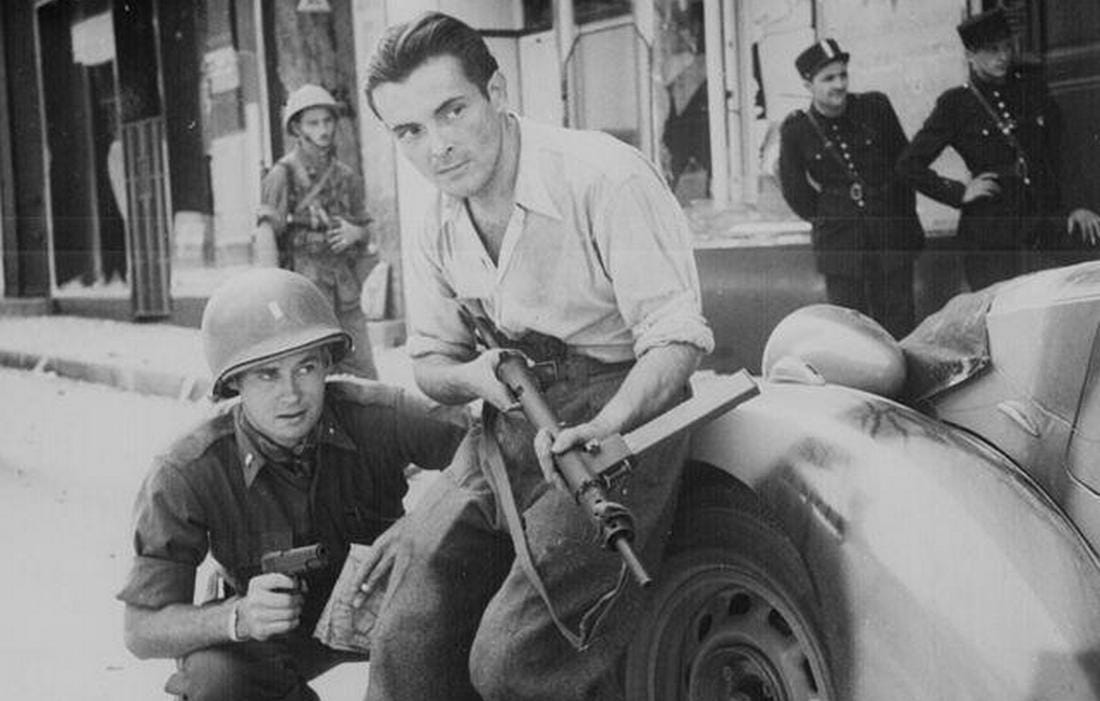
A staged photo of a French partisan with a Sten gun. Photo via Wikipedia

Tens of thousands of Stens were parachute-dropped to partisans in Europe and Asia for use against the Germans and Japanese. Suppressed versions of the weapon were also available for covert operations.

Still, descriptions of the Sten often were downright insulting. Some of the more printable epithets include “The Woolworth Special,” “The Plumbers Delight” and “The Stench Gun.”

You couldn’t blame the soldiers for calling it names. It looked like it was assembled from bits and pieces found in a hardware store—in fact, some of the Sten’s essential parts in early models such as springs were originally obtained from hardware manufacturers rather than from gunsmiths.

15 October 2014

UN snubs Pakistan on Kashmir plea

Oct 15, 2014

Pakistan PM Nawaz Sharif’s foreign affairs adviser Sartaj Aziz (above) had briefed envoys of the five permanent UNSC members asking them to urge India to respect the ceasefire pact.

NEW DELHI: Pakistan's latest efforts to internationalize the Kashmir issue by seeking UN intervention have failed to draw any response from the world body, which reiterated that New Delhi and Islamabad need to resolve all differences bilaterally through dialogue. 

India also reacted strongly on Tuesday. With it continuing to internationalize the J&K issue — the latest in the form of a briefing for P5 envoys over the LoC situation — India said Pakistan needed to understand the road to peaceful ties with India runs from Islamabad to Delhi via Lahore and not through New York or any other "third party". 

Pakistan PM Nawaz Sharif's foreign affairs adviser Sartaj Aziz had on Monday briefed envoys of the five permanent UNSC members asking them to urge India to respect the ceasefire pact. Earlier, Aziz had also written to the secretary general Ban Ki-Moon demanding an intervention by the UN in J&K.

UN secretary general Ban Ki-moon. 

Ban's deputy spokesperson Farhan Haq, when asked to comment on the letter seeking UN intervention, said he would refer to last week's statement by Ban's spokesperson in which the UN chief encouraged India and Pakistan to resolve differences through dialogue and engage construc- tively to find a long-term solution for peace and stability in Kashmir. 
An Indian Army soldier keeps watch on the line of control in J&K's Gurez sector. 
"The road to a peaceful and co-operative relationship between India and Pakistan runs from Islamabad via Lahore to New Delhi. If you divert that road to New York or elsewhere, it will not serve any purpose, because there is no place for third party in India-Pakistan relations," foreign ministry spokesperson Syed Akbaruddin said on Tuesday.

India, Canada clinch nuclear deal in record time

Oct 15, 2014

Foreign minister Sushma Swaraj and her Canadian counterpart John Baird pose for the media during their meeting in New Delhi, on October 14, 2014. (AP photo)

NEW DELHI: Canada and India are negotiating commercial contracts for supply of uranium for Indian nuclear reactors. "The nuclear agreement starts a new chapter in relations with India," said John Baird, Canada's foreign minister in an exclusive conversation with TOI.

Baird is in Delhi for the second round of strategic dialogue he held with Sushma Swaraj on Tuesday. 

The restart of nuclear cooperation with Canada has been a long journey for both countries. Therefore it was a pleasant surprise to nuclear watchers here when India and Canada concluded their nuclear deal in virtually record time. The India-US deal still remains unconsummated and it will be a while before all the procedures are completed on the India-Australia front. 

Canada expressing support for Indian membership of the Nuclear Suppliers Group. The two countries plan to cooperate on building higher capacity nuclear reactors. Indian reactors are based on the CANDU model. The DAE wants to upgrade Indian nuclear reactors from their current capacity of 200MW to 750MW, MEA spokesperson Syed Akbaruddin said as he brief on the discussions. 

Canadian foreign minister John Baird shakes hands with Prime Minister Narendra Modi (right) during their meeting in New Delhi on October 13, 2014. (PTI photo) 

As a result of the conversations between Baird and Swaraj, the two countries will do some joint development. They will also joint host a nuclear security workshop in India with some 15 countries, the first such meet India would be organizing with another country. 

Prime Minister Narendra Modi will have his first meeting with his Canadian counterpart, Stephen Harper, in Brisbane on the sidelines of the G-20 summit. Baird said, "I was very pleased to extend an invitation from Prime Minister Harper to Mr Modi to visit Canada as early as possible. I should add I had the pleasure of inviting him to Canada years ago, and we've never had any visa problems. We have had numerous ministers and parliamentarians who have visited him in Gujarat." 

The Khalistan issue is never far from India-Canada discussions. "Canada and India share a painful past when it comes to terrorism," Baird said. "When I was in high school one of the victims of the Air India crash was a fellow student. So it's a personal experience when I was very young. Terrorism is the great struggle of our generation from the Air India crash through 9/11 to what we are seeing today in Iraq."