24 October 2014

Islam’s clash with Islam


The Globe and Mail
Oct. 17 2014

Last weekend, news attention was focused on the battle between the Islamic State and Kurdish forces. At the same time, the Islamic State set off bombs in and near Baghdad that killed 45 people, including the police chief of Anbar province.

Anbar is a largely Sunni area, and yet the Sunni militants chose to attack there. Baghdad is governed by a rickety coalition with a Shia Prime Minister – from the militants’ perspective, an attack on Iraq’s seat of government is not only an attack on weakling Sunnis, but also on Shia leadership.

In Iraq, and in many places throughout the Islamic world, militant Muslims are fighting not just those of other faiths – Buddhists in Thailand, Christians in northern Nigeria and the Central African Republic – but they are also fighting other Islamic sects and secular governments headed by Muslims. To say that Islam is fighting itself stretches a point, but not that far.

Samuel Huntington, the late political scientist, popularized the phrase “clash of civilizations” for the struggle between Islam and Christianity where countries from those two traditions meet or overlap. His theory was controversial, with critics pointing to areas where no such clashes exist. But so great is the intra-Islamic struggle that it might be called a “clash within a civilization.”

Scan the Muslim world. Far from the headlines in the West, Pakistani insurgents have been attacking border posts in southern Iran. The insurgents want to carve out an independent territory in the Sunni tribal area of Baluchistan, which spills into Iran. Fighting against Iranians pits Pakistani Sunni militants against the world’s leading Shia power.

In Yemen last week, a Sunni suicide bomberkilled at least 47 people in a counterstrike against a Shia group that recently took control of the capital, Sanaa. It was the third bombing in a week – the others claimed 20 and 29 lives.

In Afghanistan, despite the election of a democratically elected government, fighting continues – especially in the southern Pashtun areas where the Sunni Taliban continue to wage war against the secular government in Kabul.

In Syria, of course, there are so many groups fighting each other – from Bashar al-Assad’s secular government dominated by the Alawite sect, an offshoot of Shiism, to the Islamic State and every shade in between – that the country has become the epicentre of intra-Islamic conflict. Syria is a cauldron of chaos into which the West has moved with the noble but nigh-impossible task of identifying and organizing “moderate” Muslims to fight simultaneously against Mr. al-Assad and the Islamic State. A mission less likely to succeed can scarcely be imagined.

In Algeria, and then Egypt, secular Muslim authorities lost elections to religious parties, then ousted those religious parties from power, provoking a nasty civil war in the former and a massive crackdown in the latter.

In Libya, an uprising against Moammar Gadhafi produced a civil war in which the North Atlantic Treaty Organization intervened to help oust the former dictator with no sense of who should replace him. Predictably, the result has been constant fighting among various warlords and sects for power.

Fight war of ideas against extremism

By Tony BlairFounder, Tony Blair Faith Foundation
14 October 2014

The last few weeks have seen a significant shift in the global response to events in Iraq and Syria. Led by the US, more than 40 countries are now joined in fighting the scourge of Islamic State (Isis). This is a sensible decision, but it is not enough.

Because the issue is larger than terror groups like Isis, Boko Haram or Al-Shabab alone. There is a fundamental problem with radical Islamism. And it is imperative that we recognise the global nature of this problem, the scale of it, and from that analysis contrive the set of policies that will resolve it.

In an essay last month, I set out the seven principles of understanding that I believe should underpin this strategy. The reaction to this invariably boiled down to the question of intervention.

There is no doubt that force is needed to confront a group like Isis; it is a group of people who fight without hesitation, kill without mercy and die without regret. But left out of the analysis was one of the most important questions this generation of leaders faces: how we uproot the thinking of the extremists, not simply disrupt their actions.

Because unless we begin to confront the underlying causes each time we take on a group like Isis another will quickly arise to take its place. And in order to fight a warped and worsening ideology in the long term we need to recognise that education is a security issue.

That this issue is raised rarely in the debate of radical Islamism is both perplexing and alarming. Because each and every day the world over, millions, even tens of millions of young children are taught formally in school or in informal settings, a view of the world that is hostile to those of different beliefs.

World views

That world view has been promulgated, proselytised and preached as a result of vast networks of funding and organisation, some coming out of the Middle East, others now locally fostered. These are the incubators of the radicalism. In particular the export of the doctrines of Salafi Wahhabism has had a huge impact on the teaching of Islam round the world.

I am not saying that they teach youngsters to be extremists. I am sure most don't. But they teach them to take their place on a spectrum of opinion based on a world view which stretches far into parts of Muslim society. They teach a view of the world that warps young and unformed minds, and places them in a position of tension with those who think differently.

The challenge we face is to show young people who are vulnerable to appeals from terrorists that there is a better path to having their voice heard; that the only future that works is one in which people are respected as equals, whatever their faith or their culture.

This issue is one I am tackling through my Faith Foundation. Working in schools in 30 countries as diverse as Pakistan, the US and Singapore, they have pioneered a schools programme for 12 to 17 year olds.

The young people in these schools take part in lessons that seek to increase understanding of the faiths and beliefs of others, the facets of identity and the requirements of global citizenship. They also take part in a video-conference with other schools in a global network, so young people from Lebanon or Indonesia can explore and articulate their values, as well as encounter those of students in Ukraine or the United Kingdom.

This can be a profound experience for the students. I recently visited an Islamic school in Jakarta, where children took part in a conference with predominantly Hindu children from a school in India. Watching these young people interacting and dealing with challenging issues around their faith and culture gave me a glimpse of what's possible.

'Deformation'

Though they lived in very different countries and followed different religions, they came together and through a shared experience gained a better understanding of each other.

The results of this engagement are apparent - and they are overwhelmingly positive. But it is only foundations like my own and the Global Community Engagement and Resilience Fund that are even attempting such an endeavour.

We have reached over 100,000 students, which is not nearly enough when a tide of young people are taught a view of religion and the world that is exclusive, reactionary. In the context of a world whose hallmark is people mixing together across the boundaries of race and culture, it is totally contrary to what those young people need to succeed in the 21st Century.

The Foreign Policy Essay: Hearts, Minds, & ISIL

October 12, 2014 

Editor’s Note: The return of U.S. military advisors to Iraq and U.S. airstrikes against the Islamic State in Iraq and the Levant have dashed hopes that the United States would be able to put the latest counterinsurgency era behind it as U.S. forces draw down in Afghanistan. As it finds itself fighting an insurgency once again, the United States should dispel the myths of past campaigns. The accepted wisdom is that victory in a counterinsurgency campaign requires winning the goodwill of the local population: commonly referred to as winning “hearts and minds.” Yet it is unclear whether this wisdom really holds true. Raphael S. Cohen of the RAND Corporation contends that winning hearts and minds does little to help counterinsurgents win and that the U.S. military can and should focus on defeating ISIL forces militarily and not on winning over the population.
***
With the decision to combat the Islamic State in Iraq and the Levant (ISIL), the United States is once again fighting an insurgency. The United States is loath to admit this fact, preferring to label its actions somewhat differently—as a “comprehensive and sustained counterterrorism strategy.” And yet the fact remains that ISIL—with an organization that numbers tens of thousands strong, controls territory, mobilizes the population, and seeks to overthrow and replace a constituted government—fitsmost definitions of an insurgency. Though it also behaves at times like a terrorist group, it is nonetheless an insurgency. The challenge facing the United States is what to do about it.

The most prominent strategy for how to counter an insurgency is “to win hearts and minds.” Popularly attributed to Field Marshal Sir Gerald Templer’s Malayan Emergency campaign against communist insurgents shortly after World War II, the term actually dates at least as far back as the American Revolution and has regularly been used to describe strategies against insurgencies ever since. Indeed, the term even made an appearance in President Barack Obama’s recent United Nations speech.

“Hearts and minds” as a strategy rests on the assumption that any insurgency’s lifeblood is its access to the population, who provide it with fighters, resources, and intelligence: in sum, everything the insurgency needs to survive and thrive. Combating an insurgency, therefore, requires wooing the population—the majority of whom are believed to be neutral or at least passive—away from the insurgency and over to the government side, often by providing political and economic incentives. Once the battle for popular opinion is won, they will provide the government with the information it needs to effectively prosecute these wars and the insurgency, starved of support, will wither away.

There are at least two problems with the “hearts and minds” logic. First, most of the population may not be open to persuasion. Violence—and its corresponding emotional toll—tends to entrench people’s views of the combatants, leaving relatively few undecided and persuadable. Moreover, changing loyalties mid-conflict can be a dangerous proposition, as those who do so are often branded turncoats or collaborators. Economic inducements, political reforms, and other such “carrots” seem paltry in comparison to matters of life and death. As a result, many may only be willing to take such a risk after the conflict’s outcome has already been decided.

Second and more problematic, even if the counterinsurgents can persuade a majority of the population to change sides, it may not matter much to the conflict’s outcome. Insurgencies do not require overwhelming popular support for their efforts to thrive. For example, while it is difficult to tell how much genuine support there is for ISIL, even if one takes the high-end estimates of ISIL’s strength, some 31,500 according to publically-released intelligence estimates, this would still be a tiny fraction of the populations of Syria and Iraq. ISIL’s passive support base likely is also smaller than often believed. Much of its wealth is believed to come from looting lucrative assets throughout the territory it controls and coercing the hapless minorities under its control into paying “taxes” rather than voluntary contributions.

Similarly, defeating insurgencies may not require overwhelming popular support either—at least in the short term. While many cite a supportive populace as being crucial to intelligence gathering, intelligence can come from a host of sophisticated technological means as well, as the United States currently is demonstrating in Iraq and Syria. Especially in the modern age, signals and imagery intelligence can often prove as if not more valuable than intelligence gathered from informants. Even with human intelligence, quality matters as much as—if not more than—quantity, so popular support may matter less than the ability to recruit a select few with the right placement and access.

Destroying ISIS In Iraq: The Missing Element


October 8, 2014. 

The campaign of air strikes against ISIS has now grown to include targets in Syria with support from several Arab states. And in their aftermath, the Administration has wasted little time in describing the effectiveness of these strikes in degrading ISIS capabilities and disrupting ISIS operations. However, this air-only strategy will never be decisive in the destruction of ISIS. Any hope of fulfilling the stated end state of destroying ISIS requires a viable ground force.

As with most ISIS-related strategies, there are no good options, as every possible ground force is flawed and ill-suited to the tough mission of both dislodging the ISIS army, and working hand-in-hand with the Sunni tribes of the ISIS-occupied areas. In order to be viable, this force must have two essential qualities: competency and compatibility.

The first essential quality is obvious: the force must possess the competence to defeat and dislodge ISIS forces by seizing terrain and executing complex offensive operations. These operations require a broad offensive of hard fighting by conventional forces to defeat and dislodge ISIS forces, coordinated with precise raids by Special Operations Forces (SOF) to attack key leaders and gain valuable intelligence. These conventional and SOF operations are supported by precise strikes from the air, to further degrade the network. This requires a ground force that is capable of conducting the tough village-by-village and block-by-block clearing operation against a well-equipped, well-entrenched ISIS force.

The second, equally critical quality of this ground force in Iraq is that it must be compatible with the reality on the ground. The center of gravity in Iraq is the Sunni population of the occupied areas and the critical task is to incentivize them to cooperate with a ground force to expel ISIS from these occupied Sunni areas. This ground force must be seen by the Sunni population and tribes as a partner with which they could cooperate and one with whom their interests align. In 2007, the Sunni tribes in Iraq aligned with American forces because they had confidence that US forces would protect them and this relationship would serve their interests. This alignment produced ‘The Sons of Iraq’ and was instrumental in defeating Al Qaeda in Iraq. This symbiotic relationship between an army and the population produces intelligence and enables targeting of ISIS leaders and other critical targets. Another reality in Iraq is that the ground force must be compatible in working for the Shia-led Baghdad government and accept the presence of, and cooperation with, the Shia militias that are operating against ISIS in Iraq.

There is much talk of the “broad international coalition” and listing of some 40 countries that have discussed supporting the counter-ISIS strategy. However, to date, no member of this coalition has expressed interest in participating in the most difficult requirement — ground operations in Iraq. While it is admittedly still early in the hard work of coalition building, it is apparent that there is really no suitable force to conduct ground operations in Iraq. All potential forces are ill suited, in either competence or compatibility, to fill the critical requirement of a viable ground force.

While several NATO forces are capable of this mission, and possess the competence to defeat ISIS forces on the ground, there are several reasons why this is not a realistic option. First, NATO is exhausted from a decade-plus commitment in Afghanistan, and another open-ended commitment in a distant battlefield is not going to happen. Also, a large contingent of NATO forces operating in Iraq is incompatible with the situation on the ground. ISIS would propagandize and exploit their presence as “occupiers” and there is no evidence that either the Baghdad government nor Sunni population would accept this foreign European force.

The most hoped-for partner is some coalition of regional Arab forces, but this is problematic for several reasons. First, given their diverse competing agendas, it is not clear which regional nations would commit to sending troops to Iraq to fight ISIS. Second, regional forces have no experience in executing the complex, sustained offensive operations to defeat ISIS on the ground. Third, as to the issue of compatibility, the Baghdad government is deeply mistrusted in the region as sectarian-motivated and dominated by Iran. So, will any regional Sunni state commit forces and accept casualties while working alongside, and on behalf of, the Shia Government of Iraq? Would they work alongside Shia/Iranian militias that are sanctioned by the Government of Iraq and are a reality on the ground? While Arab participation in the greater counter-ISIS strategy is desirable, in reality it is little more than a hope. Regional Arab forces are not a viable option for ground operations in Iraq.

Strategic border city of Kobani is key to US strategy against Islamic State

By LARA JAKES 
The Associated Press
October 17, 2014

In this Oct. 16, 2014, photo, made with an extreme telephoto lens from a hilltop in Mursitpinar on the outskirts of Suruc at the Turkey-Syria border, Kurdish fighters, bottom, enter their positions in a house in Kobani, Syria, during fighting between Syrian Kurds and the militants of Islamic State group. 

A Syrian Kurdish official called on the international community on Thursday to allow weapons into the border town of Kobani, saying the town was still in danger from Islamic State militants, despite small advances by Kurdish fighters. 

By staying put, resident Majdi al-Dabbagh is betting that Baghdad will be better defended than cities such as Mosul, seized by Islamic State after it routed the Iraqi army during a lightning advance across the north in June. 

Anbar province — Iraq's largest — was the epicenter of the bloody Sunni insurgency against U.S. forces that raged after the invasion in 2003. 

Militants with the Islamic State group on Monday captured an Iraqi military training camp in western Iraq, inching closer to full control of the restive Anbar province, as a spate of deadly bombings shook Baghdad. 

WASHINGTON — Dusty and remote, the Syrian city of Kobani has become an unlikely spoil in the war against Islamic State militants — and far more of a strategic prize than the United States wants to admit.

Perched on Turkey's border, the city of about 60,000 has been besieged for weeks by Islamic State fighters. Kobani is now a ghost town: the U.N. estimates that fewer than 700 of its residents remain as its people flee to safety in Turkey.

The Obama administration has declared Kobani a humanitarian disaster but not a factor in the overall strategy to defeat the Islamic State group.

"Kobani does not define the strategy of the coalition with respect to Daesh," Secretary of State John Kerry told reporters in Cairo earlier this week, using an Arabic acronym for the Islamic State group. "Kobani is one community, and it's a tragedy what is happening there, and we don't diminish that." But, Kerry said, the primary U.S. military focus is in neighboring Iraq.

But this week, the U.S. dramatically upped its air power strikes against IS in and around Kobani, including 59 strikes over the last four days alone, as of Friday. Several hundred IS fighters were killed, the Pentagon said.

Now, the U.S. cannot afford to lose Kobani, said Robert Ford, the former U.S. ambassador to Syria. That means the city's fate is tied, in part at least, to the success of the U.S.-led strategy against the Islamic State.

"The most important thing about Kobani now is that if it falls to the Islamic State, it would be seen as a defeat for the Americans, and thus would touch on the credibility of the American policy to contain and degrade the Islamic State," said Ford, now at the Middle East Institute in Washington.

"We have made a real effort to help the defenders in Kobani by targeting various Islamic State assets," he said. "And if it falls nonetheless, then it makes it looks like the U.S. military couldn't contain that, and that's how it would be seen in the region."

Said Navy Rear Adm. John Kirby, the Pentagon's spokesman: "We never said Kobani didn't matter."

Ukraine’s Home Front Grows War Weary

Yurko Dyachyshyn/AFP/Getty

10.23.14

As elections approach on Sunday, so do protests about the government’s neglect of soldiers on the front line.

LVIV, Ukraine — Indifference was what Ukrainian soldiers on the front lines found most painful, and indifference is what provokes their parents, struggling for their rights at home, to mount angry protests.

On a recent afternoon, a group of mothers and fathers blocked three streets around the regional administration building in Lviv, in a part of the country known for it’s fierce nationalism. They protested against the continuation of the ATO, or the Anti Terrorist Operation, as the war is known in Ukraine. A ceasefire was in effect, but the Ukrainian army was still fighting with pro-Russian separatist forces in the east.

A caravan of trams stuck in the middle of the medieval city waited in line for the protest to end. Pedestrians passed, paying no heed to the groups of relatives who held up signs that screamed for help to save the lives of soldiers in the east. Around the corner, flocks of tourists enjoyed the last warm rays of sun, the savoring hot chocolates and coffees on verandas under colorful autumn trees.

No officials came out to talk to the mothers who were terrified they’d never see their sons again. "The government's priority is to win their elections, and ours is to get our boys home alive," one of the protesting mothers complained to reporters. And those parliamentary elections, due on Sunday, seem oddly disconnected from the war, or at least from the people who are fighting it.

Thousands of Ukrainian families have suffered from a conflict that pumped young and healthy soldiers to the front lines in the separatist regions of Donetsk and Luhansk. The results of a parliamentary investigation published on Monday raised even more outrage—the officials blamed a former defense minister, Valery Geletei, and Chief of the General Staff and Commander-in-Chief of the Armed Forces of Ukraine Victor Muzhenko, for the tragedy of the August battle outside of Ilovaisk, when Russian soldiers and pro-Russian separatists killed and wounded about 1,000 Ukrainian troops. 

Last Monday Ukrainian president Petro Poroshenko saw dozens of Ukrainian National Guard troops marching towards his office in Kiev to demand demobilization. The soldiers refused to go back to their barracks, even under a threat of prosecution.

Britain has every right to challenge the EU's rules

21 Oct 2014

Europe has changed beyond recognition from the organisation that Britain signed up to


At arms length: David Cameron wants to renegotiate Britain's relationship with Europe 

There is a Yes Minister episode called The Writing on the Wall that brilliantly encapsulates Britain’s ambivalence towards Continental Europe. With barely suppressed exasperation, Sir Humphrey Appleby explains to Jim Hacker the purpose of the UK’s policy. “Minister, Britain has had the same foreign policy objective for at least the last 500 years: to create a disunited Europe. In that cause we have fought with the Dutch against the Spanish, with the Germans against the French, with the French and Italians against the Germans, and with the French against the Germans and Italians. Divide and rule, you see. We tried to break the EEC up from the outside, but that wouldn’t work. Now that we’re inside we can make a complete pig’s breakfast of the whole thing.”

But surely we are now committed to the European ideal, Hacker avers. After all, Britain was particularly keen to bring lots of new countries into the “club”. Why did we do that? “For the same reason,” says Sir Humphrey. “It’s just like the United Nations – the more members it has, the more arguments it can stir up, the more futile and impotent it becomes. We call it diplomacy, Minister.”

With this exchange, Antony Jay and Jonathan Lynn captured Britain’s historic dilemma – how to be in Europe but not run by Europe. We continue to exhibit a lukewarm, half-hearted commitment that not only irritates our EU partners but perplexes them, too. The self-regarding farewell tour of JosΓ© Manuel Barroso, the outgoing president of the European Commission, exemplifies this perfectly. He is astonished that 40 years after joining, the British still decline to embrace Europe’s Grand Design; and yet despite being an unelected official, Mr Barroso feels no compunction in lecturing the UK and its leaders about what is best for their country. It never seems to occur to him, or the others in the Brussels secretariat, that the two are connected. Moreover, because they enthusiastically subscribe to the concept of “ever closer union” as set out in the Treaty of Rome, they cannot understand why we get so worked up when the ratchet effect of membership leads us into areas we never wanted to go.

Let’s take the two issues that are giving David Cameron if not exactly sleepless nights, then serious pause for thought: EU immigration and Britain’s judicial independence. Many in Brussels do not regard the free movement of people around Europe as “immigration” in its usual sense since they are all considered citizens of the EU under the provisions of the Maastricht Treaty.

But back when the UK joined the Common Market, it was far smaller and people did find it harder to get about. Millions in eastern Europe couldn’t travel at all, except within the old Soviet bloc. After the collapse of communism dismantled those barriers, the rules on free movement remained, albeit with temporary restrictions imposed on new members (which Labour declined to use in 2004 when Poland and other ex-Warsaw Pact countries joined). We keep being told this is a “fundamental principle” of the EU and yet the circumstances in which it was enshrined have changed beyond all recognition. Why, then, should it be so outrageous to propose revisiting it as Mr Cameron has done. “Illegal, irresponsible, impossible”, blusters Mr Barroso. Actually, most people would consider it to be perfectly reasonable to look at this again.

Furthermore, it was envisaged that free movement should benefit the nationals of EU member states. Yet there are hundreds of thousands of people from outside Europe who have used its flexible migration controls and generous citizenship rules to settle in Britain. For instance, many of the Somalis who live here came from Holland and Denmark where they were first granted EU status on compassionate grounds. Nigerians have arrived through Germany, Russians through the Baltic states, South Americans through Spain and Portugal. A few years ago, Oxford University’s Migration Observatory found that 141,000 people who came to the UK under EU rules were born outside the continent. Between a third and a half of the entire Dutch Somali community has moved to the UK. There are an estimated 600,000 Russian speakers in Britain, many of whom will be from the Baltic states but also from Russia, which the last time I looked was not in the EU.

The Upside of Lower Oil Prices

October 17, 2014
(The Weekly Standard)

Many of the world's most serious security threats are enabled—directly or indirectly—by revenues from the high oil prices (about $100 per barrel) prevalent in world markets in recent years. If these prices were reduced substantially (e.g., by 20-30 percent), the liquidity that fuels the threats would probably shrink, as would the threats themselves.

Moreover, several feasible measures can contribute to lower oil prices, and these measures may be abetted by other trends that are independently moving in the same direction. Consequently, reducing oil prices should be a prominent part of strategies designed to disable the aforementioned threats.

Four threats are salient:

Iran's nuclear development—i.e., the Shiite bomb;

the Sunni-led ISIS threat in Syria, Iraq, and beyond;

Hamas attacks on Israel from Gaza using rockets and tunnels;

Russia's threat to Ukraine via the separatists it has armed in east Ukraine and the military units it has stationed along the border with Ukraine.

The driving forces behind these threats are many and complex, rooted in ethnic, religious, political, ideological, cultural, and historical conflicts. Neither energy issues in general nor oil prices in particular are among the drivers of the threats. Revenues from oil exports are enablers of the threats, not their drivers.

Since the start of this century, oil prices have tripled: The Dubai spot price of crude oil was $35 per barrel in 2000; during the period from 2011 to early 2014, prices varied between $106 and $109 per barrel. How do these sharply increased oil prices affect each of the threats?

Iran's oil exports generate revenue of $90 billion per year, comprising about 35 percent of Iran's GDP. Iran's officially reported defense spending is 4.1 percent of GDP, and spending on the country's Atomic Energy Organization may be as large or larger. Reducing oil prices by 20-30 percent would reduce Iran's GDP by 7 percent. Although nuclear development and defense spending are among Iran's priorities, this drop in GDP would seriously constrain these priorities. It would impose an additional burden of internal frictions and squabbles within Iran's opaque decision-making process, quite apart from whether current negotiations to curtail enrichment succeed or fail.

Funding for ISIS extremists appears ample and diversified. Their extensive funding network includes oil properties seized in eastern Syria and along the Syrian border with Turkey, plus individual solicitations—some voluntary, others perhaps coerced—from wealthy donors in Kuwait, Saudi Arabia, and the Gulf emirates.

Suppose daily oil revenues accruing to ISIS are between $2 million and $5 million (estimates in the press have ranged between $1 million and $6 million); also, assume that ISIS fighters number between 10,000 and 30,000 (mainly from Arab countries, but also including hundreds from Europe, the United States, and other non-Arab countries). Suppose further that these revenues are mainly used to pay and sustain ISIS fighters, while other ISIS operating costs and equipment are either acquired in-kind (from stocks left by fragmented Iraqi units) or defrayed from the other revenue sources mentioned above. These revenues would easily support the reported payments of $1,000 per month to ISIS fighters (per the king of Jordan)—many times higher than the corresponding opportunity-wage in their homelands.

Ukraine, the Euromaidan and the EU—A Net Assessment of Kyiv’s Course Toward Europe Since the Start of 2014

By: Vladimir Socor
October 20, 2014 

(Source: euromaidanpress.com)

Western powers lost control and, to some extent, lost comprehension of the situation in Ukraine during the Euromaidan mass protest movement and its aftermath. They then trailed behind the events throughout Russia’s war against Ukraine to date. The European Commission’s lame-duck status during most of 2014, Germany’s attempts to fill the European Union’s leadership vacuum, and the advent of a new Commission in October 2014, have compounded the policy confusion and drift.

Brussels had not anticipated Russia’s economic countermeasures that compelled Viktor Yanukovych’s government to backtrack on the association agreement with the EU. When that occurred, Brussels proved unwilling and basically unable to offset the impact of those Russian measures on Ukraine. The EU took the position that Kyiv’s decision was a mistaken one, not in Ukraine’s best interest, but that the president and government had been legitimately elected and were constitutionally empowered to take that decision. The EU intended to continue negotiations with Ukraine’s incumbent president and government, hoping to sign the association agreement with Yanukovych at the EU-Ukraine summit due in April 2014.

The United States initially followed the EU’s lead on Ukraine. At one point, US Assistant Secretary of State Victoria Nuland held out the appeal of a “Europe from the Atlantic to Donetsk” (Testimony of Assistant Secretary of State Victoria Nuland before the Senate Foreign Relations Committee, November 14, 2013). That was a rare example of strategic insight amid the unedifying Western debates. That definition of Europe embraced Ukraine in its entirety while excluding Russia, contrary to the “Europe from the Atlantic to Vladivostok” slogan that would marginalize the US while placing Europe, as well as Ukraine, in Russia’s shadow. Donetsk was, of course, the epicenter of Ukraine’s then-ruling authorities. But “Donetsk” failed to grasp the cooptation offer from Brussels or Washington.

Attending the EU’s summit in Vilnius in late November 2013 as guests, Ukrainian opposition leaders Arseniy Yatsenyuk, Vitali Klitschko, and Oleh Tiahnybok announced on the spot that they would launch a regime change campaign in Ukraine through extra-parliamentary methods. That campaign soon materialized on the Maidan, contradicting the EU’s policy at that stage (see EDM, December 3, 2013).

As the Maidan (soon rechristened the “Euromaidan”) grew in organized strength and numbers, and fighting with the police intensified in January–February 2014, Western governments and media reverted to the template of the 2004–2005 Orange Revolution in Ukraine. For all its subsequent failures, the 2004–2005 regime change had earned a title to legitimacy based on its peaceful character and not provoking the forces of order to intervene. By contrast, the Euromaidan deployed some violent groups of the radical right, equipped for combat and challenging the police. While the majority of Maidan demonstrators did not participate in violent actions, it was the combatant minority that determined the ultimate outcome through violence. Some political leaders abroad, and many influential commentators, treated this process mainly in terms of revolutionary expediency.

Equating the Kyiv Maidan with “the people of Ukraine” meant ignoring the views and moods of large parts of Ukraine’s east. Insisting that the Maidan’s tactics had been peaceful and legitimate emboldened anti-Maidan (or anti-Western, or simply benighted) groups in Ukraine’s east to use mirror tactics against Ukrainian authorities during the initial stages of the secessionist movement. Defending the Ukrainian people’s (instead of the state’s) right of self-determination on the European choice made it easier for the secessionists (and Russia behind them) to claim self-determination for their own Russian choice.

Dutch Defense Cyber Command Activated

Commander of new Dutch Defense Cyber Command: ‘Netherlands can play prominent cyber role within NATO’

Matthijs R. Koot, cyberwar.nl, October 22, 2014

Colonel Hans Folmer, the Commander of the newly established Dutch Defense Cyber Command (DCC), wrote a short article (.pdf, in Dutch) for “Magazine Nationale veiligheid en crisisbeheersing 2014, nr. 5″. That magazine waspublished online by the Dutch government on October 22nd 2014. Notably, Folmer states that the Netherlands “can play an important role [in cyber] within NATO”. DefCERT already has an existing covenant with NATO Computer Incident Response Capability (NCIRC). One of the three NATO Communications and Information Agencies (NCI Agencies) is located in The Hague, adjacent to the business unit Defence, Safety & Security of knowledge institute TNO. Koen Gijsbers, the General Director of the NCI Agency in the Hague, co-founded theMultinational Cyber Defence Capability Development (MNCD2) program in Brussels in 2013.

The DCC formally resides within the Royal Netherlands Army, the land forces element of the Dutch army (in Dutch: “Commando Landstrijdkrachten” (CLAS)), but involves military personnel from all military domains. It is tasked with defense (primarily), offense and intelligence. There will be cooperation with the Joint Sigint Cyber Unit (JSCU), which is tasked with the collection of data from technical sources, making it accessible and searchable, perform analysis (correlation, data mining), delivering Sigint and Cyber capability in support of the intelligence requirements of the AIVD and MIVD (possibly on-site), and innovation and knowledge development on its own task areas.

Here is a translation of Folmer’s article about the DCC (hyperlinks are mine):

The Defense Cyber Command, a new operational capability
By Colonel Hans Folmer
Commander of the Dutch Defense Cyber Command

On September 25th 2014, the Minister of Defense, Jeanine Hennis-Plasschaert, established the Defense Cyber Command in The Hague. She rightfully called [.pdf, in Dutch] the launch of a new operational unit and the final addition of the cyber weapon to the toolkit of the Dutch armed forces a historic event.

The nature and character of conflicts change. Maximum disruption of societies increasingly is the objective of malicious actors. Increasingly, better use is made of modern, easy to obtain technical digital means.

In military operations, the cyber domain is used effectively by all parties both for command and control, and propaganda. Weapons and sensory systems are digital systems. Attacks can now occur globally and in real time. The enemy does not even have to physically cross a border to attack us. On the other hand, the enemy can be grabbed at large distance, or disruptive activities can be counteracted. It is of crucial importance to recognize, understand and control this, and also to deploy cyber weapons ourselves. The Dutch armed forces draws conclusions from this and wants to play the prominent role that suits our country. To guarantee the ability to deploy the armed forces and to increase its effectiveness, the Ministry of Defense has been working on strengthening its digital defensibility for several years, and will in the coming years be developing the capability to carry out cyber operations.

British Army Upgrading Its Battlefield SIGINT Capabilities

UK renews SIGINT push

Andrew Chuter, c4isrnet.com, October 22, 2014

New Capability: A British soldier stands on top of an armored vehicle in Camp Bastion, Afghanistan. The UK has revived a plan to provide signals intelligence capabilities to troops. (LEON NEAL/ / AFP via Getty Images)

Britain is reviving plans to update battlefield signals intelligence capabilities, the first of its kind since a Lockheed Martin contract to re-equip land forces was axed in 2009.

A few lines in the UK Defence Contracts Bulletin this month signaled that the Landseeker signals intelligence and jamming program, quietly shelved along with dozens of other programs during budget-cutting measures in 2010, is back on the radar.

“Funding has been allocated to conduct a Landseeker concept and assessment phase. The Defence Contracts Bulletin announcement was placed in order to notify industry of the project’s existence. The funding category and main gate [the development and production approval date] will be established as the study activities progress with the program’s exact requirements defined during the concept and assessment phase,” said a Defence Ministry spokesman.

The MoD will not talk about timelines or cost at this early stage of the program, but executives here said they expect main gate approval around 2017.

The program, they said, would likely be a Category B project — between £100 million and £250 million (US $160 million and $400 million) — but it could be higher depending on the scope of the Royal Signals Regiment requirement.

One industry executive here said details of exactly how the Landseeker program will go forward are hazy.

“Details of how the MoD is to engage with industry during the concept phase have yet to emerge,” the executive said.

“Given that Landseeker is at such an early stage, I’m not sure that anyone has any real vision of what the program will comprise of and this will remain the situation until the concept and assessment phase has been completed. The expectation, however, is that all elements of Landseeker will be competed regardless of the status of any incumbent,” the executive said.

TO SAVE MONEY, GO UNMANNED

To Save Money, Go Unmanned


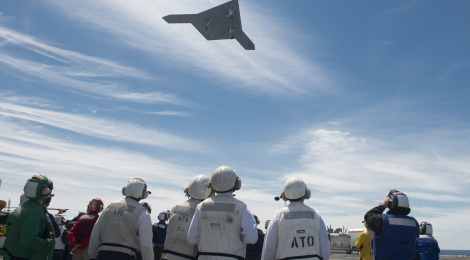
U.S. Defense Department leaders have called for a renewed effort to sustain America’s military technological dominance, but to do so they will have to fight an uphill battle against entrenched bureaucratic interests competing over a shrinking budgetary pie. Whether this initiative will be more than simply Pentagon pabulum depends on the future direction of the Navy’s carrier air wing. The Navy has two next-generation programs on the drawing board, the Unmanned Carrier-Launched Airborne Surveillance and Strike (UCLASS) drone and theF/A-XX 6th generation manned fighter. Squeezing two next-gen aircraft programs into the Navy’s budget will be difficult, particularly if, as the Navy currently plans, the UCLASS drone does not replace any manned aircrafton the deck.
UCLASS, as currently conceived, is an additional bill to pay with marginal benefit. The Navy’s current UCLASS concept, a modestly stealthy maritime surveillance drone, is largely redundant when compared to ground-based P-8 Poseidon and MQ-4 Triton aircraft. This makes little budgetary or strategic sense. In today’s fiscal environment, the Department of Defense (DoD) needs to be focusing on top priorities, including the need for longer-range aircraft to cope with a growing anti-access threat, which the current UCLASS does not address. Resetting the UCLASS program to develop a more capable drone would not only help address this operational need, but could actually save the Navy money. A higher-end UCLASS that is able to take on combat missions could replace some manned aircraft on the carrier. Because of the cost-saving advantages of unmanned aircraft, this swap would free up billions of dollars to be reinvested in other Navy priorities.
An unmanned carrier-based aircraft program could be significantly less expensive than an equivalent manned carrier aircraft program, even if the actual development and production costs of the aircraft are identical. Because of their high degree of automation, unmanned aircraft require significantly fewer flying hours than equivalent manned aircraft for initial qualification training and “currency” training to maintain pilot skills. This translates into reduced operations costs as well as reduced aircraft needed for training and attrition. Savings can be particularly large for carrier-based aircraft, on the order of 40-50% of total procurement and operations costs. Reduced procurement costs alone could save several billions of dollarsannually early in the program, translating to additional ships, submarines, munitions, or other aircraft. Recurring savings in operations costs could range in the hundreds of millions annually. Most importantly, unlike many promises of reduced costs that never materialize, these savings are based on real-world experiences with unmanned aircraft today.

NATO Tries to Define Cyber War

October 20, 2014

Imagine that China launches a cyber attack on the United States tomorrow. It devastates systems, crippling the financial sector or causing loss of life. But does it merit a military response? The answer to that big question also informs a much larger, looming debate: As it becomes increasingly clear that few cyber attacks can be defined as acts of war, what should the role of institutions such as NATO be? And in this new world, how do we define what is war - and what is not?

The topic was discussed at September's NATO Summit in Wales. Attending heads of state agreed that cyber attacks can reach a threshold that not only threatens Transatlantic prosperity and security, but could even be "as harmful to modern societies as a conventional attack" and thus merit an invocation of Article 5, the collective defense clause. Treading carefully, though, they refrained from defining which cyber attacks cross this threshold.

This is an important declaration and the culmination of a seven-year internal debate that stems from Distributed Denial of Service attacks pointed at Estonia in April 2007. But the emerging policy still begs questions, about NATO's response to cyber attacks in particular, but more broadly about the general function of the Alliance.

On April 27, 2007, Estonia, a NATO member, relocated a Soviet-era war memorial. Within hours, a large-scale DDoS campaign began, targeting the websites of government departments, banks, telecoms, and news organizations. Some sites were shut down entirely, while others were defaced.The attacks rendered a number of Estonian government sites inaccessible for weeks and generally disrupted communication in the country.

The attack on Estonia illuminated the vulnerability of NATO members in cyberspace and placed the enhancement of cyber capabilities near the top of the Alliance agenda. In June 2007, NATO defense ministers committed to take up the issue, and in 2008, the Alliance opened the Cooperative Cyber Defence Center of Excellence in the Estonian capital, Tallinn.

The latest Alliance statement, however, does little to clarify NATO's role. At its core, Article 5 is a reactionary clause. Its only invocation in the 65-year history of the Alliance came in response to the 9/11 terrorist attacks. And as the summit declaration states, a certain threshold must be met to consider invoking Article 5.

Definitions

But how do we define thresholds in cyberspace? It is useful to consider three dimensions: confidentiality, integrity, and availability of data. A few key cases help unpack these concepts.

Confidentiality is the principle that sensitive data should be kept out of the wrong hands, and breaches of confidentiality are perhaps the most common form of cyber attack. Take the widespread accusations that the Chinese hacked Lockheed systems and stole blueprints for the new F-35 aircraft. This attack produced a tangible strategic loss for the United States - and for allies who buy the F-35. It provided the Chinese with not only the information to build a competitor aircraft, but also information to help defend against such an aircraft. Chinese responsibility for the incursion is widely acknowledged. The response? The Department of Justice indicted the hacker in question. For better or worse, confidentiality breaches have been treated as crimes.

15 PREDICTIONS FOR THE FUTURE OF THE INTERNET COMPARTMENTALIZED, GATED, ARMORED, CAMOUFLAGED, DECEITFUL, DANGEROUS, WONDERFUL. RESENTED — A ‘DR. NO’ IN CYBER SPACE — AND AN OFF THE NET MOVEMENT

October 15, 2014 

15 Predictions For The Future Of The Internet Compartmentalized, Gated, Armored, Camouflaged, Deceitful, Dangerous, Wonderful. Resented — A ‘Dr. No’ In Cyber Space — And An Off The Net Movement

Bridget Shirvell, had an interesting and thought-provoking article back in March of this year on the PBS NewsHour website on what may lay ahead for the future of the Internet. We are all aware that the overwhelming majority of us are no longer network enabled; but, more like network dependent. And, as Ms. Shirvell notes, “the Internet has radically changed everyday life –[ particularly] in American society. It has created [opened] new ways to connect family and friends; disrupted the way we do business; and, rewired just about everything in between. But, the Internet and the worldwide web are still relatively young. The public web is only 25yrs. old; and, like most twenty-somethings…it still has a lot of growing up to do.”

“While the debate continues on net neutrality,” Ms. Shirvell writes, “privacy, and architecture of the Internet, there is some agreement about the future of the Internet over the next ten years. As part of a series of reports marking the 25th anniversary of the Web, Pew Research Center’s Internet Project, in partnership with Elon University’s Imagining The Internet Project, asked nearly 1,500 Internet experts open-ended questions the future of the web.” What they found probably won’t surprise you in most respects; but, in others, it could be breath-taking.

The majority believes the Internet will become like electricity during the next decade, less visible; but, more important…and, embedded in everyday life. While a majority of the experts surveyed agreed that the Internet is likely to continue to grow/expand, there was disagreement on the implications — especially with respect to its good and bad aspects, Ms. Shrivell wrote. Pew has been conducting this survey since 2004 [ten years] and interestingly, this was the first time that there were as many negatives…as there were positives. “They worry about interpersonal ethics, surveillance, terror, and crime; and, the inevitable backlash as governments and industry try to adjust,” said Elon University Professor Janna Anderson, a primary author of the report.

So, what is the future of the Internet? Here are 15 predictions from the report released back in March, 2014, Digital Life at 2025:

— Information sharing over the Internet will be so effortlessly interwoven into daily life that it will become invisible, flowing like electricity, often through machine intermediaries;

— The speed of the internet will enhance global connectivity, fostering more positive relationships among societies;

— The Internet of Things, artificial intelligence, and big data will make people more aware of the their world; and, their own behavior;

— Augmented reality and wearable devices will be implemented to monitor and give quick feedback on daily life, especially in regard to personal health;

— Political awareness and action will be facilitated and more peaceful change; and more public uprisings like the Arab Spring will emerge (see Hong Kong now);

— The spread of the “Ubernet” will diminish the meaning of borders, and new “nations” of those with shared interests may emerge online; and exist beyond the capacity of current nation-states to control;

— The Internet will become “the Internets,” as access, systems, and principles are renegotiated;

— An Internet-enabled revolution in education will spread more opportunities, with less money spent on buildings and teachers;

— Dangerous divides between the haves and have-nots may expand, resulting in resentment and possible violence;

— Abuses, and abusers will ‘evolve and scale.’ Human nature isn’t changing; their laziness, bullying, stalking, stupidity, pornography, dirty-tricks, crime, and the offenders will have new capacity to make life miserable for others;

— Pressured by these changes, governments and corporations will try to assert power — and at times succeed — and at times succeed — as they invoke security and cultural norms;

— People will continue — sometimes grudgingly, to make tradeoffs favoring convenience, and perceived immediate gains over privacy; and, privacy will be something only the upscale enjoy;

— Humans and their current organizations may not respond quickly enough to challenges presented by complex networks;

— Most people are not yet noticing the profound changes today’s communications networks are already bringing about; these networks will be even more disruptive in the future;

— Foresight and accurate predictions can make a difference. The best way to predict the future….is invent it.”

U.S. Spy Programs May Break The Internet If Not Reformed, Google Leader Says

ANDREW MARSHALL [AKA: 'YODA'] TO RETIRE FROM PENTAGON’S NET ASSESSMENT OFFICE IN JANUARY

By VAGO MURADIAN and PAUL McLEARY 
October 18, 2014 

Andrew Marshall [aka: 'Yoda'] To Retire From Pentagon’s Net Assessment Office in January

Andrew Marshall has run the Pentagon’s Office of Net Assessment since 1973.

Andrew Marshall has run the Pentagon’s Office of Net Assessment since 1973. (Department of Defense)

WASHINGTON — Andrew Marshall — a Pentagon institution who influenced policy makers from the Cold War to today — has signaled his intention to step down in January, according to sources.

Marshall, 93, heads the Office of Net Assessment (ONA), which months ago was spared the budget ax as part of a restructuring of the Office of the Secretary of Defense.

Having founded the Pentagon’s internal think tank in 1973, Marshall is the only director it has ever known. His influence over the decades on defense policy analysis in Washington has been vast.

Pentagon leaders such as Deputy Defense Secretary Bob Work, Director of Cost Assessment Jamie Morin and Undersecretary for Intelligence Mike Vickers have all worked for Marshall, as have dozens of other leading national security thinkers spread through think tanks and policy shops.

As of Friday evening, a spokesman for the Pentagon was unable to comment on Marshall’s departure.

Once Marshall vacates his Pentagon office, questions will invariably arise over the small organization’s future; speculation over who will step in to run the office will likely be intense.

“The function of that office needs to be retained,” said Andrew Krepinevich, president of the Center Strategic and Budgetary Assessments (CSBA), who worked for Marshall as an Army officer and whose organization still does work for the ONA.

“In order for that office to perform successfully, you need a person who understands the analytic approach to net assessment,” Krepinevich added. “It also requires a significant budget, and the independence to decide what will be studied.”

What is seen as ONA’s greatest strengths — Marshall’s ability to keep it independent of political or bureaucratic influence from inside or outside the building — could be difficult to maintain without him at the helm, however.

Richard Danzig, former Navy secretary who is now the vice chairman of RAND and a member of the Pentagon’s Defense Policy Board, maintains that one of the key attributes that Marshall’s eventual successor must have is to be “a person who thinks long term and with originality. That successor doesn’t necessarily have to be someone who comes out of the community of Andy’ sprotΓ©gΓ©s,” he said.

“Andy is so unique and so idiosyncratic in his style that I wouldn’t try to replicate him, but attempt to find someone with his virtues of far-sightedness, rock solid integrity, and original thought,” Danzig said.

After a reorganization late last year, the office lost a bit of its independence when it was decided that it would begin reporting to the undersecretary of defense for policy. But Defense Secretary Chuck Hagel promised in December that “we will preserve ONA as a distinct organization with direct links to the secretary of defense, but this change will better ensure that its long-range comparative analyses inform and influence DoD’s overall strategy and policy.”

A taste of what ONA does can be seen in an announcement issued in May seeking proposals to look at everything from “military competition on and under the surface of the sea,” to future precision-strike capabilities; potential policy fallout from increased nuclear proliferation; and military competition in space.

Over the summer, the office issued research contracts worth more than $10 million to a variety of organizations like CSBA, Booz Hamilton, the Hudson Institute and IHS International to carry out these projects over the next several years.

“An interesting consideration some years from now would be the benefits of longevity,” Danzig said. “Would we want Andy’s successor to stay five years or 35? That question is probably best answered five years after the successor has been on the job.”

Overall, Krepinevich — author of the forthcoming book “The Last Warrior: Andrew Marshall and the Shaping of Modern American Defense Strategy” with fellow ONA alum and CSBA senior analyst Barry Watts — mused that Marshall “was fortunate that defense secretaries saw the need to have an office to do this kind of work without having to go though all the bureaucratic coordination that takes the sharp edge off of ideas … that sort of intellectual freedom is needed to think strategically, and challenge the conventional wisdom.” ■