December 10, 2014

Troops from Oman, part of the joint command Peninsula Shield, in the Kuwait desert, March 2003.
Over the past 25 years, Western coalitions have been sucked into several wars in the Arab world, including in Iraq and Libya. On each occasion, critics have asked why outside powers should provide security in a region equipped with thousands of its own Western-supplied warplanes and whose commanders are trained at Western military academies such as Sandhurst and Fort Leavenworth. As if to address these concerns, the Gulf Cooperation Council (GCC) recently announced the creation of a joint military command among its six member nations. The command, which will reportedly comprise several hundred thousand soldiers, will be built to respond to regional threats, namely from militant Islamists and perennial rival Iran.
However, the move is considerably less revolutionary than it sounds. For one, Arab military coalitions have played a part in most modern conflicts in the region, including all four Arab-Israeli Wars, the First Gulf War, and the peacetime interludes. In addition, just a few years after the GCC was formed in 1981, the council created the Peninsula Shield, a small deterrent force based in Hafr al-Batin, near Saudi Arabia’s border with Kuwait. But what was impressive on paper was less so in reality. Peninsula Shield was so ineffective in the buildup to the First Gulf War that the commander of the joint Arab forces sent the GCC units back to their national armies, and when it was deployed to Bahrain in 2011—to quell pro-democracy protests—two members, Kuwait and Oman, refused to send troops.


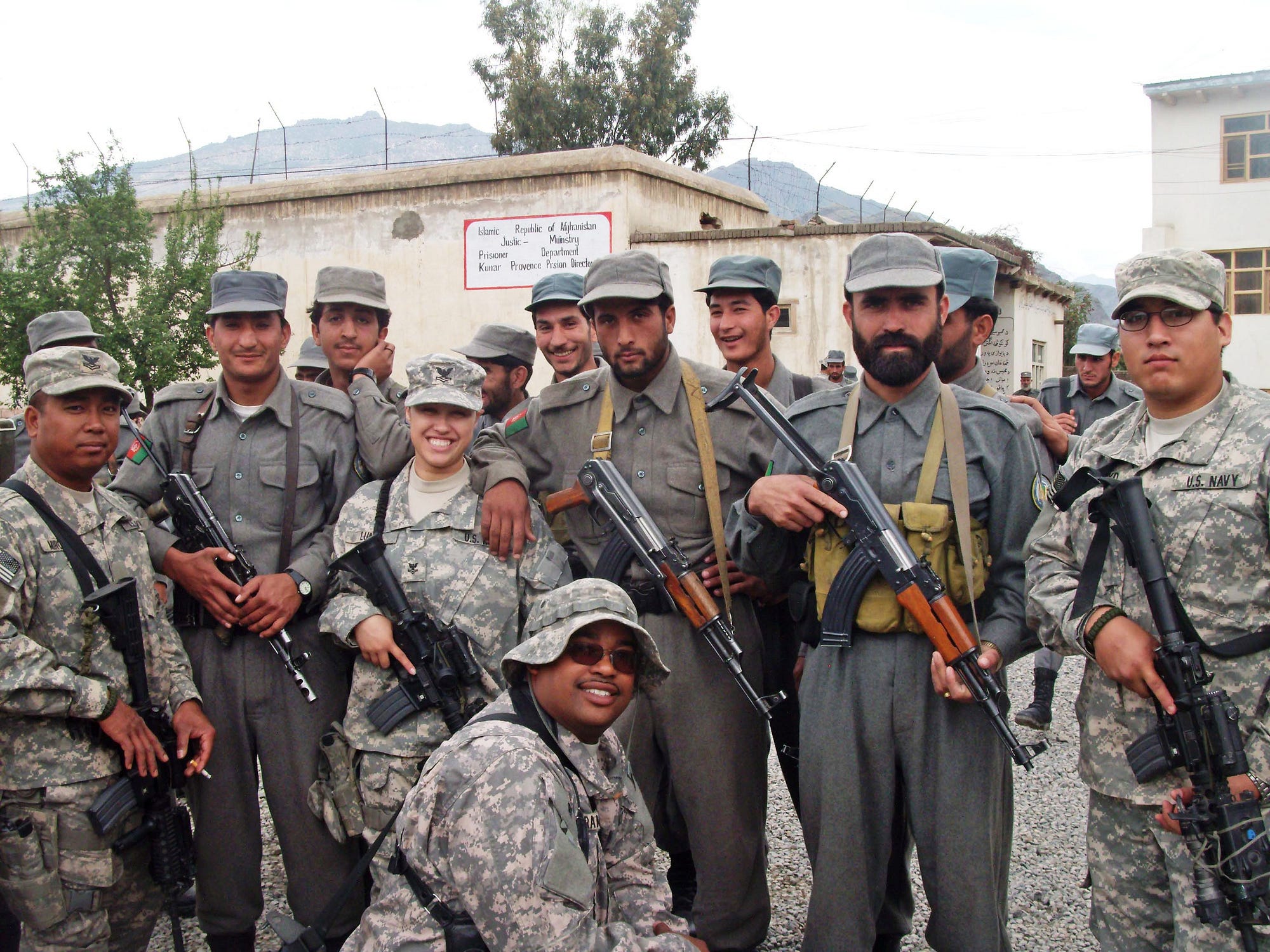 Above—U.S. Navy sailors and Afghan National Auxiliary Police. Navy photo. At top—Afghan Public Protection Force members. Army photo


