27 December 2014

Reluctant Kyrgyzstan Officially Joins EEU

December 25, 2014

The Eurasian Economic Union is not dead yet. But the indicators are not good. 

After months of awkward delays and thinly disguised aversion, Kyrgyzstan has officially signed on to the Russia-led Eurasian Economic Union (EEU). Joining Russia, Kazakhstan, Armenia, and Belarus, Kyrgyzstan’s agreement will enter into full force by May 9. This agreement should put to bed rumors that Kyrgyzstan had pulled out of the arrangement, but nonetheless came with thedistinct lack of enthusiasm recently seen in Bishkek’s rhetoric.

With this expansion has come a raft of questions that continue to poke holes in the Kremlin’s notion of the EEU as a group centered on equality, rather than a vehicle for Russia’s neo-imperial ambitions. Not only has Kyrgyzstan announced that it would not achieve all of the union’s regulations until 2020, but it remains wholly possible that the new customs requirements that would otherwise cut off Kyrgyzstan’s lucrative re-export trade from China may not be as rigorously enforced as otherwise demanded. Much like the new customs realities surrounding the Armenian-held enclave of Nagorno-Karabakh – which has recently seen at least one official come out vociferously against the EEU – these customs requirements may yet exist primarily on paper, without being translated to the reality on the ground. While the lack of enforcement may help tamp Kyrgyzstan’s looming unemployment crisis, it won’t exactly inspire confidence in the EEU’s efficacy.

This remains to be seen. What has arisen over the past week, however, is a sudden surge in divergences between the three founding members of the EEU. Relations between Kazakhstan and Russia had already seen a noted downturn in 2014 – and this past week only highlighted trends. Kazakhstani President Nursultan Nazarbayev paid a visit to Kyiv, offering financial and energy-based aid to the struggling Ukrainian government. The visit presents a stark volte face for Astana; Kazakhstan, after all, not only recognized the Crimean annexation earlier this year, but was the only nation besides Russia to refer to the EuroMaidan protests as a “coup.” Such recognitions make Nazarbayev’s recent claims that Kazakhstan supports Ukrainian territorial integrity a bit confusing. (Certain Ukrainian protesters have not forgotten Kazakhstan’s unwillingness to support the protests earlier this year, and publically voiced their opposition last week.) Now, Nazarbayev stakes that “both Ukraine and Russia are equally close to Kazakhstan.” Suffice it to say, Nazarbayev appears to be resuscitating Kazakhstan’s much-weakened multi-vector policy – likely because he recognizes the significant parallels between the Kremlin’s rhetoric surrounding both Kyiv and Astana.

While in Ukraine, Nazarbayev also offered some commentary on the EEU. The union, Nazarbayev said, “is exposed to a major risk.” Rather than citing the Russia-led currency slump or the collapsing intra-EEU trade, however, the Kazakhstani president noted the swell in Russian businesses hampering local commerce. This disadvantage has been accelerated that much more by Kazakhstan nationalscrossing the border to take advantage of Russia’s weakened currency.
Copernicus and America’s Blame Israel Problem

December 26, 2014


“Israel is not what is wrong about the Middle East. Israel is what is right about the Middle East

Prussian astronomer Nicolaus Copernicus was a rebel and he knew it. Well aware how theologically radical and politically mutinous his ideas on heliocentrism were, he equivocated as to whether he should publish them. When he did so in 1543, he acknowledged his expected ostracismin a letter to the Pope: “when I considered in my own mind how absurd a performance it must seem to those who know that the judgment of many centuries has approved the view that the Earth remains fixed as center in the midst of the heavens, if I should, on the contrary, assert that the Earth moves; I was for a long time at a loss to know whether I should publish the commentaries which I have written in proof of its motion.” Whatever hesitation he might have had in launching an assault on the Catholic Church’s monopoly on scientific thought, he persevered. Shortly before his death, he published his seminal Revolutions of the Heavenly Bodies, asserting that the sun, not the earth, was at the center of the universe around which all other celestial bodies revolved.

To judge from Secretary of State John Kerry’s October comments linking Israeli actions to ISIS’ potency, a similar canon beguiles the Western understanding of the Middle East. In unscripted remarks in mid-October, Kerry recounted how his Arab interlocutors implored him “to try to get peace between Israel and the Palestinians, because it was a cause of recruitment and of street anger and agitation that they felt – and I see a lot of heads nodding – they had to respond to. And people need to understand the connection of that.”

Kerry’s comments indeed caused an uproar, but they were hardly novel. America’s preeminent diplomat was merely vocalizing what many have called “linkage theory,” a catchall assumption that places the Palestinian-Israeli conflict at the center of the Middle East’s universe. To carry the thesis to its natural conclusion—it’s doubtful Kerry meant that Arabs were “agitated” to join ISIS by Hamas’ targeting of Israeli civilians—linkage theorizes that somehow Israel’s actions in Gaza or in the West Bank were spurring Muslims across the globe to join the Islamic State. As Israeli Economy Minister Naftali Bennett acerbically put it, “even when a British Muslim beheads a British Christian, someone will always blame the Jew.”

Obama, a One-Man Revolution

DECEMBER 25, 2014 

In his “fourth quarter,” he feels free to ignore popular opinion, the rule of law, and Congress. 

Until now there were two types of peaceful American change. One was a president, like Franklin D. Roosevelt or Ronald Reagan, working with Congress to alter American life from the top down by passing a new agenda. The other was popular-reform pressure, as happened in the 1890s or 1960s, to change public opinion and force government to make new laws or change existing ones.

Barack Obama has introduced a quite different, third sort of revolution. He seeks to enact change that both the majority of Americans and their representatives oppose. And he tries to do it by bypassing Congress through executive orders and presidential memoranda of dubious legality.

Take so-called climate change. Even when Obama enjoyed a Democrat-controlled Congress, he could not ram through unpopular cap-and-trade legislation. Now he promises to reduce carbon emissions through executive orders. He just signed a climate-change “accord” with China, bypassing the U.S. Senate, which by law must approve treaties with foreign powers.

Polls show that a majority of Americans oppose amnesties and want immigration laws enforced. The 2014 midterm elections were a reminder of those realities. No matter. Obama just did what for six years he warned was illegal: bypass immigration law and grant millions exemptions from enforcement through what he once called “a pen and a phone.”

For over a half-century, both Democratic and Republican administrations and Congresses have excluded Cuba from normal U.S. relations. The Castro regime once hosted nuclear missiles pointed at the U.S. It sent expeditionary forces around the globe to spread Communism. It executed opponents, and it still locks up tens of thousands of political prisoners. It drove more than a million refugees to U.S. shores.

Obama knew there was neither popular nor congressional support to reestablish normal ties, especially given that the elderly dictators the Castro brothers are soon to pass on. The traditional props for Cuba’s failed Cuban economy – Russia and Venezuela – now have failed economies of their own.

Vladimir Putin Embodies the Russian Mindset

Posted by Alex Berezow 
December 26, 2014

(ELBLΔ„G, Poland) -- Comedian Norm Macdonald was fond of pointing out that Germans love David Hasselhoff. As true as it may have been (and may still be), Germany's infatuation with "The Hoff" pales in comparison to Russia's admiration of Vladimir Putin, that archaeology-loving, race-car-driving, tiger-tranquilizing, bare-chested survivalist known affectionately to some former world leaders as Pooty-Poot.

A new poll by AP-NORC Center confirmed yet again that, despite a deeply troubled economy, international notoriety, and a ruble that has collapsed in value, Russians are standing by their man with a stunning 81% approval rating. This is not a fluke result. The Levada Center, which has conducted monthly opinion polling on Mr. Putin since he first became prime minister in August 1999, shows similar numbers. (See chart.)


The raw data provided by the Levada Center via RussiaVotes.org indicates that Mr. Putin has maintained an approval rating of 61% or higher since he has assumed high public office. (The only exceptions were his first two months in office when many Russians still didn't know who he was.)

What can we conclude from this? An Eastern European political observer commented that Russians may be afraid to admit that they disapprove of Mr. Putin. While the data does not preclude that explanation, I find it unconvincing. Mr. Putin's popularity went soaring within months of his taking office, well before he began his autocratic consolidation of power. Moreover, his approval rating has remained high for 15 years. The more tyranical he behaves, the more popular he becomes.

Putin's popularity, therefore, is likely to due something else: Russians don't think highly of Western-style democracy.

Review: Without You, There Is No Us

By Catherine Putz
December 25, 2014

Suki Kim’s memoir explores deception, dishonesty, and darkness in an attempt to humanize North Korea. 

Suki Kim, author of the award-winning novel The Interpreter and recipient of multiple fellowships including a Fulbright Research Grant and a Guggenheim Fellowship, spent six months in 2011 teaching English at Pyongyang University of Science and Technology (PUST), North Korea’s only privately funded university. The university is staffed by foreigners and exclusively teaches the sons of North Korea’s elites. Kim’s recent memoir,Without You, There Is No Us; My Time with the Sons of North Korea’s Elites chronicles her stay in the country and sheds some light on the lives of the young men she taught.

Many first-hand accounts of life in North Korea come from defectors who, as Kim notes, tend to be poorer and from the far north, along the Chinese border. In any case, their perspectives are narrow. High-level defections are rare and knowledge of how the upper-crust lives is equally scarce. Other views of life in North Korea stem from carefully orchestrated events – such as the New York Philharmonic’s 2008 visit. Reporters allowed in for such events are herded through a choreographed experience, like tourists sitting through the It’s a Small World boat ride in Disney World.

In 2008, Kim was assigned by Harper’s magazine to go to Pyongyang with the New York Philharmonic. “Not being a real journalist – at least I did not consider myself one” she writes, “I dreaded the prospect of covering the DPRK alongside so many veterans, until I realized how little they knew of North Korea, and how little they managed to find out.”

Without You, There Is No Us is a perfect analogy for North Korea: you always only get half the story, are constantly reminded of George Orwell’s 1984, and the chances of reunification seem to be zero. Although Kim has come under some criticism for her methods – the president and founder of PUST has denounced her for breaking a promise, which she maintains she did not make, to not write about her experience – Kim’s deceptions in gaining access to North Korea are small sins.

Kim has penned a response to criticism of her methods. The core of her counter is that it is disingenuous to criticize her while ignoring the markedly larger sins of the North Korean state.

“The gist of the negative emails and Twitter messages that I have been receiving seems to be that I have blood on my hands. I disagree. The blood, I believe, is on the hands of all of us who sit back, debating the moral guidelines of journalism, waiting for North Korea’s permission to tell North Korea’s truth according to North Korea. There are so few unfiltered portraits of life inside North Korea, and our understanding of this brutal nation remains dismal.

Meanwhile, in the six decades since Korea was divided, millions have died from persecution and hunger. Today’s North Korea is a gulag posing as a nation, keeping its people hostage under the Great Leader’s maniacal and barbaric control, depriving them of the very last bit of humanity.”

Deception is a central theme in both Kim’s book and the reality of life in North Korea. Unlike the North Korean state, Kim is upfront with her own deceptions. “It was a mystery to me,” she writes, “why I had been allowed in.” She applied for the position at PUST using her real name. A quick Google search would have revealed Kim as a writer who had published numerous articles about North Korea. But even her students, who were technically computer science majors, were unaware that the intranet they used was not the global Internet.

2015 Set to Be a Tough Year for Commodities

December 25, 2014

The region’s miners have had a year to forget. Will 2015 be any better? 

On Monday, Australia’s Department of Industry cut its iron ore price forecast for next year by a third, from the $94 a metric ton forecast in September to just $63, with rising output continuing to exceed demand.

Prices have nearly halved this year as major miners ramped up production, forcing a number of smaller companies to the wall and hitting employment and government tax revenues. On Tuesday, the price of the key steelmaking ingredient fell to $66.84 in China, its lowest level since June 2009.

According to Bloomberg Intelligence, 22 iron ore projects have been canceled or suspended since July in response to the low prices,eliminating an estimated 140 million tons of extra capacity. However, more than 100 million tons of new capacity has entered the market during the same period, with an estimated 340 million tons extra forecast over the next five years, mainly from Australia and Brazil.

China buys two-thirds of global seaborne iron ore but is set to produce its weakest annual growth since 1990, with a slowing real estate sector also reducing demand. China’s steel consumption is estimated to have risen by 1.5 percent in 2014 compared to its post-global financial crisis average of around 10 percent a year, hit by the downturn in residential construction that accounts for nearly half of its steel use.

While ANZ forecasts the iron ore price will average $80 a ton in 2015, JPMorgan predicts $67 and Citigroup as low as $60, according toBloomberg News.

However, Australia’s government forecaster sees better times ahead, although not until later next year: “The current market oversupply is expected to prevail through the start of 2015 in response to a likely ongoing cyclical downturn in China’s housing sector. Prices are forecast to rebound in the second half of 2015 as some producers cease production and housing construction activity in China starts to recover; however this rebound in the housing sector remains a key area of uncertainty.

“Further growth in low cost supplies from Australia and Brazil are also expected to offset production closures and maintain downward pressure on the iron ore price in 2015,” the industry department said in its December resources and energy quarterly.

According to the department, Australia’s earnings from mineral and energy commodities will fall by 10 percent to A$176 billion ($142.7 billion) in fiscal 2015, with earnings from iron ore slumping by 24 percent, although a lower Australian dollar will partly offset some of the losses from falling commodity prices. It also noted a 29 percent dive in exploration expenditure year-on-year in the September quarter 2014, with capital expenditure down 14 percent and mining employment similarly lower.

Coal Oversupplied

The State of Race in America

December 25, 2014 

“One would have to be morally obtuse to deny the progress. One would have to live in a fantasy world to believe that all is well.”

In 1966, the legendary folk-rock duo Simon and Garfunkel recorded“Silent Night” over a simulated nightly news report. One of the most recognizable Christmas carols performed against the backdrop of war, crime, racism, and comedian Lenny Bruce’s untimely death.

Come Christmas 2014, the names have changed but the song remains the same. America is at war not only abroad, but also at home.

From Ferguson, Missouri to New York City, mostly black crowds chant “I can’t breathe,” deeply convinced that their children and fathers are at risk of having their most basic human rights violated by the people their tax dollars pay to protect and serve them.

In some corners, the appeals for justice turned into cries for blood. Protestors were photographed carrying banners saying, “No cops, no jails.” Others chanted, “What do we want? Dead cops! When do we want them? Now!”

What the mob demanded, soon it received. Officers Wenjian Liu and Raphael Ramos were brutally murdered by a crazed gunman who thought he was avenging Eric Garner and Michael Brown. Two New York policemen killed in cold blood.

Beware Putin’s Special War in 2015

December 23, 2014

December 2014 is the month Putin’s Russia was plunged into undeniable crisis. Between the dramatic drop in oil prices and the collapse of the ruble, under Western sanctions pressure, Russians are going into the new year in a dramatically different, and lessened, economic situation than the one they enjoyed at the beginning of the year now ending.

This will bring myriad hardships to Russians, particularly because even Moscow is admitting that low oil prices may be the “new normal” until the 2030’s. Caveats abound here. The vast majority of Russians don’t travel abroad, much less have vacation properties in Europe, nor do they have hard-currency mortgages (the ruble now having returned to its Soviet-era pariah status). Moreover, the average Russian has a physical and mental toughness about getting by in tough times — it is an unmistakable point of national pride — that Westerners cannot really fathom. In no case now does Russia face the sort of complete economic collapse that it endured in the 1990’s, when the Soviet implosion pushed poor Russians to the edge of survival (were not so many Russians but one generation removed from the farm, and therefore had access to their own food supply, famine might well have happened under Yeltsin). Life in Yeltsin’s Russia, particularly beyond the bright lights of Moscow and St. Petersburg, where few Westerners visit, was harsh and frankly dismal.

Nevertheless, the economic undoing of Putinism over the last weeks, brought about by Western sanctions in response to Moscow’s aggression against Ukraine which began in early 2014, heralds major changes for the Kremlin, and not just in its domestic affairs. While Russia has far deeper hard currency reserves than it possessed in 1998, the last time the ruble’s bottom fell out, and it’s clear that Moscow will try to prevent banks from failing, there should be little optimism among Putin’s inner circle. Russia now faces a protracted and serious financial-cum-economic crisis that will get much worse before it gets better. Since much of Putin’s popularity has derived from the impressive economic growth his fifteen years in the Kremlin have brought, a rise in living standards that has benefited average Russians as well as oligarchs, the political implications of this collapse for Russia’s president are grave.

But are they enough to get Putin to cease his aggression and, in the long run, perhaps even leave office? Western politicians, eager to avoid armed confrontation with Russia, have assumed that enough sanctions-related pain will force Putin’s hand and get him to back off in Ukraine and elsewhere. This was always a questionable assumption. In the first place, sanctions tend to work as intended mostly against countries that strongly dislike being a global pariah, like apartheid-era South Africa, whose English-speaking white elites hated how they suddenly were no longer welcome in the posh parts of London. There is no evidence that Putin and most average Russians find being despised by the West particularly objectionable; on the contrary, many seem to revel in it.

Then there is the touchy fact that sanctions sometimes work not at all as intended. Using economic warfare to break a country’s will, which entails real hardship for average citizens, can cause more aggression rather than cease it.The classic example is Imperial Japan, which faced grim economic realities once U.S.-led oil sanctions took effect in retaliation for Tokyo’s aggressive and nasty war in China. Lacking indigenous petroleum, Japan was wholly dependent on imports that Washington, DC, blocked with sanctions. These placed Japan on what strategists would term “death ground,” since without imported oil its economy and its military could not function. Moreover, the sanctions were seen — correctly — by Tokyo as a sign that the United States and its allies did not want Japan to dominate the Western Pacific region, which constituted an intolerable affront to Japanese pride. The closest place to get the oil Japan needed was the Dutch East Indies, today’s Indonesia, and Tokyo resolved to seize the oil there by force. To do that, Japan first had to drive the Royal Navy out of Singapore and the U.S. Navy out of the Philippines, and to enable that they had to disable America’s Pacific Fleet, which was ported in Pearl Harbor…and the rest of the story you know.

The Dangerous Cultural Divide Within The US Veterans Population


December 23, 2014

A common theme among generations of veterans who fought in different wars is the mindset that the previous generation “had it so much harder than today’s military.” 

As post-9/11 service members hang up their uniforms, they join a growing community of service members in transition after more than a decade of war. Yet, within this veterans community, there are long-standing gaps between the different generations of veterans who fought in different wars, or served in times of peace. And, unfortunately, a common theme among these generations is the mindset that the previous generation “had it so much harder than today’s military.”

This perception presents a new set of challenges for the veterans of an all-volunteer force. Compounding the issue is the low overall percentage of the population who served in the past decade compared to previous generations. According to Department of Veterans Affairs estimations, veterans aged 20-34 only constitute small percentages of the veteran population in any state, the highest being 17% in Alaska. While these percentages are estimations based on two different data sets, they demonstrate a cultural divide between not only civilian and military populations, but between different populations of veterans. Vietnam veterans represent approximately a third of the veteran population in nearly every state, and constitute the majority of our population density. Vietnam veterans have defended our rights and benefits in many areas, but there remains a struggle between maintaining the rights and benefits of previous generations of veterans, while giving equal consideration to millennials. The generation gap is killing our veteran lobbying efforts as a whole, and if we don’t resolve it, all generations will lose. I witnessed this dynamic at a local level recently, but to think it is an isolated incident would be foolish.

In my homestate of Maine, some veterans are accounted for, but many are not. Almost one in 10 Mainers served in the military, according to the VA, but many more live off the grid or hide in plain sight. Roughly 47% of the veterans in our state are over the age of 65. Only 7% of the population is 20-34.

North Korea's Nukes Are Scarier Than Its Hacks

DEC 23, 2014

While the world’s attention focuses on North Korea’s cyberwar with Sony, the Hermit Kingdom is rapidly increasing its stockpile of nuclear weapons material, with little real pushback from the United States.

A new analysis of North Korea’s nuclear program by a group of top U.S. experts, led by David Albright, president of the Institute for Science and International Security, estimates that North Korea could have enough material for 79 nuclear weapons by 2020. The analysis, part of a larger project called "North Korea's Nuclear Futures" being run by the U.S.-Korea Institute at the Johns Hopkins School of Advanced and International Studies, has not been previously published. Albright said the North Korean government is ramping up its production of plutonium and highly enriched uranium, speeding toward an amount that would allow it to build enough nuclear weapons to rival other nuclear states including India, Pakistan and Israel.

“North Korea is on the verge of being able to scale up its nuclear weapons program to the level of the other major players, so its critical to head this off,” Albright said in an interview. “It is on the verge of deploying a nuclear arsenal that would pose not only a threat to the United States and its allies but also to China.”

According to the analysis, which included the input of a team of former government officials, nuclear experts and North Korea-watchers, the regime now has as many as four separate facilities churning out nuclear weapons material or preparing to do so. The best-known one, at Yongbyon, has a functioning 5-megawatt plutonium reactor, a uranium enrichment grid with thousands of centrifuges and a light-water reactor that could be used for either military or civilian purposes. The U.S. intelligence community also believes the North Koreans have a second centrifuge facility they have never acknowledged.

As this chart shows, even if that second uranium facility is taken out of the equation, Albright's team projects that North Korea will have enough material for 67 bombs in five years time. The light-water reactor at Yongyon isn’t online yet, but it should be soon. Even if that reactor is never turned on or limited to civilian purposes, North Korea could still have 45 bombs by the time the next U.S. president is finishing up his (or her) first term. 


North Korea is estimated to have 30 to 34 kilograms of weapons-grade plutonium now, enough for around nine nuclear weapons, depending on the size of each bomb. Last year it conducted its third nuclear weapons test. 

Year in review 2014: A look back

The National staff
December 25, 2014

A girl from the minority Yazidi sect, fleeing the violence in the Iraqi town of Sinjar, rests at the Iraqi-Syrian border crossing in Fishkhabour, Dohuk province, in this August 13 file photo. Youssef Boudlal / Reuters

From big ideas and giant leaps in space to earthly misadventures, The National reflects on the year that was.

It was a year filled with sadness and tragedy as the world learned more about the growing threat of ISIL, watched as Israel launched a 50-day offensive against Gaza and mourned when 133 children were killed in a Pakistan school.

Closer to home, the UAE community gathered together after a teacher was brutally murdered in a mall toilet by a ‘lone wolf’ attacker.

But the coming year promises major changes, not only in geopolitics but also in arts and culture.

The Louvre Abu Dhabi is not scheduled to open until December next year, but there is much to look forward to - from unmissable exhibitions to must-read books - in 2015.

Stories that shaped the region

Cuba Derangement Syndrome

Rand Paul and Marco Rubio shouldn’t get so worked up over a geopolitical irrelevancy. 

Barack Obama has made a geopolitical irrelevancy suddenly relevant to American presidential politics. For decades, Cuba has been instructive as a museum of two stark failures: socialism and the U.S. embargo. Now, Cuba has become useful as a clarifier of different Republican flavors of foreign-policy thinking.

The permanent embargo was imposed in 1962 in the hope of achieving, among other things, regime change. Well.

Fidel Castro, 88, has not been seen in public since January and may be even more mentally diminished than anyone — including his 83-year-old brother — who still adheres to Marxism. Whatever Fidel’s condition, however, Cuba has been governed by the Castros during eleven U.S. presidencies, and for more years than the Soviet Union dominated Eastern Europe. Regime change — even significant regime modification — has not happened in Havana.

Some conservative criticisms of Obama’s new Cuba policy — which includes normalizing diplomatic and commercial relations, to the extent that presidential action can — seem reflexive. They look symptomatic of Cold War nostalgia and 1930s envy — yearnings for the moral clarity of the struggle with the totalitarians. Cuba’s regime, although totalitarian, no longer matters in international politics. As bankrupt morally as it is economically, the regime is intellectually preposterous and an enticing model only for people who want to live where there are lots of 1950s Chevrolets.

Eleven million Cubans, however, matter. Obama’s new policy is defensible if it will improve their political conditions by insinuating into Cuba economic and cultural forces that will be subversive of tyranny.

Senator Rand Paul, a potential Republican presidential candidate, evidently considers this hope highly probable. He is correct to support giving it a try. But he may not understand how many times such wishes have fathered the thought that commerce can pacify the world. In 1910, 40 peaceful European years after the Franco–Prussian War, Norman Angell’s book The Great Illusion became an international best-seller by arguing that war between developed industrial countries would be prohibitively expensive, hence futile, hence unlikely. Soon Europe stumbled into what was, essentially, a 30-year war.

Angell’s theory was an early version of what foreign-policy analyst James Mann calls “the Starbucks fallacy,” the theory that when people become accustomed to a plurality of coffee choices, they will successfully demand political pluralism. We are sadder but wiser now that this theory has been wounded, if not slain, by facts, two of which are China and Vietnam. Both combine relatively open economic systems with political systems that remain resolutely closed.

Sony’s $60 Million Blunder

December 25, 2014 

“This is not an artistic or free speech matter—it is about Sony’s wisdom in choosing to support someone else’s free speech.”

It’s not entirely clear how much Sony Pictures spent to make and marketThe Interview, though estimates range from $60 million to $90 million. Nor is it clear what damage the film-related hacking scandal will do to the company’s reputation over the long term. Despite the uncertainty in these two areas, however, it should be obvious that top executives blundered in approving the project in its current form. If I were a Sony shareholder, I would want a much better explanation than Sony PicturesCEO Michael Lynton has offered so far.

NPR’s Melissa Block deserves praise as one of few journalists to askLynton “who thought it was a great idea to make a movie that shows the assassination of a head of state and treats that as comedy.” This should be the central question in this entire ridiculous story. Lynton’s response—that “we saw this as a comedy” and that “political satire has a long tradition in film”—is weak and superficial.

First, there are important differences between The Interview and other satirical films dredged up in the current discussion. Charlie Chaplin’sThe Great Dictator, parodying Adolf Hitler, did not use Hitler’s name or portray his assassination. Team America: World Police, which some have mentioned as a recent film that also deals with North Korea, shows the death of Kim Jong-un’s father Kim Jong-Il but only in cartoon form—one step removed from the more realistic live-action killing of his son in The Interview.

No rules of cyber war

12/23/14
U.S. in uncharted waters with ‘proportionate response’ on hack attacks.

A day after a nine-hour Internet outage in North Korea, experts are still debating whether the U.S. government pulled the plug, or perhaps a rogue group of hackers.

But whether or not the U.S. was behind the downing, President Barack Obama’s promise of an American response to the apparent hacking of Sony databases by North Korea has Washington squarely confronting a new national security reality that has been the subject of mostly abstract debate for more than a decade.

And many experts say the U.S. wasn’t ready for theory to become reality.

“Unlike plans for possible conventional military attacks in hotspots, the U.S. doesn’t have off-the-shelf response plans for cyberattacks of this sort,” said Matthew Waxman, a former senior State and Defense Department official now at Columbia University Law School.

“The legal authorities, bureaucratic responsibilities and other things are still being worked out inside the U.S. government,” Waxman said — adding that the problem is compounded by the variety and uncertainty of the cyberthreat.

With limited experience to draw from — the Sony attack has no clear precedent — administration officials have struggled to define different kinds of cyberattacks and how to respond to them. International law and the laws of war offer only partial guidance, experts say. And strategic thinking about how to punish a hacker without inviting an even more damaging response is still evolving.

“We don’t have the norms, the rules of engagement, the rules of the road for how we and other countries should operate in this space,” said Gen. Keith Alexander, former director of the National Security Agency and head of U.S. Cyber Command.

Top U.S. officials have warned for years that the nation is unready for a major cyberattack. Then-Defense Secretary Leon Panetta said in late 2012 that the U.S. faced the possibility of a “cyber Pearl Harbor” at the hands of foreign attackers.

What Would Happen If We Really Went to War Against Christmas?

Dec. 18, 2013 

You've heard about the "War on Christmas," a cynical but largely successful attempt by grown men and women to drive up cable news ratings and sell terrible books. But what about an actual war on Christmas? If President Barack Obama wanted to take down Santa Claus*, how would he do it? And would it work? A classified report obtained by Mother Jones sheds new light on the Department of Defense's plans. Take a look:

Overwhelming force: On paper, it looks possible. The United States has 22,000 military personnel in Alaska, mostly at major Air Force bases outside Anchorage and Fairbanks (home to the 354th fighter wing).* A military airstrip at Barrow, the country's northernmost point, could also be used a forward operating base, as could Thule Air Base in northwest Greenland, 750 miles north of the Arctic Circle. The Navy and Air Force regularly conduct carrier group exercises in the Gulf of Alaska; so they're not exactly coming in cold.

But Santa's best defense is that the North Pole is—spoiler—really cold. The US Navy doesn't have any icebreakers, and the Coast Guard only has two, both of which are research vessels. (An amendment to the 2013 National Defense Authorization Act would have commissioned four new icebreakers, but that's still pending congressional approval.) And unlike the Russians and the Finns, the United States doesn't have any ground units specifically trained to handle polar climates.

The Twelve Days of Airpower Christmas

 by Tony Carr 
December 22, 2014


Despite an Air Force push to send it to the boneyard (hotly contested by many, including the service’s own combat controller community), the A-10 continued to support troops in contact throughout the past year, saving countless coalition lives while sending scores of enemies to their ultimate demise. With the Hawg now having pivoted to supporting a new push to roll back ISIS in Iraq and Syria, it promises to be the gift that keeps on giving.

Infrastructure has been scaled back in Afghanistan, but troopers have continued to man posts on the frontier. Keeping them supplied is a core capability for airmen employing C-17s and C-130s. They do it with precision and professionalism, making the sight of bundles descending from the sky under parachutes the ultimate gift of joint operations.

Even as it continues through a 14th consecutive year of low-intensity conflict, the Air Force recognizes a need to stay sharp in all of the disciplines of theater warfare, to include air assault and airfield seizure. Recently, scores of aircraft, airmen, and paratroopers came together to hone this skill in a joint exercise at Nellis Air Force Base. This is just the most visible in a continuous stream of practice sessions to make sure the air-land team remains ever capable of kicking down the enemy’s door to fill his stocking with hot lead.

Where airpower is exercised, controllers are on the watch. They’re always among the first to deploy and the last to come home, and have one of the most challenging and unforgiving jobs in the service. Every time a controller keys the mic, lives and the mission are in the balance. That’s a weight responsibility for these little helpers.

Air Force KC-135s and KC-10s are a critical asymmetric advantage for American combat power, extending the range, loiter, and impact of the fleet. Tanker crews and maintainers work tirelessly and thanklessly to make this capability real, giving combatant commanders the economy of force they need to keep pace with adaptive adversaries.

Aircraft parked on a ramp at an expeditionary base represent a high-value target for adversaries. All that stands between their designs and destruction of the assets critical to the airpower mission is the eternal vigilance and unflinching killing power of airbase defenders. With one of the most punishing deployment tempos in the entire defense department and freshly gutted by the drawdown, defenders have had an excruciating year. Then again, they probably wouldn’t know how to react to anything less.

Remotely piloted aircraft have revolutionized modern warfare and substantially changed the role of the Air Force in combat operations. It hasn’t come easy. Behind this massive adaptation stands a legion of operators, maintainers, and intelligence professionals tirelessly providing a constant, ruthless, and unblinking eye of surveillance. This is a mission with deep roots in the origins of airpower, and one many airmen have given their all to revive over the last decade, sometimes against the resistance of their own service leaders. Drones are the reason the Air Force seems to be everywhere, all the time, figuring out who has been naughty and who has been nice.

You Can Thank the U.S. Navy for Your Glow Sticks

The sailing branch led Pentagon research into glowing chemicals

You’ve probably played games or gone hiking with a glow stick—a plastic tube filled with chemicals that give off a soft, eerie light.

But you might not know that the U.S. Navy was deeply involved in the development of the glow-in-the-dark novelty.

Only for the sailing branch, it wasn’t for fun.

By 1962, the sailing branch was investing a lot of time and effort to find so-called “chemiluminescent” compounds for military use.Chemiluminescence is the light you get as certain chemicals interact.

The year before, the DuPont chemical company had invented a new formula called PR-155. The liquid was lighter than water and produced a greenish-yellowish light when exposed to air.

After the discovery, the Naval Ordnance Test Station at China Lake in California partnered up with DuPont and kicked off the Target Illumination and Recovery Aid project, or TIARA.

The Advanced Research Projects Agency—the predecessor to the Pentagon’s current research arm DARPA—funded the program.
The “formulation can be used whenever it is desired to illuminate an area or an object at night,” according to a contemporary issue of the official Naval Weapons Bulletin.

And chemists could remix the material to produce more or less light for varying lengths of time or even to change its basic state. For example, DuPont and China Lake employees created Marsticks—“a luminous marking crayon”—by blending PR-155 with wax, according to an official Navy history.

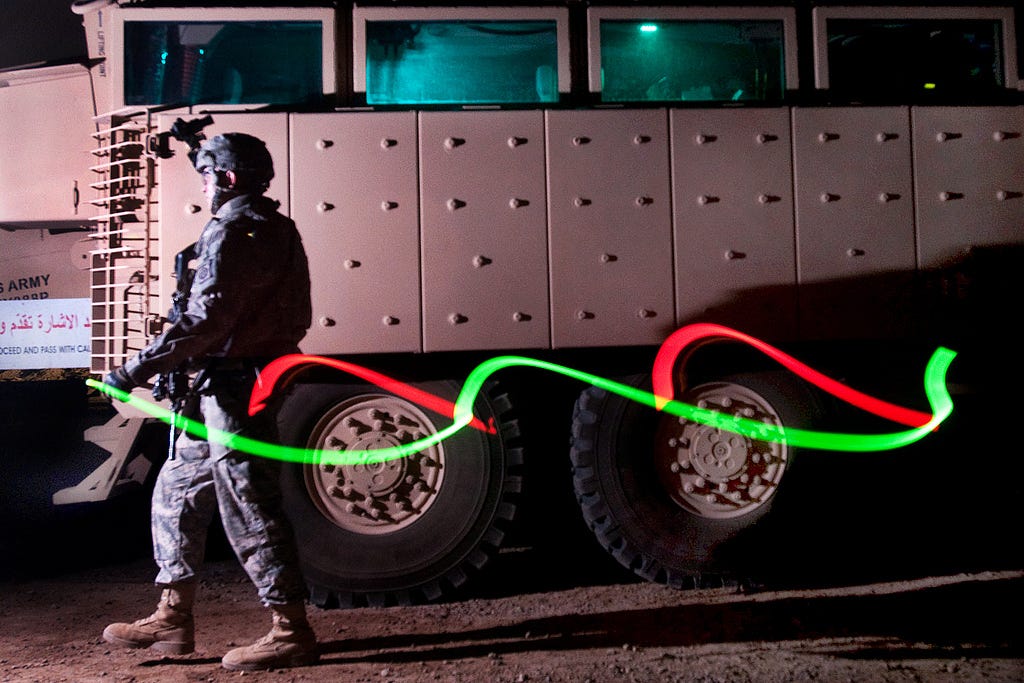
At top, above and below—U.S. Army soldiers with glow sticks. Army photos

Researchers at China Lake envisioned troops and sailors using the chemicals to see in the dark and point out targets for air and artillery strikes. Navy weaponeers promptly filled experimental cluster bombs, mortar shells, land mines and grenades with PR-155.

ARMY The Military Wants Smarter Insect Spy Drones

December 23, 2014

The Defense Advanced Projects Research Agency put out a broad agency announcement this week seeking software solutions to help small drones fly better in tight enclosed environments. The Fast Lightweight Autonomy program, the agency said, “focuses on creating a new class of algorithms to enable small, unmanned aerial vehicles to quickly navigate a labyrinth of rooms, stairways and corridors or other obstacle-filled environments without a remote pilot.”

Patrick Tucker is technology editor for Defense One. He’s also the author of The Naked Future: What Happens in a World That Anticipates Your Every Move? (Current, 2014). Previously, Tucker was deputy editor for The Futurist, where he served for nine years. Tucker's writing on emerging technology ... Full Bio

The solicitation doesn’t focus on new drone designs so much as helping very small drones — able to fit through an open window and fly at 45 miles per hour — navigate tight and chaotic indoor spaces without having to communicate with operators, get GPS directions, or receive data from external sensors. All the thinking, steering and landing would be in the drone.

“Goshawks, for example, can fly very fast through a dense forest without smacking into a tree. Many insects, too, can dart and hover with incredible speed and precision. The goal of the FLA program is to explore non-traditional perception and autonomy methods that would give small UAVs the capacity to perform in a similar way, including an ability to easily navigate tight spaces at high speed and quickly recognize if it had already been in a room before,” Mark Micire, DARPA program manager, said in a press release.

The agency put out this video to demonstrate what they’re looking for.

26 December 2014

Sierra Leon nurses strike over Ebola hazard pay amid lockdown

Dec 26, 2014

Some 30 nurses at the Mabenteh Hospital in the town of Makeni said they had been refusing to work since Wednesday because of "the non payment of risk allowance" by the government for the month of November.

FREETOWN, Sierra Leone: Nurses at a public hospital in northern Sierra Leone were on strike on Thursday to demand hazard pay for treating Ebola patients, as the region was under lockdown in a bid by authorities to combat the killer virus. 

Some 30 nurses at the Mabenteh Hospital in the town of Makeni said they had been refusing to work since Wednesday because of "the non payment of risk allowance" by the government for the month of November. 

A spokesman for the nurses, Henry Conteh, told public radio: "We are not going to attend to any patients who are already admitted and will not accept any new cases until we are paid." 

"The matter is serious and needs to be settled urgently," he said. There was no immediate information available on how much money the health workers were owed or how many patients had been turned away. 

The manager of the Mabenteh Hospital board, Ibrahim Bangura, said he was working "to resolve the issue with the authorities so that patients' lives will not be at risk." 

The strike action came as Sierra Leone's northern region marked the second day of a five-day lockdown as part of intensified government efforts to contain the Ebola epidemic, with many public Christmas and New Year celebrations also banned. 

Ebola has killed more than 7,500 people over the past year, almost all of them in Liberia, Guinea and Sierra Leone. 

Sierra Leone recently overtook Liberia as the country with the highest number of infections, recording 9,004 cases and 2,582 deaths, WHO said in its most recent update. 

Markets and shops were shut in the country's north on Thursday and travel between districts was strictly forbidden save for Ebola health workers and authorised personnel. 

Except for Christmas Day mass, no public gatherings were allowed. The resident minister for the Northern Region, Alie Kamara, told AFP that despite the many restrictions there was "much compliance" with the lockdown. 

The Sierra Leonean government already imposed a nationwide shutdown for three days in September in a bid to halt the spread of the disease, when more than 28,000 volunteers went house-to-house to raise awareness about Ebola. 

Russia battles to contain Black Sea oil spill

Dec 25, 2014

A Russian Black Sea city declared a state of emergency on Thursday after a burst pipeline spewed oil into the landlocked water body, with stormy weather hampering cleanup efforts.

MOSCOW: A Russian Black Sea city declared a state of emergency on Thursday after a burst pipeline spewed oil into the landlocked water body, with stormy weather hampering cleanup efforts.

The pipeline near the city of Tuapse burst late on Tuesday, according to ChernomorTransneft, a subsidiary of Russia's main oil transport company Transneft.

"The wall of the pipeline broke due to... a landslide," the company said in a statement, adding that the rupture caused 8.4 cubic metres to leak out into the Tuapse river, which empties into the Black Sea.

Environmentalists warned however that the volume of the spill could be nearly 100 times greater than claimed by Transneft.

A sign that reads 'Prohibited area! No entry!' hangs on a barbed wire fence outside an area of Tuapse oil refinery in the Russian Black Sea coastal town of Tuapse. (Reuters photo)

The oil transport company said the damaged section of the pipeline — about nine kilometres (five miles) from the Black Sea coast — was under construction by a subsidiary of oil giant Rosneft and was not yet in use by Transneft.

Rosneft also operates a major oil refinery in Tuapse.

Russia's sea and river transport agency said a cleanup mission was launched on Wednesday afternoon, though stormy weather precluded the use of boats.

By Thursday, the local authorities declared a state of emergency in Tuapse and more than 300 workers were at the scene, according to the Krasnodar regional government website.

"There is a state of emergency for Tuapse city," a statement on the Krasnodar regional government website said. "Work is complicated by a storm, with waves two to three metres (up to 10 feet) high," it said.

Oil leaks are seen at the Tuapse river in the Russian Black Sea coastal town of Tuapse, December 24, 2014. (Reuters photo) 

World Wildlife Fund said on Thursday that the spill already polluted 15 kilometres of the Black Sea shore, and accused Rosneft and Transneft of failing to act quickly and understating the real extent of the damage.

China readies sea-based nuclear deterrent against U.S.

ATUL ANEJA
December 26, 2014

So far, China could strike the U.S. only with land-based missiles.

China is set to reinforce its nuclear second-strike capability by mounting on some of its submarines long-range ballistic missiles, which could target the U.S.

So far, China could strike the U.S. only with land-based intercontinental ballistic missiles. But with western advancements in surveillance that could track their location and movements, these weapons had become vulnerable to a U.S. first strike, gravely undermining Beijing’s nuclear deterrence.

However, China is on the verge of a course correction, says a report submitted in November to Congress by the U.S.-China Economic and Security Review Commission. The commission has concluded that the Chinese are set to acquire a reliable, hard-to-destroy sea-based deterrent. A cluster of 12 JL-2 missiles, with a strike range of around 7,350 km, are being mounted on its JIN class of submarines.

China has three JIN-class nuclear-powered submarines, which began entering service in 2007. Despite their fairly high noise level, their lethality has now multiplied, following the integration of the new missiles, giving China a credible second-strike capability.

Alaska within reach

Rebels without a cause


SANJOY HAZARIKA
December 26, 2014

PTI"The size of Assam state's police machinery is inadequate to deal with the problems it faces." Picture shows a village house after it was set abalze by National Democratic Front of Boroland militants, in Phulbari.

The National Democratic Front of Boroland (Songbijit) does not seem to have any clear and tangible goal apart from that of spreading mayhem and terror

The massacre of innocent men, women and children in Sonitpur and Kokrajar districts of Assam is a familiar, cynical, bloody cycle of violence that is never far away; it is a testament to the simmering cauldron of suspicion, fear and hate stalking the Assam valley and hills. Can there be any ‘reason’ that can even begin to justify such murders of children, some of them barely a few months old?

The butchery indicates a set of well-planned and coordinated operations that clearly caught law enforcement agencies and the State government by surprise. The marauders had been under pressure for some time, with police forces inflicting recent losses on them in Sonitpur district. A breakaway group of the National Democratic Front of Boroland (NDFB) named after its elusive leader, I.K. Songbijit, is the group responsible for the killings, State police and administrators say. The faction is opposed to talks between the larger NDFB group and the Indian government but does not seem to have any clear and tangible goal apart from that of spreading mayhem and terror.

It recently told the local media that it would show that it is capable of tough retaliation if the pressure continued. But the use of weapons against women and children in the northeastern region is not new or limited; such abuse and brutality has been extensive not just in Assam, but also its neighbouring States. In Meghalaya for instance, earlier this year, a Garo armed group shot dead a young woman in front of her children. There are allegations of abuse against armed groups in Nagaland and Manipur as well.

What has also made such groups difficult to tackle is the fact that they camp on the forested and lightly patrolled border tracts of Arunachal Pradesh and Bhutan, according to officials. The latter was the camping ground, until 2003, of three major armed groups — NDFB, United Liberation Front of Asom (ULFA) and Kamtapur Liberation Organisation — which were using it to organise attacks and recruit members in Assam. That year, they were attacked, devastated and driven out by the Royal Bhutanese Army. There have been reports that some groups have relocated to these thickly forested and sparsely populated areas.

No rationale