11 May 2015

Combat Fleet of the IAF: Present and Future

08 May , 2015

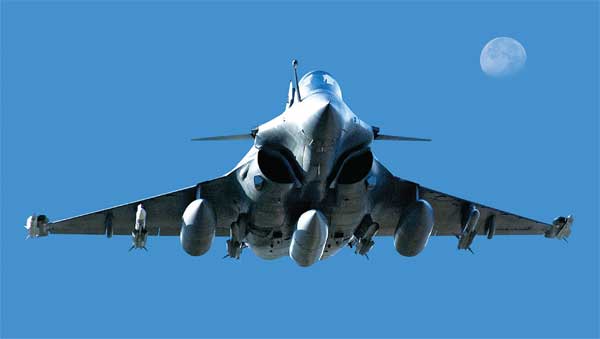
Combat aircraft constitute the cutting edge of any air force and so it is with the IAF as well. Modernisation and upgradation of combat platforms are ongoing processes that will help the IAF maintain the operational edge at all times. By the end of the 15th Five Year Plan, it is expected that the IAF inventory would consist largely of fourth and fifth generation platforms. Notwithstanding the depleting numbers that are being witnessed today, the continuing induction of new combat platforms such as the SU 30 MKI as well as the plans of acquiring the Rafale and the Tejas, the IAF would have the capability of long-range precision attack and of delivering conventional and nuclear weapons. This would give the IAF not just the necessary deterrence capability, but also a reliable second-strike capability.

During any interaction with the layman about the Indian Air Force (IAF), the discussion normally veers to the topic of ‘fighter aircraft’. The general public holds a greater fascination for the various types of aircraft in the combat fleet (read fighter fleet) of the IAF, as can be witnessed at any public gathering that has an air display or show, which has a fly-past at its culmination. Be it the Republic Day celebrations or the Air Force Day parade or any other such occasion, it is always the display by fighter aircraft that gets the maximum applause. The fascination is not restricted to just the man on the streets but even movies and television serials portray the combat fleet of the IAF as the ‘guardians of the Indian skies’. People seldom realise that the fighter aircraft of the IAF operate in close coordination with other weapon platforms and systems which, as a team, form a lethal combination but are rarely in the public eye.
Institutionalizing Military Role in Disasters – the subterfuge

09 May , 2015

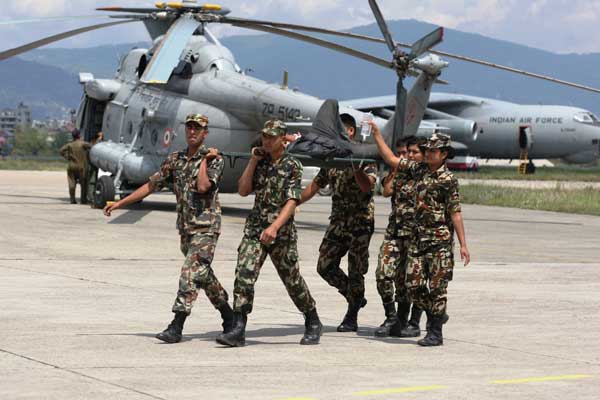
Personnel carrying a stranded person brought from an IAF helicopter at Kathmandu airport to a safer place following a massive earthquake in Nepal.

In a perspective, war is an unnatural disaster which the Armed forces are the first and last respondent. With no one to fall back on they might as well make a good job of it!

Four days into the Nepal quake and write ups in media started emerging about how the Armed Forces should handle disasters in future. An Op-Ed in a prominent national daily called for the role of the military to be institutionalized in disaster relief. Then one began reading some enlightened authors recommending that since conventional wars are things of the past, disaster relief should be one of the “primary” tasks for the military.

Some even went to the extent of recommending that the Army (mercifully the Air Force and the Navy were not been mentioned) should develop core competency in disaster relief by carrying out specialized training, procuring specialist equipment and create appointments for the new role, interact with NDMA and other agencies to map disaster relief assistance required in its areas of responsibility to create specialist nodes, amalgamation the effort at Centre and state level to develop an effective response strategy, so on and so forth. So one may envisage a Directorate General of Disaster Relief somewhere in Army Headquarters and related appointments down the line at Command, Corps, Division levels at least, if not beyond down to Brigades.

Military compensation reform proposals face new critique


By Andrew Tilghman

The slate of proposed changes to military pay and benefits is facing a new round of criticism for failing to fully tackle the long-term problems confronting the military personnel system.

For months, the Military Compensation and Retirement Modernization Commission's recommendations for reform were scorned by veterans groups that claimed the proposals were too aggressive and threatened retention.

Now some military personnel experts are lodging the opposite critique.

"The commission did not go far enough," said Arnold Punaro, a retired Marine major general and chairman of the Reserve Forces Policy Board, a Pentagon advisory group.

Punaro joined other military personnel experts and former officers at the Center for American Progress in Washington on Thursday. They offered similar views that the commission's recommendations, particularly the proposed changes to the retirement system, fail to sufficiently cut manpower costs or lay a substantive foundation for a modern, flexible force of the future.

WEEKEND READING: MAY 8-10 EDITION

Source Link
May 8, 2015 

It’s Friday, which means it’s time to kick back, relax, and maybe try your hand at mixing yourself a Caipirinha. And of course, we’re hear to help fill a bit of your free time with some of the best reads we’ve come across in the past week.

This spring’s hottest European fashion? Increased defense spending.After years of European defense budgets that made NATO’s two-percent-of-GDP spending targets seem increasingly irrelevant, a new trend appears to be emerging: European governments announcing cash injections into their planned defense spending. France, Sweden, and Germany are the latest to promise increased funds, driven in large part by threats of Islamist violence and fears over Russian adventurism. While most NATO countries will still fall short of the two percent target, write RUSI’s Elizabeth Quintana and Henrik Heidenkamp, “the recent developments might therefore be regarded as being indicative of a substantial change in the countries’ defence discourse both at the political level and within the broader public debate.” However, conspicuously absent from the defense spending bandwagon, they note, is the United Kingdom.

A Really Bad Idea: Ignoring the Lessons of V-E Day

May 8, 2015 

"A hundred years ago, Europe was the power center of the world. Yet V-E day marked more than the end of German militarism; it also announced the eclipse of Europe by America and Russia."

Imagine the Nazi swastika flying over New York, London and Moscow. Jews are a forbidden memory, freedom of thought has vanished, and the world is a vast ant colony ruled by an ubermenchen 1 percent blessed with "superior" Aryan genes.

Did V-E Day -- the surrender of Nazi Germany on May 8, 1945 -- matter? It mattered enough to millions of Americans, Britons, Russians and others, who died to make that day happen. 

But on this 70th anniversary of V-E Day, as the World War II generation fades away (my father-in-law), so the war itself seems to have faded into nothing more than Hollywood action movies and repetitious cable TV documentaries.

This isn't right. V-E Day does matter, and we would be foolish to ignore its lessons.

The Lusitania Sinking: Why No American Declaration of War on Germany?

May 8, 2015

Asking “what if” is a popular parlor game. Seldom, however, do we ever get an answer, and certainly not almost immediately.King George V of Britain is a rare exception. On the morning of May 7, 1915 in the midst of discussing Germany with a visiting American envoy, Colonel Edward M. House, he asked, “Suppose they should sink the Lusitania, with American passengers on board?” Within hours he had his answer.

The day had turned out to be surprisingly beautiful off the coast of southern Ireland. The morning’s fog had lifted, replaced by bright sunshine. The passengers on board the RMS Lusitania, the fastest and most luxurious cruise ship on the seas, eagerly anticipated their impending arrival in Liverpool, just six days after departing New York. What they didn’t know as their ship sliced through the Irish Sea in the early afternoon, just a dozen miles off Old Head of Kinsale, was that a German submarine had spotted them, or that, the Lusitania’s captain, despite knowing of possible submarine activity in the area, ignored recommendations that he plot an evasive course. It was a fatal mistake. At 2:10 p.m., the submarine fired one of its two remaining torpedoes, scoring a direct hit. The “Greyhound of the Seas” sank in just eighteen minutes. Nearly 1,200 people died, including 128 Americans.

Six Characteristics of the Highly Effective Staff Officer

Lieutenant Colonel James M. Stewart, 

The following guest post was penned by Andrew “Evan” McCoy, Assistant Operations Officer for 4th Squadron, 2nd Cavalry Regiment. The views in this post are those of the author and do not reflect those of the Department of the Army of the Department of Defense.

There are many things that an Army Officer, specifically a combat arms Officer must be. There are the standards; empathy, discipline, physical fitness, confidence, resilience, mental agility, innovation, strong communication, that list could actually go on for days, and there would still be arguments for and against what characteristics a great Officer should have.[i] This paper is not focused on these, but is focused on a much smaller list of characteristics, those that I see as essential to any junior Officer who is lucky enough to find themselves occupying a desk in the bowels of the headquarters building.

Let me preface this by stating plain and simply; I do not see myself as a Highly Effective Staff Officer. I have had the opportunity to observe and learn from many of the best staff officers around, and it is through those observations that I frame this paper.

My purpose for writing this is to serve as a guide to the junior staff Officer, most specifically lieutenants and junior captains, who have finished time as a platoon leader and find themselves thrust into staff meetings, command and staff meetings, training meetings, training resource meetings, daily commanders updates and a myriad of other staff functions to which they have previously had limited if any exposure to.

10 May 2015

India and Asian Leadership

By Jayshree Borah
May 08, 2015
http://thediplomat.com/2015/05/india-and-asian-leadership/

Sixty years ago, India was at the forefront of efforts to create a new world order. Times have changed. 
Sixty years ago, delegates from 29 Asian and African countries gathered in Bandung, Indonesia for a conference to decide their own futures and destinies, free of the yoke of colonialism. The aspiration of building an “intermediate camp” of national independence and neutralism to counter the “imperialist camp” of the United States and the “socialist camp” of the Soviet Union was also very much part of the motive behind the conference.

However, the tone for that 1955 conference on Afro-Asian solidarity was actually set by then Indian Prime Minister Jawaharlal Nehru almost a decade earlier. Nehru’s enthusiasm for pan-Asian cooperation found its expression in the Asian Relations Conference, convened in New Delhi in March and April 1947. This earlier conference had special significance as it created an Asian Relations Organization in New Delhi and made Nehru its president.

A historic first for Grenadiers

SUHASINI HAIDAR
May 9, 2015 

The Grenadiers are all set to march at the Red Square in Moscow. Photo: Special Arrangement

They will march in Victory Day parade in Moscow’s Red Square on May 9.

It’s a historic day for a historic regiment of the Indian Army: the first time a contingent of the Nine Grenadiers regiment will march in an international military parade, as part of Russia’s Victory Day commemoration.

The 75-member contingent has been practising at an army facility outside Moscow since April 25, and will be part of 10 militaries, including Russia’s Red Army and China’s PLA, to take part in the May 9 parade. While Russia marks the day each year for the defeat of Hitler’s army in 1945, this year is special as it is the 70th anniversary, and President Pranab Mukherjee is one of about 16 presidents expected to attend the parade.

Coming Out of the Closet: India-Israel Ties Under Narendra Modi

BY RONAK D. DESAI
MAY 7, 2015

Despite a cordial closeted relationship for decades, India and Israel are now making their private affair public — thanks in large part to the unprecedented embrace of the Jewish state by Narendra Modi. Is this stark departure one of style or substance?

Relations between India and Israel are experiencing a diplomatic renaissance. Indian Prime Minister Narendra Modi’s landslide victory in India’s elections last year has ushered in a new, conspicuously more visible phase of bilateral ties.

Cooperation with Israel—conducted secretly throughout most of India’s history—has now become a public affair. Modi has openly and enthusiastically embraced the Jewish state. Although some wonder whether the change is merely one of style rather than substance, there is no question that India’s recent public displays of affection toward Israel are a stark departure from the past. If current trends continue, the Modi government could become the most pro-Israel government New Delhi has ever seen.

Throughout most of its post-independence history, India benefitted privately from Israel while refusing to publicly acknowledge it. New Delhi voted to recognize Israel in 1950, but Cold War alignments, fear of alienating its large Muslim population, and its need to maintain strong ties to the Arab world over the Kashmir issue resulted in New Delhi adopting an unsympathetic, if not outright hostile, posture toward Israel.

Narendra Modi Is Bad for Big Business And that's a good thing -- particularly when India’s top CEOs are getting mad at him.

BY RUPA SUBRAMANYA
MAY 7, 2015

A year ago this month, corporate titans around the world celebrated the victory of Narendra Modi’s Bharatiya Janata Party (BJP) in India’s elections. In a country where radical leftists still exert a mighty influence in some states and on the intellectual center of gravity, Modi’s platform was unapologetically pro-business. But to make India more friendly to the free market, Modi has had to step on the toes of some of the same business leaders who backed him.

Modi, before becoming prime minister, as chief minister of Gujarat was widely seen as presiding over one of the most business-friendly state governments in recent memory. Many of India’s top CEOs all but openly backed Modi and the center-right BJP last year. The result was a landslide victory in which the long ruling center-left Congress party was ousted from power. Now, however, some of these same business leaders have changed their tune, and there are more than a few grumblings of dissatisfaction.

In February, Deepak Parekh, chairman of Housing Development Finance Corporation (HDFC), a major financial institution, complained of “a little bit of impatience” regarding what he saw as the lack of change on the ground in the business environment. In March, following the budget, Anil Manibhai Naik, chairman of Larsen & Toubro, a major engineering and construction conglomerate, said that the government’s steps to revive the economy were not “adequate”. And, last month, Harsh Mariwala, chairman of consumer goods group Marico, took to Twitter to argue that the “sheen is falling” off the Modi government in the context of its promises and slow delivery.

What explains this backlash?

Explained: A RAW deal

May 8, 2015 
http://indianexpress.com/article/explained/explained-a-raw-deal/

Over the last 3 weeks, Gen Raheel Sharif and others have blamed the Research & Analysis Wing for everything from killings in Karachi to the insurgency in Balochistan.

For months now, as Pakistan’s anti-jihadist campaign has escalated, Islamists have accused the army of being apostates, acting at the behest of the US, India and Israel.

Somewhere inside Pakistan, an Indian spy has unleashed an inner Rajinikanth no one ever suspected existed — if the Pak Army is to be believed, that is. Over the last 3 weeks, Gen Raheel Sharif and others have blamed the Research & Analysis Wing for everything from killings in Karachi to the insurgency in Balochistan. PRAVEEN SWAMI gives the facts and perspective.

For months now, as Pakistan’s anti-jihadist campaign has escalated, Islamists have accused the army of being apostates, acting at the behest of the US, India and Israel. Propaganda videos circulated by groups like al-Qaeda are suffused with images of killings carried out by the Pak army. In a society radicalised by state-backed Islamism, these allegations carry weight. Hitting out at India is an easy way to get the public together behind nationalism, and the Pak army.

Government must change the Gilgit-Baltistan narrative

08 May , 2015


Sadly, successive government in India since independence has chosen to remain silent spectators with regard to the oppression and atrocity that is being heaped on the people of Gilgit-Baltistan by Pakistan.

The word Gilgit-Baltistan is nowhere mentioned in the Constitution of Pakistan.

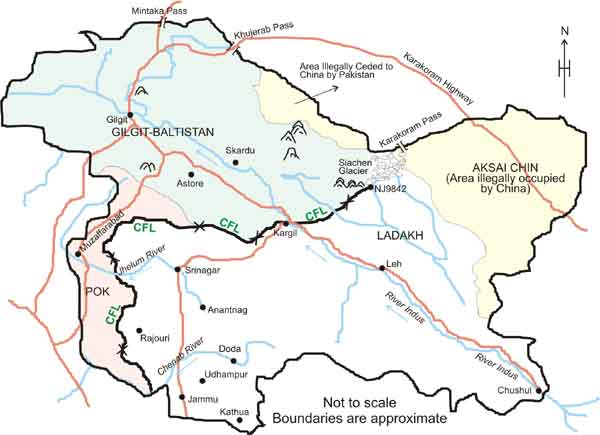
Despite the people of Gilgit-Baltistan opting to join the state of Pakistan at the time of division of the Indian Sub-continent in 1947, Pakistan has not honoured its commitment of totally integrating the region with the nation. It misused the UN resolution on Jammu and Kashmir to declare Gilgit-Baltistan a disputed territory; re-designated the region as Northern Area and exercised control over it through political agents. The word Gilgit-Baltistan is nowhere mentioned in the Constitution of Pakistan.

In the last six decades plus, Gilgit-Baltistan has been given only cosmetic rights of self governance. Actual power is vested upon the federal government and exercised through the Ministry of Kashmir Affairs and Northern Areas. The demand for a full fledged Provincial status has also not been met by the federal government.

For The Record: Preserving Calcutta for the future

By: Amit Chaudhuri
May 9, 2015

A letter to the chief minister of West Bengal on safeguarding and restoring the city’s architectural heritage.

Calcutta is one of the great cities of modernity, and Asia’s first cosmopolitan metropolis. Like other great modern cities, its cultural inheritance is contained not only in its literature, cinema, art and music, or in its political and intellectual history, but palpably in its lived spaces and its architectural ethos. This ethos is remarkably distinctive, and unique to Calcutta; it includes not only the rajbari mansions of north Calcutta and the grand colonial institutional buildings of central Calcutta, but the houses in which people have lived, and still live, in various neighbourhoods in the city — Bakulbagan, Hindustan Park, Kidderpore, Paddapukur Road, Bhowanipore, Sarat Bose Road, and Ganguly Bagan, to name just a few. These and others areas should really be declared heritage precincts. As Esther Duflo, professor of poverty alleviation and development economics at the Massachusetts Institute of Technology, has said, Calcutta neighbourhoods should be showcased to the world in the same way that Prague and other great cities showcase their architecture. The first reason for this is the vivid way in which the history of a unique Bengali modernity is represented by Calcutta’s buildings from the last century to the 1950s. The second reason is that, as Duflo points out, these buildings and precincts are the very things that will attract the international visitor to the city.

Deadly Pakistan Helicopter Crash Kills Diplomats

May 09, 2015

The TTP has claimed responsibility, but experts believe the tragic crash was an accident. 

A military helicopter carrying foreign diplomats and their wives crash-landed in Pakistan’s Gilgit-Baltistan territory on Friday, killing seven of the 17 passengers aboard. According to the Twitter account of Asim Bajwa, the director-general of Inter-Service Public Relations (ISPR), the Pakistan army’s media brand, the dead included four foreigners – the ambassadors of Norway and the Philippines, and the wives of the Indonesian and Malaysian ambassadors – and three Pakistanis (two pilots and one crew member). Ambassadors from Poland and the Netherlands were injured in the crash.

The Mi-17 helicopter crashed into a building that part of an army school complex, but fortunately there were no children inside at the time. No on-ground casualties were reported from the crash.

The helicopter was one of three carrying passengers to the Naltar valley, where the guests were to attend the opening ceremony of a new ski chairlift donated by Switzerland. According to the BBC, the ceremony had already been delayed several times due to Prime Minister Nawaz Sharif’s schedule. The aircraft carrying Sharif, who was also slated to attend, turned back immediately upon hearing of the crash.

The ceremony has been cancelled and Sharif had declared a day of mourning over the crash. Sharif and Pakistani Chief of Army Staff Raheel Sharif (no relation) both expressed grief over the accident and condolences to the families in separate statements.

Are Afghanistan’s Police Safe?

By Jack Detsch
May 08, 2015

The killing of 18 officers in Northeastern Afghanistan once again calls into question the safety of Afghan policemen 

Afghan militants reportedly attacked 13 police and military checkpoints in Badakhshan province Monday leaving 18 policemen dead, according to a hospital director in the provincial capital. Badakhshan borders both Pakistan and Tajikistan. The attack is yet another sign, with the Taliban’s spring offensive against police, military, and government officials well underway, that Kabul’s counteroffensive lies on tenuous ground. Militants seem increasingly comfortable fighting far from their center of gravity, in the bloody provinces of Kandahar and Helmand, which have seen the bulk of the fighting over the past fourteen years.

Afghanistan’s police have long been a target of militant attacks. With the Afghan state still taking small steps toward self-sufficiency, the Taliban has used suicide bombings, green-on-blue attacks, and infiltration within the ranks of Afghan security forces to stir up dissent and decrease morale for the underpaid, overworked, and overstretched hand of Kabul’s law enforcement.

Too Late To Tango? Ashraf Ghani’s Risky Outreach To Pakistan

BY SCOTT SMITH, MOEED YUSUF

The resurgence of fighting in Afghanistan might mean that Ghani's strategy of reaching out to Pakistan is too little too late. But Ghani did not seem to have many other options.

The Afghan Taliban have announced their spring offensive and followed it up with spectacular attacks around the country. This puts Afghan President Ashraf Ghani in a bind, given that he had gone out on a limb to reenergize the peace process with the Taliban by engaging with Pakistan. Does the renewed spring fighting in Afghanistan mean that his strategy has failed?
Ghani’s likely diagnosis is that the enduring Taliban insurgency is a symptom of an undeclared but constant state of hostility between Afghanistan and Pakistan. It is precisely because he believes that Pakistan is the problem that he is trying to address it. His gamble is that if he can satisfy Pakistan’s main concerns regarding Afghanistan, then Pakistan may force the Afghan Taliban to strike a political deal with Kabul.

Ghani’s move is probably more a reflection of his lack of alternatives than any liking for Pakistan or naivetรฉ about how much he can trust his neighbor. It is nonetheless a dramatic departure from former President Hamid Karzai’s policy of trying to coerce Pakistan into giving up support for the Taliban or attempting to engage with the Taliban without Pakistan’s support. Over the past decade, Pakistan has been able to maintain the Taliban and Haqqani network sanctuaries and thwart attempts at peace talks when it wanted to.

Why did the Pakistan army warn R&AW?

May 08, 2015

'After General Raheel Sharif took on the Tehrik-e-Taliban Pakistan, some sections of the military establishment may have felt unease as to whether the crackdown could be extended against friendlier 'non-State' actors like the Lashkar-e-Tayiba,' says Rana Banerji.

While it has been customary to use the media grapevine or pliable journalists to blame Indian intelligence agencies for whatever goes wrong in Pakistan, the Inter Services Public Relations May 5 press release, issued after the corps commanders conference the same day, 'taking serious note of RA&W's involvement in whipping up terrorism in Pakistan,' is certainly unusual in the sense that such a direct charge proximate to domestic events has not been made in the recent past.

Defence Minister Khwaja Asif -- who descends from a notable Muslim League family close to Jinnah, and who is currently engaged in a factional squabble within the ruling PML (Nawaz) party against Interior Minister Chaudhry Nisar Ali -- duly weighed in with a Geo TV cameo, alleging that RA&W had been 'formed to undo Pakistan' and 'wipe it off the map of the world.'

What’s our Hindustan problem?

May 01, 2015

Our heroes are the Muslim conquerors of Hind, from Mahmud Ghaznavi onwards. We name our missiles after them — Ghauri, Abdali — and of course after Iqbal’s mythical Shaheen. We take ourselves to be the descendants of the Timurid conquerors, the House of Babur. Yet Pakistan defines itself by its fear of Hindustan, the land conquered, occupied and ruled by the supposed ancestors, the spiritual and temporal forbears, of today’s Islamic Republic.

Perhaps there are a thousand justifications for Pakistan to have a large standing army. Perhaps there are many reasons, and valid ones at that, for Pakistan to possess a nuclear capability. But for Pakistan the overriding reason for tanks, missiles and nuke capability is not the Arabian Sea, not the Himalayas, but India.

What are we afraid of? What are our generals afraid of? Is Pakistan a morsel on a map that anyone can swallow? But we conduct ourselves and we talk as if we face an ‘existential’ threat from our neighbour to the east. I wish we would take this word existential out of our lexicon. It has been worked to death. The only threat Pakistan faces is: 1) from incompetence and 2) from fantasies about ‘jihad’ — about conquering lands to our west and east, fantasies which have brought us to our present pass.

If only we had remained a normal country without the urge to hitch our national wagon to distant stars we could have avoided so many of our troubles and become the crossroads of east and west, and Central Asia and the Indian Ocean, that we can still become if only we choose to transcend some of the strange notions that afflict our national thinking.

How Pakistan Plays the Middle East

May 7, 2015 


Anthony Bubalo recently lamented that alliances and enmities in the Middle East are becoming so complex that even long-term watchers are struggling to keep up. Well, if that's the case, Pakistan just added to the layers of confusion.

Last month, Pakistan surprisingly refused to join its long-time ally and benefactor Saudi Arabia in its intervention to combat Houthi rebels in Yemen. As the royal kingdom sought to build its coalition, most analysts believed Pakistan's involvement was a foregone conclusion. 

There were many reasons to make this assumption. Pakistan Prime Minister Nawaz Sharif spent much of his time in exile in Riyadh and may owe his political career and even his life to the deft diplomacy of the royal family (Nawaz and his brother Shahbaz were provided sanctuary in Saudi Arabia after General Pervez Musharraf seized power in a military coup).

Beyond these close personal ties, the Saudi-Pakistan relationship has been extremely close since the 1960s, when Saudi King Faisal sought to consolidate the Gulf state's position as a leader of the Muslim world by bringing the newly established Pakistan into its orbit.

Pakistan-Defining-National-Security

By Muhammad Sajjad Haider

The terrorist attack on Army Public School, Peshawar generated a serious debate as to how to confront terrorist attacks in future. The meeting of all parliamentary leaders held in Peshawar on next of the attack under the chair of the Prime Minister concluded with the decision to form a committee to recommend steps to be taken in this direction with the mandate to submit its recommendations within seven days from the date of its formation. The Government consequently constituted the committee comprising of leaders from different political parties, which includes one former Federal Minister for Interior who had rich knowledge and experience to confront these terrorists. The inclusion of professionals and expert on counter-terrorism in the committee would have been an extra advantage to the committee.

Although this was a right step towards creating consensus to deal with the Taliban/terrorists yet unfortunately it was not the first initiative. In the past, a similar APC was convened on the subject where certain decisions to deal with the terrorism were taken but without any results. The political as well as religious parties are widely divided on the lines of sects and opposing political philosophy. Apart from few political parties, majority of political parties depend on the vote bank of religious and rightist groups. The fear of losing vote bank by the ruling party consequent to an operation against proscribed groups helped those groups to energise themselves.

Decoding Chabahar


Chabahar and Gwadar; Do these names rings bell in your mind? These two are small ports of Iran and Pakistan respectively. Both these cities are in the news since last two weeks and are becoming the new centers of economic warfare between two giants of Asia - India and China; the battlefield has shifted from building their infrastructure within the country to build outside.


Not far from Gwadar is Chabahar Port. Gwadar’s main competitor in this region and better positioned to connect with Central Asian Republics and Afghanistan. And this is where India comes in picture. Chabahar port plays an important role in India’s Central Asian Diplomacy. Connecting landlocked Afghanistan to Chabahar Port is a major part of India’s $750 million USD aid to Afghanistan. Chabahar-Milak-Zaranj-Dilaram route is under construction by India and has already spent about $100 million USD to build a 220-km (140-mile) road in western Afghanistan to link up with Chabahar Port in Iran.

Indian Ocean 21st century security dilemma

By Amrita Jash

Indian Ocean is where global struggles will play out in the twenty-first century. It is a “new great game” in the making. 

Indian Ocean is the new theatre of ‘Great Power’ politics of the twenty-first century. With a tactical geopolitical landscape, the Indian Ocean- third largest waterway in the world surpassing the Atlantic and Pacific Oceans as the world’s largest and most strategically significant maritime trade for global economy and security. The Indian Ocean Region (IOR) is surrounded by Africa, Asia and Australia serves as a maritime highway linking transcontinental human and economic relationships. In this context, the strategic importance of Indian Ocean can be best assessed in the prophetic words of maritime strategist Rear Admiral Alfred Thayer Mahan, who famously stated: “Whoever attains maritime supremacy in the Indian Ocean would be a prominent player on the international scene. Whoever controls the Indian Ocean dominates Asia. This Ocean is the key to the seven seas in the twenty-first century, the destiny of the world will be decided in these waters.”

It is these prophetic words that forms the new pivot to the changing strategic dynamics in the Indian Ocean which Robert D. Kaplan envisaged as the ‘Centre Stage for the 21st Century’ whereby in the spiraling rivalry of a rising China and India, ‘Indian Ocean is where global struggles will play out in the twenty-first century’- a “new great game” in the making.With a gradual decline in U.S. dominance, the power struggle seem to have taken its initial roots, whereby both China and India are looking the “Mahanian way” in redirecting their gaze from the continent to the seas. In this view, the Indian Ocean is the new limit to China-India’s complex power politics- where both are determined to make it their nautical backyard. This strategic objective has added a maritime dimension to their geopolitical rivalry.

Road Rage in China: A Cautionary Tale

May 09, 2015
http://thediplomat.com/2015/05/road-rage-in-china-a-cautionary-tale/

After an incident in Chengdu, many in China sympathize with a man who attacked the woman who cut him off in traffic. 

In Chengdu this past Monday, a traffic violation led to an act of brutal violence and then became a national news story that ended with many Chinese citizens supporting the attacker.

It all began when a young woman named Lu Yang abruptly changed lanes to avoid missing her exit, thereby cutting off another driver, later identified as Mr. Zhang, who was then forced to slam on his brakes. Zhang was with his wife and infant child, and the sudden stop caused his child to begin crying. He followed Lu off the main road, overtook her, and then cut her off as she had done to him. A few hundred meters later, Lu overtook Zhang again, driving him into the bicycle lane and almost forcing him to hit a pedestrian.

China and Russia Are More Likely to Become Allies Than You Think

May 09, 2015

Plus, Xi remembers WWII, China in Antarctica, and new leaders for China’s oil giants. Friday China links. 

It’s that time of the week again: your Friday wrap-up of China news.
With Xi Jinping heading to Russia to attend the Victory Day parade and other events commemorating the surrender of German forces 70 years ago, now’s a great time to check out Alexander Korolev’s piece for the Asan Forum debunking four myths about factors preventing a China-Russia alliance. The four myths: Russia will not ally with China because it fears being overshadowed by Chinese power; Russia is concerned about Chinese migrants flooding into Siberia; Russia worries about becoming too close to (and thus too economically dependent on) China; and China and Russia do not trust each other enough to form an alliance. If you’ve ever waved away a possible China-Russia axis on the basis on one (or all of these) arguments, read Korolev’s counterarguments.

Also as Xi heads to Russia, Xinhua ran an article highlighting China and Russia’s joint contributions to Allied victory in World War II. The pieces quotes at length from an article by Xi himself that appeared in the Russian Gazette. “Decades ago, the Chinese and Russian nations shared weal and woe and forged an unbreakable war friendship with fresh blood,” Xi wrote. “Today, the two peoples will jointly move forward, safeguarding peace and promoting development, and continue to contribute to enduring global peace and the common progress of mankind.”

Revealed: China's New 'Carrier Killer' Sub Simulator

May 08, 2015

When can we expect Beijing’s stealthy new submarine to enter service? A simulator may offer some clues. 

Over at Eastern Arsenal, Jeffrey Lin and P.W. Singer, are discussing in detail a new Chinese submarine simulator that could provide clues what could become Beijing’s stealthiest (and deadliest) nuclear-attack submarine (SSN) when it enters service in two to four years – the Type 095 (Chinese designation: 09-V).

Once in service, the Type 095 will “provide a generational improvement in many areas such as quieting and weapon capacity,” the Pentagon’s Office of Naval Intelligence (ONI) states in an unclassified assessment of the Chinese navy’s new capabilities and missions in the years ahead.

Reclamation, Arbitration, Competition: South China Sea Situation Report

May 09, 2015

The Diplomat’s editors discuss recent events in the South China Sea. 

Host and editor Ankit Panda speaks to the The Diplomat‘s Shannon Tiezzi and Prashanth Parameswaran about recent events in the South China Sea, including China’s land reclamation activities and Southeast Asian claimant states reactions to China’s actions. For more on South China Sea disputes, following The Diplomat‘s Flashpoints blog which focuses on disputes and crises in the Asia-Pacific region.

Click the arrow to the right to listen. You can also subscribe to The Diplomat’s Asia Geopolitics podcast on iTunes here. If you like the podcast and have suggestions for content, please leave a review on iTunes.

China's Silk Road in the Spotlight as Xi Heads to Kazakhstan

May 08, 2015

Kazakhstan, the first stop on China’s Silk Road Economic Belt, is of growing strategic importance to Beijing. 

Before making his way to Russia for the Victory Day celebrations, Chinese President Xi Jinping made a one-day stopover in neighboring Kazakhstan. The Central Asian state is of growing diplomatic and strategic importance to China, a fact reflected in Beijing’s attention on the region in recent years.

Kazakhstan is crucial to getting China’s Silk Road Economic Belt off the ground, which is why Xi first announced that initiative during a visit to Astana in September 2013. Since then, Kazakhstan has become a major site of Chinese investment. During Premier Li Keqiang’s visit in December 2014, China and Kazakhstan signed a framework deal that will see the two countries cooperate on infrastructure, energy, and housing deals worth over $14 billion. When Kazakh Prime Minster Karim Masimov visited China in March, the two countries signed more deals worth another $23.6 billion, this time focusing on industrial capacity in the steel, oil refining, hydropower, and automobile sectors.

China's Coming 'Lawfare' and the South China Sea

By Patrick M. Renz and Frauke Heidemann
May 08, 2015

What China’s growing legal expertise could mean for its foreign policy. 

As the South China Morning Post has learned, earlier this year the Chinese Ministry of Foreign Affairs established an international legal committee with the hope of advancing its interests through treaties and legal provisions. This team of legal experts will be tasked with helping to repatriate fugitives of the anti-corruption campaign. From a Western perspective, this development should be welcomed. It forces China to face the concerns many nations have about the human rights situation and death penalty in China if the country wants to sign more bilateral extradition treaties.

Premier Li Urges Innovation in China’s ‘Silicon Valley’

May 08, 2015
http://thediplomat.com/2015/05/premier-li-urges-innovation-in-chinas-silicon-valley/

Li continued his push for innovation in a visit to Beijing’s Zhongguancun technology district. 

While President Xi Jinping is headed to Kazakhstan, Russia, and Belarus, China’s number two, Premier Li Keqiang made his own tour – of Zhongguancun, the technology district in Beijing often referred to by Chinese media as “China’s Silicon Valley.” The purpose of Li’s visit, according to Xinhua, was “sending another heartening message to China’s budding entrepreneurs.”

“As China is upgrading its growth mode, your stories of striving for success will inspire an innovation-driven and knowledge-based economy,” Li told young IT workers at a coffee shop in Zhongguancun. He also promised that the government would eliminate red tape and other barriers to both new start-ups and innovation in general.

Why pessimistic views of China’s economy are unconvincing


Apr 9 2015
Source Link

In late 2001, I first used the phrase BRIC to discuss the likely rise of Brazil, Russia, India and China as growing shares of the world economy and outlined a number of scenarios in which it seemed pretty inevitable that their share would rise sharply by the end of that decade. In 2003, along with some Goldman Sachs colleagues, we first projected what the world might look like by 2050 if the BRIC and other large emerging economies reached their potential, a world that would be dramatically different than the one prevailing at the time.

It was these two papers that led to the beginning of the focus on the phrase BRIC and indeed, my own central role in the story that since unfolded. What is especially noteworthy over the subsequent 13 and ½ years is just how dominant China has become within the BRIC group in terms of economic size, as well of course, it’s increasing importance to the world economy. At the end of 2014, China’s economy surpassed $ 10 trillion in current US$ and according to the World Bank, in purchasing power parity terms (PPP), actually was larger than the US. At $ 10 trillion, China is around one and a half times the size of the other three BRIC countries put together. It is also bigger than the combined size of France, Germany and Italy. It is about twice the size of Japan (in the 2003 Paper, we thought it might take China until 2015 to reach the size of Japan, never mind twice). Its economic size has nearly risen tenfold since I first mentioned the word “BRIC” and since the 2008 global credit crisis, China has doubled its own size.