 The Department of Defense’s pivot to Asia has been well documented and debated, but the department is also pursuing a less discussed pivot toward commercial technology. Secretary of Defense Ash Carter’s recent visit to Silicon Valleyhighlights this growing anxiety throughout the defense community — that the commercial sector is the locus of cutting edge technology with military importance, but the department is poorly positioned to capitalize on this development. Carter’s trip demonstrates high-level interest in commercial technology within the Pentagon, as senior leaders like Carter, Deputy Secretary Bob Work and acquisitions chief Frank Kendall continue to push the organization to adapt. Big questions remain for this pivot, most notably whether or not the department will be able to undertake the necessary reforms to access the commercial technology it desires. But these are only the first order questions. Even if the department’s leadership succeeds in its pivot to commercial technology, how will the U.S. military maintain its unique warfighting advantages when using widely available technology?
15 May 2015
TIME FOR A PRIVATE-SECTOR PIVOT ON MILITARY TECHNOLOGY
The Department of Defense’s pivot to Asia has been well documented and debated, but the department is also pursuing a less discussed pivot toward commercial technology. Secretary of Defense Ash Carter’s recent visit to Silicon Valleyhighlights this growing anxiety throughout the defense community — that the commercial sector is the locus of cutting edge technology with military importance, but the department is poorly positioned to capitalize on this development. Carter’s trip demonstrates high-level interest in commercial technology within the Pentagon, as senior leaders like Carter, Deputy Secretary Bob Work and acquisitions chief Frank Kendall continue to push the organization to adapt. Big questions remain for this pivot, most notably whether or not the department will be able to undertake the necessary reforms to access the commercial technology it desires. But these are only the first order questions. Even if the department’s leadership succeeds in its pivot to commercial technology, how will the U.S. military maintain its unique warfighting advantages when using widely available technology?ELTON “IBRAHIM” SIMPSON’S PATH TO JIHAD IN GARLAND, TEXAS
 Why did they do it?
This is the question that is inevitably asked after every jihadist attack — whether attempted or successful. And so it went with Elton “Ibrahim” Simpson and his roommate Nadir Soofi after the pair were killed during their attack on a “Draw Muhammad” event in Garland, Texas.
In the course of my own investigation into Western foreign fighters going to join forces with the Islamic State and Jabhat al-Nusra in Syria, I came across some fascinating information on Simpson’s path to extremism, including his own account of his conversion to Islam, which has thus far not been revealed in the media. It can be read here at War on the Rocks for the first time.
I currently co-direct a study at the University of Waterloo in Canada on Western foreign fighters joining the conflict in Syria and Iraq. For this study, I interview current and former fighters, the friends and family of these jihadist volunteers, and members of the close-knit transnational virtual community of Islamic State supporters. They call themselves the “baqiyafamily.” Baqiya means enduring, and is often used as a war cry by members of the Islamic State.
Romania Helping the Ukraine Fight Persistent Russian Cyber Espionage Efforts
May 12, 2015
BUCHAREST, Romania - Ukraine is turning to an unlikely partner in its struggle to defend itself against Russian cyber warfare: Romania.
The eastern European country known more for economic disarray than technological prowess has become one of the leading nations in Europe in the fight against hacking. The reason: the country’s own battle against Internet renegades and a legacy of computing excellence stemming from Communist dictator Nicolae Ceausescu’s regime.
Both historic twists have ironically turned Romanian cyber sleuths into some of Europe’s best. So much so that NATO tapped Bucharest to defend Ukraine from Russian digital espionage by sending experts to monitor Kyiv government institutes and train Ukrainian IT specialists.
Ukraine says Russia’s Federal Security Service is co-ordinating attacks on government offices as part of a proxy war against Ukraine’s government, amid real fighting between Ukrainian forces and pro-Russian rebels in the east. Ukrainian security operatives say that, with Romania’s help, they have foiled attempts to spread malicious software intended to disable the government’s computer network or steal intelligence.
New Battle Command Network Offers Unprecedented Micromanagement Opportunities
 FORT LEAVENWORTH, Kan. — The U.S. Army unveiled its latest digital command and control system, allowing commanders at higher echelons to make decisions at increasingly lower levels of responsibility.
“We hear all this talk about Carl von Clausewitz and ’empowering subordinates’ in ARDP 3-0″ said Brig. Gen. William Burleson, Commander of the Mission Command Center of Excellence, referring to the Prussian officer’s influence on the Army’s latest operations manual. “But what I think we’re forgetting is that Clausewitz never said anything about empowering subordinates. The guy was actually a huge micromanager. With this new battle command network, we can micromange our troops in ways Clausewitz never dreamed of.”
Officials at the Mission Command Center of Excellence demonstrated how commanders could monitor whether or not soldiers were wearing reflector belts through an “exquisite” computer network linked to imagery from surveillance drones. Other unique features allow generals to examine down to the individual soldier level, such as whether or not they had complied with mandatory Consideration Of Others (CO2) training.
A Bad Idea: America Concluding a Defense Pact with the GCC
Emma M. Ashford
May 13, 2015
 This week, President Obama will play host to leaders from the Gulf Cooperation Council (GCC) states, first at the White House, and later at Camp David. The meetings are intended to soothe Arab leaders worried about the ongoing U.S.-Iranian nuclear negotiations. But President Obama must reject GCC demands for a formal or informal defense pact with the United States, which would tie American security ever more closely to countries whose interests and values do not align with our own.
Though a successful nuclear deal with Iran should in theory reduce tensions in the Middle East, the Gulf States are concerned about future Iranian growth. Nuclear-related sanctions have indeed cost the country as much as $4 to $8 billion a month in lost oil revenues. Regaining this income, in addition to other sanctions related benefits, will increase Iran’s power and ability to act in the Middle East.
As a result, GCC leaders are pushing the idea of a stronger military alliancewith the United States. And though it remains unclear what possible deals the Obama administration is considering, the possible outcomes are wide-ranging, from minimal increases in arms sales or intelligence sharing to a formal mutual defense treaty.
The Coaching Tree The Impact of Leadership through the Generations
At a time when people seem to be increasingly pushed aside as we race toward an uncertain future, each of these issues represents an essential component of contemporary mentoring. But it’s the first point that brought us here today.
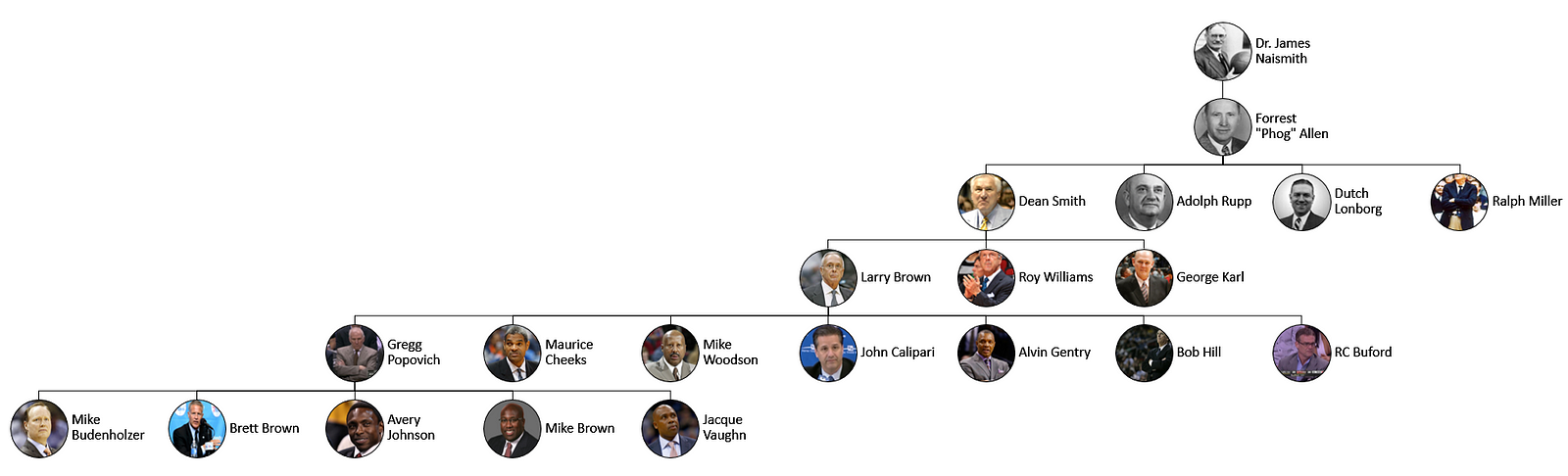 The coaching tree of Dr. James Naismith, the inventor of basketball
Any student of mentoring will recognize the name Fox Conner. His influence on the leaders of “The Greatest Generation” has been the subject of monographs, books, and countless articles. If you were to scribble Connor’s “mentoring tree” on the back of a napkin, it would probably look very similar to the “coaching tree” of Dr. James Naismith, whose influence on the sport of basketball is still visible today. Connor’s tree would likely feature the names of his early proteges, leaders such as George C. Marshall, Dwight D. Eisenhower, Omar Bradley, and George S. Patton. It would branch into subsequent generations and capture the incredible influence of a humble man whose subtle leadership defined how we view mentoring today.
GETTING THE GCC TO COOPERATE ON MISSILE DEFENSE
 This week President Obama convenes a summit with the leaders of the Gulf Cooperation Council, at which he will reportedly urge GCC members to move forward on missile defense cooperation. The range of cooperation under consideration consists of greater information and intelligence sharing, interoperability, additional foreign military sales on both a bilateral and cooperative basis, and joint operational planning. In the context of the P5+1 nuclear negotiations aimed at suspending or slowing Iran’s nuclear weapons program, the GCC would be wise to heed this advice — if only because many of them doubt the anticipated nuclear deal will go far enough in restraining Iran’s nuclear programs and other regional ambitions.
HOW TO TAKE OVER A SMALL COUNTRY IN 10 EASY STEPS
Sean McFate
May 13, 2015
 Mercenaries are back! After a three-century hiatus, sensible people are once again realizing that renting an army is cheaper than owning one: the United States in Iraq and Afghanistan, Putin in Ukraine and Syria, even Nigeria against Boko Haram. It’s boom time, boys! But why work for someone when you could be king? Countries are ripe for the plucking these days, from the Crimea to theGambia to large swaths of the Middle East. Just don’t be an amateur about it. Here are some tips to be a professional coup maker.
1. Choose your country. Select a country that has been consigned to the trash heap of history, preferably one without strong regional allies. The discerning mercenary looks for the following qualities in a potential selection: exploitable natural resources, corruptible and/or incompetent military, and at least one functional airstrip.
To facilitate recreational activities, make certain your target country has a good brewery, beautiful beaches, and women sans veils. Although this rules out central Africa, most of the Middle East, and some of Asia, you’ll have a much more enjoyable war with beer, bathing, and babes.
2016 National Defense Authorization Act: 4 Big Takeaways
Daniel R. DePetris
May 13, 2015
 Americans, including myself, often complain ad-nauseam that their elected representatives don’t do their jobs well, or at all. Instead, we tend to depict the 535 members of Congress as people who sit in their spacious offices, order interns to get them coffee or print out hundreds of pages of documents to be read by other interns, or use most of their time in office fundraising for their party, for their friends, or for themselves to get a head-start during the next election.
However, if these stereotypes hold the strength of law, they lose some of their luster, as when two weeks ago, the House Armed Services Committee engaged in a long and brutal 19-hour markup session of the Fiscal Year (FY) 2016 National Defense Authorization Act (NDAA). This bill is the most important legislation that the Armed Services Committees in both houses of Congress write and pass every year. The bill spells out what programs the Pentagon is authorized to conduct, what resources, installations, and weapons systems are available, and what investments the U.S. Armed Forces are required to make over the next year to remain at the top of their game. This year’s NDAA debate was no different.
Funding America's Nuclear Triad
Mackenzie Eaglen
May 13, 2015
 "The argument in favor of funding 'national assets' through defense-wide accounts is a convincing one, but only when applied to the military."
In a quiet but significant development in the annual defense policy bill recentlypassed by the House Armed Services Committee, the Navy strengthened its argument that its soon-to-be-built nuclear ballistic missile submarines are “national assets” that should not be paid for within the traditional shipbuilding budget.
This effort to increase money for the Navy and shipbuilding through back-door accounting is selfish, but smart, and should prompt a wider discussion about the looming modernization cost of America’s nuclear triad and the strategic wisdom of service funding parity. Rather than attempting to siphon off funds from within and among the joint force through the usage of unobligated funds in this special account, the services should argue for a topline increase to ensure a capable nuclear triad and a balanced future force.
National Asset Argument Increasingly Attractive as Pentagon Acquisition Squeeze Looms
14 May 2015
Interpreting Modispeak on China

May 14, 2015 : JABIN T. JACOB
 Indications are that Prime Minister Narendra Modi will not just push an economic agenda, but will also try and craft a strong politico-cultural plan during his visit.
Mr. Narendra Modi will make his first visit to China as Prime Minister from May 14 to 16. He is unique among Indian political leaders in possessing some significant experience of China before attaining office. In fact, despite — or perhaps because of — the differences in world views and how he has gone about understanding China, he is probably the first Prime Minister after Jawaharlal Nehru capable of shaping a unique approach to China. His forthcoming visit will be one of many such opportunities to do so.
The differences between the two Prime Ministers also show how both China and the Sino-Indian relationship have changed over time. For one, until the defeat of 1962, Mr. Nehru looked at China in anti-colonial and anti-imperialist solidarity and so, promoted communist China’s membership of international organisations and participation in international affairs. This is not to say that he did not understand the geopolitical challenges posed by another large country next door that had a length of history and greatness of civilization equal to that of India, a population of similar size, and, importantly, a different political ideology. But Mr. Nehru also believed that India and China had the potential to do much together to reshape the world.
When Nehru and Mao met
AMIT BARUAH : May 14, 2015
 The Mao-Nehru conversation of 1954 can remind present leaderships in the two countries that the founders of both nations had wished for a future where their mutual rise was a possibility
The autumn of 1954 is fascinating and a record of history for it was in this year that four-and-a-half hours of conversation, between Jawaharlal Nehru and Mao Zedong, revealed how two strong-willed leaders tried to make sense of the post-Second World War world.
The minutes of the three meetings, that were made public by the Chinese side ahead of the 60th anniversary of the Bandung conference, on April 18, present a compelling picture of two equals trying to analyse changing power equations between the great powers. In this, Mao candidly admits that China’s economic development was “lower” than that of India and it would take “ten to twenty” years for industrial development to achieve tangible results. The records are available at the Digital Archive of the Wilson Center, Washington DC, that provide unprecedented insights into the history of international relations and diplomacy.
Our Chinese complex
May 14, 2015
We can outthink China and the West, by exploring alternatives, creating diversities, inventing new margins in a way the Chinese elite and America cannot dream of
Prime Minister Narendra Modi’s trip to China has raised a whole array of anticipations and anxieties. As metaphor and presence, China for the last few decades has been problematic for India and, some would add, the idea of India. The subject has been reduced to a foreign policy problem and is analysed by security experts and foreign policy analysts; rarely do ordinary citizens respond to the issue. The question is, can an ordinary citizen bring a different perspective to it?
Let us begin with the current folklore. We are two large nations, two large landmasses, two of the oldest civilisations confronting each other. Today we are seen as the two largest markets in the world and futurists claim that this century belongs to India and China.
Our elite is less confident. It feels the world respects China more because it is more decisive, more demanding and more masculine. Every time we confront eye to eye, it is India that seems to blink and then go hysterical. The last time we felt superior was when Jawaharlal Nehru pretended to be the head of the non-aligned world, and the Chinese watched him with amusement.
The Nagas of India and Myanmar
May 14, 2015
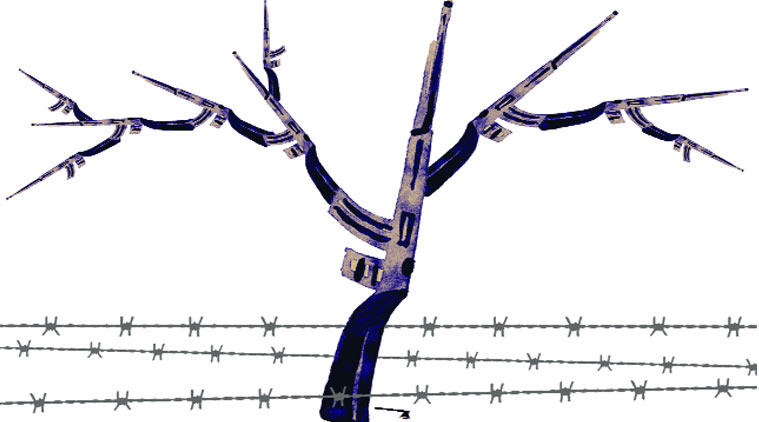 You can choose your friends, but not your neighbours” is a cliché that our decision-makers like to quote when referring to China. But if geography is destiny, it has lessons for our Myanmar policy as well. Myanmar presents what Samir Das calls a “frontier dilemma” for India’s Look East policy — now awkwardly renamed the “Act East” policy. Its goal may be to connect the Northeast to the “powerhouses” of Southeast Asia. But some of those places are far away. What lies next door to Northeast India is the poor, politically unstable and strife-torn region of Myanmar. To make matters worse, some of the ethno-territorial conflicts in western Myanmar and Northeast India are part of a single regional conflict complex.
Increasingly, the Indian approach to the Naga conflict is at odds with developments across the border. The ceasefire between the government of India and the S.S. Khaplang-led faction of the NSCN has unravelled and there have been attacks on Indian soldiers by NSCN-K militants.
A closer partnership
May 14, 2015
 The PM’s visit will build substantially on these agreements. Business deals worth another $20bn in infrastructure and manufacturing sectors are likely to be pledged.
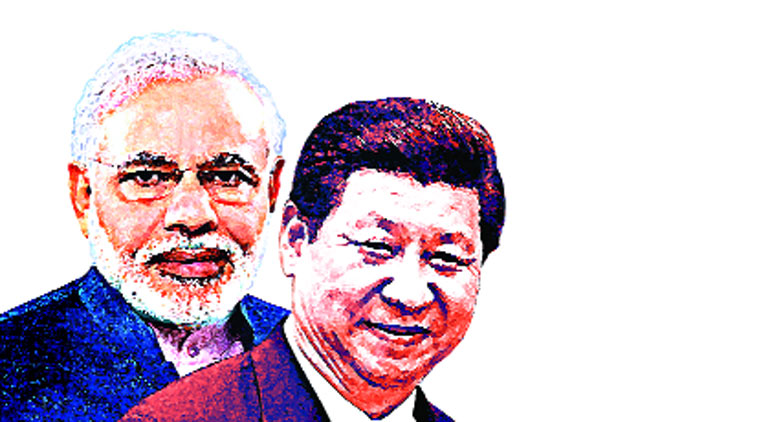
India and China have entered a new phase of their bilateral relationship as new leaders have assumed charge in both countries over the last two years. As Prime MinisterNarendra Modi travels to China, a definitive agenda for mutual economic engagement is being shaped, supporting the developmental aspirations of the two largest and fastest-growing emerging economies. Indian industry identifies multiple new opportunities arising from such a shift, and is acting quickly and strategically to leverage the emerging sectors of cooperation.
President Xi Jinping’s visit to India last September, during which the two countries signed up for a “closer developmental partnership”, promised commercial agreements worth about $20 billion. This is a big leap from the Chinese investment presence in India of less than $1bn between 2000 and February 2015. China would step into railways, sustainable urbanisation and industrial parks. There is interest in India’s high-speed rail project, railway station modernisation and the smart city initiative.
Wooing China, never mind the pinpricks
Sandeep Dikshit
May 14 2015
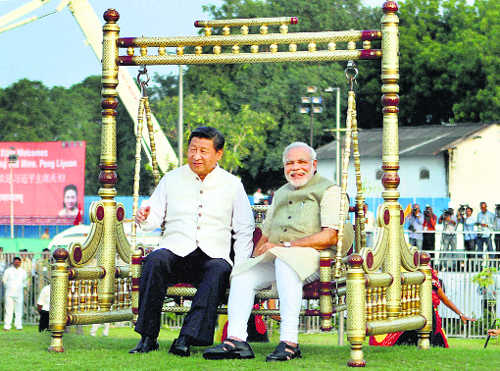 Prime Minister Narendra Modi has been unusually subdued and even accommodating towards China on strategic issues. A look at what’s on the anvil, in the runup to the PM’s visit to China, besides Mongolia and South Korea
THE high-profile Pakistan China Economic Corridor (PCEC) and a $46-billion development plan announced by Chinese President Xi Jinping last month extracted a few annoyed murmurs in contrast with earlier Indian fulmination when Beijing sought to restore a damaged trans-Himalayan connection with Islamabad via Pakistan Occupied Kashmir (PoK). India's virtual lack of response prompted a former Foreign Secretary, counted as among the hawks in the strategic community, to urge the Government to protest more strongly on China planning a permanent link to Pakistan via the disputed PoK.
A little earlier, Defence Minister Manohar Parrikar put the brakes on the previous United Progressive Alliance Government's plan to raise a special mountain corps to beef up defences against China. The raising of the China-centric 62 Mountain Strike Corps will be a decade-long process and there was no urgent requirement for Mr Parrikar to announce curtailing of such long- term plans, if only to keep alive the element of uncertainty or “strategic ambiguity”. But the signal to China about downsizing of the corps was distinctively non-adversarial.
What to expect from Modi's China visit
By Swaran Singh (chinadaily.com.cn)
2015-05-12
India's Prime Minister Narendra Modi listens to a speaker ahead of launching three new national social security schemes at a function in Kolkata May 9, 2015. [Photo/Agencies]
 The bonhomie on display between Chinese President Xi Jinping and Indian President Pranab Mukherjee, along with Russian President Vladimir Putin during the celebrations to mark the 70th anniversary of the victory of Allied forces over Nazi Germany in World War II provides an interesting backdrop for Indian Prime Minister Narendra Modi's visit to China from May 14 to 16.
For the first time, Russian soldiers marched with units of People's Liberation Army and Indian armed forces, which reflected that the Russia-China-India strategic triangle (all three countries are incidentally members of BRICS) has gained special significance in face of the Western boycott of the celebrations in Moscow.
India's foreign policy is known for continuity rather than change. Most formulations, therefore, still continue to be grounded in the Nehruvian paradigm (the policies followed by India's first prime minister Jawaharlal Nehru) seeking peace through dialogue and steering clear of military alliances. Modi did initially seek to make a major departure from the policy, but other than his accelerated pace of foreign visits there has been no change in its content. India's power elite continues to agree that India needs to seek a fruitful engagement with China and is willing to play the role of a partner.
Xi Jinping’s brotherly love for Pakistan
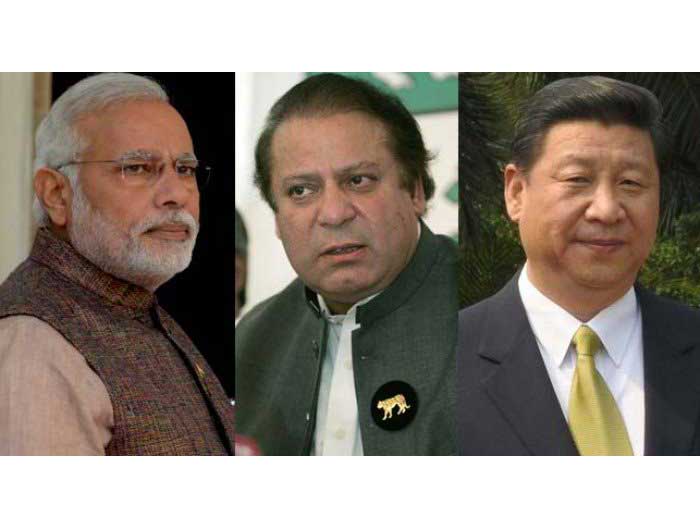
13 May , 2015
As Prime Minister is preparing to pay his maiden visit to Beijing (as Prime Minister), it necessary to come back on another visit, President Xi Jinping’s trip to Pakistan and the enormity of the ‘gifts’ that Chinese President brought in his luggage as he landed in Islamabad.
“Xi arrived in Islamabad bearing real gifts: an eye-popping $46 billion worth of planned energy and infrastructure investment to boost Pakistan’s flagging economy. This would include adding some 10,400 megawatts to Pakistan’s national grid through coal, nuclear and renewable energy projects.”
This sounds like a Chinese Dream for Islamabad!
Beijing has decided to help Pakistan to develop a China-Pakistan Economic Corridor which will eventually link up its pet project, the two New Silks Roads (also known as ‘One Belt, One Road’).
In other words, the Chinese-sponsored port of Gwadar on the Arabian Sea will be connected through the Karakoram Highway, to the Xinjiang province in China’s Far West and Central Asia …and later Middle East, Africa and Europe.
SY HERSH’S BIN LADEN STORY FIRST REPORTED IN 2011 — WITH SEEMINGLY DIFFERENT SOURCES
 R.J. Hillhouse, a former professor, Fulbright fellow and novelist whose writing on intelligence and military outsourcing has appeared in theWashington Post and New York Times, made the same main assertions in 2011 about the death of Osama bin Laden as Seymour Hersh’s new story in the London Review of Books — apparently based on different sources than those used by Hersh.
Bin Laden was killed by Navy SEALs on May 2, 2011. Three months later, on August 7, Hillhouse posted a story on her blog “The Spy Who Billed Me” stating that (1) the U.S. did not learn about bin Laden’s location from tracking an al Qaeda courier, but from a member of the Pakistani intelligence service who wanted to collect the $25 million reward the U.S. had offered for bin Laden; (2) Saudi Arabia was paying Pakistan to keep bin Laden under the equivalent of house arrest; (3) Pakistan was pressured by the U.S. to stand down its military to allow the U.S. raid to proceed unhindered; and (4) the U.S. had planned to claim that bin Laden had been killed in a drone strike in the border regions of Afghanistan and Pakistan, but was forced to abandon this when one of the Navy SEAL helicopters crashed.
Hersh’s article makes the same key claims about the bin Laden raid, with this description of his sources:
Nepal’s Recent Quakes Don’t Mean a Bigger One Isn’t Coming
A house in Sankhu, Nepal house that was already severely damaged in the April 25th earthquake, shakes as a new 7.4-magnitude earthquake hits on May 12, 2015.

Nepal and the rest of the Himalayan region suffered another major earthquake today—a 7.3 magnitude quake that struck about halfway between Kathmandu and Mt. Everest, near the Chinese border. Early reports estimate that up to 1,000 people are injured, and at least 68 have been killed in both Nepal and India.
The region, especially urban areas like Kathmandu and Chautara, had already been reeling from the devastation wrought by the 7.8 magnitude event that hit the country on April 25 and killed over 8,000 people. Hundreds of aftershocks—some as strong as 6.7 magnitude—have continued to hamper relief efforts and keep residents in a panicked state.
This latest quake, however, is not an aftershock, but a brand new seismic event. According to the United States Geological Survey, today’s earthquake occurred 9.3 miles deep in the earth’s crust—the same depth as the April event. Cities and villages in the area have already felt six aftershocks, and the new quake created a whole new wave of landslides further north in the Himalayan mountains.
Is It Time to Meet China Halfway?
May 12, 2015
Book Excerpt: An important new work offers important ideas on how to difuse the emerging U.S.-China rivalry.
 Editors Note: The following is the introductory chapter from frequent TNI contributor Lyle Goldstein's new book Meeting China Halfway: How to Defuse the Emerging U.S.-China Rivalry. Copyright 2015 Georgetown University Press. Reprinted with permission. www.press.georgetown.edu.
Dr. Goldstein is the author of TNI's occasional essay series "Dragoneye" which seeks insight and analysis from Chinese writings on world affairs. You can read all essays from the series here.
Reversing the Escalation Spiral: More than six decades have now passed since young Lieutenant John Yancey of the Seventh Marine Infantry Regiment watched half his platoon mowed down by Chinese bullets on an obscure ridge in Northeast Asia. He turned to his surviving men and said: “Stand fast and die like Marines.” More than one thousand fellow Americans would perish in the frozen onslaught of the Chosin Reservoir campaign in late 1950. That battle was not supposed to happen. Two weeks earlier, Far East commander General Douglas MacArthur had assured President Harry Truman in a face-to-face meeting on Wake Island that the chance of Chinese military intervention in the Korean War was “very small,” despite high-level warnings from Beijing that US forces crossing the 38th Parallel represented a “menace to the security of China.”1
Through Beijing's Eyes: How China Sees the U.S.-Japan Alliance
May 12, 2015

Yet another attempt to contain China, or a sincere partnership?
For Americans, Japanese prime minister Shinzo Abe’s visit to the United States was a proud reminder of what can be achieved through the advancement of common interests and universal values. The story has the making of a Hollywood film: once bitter adversaries, Japan and the United States have worked together to build an alliance and global partnership that has stood the test of time. On April 28, after fifty-five years of bilateral defense cooperation, the United States and Japan agreed to revise their defense guidelines to further integrate military operations and cooperation on activities ranging from peacekeeping to intelligence collection.
From China’s perspective, rather than demonstrating the power of reconciliation, the revision of the U.S.-Japan defense guidelines “is a worry for all nations with direct experience of these countries’ previous overseas military escapades.” Once seen as a valued restraint that checked Japan’s ambitions for regional hegemony, the U.S.-Japan alliance is now viewed as a threat. Chinese president Xi Jinping has gone beyond mere calls, such as were made by his predecessor, for the elimination of such alliances in the Asia-Pacific to proposethe establishment of a new regional security architecture that transcends “the outdated thinking from the age of Cold War and zero-sum game.”
The Life of Chinese Soldiers in the Spratlys
May 12, 2015
An article by China’s state news service highlights the soldiers on guard in the South China Sea.
 A China News Service piece republished by several Chinese media outlets gives a rare glimpse into the “bittersweet” lives of Chinese soldiers stationed on various outposts in the Spratlys. The piece includes photographs of Chinese soldiers on patrol on Fiery Cross Reef and participating in drills on Johnson South Reef.
According to the article, soldiers rise at 6 a.m. and spend their days doing firearms training and island defense drills. At night, they take shifts standing guard. Their task is made harder by “unidentified vessels” that sometimes come close to “harass” the reefs. During such times, soldiers might go several days without adequate rest.
The article highlights the bravery of China’s Spratlys soldiers in the face of harsh conditions — heat (sometimes in excess of 60 degrees centigrade), humidity, and even frequent typhoons. Plus, the soldiers face immense “psychological pressure,” particularly the loneliness that comes from being stationed in the middle of the ocean, hundreds of miles away from their families. During Spring Festival, when other Chinese are heading home, the soldiers stage plays and performances in the Spratlys to celebrate the lunar new year.
And yet despite the hardship, the piece claims, soldiers request this garrison duty, even when they have a chance to transfer away from the South China Sea. One solider even said that he will come back to guard the Spratlys if he is reincarnated as a soldier in the next life.
Can China and the EU Cooperate on International Security?
By Greg Austin
May 12, 2015
There is ample room for Brussels to deepen the conversation with Beijing on security goals of mutual interest.
 EU foreign policy chief, Federica Mogherini, was in China last week discussing possible joint actions in international security. Past cooperation in piracy operations off the Somalian coast and in various international peace initiatives provides a solid basis, as does cooperation in combating climate change. There has even been a reasonable degree of contact on countering terrorism and cyber crime.
The day after Mogherini left China, the country’s National People’s Congress released the second draft of a new law that is China’s first attempt to provide a legal basis for an overall approach to internal security. The law, which upholds the ruling position of the Communist Party as well as laying out division of administrative responsibilities in maintaining that political and social order, should give the EU some pause for thought on just how far any joint actions might go. The authoritarian elements of the draft law are a useful reminder of why the EU maintains an arms sales ban on China first imposed in 1989 in response to the Tian An Men Square repressions.
1 Year Later: Reflections on China's Oil Rig 'Sovereignty-Making' in the South China Sea
What is the long-term significance of China’s decision to move an oil rig into Vietnam’s exclusive economic zone in May 2014?
 One year ago, China’s state-owned China National Offshore Oil Company (CNOOC) moved an exploratory oil rig, Haiyang Shiyou 981 (HD-981), worth an estimated $1 billion, into waters within Vietnam’s exclusive economic zone. The incident sparked a major bilateral crisis between the two countries—both of whom claim the disputed Paracel Islands. In hindsight, the event marked the start of China’s attempts to change the status quo in the South China Sea by committing its civilian and non-military assets to disputed areas.
The timeline of the HD-981 stand-off was recently featured in the U.S. Department of Defense’s 2015 report on China’s military. On May 3, 2014, Hainan province’s Maritime Safety Administration declared that the oil rig would begin drilling operations off the disputed Paracel Islands, ending in August that year. The next day, Vietnam’s government protested the Chinese announcement. China declared a 3 nautical mile security radius around the oil rig, far exceeding the 500 meter safety zone state parties to the United Nations Convention on the Law of the Sea are entitled to under that treaty.
Q and A on New Pentagon Report on the Chinese Military
Michael Forsythe
May 11, 2015
Q. and A.: Andrew S. Erickson on China’s Military Goals and Capabilities
Every year, the United States Department of Defense must submit a report to Congress — a classified version and an unclassified one — on “military and security developments involving the People’s Republic of China.” This year’s 89-page unclassified report, released last week, analyzes China’s evolving military goals and strategies and new developments in its naval, air and ground capabilities.
The report regularly draws an official rebuke from China, and this year was no exception. A spokeswoman for the Ministry of Foreign Affairs, Hua Chunying, saidon Sunday that the United States should “abandon its Cold War mind-set, take off its colored glasses and have an objective and rational understanding of China’s military development.”
In an interview, Andrew S. Erickson, an associate professor at the United States Naval War College and a scholar affiliated with Harvard University’s John King Fairbank Center for Chinese Studies, discussed the report, Beijing’s ambitions and the chances that China will close the military power gap with the United States:
China’s (Not So Scary) Drone Army
May 11, 2015

WASHINGTON: How many drones is Beijing building? Relying on unidentified “estimates,” the Pentagon’s latest Chinese Military Power report says “China plans to produce upwards of 41,800 land- and sea-based unmanned systems, worth about $10.5 billion, between 2014 and 2023,” including armed and stealthy unmanned aircraft. (More on the report here). That sentence gave rise to at least one story about China’s robotic “army.” But all drones are not created equal, experts from the tech-savvy Center for a New American Security reminded me this afternoon.
“It’s not like the sky is falling, but it would suggest a future where China will have better situational awareness over its surrounding regions,” said Paul Scharre, director of the future-looking 20YY Warfare Initiative at CNAS.
Pentagon Reports On China’s Satellite Killers
May 11, 2015
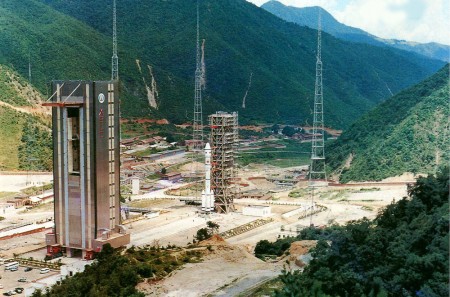
Chinese space launch facility
 WASHINGON: From space weapons to armed drones, Chinese technology is accelerating into worrying new arenas, warns the Pentagon’s annual report on Chinese military power. But that doesn’t mean China is overtaking the US, a leading space expert cautioned, and a panicked over-reaction could drive bad policy.
“Perhaps the most worrying part of the report from a US perspective is the section talking about Chinese counterspace capabilities,” said Brian Weeden, the Secure World Foundation‘s technical advisor. “The tough question is what to do, [and] some of thepotential options could make the situation worse instead of better.”
The report discusses three apparent tests of Chinese anti-satellite systems (ASAT), not just the well-known two. Everyone knows about China’s 2007 test when it destroyed its own defunct satellite, scattering debris that continues to orbit the planet and threaten space assets of every country. A fair number of people know that in 2014, China conducted what the Pentagon called a “successful” test of the same system, albeit without actually destroying a target, to everyone’s relief.
Seven Reasons China Will Start a War By 2017
April 30, 2015
Very few people in China believe in communism anymore, including almost all of the 80 million members of the Chinese Communist Party. The party itself is now a club for mutual enrichment. The legitimacy of the party ruling China is derived from the notions that democracy does not suit China and that the party is the organisation best placed to run the country. The latter is based on an ongoing improvement in conditions for the bulk of the population. In the absence of economic improvement, some other reason must be found for the population to rally around the party’s leadership. This may explain the sudden base-building that started in the Spratly Islands in October 2014.
China’s public debt grew from US$7 trillion in 2007 to US$28 trillion in 2014. This is on an economy of US$10 trillion per annum. A high proportion of the economic growth of the last seven years is simply construction funded by debt. The real economy is much smaller.
The Chinese government is likely to see the contracting economy and realise that issuing more debt won’t have an effect on sustaining economic activity. Thus the base-building was accelerated to allow the option of starting their war. This is a life and death matter for the elite running the party. They are betting the farm on this. If this gamble does not work out then there is likely to be a messy regime change.
Chosen Trauma
Japan treated the Chinese as sub-humans during World War 2. Before that, Japan starting mistreating China by attacking it in 1895, not long after they started industrializing themselves. That was followed by Japan’s 21 demands on the Chinese state in 1915. The Nationalist government in China started observing National Humiliation Day in the 1920s. Then followed the Mukden Incident of 1931 and China’s start to World War 2 in 1937.
KILL IBRAHIM? THE PROS AND CONS OF TARGETING ISIL’S LEADERSHIP
 For the third time in the last six months, reports are emerging from Iraq that Abu Bakr al-Baghdadi, the self-proclaimed caliph and leader of the Islamic State in Iraq and the Levant (ISIL) has narrowly survived a U.S. airstrike. The Guardian recently reportedal-Baghdadi was severely wounded in a March airstrike in the al-Baaj district of Nineveh province near the Syria-Iraq border. While details are sparse — Martin Chulov has subsequently reported that al-Baghdadi suffered spinal damage — al-Baghdadi’s condition was allegedly critical enough to prompt frantic meetings by senior ISIL officials who appointed a stand-in leader while al-Baghdadi is incapacitated.
There is cause to be skeptical of this development. In addition to the previous inaccurate accounts of al-Baghdadi being injured in November and December, Iraqi officials reported his predecessors — Abu Omar al-Baghdadi and Abu Ayub al-Masri — as having been killed numerous times prior to their actual demise in April 2010. Even more implausibly, the Iranian news agency FARS has reported that Abu Bakr al-Baghdadi died while receiving treatment in an Israeli hospital. Meanwhile, defense officials toldThe Daily Beast that the March 18 air strike was not aimed at a high-value target and that they “have no reason to believe it was Baghdadi.”
Zakaria: How ISIS shook the world
May 8, 2015
 Documents show how ISIS functions as a government 7 photos
A schedule for final exams at the Mosul College of Medicine shows areas to be tested included students' knowledge of obstetrics, parasites, X-rays and ethics.
Documents show how ISIS functions as a government 7 photos
This notice criticizes the greed of some fishermen and lays out new rules, including no fishing during spawning season and no use of electrical current to catch fish, as it harms other creatures, too.
Documents show how ISIS functions as a government 7 photos
The Confused Person's Guide to Yemen
KARL SHARRO
MAY 11, 2015
It’s simply a Saudi-Iranian-American-Yemeni-al-Qaeda civil/proxy war.

“What the hell is happening in Yemen?” is now one of the most urgent geopolitical questions in the Middle East. Sadly, few people are qualified or knowledgeable enough to answer this pressing question. Most experts agree that most experts can’t give you a straight answer. The reality is Yemen is a complex place that is very hard to understand for outsiders, and even more so for insiders. Indeed, most of the people asking what is happening in Yemen are Yemenis themselves.
Now I am not an expert on Yemen. But being Lebanese, I am an expert on not knowing what is happening in my country, which gives me valuable insight into the situation in Yemen. I have therefore compiled this essential primer for understanding the current conflict in Yemen and what will happen there next. (Experts also agree that anything is possible there next, which narrows things down.)
Syria's Mercenaries: The Afghans Fighting Assad's War
By Christoph Reuter

Syrian dictator Bashar Assad is running out of soldiers and is forced to rely on mercenaries in his ongoing battle against rebels. Many of his foreign fighters come from Afghanistan -- men like Murad, who is now being held in Aleppo as a prisoner-of-war.
His war only lasted from one dawn to the next. When the sun rose for the second time over the Syrian city of Aleppo, Murad, a farmer from Afghanistan, was still cowering on the second floor of the house he was supposed to defend to the death. That, at least, is what his Iranian officer had ordered him to do.
How, though, did he get to this war-torn city far away from his village in the mountains of Afghanistan? All he had wanted was an Iranian residence permit, he says. But at the end of his trip, he found himself fighting as a mercenary in the Syrian civil war on the side of the Bashar Assad regime.On that morning in Aleppo, Murad didn't know how many from his unit were still alive, nor did he know where he was or who he was fighting against. His four magazines had been empty for hours. When a violent explosion caused the house he was in to collapse, he found himself thinking about his daughters, he says. "I screamed and thought I was suffocating. And then, everything around me was quiet."
How IS uses water as weapon of war
Author Walaa Hussein
May 11, 2015
Peshmerga fighters stand guard at the Mosul Dam in northern Iraq, Aug. 21, 2014.
 CAIRO — The Middle East is facing a water crisis. As the region experiences conflicts over water and faces the continuous risk of war breaking out, experts on water predict that the Islamic State (IS) aims to exacerbate this water crisis, as evidenced by its efforts to seize rivers and dams in Syria and Iraq, starting in 2013.
Summary⎙ Print The Islamic State's expanding control over the water resources of the Middle East will only compound the region's water crisis.
The Arab League has worked since 2008 to establish a new Arab convention on water usage, which would establish parameters on how to deal with the water crisis. However, the final draft is still under review because of the reservations of some member states.
Subscribe to:
Posts (Atom)