26 July 2015

Super Humans and Killer Robots: How the US Army Envisions Warfare in 2050

July 24, 2015
Source Link

A new breed of super humans and autonomous combat robots will be two of the key features of the battlefield in 2050, according to a new report summarizing the findings of a U.S. Army-sponsored workshop.
The workshop, held in March 2015 in Maryland, brought together a diverse group of experts to envision the 2050 tactical ground battlefield. Their conclusion: humans will be in the minority on the modern battleground:

A time traveler from today would be immediately taken with the “over-crowding” of the battlefield of 2050 populated by all manner of robots, robots that greatly outnumber human fighters, and robot-looking humans.

In detail, the report lists seven specific capabilities that will shape future land warfare: augmented humans; automated decision making and autonomous processes; misinformation as a weapon; micro-targeting; large-scale self-organization and collective decision making; cognitive modeling of the opponent; and the ability to understand and cope in a contested, imperfect information environment.

Why Did North Korea's Defense Minister Vanish?

This article was first published at 38 North, a blog of the U.S.-Korea Institute at Johns Hopkins SAIS. It is republished with kind permission.
Kim Jong-un dismissed Hyon Yong-chol as North Korea’s minister of defense around April 30, 2015—this much we know, but little else about his fate is certain. South Korean intelligence reported the following month that the regime executed Hyon, but in truth, it remains unclear today if he is dead or alive.

If South Korean intelligence is correct, Hyon’s death would mark a grisly end to an illustrious military career and feed into Seoul’s narrative of a bloody wave of purges carried out by Kim Jong-un.

But a number of signs suggest that the ROK government’s report of Hyon’s death is premature. North Korea has so far revealed no direct or circumstantial evidence to support the ROK National Intelligence Service (NIS) allegation, and the South Korean agency’s past record does little to inspire confidence. Moreover, no one outside Kim’s inner circle knows what prompted Hyon’s ouster, casting doubt on whether his presumed misstep justified the execution of a 66-year-old regime stalwart.

Great Expectations During Japan Military Chief's US Visit

Between July 12-19, Admiral Katsutoshi Kawano, the Japan Self-Defense Forces’ (JSDF) chief of Joint Staff, visited the United States at the official invitation of his U.S. counterpart, General Martin E. Dempsey, chairman of the Joint Chiefs of Staff. During his stay, he visited U.S. Strategic Command (STRACTOM), Central Command (CENTCOM), Special Operation Command (SOCOM), and Camp Lejune prior his arrival in Washington DC.

Most notable, however, was Kawano’s D.C. itinerary. In addition to his meeting with General Dempsey and a speech at the Center for Strategic and International Studies (CSIS), a major think tank in Washington, he also had a series of high-level meetings with other high-ranking officials, including Vice President Joseph Biden, Deputy Secretary of State Anthony Blinken, and Deputy Secretary of Defense Robert Work. In fact, Kawano became the first Japanese chief of Joint Staff to meet with the vice president of the United States.

The American Military's Worst Nightmare: The Fog of War Reborn


For a work of fiction, Ghost Fleet: A Novel of the Next World War by PW Singer and August Cole has been receiving more attention than usual from the defense analyst community. 

It's attention for all the right reasons. Clearly inspired by Tom Clancy's classicRed Storm Rising, Ghost Fleet does an able job explaining why Russia and China would enter a war with the U.S. in the Pacific. Reading the first half of the novel will feel like reading a fictionalized version of a future trends report: nuclear terrorism, growing resource demands, financial crisis and major technological shifts all inter-play to realign the geopolitical scenery.

The action is frenetic and truly global in scope (there are space pirates), although compared to Red Storm Rising I feel the technical detail and military jargon, which made that novel feel so engrossing, is missing here. Also, in a war between the U.S. and China in the Pacific, it is odd that South Korea and the 28,000 US troops stationed there are never mentioned. This is a lost opportunity to explore the military choices of a country in a particularly difficult situation.

The nuclear escalation scenario between the U.S. and China is also rather meekly explained away. At one point, as Chinese ballistic missiles are raining down on a U.S. naval task force, the co-pilot of a US Navy P-8 asks the pilot if he thinks they contain nuclear warheads. The pilot replies, “Nope. If it was a nuke, they'd only send one.” Yeah, maybe. But probably not, if the Chinese think the U.S. Navy's air defenses can handle a single ballistic missile.

Does the F-35 Have a Fatal Flaw?


I read Australian MP Dennis Jensen’s article ‘Time to remember the Vietnam air war lesson’ in yesterday’s West Australian with interest. In essence, Dr. Jensen paraphrases the US Air Force experience in Vietnam as placing too high an emphasis on the technological promise of air-to-air missiles in the early stages, only to be brutally dragged back to the ‘fundamentals’ of close-in air combat in the form of maneuverability and bringing a gun to the fight.

Taken at face value, that narrative seems to suggest that the design of the F-35 Joint Strike Fighter is badly conceived, and that it ignores a vital lesson from history. If that analysis were true, it would indeed be a damning indictment on an aircraft Australia is about to spend well over $10 billion on. But there are two reasons to doubt Dr. Jensen’s conclusion. The first is that it’s not at all clear why a technological lesson from over 40 years ago tells us what to expect today. A look at pretty much any other modern electronics-based system compared to its ancestor from that time shows why. It’s a bit like studying copper wire telephony and drawing conclusions about the capabilities of smart phones.

A 5-Step Plan for a New Indian Maritime Strategy

July 23, 2015

Whither Indian maritime strategy? New Delhi reportedly wants to fit out a200-ship navy by 2027, centered on aircraft-carrier task forces, a mix of conventional and nuclear-powered submarines, and missile-toting aircraft and surface combatants. That’s up from 124 by my tally. What will India do with a navy whose numbers mushroom by over 60 percent in a dozen years?
It’s a fair and indeed vital question to ask. India would be far from the first seagoing nation to build ships for shipbuilding’s sake. Now, it’s important to preface any foray into naval matters with a caveat, namely that it’s crucial not to get transfixed by brute numbers of hulls. Big round numbers exert a particularly potent allure—witness America’s bid for a 600-ship U.S. Navyduring the 1980s, and its struggle to maintain a 300-ship navy today.

Anyway. Estimating the combat punch of a 200-ship Indian Navy requires observers to ask: which 200 ships is the navy procuring? After all, an unarmed tanker counts the same as a flattop in bean-counting terms. They’re both hulls—even though one of these things avowedly is not like the other.

El Chapo’s Escape from Prison: Good for Mexico?


"By translating this unfortunate episode into significant changes in the way the current administration carries out its rule of law and security policies...the Mexican government can snatch victory from the jaws of defeat."

“That risk does not exist” brazenly stated Jesus Murillo Karam, Mexico’s former Attorney General, when quizzed on the possibility of El Chapo Guzman escaping once again from the maximum-security prison where he was incarcerated. At the time of his second arrest in February 2014, Guzman’s 2001 spectacular jailbreak in a laundry cart naturally had everyone asking: “Will he do it again?”

Only 16 months after being apprehended for the second time, the most visible leader of the Sinaloa cartel, Joaquin “El Chapo” Guzman Loera, found his way back to freedom. His finely designed escape has been labeled an “egg to the face,” and “the biggest embarrassment” for Mexican authorities, and, particularly, for Enrique Peรฑa Nieto’s presidency. Guzman’s 2014 arrest was largely portrayed as “crowning” Peรฑa Nieto’s anti-organized crime efforts, with the president himself stating at the time that another El Chapo prison break “would be more than regrettable; it would be unforgivable.”

THE LEGACY OF SREBRENICA, AMERICA’S GENERALS, AND MULTILATERAL HUMANITARIAN INTERVENTION


This summer marks the 20th anniversary of the massacre at Srebrenica. Between July 9 and July 20, 1995, Serb forces killed almost 8,000 Muslims in this Bosnian town while UN peacekeepers stood idly by. The United States, unable to persuade its western European allies to support coercive airstrikes, had hitherto refused to intervene decisively in the conflict tearing apart the Balkans. That changed after Srebrenica, which was the worst atrocity committed in Europe since World War II. As George Packer wrote in the run-up to the 2003 invasion of Iraq, the war in Bosnia-Herzegovina turned many liberals into interventionist hawks. The main lesson these liberals took away from Bosnia was that the United States should never again “hide behind dithering allies or a weak U.N.” and instead take decisive action to fight ethnic cleansing and genocide, acting unilaterally where necessary. Why, then, has the United States continued to crave multilateral approval from the United Nations or NATO for humanitarian military interventions?

25 July 2015

Kargil: Pakistan’s dastardly misadventure


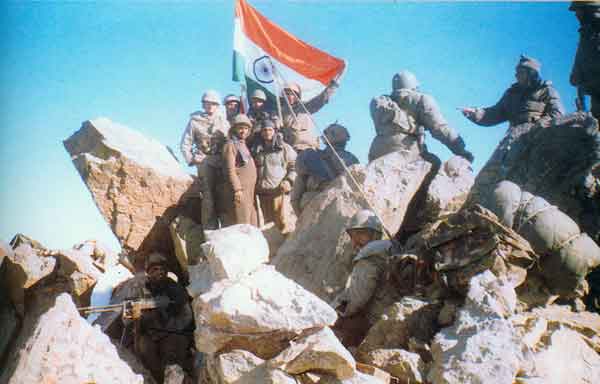
Sixteen years have elapsed since the fateful day, 26 July 1999, when India emerged victorious in the Kargil war. The ignominious designs of a belligerent neighbour (Pakistan) to violate the territorial integrity of the nation were thwarted by a military action that has no parallel in the annals of military history.

On the sixteenth anniversary of the war, it would be appropriate to revisit the treachery, duplicity and deceit that went into the planning and execution of the war by Pakistan.

On this day, the brave soldiers of the Indian Army, fighting against insurmountable odds, successfully restored a situation that had the potential of escalating into a nuclear holocaust.

The situation was contained by orchestrating a mature and restrained response that won international acclaim and gave India, not only a military victory, but also a moral ascendancy over Pakistan.

Permanent Chairman COSC – cementing Parkinson’s in defence

By Lt Gen Prakash Katoch
24 Jul , 2015

Media reports that the proposal to create the new post of a Permanent Chairman of the Chiefs of Staff Committee (COSC) is at “an advanced stage of planning” now, albeit this has to be ultimately approved by the Union Cabinet since “the issues involved are very complex”. Reminds one of the OROP issue being at an ‘advanced stage’ and the time being taken to arrive at the endemic inter-ministerial wrangling despite the definition of OROP having been accepted by two Parliaments in the past and the Indian Railways, as large as the Indian Army, availing past several years the benefit of future increases after initial fixation of pension automatically passed on to past pensioners so as to bridge the gap between the rate of pension of the current pensioners and the past pensioners, even though the nomenclature of OROP is not used.

…the military has been kept away from the strategic planning on matters military. This is why despite hosts of defence scams, no MoD bureaucrat has ever been questioned leave aside prosecuted.

IAF defeated PAF in 1965 War

By Air Vice Marshal AK Tiwary
Issue: Vol 22.1 Jan - Mar 2007 Date : 24 Jul , 2015

After few sorties by the IAF against East Pakistan on 7 Sept a political embargo was imposed on further attacks in the East. This remained in force despite continued PAF strikes in East on 7 Sept, 10 Sept and 14 Sept.

“The performance of the Army did not match that of the PAF (Pakistani Air Force) mainly because the leadership was not as professional. They had planned the ‘Operation Gibralter’ (infiltration into J&K) for self glory rather than in the national interest. It was a wrong war. And they misled the nation with a big lie that India rather than Pakistan had provoked the war and that we were the victim of Indian aggression.”

Air Marshal (Retd) Nur Khan quoted in ‘Dawn’ – Karachi. 6 Sep, 2005

It took 40 years for Air Marshal (Retd) Nur Khan – Chief of the PAF during 1965 war to state the truth about the genesis of 1965 war.

“Since the 1965 adventure, Pakistan’s generals have maintained a Standard Operating Procedure (SOP) in public relations about military matters.” According to this virtual SOP, “The Pakistani military wins every war it fights and Pakistan’s generals make no mistakes. Any blame for failure lies either with civilians or the Americans”.

The Pakistan Paradox

http://www.strategypage.com/htmw/htlead/articles/20150723.aspx

July 23, 2015: In mid-2015 Pakistan announced a new defense budget (for the year beginning July 1st) that would be (at $7.8 billion) 11 percent higher than the current budget. Neighboring India spends over $40 billion a year on Defense. But in one area Pakistan surpasses India and that is the degree to which corruption is involved with defense matters. The most unpopular form of corruption is defense related spending that is not even part of the defense budget. A lot of this money disappears into foreign bank accountsand is considered a fringe benefit by senior officers and civilian defense officials. Another major source of corruption is procurement. India is making progress in reducing this form of waste and theft but in Pakistan journalists still risk death going public with details about this sort of thing that is alive and thriving there.

In 2013 Pakistan increased its defense budget by 15 percent (to $6.4 billion). There have been similar increases since 2010. While Pakistan has always increased its defense spending every year, to try and keep up with archrival India, it rarely goes up enough to be a real threat to India. These recent record increases are largely due to U.S. aid (over $40 billion since 2002) and economic incentives (allowing Pakistani goods into the U.S. at lower customs duties). Before 2001 Pakistan was really struggling to scrounge up the cash to keep its armed forces going. The increases since 2010 have mostly been due to the war against the Taliban in the tribal territories and the expense of dealing with Islamic terrorism in general. This war was a self-inflicted problem as Pakistan created the Taliban in the early 1990s and had begun sponsoring Islamic terrorists in the late 1970s. Many of these Islamic militant groups turned on Pakistan when American told Pakistan, after September 11, 2001, to either become an ally in the war against Islamic terrorists or be considered an enemy. It was an offer Pakistan could not refuse but there were expensive consequences. Thus Pakistan complains that American aid is not sufficient to pay for what it costs Pakistan to fight the Islamic terrorists it created. The U.S. suggests that Pakistan take responsibility for what it did to foster Islamic terrorism but Pakistan refuses to admit any fault in this matter.

Thailand: The Chinese Threat


July 22, 2015: The Islamic terrorist campaign in the south has been going on since 2004, leaving 6,400 dead and 11,000 wounded. Efforts to negotiate an end to the violence have failed so far because of disagreements among the many factions (separatists, Islamic terrorists, gangsters) making the violence possible. Because there is nothing to show for all the violence but a lot of dead and maimed civilians and an obvious impediment (all the violence) to badly needed economic growth some officials fear the attacks may go national. Local security officials point out that this is unlikely as there are not many active Islamic terrorists causing all the violence and most of these (at least according to those captured and seized documents) justify their actions as “defending their homeland” (the three largely Moslem southern provinces) and depend on some local support to keep at it. Attacks outside the south would be more difficult to carry out as the southerners look and sound differently and would be easier to spot. Moreover the Islamic terrorists would lose even more popular support in the south, where their violence has been increasingly unpopular, even though the Islamic terrorists have tried lately, with some success, to avoid hurting civilians. The continued attacks have made the economic situation worse, despite government efforts to spend more on developing the economy down there. The money is largely wasted as long as the violence persists and the local civilians know it and blame the Islamic terrorists.

China Though CIA Was Using Macau Casinos to Entrap Corrupt Chinese Government Officials

Chris McGreal, with Lowell Bergman and Zachary Staufer
July 23, 2015

China feared CIA worked with Sheldon Adelson’s Macau casinos to snare officials 

China feared that casinos in Macau owned by the billionaire gambling magnate and Republican party funder Sheldon Adelson were used by US intelligence agents to entrap and blackmail Chinese officials, according to a “highly confidential” report for the gambling industry.

CIA allegedly worked with Macau casinos to spy on China: read the report

The report, by a private investigator in 2010, said that Beijing believed US-owned establishments in the former Portuguese colony were working in league with theCIA.

“Many of the (Chinese) officials we contacted were of the view that US intelligence agencies are very active in Macao and that they have penetrated and utilised the US casinos to support their operations,” it said.

Assembly of Chinese AG-600 commences

22nd July 2015

Assembly of the first AG-600 amphibious aircraft is on track for completion by the end of 2015 ahead of its maiden flight in the first half of next year.

With assembly officially commencing on 17 July, several subsidiaries of the Aviation Industry Corporation of China (AVIC) have also assisted in the construction of the world's largest amphibious aircraft. In late April, the 17.5m long mid/aft fuselage came off the assembly line of the Hanhong Aircraft Company.

Developer of the AG-600, the China Aviation Industry General Aircraft Company (CAIGA) describes the aircraft as a fire-fighting and water rescue craft but analysts consider it likely to fulfil a military role too. It is believed the People’s Liberation Army Navy (PLAN) currently does not operate any amphibious aircraft since the decommissioning of its Harbin SH-5 craft.

With China embroiled in territorial disputes in the South China Sea as well as with numerous island reclamation projects an amphibious aircraft would offer the PLAN great utility in terms of maritime patrol and territorial enforcement. China is constructing an airstrip on Fiery Cross Reef, but the AG-600 could readily service other islets and facilities where no airstrip is available.

China debuts Zubr LCAC in show of amphibious force in South China Sea

Ridzwan Rahmat
21 July 2015
Source Link

Images from Chinese state television show what is said to be the Zubr-class LCAC's debut in an amphibious landing drill. Source: Chinese state television.

The People's Liberation Army Navy (PLAN) featured one of its Zubr-class landing craft air cushion (LCAC) for the first time in an amphibious landing exercise, Chinese state television CCTV reported on 20 July.

IHS Jane's understands that the drill was conducted on Hainan Island, which is in the South China Sea and the main location for the PLAN's South Sea Fleet bases.

While it is not clear whether it was from the same exercise, other CCTV footage shows the LCAC being transported and unloaded from the PLAN's new semi-submersible heavy lift ship Donghaidao (868). Construction of this ship was reported by IHS Jane's in early June and the ship was commissioned into the PLAN's South Sea Fleet on 10 July.

The CCTV report described the exercise as testing the PLAN's ability to land an amphibious assault force in collaboration with other parts of the armed forces. Screen grabs from the report show what appears to be a PLA Type 99 main battle tank (MBT) emerging from the LCAC.

Japan-China Maritime Dispute Back in the Spotlight

In the recently-released “Defense of Japan” white paper, Japan’s Ministry of Defense had a lot to say about China as a security threat. In one of the more specific criticisms, the paper takes China to task for its “unilateral development” work in the East China Sea, where Japan and China have not yet delimited their exclusive economic zones (EEZs), thanks in part to an on-going territorial dispute over the Senkaku/Diaoyu Islands.

The white paper argues that China “has been continuing activities seen as high-handed to alter the status quo by force and has attempted to materialize its unilateral claim without making compromises.” In recent months, similar accusations have mostly been leveled at China with regards to its activities in the South China Sea, especially its land reclamation and island-building activities. Japan, however, remains concerned about China’s activities in the East China Sea, which are more directly relevant to Japan’s national security interests. While most of the world has turned its attention away from the East China Sea since China-Japan relations entered a period of thaw last fall, Japan’s white paper reminds the world of its concerns.

Civil-Military Relations

Vol - L No. 29, July 18, 2015

Army and Nation: The Military and Indian Democracy since Independence by Steven I Wilkinson, Permanent Black in association with Ashoka University, 2015; pp 295, Rs 795.

Atul Bhardwaj (atul.beret@gmail.com) is Senior Fellow, Indian Council of Social Science Research, New Delhi and at the Institute of Chinese Studies, Delhi.

Stephen Cohen was the first American to study the Indian military. He came to India as a Fellow of the American Institute of Indian Studies, an “outpost” of Philadelphia University, established in Pune in 1961. His subject was the “role of the military in early and middle stages of political development in Indian subcontinent in 1920” and “the military and Indian constitutional order” in 1964.1

With the release of Army and Nation, we seem to have come full circle. If the study of the Indian military by Stephen Cohen was funded by Ford Foundation, Steven I Wilkinson’s research is a part of the Yale India Initiative supported by an Indian philanthropic organisation, headed by Nandan Nilekani, co-founder of Infosys Technologies Limited.

Creepin': Here's How Iran Will Really Build the Bomb


"The real danger is that the mullahs will put off a breakout attempt in the next decade or so, while creeping out of their obligations."

In assessing whether the Joint Comprehensive Plan of Action (JCPOA) signed by the P5+1 world powers and Iran last week is an adequate safeguard against the latter’s pursuit of a nuclear weapon, Obama administration officials and arms control wonks typically discuss two heavily stylized breakout scenarios.

In an overt breakout, Iran brushes aside nuclear inspectors and begins openly racing to enrich weapons grade uranium (WGU) using its two declared enrichment plants at Natanz and Fordow. The JCPOA ostensibly blocks this path by limiting the number of centrifuges Iran can operate to 5,060 and capping the amount of low-enriched uranium (LEU) it can keep on hand to use as feedstock at 300 kilograms. This supposedly lengthens its breakout time—how quickly it can produce sufficient fissile material for one atomic bomb should it make a rush to build one—from two or three months at present to at least a year, giving the international community more time to mobilize a response to the breakout.

Iran’s Next Need: Internal Healing

By HALEH ANVARI
JULY 21, 2015

LONDON — Now that we Iranians have begun breaking out of our three-decade antagonism with the West, it is time to initiate a long overdue reconciliation at home. For 35 years now, Iranian people have been categorized as insiders and outsiders by the state. To understand the structure of this division, the key lies in the narrative of the Iran-Iraq war.

Last month, even as the nuclear talks between Iran and the negotiators from six foreign powers were grinding toward the agreement, the remains of 175 combat divers killed during the Iran-Iraq war were buried in Iran. They died during a failed offensive in 1986, known as Operation Karbala, to capture Basra in southern Iraq. Their remains, which were returned in May, had been found in a mass grave. Still wearing their diving suits, some of them had their hands tied; the authorities said the men had apparently been buried alive.

Photographs of their corpses, bound and suffocated, proved compelling for Iran’s younger generation. They honored the divers on social media and, on June 16, attended the funeral procession through Tehran’s streets in unexpected numbers.

Why does Iran even have a nuclear program in the first place?

by Zack Beauchamp
July 21, 2015

Iran has had a nuclear program since the country restarted it in the 1980s, has been under economic sanctions for it since the 1990s, faced the threat of war over it in the 2000s, and now has come through 20 grueling months of negotiations just to keep part of the program in place.

On its face, Iran's nuclear program makes very little strategic sense. Though Iran insists the program is only for peaceful purposes, it's far beyond what's necessary to generate nuclear power. And it's never made sense as an energy investment; other types of energy are more efficient for Iran, and its grid desperately needs upgrading.

"No sound strategic energy planning would prioritize nuclear energy in a country like Iran," Iran experts Ali Vaez and Karim Sadjadpour wrote in a Carnegie Endowment report.

This is why arms control experts believe that, as Monterey's Jeffrey Lewis put it, the program "could be used to make a bomb, and we think was originally intended to make a bomb." That said, there is an important distinction between developing nuclear weapons capability versus building an actual bomb (more on that later).

Pentagon confirms Iraq drone crash that surfaced online

July 22nd 2015 

There are a lot of hoaxes on the internet, but if you see images of a drone that looks like the one above, lying motionless in the middle of the desert, then you can be sure those aren't fake. Pentagon has admitted to BuzzFeed that the pictures of a drone crash that recently started circulating on social media websites are real. Those photos were posted on Twitter by Iraqi journalist Steve Ishak, who told the publication that he got them from a follower who, in turn, got them from local villagers in the country's Samawa province. "We can confirm an MQ-1 crashed on its way to its recovery base in Iraq," military spokesperson Major Genieve David said, adding that the UAV malfunctioned due to "loss of communication."

The images themselves corroborate the major's claim, because it doesn't seem like the plane was shot down, and the damage it incurred at least looked consistent with a crash. MQ-1 Predator Gray Eagle drones are part of the U.S. Army's Aviation Modernization Plan, cost around $21 million each and can carry payload, including Hellfire missiles, weighing up to 1,075 pounds. David, who didn't elaborate on what the broken drone was used for, said the broken UAV wasn't carrying any weapon. At the moment, Pentagon is working with Iraq to recover the MQ-1's metallic carcass, even though the drone might never fly again.

FBI Says ISIS Bigger Threat Than Al Qaeda

July 23, 2015

FBI Chief: Islamic State Group Bigger Threat Than Al-Qaida

ASPEN, Colorado — The Islamic State group’s effort to inspire troubled Americans to violence has become more of a terror threat to the U.S. than an external attack by al-Qaida, the FBI director said Wednesday.

FBI Director James Comey told an audience at the Aspen Security Forum that the Islamic State group, which has proclaimed a caliphate in parts of Syria and Iraq, has influenced a significant but unknown number of Americans through a year-long campaign on social media urging Muslims who can’t travel to the Middle East to “kill where you are.”

Twitter handles affiliated with the group have more than 21,000 English-language followers worldwide, he said, thousands of whom may be U.S. residents.

The FBI has arrested a significant number of people over the last eight weeks who had been radicalized, Comey said, without specifying a number. He repeated his previous disclosure, without elaborating, that several people were arrested who were planning attacks related to the July Fourth holiday. The bureau has hundreds of investigations pending into such cases across the country.

ISIS Rise Could Have Been ‘Prevented’ By US, Says Retiring Army Chief Raymond Odierno

July 22 2015 

The United States could have prevented the rise of the Islamic State group and the resultant chaos in the Middle East, General Raymond Odierno, the current Chief of Staff of the U.S. Army, said Tuesday. Odierno, who is set to retire as army chief in August, said that it is “frustrating” to watch the growing threat of ISIS in the Middle East, where the U.S. Army once achieved significant gains.

In an interview with Fox News, Odierno talked about several topics, ranging from the Iran nuclear deal and the U.S. Army’s plan to cut 40,000 troops owing to a shrinking budget. But he emphasized the growing concerns from the rise of ISIS in Iraq and Syria, suggesting more effective preventive measures should have been taken as the fall of large parts of Iraq to the extremist group was not unavoidable.

“If we had stayed a little more engaged, I think maybe it might have been prevented,” Odierno told Fox News. “I've always believed the United States played the role of honest broker between all the groups and when we pulled ourselves out, we lost that role.”

Odierno expressed his concerns about the deep cuts to the U.S. Army at a time when ISIS is turning out to be a growing threat in the Middle East, even as Russian military movements along its border with Eastern Europe have escalated tensions in the region.

We Need to Hunt Terrorists On and Offline

7/22/2015 

Used to be that, when a crime occurred, investigators would flood the crime scene. Now, they race to access the perpetrator’s footprint in digital space. Often, that’s where they’ll find the most crucial clues.

Digital tracing has proved particularly important in suspected terrorism cases. In grappling with the dramatic surge in homegrown terror plots, investigators search social networking sites, emails and digital address books for signs of radicalization or links to transnational groups.

Over a decade ago, researcher Gabriel Weimann delivered a troubling report about terrorist activity online. Bad actors were less interested in attacking the Internet or conducting malicious activity than they were in exploiting the medium for everything from raising money to scouting potential targets.

A few years later (even as the activities of evil-doers exploiting the internet grew), the world witnessed a second phenomenon exhibiting the growing power of social media. Disputed results for Iran’s 2009 presidential election triggered a wave of public protests in Iran. The mass demonstrations were fueled and organized, in large part, by the use of social networking sites.

Is Libya a proxy war?

By Frederic Wehrey 
October 24, 2014

Recent reports of Egyptian military aircraft bombing Islamist militant positions in the eastern Libyan city of Benghazi have highlighted once more how the Mediterranean state has become a contested site of regional proxy wars. The projection of Middle Eastern rivalries onto Libya’s fractured landscape has a long pedigree, dating back to the 2011 revolution and perhaps even further, when Moammar Gaddafi’s propaganda apparatus portrayed the country as a plaything at the mercy of predatory imperialists. During the uprising, the United Arab Emirates and Qatar jostled for influence, with their respective special forces supporting disparate revolutionary factions with intelligence, training and arms. Initially, the choice of actors had less to do with ideological affinity and more with expediency, history and geography. Libyan expatriates residing in each country shaped the channeling of funds and weapons.

We Cannot Defeat ISIS Until We Stop Iran and Saudi From Pouring Fuel on the Sectarian Fire

22/07/2015 

SHARJAH, United Arab Emirates -- Sunni vs. Shia sectarian tension and violence is raging, and ISIS -- a Sunni terrorist group -- is taking advantage of it. We cannot defeat ISIS unless parties on both sides -- particularly Iran and Saudi Arabia -- stop fueling sectarianism.

Shia, Christians, Alawites, Sunnis, Kurds, Sufis and Yazidis are amongst the many sects that have suffered at the hands of the violent jihadi Sunni extremists of al Qaeda and ISIS. ISIS attracts youth to fight in part by claiming an existential threat for Sunnis posed by Alawite and Shia oppressors. ISIS encourages its followers to carry out attacks in their own countries, where ISIS's presence is limited, such as in Saudi Arabia and Kuwait. Along sectarian lines, ISIS (Sunni) recently claimed responsibility for a horrific bombing of a Shia mosque in Kuwait that killed 27 people and injured more than 200.

ISIS's strategy seems to be making a major shift from expanding in the failed states of Syria, Iraq, Yemen and Libya to destabilizing members of the anti-ISIS coalition that was formed to counter it. ISIS is betting that there is a degree of support for it within some of the Middle Eastern states taking part in the coalition that it can call on to carry out attacks.

Springtime for America’s Enemies

Garry Kasparov
07.22.15

Dangerous and short-sighted U.S. diplomacy has empowered no one except state sponsors of terrorism and fascistic regimes.

There has never been a better time in history to be an enemy of the United States of America. While America’s traditional allies in Europe and the Middle East express confusion and frustration, Obama’s White House delivers compliments and concessions to some of the most brutal dictatorships in the world. In the span of a single week, the U.S. has restored diplomatic relations with Cuba, pressured Ukraine to accept Vladimir Putin’s butchering of its eastern region, and brokered a deal to liberate Iran from sanctions.

These actions would represent a tremendous series of diplomatic triumphs if they improved human rights in these repressed nations, saved lives in conflict regions, or improved global security. That is, in fact, what the White House says these deals will do, despite copious evidence to the contrary. These negotiations represent willful ignorance of the fundamental nature of the regimes in question, especially those of Iran and Russia. Cuba is a political hotspot in the U.S. and remains a potent symbol of totalitarianism, but despite its regional meddling, especially in Venezuela, it isn’t on the scale of the global threats represented by Iran’s terrorism and nuclear ambitions and Putin’s nuclear-backed expansionism. Regardless of the wishes of the Iranian and Russian people, their leaders have no interest in peace, although they are very interested in never-ending peace negotiations that provide them with cover as they continue to spread violence and hatred.

Israeli Institute Funded by GOP Fundraiser Sheldon Adelson Leading Fight Against Iran Nuclear Deal

Daniella Cheslow
July 23, 2015

Israeli think tank with GOP ties at center of Iran deal opposition 

With the U.S. Congress beginning hearings on the nuclear accord with Iran, Israeli opponents of the agreement are readying a full-court press to persuade that the deal has too many loopholes that would allow Iran to build a nuclear weapon.

“We will make our voice heard,” Foreign Affairs Ministry spokesman Emmanuel Nahshon told McClatchy. “We will not miss an opportunity to tell our side of the story because it is our moral duty.”

One Israeli think tank at the center of the campaign is the Jerusalem Center for Public Affairs, whose largest donor is U.S. casino magnate and Republican benefactor Sheldon Adelson.

Adelson and his wife, Miriam, gave $465,000 to political candidates and parties in 2014 – all to Republicans, according to the Center for Responsive Politics. Recipients in recent years included Republican presidential candidates Sens. Marco Rubio of Florida and Lindsey Graham of South Carolina, and both House Speaker John Boehner of Ohio and Senate Majority Leader Mitch McConnell of Kentucky.

Looking Back on the 2007 National Intelligence Estimate on Iran’s Nuclear Program

Bill Gertz
July 23, 2015

Controversial Iran intel estimate revisited

One of the enduring questions about Iran’s nuclear program, which could be answered under the nuclear deal reached in Vienna this month, is whether a highly debated 2007 National Intelligence Estimate (NIE) on Tehran’s nuclear program was accurate or off the mark.

The controversial NIE concluded that Iran had halted all work on nuclear arms in 2003. The report marked a dramatic and surprising shift by intelligence analysts. Two years earlier, another NIE report said Iran was building enriched uranium-based nuclear arms with help from the covert Pakistani nuclear supplier network headed by A.Q. Khan.

The 2007 estimate concluded, “We judge with high confidence that in fall 2003, Tehran halted its nuclear weapons program.”

That analytic position then became one of the central canons among analysts at CIA and other agencies, which stubbornly continue to insist Iran ended its nuclear program in 2003, despite evidence to the contrary.

Russia's Second Crimean Invasion

By Brian Whitmore
July 22, 2015

In Crimea, the honeymoon is over.

More than a year after the anschluss, Crimea is about to experience what a real Russian invasion feels like.

And this time it won't be "polite people" arriving to lead a virtual liberation of the peninsula from the clutches of mythological Ukrainian fascists.

Pentagon Names Next Director of Naval Nuclear Reactors

By Christopher P. Cavas
July 22, 2015
Source Link

WASHINGTON — Vice Adm. James F. Caldwell Jr., was formally announced Wednesday by the Pentagon to become the next director of the Naval Nuclear Propulsion Program, commonly known as "NR."
Caldwell, selected for a fourth star and appointment to the rank of admiral, would succeed Adm. John Richardson as the 7th director of naval reactors.

Richardson has been nominated to become the next chief of naval operations (CNO), succeeding retiring Adm. Jon Greenert. Richardson has yet to be confirmed in the new post pending a Senate Armed Services Committee confirmation hearing tentatively scheduled for the first week of August.

The NR billet is unique in the Navy, with an eight-year tour of duty. Richardson, who assumed the NR job in November 2012, would become the first admiral to leave before completing a full eight-year term since 1988.

Nigerian President Slams U.S. Law

July 22, 2015
Source Link

US President Barack Obama meets with Nigerian President Muhammadu Buhari in the Oval Office of the White House in Washington July 20. Buhari said in an address July 22 that he had urged the Obama administration as well as members of Congress to examine how the United States can provide Nigeria with “far more substantial counterterrorism assistance with minimal strings.” 

Nigerian President Muhammadu Buhari—at war with Boko Haram militants at home—in a July 22 address in Washington lashed out at US laws that ban the sale of weapons to foreign militaries accused of human rights violations saying such restrictions have only aided the insurgency.

“Unwittingly, and I dare say unintentionally, the application of the Leahy law amendment by the United States government has aided and abetted the Boko Haram terrorists,” Buhari said in an address at the United States Institute of Peace that was co-hosted by the Atlantic Council.

A Bangladeshi Town in Human Trafficking’s Grip

Written by ELLEN BARRY
JULY 23, 2015

SHAH PORIR DWIP, BANGLADESH — From his shop overlooking a pier on this island near the border with Myanmar, Mohammad Hossain watched the human smuggling business swell.

Over the years, the trickle gradually grew into an unending stream. The late-night flashes of light on the water, signaling that the coast was clear to launch boats, multiplied until they looked like summer lightning. That the boats were not carrying fish was an open secret here: One day, when a trawler sank on its way out, the water was littered with human bodies.