28 July 2015

Syrian President Assad Admits His Military Is Short of Manpower

July 27, 2015

Syria’s Embattled President Admits Manpower Shortage

BEIRUT — In his first public address in a year, embattled Syrian President Bashar Assad vowed Sunday to win his country’s long-running civil war while acknowledging his troops had lost territory to rebel forces and were running short on manpower.

Assad’s speech, while confident, came in the fifth year of a conflict pitting his forces against rebels, Islamist insurgents and the extremist Islamic State group. Turkey, which has long backed the rebels, has begun striking the IS group and Kurdish fighters battling the extremists, adding a new layer of complexity to a brutal war with no end in sight.

Assad’s televised speech Sunday morning, given to local dignitaries in the Syrian capital, Damascus, was his first public address since he was sworn in for a third, seven-year term in July last year. Assad has given interviews to several Arab and international media outlets in the meantime.

Assad acknowledged that his generals have had to move forces from one front to another in order to protect areas that are militarily, politically or economically more important. He added that the loss of some areas to insurgents has led to “frustration” among Syrians.

Syrian forces have suffered several setbacks since March, including the loss of the northwestern city of Idlib, the capital of a province that borders Turkey. In May, the government lost the historic central town of Palmyra to IS extremists, who also captured parts of the northeastern city of Hassakeh.

CUT DEFENSE SPENDING BECAUSE…?

July 27, 2015 

Here we go again. An editorial last week in Bloomberg Viewargued for steep cuts in national security spending. While much of the editorial supported important reform efforts that will be carried in the National Defense Authorization Act, it never bothered to explain why the spending cuts are necessary.

Indeed, the only rationale offered was the observation that national security spending “has doubled since 2001.” Apparently, we’re to take this as sufficient proof that security spending “urgently needs to be brought under control.” It isn’t.

Defense spending went up after 2001 for a reason. The American public expected a response to the terrorist attacks on 9/11, and an increased defense budget was a necessary part of that response.

Even outside the context of 9/11 and the response it required, the defense budget in 2001 was dangerously low. Americans had been told that the end of the Cold War had ushered in a new era of peace, that history had ended and we could cash the “peace dividends” indefinitely. Post-Cold War national security spending, measured in 2014 dollars, bottomed out in 1998, and by 2001 it had barely moved. 9/11 jolted Americans out of this fantasy, but even if it had never happened, the dangerous realities of geopolitics would have reasserted themselves in another way.

The Missing Ingredient in America's Middle East Policy

July 27, 2015

The debate over technical and procedural issues of the Iran nuclear deal may have reached a ceiling. Grossly under-analyzed still is how the United States can effectively protect this strategic investment and other vital interests in the Middle East. The deal notwithstanding, the region is burning and its fires could soon consume this limited arms control accord. Washington needs a comprehensive security strategy for a part of the world whose order and stability, whether we like it or not, will continue to be indispensable for global commerce, nuclear nonproliferation, and transnational counterterrorism.

As I argued in a recent Atlantic Council report calledThe New Containment: Changing America’s Approach to Middle East Security,” U.S. policy-makers’ consideration of options for Middle East security strategy should be informed by four inescapable realities:

First, there is no lasting security and stability in the region without real political and economic development. Until the Arab world charts a path forward and starts addressing its rampant political decay, religious hubris, and economic mismanagement, regional security will remain scarce, and challenges such as the Islamic State of Iraq and al-Sham (ISIS), Iran’s destabilizing behavior in the region, and the growth of violent extremism—to just name a few—will continue to present themselves and possibly worsen with time.

5 Most Lethal Wars in Human History


All wars are awful. Some wars are much, much more awful than others.

This is by no means a comprehensive list, nor does it comprise anything but a fraction of the overall deaths in wars in human history. Still, the five wars on this list may have collectively killed up to a quarter of a billion people.
These wars were big and upset the status quo. The Chinese Civil War turned more than half a billion people Red. World War II destroyed a totalitarian menace. Even the Mongol invasions echo in the present as an estimated 16 million people worldwidecarry the genes of Genghis Khan.

Chinese Civil War

The Chinese Civil War was fought between the forces of the Republic of China (ROC) and the Chinese Communist Party (CCP). The war was fought on and off for more than 20 years, from 1927 to 1950, and resulted in the establishment of the People’s Republic of China on the mainland and the Republic of China on the island of Taiwan. Some eight million were killed in a conflict complicated by the presence of Japanese forces in China.

Taiwan Navy Eyes New US Anti-Submarine Warfare Helicopters

Taiwan’s Navy is seeking to procure new anti-submarine warfare (ASW) helicopters via the US Foreign Military Sales program, DefenseNewsreported citing a local defense industry source.
According to sources, the Taipei is looking to get eight to 10 MH-60R Seahawk ASW helicopters to replace its aging MD500 “Defender” helicopters in a deal estimated at $700 to $800 million. An announcement is expected by the end of this year and a possible letter of acceptance by 2016.

The MH-60R Seahawk – dubbed the world’s most advanced maritime helicopter – is currently deployed by the U.S. Navy as the primary anti-submarine warfare anti-surface weapons system for open ocean and littoral zones. In addition to detecting and prosecuting modern submarines and conducting anti-surface warfare missions, it can also be used for search and rescue, vertical replenishment and medical evacuation as well.

If the deal does go through, Taiwan would be the third international customer to have the U.S. helicopter in its inventory, after Australia and Denmark. The helicopters would serve as an important new capability for the country’s navy, eventually replacing the aging MD500 Defender helicopters procured in 1980. The MH-60R Seahawks are designed to operate from frigates, destroyers, cruisers and aircraft carries, and the Taiwanese Navy would be able to place the helicopters on board ships to boost their anti-ship capabilities.

US Navy Boosts Defense Ties With East Timor in Maritime Exercise

The U.S. Navy and the Timor-Leste Defense Force are conducting an annual bilateral maritime exercise this week as part of the growing defense relationship between the two countries.
Both nations will hold their third Cooperation Afloat Readiness and Training (CARAT) exercise in Dili and in the vicinity of Port Hera Naval Base from July 27-28.

As I have noted previously, CARAT Timor-Leste is part of a set of annual bilateral exercises that the United States conducts with nine partner nations from South and Southeast Asia – Bangladesh, Brunei, Cambodia, Indonesia, Malaysia, the Philippines, Singapore, Thailand and Timor-Leste (See: “US Eyes Expanded Military Exercises with ASEAN Navies”). Timor-Leste is among the newer members relative to others like Singapore which just completed its 21st annual CARAT exercise with the United States last week.

According to a U.S. Navy press release seen by The Diplomat, this year’s exercise will involve about 100 personnel from the U.S. side and 300 from East Timor. It will feature seamanship and navigation exercises and symposia, civil engineer-exchanges and security training, and a community service and outreach project to interact with the local community.

27 July 2015

Winds of change in West Asia

July 27, 2015

The Iran nuclear deal can only be judged against the options available. Therefore, the Joint Comprehensive Plan is the best deal possible for ushering in non-proliferation, regional balance, stability and ensuring stronger India-Iran relations.

There has been no dearth of hyperbole on the nuclear agreement signed last weekin Vienna between Iran and the P5+1 (the United States, the United Kingdom, France, China, Russia and Germany — along with the European Union). U.S. President Barack Obama was the most restrained when he said that the deal “offers an opportunity to move in a new direction”; Iranian President Hassan Rouhani called it a good agreement when he announce(d) “to our people that our prayers have come true”. On July 20, the Agreement was submitted to the U.S. Congress for a mandatory 60-day review. U.S. Speaker John Boehner slammed it as “a bad deal” that “paves the way for a nuclear Iran” and “vowed to do everything possible to scuttle it” even as Mr. Obama warned that he would veto a negative decision by Congress. Senator Lindsey Graham, a Republican presidential candidate, described it as “a most dangerous irresponsible step”, while a group of 60 former secretaries, national security advisers,

Rakesh Soodmilitary generals and ambassadors, led by former secretary of state Madeleine Albright and former secretary of defence William Perry issued a statement welcoming it as “a landmark agreement unprecedented in its importance...” Russian President Vladimir Putin said that “the world heaved a sigh of relief” while German Chancellor Angela Merkel called it “a hugely important success”.

Behind the diverse reactions

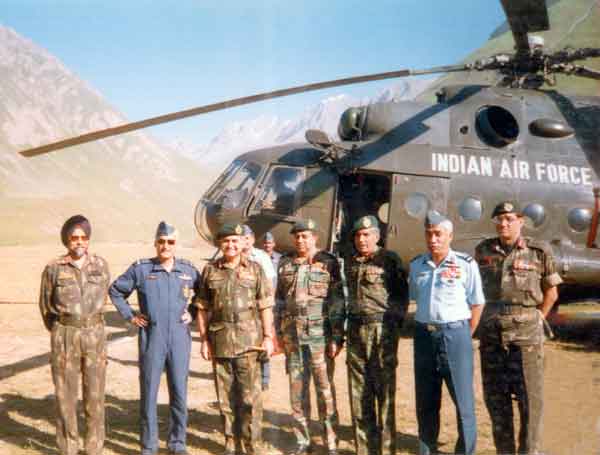
Kargil Controversy: Army trashes IAF perspective

By Lt Gen Mohan Bhandari
26 Jul , 2015

While Air Marshal Bedi in his article ‘KARGIL-AN IAF PERSPECTIVE’ has tried his best to educate readers, in his words, “inadequate understanding of fundamental percepts of air power… and hopefully set the records straight in the interest of inter service bonhomie”, he perhaps has also taken recourse to sift inputs from plethora of material available on Op VIJAY. Even after ten years, controversies keep on erupting on the conduct of this operation. These will continue in the future as well because certain facts have not come out in the open.

Bedi has written: “Apparently, it was the American Ambassador John Galbraith who advised Prime Minister Nehru not to commit the Air Force.” It is astonishing to note that the Service Chiefs, and the Air Chief in particular, were mute spectators in the 62 Sino–Indian conflict. He later goes on to say, in his own words: “The Chinese did not have any significant capability then.” Did the Air Chief at that time give his professional advice to the Government or did he go to the Prime Minister seeking employment of air power? Do you depend on a diplomat’s advice for professional employment of a particular service? Why then have the Service Chiefs?

No CDS only a Four Star General No1 Babus Win Again

By Brigadier Arun Bajpai
25 Jul , 2015

An IIT graduate, the new Defence minister of India Mr Manohar Parrikar within months of his taking over as RM made a public statement that Chief of Defence Staff system is a must for India and he is already working on this concept. One thought that now the days of Babus of the MOD who have been lording over the Ministry of Defence and playing the Game of General General for last 68 years of Indian independence, playing one service against other and feeding Indian netas the apprehension that if armed forces of India are not kept under tight leash then be prepared for coup are over and Indian Armed forces will also have a five star general as CDS like 70 countries of the world including Pakistan have it to integrate and synergise the three services in real sense as also to provide single point military advise to the ruling political class. Alas the hopes have been dashed and the Babus have again won.

If one asked the Indian politicians and bureaucrats as to why India is not implementing CDS system answer always was that Services don’t agree and more forcefully that “we need political consensus”.

IB Doesn’t Consider Snooping As Rights Violation

24 Jul, 2015

For more than a decade, Anuj Dhar has devoted himself to resolving the mystery surrounding the disappearance of Subhash Chandra Bose. His 2012 bestselling book India's Biggest Cover-up (Netaji Rahasya Gatha in Hindi) triggered the demand for declassification of the Bose files. 

The Intelligence Bureau refuses to give reasons for the snooping done on Netaji’s kin. Anuj Dhar’s struggle continues. 

This is the year 2015, the era of the Right to Information, and the top intelligence agency seems to be caught up in a time warp. Or perhaps, the spooks are vary of skeletons tumbling out if this writer’s RTI request concerning snooping on the family members of Subhas Chandra Bose and others is accepted.

First, the latest news. The Intelligence Bureau will neither give reasons nor provide any details about the extensive surveillance mounted on the kin of Subhas Chandra Bose from the late 1940s to the late 1960s.

What’s our Hindustan problem?

May 01, 2015

Our heroes are the Muslim conquerors of Hind, from Mahmud Ghaznavi onwards. We name our missiles after them — Ghauri, Abdali — and of course after Iqbal’s mythical Shaheen. We take ourselves to be the descendants of the Timurid conquerors, the House of Babur. Yet Pakistan defines itself by its fear of Hindustan, the land conquered, occupied and ruled by the supposed ancestors, the spiritual and temporal forbears, of today’s Islamic Republic.

Perhaps there are a thousand justifications for Pakistan to have a large standing army. Perhaps there are many reasons, and valid ones at that, for Pakistan to possess a nuclear capability. But for Pakistan the overriding reason for tanks, missiles and nuke capability is not the Arabian Sea, not the Himalayas, but India.

What are we afraid of? What are our generals afraid of? Is Pakistan a morsel on a map that anyone can swallow? But we conduct ourselves and we talk as if we face an ‘existential’ threat from our neighbour to the east. I wish we would take this word existential out of our lexicon. It has been worked to death. The only threat Pakistan faces is: 1) from incompetence and 2) from fantasies about ‘jihad’ — about conquering lands to our west and east, fantasies which have brought us to our present pass.

If only we had remained a normal country without the urge to hitch our national wagon to distant stars we could have avoided so many of our troubles and become the crossroads of east and west, and Central Asia and the Indian Ocean, that we can still become if only we choose to transcend some of the strange notions that afflict our national thinking.

Water, water, everywhere …

24 Jul 2015

Pakistan is devastated by floods every year. The Economic Survey calculated that the country lost over 3,000 lives and more than $16 billion to floods in 2010, 2011 and 2012. The National Disaster Management Authority estimated the negative impact of floods on the economy of over $2 billion in 2013 and damages to over 1 million acres of standing crops. But how many Pakistanis know that their country has been classified by international environment agencies as the third most “water-scarce” country in the world, more “stressed” than the likes of Ethiopia and some other semi-desert African countries where famine, drought and disease are common?

Water availability per capita in Pakistan in 1947 was 5600m3. By 2020, experts claim it will be down to 855m3, a shortfall in minimal needs of over 30%. By contrast, it is 6000m3 in the USA, 5500m3 in Australia and 2200m3 in China. A new IMF report has sounded the alarm bell. It claims that Pakistan’s water intensity rate — the amount of water, in cubic metres or m3, used per unit of GDP — is the world’s highest, suggesting that its economy is more water dependent than any other country’s in the world. Such levels of rising water consumption and depletion have dangerous consequences: the underground aquifers of the Indus Basin are the second most stressed in the world and groundwater levels, for example, are plunging by several metres every year in rapidly urbanizing parts of the country.

Pakistan Taps All International Communications Coming Into and Out of Country on Fiber Optic Cable

Pakistan tried to tap international web traffic via underwater cables, report says 

Pakistani intelligence sought to tap worldwide internet traffic via underwater cables that would have given the country a digital espionage capacity to rival the US, according to a report by Privacy International.

The report says the country’s Inter-Services Intelligence (ISI) agency hired intermediary companies to acquire spying toolkits from western and Chinese firms for domestic surveillance.

It also claims the ISI sought access to tap data from three of the four “landing sites” that pass through the country’s port city of Karachi, effectively giving it access to internet traffic worldwide.

Pakistan was in talks with a European company in 2013 to acquire the technology, but it is not clear whether the deal went through – a fact the rights organisation said was troubling.

“These cables are going to route data through various countries and regions,” Matthew Rice, an advocacy officer for Privacy International, said.

Beijing’s Maritime Silk Road Passes Through Islamabad

Dilip Hiro
21 July 2015

Ties between China and Pakistan run strong and often aim at containing India. In recent decades, China helped Pakistan with its nuclear-weapons program and after 1991 became the country’s chief arms supplier. The relationship could signal that China’s One Belt, One Road project is as much about developing a strategic military network as trade and cultural exchange, suggests historian and author Dilip Hiro. The port of Gwadar in Pakistan, less than 400 kilometers from the Strait of Hormuz, will be linked by rail and road to the Chinese city of Kashgar. “Aiming initially at safeguarding the sea lanes used to ferry Middle East oil for its voracious industry and rising living standards of its people, China has come to view Pakistan as a critical element in containing India on a wider scale,” Hiro writes. “China follows a similar pattern by investing millions in airports, roads, ports and other transportation infrastructure in other nations, too, like Sri Lanka and the Republic of Maldives to develop influence throughout the Indian Ocean region. 

With strong ties to Pakistan, China extends economic and strategic influence over the Indian Ocean region

Planning the Silk Road, on land and sea: China’s President Xi Jinping plants tree with Pakistani Premier Nawaz Sharif, top, and pledges airport upgrades to his Maldives counterpart, Abdulla Yameen

LONDON: In most countries, governments change and policy follows. In China, where the Communist Party is determined to stay in power for perpetuity, the government can lay down policies and carry them out over the long haul. The long-term policy can be upgraded as the economy and technology permit. 

China is building two untested nuclear reactors on Pakistan's coast

JULY 6, 2015

Pakistan has agreed to the construction of two nuclear reactors in Karachi, a coastal city in a tsunami-prone zone. After the 2011 Fukushima disaster in Japan, scientists and civil society activists are asking why. 

ISLAMABAD, PAKISTAN — Pakistan's largest city and financial hub has given China a green light to build two nuclear power stations on a beach about 15 miles from downtown, raising public alarm over both the location – the coastline is vulnerable to tsunamis – and the fact that the nuclear reactors are new and untested. 

Karachi approved the plan in late June when the city’s environmental agency deemed, “after careful review,” that the project was safe. Yet the impact assessment on the reactor site, at a popular beach known as Paradise Point, remains secret.

Chinese Outward Investment and Host Country Corruption

By Jean-Marc F. Blanchard and Juliette Devillard
July 26, 2015

The effect of Chinese outward investment (COI) on host country corruption levels, government accountability, and transparency has been a topic of considerable interest among activists and scholars as well as businesspeople and policymakers who fret Chinese malfeasance is putting their firms at a competitive disadvantage. This makes sense given billions of dollars of Chinese investment in countries such as Angola, Sudan, and Venezuela, which fare quite poorly in the pertinent international rankings. Moreover, there are numerous reports of Chinese companies paying bribes to secure a major port deal in Sri Lanka, to try to obtain a major broadband telecommunications deal in the Philippines, and to secure lucrative oil and gas opportunities in Kazakhstan. Beyond this, Transparency International’s 2011 Bribe Payer Index ranks Chinese companies second out of a list of 28 countries in terms of their willingness to pay bribes. Indeed, one set of writers from Pacific Forum CSIS has accused China of hypocrisy, waging a vigorous fight against corruption at home, but “turning a blind eye to the dangers that could result from massive infusions of Chinese money.” Simply put, China is ignoring how its investment and associated financial aid and loans can “nurture corruption and distort good governance.”

China’s Elegant, Flawed, Grand Strategy

China is a country with more than a billion people, but as Ross Terrill observed, when we ask what China wants, we are really attempting to discern the goals of the nine “male engineers” who make up the Standing Committee of the Politburo of the Chinese Communist Party. This clarification makes the answer straightforward: Like any bureaucracy or interest group the CCP wants to ensure its survival, which depends on maintaining legitimacy with the Chinese people. To meet this goal, the CCP under President Xi Jinping has articulated a strategy of peaceful development; however, increasing Chinese military capabilities and strategic coercion will cause other states to balance against China, making it harder for the CCP to protect its core interests and continue its economic and strategic rise.

China’s Long-Term Goals

America’s Security Role in the South China Sea

JULY 23, 2015

Tensions over the South China Sea threaten to drive U.S.-China relations in a more adversarial direction and destabilize the region.

Thank you for inviting me to testify today.

For the United States, the South China Sea is an important area of the Asia-Pacific region for three reasons: 1) it is part of a major transit route for maritime commercial traffic to and from East Asia and for the United States Navy; 2) disputes over the ownership of its many small islands, reefs, atolls, and rocks among China and several nearby Southeast Asian states (including one United States ally, the Philippines) are generating tensions that could result in conflict and instability; and 3) Beijing could eventually use its growing influence in the area to create a sphere of influence detrimental to United States interests.

These factors justify United States attention to events occurring in the South China Sea, and a set of policies designed to ensure access and transit, prevent or minimize tensions, and support the peaceful and legally based management of local disputes. Unfortunately, United States statements and actions at present are not effectively achieving such objectives, and growing tensions over the issue are threatening to severely destabilize the critical United States-China relationship in unnecessary ways.

Reacting to continued Chinese land reclamation efforts on several reefs in the Spratly Islands, senior United States officials and military officers vow to “fight tonight” if needed to defend United States interests across the Indo-Pacific, while referring to Chinese claims across the South China Sea as “preposterous” and Chinese land activities there as designed to “militarize” the region and to build a “great wall of sand.” In response, Chinese officials and spokespersons warn the United States against provocative actions, insist that China will not back down, and reiterate their determination to “safeguard our own sovereignty and territorial integrity.”

Great game: Polls in Pakistani Kashmir smooth way for epic China pipeline

By Umar Farooq, Correspondent 
JUNE 23, 2015

Prime Minister Nawaz Sharif's Party of Pakistan won a majority of seats in disputed territory crucial to a $46 billion China-built corridor from Xinjiang to the Indian Ocean.

GILGIT, PAKISTANI-CONTROLLED GILGIT-BALTISTAN — Pakistan’s disputed Gilgit-Baltistan region, located above India’s Kashmir Valley and the site of a bitter war between India and Pakistan in the late 1990s, is today ground zero for a pending China pipeline to the Indian Ocean – a $46 billion project that represents Pakistan’s largest-ever foreign investment. 

It was also the site of elections earlier this month that saw Prime Minister Nawaz Sharif's Pakistan Muslim League take a majority in the 24-seat assembly.

Pakistan says the election results will provide the necessary stability to keep the pipeline deal on track. But for India, both the elections and the pipeline corridor have aroused suspicion about a region that has become a linchpin in a China-Pakistan alliance often regarded as hedge against India. 

The victory came after last fall's elections next door in Indian-controlled Kashmir, where the Hindu nationalist party of Indian President Narendra Modi won enough seats to form a ruling coalition in territory long disputed by Pakistan. 

China in the South China Sea: Has Beijing overstepped the mark?

JULY 22, 2015

A briefing on what China wants: It speaks of a 'peaceful rise' in Asia and of binding the region with liberal markets. But it's creating military bases and throwing sharp elbows far below its own territory.

BEIJING — Why has China just built seven artificial islands in the strategically sensitive and economically critical South China Sea, alarming its neighbors and risking confrontation with the United States?

Because Beijing believes it can get away with the nervy move and bolster an old desire for regional dominance.

“China has wanted to do this for a long time,” says Zhang Jie, head of the Asia Pacific Security program at the government-linked Chinese Academy of Social Sciences. “Now it has the dredging boats, the money and the people. So it is doing it.”

At the US Naval War College, strategist Peter Dutton has reached the same conclusion. “As China’s interests and horizons expand, so will its impulse to exert physical control,” in its region he predicts.

Forbes: White House Has No China Strategy; Here’s Mine

July 24, 2015 

WASHINGTON: What’s the strategy for coping with what everyone on Capitol Hill and inside the Obama administration agrees is an increasingly assertive China? The White House can’t answer, Rep. Randy Forbes says, “because they don’t have it.” So, it’s fair to ask: what is Forbes’s strategy, then?

The House seapower chairman’s outline for a “winning strategy” boils down to five principles, he told me in an interview:

Have a clear objective: a peaceful and prosperous Pacific where China follows the rule of law and the US works closely with its partners.

Speak truth to Chinese power: Be willing to offend Beijing with frank statements, especially on issues like human rights and Taiwan.

Punish Chinese provocations, for example by un-inviting them from international wargames like RIMPAC if they continue building artificial “islands.”

Terrorists Use Social Media to Win War of Ideas

July 25, 2015 

An example of ISIS' media outreach: A video released from ISIS shows militants executing 25 captives (Syrian army soldiers) in the ruins of the main Roman amphitheater in the ancient city of Palmyra, Syria. (Photo: Balkis Press / ABACA/Newscom)

James Jay Carafano, a leading expert in national security and foreign policy challenges, is The Heritage Foundation’s Vice President, Foreign and Defense Policy Studies, E. W. Richardson Fellow, and Director of the Kathryn and Shelby Cullom Davis Institute for International Studies.Read his research.

Used to be that, when a crime occurred, investigators would flood the crime scene. Now, they race to access the perpetrator’s footprint in digital space. Often, that’s where they’ll find the most crucial clues.

And that’s why the FBI wants to know everything Chattanooga shooter Mohammad Youssef Abdulazeez did online.

Digital tracing has proved particularly important in suspected terrorism cases. In grappling with the dramatic surge in homegrown terror plots, investigators search social networking sites, emails and digital address books for signs of radicalization or links to transnational groups.

Why Turkey Has Finally Declared War on ISIS

July 24, 2015

After two years of inaction, Turkey has struck back inside its own borders and beyond

For almost two years, Turkish troops sat idly on the country’s shared border with Syria as Islamic militants increased their territory and fought on the frontier. The Turkish parliament voted in October to allow its military to join the fight against the Islamic State or Iraq and Greater Syria (ISIS) but little happened. Then, early Friday morning, a squad of Turkish F-16s struck ISIS positions inside Syria. It was a quick and significant change in the country’s actions toward the militants.

“ISIS and Turkey had a nearly two-year-long Cold War in which they avoided fighting, with the knowledge that their confrontation would lead to destruction on both sides,” says Soner Cagaptay, director of the Turkish Research Program at The Washington Institute. “That Cold War is definitely over.”

Turkey, a member of NATO, was already a signed ally in the fight against ISIS, but has done little to combat the militants or even restrict their access to Syria through Turkey. Cagoptay says this “open door policy” was meant to allow all fighters who want to oust President Bashar al-Assad into Syria. The Islamist-leaning government in Ankara maintains that Assad is enemy number one in Syria, not his opponents but the U.S.-led coalition has attacked ISIS and al-Qaida-linked groups in Syria but not the Assad regime.

India and the Iran deal

Tanvi Madan 
July 20, 2015

The Indian government welcomed news of the Iran deal. A former Indian national security advisor described the accord reached as the “best deal available.” India has a complicated relationship with Iran, and its leaders will watch closely as implementation and the consequences of the deal play out. The deal could open up economic and strategic opportunities for India and thus it’s being seen mostly with hope; however, those hopes are tempered by some challenges and uncertainties.

In some ways, India has been preparing for a deal for several months, re-engaging Iran at the highest levels. Since February, the Indian national security advisor, transport minister and foreign secretary have traveled to Iran, and the foreign minister intended to do the same until her meeting was postponed. Most recently, Prime Minister Narendra Modi met with President Hassan Rouhani on the sidelines of the Shanghai Cooperation Organisation summit in Ufa, Russia last week. He reiterated an invitation for Rouhani to visit India and said he looked forward to visiting Iran as well. 

India never stopped engaging with Iran and some of the recent trips may have taken place even in the absence of the deal. There are certain imperatives for the relationship that make it important for India regardless (mentioned below). Furthermore, after spending its first year focused on India’s immediate neighborhood, the Asia-Pacific and the G-7, the Modi government has made clear its intention to “look west” over its second year, including with high-level trips to Central Asia (completed), Israel, Palestine, Jordan, and Turkey (for the G20 summit). This engagement becomes easier and more crucial for Delhi with the Vienna deal, which has implications for India in the energy, economic and geopolitical spheres.

Arab Armed Forces: State Makers or State Breakers?

Jul 14, 2015 

Jordanian military police, 2013.

Proliferation and intensification of coercive force in the Arab world since 2011, combined with apparent decay of Arab states, seems at first glance to run counter to the implicit predictions of two relevant bodies of literature. The modernization school, which emerged as Arab states were becoming independent in the 1950s, held that Arab militaries were state builders—mobilizing, integrating, and organizing their societies to face development challenges, including that of inter-state war.[1] More or less simultaneously, European-focused historical sociology, led by Charles Tilly, made the case that war making, requiring as it does increased domestic extraction coupled with subordination to central authority of internal rivals, was the engine of state making.[2] And indeed, the historical trajectory of the Arab world for some half a century up until 2011 seemed to substantiate both views, as militaries and states grew in tandem under the ever present threat of war.

The near collapse over the past four years of both militaries and states in Syria, Libya, Iraq, and Yemen, however, calls into question the interpretation of the military as socioeconomic modernizer and state maker. Egypt, although not facing imminent state collapse, seems also to be a case where military-led state building has failed, as suggested by the army’s direct seizure of power in 2013, thereby implicitly admitting the shortcomings of the army’s state building project that commenced with the 1952 coup. The monarchies have behaved ostensibly as the European historical model would predict, redoubling their efforts to further expand military capacities in the face of various threats. 

How Russia Tries to Intimidate Japan

Russia plans to massively invest in military and civilian infrastructure projects on the Kuril islands,TASS reports quoting Russian Prime Minister Dmitry Medvedev.

“We’re restoring both the civilian and defense infrastructure of the Kurils,” he said this Thursday at a news conference where he also announced a visit to the islands located in the Sea of Okhotsk in the Northwest Pacific.

“I am planning to go there and have a look how matters stand there. And I invite the others,” Medvedev told members of his cabinet. He already visited the disputed islands – known in Japanese as the Shikotan, Kunashiri, Etorofu and the Habomai islets – once before in 2010 becoming the first incumbent Russian president to do so.

The Soviet Union seized the islands at the end of the Second World War and by 1949 had expelled all 17,000 Japanese residents. Under the 1951 San Francisco Peace Treaty Tokyo renounced “all right, title and claim to the Kuril Islands,” however, the Soviet Union never signed the peace treaty and Japan refused to concede that the four disputed islands where in fact part of the Kuril chain.

Alarm Bells On Aadhar


Our worse privacy nightmares will come true if Aadhar is mounted without a stringent and water-tight law backing it.

Privacy remains the major concern of activists in the run up to the introduction and roll out of the Unique Identification (UID) number or Adhaar in India. Strong concerns persist on how peoples' privacy could be compromised given the faulty premise and process on which the exercise is being mounted.

In fact, right from the beginning, Aadhar was attacked by various activists over its data collection methods and the process followed to give shape to this gigantic activity. This had the potential to compromise people's privacy and give access to people's data to unscrupulous quarters. There was a strong pitch to have the process scrapped despite Aadhar having moved ahead into mapping the Indian population.

But this week, attorney general Mukul Rohtagi has sung a different tune saying that privacy, the main concern over Adhaar was a non issue. He told the Supreme Court that Indian citizens cannot claim privacy as a fundamental right. He cited a 1954 judgment that says that privacy is not a fundamental right. As such, he said, the Adhaar exercise cannot be scrapped on grounds of privacy.

THE VIEW FROM OLYMPUS: WTF?


Marine General Joseph F. Dunford, who has been nominated to be the next chairman of the Joint Chiefs of Staff, is by reputation one of our best and brightest generals. Friends who have worked with him tell me he’s great. In his short tenure as Marine Corps Commandant, he moved to end much of the nonsense that had gone on under his predecessor, including suppression of dissent. Virtually all the Marines I know let great hosannas ring when he took over.

So how, in his recent confirmation hearing before the Senate Armed Services Committee, did he get it so wrong?

According to the July 10 New York Times, General Dunford told the committee,

Russia’s aggressive behavior and its nuclear arsenal make it the single greatest national security threat faced by the United States…

Throughout the hearing, when asked about threats, General Dunford returned repeatedly to Russia…

Russia—A Different Kind of Threat

JULY 20, 2015

Russia is a superpower in decline, and the challenge it poses to the United States is very different from that posed by the Soviet Union.

On July 13, 2015, the barracks of a unit of elite Russian airborne troops in Omsk, Siberia, collapsed, killing 23 servicemen. A day later, a long-range Tu-95 Bear bomber crashed in eastern Russia, the fifth Russian Air Force plane crash in a month. The entire Tu-95 fleet was grounded as a result. A few days earlier, though, two Bears were in the air, on a long-range patrol near the coast of Alaska, where they were intercepted by U.S. fighters.

In Washington, U.S. President Barack Obama’s nominee to be the chairman of the Joint Chiefs of Staff, General Joe Dunford, called Russia “the greatest threat” to the United States at his July 9 confirmation hearing. In an interview the day before, Air Force Secretary Deborah Lee James made the same claim. The White House andState Department promptly distanced themselves from Dunford’s comments, but they failed to smother the impression that Dunford may be on to something.

Russian aggression against Ukraine has revived the long-forgotten craft of marketing the Russian threat. Russia certainly is a problem, and the U.S. relationship with it is at its worst since before the Cold War ended. But a sober look at Russia reveals a superpower in decline. Its economy is stumbling; its military capabilities are no match for those of the United States and its allies; and its actions are in large measure driven by exaggerated threat perceptions and insecurity at home and abroad.

Scott Walker: 'Our allies do not trust us, and our enemies do not fear us'

July 24, 2015

Editor’s Note: Zachary Keck, Managing Editor of the National Interest, posed the following questions to 2016 Republican Presidential candidate Wisconsin Governor Scott Walker. The exchange is below:
Keck: First things first, what is your reaction to the recently announced Iran nuclear deal? Do you really intend to terminate it on your first day in office?

Walker: The Iran deal is a terrible agreement that will be remembered as one of the biggest diplomatic disasters in U.S. history. It is a threat to our safety and the safety of our closest allies, especially Israel. It gives an American stamp of approval to the Iranian nuclear program, undermines the principle of nonproliferation across the globe, lifts the conventional arms and ballistic missile embargoes on Iran, and provides a signing bonus of around $150 billion to the world’s leading state sponsor of terrorism. Seeing this bad deal and President Obama’s lack of resolve, our allies are now taking matters into their own hands. That’s why I’ve said this deal is the starting pistol in a Middle Eastern nuclear arms race and will actually make war with Iran more likely, not less.

Get Ready, Japan: Russia Has Its Own Island-Buildup Project

July 23, 2015
China isn’t the only country embarking on an island-building campaign on disputed territory.

"We’re restoring both the civilian and defense infrastructure of the Kurils," Medvedev said, according to Russia’s state-owned media.

Medvedev went on to explain that this initiative would be led by the Russian armed forces and Defense Ministry. "The Armed Forces, and the Defense Ministry of Russia are dealing not only with the military but also with the civilian component," the Russian premier said.

Medvedev also announced that he will be visiting the Kuril Islands shortly. "I am planning to go there and have a look how matters stand there,” he said. He further encouraged other Russian cabinet members to visit the islands.

The decision to build up the islands’ infrastructure, as well as have the Russian prime minister and other cabinet members visit the Kuril Islands, is likely to set off tensions with Japan. Tokyo has long claimed the islands, and previously occupied them under the terms of Russia and Japan’s first bilateral treaty, the Treaty of Shimoda, signed in 1855. Soviet forces seized the islands in the waning days of WWII, and Russia and Japan have technically remained at war ever since over the dispute.