11 April 2016

Imperial ambitions Mark Zuckerberg prepares to fight for dominance of the next era of computing

http://www.economist.com/news/leaders/21696521-mark-zuckerberg-prepares-fight-dominance-next-era-computing-imperial-ambitions?fsrc=scn%2Ftw%2Fte%2Fpe%2Fed%2Fimperialambitions
Apr 9th 2016 | 


NOT since the era of imperial Rome has the “thumbs-up” sign been such a potent and public symbol of power. A mere 12 years after it was founded, Facebook is a great empire with a vast population, immense wealth, a charismatic leader, and mind-boggling reach and influence. The world’s largest social network has 1.6 billion users, a billion of whom use it every day for an average of over 20 minutes each. In the Western world, Facebook accounts for the largest share of the most popular activity (social networking) on the most widely used computing devices (smartphones); its various apps account for 30% of mobile internet use by Americans. And it is the sixth-most-valuable public company on Earth, worth some $325 billion.
Even so, Mark Zuckerberg, Facebook’s 31-year-old founder and chief executive, has even greater ambitions (see article). He has plans to connect the digitally unconnected in poor countries by beaming internet signals from solar-powered drones, and is making big bets on artificial intelligence (AI), “chatbots” and virtual reality (VR). This bid for dominance will bring him into increasing conflict with the other great empires of the technology world, and Google in particular. The ensuing battle will shape the digital future for everyone.
In this section

Empires built on data
Facebook has prospered by building compelling services that attract large audiences, whose attention can then be sold to advertisers. The same is true of Google. The two play different roles in their users’ lives: Google has masses of data about the world, whereas Facebook knows about you and your friends; you go to Google to get things done, but turn to Facebook when you have time to kill. Yet their positions of dominance and their strategies are becoming remarkably similar. Unparalleled troves of data make both firms difficult to challenge and immensely profitable, giving them the wealth to make bold bets and to deal with potential competitors by buying them. And both firms crave more users and more data—which, for all the do-gooding rhetoric, explains why they are both so interested in extending internet access in the developing world, using drones or, in Google’s case, giant balloons.
The task is to harness data to offer new services and make money in new ways. Facebook’s bet on AI is a recognition that “machine learning”—in which software learns by crunching data, rather than having to be explicitly programmed—is a big part of the answer. It already uses AI techniques to identify people in photos, for example, and to decide which status updates and ads to show to each user. Facebook is also pushing into AI-powered digital assistants and chatbot programs which interact with users via short messages. Next week it is expected to open up its Messenger service (which can already be used to do things like order an Uber car), to broaden the range of chatbots. And Facebook’s investment in VR—it bought Oculus, the cheerleader of this emerging field, for $2 billion in 2014—is a bold guess about where computing and communication will go after the smartphone.

Top secret "28 pages" may hold clues about Saudi support for 9/11 hijackers

http://www.cbsnews.com/news/top-secret-28-pages-may-hold-clues-about-saudi-support-for-911-hijackers/
Former Senator Bob Graham and others urge the Obama administration to declassify redacted pages of a report that holds 9/11 secrets
Current and former members of Congress, U.S. officials, 9/11 Commissioners and the families of the attack's victims want 28 top-secret pages of a congressional report released. Bob Graham, the former Florida governor, Democratic U.S. Senator and onetime chairman of the Senate Select Committee on Intelligence, says the key section of a top secret report he helped author should be declassified to shed light on possible Saudi support for some of the 9/11 hijackers. Graham was co-chair of Congress' bipartisan "Joint Inquiry" into intelligence failures surrounding the attacks on Sept. 11, 2001, that issued the report in 2003. Graham speaks to Steve Kroft for 60 Minutes report to be broadcast Sunday, April 10 
Graham and his Joint Inquiry co-chair in the House, former Representative Porter Goss (R-FL) -- who went on to be director of the CIA -- say the 28 pages were excised from their report by the Bush Administration in the interest of national security. Graham wouldn't discuss the classified contents, but says the 28 pages outline a network of people he believes supported hijackers in the U.S. He tells Kroft he believes the hijackers were "substantially" supported by Saudi Arabia. Asked if the support was from government, rich people or charities, the former senator replies, "all of the above."

Why Victory in Mosul Won’t Solve America’s Iraq Conundrum

Sunday, April 10, 2016
ISIS is back on its heels in both Syria and Iraq, and the Iraqi government announced on March 24 that the all-important, yet much-delayed campaign to re-take the critical Iraqi city of Mosul has finally begun. Starting with attacks on towns south of the city, the campaign’s goal is to effect a “slow strangulation” of ISIS in Mosul, much as in the successful effort against ISIS in Ramadi last year.
Unfortunately, it is one thing to recognize that ISIS is becoming weaker, but quite another to exploit its weakness in a way that leads to a meaningful victory and a durable peace. Three crucial questions remain unanswered about the coming battle for Mosul and the larger implications for the United States and Iraq. Without good answers, even a vigorous campaign may deliver only marginal strategic results.

Who will fight the battle?
The Mosul campaign includes a hodge-podge of actors with varying interests, capabilities, and will to fight. It is a microcosm of the war as a whole.
Washington has been sending mixed signals about its own commitment to the battle. On the one hand, the Obama administration is careful to stress that it must be and will be an Iraqi-led effort. The president has repeatedly declared that he does not want U.S. forces in a large ground war resulting in an open-ended occupation of Iraq.
On the other hand, he has pledged the destruction of ISIS, as have all the presidential candidates. This suggests that the United States will settle for nothing less than a comprehensive victory. And given Mosul’s size and symbolic importance for ISIS, it is not hard to imagine that the United States will send additional U.S. forces if the Iraqi army fails. Indeed, the United States has already established a division headquartersin Iraq, which is a somewhat odd command arrangement for what amounts to a brigade-sized force. It has also committed a disproportionate number of generals to Iraq. Both of these decisions suggest that the United States has put in place the logistical backbone for a much larger surge of land forces if required. 

The Iraqi army has also sent mixed signals. Although its leaders have recently expressed confidence in their growing capabilities, there are real reasons to doubt them. The ISIS summer offensive in 2014 quickly routed the army in all areas except the Shi’a heartland in Baghdad and southern Iraq. Officers and soldiers showed little enthusiasm for fighting far from home. Efforts to improve their capabilities and inject new motivation have been halting at best since that time. The recent victories against ISIS resulted largely from action by Kurdish and Shi’a militias, U.S. airpower, and a small force of increasingly overworked elite Iraqi counterterrorism troops that were intensively trained by U.S. Green Berets—not from the efforts of conventional Iraqi forces. Indeed, one analyst has gone so far as to argue that the army itself is afiction.
The Mosul campaign includes a hodge-podge of actors with varying interests, capabilities, and will to fight. It is a microcosm of the war as a whole

German Spy Chief Says Terrorism Situation in Germany Is “Very Serious”

German spy chief says Islamic State wants to attack but no firm plan known
Reuters, April 9, 2016

Islamic State wants to carry out attacks in Germany and the security situation is “very serious”, the head of the country’s domestic intelligence agency (BfV) told a Sunday newspaper, adding that he knew of no concrete plot to strike.
The militant group released a video on Tuesday suggesting it may carry out further attacks in the West after the Brussels bombings and Paris attacks, naming London, Berlin and Rome as possible targets.
Hans-Georg Maassen told German newspaper Welt am Sonntag the group wanted to carry out attacks against Germany and German interests, but added: “At the moment we don’t have any knowledge of any concrete terrorist attack plans in Germany.”
He said Islamic State propaganda was aimed at encouraging supporters to take the initiative to stage attacks in Germany.
Maassen said there were several cases linking Germans returning from Syria to attack plans and warned that the danger posed by jihadists from Germany remained “virulent”.

He said the country had avoided a big attack so far thanks to the successful work of security authorities and luck such as a bomb detonator not working properly on one or two occasions.
In 2014, a German man described as a radical Islamist was charged with planting a pipe bomb – which never exploded – at Bonn train station in 2012. In 2006, two suitcase bombs left by Islamist militants on trains in Cologne failed to explode.
Asked how many Islamists in Germany were considered highly dangerous, Maassen said there were about 1,100 Islamists who were seen as a potential terrorism risk.

Maassen said his agency was aware of about 300 attempts by Salafists and other Islamists to recruit refugees.
“I’m particularly concerned about the many unaccompanied minors – this group is being deliberately targeted,” he said, adding that he saw a “huge radicalization potential” in these attempts to recruit people.

* Using Data Mining to Spot Potential Terrorists Entering Your Country

April 9, 2016
Border security based on data mininG
Pierre Tran, Defense News, April 9, 2016

PARIS — Zettafox, a privately owned consultancy, is working on a system to mine big data to help border security officers gauge the risk factor of travelers, a critical area following recent deadly assaults in Brussels and Paris by Islamic State attackers.
A grave concern on frontier control has risen as attackers crossed national borders before staging bomb attacks that left dozens dead in the center of the two European capitals.
Border controls are so important that Britain performs a “security-related” check on all passport holders entering the country, a former senior intelligence officer said.
“The UK conducts security-related checks on the passports of every single individual, including all (European Union) citizens, entering the UK from continental Europe or elsewhere,” Pauline Neville-Jones former chair of the Joint Intelligence Committee, said in a March 25 article in the Guardian daily newspaper.

European border security and a lack of sharing of national intelligence have become highly sensitive political issues.
The Zettafox directors have focused on an algorithm that extends the predictive to the prescriptive, namely extending the function of what might happen to recommending the best action to take.
The consulting firm, founded by Patrick Zerbib and Marc Atallah, worked in late 2013 and early 2014 on a software-driven simulator to demonstrate to a European national border agency a “smarter approach to raising the red flag,” Atallah said.
Zerbib and Atallah developed the prescriptive approach when they were working with Deloitte, an auditing and consulting firm, he said.

Such a border security system allows a “profile” of a potential risk to be drawn by processing “overwhelming big data,” Zerbib said. In the vast “data lake” there is personal information based on elements such as credit cards, Facebook and Twitter social media accounts, and cellphones.
Data science seeks to spot high-risk profiles, he said.
Once the data system flags a warning sign, border officials can hold the suspect for questioning.
“Human trafficking, the abusive movement of people across borders for exploitation, could be better detected by use of the data,” Atallah said.

Killing a Zero-Day in the Egg: Adobe CVE-2016-1019

https://www.proofpoint.com/us/threat-insight/post/killing-zero-day-in-the-egg
On April 2, 2016, Proofpoint researchers discovered that the Magnitude exploit kit (EK) [1] was successfully exploiting Adobe Flash version 20.0.0.306. Because the Magnitude EK in question did not direct any exploits to Flash 21.0.0.182, we initially suspected that the exploit was for CVE-2016-1001 as in Angler [2], the combination exploit "CVE-2016-0998/CVE-2016-0984" [3], or CVE-2016-1010.
In the course of our investigation, we shared our findings with fellow researchers in the security community in order to accelerate identification of the exploit. A colleague at FireEye determined [4] that the exploited vulnerability was unknown. Adobe was promptly notified of the issue, and they verified that although a mitigation integrated in 21.0.0.182 appeared to cause the exploit to fail, it was a previously unreported vulnerability and assigned it CVE-2016-1019. An emergency patch for the vulnerability was released on April 7 [5].

Despite the fact that this new exploit could potentially work on any version of Adobe Flash, including a fully patched instance of Flash, the threat actors implemented it in a manner that only targeted older versions of Flash. In other words, equipped with a weapon that could pierce even the latest armor, they only used it against old armor, and in doing so exposed to security researchers a previously unreported vulnerability. We refer to this type of faulty implementation as a “degraded” mode, and it is something that we have observed in the past with CVE-2014-8439 [6] [7] and CVE-2015-0310 [8] in Angler. While there will be a period of time when systems are not yet patched for CVE-2016-1019 and thus vulnerable to new exploits, “degraded” implementations of potential zero-day exploits offer security researchers and vendors a valuable opportunity to identify and mitigate previously unknown vulnerabilities.

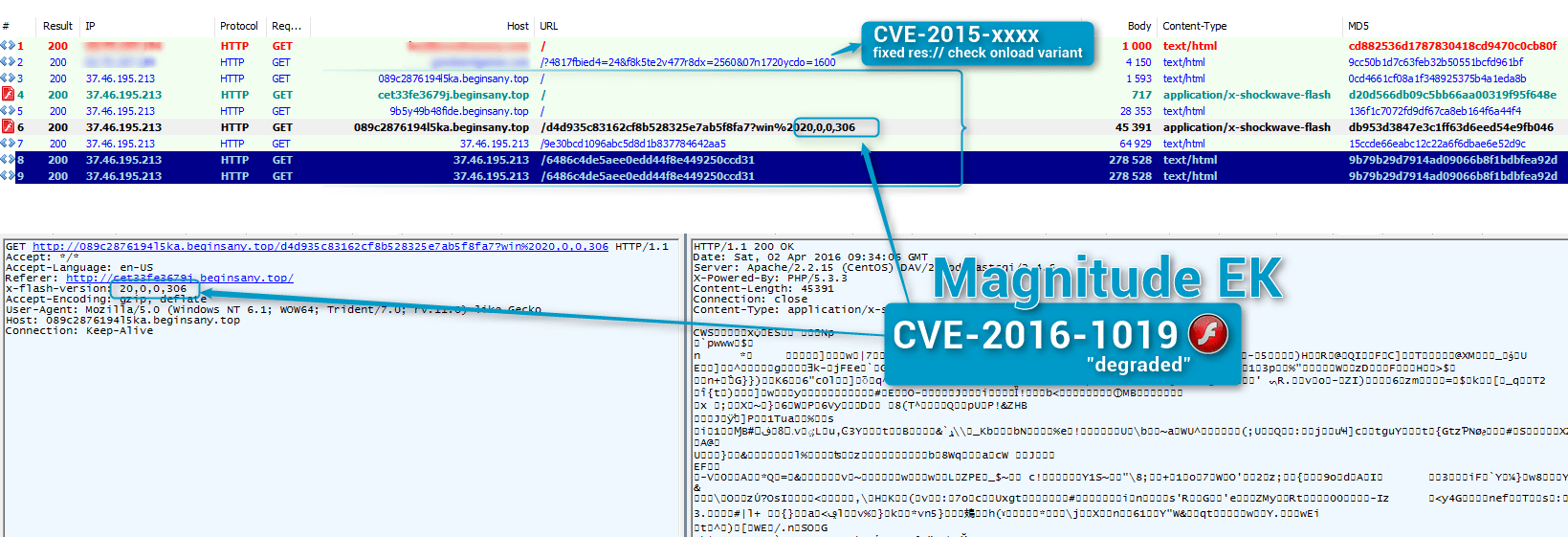
Let’s look at this ‘degraded’ implementation of CVE-2016-1019 in action:

Figure 1: 2016-04-02 Magnitude exploiting CVE-2016-1019 in “degraded” mode to spread Cerber ransomware

“ANONYMOUS” VOWS TO CARRY ON ITS ANNUAL ASSAULTS ON ISRAELI INFRASTRUCTURE LINKED TO ITS #OPISRAEL CAMPAIGN ON APRIL 7, 2015 — HOWEVER, IT SEEMS MORE HYPE THAN HARM

https://www.hackread.com/anonymous-cyber-attack-on-israel/?_e_pi_=7,PAGE_ID10,9533576952&utm_source=hs_email&utm_medium=email&utm_content=28253670&_hsenc=p2ANqtz-_1gPg0bw2Pr6zESg-hJIKSA5iVyNA8mjB5m9py2XDweg7XZ3HA7akmsIrzTdI5Cu1dXs5PEDApNmIp3LAG6syZyabhcw&_hsmi=28253670
Anonymous Conducts Usual DDoS Attacks on Israel for #OpIsrael
The first attacks in connection with #OpIsrael occurred in 2013, wherein some divisions of the Anonymous hackers mutually launched multiple organized cyber-attacks against Israeli websites on the eve of the Holocaust Remembrance Day, on April 8.
From 2013 onwards, the group carried out such attacks consistently same date every year, and in a recent video statement, it has pledged to continue these attacks in 2016. However, this year, Holocaust Remembrance Day is on May 4, but the attacks will still occur on April 7.

Israel has planned a hackathon on ironically the same day:
In recent years, these cyber attacks contained DDoS attacks, database leaks, website defacements, and social media account hijacking but aAfter the recent spasms against Ukraine’s electrical power grid, this year, the Israeli government has also arranged a hackathon with over 400 participants who will take on against the potential cyber-attack on the country’s power grid, transportation system, and government IT networks. This potential threat based hackathon is also scheduled for today. 

* The Castration of the Joint Chiefs of Staff

http://usdefensewatch.com/2016/03/the-castration-of-the-joint-chiefs-of-staff/
By Ray Starmann
Will the Joint Chiefs ever make a stand against the Obama Administration?
Will the Joint Chiefs ever stand up against the insane social engineering policies which are eviscerating the military like a late night Ginsu chef?
Last September, General Martin Dempsey retired as Chairman of the Joint Chiefs of Staff and escaped in a rowboat down the Potomac as the Pentagon began to sink into the cold depths of the wide, grey river.
Dempsey’s reign of cowardice and political correctness was a genuine disaster for the US military. Under Dempsey and his sidekick, Army Chief of Staff, General Ray Odierno, Don’t Ask, Don’t Tell was repealed, transgenders were authorized to serve in the military and we departed Iraq leaving a power vacuum and the keys to a Pandora’s Box.
Under Dempsey, crippling rules of engagement in Afghanistan continued, which make our soldiers and Marines pop up targets of opportunity. Under Dempsey, military personnel were subjected to hours and hours of sensitivity training, doing physical training wearing pregnancy simulators, lactation and breastfeeding memos distributed to combat commands, a war in the ranks against Christianity, a purge of hundreds of general officers and admirals and my personal favorite…the ordering of US Army ROTC male cadets to parade around college campuses in red high heels, in order to feel sympathy for rape victims.

Under Dempsey, the US began Operation Inherent Resolve, the Five O’Clock Charlie air campaign against ISIS that is the laughing stock of the Middle East.
Under Dempsey, the graduation of three women at Ranger School took place, including a 37 year old woman, in what is still a giant cover up. So much obfuscation and Kool Aid drinking is taking place at Benning, it should be renamed Fort Cognitive Dissonance.
Did Dempsey really believe in all of these lunatic radical cultural Marxist policies? Probably not; I’m sure when Dempsey was a Major in the 3rd Armored Division in Desert Storm he probably never thought, “Well, one day I will command men who will wear red high heels in uniform.” “One day, my boys will run PT in pregnancy simulators in order to feel what it’s like to be pregnant.” One day, when I’m Chairman of the JCS, my soldiers will take classes that will instruct them how the Bible and the Declaration of Independence are sexist documents.”

Most military people are conservative and live to defend the tradition of their service branch, their division, their regiment, their MOS. What did Dempsey believe in? What did Dempsey defend? Dempsey believed in the greater good of Dempsey. Dempsey defended Dempsey’s retirement benefits.
While Dempsey was Chairman of the JCS there was not one iota of criticism from him or Odierno or the other Joint Chiefs against any of the looney directives being issued from 1600 Pennsylvania Avenue.
With Dempsey gone, it was hoped that the new Chairman, General Fighting Joe Dunford, a Marine would take the helm and put a stop to the radical left wing policy initiatives that are killing the US military. If anyone could save the US military it was a Marine. Right?

Wrong…
Sadly, we haven’t seen much fighting from General Joe. He appears to be as lost in the Pentagon as Dempsey, wandering the halls in a surreal fugue state like a late night ghost on the Queen Mary.

Army Never Outgunned If Joint Force Can Help

http://breakingdefense.com/2016/04/army-never-outgunned-if-joint-force-can-help/?utm_campaign=Breaking+Defense+Daily+Digest&utm_source=hs_email&utm_medium=email&utm_content=28252672&_hsenc=p2ANqtz-_Htd9MFMPHbHtSs2jnrP4wZqXL8U2Ru5QoAFZ0O2_u9cLQlV118XEfvZkkndc-tLJUH-flgRCDxzBfZDgw0xF56D1U_g&_hsmi=28252672
By DAVID DEPTULA and DOUG BIRKEYon April 08, 2016 

Army Lt. Gen. H.R. McMaster issued a warning April 5 to the Senate Armed Services Airland subcommittee saying that the service will be “…outranged and outgunned by many potential adversaries in the future….” This statement garnered much attention in the media, but it artificially assesses Army capabilities in a stovepipe and fails to account for the realities of joint power projection. Bottom line: the individual services don’t fight wars, the Combatant Commanders do by assembling an optimized mix of forces from each of the services to execute a given strategy to attain a desired set of conditions against a specific threat.

Focusing too much on individual service capabilities without recognizing how they fit within the broader joint construct reflects classic Washington D.C. parochial budget posturing. While it is important that each service is adequately equipped, it is crucial to ensure that such priorities are defined within a broader strategic context.
No war has been won through the mere presence of personnel or material—whether they are infantry, tanks, ships, or airplanes. If that were the case, the United States would have prevailed in Vietnam with the presence of half a million US boots on the ground in 1968, or through the expenditure of over one trillion dollars on personnel and resources over the past 14 years in Afghanistan and Iraq. Bottom line—it takes an insightful, flexible, and prudent strategy to deliver victory in any military operation.

10 April 2016

*** France Confronts Germany on Defense

April 8, 2016
By George Friedman
The two countries have diverging views on boosting their military efforts.
Summary France and Germany are growing further apart. When it comes to their approach to security threats, military operations and spending priorities, the two countries increasingly diverge. The differences between Paris and Berlin underline Europe's fragmentation.
One day before a joint meeting of French and German officials on April 7, French President Franรงois Hollande said in an interview with the German newspaper Bild, "Our two countries must agree to a budgetary effort on defense. And to act outside Europe. Let's not rely on another power, even a friendly one, to do away with terrorism." This is a statement that requires serious consideration.

The European Union was built on a core concept. The origin of European conflict, going back to 1871, has been the divergent interests of France and Germany. The post-World War II solution was to integrate the French and German economies so deeply that political divergence became impossible. The European Union has lost its cohesion, and the alignment between France and Germany is holding it together. The union is not what it once was, but so long as these two countries retain a fundamental alignment, it is reasonable to say that all is not lost. However, relations between the two countries have come under strain, and anything that adds to the existing tension raises red flags. The statement made by the French president on the eve of a meeting with the Germans to showcase harmony is a red flag.
The attacks in Paris and Brussels have posed a fundamental question for France. It cannot simply accept this threat, but must do something about it. There are two parts to dealing with this threat. First, the conflicts that are raging in the Middle East must be brought under some control. Second, the issue of radicalization in Muslim communities must in some way be addressed. In the Bild interview, Hollande made the latter clear, although how he will respond to this issue is uncertain. But for the French, building a European military force around France and Germany is the necessary precondition for any solution to Europe's growing challenges.

This goes counter Germany’s fundamental sense of self and its interests. For Germany, building a military force after World War II has been problematic. It had one during the Cold War, but in many ways it was not under Germany’s command but NATO’s. It did not have the feel of a resurgent European military because it was, in the end, the junior partner of the United States. 
Hollande specifically said that France and Germany could not depend on a third power, no matter how friendly, to fight their battles. He clearly was referring to the United States. Collaborating on defense budgets, with each nation contributing based on economic size, would mean that Germany would be both the leading economic and military power in Europe. Within the EU, Germany is first among equals. Creating a substantial military force would cement that. And that raises for Germans the specter of a return to what must never be again.
There is another reason for the divergence between the two countries, which explains why the French are not more frightened of this proposal than they should be. The French want an expansionary budgetary policy, while the Germans want to restrain spending. Defense spending would generate budget deficits, but this would also stimulate Europe’s economy. German unemployment at the moment is 4.5 percent, while France’s is much higher. Germany, at full employment, fears inflation, but France fears stagnation.

There is a psychological divergence as well. The French are responding to terror attacks with a sense of helplessness. The Germans have not been attacked in the same way and are more sanguine. This reminds me of the U.S. response to 9/11 and the European sense at the time that the U.S. was overreacting. The schism between those who have been victimized and those who have not is profound. One must act, while the other sees no urgency and cautions prudence. 
The implicit reference to the United States is also important here. France is acknowledging that Europe cannot simply rely on the U.S. to fight wars with the jihadists. Indeed, the U.S. has shifted away from multidivisional ground combat. We can see that in Syria. The Americans have learned that it is easy to defeat a conventional military force, as it did in Iraq. However, the Iraqi military fragmented and evolved into a resistance that would require massive force to even attempt suppressing. The United States simply does not have a force of that size. It will not engage on the ground in Syria, confining itself to special operations and airstrikes. In a way, the Americans have learned the lesson the French have been trying to teach them since 2003. But on the other hand, the French have now learned the reality the Americans have lived with since 2001.

Pakistan is not the core of India’s foreign policy

Saturday, 09 April 2016 | Ashok Malik |
http://www.dailypioneer.com/columnists/edit/pakistan-is-not-the-core-of-indias-foreign-policy.html

Instead of getting all worked up over loose allegations that opposition parties are levelling against the Modi Government on engaging with Pakistan, it makes sense to understand India’s broader neighbourhood policy
Rather than jump at every loose comment and respond to every new prime-time provocation, it makes sense to place India’s Pakistan conundrum in the context of a broader neighbourhood policy. This indicates the challenges that successive Governments have wrestled with, and point to a trend that all parties deny in opposition but all Governments in some manner endorse.

Economic reform and liberalisation in 1991 had an immediate impact on India’s external outlook. However, its effect on neighbourhood policy was not instant. The initial outreach was to stronger economies and investment sources in Southeast Asia (‘Look East’) and in the West, encompassing early efforts at a post-Cold War rapprochement with the United States. However, the insurgency in Kashmir valley, the dispersal of pan-Islamist jihadis from Afghanistan and the final chapter in Punjab’s decade of terror meant no meaningful engagement with Pakistan, and by extension no meaningful South Asian compact, was possible.
It was only by the late 1990s that the impetus to improve India’s relations with the neighbourhood was felt. As the economy gradually became more integrated with the global system, there was the realisation that India couldn’t really bypass South Asia, and that its ability to reach its potential as an economic actor, a safe and credible business destination and a regional and Asian power was to a substantial extent dependent on establishing a certain equanimity in its near neighbourhood. Of course, this had to be done without compromising the ability to anticipate and deter terrorism resulting from growing religious radicalism in Pakistan and Afghanistan and to a degree Bangladesh as well.

Most important, both India and Pakistan had crossed a critical nuclear threshold and even before the Pokhran and Chagai tests of 1998, it was clear that the autonomy of action (or inaction) that India had enjoyed in its bilateral relationship with Pakistan would be circumscribed by global concerns about the arrival of two putative nuclear powers in the subcontinent. India needed to take the initiative, because that was expected of it as the region’s obvious leader.
How exactly would such an initiative be packaged? The first response came in 1996-98, in the two years of the United Front Government, with IK Gujral as External Affairs Minister and then Prime Minister. His ‘Gujral doctrine’, as it came to be known, saw India make a series of unilateral concessions to its neighbours without any expectation of reciprocity. Generous as this was, it was not viable as it did not have an adequate domestic political constituency.

Major India-US defence deals to be signed next week

http://www.rediff.com/news/report/major-india-us-defence-deals-to-be-signed-next-week/20160409.htm
April 09, 2016 1
Members of his team and industry were right now in India, US Defence Secretary Ash Carter disclosed, 'looking at the potential co-production of fighter aircraft.'
Aziz Haniffa/Rediff.com reports from Washington, DC.
United States Defence Secretary Ash Carter Friday, a day before emplaning for India, strongly indicated that some significant defence and military agreements on US-India co-production and or co-development, may be on the cards during his three-day visit.
In his remarks to the Council on Foreign Relations, Dr Carter, who conceived and pushed through the US-India Defence Technology and Trade Initiative during his earlier incarnations at the Pentagon, said, "While I am in India, I will meet with Prime Minister (Narendra) Modi and Defence Minister (Manohar) Parrikar to discuss the progress we have made together in aircraft carrier, jet fighter, and jet engine collaboration."
"And we will talk about exciting new projects, the details of which I cannot got into this afternoon, but stay tuned for when I'm with Minister Parrikar," he added, to chuckles from the audience.
"Last year, the Modi government reached out to the United States to discuss the possibility of launching joint production on a new platform -- to build on the work Lockheed Martin and Indian industry achieved on the C-130J project and what Boeing and the Indian industry will achieve on the production of Apache and Chinook helicopters India recently purchased," Dr Carter noted.
Members of his team and industry were right now in India, Dr Carter disclosed, "looking at the potential co-production of fighter aircraft."
"These conversations represent the growing enthusiasm of the US-India partnership,' he added, "and even more than that, its promise."
Wile acknowledging that "these negotiations can be difficult and global competition is high," Dr Carter declared that he had "no doubt that in the coming years, the United States and India will embark on a landmark co-production agreement that will bring our two countries closer together and make our militaries stronger."

US Defence Secretary Carter Visit: A Test of India’s Multi-Alignment Foreign Policy

Rahul Bhonsle
Apr 8, 2016 
US Secretary of Defence Mr Ashton Carter is due to visit New Delhi on 10 April. Carter has earned the reputation of being the most pro-India head of the Pentagon in recent years if not all times to come. He is seen as the principal architect of the US-India Defence Technology and Trade Initiative (DTTI). DTTI has made some preliminary strides in identifying possible key projects in the past two years.
Indian media including The Hindu, which is known for being left of centre is abuzz with the news that India and the United States will be signing the three foundational agreements, Communications and Information Security Memorandum of Agreement (CISMOA), Logistics Support Agreement and Basic Exchange and Cooperation Agreement (BECA). There are other reports that minimal achievement during the Carter visit is likely to be the Logistics Support Agreement (LSA) suitably modified to meet some of the Indian concerns.

The Secretary of Defence comes well armed with a Bill that has been introduced in the US Congress for institutionalising India-US Strategic relationship. US-India Defence Technology and Partnership Act (HR 4825) has a larger purport with the Bill stating, “The President is encouraged to coordinate with India on an annual basis to develop military contingency plans for addressing threats to mutual security interests of both countries”. The Bill also calls for developing strategic operation capabilities, defining these as, ‘‘strategic operational capabilities’’ means the ability to execute military operations of mutual security interest while sustaining minimal damages and casualties, through the use of military means, possessed in sufficient quantity, including weapons, command, control, communication, intelligence, surveillance, and reconnaissance capabilities”.
Congressman George Holding, Co-Chair of the House India Caucus who has proposed the Resolution states, "This legislation will cement the process that has already been made and will lay a foundation for future cooperation and growth." While the Bill is under consideration, its initiation will provide Carter, a strong hand in suggesting the United States long-term interests in a defence relationship with India overlapping administrations with Congressional oversight.
There have been extensive preparations made ahead of the Visit. Secretary Carter in his remarks at the Center for Strategic and International Studies,” Breaking New Ground: Preparing DoD for the Future,” on 5 April 2016 when asked about the trajectory of defence relations with India given that he has invested a lot of time in the same was pragmatic.

kraine competes with Russia to service Soviet military tech

4 April 2016 SPUTNIK
In India, Ukraine is looking to grab a piece of the market dominated by Russia in the servicing and repair of Soviet-era equipment. However, the recent scandal in Croatia around the delivery of faulty Ukrainian MiG-21s should force the countries that own Soviet tech, India included, to carefully consider whether the hunt for low prices is worth it.
"Ukraine is making aggressive moves to break the Russian monopoly on cooperation with India over the repair and maintenance of [Soviet-era] military equipment," Russia's Gazeta.ru newspaper notes, citing a report by Defense News on the Ukrainian delegation's efforts at Defexpo India 2016, one of the leading global exhibitions of arms and military equipment.
Petro Fedoruk, the chief adviser to Ukroboronprom, Ukraine's largest defense industry consortium, told Defense News that Ukraine is looking to push Russia out of its monopoly position in the repair of Soviet equipment. "We are here now [in] India for the long term to manage Soviet-era headaches, which India cannot manage alone," he said.

"For nearly a decade Russia has forcefully blocked our entry," Fedoruk added, referring to a decline in Ukrainian-Indian military cooperation in the late 1990s, after Kiev sold Pakistan, Delhi's long-time military adversary, a large shipment of T-80 tanks.
At the same time, he noted that Ukraine had "offered multiple solutions to give new life to Soviet-era weaponry, as we are the original equipment manufacturer."
“Open Partner” Russia has advantage in Indian defence arena
Now, Defense News writes, "armed with salutations of a government-level delegation…and with over a dozen defense companies showcasing new programs at Defexpo, Ukraine is attempting to embrace India and break the Russian monopoly on the Soviet-era platforms."

Delhi, members of the delegation suggested, may be interested in the low-low prices offered by Ukraine.
For example, Ukroboronprom naval projects head Nikolai Gordienko told the daily, "we are offering a new solution to manage and refit the Soviet-era aircraft carrier Admiral Gorshkov, which is 50 percent cheaper than the Russian offer."
The Admiral Gorshkov, commissioned by the Soviet Navy in 1987 and transferred to the Russian Navy after the Soviet collapse, was sold to India in 2004, and commissioned into the Indian Navy in November 2013, rechristened as the INS Vikramaditya. The ship underwent extensive upgrades at Sevmash Enterprise in Russia's Severodvinsk before the handover.
Now, Defense News reports, "the Indian Navy is evaluating a proposal by Ukraine for the overhaul and maintenance of gas turbines used in Delhi-class warships and the carrier Admiral Gorshkov."

** Will Russia and China Become Allies?

https://geopoliticalfutures.com/will-russia-and-china-become-allies/
By Jacob Shapiro

Summary: The idea that Russia and China are going to become close allies fails to account for the constraints and geopolitical imperatives of both countries. Neither can be content in a situation where the U.S. has untrammeled power in the world. But that does not change the geography that makes the interests of Beijing and Moscow so different. In this case, the enemy of my enemy is not necessarily my friend.
The United States is the world's dominant power, and is without peer. But Russia and China are arguably the next two most significant world powers on the list. Russia's economy may be in shambles, and it is in the process of updating its military and rearming for 21st century conflict - but even so, Moscow boasts a formidable arsenal of nuclear weapons and just demonstrated in Syria how effective a limited deployment of Russian troops can be. China now has the second largest GDP in the world, and convulsions in the Chinese economy have global ramifications, as the crisis of the exporters has demonstrated.
U.S. relations with Russia and China have become tense in recent years. The American "reset" of relations with Russia froze with the Ukrainian revolution of February 2014. The U.S.-China relationship is less hostile: there has been ostensible progress on economic issues, on isolating North Korea and levying sanctions against Pyongyang, and even on issues related to climate change. But China's saber rattling in the South China Sea is a challenge for America's Asian allies and a nuisance to the U.S. Nor can the U.S. be comfortable with Chinese President Xi Jinping's moves to affirm his status as Chinese dictator. On the surface, it would make sense for China and Russia to marry their fortunes together. An alliance would create exactly the type of Eurasian force that U.S. policy is designed to thwart. But here, geopolitics asserts itself.

Areas of Increased Cooperation
That Russia and China might seek to increase cooperation to the point of becoming allies is not a red herring argument. On both a macro and a micro level, relations between Russia and China are arguably better today than they have been at any point since World War II. Since the fall of the Soviet Union in 1991, Sino-Russian relations have improved markedly. The 1991 Sino-Soviet Border Agreement settled many territorial disputes between the two countries - the last of these disputes was addressed in a 2004 agreement that dealt with the eastern section of the border. In 2001, China and Russia signed a Treaty of Friendship, a 20-year agreement that not only provides the basis for peaceful relations, but also has been interpreted as an implicit defense pact.
The countries' ties have accelerated in recent years in three areas: energy, finance and infrastructure/technology. Russia and China flirted with energy cooperation in the past, but in 2013 the two sides signed a number of deals, including a $270 billion oil deal and a joint venture between Rosneft and China National Petroleum Corporation that constituted Russia's first attempt to break into China's gasoline market. Overall, according to the Bank of Russia, Chinese foreign direct investment into Russia increased by a factor of five from 2009 to 2014.

The 2008 financial crisis hit Russia hard and would turn out to be a harbinger for more serious problems to come. Russia once bragged it could survive if oil prices dipped as low as $70 a barrel, which now seems like wishful thinking. The recent March "rally" in oil prices to $40 then just made a catastrophic situation a little easier to swallow. Meanwhile, Moscow's underestimation of the crisis in Ukraine and the subsequent sanctions tacked on after Russia formalized its rule of Crimea drove Russia to look east more than it had in the past. In May 2014, Putin signed a bevy of agreements, though many of these have not moved forward at the anticipated pace. More important for Russia is financing - and this also has picked up. Just last month, Gazprom secured a $2.17 billion loan from the Bank of China, and according to the Bank of Russia, new Chinese loans to the non-financial sector and households in Russia in 2014 totaled $11.6 billion - almost four times as much as Russia's next biggest lender.

To the Future President of the United States

April 8, 2016
By Reva Goujon
Dear candidates of the 2016 U.S. presidential race,

Five of you remain with less than 31 weeks until Election Day. Three of you won't even make it out of the primaries. And yet, American voters and foreign observers all search for substance in your stump speeches, trying to imagine their lives and the world at large under your leaderships. Those of us who view the world through the prism of geopolitics remind ourselves that campaign rhetoric tends to diverge from post-election policy. The constraints built into the presidency as well as those shaping the international system will inevitably blur personal distinctions and mold policy decisions, whether the winning candidate carries anti-establishment credentials to Washington or is working to create or uphold a political dynasty. We understand that perspective is hard to come by at this stage of the race, and you are obsessively watching the polls and attempting to shape your image to a media ready to pounce on every slip. But the world is watching at a time of great uncertainty. Candidates will require dispassionate analysis and a deep understanding of history to navigate the challenges that lie beyond our borders. Whoever enters the White House come January, this briefing attempts to frame the geopolitical state of the world awaiting you.

Back to Growth Fundamentals
While it is easy to blame presidents for breaking the economy or credit them for fixing it, they will ultimately be judged by how well they manage the phase of the country's economic cycle that overlaps their time in office. It just so happens that the current phase of the cycle - the great global deleveraging - is comparable to that of the 1930s. Eight years ago, central banks reluctantly became the first responders to a world that had seized up after overindulging in credit-fueled growth enabled in large part by China's record rise. As debt repayments soared and global depression loomed, governments and central banks had no choice but to intervene. The painkillers came in the form of liquidity injections, large-scale purchases of market securities and a discomforting world of zero and negative interest rates, all in the hope of stimulating consumer spending to drive sustainable growth. As governments became more wary of their debt burdens and voters, they backed off, and the central banks were largely left to manage the crisis. And while central banks have lulled markets back into complacency and have bought political leaders time, growth engines are still sputtering, and income inequality has reached a point of political severity.

The United States, less exposed to trade fluctuations than its peers, has been the first to recover and begin the process of normalizing its economy through a gradual rise in interest rates. But that strategy is sensitive to economic headwinds from abroad. The U.S. economy cannot operate in a vacuum, and the global dominance of the dollar stretches U.S. influence into nearly every corner of the world. And so while the U.S. president does not influence the Federal Reserve's monetary policy, the consequences of that policy reach around the globe. For example, a dovish Fed policy in raising rates will limit the damage inflicted on the Chinese yuan by a strong dollar, but that move simultaneously creates more problems for the euro and yen by pushing them higher in relative terms at a time when both the European Central Bank and the Bank of Japan are running out of ammunition. The more unorthodox measures that central banks must undertake to stimulate growth, the more political scrutiny they will face as their efforts decline in utility with time. If central banks cannot carry sick economies through the deleveraging process, then the more burden politicians will have to shoulder to find the right blend of spending cuts, wealth transfers and debt restructuring to pave the path toward rising incomes, productivity growth and inclusive employment.

Panama Papers Reveals Lots of Chinese Communist Elite Are Hiding Money in Offshore Bank Accounts

New ‘Panama Papers’ Report Hits China’s Red Elite
David Werteim
Foreign Policy, April 6, 2015
The global image of Capitalism with Chinese characteristics took yet another hit on April 6, when the International Consortium of Investigative Journalists (ICIJ), in conjunction with German outlet Sรผddeutsche Zeitung, published a China-focused report that peels back further the curtain that usually shields the financial machinations of China’s elite and well-connected from public view. The report, authored by former Foreign Policy reporter Alexa Olesen, reflects the author’s access to the trove of 11.5 million underlying documents leaked from Panama-based law firm Mossack Fonseca, which has specialized in the formation of offshore entities in jurisdictions like the Cayman Islands and the British Virgin Islands (BVI), a leak first exposed on April 3 and dubbed the “Panama Papers.”
While the latest findings are unlikely to surprise Chinese palace-watchers, they cement the country’s reputation as a place whose leadership, despite its Communist provenance, is both willing and able to use the levers of international finance to obfuscate asset ownership and to utilize positions of power to benefit friends and family. The results include a dizzying array of shell companies with meaningless monikers like Glory Top, Ultra Time, Keen Best, Dragon Stream, and Purple Mystery.

For the first time, the April 6 report names each of the eight current and former members of China’s elite, Politburo Standing Committee (PSC) with a family member implicated in the leaked papers. The list reaches surprisingly far back into China’s history, touching even Mao Zedong, the founder of the People’s Republic of China. It includes:

Mao Zedong (deceased), who led the country with an iron fist from 1949 to his death in 1976: Mao’s grandson-in-law incorporated a BVI company in 2011.
Hu Yaobang (deceased), who headed the Communist Party from 1982 to 1987: Hu’s son, Hu Dehua, was shareholder, director, and beneficial owner of a BVI company incorporated in 2003.
Li Peng, former Premier: Li’s daughter, Li Xiaolin, owns a BVI company incorporated in 1994. She and her husband previously owned the entity via bearer shares, which obfuscate ownership.
Zeng Qinghong, former Vice President: Zeng’s brother, Zeng Qinghuai, was director of a company incorporated in Niue, later shifted to Samoa.
Jia Qinglin, former PSC member: Jia’s granddaughter Jasmine Li Zidan (no relation to Li Xiaolin) became the owner of an offshore company in 2010 and later came to own two BVI shell companies with total registered capital of $300,000.
Xi Jinping, current President: Xi’s brother-in-law, Deng Jiagui, acquired three offshore firms over several years.
Zhang Gaoli, current PSC member: Zhang’s son-in law, Lee Shing Put, owned shares in three BVI companies.
Liu Yunshan, current PSC member: Liu’s daughter-in-law, Jia Liqing, was director and shareholder of a BVI company in 2009.

Other notable Chinese clients of Mossack Fonseca who have not held high office include Shen Guojun, founder of a Chinese shopping mall chain, and Jackie Chan, the kung-fu star notable for his worldwide appeal and his full-throated expressions of fealty to the ruling party, including a 2009 statement that the people of China “need to be managed.” Shen and Chan, together with others, owned a BVI company incorporated in 2008. The report states neither Shen nor Chan responded to repeated ICIJ requests for comment.

How the Middle East and North Africa can benefit from low oil prices

Shanta Devarajan | April 6, 2016 9:42am

The Middle East and North Africa (MENA) is a region of extremes. It has the highest unemployment rate in the developing world, with the rate for women and young people double the average. Its economies are among the least diversified, with the Herfindahl index—a measure of the concentration of exports in a few commodities—ranging between 0.6 and 1 for most countries. The region had the highest number of electricity cuts per month. The ratio of public- to private-sector workers is the highest in the world. While, until recently, the region had been averaging 4-5 percent GDP growth, that average masked a highly volatile growth path.

These extreme outcomes are associated with policies in the region before 2014. MENA is home to 8 percent of the world’s population, 5 percent of its GDP—and 48 percent of the world’s energy subsidies. These subsidies are an incentive to energy-intensive industries, which tend to have large, old firms. These firms don’t create many jobs; small, young firms do. So the subsidy to energy acts as a tax on labor, contributing to the high unemployment rates. Energy subsidies also reduce the ability and incentive to maintain the grid, leading to chronic power cuts. Diesel subsidies give an incentive to farmers to pump water, contributing to MENA being the most water-scarce region in the world. Finally, fuel subsidies induce people to drive cars more often. Traffic congestion along eleven corridors in Cairo alone costs the Egyptian economy $2 billion a year in lost competitiveness.

In almost every MENA country, citizens working in the public sector are paid more than their private-sector counterparts. As a result, young people show a distinct preference for working in the public sector. In some of the Gulf Cooperation Council (GCC) countries, the government “tops up” the salary of citizens working in the private sector. Needless to say, with so many people working in the public sector at high wages, it is difficult to have a diversified private sector. Finally, growth is volatile because very few of these commodity-dependent countries have fiscal rules for managing price fluctuations. When the price of oil, say, rises, it is difficult for an oil exporter to resist the temptation to spend (and run fiscal deficits), which means that when the price falls, the countries have to tighten their belts and experience even slower growth.

Dysfunctional Afghan Government Harming Counterinsurgency Fight Against Taliban and ISIS

Afghan insurgency battle marred by political dysfunction
Associated Press, April 8, 2016
KABUL, Afghanistan (AP) — When the spokesman for an Afghan government ministry was asked why he wasn’t answering his phone, he said he was on strike as he hadn’t been paid for nine months.
One official responsible for monitoring corruption resigned after a year, saying he was being ordered to bend the rules for the associates of senior politicians.
Some officials have resorted to social media to embarrass the government of President Ashraf Ghani. The former head of Afghanistan’s spy agency, Rahmatullah Nabil, announced his resignation via a Facebook post in December. Weeks earlier, an official in Helmand warned on the social networking site that Taliban militants were poised to overrun part of the province. He said that he had failed to get a response when he tried to contact authorities through conventional channels.
Afghanistan’s government is in disarray. Following bitterly fought and inconclusive presidential elections in 2014, Ghani and Chief Executive Abdullah Abdullah are sharing power under a deal brokered by U.S. Secretary of State John Kerry. But the country’s so-called unity government is proving anything but unified.
Under the deal, Abdullah’s role as chief executive was to segue into a prime ministerial role, a first for the young democracy. The smooth transition of power from former President Hamid Karzai to Ghani was hailed as a sign of Afghanistan’s acceptance of the international community’s democratic project that followed the U.S. invasion and toppling of the Taliban.

While some predict the government could collapse due to widespread corruption and administrative incompetence, officials and diplomats say there is simply no alternative.
“There is no plan B, they have to make it work,” said a European diplomat in the Afghan capital, Kabul, speaking on condition of anonymity as he was not authorized to speak publicly.
The national unity government agreement expires in October, when parliamentary elections are due to take place, though many observers believe the vote will be postponed until next spring because promised electoral reforms have not been implemented.
The head of the United Nations’ assistance mission in Afghanistan, Nicholas Haysom, recently told the U.N. Security Council that “for 2016, survival will be an achievement for the national unity government.”

Explainer: What Are 'Tax Havens'?

from The Conversation
-- this post authored by Tommaso Faccio, University of Nottingham
The Panama Papers leak sheds some light on the intricate ways in which the wealthy can exploit secretive offshore tax regimes. As well as charging minimal or no tax to residents and non-residents, the main characteristics of tax havens are their lack of transparency and effective information exchange.
As the leaked files of Panama-based law firm Mossack Fonseca show, these havens are used by individuals and companies to stash their cash, away from the prying eyes of civilians or investigators. This is not necessarily because their money has been obtained illegally. In the case of public figures such as politicians, for example, they may want to keep the size of their wealth a secret or hide from their electorates that they or their relatives are legally minimising their tax. To do so, they hide their identity using a number of complex legal mechanisms.
Whether it is a wealthy entrepreneur or a drug trafficker, the tricks used to make their affairs hard to trace are pretty similar. It all starts by incorporating a "shell company" (or a "letterbox company") in an offshore tax jurisdiction, using the services of a law firm such as Mossack Fonseca. These companies have the outward appearance of being a legitimate business but in reality are just empty shells. They manage the money they receive and hide who owns it. The management is made up of lawyers and accountants, whose only role is to sign documents and allow their names to appear on the company's letterhead.
by Jim Welsh
MacroTides Monthly Report 07 April 2016
U.S. Economy
Since the end of 2014 a growing gap has developed between pro forma earnings and earnings based on Generally Accepted Accounting Practices (GAAP), according to figures from Factset and S&P Dow Jones Indices.


Pro forma earnings for companies in the S&P 500 were 59% above GAAP earnings in the fourth quarter, compared to the end of 2014. For the year of 2015, pro forma earnings were $1.04 trillion, 32.5% more than the $787 billion of GAAP earnings. Pro forma earnings rose .4% in 2015, but GAAP earnings per share actually fell by -12.7%. The last time the spread between pro forma and GAAP earnings was this large was in 2001, 2002, and 2008, which weren't particularly great years for U.S. equities.

Of the $256 billion difference between pro forma earnings and GAAP earnings, energy accounted for $93 billion, materials $43 billion, health care $43 billion, and $42 came from technology firms. The remaining $25 billion was spread out among the other 5 sectors of the S&P 500. Excluding energy, the gap between pro forma and GAAP earnings was 14%, the highest since 2008.

Since 1985 the stock market has experienced declines of 20% or more whenever year-over-year corporate profits have been negative (1987, 1998, 2001, 2002, 2008, and now?). After-tax profits as a share of gross domestic income, a good proxy for economy-wide profit margins, were 7.5% in the fourth quarter. After tax profits peaked in the second quarter of 2013 at 10%.
The 50-year average of employee compensation as a percent of gross domestic income is 55.8%. In 2015 it rose to 53.6% from 52.8% at the end of 2014. Despite the improvement in 2015 it is still 4% below the 50-year average. Given these statistics, one must wonder why the S&P has been able to hold up so well, and still only 3% from an all time high.
Simple answer: Monetary policy intervention has never been so dominant a factor as it is now. Equity investors around the world have learned that when a central banker says "We're easing monetary policy even more", investors hear JUMP, and only ask "How high?"

MARSHAL ISLANDS CASES BEFORE INTERNATIONAL COURT

Dear Sir,

LECTURE AT ISIL BY AMB/PROF--- GUDMUNDUR EIRICKSSON+++ICE LAND/ JINDAL UNIVERSITY¬¬¬¬¬JURISDICTION & ADMISSIBILITY ISSUES--'''' MARSHAL ISLANDS CASES BEFORE INTERNATIONAL COURT 

1. First it is to thank you for your kind invite to Lecture on Legal Challenge posed by Marshal Islands in International Court of Justice, which was followed as usual by High Tea.

2.Lecture by Prof Eirickson was salient for India to reckon with. He has been Iceland Ambassador to India and is now teaching at Jindal Law College. He is an Engineer + Law and much more.
It was a very clever and subtle Lecture to influence the young minds from his Class plus local Law Students.

3. His outline was very clear to brainwash Indian mind to accept the verdict of ICJ.

Introduction [ Background--NPT & Nuclear Weapons Advisory Opinion] ++++Preliminary Remarks++++Submission and Arguments of the Parties++++Conclusion.

4. Please recall Bipartisan US Domestic Commitment which was tackled by Bill Clinton, George Bush and Barak Obama, with different tactics. US was surprised by Nuclear Explosion by Atal Bihari Vajpaie!!!! To cap Indian Nuclear Weapon Programme and roll it back. This domestic aim has not changed. To conclude Civil Nuclear Energy Programme, the Weapon Count and military Plants were limited to tackle India's Nuclear Weapon Friends--Pakistan and China. China has already overshadowed India's limit by increasing Pakistan Nuclear Weapon Capacity plus added Tactical Nuclear weapons to nullify India's 2X Cold Front Start Doctrine.
Plus India's Civil Nuclear Programme is being delayed on one account or the other and India is being held responsible.

5. So Marshal Islands Claims have been raised in ICJ in a very contrived way.
There are 9 Nuclear Weapon States--P5+ India+Paksitan+N Korea+???? ===6 States including China do not accept Jurisdiction ICJ Jurisdiction. That leaves UK+India+Pakistan. UK is a signatory to NPT, India is compliant without acceding to it. Pakistan will not India signs.
It is common knowledge that S Korea is one week away, Japan is 6 months away if America gives permission. Israel is its own jurisdiction. Iran and Syria have been disabled. S Arabia is a Nuclear Power by Proxy.

So India remains the number one Target of P 5 and to achieve that they would do what ever it takes.
6. Marshal Islands and other Polynesian Islands took 1.2 Billion US Dollars from France and another 750 Million Dollars from US for conducting nuclear Tests in their waters.
7. The Proxy Case rests on three Pillars---
>>>Laws of the Seas-UNLAWS
>>>Environment/Climate Change
>>>Common Law
All 3 have no connection as such but India must sign NPT.
Ingenious!!!! This is a Left Hook to divided India. One never knows a corrupt and divided India would fall or fail!!!

8. India and Pakistan have more or less same approach. Their stand -- it is for Self Defence and belongs to Domestic Arena over which ICJ has no Jurisdiction.
Now the big Nuclear Weapons would keep at India from all Directions including FDI, Technology Transfer, Concluding pending Agreement with Pentagon for which Defence Secretary is coming 10 April for Defence Cooperation.

9. Russia's and America's Major number of Nuclear Tipped Missiles are locked against each other which have to overfly Iceland and Greenland so why these two countries are not asking US and Russia to disarm totally. India was also blackmailed to stop 1971 War with Nuclear Threat when both Soviet Union and US forced India to stop in its Tracks on West Pakistan Front.

10. Why Australia is shying off from accepting Climate Change Refugees from Ocean Island Countries when EU is taking 2 Millions Refugees. Why India which would have to resettle nearly 2 Million of its own Coastal Refugees ++ Bangladesh ++ Sri Lanka ++ Maldives, would keep coming. Should India stop developing and alleviating poverty, etc. To add to this West is unwilling to fund Climate Change Refugee Fund when it is primarily due their over consumption causing Global Warming.

11. Following Edwina Mountbatten's lead in 1948 advising Panditji to take the Kashmir to UNO, Prof Gudmunur advised India to go through ICJ proceedings-India would win and world would celebrate this International Rule of law. Hopefully, Indian Leadership does not fall into this clever Trap again!!!!
With best regards,
Commander Prem P Batra Retired

Is the TAPI Pipeline ‘Doable’? The Asian Development Bank thinks so.

http://thediplomat.com/2016/04/is-the-tapi-pipeline-doable/
By Catherine Putz, April 09, 2016
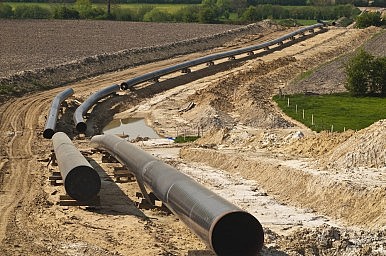
The Asian Development Bank this week oversaw the signing of an investment agreement among the four partners in the much-discussed Turkmenistan-Afghanistan-India-Pakistan pipeline. The four agreed to invest an initial budget of more than $200 million.
As has been frequently discussed in these pixels, the TAPI project is impressive in its ambitions and massive in its mysteries. Last December, Turkmenistan hosted a groundbreaking ceremony and in February regional media reported that Turkmen President Gurbanguly Berdimuhamedov had told a gathering of his ministers that “topographic, engineering and survey works have been completed for the construction of TAPI.”

The recent ADB press release, however, implies otherwise:
This [the $200 million investment] includes funding for detailed engineering and route surveys, environmental and social safeguard studies, and procurement and financing activities, to enable a final investment decision, after which construction can begin. Construction is estimated to take up to 3 years.
For years TAPI has been spinning its wheels, with the partners making periodic updates and statements which are a simple simulacrum of progress.
In an interview with Reuters, Sean O’Sullivan, the Central and West Asia director general of the ADB, said that present timetables peg 2020 for completion of the pipeline, which will carry 33 billion cubic meters (bcm) of gas annually from the Galkynysh field in Turkmenistan to markets in Afghanistan, Pakistan, and India. According to Reuters, the current plans for the pipeline include an underground pipe through some of the most volatile regions in Afghanistan:

“I agree … we’re going through some of the toughest territory in Afghanistan,” said [O'Sullivan], a transaction adviser for the project.
“The challenge is there. There’s no doubt about it, but I am sure it’s doable.”
He added, “I think if it happens, it will be quite an unprecedented example of regional cooperation, particularly in a region that finds it difficult to cooperate.”