11 April 2021

US Destroyer Carries Out FONOP in Indian EEZ

By Abhijnan Rej

According to the United States 7th Fleet, USS John Paul Jones carried out a freedom of navigation operation near India’s Lakshadweep Islands on April 7. The Arleigh Burke-class guided missile destroyer “asserted navigational rights and freedoms approximately 130 nautical miles west of the Lakshadweep Islands, inside India’s exclusive economic zone, without requesting India’s prior consent, consistent with international law,” a statement from the Fleet claimed.

“India requires prior consent for military exercises or maneuvers in its exclusive economic zone [EEZ] or continental shelf, a claim inconsistent with international law. This freedom of navigation operation (“FONOP”) upheld the rights, freedoms, and lawful uses of the sea recognized in international law by challenging India’s excessive maritime claims,” the statement explained.

This is far from being the first time that the United States has challenged India’s position that it be served prior notice before foreign navies pass through its EEZs. Experts maintain that in order to further India-U.S. maritime cooperation, developing a common and shared understanding of international maritime law remains an imperative.

But the fact that the FONOP comes amid deepening maritime collaboration with the U.S. – and widespread enthusiasm in New Delhi’s strategic community about the Quad’s potential to develop a security architecture for the Indo-Pacific – has the potential to add complications. At the very least, it demonstrates that the U.S. remains concerned about what it describes as “excessive maritime claims” across the Indo-Pacific – and not just that presented by China alone in the region.


What the China-Iran Strategic Cooperation Pact Means for India

By Mahima Duggal

On March 27, China signed a landmark 25-year Strategic Cooperation Agreement with Iran, marking a renewed commitment to their Comprehensive Strategic Partnership established in 2016. News reports have claimed that the deal may be worth $400 billion in Chinese investments and provide Beijing with a source of cheap oil for the coming quarter century. The finalization of the deal – a draft of the 18-page document was leaked in June 2020 – caused a media frenzy, with many concerned that China and Iran were looking to form a new axis in the Middle East, aimed at undermining the United States.

India’s stake in the situation hinges on its interest in Iranian natural gas reserves and its desire for continued participation in the Chabahar port project with Iran. With the deal now inked, and considering India’s changing geopolitical and security environment vis-a-vis China, what are the key implications of the China-Iran pact for India? How can New Delhi respond to Beijing’s major drive to support Tehran?

A China-Iran Axis in West Asia?

Historically, China’s relationship with Iran has been a positive, albeit largely limited one. China has been exceedingly careful in its dealings with the turbulent Middle East; it has cautiously adhered to a balanced policy of not cozying up to Iran and maintaining an equidistant relationship with rival Gulf nations like Saudi Arabia and the United Arab Emirates (UAE). In fact, a quantitative analysis of China’s economic and security engagement in West Asia found that Iran is lagging in comparison to other states like Pakistan and Saudi Arabia.

Did Lavrov’s India Trip Reset India-Russia Ties?

By Rajeswari Pillai Rajagopalan

Earlier this week, Russian Foreign Minister Sergey Lavrov took a two-day trip to India, where he met his Indian counterpart, S. Jaishankar. Lavrov then traveled to Pakistan from New Delhi. A statement from the Russian Embassy in Delhi stated that “[a] special and privileged strategic partnership with India is one of Russia’s foreign policy priorities.” During their joint press conference, the two foreign ministers reiterated the “time-tested” nature as well as the “the remarkable resilience” of their bilateral ties in the face of the increasing difficulties that have affected India-Russia ties in recent times.

Both Jaishankar and Lavrov did everything they could to show that all is well in the India-Russia bilateral relationship and they are looking at ways to reinvigorate their partnership further. It does not appear to have been enough.

India-Russia relations have seen their fair share of problems recently. Lavrov’s visit was meant to repair frayed ties. Jaishankar in his remarks at the joint press conference stated that bilateral ties continued to be “energetic and forward looking” and that the two sides reviewed their cooperation in areas such as nuclear and space technology and the defense sector. The two sides also took stock of economic ties that have been affected negatively by the pandemic and agreed to pursue new opportunities in Russia’s Far East. Highlighting the potential of connectivity in the bilateral context, Jaishankar and Lavrov talked about the International North-South Transport Corridor and the Chennai-Vladivostok Eastern Maritime Corridor. Jaishankar invited Russia to play a major role in India’s Atmanirbhar Bharat (“’self-reliant India”) economic vision that can provide new openings for a more contemporary dynamic economic relationship between the two sides.

IMPERIAL POLICING REDUX: THE FOLLY OF STAYING THE COURSE IN AFGHANISTAN

Paul Poast 

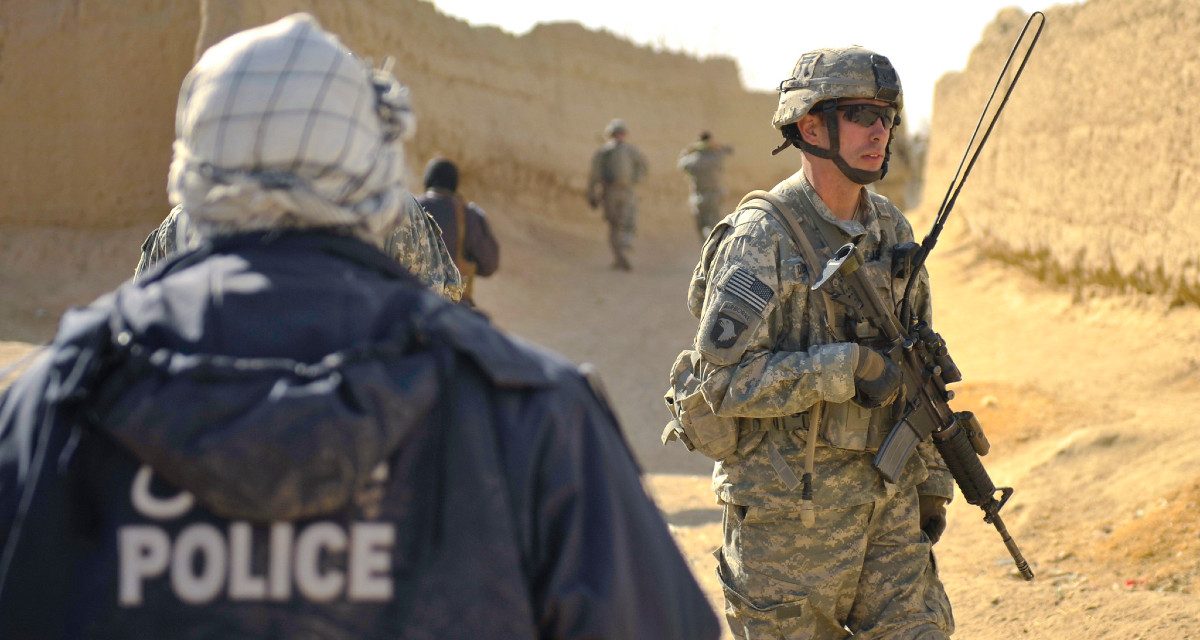
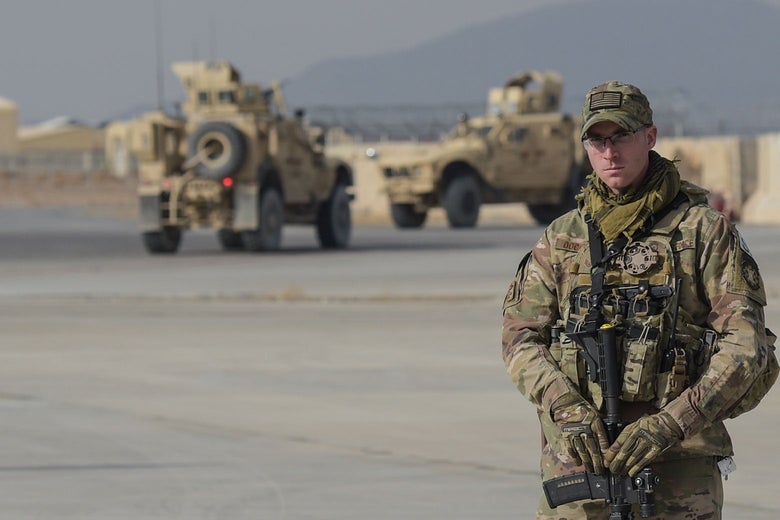
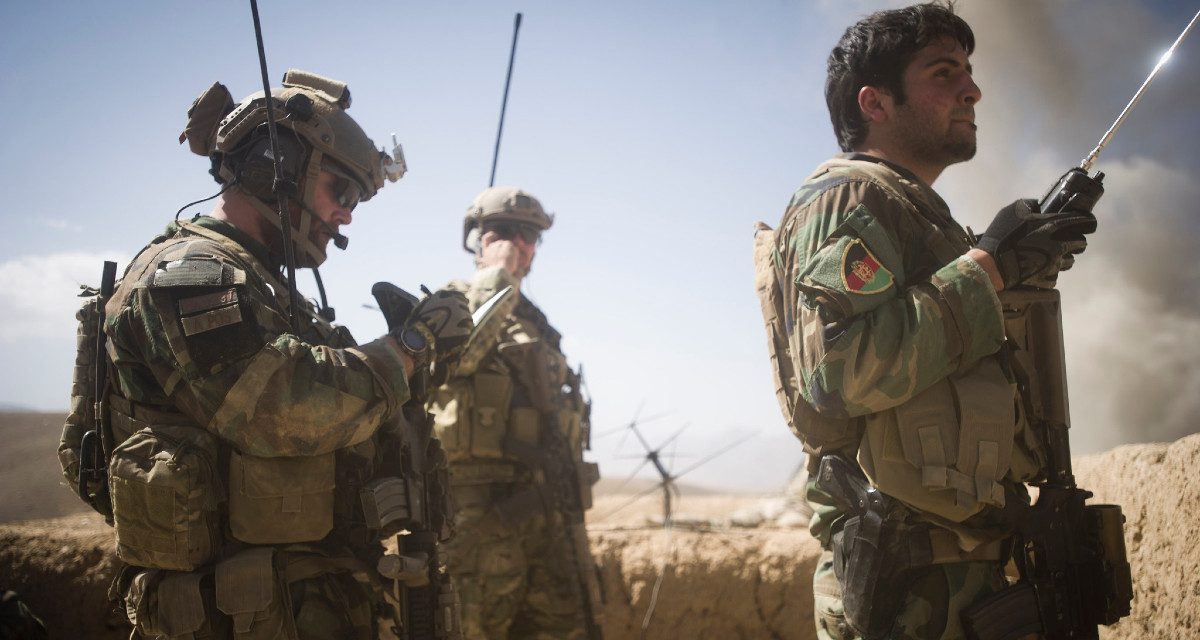
The US military is not an imperial police force. And yet, US policy in Afghanistan and elsewhere over the last two decades has normalized exactly this role. A change seemed possible just last year, when the Trump administration negotiated a deal to allow US forces to completely withdraw from Afghanistan by May 1, 2021. Under the terms of the agreement, the United States and coalition partners would gradually draw down forces and work to remove the Taliban from economic sanctions lists. In exchange, the Taliban would engage in intra-Afghan dialogue and prevent Afghanistan’s soil from being used to “threaten the security of the United States and its allies.” The removal of American forces on this timeline is now unlikely to happen. Instead, the withdrawal is delayed (possibly indefinitely) over claims that the Taliban is failing to uphold its commitments under the terms of the original deal.

The travails of removing US troops from Afghanistan highlight a more fundamental question: Does US national security require indefinite, low-level military engagement globally? On the one hand, the presence of US troops in countries such as Afghanistan, Iraq, and, until January, Somalia increases the perception that American troops are involved in endless wars that fail to serve American interests and suggests that America’s overall role in the world is a contributor of war, not peace. This perception contributed to planned troop withdrawals during the last administration and current bipartisan efforts to repeal various congressional authorizations for using force globally.

An Endgame in the Endless War

BY JOSHUA KEATING

When Americans call Afghanistan an “endless war,” they are generally referring to the conflict that began with the U.S.-led invasion of the country in 2001—an event many of the U.S. troops now there may barely remember, if they were even alive for it. In fact, this understates things. Afghanistan has been in a state of ever-mutating war for more than 40 years, with various levels of American involvement throughout.

Last year, the Trump administration attempted to bring an end to the 20-year portion of the war by striking an agreement with the Taliban for the withdrawal of the last U.S. troops from the country by May 1, 2021. Technically speaking, that deadline is still in place. But at his first press conference as president last week, Joe Biden all but confirmed what’s been obvious for some time: U.S. troops will still be in the country in May. “It’s going to be hard to meet the May 1 deadline,” he said. “Just in terms of tactical reasons, it’s hard to get those troops out.”

It’s true that such a withdrawal would take months to carry out, but this answer was also somewhat misleading, given that the administration has been in office for more than two months and could have ordered withdrawal preparations immediately had it wanted to.

Biden is a longtime skeptic of the U.S. mission in Afghanistan—almost alone among Barack Obama’s senior officials, he opposed the 2009 troop “surge”—but he also doesn’t particularly relish watching the country collapse, or the Taliban take power, after the U.S. leaves. This has led to a last-ditch effort to forge a peace agreement between the Taliban and the U.S.-backed Afghan government. However, Biden also said that he “can’t picture” U.S. troops being in Afghanistan next year, which gives diplomats just a matter of months to end the 40-year war. It’s a tall order.

A road map for the Quad

BY W. BRUCE WEINROD

The People's Republic of China is engaging in a relentless military buildup that poses a serious security threat to the U.S. and its allies and friends in the Indo-Pacific region. In order to deter or if necessary prevail against Chinese military aggression, it is essential that the U.S. not only enhance its own regional military capabilities but that U.S. allies and friends in the Asian region increase their own capabilities and enhance their security cooperation with the U.S.

For this purpose, the U.S. should utilize to the fullest extent possible the Quadrilateral Security Dialogue (known as the “Quad”), an informal regional multilateral structure composed of the U.S., Japan, Australia and India. Established originally as a Japanese initiative, the Quad has met irregularly over the years but without any meaningful security-related activities.

The Quad can act as a military force multiplier enhancing the combined regional military capabilities of key Asian nations as well as the U.S. Such strengthened security cooperation can also signal that the Quad’s Asian members are prepared to respond to China’s military challenge.

While an “Asian NATO” as such is not practical for various reasons, the Quad can instead adopt a NATO-like model and develop and implement strengthened multilateral security cooperation through a series of phases.

In the first phase, the Quad should establish regular contact among political and military officials, share regional threat assessments and compare approaches for combating terrorism and cyber attacks. The Quad can also organize multilateral search and rescue and disaster relief exercises which can provide useful preparation for subsequent regular military-related training.

Will Protests against China Push Beijing to Intervene in Myanmar?

Abby Seiff

Among the earliest images to go viral at the start of Myanmar’s anti-coup protests was a photo of an airplane unloading cargo. Source unknown, the picture was often paired with a second showing workers moving long army-green boxes from what appeared to be the inside of a plane. Netizens found evidence of nightly flights between the southwestern Chinese city of Kunming and Myanmar’s former capital Yangon and insisted the photos, therefore, had to be proof that Beijing was supplying Myanmar’s military, or Tatmadaw, with arms and ammunition. When the Chinese Chamber of Commerce in Myanmar released a statement saying the planes were delivering seafood, it was met with widespread mockery.

Angry with the results of the November election, which saw a landslide win for the ruling National League for Democracy (NLD) party, Myanmar’s military claimed electoral fraud. On February 1, they seized power from the civilian government, rounding up longtime NLD leader Aung San Suu Kyi and the rest of the country’s civilian leadership and unleashing an increasingly violent force against the public. Hundreds of thousands have since taken to the streets, and the military has arrested thousands and killed more than 500.

Almost from the start, protests against the coup have targeted not just the Tatmadaw, but neighboring China.

“China will work with whoever is in power, but the protestors believe that China should not have the liberty or the right to work with [an] illegitimate junta. If China does, it is perceived as China’s support of the junta,” China-Myanmar expert Yun Sun, Senior Fellow and Co-Director of the East Asia Program and Director of the China Program at the Stimson Center, wrote in an email.

Would Access to Cambodia’s Ream Naval Base Really Benefit China?

By Chen Heang

The potential establishment of a Chinese naval base in Cambodia has received extensive attention since the publication of report by the Wall Street Journal in mid-2019, claiming that Cambodia had signed a secret agreement granting the People’s Liberation Army Navy access to the Ream Naval Base on the Gulf of Thailand. Much of this attention has been devoted to speculation over what this means in terms of Cambodia’s relationship with China and the United States, and also its potential to augment China’s expanding military presence in the region.

The attention paid to the possible Chinese access to Cambodian naval facilities, however, too often ignores the realities of Cambodia’s geography. As we know, geography is crucial to understanding the strategic significance of military operations, and has profoundly informed the capabilities, limitations, and vulnerabilities of armed forces throughout human history. In this specific case, the geography of Cambodia suggests that China does not stand to gain much strategic advantage by equipping military facilities on the Kingdom’s shores.

Most notably, the waters off Cambodia’s coasts are not deep enough to be useful to a powerful navy. These waters, in the Gulf of Thailand, are on average about 50 meters deep. Where this base is allegedly to be situated, on the bay of Kampong Som, the water is only five to 10 meters deep.

These depths would not permit China to undertake major naval actions in the Gulf, and the use of submarines, among the most powerful weapons in any naval operation, would be rendered impractical. To assure a strike capability, a submarine must create low noise and electromagnetic waves in order to avoid radar, something that would be challenging in shallow waters like those found in the Gulf of Thailand.

Chinese armed attacks in West PH Sea to ‘trigger US obligations’ in defense treaty – official


Metro Manila (CNN Philippines, April 8) — The Biden administration remains steadfast in its support for the Philippines amid its ongoing diplomatic protest against China over the continued presence of Chinese vessels at Julian Felipe Reef in the West Philippine Sea.

US Secretary of State Anthony Blinken, in light of Chinese incursion in Philippine waters, has assured the activation of the mutual defense treaty between the two states if necessary.

"As we have stated before, an armed attack against the Philippines armed forces, public vessels, or aircraft in the Pacific, including in the South China Sea, will trigger our obligations under the US-Philippines Mutual Defense Treaty," Blinken's spokesperson Ned Price said on Thursday.

The decades-old military agreement between Manila and Washington states that each country would come to the defense of the other in case of an attack by a foreign country.

The US State Department quoted Blinken, "'United States stands with our ally, the Philippines, in the face of the PRC's [People's Republic of China's] maritime militia amassing at Whitsun Reef. We will always stand by our allies and stand up for the rules-based international order.'”

The Philippines on Wednesday started its plan to fire off daily diplomatic protests for each day Chinese vessels believed to be maritime militia refuse to leave Julian Felipe Reef. The country's officials have issued stern statements regarding their presence but the vessels still would not leave the area.

China’s Economic Self-Harm

MINXIN PEI

CLAREMONT, CALIFORNIA – Early last month, China’s rubber-stamp legislature, the National People’s Congress, officially approved the country’s 14th Five-Year Plan. The strategy was supposed to demonstrate that China has a long-term economic vision that will enable it to thrive, despite the country’s geopolitical contest with the United States. But before the ink on the NPC’s stamp could dry, China had already begun sabotaging the plan’s chances of success.

The 14th Five-Year Plan’s centerpiece is the “dual-circulation” strategy, according to which China will aim to foster growth based on domestic demand and technological self-sufficiency. This will not only reduce China’s reliance on external demand; it will also increase the reliance of its major trading partners – except the US – on access to its market and increasingly high-tech manufactures.

China has been laying the groundwork for this strategy for a while. Notably, at the end of last year, President Xi Jinping concluded the Comprehensive Agreement on Investment (CAI) with the European Union. He had to make some concessions to get there, but it was worth it: the deal had the potential not only to deepen EU-China ties, but also to drive a wedge between Europe and the US.

The Return of the Quad: Will Russia and China Form Their Own Bloc?


President Biden’s recent virtual Quad summit with the prime ministers of India, Australia, and Japan on the surface focused on regional security, emerging technologies, and climate change. But beyond that, the Quad summit marked the official return and strong embrace of this coordinating mechanism among maritime democracies to ensure stability in the Indo-Pacific region. Initiated during the George W. Bush administration to discuss regional security issues, today the Quad has a greater purpose: addressing strategic competition with China. Although the Quad is not a formal alliance, its renewed purpose has been catalyzed by China’s growing regional assertiveness: the militarization of so-called reclamation islands across the South China Sea; economic coercion against Australia and other countries; coercive pressure on Japan in the East China Sea; and its brinksmanship in the Himalayas, which resulted in the death of 20 Indian soldiers. U.S. strategy toward the Indo-Pacific will continue to be shaped by this strategic competition, as will the United States’ robust alliances and partnerships in the region.

As we know from Newton’s Third Law, for every action—no matter how positive for U.S. interests—there is an opposite reaction. Sino-Russian strategic cooperation was rapidly expanding before the Quad Summit, but Moscow and Beijing have responded to this renewed momentum and solidarity among the Indo-Pacific maritime democracies with a flurry of military exercises and diplomacy of their own, including a new embrace of Iran as well as warm words for North Korea and the Myanmar junta. It appears that Beijing and Moscow’s affection for Iran and North Korea is at best branding them as disrupters rather than winning them powerful allies. The wisdom of these latter moves is debatable, particularly as China’s aggressive language and counter-sanctions against the European Union and the United Kingdom drives the world’s democracies toward the United States and the Quad.

Still, the United States and its allies would be making a mistake to assume that Newton’s Third Law will inevitably move the international system toward a stark division between two blocs, or that Moscow and Beijing will be aligned by mutual interests beyond a common perception that democratic norms and Western alliance structures pose existential threats to their regimes. Indeed, over the course of history, Chinese and Russian interests in Asia have more often been in conflict than alignment. Moreover, the combination of Russia’s proficiency in disruptive malign influence and Chinese economic and military weight will add new and unwanted complications to U.S. and allied military and diplomatic strategies.

China’s Taiwan conundrum: Will use of force to unite be followed by new division?

BY FRANK CHING

In 2005, China’s National People’s Congress enacted an Anti-Secession Law. The law’s first article said its intent was to oppose “Taiwan’s secession from China” and to bring about “peaceful national reunification.”

The word “peaceful” occurs nine times and “nonpeaceful” three times in the law.

Thus, Article 8 says that “in the event … that possibilities for a peaceful reunification should be completely exhausted, the state shall employ nonpeaceful means and other necessary measures to protect China’s sovereignty and territorial integrity.”

That is to say, if Taiwan doesn’t agree to be absorbed peacefully, it will be forced to do so.

Beijing now feels that there is little likelihood of peaceful unification. Until 2019, the premier’s annual report to the NPC had a paragraph on “China’s peaceful reunification.” In 2020, the word “peaceful” was dropped. Last month, at the 2021 session, the word was again missing.

The signal has been picked up. On March 9, Adm. Philip Davidson, head of the U.S. Indo-Pacific command, warned that China might try to take over Taiwan “within the next six years.” Two weeks later, the man nominated to be his successor, Adm. John Aquilino, told U.S. lawmakers that the threat was more imminent “than most think” and called for urgent steps to strengthen defenses in the region.

Global Times, a nationalistic paper published by the official People’s Daily, has reported ongoing discussions on a new law that may provide a timeline to unification and measures to be taken to bring this about, including what life in Taiwan would be like in the future.

The Other Sides of Renegotiating the JCPOA Iran Nuclear Agreement


So far, most of the debate over the JCPOA agreement has been a repetition of the original debates that took place while the current agreement was first being negotiated. The public side of this debate focused almost exclusively on preventing Iran from getting enough fissile uranium and plutonium for a nuclear weapon, and it made no effort to describe what kind of nuclear weapon or nuclear force posture would be involved, what delivery systems would be involved, or what level of nuclear weapons yield and nuclear force Iran would or could acquire in a breakout effort.

These negotiations also took place at a time when few estimated how quickly Iran’s missile and UCAV/drone forces could develop, how quickly it could acquire precision conventional strike capabilities, how much it could expand its regional ties and influence, and what the potential effects could be of new Russian and Chinese arms transfers to Iran’s other forces.

They did not attempt to address the overall stability of the future military balance in the Gulf and MENA region or to reach compromises that were valid at the time – assuming that the agreement would be the first step in achieving a broader level of stability in the region.

The U.S. withdrawal from the JCPOA, Iran’s progress, and the increasing level of instability in the region have all changed these conditions. This does not necessarily mean that the JCPOA should not be revived, but it does mean that the JCPOA should be addressed in very different terms.
What kind of nuclear weapons can Iran design, partially test, and deploy?

Acquiring enough fissile material for one weapon is a “breakout” of a kind. It is not, however, any guarantee that a country can actually design and assemble a reliable weapon with a predictable yield and reliability – a weapon that Iran can trust to be almost totally reliable, and one that it can deploy in enough numbers to create a credible force.

Learning the Wrong Lessons From Suez

By Richard Hanania

In March, a ship got stuck in the Suez Canal. After six days, it was finally freed, thanks to the efforts of tugboat crews combined with shifting tides.

Before the freeing of the ship, analysts made dire warnings about how the crisis in the canal proved the inherent instability of the globalized economy. According to a headline in The Washington Post, “The Suez logjam shows how fragile our global trade system is.” Bloomberg went even further, saying, “Suez Shows Civilization Is More Vulnerable Than We Think.” One ship had shut down a route that accounted for more than 10% of international trade, and, the author argued, this showed how the existence of civilization itself is vulnerable to the closing of a few chokepoints.

The lesson of Suez is actually quite the opposite. Globalization does not increase fragility, but in fact makes supply chains robust against shocks. Once we understand this, we can see that many arguments for protectionism and investing heavily in American military primacy fall apart.

A recent White House document says it is the goal of American foreign policy to “defend access to the global commons, including freedom of navigation.” The United States must remain in the Middle East lest Iran close the Strait of Hormuz, according to former Secretary of State Mike Pompeo. Likewise, the U.S. Navy conducts Freedom of Navigation Operations through waters claimed by Beijing in the South China Sea, risking war in order to make sure they remain open to international shipping.

The problem with such arguments is that they ignore redundancies in the system, and the ability of consumers and producers to adjust to novel circumstances when given an economic interest to do so. If a street in your town is shut down, it does not mean that it becomes impossible to get from Point A to Point B. Some people will take other routes, while others will maybe rely more on public transportation or work from home. Eventually, the road will get fixed or a new one built.

Tracking Biden’s Progress on a Foreign Policy for the Middle Class

DAN BAER

In the early days of his administration, U.S. President Joe Biden has continued his campaign rhetoric on championing the needs of the middle class and working people. This policy focus unsurprisingly has animated his domestic agenda, particularly his successful passage of a pandemic economic recovery package and his newly unveiled infrastructure investment plan. But a focus on the middle class has also informed his outlook on foreign policy.

Yet drawing—and explaining—linkages between foreign policy decisions and the interests of working Americans is no straightforward task. How should the Biden administration set such an agenda and how should outside observers gauge the effectiveness of its work?

A SHIFT WITHIN A SHIFT

Biden’s boyhood home of Scranton, Pennsylvania, is an indispensable setting to his political narrative. It anchors his identity as a child of a working-class town, as a son who remembers his father’s job loss forcing the family to move, and as a political figure who has, for half a century, kept his eye on working people and the middle class. Those who have worked closely with the president report that this is more than a schtick. In the middle of briefings on a healthcare plan, tax reform proposal, or support package for early childhood education, he will stop meetings and ask his aides to cut the mumbo jumbo and explain what the proposal means for, say, a single mom with two kids working two jobs in Canton, Ohio.

Eclipsed by Fame

James Gleick

The world’s first scientist-celebrity, Isaac Newton, was entombed in Westminster Abbey with high ceremony, alongside statesmen and royalty, under a monument ornately carved in white-and-gray marble, bearing a fulsome inscription in Latin: “Mortals rejoice that there has existed so great an ornament of the human race!” His fame had spread far across the European continent. In France the young Voltaire lionized him: “He is our Christopher Columbus. He has led us to a new world.” An outpouring of verse filled the popular gazettes (“Nature her self to him resigns the Field/From him her Secrets are no more conceal’d”). Medals bearing his likeness were struck in silver and bronze.

When Stephen Hawking died, in 2018, the abbey buried his ashes a few yards away from Newton’s grave. Besides family and luminaries, the interment ceremony drew so many mourners that a thousand were chosen by lottery and 26,000 turned away. “His name will live in the annals of science,” said Martin Rees, Britain’s astronomer royal. “Nobody else since Einstein has done more to deepen our understanding of space and time.” Hawking’s own words—generated by a speech synthesizer he used after a degenerative disorder took away his ability to speak—echoed from loudspeakers placed around the church: “I am very aware of the preciousness of time. Seize the moment. Act now. I have spent my life travelling across the universe inside my mind.” Far away in Spain, a radio telescope beamed the same words into the heavens. Benedict Cumberbatch, who had portrayed Hawking in a television movie, read from the Wisdom of Solomon: “For it is he who gave me unerring knowledge of what exists.” The abbey choir sang. Now the gift shop sells a postcard of his gravestone.

Hawking was no Newton. He said so himself. At a White House event in 1998, First Lady Hillary Clinton read a question from the Internet: “How does it feel to be compared to Einstein and Newton?” He replied, “I think to compare me to Newton and Einstein is media hype.” Then again, as Charles Seife demonstrates in Hawking Hawking, he “worked very hard to cultivate” these comparisons. He played for the White House audience a clip of his cameo appearance on Star Trek: The Next Generation, in which he banters with holographic representations of Newton and Einstein over a game of poker. Einstein calls his bet: “All the quantum fluctuations in the universe will not change the cards in your hand.” But Hawking is the winner in this game, as Seife recounts: “‘Wrong again, Albert,’ Hawking gloats, a huge grin on his face, as a motorized arm reveals his hand. Four of a kind.”

FACT: The U.S. Army Plans to Take on Drone Swarms with Microwaves

by Peter Suciu

Here's What You Need to Remember: The AFRL THOR program has taken on the challenge to design, build and test an effective counter-unmanned aircraft system that could engage many targets at once, and at long distances. High-power microwaves have been seen as one solution to this challenge.

You don’t need to be a Marvel superheroes fan to know that Thor is the god of thunder. Now the U.S. Army is calling in the god-like powers, not of Thor but rather THOR—the Tactical High Power Operational Responder. This system, which was developed by the United States Air Force Research Laboratory's (AFRL’s) Directed Energy Directorate at Kirtland Air Force Base (AFB), can address the increasing threat posed by enemy drones and other airborne threats.

While still in the prototype stage, THOR doesn't have a mighty hammer, but rather utilizes directed energy to disable the electronics in drones. It was specifically engineered to counter multiple targets including drone swarms with rapid results.

It is compact enough that the platform can be housed in a twenty-foot-long shipping container and can thus be stowed and transported via a military cargo plane, and when deployed in the field can be assembled by just to people. And much like the fictional Avengers, this is clearly a team effort that involves the Army and Air Force.

“The Army’s directed energy capabilities will need to provide a layered defense with multiple ways to defeat incoming threats,” said U.S. Army Lt. Gen. L. Neil Thurgood, director for Hypersonics, Directed Energy Space and Rapid Acquisition.

Experts Torn on Proper Role of National Cyber Director

BY MARIAM BAKSH

Former Cybersecurity and Infrastructure Security Agency Director Christopher Krebs is breaking with lawmakers and other cybersecurity professionals who are pushing the Biden administration to identify a national cyber director.

The position was created by a provision of the National Defense Authorization Act for fiscal 2021, but the administration has yet to name an individual to the post, which would operate with a staff of about 70 personnel within the Executive Office of the President but outside of the National Security Council. The national cyber director would advise the president and the NSC while engaging with Congress and the private sector.

“There are some things that structurally the National Security Council is not really well set up to do, and two of them, in particular, are interacting with the private sector and interacting with Congress, which is actually something that you very much need to be doing in cybersecurity policy,” Michael Daniel, president and CEO of the Cyber Threat Alliance, said at a Center for Strategic and International Studies event Wednesday.

Daniel, who served as cybersecurity coordinator within the NSC during the Obama administration, said, “That's why I think that actually having a national cyber director that is [an] office within the broader Executive Office of the President, so those set of agencies that directly support the White House, is critically important.”

Former President Donald Trump’s national security director eliminated the cybersecurity coordinator role within the NSC in 2018. The national cyber director position was conceived as a way to fill the void. The individual would coordinate the cybersecurity roles of various government entities and require Senate confirmation.

While President Joe Biden has not filled the national cyber director position, he did appoint Anne Neuberger to be deputy national security advisor for cyber and emerging technology—a position within the National Security Council. She was serving as cybersecurity director for the National Security Agency under Trump.

Vaccinate the Americas


Eric Farnsworth 

The White House’s announcement last month that the United States will offer millions of coronavirus vaccines to its two immediate neighbors, Mexico and Canada, is a welcome step toward the reversal of the Trump administration’s “America First” policies. But for humanitarian, economic and strategic reasons, it must be just the first step toward an intentional program of U.S. leadership to vaccinate the Americas.

In the global struggle against COVID-19, Latin American and Caribbean countries have fallen behind. Weak health systems, uncertain leadership, high numbers of informal workers and bad luck have created a perfect storm in the region. Even as the U.S. and other wealthy nations begin to reopen and look forward to a return to normalcy, Latin America and the Caribbean are struggling to climb out of their steepest economic contraction in over 100 years, wiping out a decade of anti-poverty gains and exacerbating already rampant inequality. Per capita GDP is not expected to recover to pre-pandemic levels until 2023, previewing yet another “lost decade,” in addition to financial strain and the high potential for political volatility.

Experts Torn on Proper Role of National Cyber Director

BY MARIAM BAKSH

Former Cybersecurity and Infrastructure Security Agency Director Christopher Krebs is breaking with lawmakers and other cybersecurity professionals who are pushing the Biden administration to identify a national cyber director.

The position was created by a provision of the National Defense Authorization Act for fiscal 2021, but the administration has yet to name an individual to the post, which would operate with a staff of about 70 personnel within the Executive Office of the President but outside of the National Security Council. The national cyber director would advise the president and the NSC while engaging with Congress and the private sector.

“There are some things that structurally the National Security Council is not really well set up to do, and two of them, in particular, are interacting with the private sector and interacting with Congress, which is actually something that you very much need to be doing in cybersecurity policy,” Michael Daniel, president and CEO of the Cyber Threat Alliance, said at a Center for Strategic and International Studies event Wednesday.

Daniel, who served as cybersecurity coordinator within the NSC during the Obama administration, said, “That's why I think that actually having a national cyber director that is [an] office within the broader Executive Office of the President, so those set of agencies that directly support the White House, is critically important.”

Former President Donald Trump’s national security director eliminated the cybersecurity coordinator role within the NSC in 2018. The national cyber director position was conceived as a way to fill the void. The individual would coordinate the cybersecurity roles of various government entities and require Senate confirmation.

The Perils of Overhyping Artificial Intelligence

By Julia Ciocca, Michael C. Horowitz, and Lauren Kahn

In 1983, the U.S. military’s research and development arm began a ten-year, $1 billion machine intelligence program aimed at keeping the United States ahead of its technological rivals. From the start, computer scientists criticized the project as unrealistic. It promised big and ultimately failed hard in the eyes of the Pentagon, ushering in a long artificial intelligence (AI) “winter” during which potential funders, including the U.S. military, shied away from big investments in the field and abandoned promising areas of research.

Today, AI is once again the darling of the national security services. And once again, it risks sliding backward as a result of a destructive “hype cycle” in which overpromising conspires with inevitable setbacks to undermine the long-term success of a transformative new technology. Military powers around the world are investing heavily in AI, seeking battlefield and other security applications that might provide an advantage over potential adversaries.

PSYOP, CYBER, AND INFOWAR: COMBATING THE NEW AGE IED

Chaveso Cook and Liam Collins 

Editor’s note: This article is the fourth in a series, “Full-Spectrum: Capabilities and Authorities in Cyber and the Information Environment.” The series endeavors to present expert commentary on diverse issues surrounding US competition with peer and near-peer competitors in the cyber and information spaces. Read the first three articles in the series here, here, and here.

Special thanks to series editors Capt. Maggie Smith, PhD of the Army Cyber Institute and MWI fellow Dr. Barnett S. Koven.

Extremist ideology and the associated mass-casualty acts of both domestic and foreign terrorism remain a threat to the global community. Ideology is the manifestation of deeper beliefs based upon intensely held but rarely understood underlying assumptions. A bullet may kill an extremist but it will not kill extreme ideology; that is, “Bullets do not kill ideas. . . . A ‘hot’ war against an idea is destined to be a losing prospect.” Arguably, 9/11-like events in the form of large suicide bombs will be replaced by mass media exploitation, political chess, electoral manipulation, and cyber intrusion via social influence mediums. These events will likely occur just beneath the surface, more improvised explosive device (IED) than weapon of mass destruction (WMD).

The ubiquity of the internet and social networking involves the exponential growth of a globally connected culture. As a consequence, a comprehensive understanding of the web is critical for the defense of our nation. As a manifestation of Moore’s Law, technology has advanced at an exponential pace and the associated technological platforms have evolved at an even higher rate. These platforms need to be understood, as recognized in the creation of US Cyber Command (USCYBERCOM) in 2009. However, it is possible that the social network is the new daisy-chained IED, in that it may be the case that USCYBERCOM is not best positioned to be the assault force, quick reaction force (QRF), or explosive ordinance disposal (EOD) team. To address this possibility, this article examines the reasons why psychological operations (PSYOP) forces have distinct advantages in comparison to the cyber community regarding online influence efforts.

PULLING LEVERS, NOT TRIGGERS: BEYOND DIRECT AND INDIRECT APPROACHES TO IRREGULAR WARFARE

Cole Livieratos 

In all fighting, the direct method may be used for joining battle, but indirect methods will be needed in order to secure victory.— Sun Tzu, The Art of War

The plan on paper was that the indirect actions were primary, and that direct action was only meant to buy space and time. But in practice, direct action came to rule the day.—Admiral Eric Olson, former commander of US Special Operations Command, October 8, 2020

After two decades of waging irregular warfare the United States remains ineffective at influencing populations. Rather than using its power to achieve legitimacy through persuasion and influence, the United States relies on two coercive approaches to irregular warfare: directly attacking enemy forces and training partner forces to directly attack enemy forces. The military refers to these as “direct” and “indirect” approaches, descriptions that differ according to narrow means, the who, rather than broader ways, the how. As a former Special Forces officer describes it, “both [approaches] come to the same place: killing somebody. The question then becomes who pulls the trigger.” This poor conceptualization leads the US military to overly focus on units and capabilities that employ coercion and neglect those that influence populations.

Why has the US military’s understanding of irregular warfare converged on the use of coercive force over the last two decades? In 1989, retired Colonel Arthur Lykke published a renowned article in Military Review defining strategy as the sum of ends, ways, and means. The reductionist formula has led to “an overemphasis on simplistically applying resources” while failing to develop creative ideas for how to employ them. The tendency to focus on means plagued the United States as it waged counterinsurgency and counterterrorism campaigns around the world after 9/11. Options focused too narrowly on the exact size and composition of US forces to the exclusion of how those forces should be employed. Instead, irregular warfare must be understood according to the ways, such as the type of power employed and the intended effect of that power. Alternative ways of population influence include information operations (persuasion) and defense institution building (inducement); though they have played a supporting role to coercive force in the post-9/11 era, they have not been considered independent approaches. State adversaries have taken note, adapting their own strategies to capitalize on America’s inability to conduct successful information and influence operations.

In the Wake of SolarWinds: Making and Breaking a Rules-Based Global Cyber Order

Anatol Lieven

Paul Kolbe is entirely correct in reminding us that there is a great deal we still do not know about the SolarWinds hack. Russian official responsibility does seem probable, but it is not absolutely proven. The strongest statement that the U.S. agencies concerned have come up with is that the hack was “likely Russian in origin.”

Kolbe’s article and Erica Borghard’s response are also very valuable for their warning of the need to distinguish between cyber espionage and cyber sabotage or terrorism, as this crucial distinction has been blurred by the loose and lazy term “cyber attack,” as well as by the hysterical response to the SolarWinds hack by some U.S. politicians, with their very dangerous talk of an “act of war” (on which I have written previously here and here).

I would however like to point out in response to Borghard that Russia’s denial of responsibility is absolutely normal in espionage operations, even when these have been unquestionably revealed. In 2006, the British government denied Russian allegations of a British spying operation in Moscow using a device hidden in a fake rock, though after a few years a former British official admitted that the story was entirely true. The difference in the case of cyber operations is that (with all due allowance for freelances and double agents) conventional espionage has been the monopoly of states. On the internet, there are vastly more opportunities for independent actors, seeking personal gain or mere amusement. Most teenage hackers in the U.S. are not working for the CIA.

The Air Force Is Making an App That Basically Does What a General Does

BY PATRICK TUCKER

Tentatively titled Arachnid, the nascent decision-support tool is a product of DARPA’s Adapting Cross-domain Kill-webs program, The vice chairman of the Joint Chiefs and other service vice chiefs were briefed on the app on Monday as part of a trip by the Pentagon’s Joint Requirements Oversight Committee, or JROC.

“You identify a threat and it's supposed to give you multiple options for what effect do you want to achieve on that threat,” said Lt. Col. Antony “Bigfoot” Braun, director Of operations at the Western Air Defense Sector of the Washington Air National Guard. “It says, ‘You want to scramble this base over here? You want to scramble this base over there? Here are the pros and cons and pluses and minuses associated with your timelines and all of those things.’”

“It’s trying to automate the decision-making cycle and then, from a machine-to-machine perspective, allow you to press a button and when you press that button it generates all the command messages.”

In other words, it’s a general in app form.

Service Chiefs Versus Combatant Commanders

By Mackenzie Eaglen

A military family feud is spilling into the headlines just as the Biden budget wars heat up behind closed doors. While this is unfortunate, it is also expected as uniformed leaders try to shape the narrative and frame the debate for policymakers.

The more interesting discussion, however, is the one going on between the service chiefs and the combatant commanders, which for the moment, appears pretty one-sided. Generals Berger and Brown have spilled ink now in two prominent publications to make their case that a longer-view needs to be taken on readiness, regional commanders’ demands for forces, and reprioritized investments toward competition with China. The Commandant of the Marine Corps and Chief of Staff of the U.S. Air Force have made a compelling case that now must be addressed and answered.

Overcoming ‘The Tyranny of the Now’

At the Pentagon, the inbox always wins. In a world of unsteady peace, the military is as busy as ever—steaming, flying, and driving all over the world every day to deter would-be enemies, assure friends and partners, and be present to train, exercise and be available should something flare up in regions of interest. In the words of a former Deputy Secretary of Defense, the result is one where “the Pentagon has been unable to treat regional combatant commander requests for forces as “desirements“ rather than “requirements.” So, the default answer for requests for forces is “yes.”’

Thankfully, Congress is paying attention. A bipartisan group of lawmakers, led by Rep. Rob Wittman (R-VA), has called for Pentagon leaders to scrutinize the mission demands placed on the United States military, treating the current strain on the services with needed seriousness. The members rightly identify the causes and consequences of unrestricted requests for forces from Combatant Commanders (COCOMs) and ask a series of smart questions regarding the nature of how additional force requests are managed, evaluated, and might be revised in the future. Much of this effort deserves applause, but three key recommendations merit particular commendation.

Overdue Task Prioritization in Alignment with the Defense Strategy

Congress wants reprioritization by defense leaders. They write that each additional Request for Forces (RFF) from COCOMs outside the Global Force Management Plan (GFMAP) should be considered “based on the extent to which it represents necessary mission, activity and task prioritization in alignment with the [National Defense Strategy].” That is exactly right, and all too often, the answer disappoints.

10 April 2021

Pakistan’s Geoeconomic Delusions

BY ARIF RAFIQ 

In recent weeks, senior Pakistani officials, including
the country’s powerful army chief
, have signaled or outright said that, from now on, their country’s foreign policy will emphasize geoeconomics. This is a welcome rhetorical shift. Decades of bartering Pakistan’s geostrategic value—including as a “front-line state” in the Cold War and war on terror—has contributed to the loss of countless lives, stifled human development, and turned Pakistan into a heavily indebted security state.

Geoeconomics would flip that script. Definitions of the term vary, but Pakistani officialdom uses it to connote something akin to an end to war. In a public address last month, Pakistani Chief of the Army Staff Gen. Qamar Javed Bajwa offered a “geo-economic vision” that centers regional integration and the collective pursuit of sustainable development in an environment of peace and stability. The upside for one of the world’s poorest and least integrated regions would undoubtedly be tremendous.

But good intentions aside, Pakistan’s pivot toward geoeconomics is likely to hit a brick wall of reality—and fast.

For starters, the country cannot easily escape geopolitics. And the regional outlook portends conflict, not connectivity. Neighboring Afghanistan could see civil war as the United States departs. And despite the restoration of a cease-fire with India along the Line of Control, there are no signs that either side will make the kinds of concessions on the Kashmir dispute that would be essential for lasting normalization.

Afghanistan: A Difficult Road Ahead, But Change Is Inescapable

By Abdallah Al Dardari and Zafiris Tzannatos

Afghanistan has made hard won gains in the last two decades, including the increase in education enrollments, expansion in health services, infrastructure development, improvements in regional connectivity, and progress ranging from doing business to gender equality. Last year could have been a turning point as peace talks were initiated, violence diminished during the early months of the year, and donors reiterated their support to Afghanistan by pledging critical funding and technical assistance.

Unfortunately, a peace agreement is yet to be reached. Violence has increased following the initiation of intra-Afghan negotiations last September. Improvements in governance and expanding national outreach have been delayed. Since the onset of the pandemic, GDP has shrunk by 5 percent, the budget deficit has increased, investment has collapsed, and exports have been reduced. The U.N. has estimated that half of the population will be in need of humanitarian assistance in 2021, a six-fold increase compared to four years ago.

“The best time to plant a tree was 20 years ago. The second-best time is now.” In the spirit of that proverb, the government’s Afghanistan National Peace and Development Framework (ANPDF II) outlines objectives and priorities that can turn the tide around. To support this effort, the United Nations Development Program (UNDP) in its most recent report on Afghanistan has assessed Afghanistan’s current constraints, opportunities, and challenges and proposes several policies and programs in line with triple axis of peace building, state building, and market building envisaged in ANPDF II.

Whether America Stays or Goes, the Taliban Will Control Afghanistan

by Michal ล enk

When the Trump administration announced in 2020 that it would begin a full withdrawal of troops from Afghanistan, many were quick to conclude that after almost two decades the United States was, in effect, conceding defeat in its longest war, capitulating to an insurgent group. A number of indicators certainly pointed in that direction. Signing the agreement with the Taliban served not only as a sober admission that, despite years of fighting, the Taliban remained undefeated. More importantly, as the United States bound the Afghan government to negotiate with the group, Washington effectively acknowledged that, in one way or another, the insurgent group was non-excludable from shaping the country’s future. To realize that the path towards stability leads through sharing power with an enemy may be an enlightened thing to do, but the human and financial costs of the twenty-year campaign hardly make it a cause for celebration in either Washington or Kabul.

The same cannot be said of the Taliban, though. Henry Kissinger famously noted that an insurgent wins “if he does not lose.” This means that all an insurgency has to do is stay put, resist, and wait until its adversary loses the will to carry on. With the U.S. departure in the cards, it is, then, not misplaced to argue that the Taliban has emerged with the upper hand from the drawn-out civil war. In fact, some go as far as to argue that the group has gotten exactly what it wanted: the moment the last of the U.S. boots leaves the ground there will be little stopping the Taliban from eventually reclaiming the country—a goal it has fought for ever since it was deposed in 2001.

Such concerns are clearly not lost on the Biden administration: it is currently reviewing the deal, raising hopes in security circles that the withdrawal might be delayed if there is a real prospect that it could lead to a Taliban victory. On the face of it, this is good news, as it might put to rest fears that deal was rushed through for the Trump presidency to secure a foreign-policy victory in an election year. But placing too much hope on the idea that the U.S. presence alone would be enough to avert the dreaded Taliban takeover is both falsely reassuring and dangerously misleading. In fact, although leaving in haste is hardly advisable, it is now possible to imagine that the Taliban might achieve its victory even if the United States stays.

The End of Quiet Diplomacy in Myanmar


BY COLUM LYNCH 

In the weeks following Myanmar’s military coup, United Nations special envoy Christine Schraner Burgener privately delivered a blunt appeal to foreign diplomats: Shun Myanmar’s military regime lest you lend it legitimacy, impose an arms embargo, and hit the coup plotters with targeted financial sanctions. Make it hurt.

The envoy’s outreach marked a stark departure from the U.N.’s traditional nonconfrontational approach to diplomacy, which places a premium on maintaining cordial relations with regimes in power. In the past, U.N. envoys to Myanmar, including Burgener, and other top officials have largely held their tongues in public, even when the country’s military, known as the Tatmadaw, threatened democracy and carried out mass atrocities against the country’s minority Rohingya Muslims.

The Feb. 1 military coup in Myanmar has changed that.

“I have to be loud now so that people understand that this is not acceptable,” Burgener said, who has been criticizing Myanmar’s military rulers as cruel and repressive since the coup in front of the U.N. Security Council and in interviews with the press. Burgener said the U.N. is not in a position to openly promote the imposition of sanctions before the U.N. Security Council, saying it is up to member states to make such decisions. China and Russia have made it clear they oppose sanctions. But she can offer governments her own advice.

She has been privately counseling a broad range of punitive measures against key sectors of Myanmar’s economy controlled by the military, including sanctions on Myanmar’s oil and gas sector. She has also urged sanctions against military economic powerhouses, Myanmar Economic Holdings Limited and Myanmar Economic Corporation, which own some 120 businesses in construction, pharmaceuticals, insurance, tourism, banking, and precious stone mining like jade and rubies, according to a report by a U.N. fact-finding mission. Burgener has advised one Asian delegate to invite State Counselor Aung San Suu Kyi—the former de-facto president who is now under house arrest after the coup—to the next Association of Southeast Asian Nations summit, sending a strong message that the legitimate government of Myanmar is not present.