SYDNEY J. FREEDBERG JR.
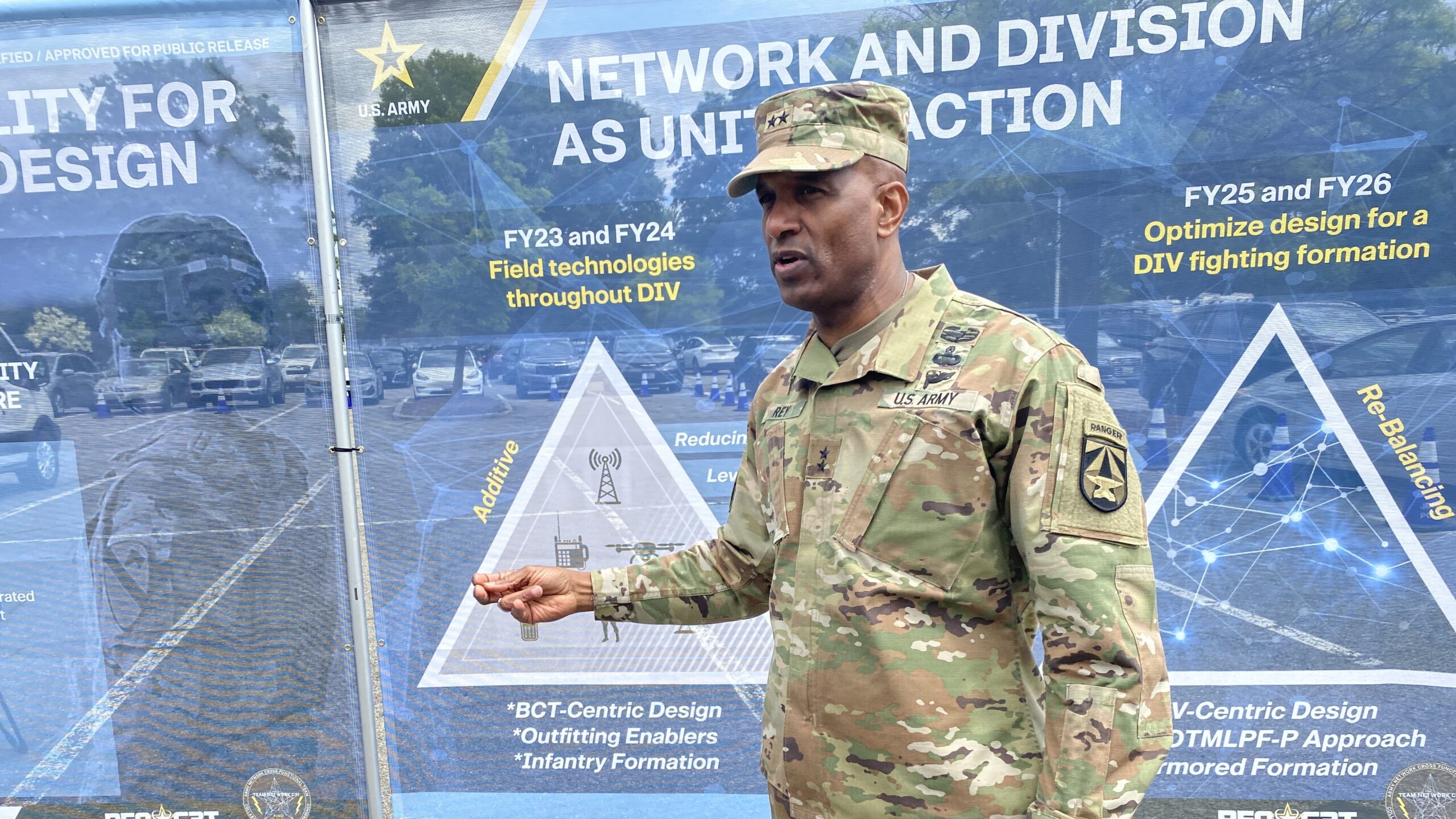
Maj. Gen. Jeth Rey briefs reporters at Fort Myer in May 2023. (Sydney J. Freedberg Jr. photo for Breaking Defense)
FORT MYER, Va. — As ceremonial cannons boomed intermittently in the distance, the two two-star generals tasked with modernizing the Army’s combat networks laid out how the lessons of Ukraine are forcing the service to speed up — both in acquisitions and on the battlefield.
“We need to be on the move,” said Maj. Gen. Jeth Rey, head of the Network Cross Functional Team at Army Futures Command. If US Army units, as currently equipped and organized, had to fight a high-intensity conventional conflict like the one ongoing in Iraq, their large and slow-moving headquarters units would be located by enemy drones or electronic sensors and struck by long-range missiles, rockets, or cannon fire in “minutes” of stopping to set up their communications gear.
“We don’t believe that their command posts are going to survive,” Rey said. “We can’t halt” to set up radio antennas and get connected to the network. Instead, the service needs command posts that can stay connected and communicate continuously while on the move.
That kind of mobility may require slimming down the complexity and capability of network equipment in smaller, front-line units like battalions and even brigades, said Rey and Maj. Gen. Tony Potts, the Army’s acquisition Program Executive Officer for tactical communications (PEO-C3T). The generals spoke at a briefing for reporters during a demonstration of Army communications tech.
One big example: classified networks. Today, Potts explained, units as small as front-line battalions — as few as 400 soldiers — are equipped with the Command Post Computing Environment, which requires bulky “tactical servers.” But if you want more mobile battalions, and you’re willing to let them rely on higher headquarters for some functions, “do you really need that level of command post computing inside a battalion formation?” he asked. What if you gave battalions smaller, cheaper systems available on the civilian market, networks not certified to handle classified data but still using robust “commercial standard encryption” — a standard known as “Secure But Unclassified – Encrypted” (SBUE).



 The Rooppur nuclear power plant currently under construction in Rooppur, Bangladesh, June 29, 2022. Credit: