ALINA POLYAKOVA
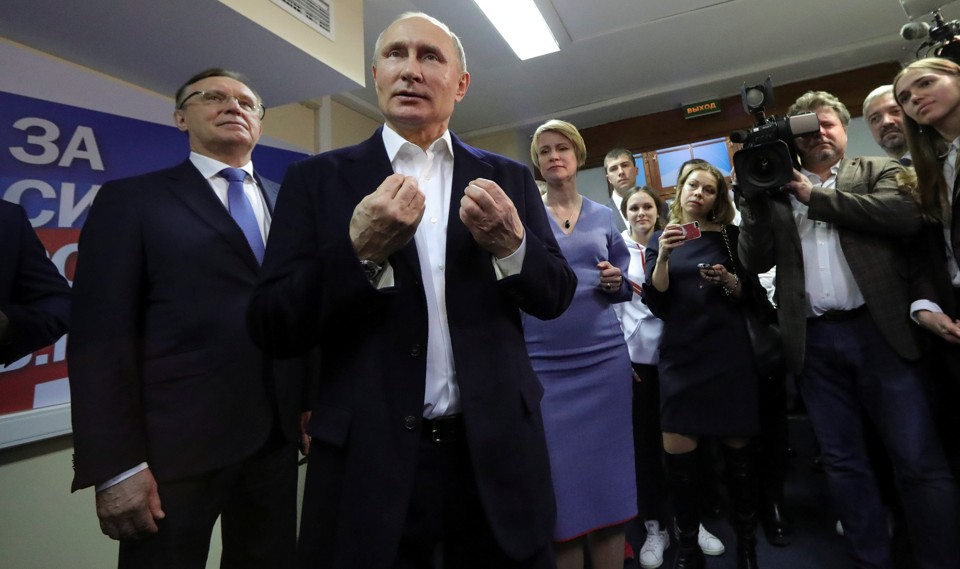 Vladimir Putin, Russia’s longest-serving ruler since Joseph Stalin, surprised no one with his landslide re-election on Sunday. While his victory, in which he claimed 73.9 percent of the vote according to state-run exit polls, was a foregone conclusion, the Kremlin was reportedly anxious about turnout, and conducted an elaborate, well-financed get-out-the-vote campaign. For an authoritarian regime in which election results and turnout are pre-ordained, such concerns may seem odd. But even in Russia’s “managed democracy,” appearances still matter, and the Kremlin needed to present believably high levels of support to ensure Putin’s mandate. Shortly after polling centers closed on Sunday night, Putin appeared to be on target to achieve the desired 65 percent turnout. But even more important for Putin is that this election marked the culmination of his nearly two-decades-long project to control information in Russia and manipulate Russian society. Now, Putin has proven beyond any doubt that the Russia he has built is his and his alone.
Putin began his long-running disinformation campaign when he came to power in 2000, taking over Russia’s independent television channels and bringing the oligarchs who owned them to heel or ousting them from the country. Since then, he has chipped away at free expression, political dissent, and independent voices one newspaper, one website, and one blogger at a time. Each new amendment to the law declaring NGOs as foreign agents and undesirables, each assassination of a journalist or political leader who went too far, and each expansion of what constitutes “extremist” content online (and thus, subject to censorship) brought Putin one step closer to this day.
Before the Kremlin unleashed its notorious Internet Research Agency (IRA) troll factory on the 2016 U.S. elections, it was busy testing its arsenal of disinformation tools on Russians. Moscow’s specific focus on online operations began after the 2011 protests against election fraud, which brought 100,000Russians to the streets of Moscow. The protests coincided with Putin’s return to the presidency in 2012 following a brief stint as prime minister. Reports suggest that it was at this point that the Kremlin launched what eventually became the IRA. As a recent indictment released by Special Counsel Robert Mueller detailed, the IRA’s elite “American unit” employed more than 80 people. But this foreign unit was a small part of a much bigger Russian-language influence operation aimed, first and foremost, at the domestic Russian population.
In 2015, when an undercover Russian investigative reporter infiltrated the IRA, it employed approximately 400 individuals. Today, it has ballooned to almost 1,000 employees and has moved to a new office three times the size of its original space. This expansion was planned in preparation for the March presidential elections. In the lead-up to the vote, the 900 or so Russian trolls, state-owned media outlets, and government officials, together deployed a coordinated and structured disinformation campaign. It had several themes: to deny any allegations of election fraud, to scare or entice Russians into voting to bolster turnout, and to blame all signs of dissent or corruption on the West and the Russian opposition (which, the Kremlin believes, the West controls).
On March 15, a user of the popular messaging app Telegram claiming to be an employee of the Russian-language section of the IRA published what he claimed were instructions on how to respond to inevitable allegations of election fraud. The instructions, shared on Telegram, included links to articles already created by the IRA to be used as sources when posting comments. Among other things, the instructions directed the troll factory’s employees to disseminate on social media a rumor that the West has been planning to interfere in the Russian elections, a claim previously made by the Russian foreign ministry. On election day, Interfax, a state-owned media organization, reported that the Central Elections Commission had prevented a cyberattack from 15 countries. No evidence of the attack was provided.
While social-media trolls amplified disinformation narratives aimed at legitimizing the brazenly illegitimate election, Russian television—the real powerhouse of the state’s propaganda machine—pushed hard to get voters to the polls. In Crimea, where residents voted in Russia’s election for the first time since its military takeover of the peninsula in 2014, fear mongering and conspiracy theories dominated the airwaves. As the Washington Post reported, the newly outfitted government television channels warned viewers that high turnout was the only thing protecting the Russian people from annihilation by the West. Elsewhere in Russia, regional officials sought to lure residents to vote by staging festivals and raffles for iPhones. Local businesses sold discounted clothing near polling stations, and some localities gave away free food, creating a holiday-like atmosphere. Some Russians went to extreme lengths to maximize their chances of winning the freebies. All of Russia seemed to be plastered in pro-Putin billboards and banners, with some of them even appearing in polling stations(which is against Russian law).
Working in unison to amplify and disseminate the same messages through state-run television, social media, and government officials, the Kremlin reached its desired benchmarks. It also accomplished something else, something perhaps even more important to Putin: despite recent protests against corruption across Russia and brazen instances of voter fraud, no demonstrations took place.
Basking in the glow of a pre-ordained “victory,” Putin must be pleased. Not just because he’ll be Russia’s president once again—a prospect he seemed bored with during his nonexistent re-election campaign. Rather, he’s no doubt thrilled because his diligent efforts to control information in Russia have finally blossomed. For Putin, this is the real victory.
No comments:
Post a Comment