


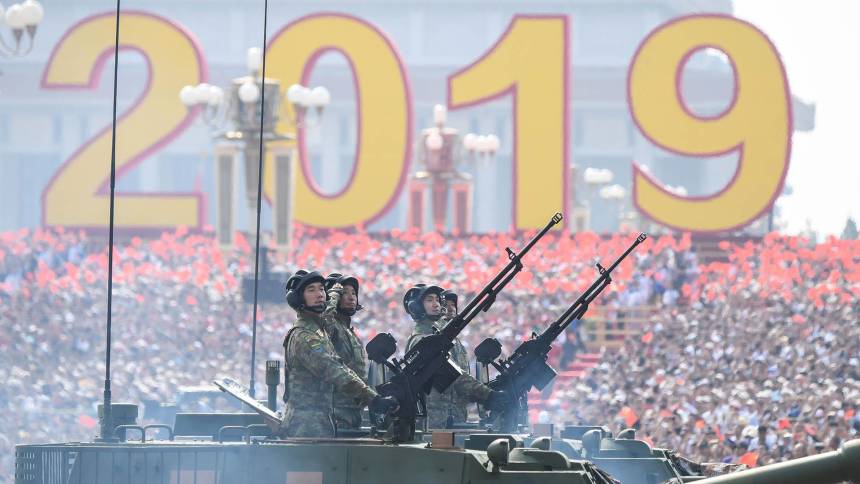
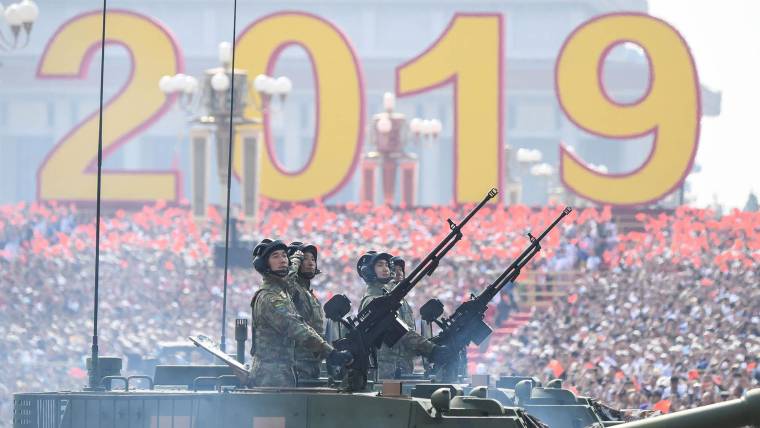
 The celebration of the 70th anniversary of the founding of the People’s Republic of China at the beginning of this month promised plenty of pomp and power projection. In the days leading up to the grandiose parade through Beijing’s Tiananmen Square, Chinese citizens began sharing photos of tarp-covered vehicles and missiles being rolled into Beijing for a rehearsal.
The event Oct. 1 didn’t disappoint. The People’s Liberation Army unveiled brand new high-tech drones, robot submarines and hypersonic missiles — none of which have an equivalent in operational service elsewhere on the planet.
China’s new military capabilities are tailored to its plans to become the dominant military power in Asia and the western half of the Pacific.
China’s rapid modernization is increasingly forcing the Pentagon to face the sclerosis in its own procurement pipeline arising from shifting program goals, endemic cost overruns and delays. Despite starting technologically well behind the United States, China has developed new systems faster and more cheaply.
They are doing so to counter American influence in East Asia, meaning U.S. ships and bases in the region are vulnerable to the advanced weapons systems in ways they weren’t just a decade earlier. There are some lessons in this for the Pentagon, and they need to be learned quickly.
After falling behind during the 1960s and the ’70s, China’s military spending rose in tandem with extraordinary economic growth that began in the 1980s — and in recent years has outpaced the broader economy, growing 7.5 percent in 2019. In addition, China has taken shortcuts by acquiring technology from abroad. Sometimes, this involved importing technology from France, Russia and Israel and reverse-engineering the components. But industrial espionage has also played a major role, including hacking that has stolen blueprints for F-22 and F-35 stealth fighters and top-secret Navy cruise missiles.
But the recent parade shows that it’s wrong to assume there’s no innovation taking place. Chinese scientists are performing cutting-edge research on quantum radar, laser-based submarine detection, hand-held laser guns designed to blind or burn, and particle teleportation with applications to communications and encryption. China still lags behind in jet engine design and submarine acoustic stealth, but it’s advanced in terms of radars, jammers and digital networking.
Beyond the new items shown off in the parade, China in the last year has also fielded its first entirely home-built aircraft carrier, its first amphibious landing carrier, new carrier-based radar and jamming planes and a cutting-edge light tank for use in the Himalayas, while developing an advanced long-range stealth bomber.
The weapons systems unveiled this month include the eye-catching “Sharp Sword” stealth drone shaped like a manta ray with two internal bays that could be used to carry weapons. While Russia, the U.S. and Europe have developed stealth attack-drone prototypes, none have any that are openly operational.
The even more exotic-looking supersonic DR-8 drone on display was designed for release from another plane in order to fly ultra-fast spy missions to determine whether China’s unique land-based anti-ship missiles have managed to hit their targets.
Perhaps even more troubling were the next generation of missiles on view. China’s new hypersonic missiles — which travel faster than a mile a second but have flatter trajectories than high-arcing ballistic missiles — will reach their targets faster and be harder to track and shoot down. While Russia and the U.S. are busily developing hypersonic weapons, neither has any land-based weapons in service.
The bizarre-looking DF-17 missile, for example, has a range over a thousand miles but can land within meters of its targets. DF-17s could strike U.S. bases in Japan and Korea within minutes of launch, destroying command centers and parked warplanes. China also sprung a new DF-100 hypersonic missile shrouded in mystery, but supposedly designed to sink large warships from over 1,000 miles away.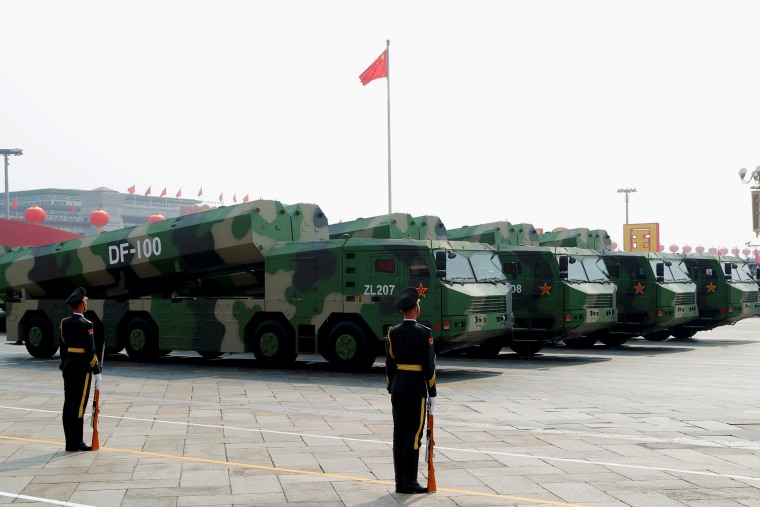 Military vehicles carrying DF-100 hypersonic cruise missiles past Tiananmen Square in Beijing on Oct. 1, 2019.Thomas Peter / Reuters file
Military vehicles carrying DF-100 hypersonic cruise missiles past Tiananmen Square in Beijing on Oct. 1, 2019.Thomas Peter / Reuters file
The piece de resistance was the reveal of two large HSU-001 unmanned underwater vehicles — robot spy submarines designed to patrol the depths without human direction, since a submarine can travel faster, deeper and more quietly when it doesn’t have to provide life support for human crew members. The U.S. only just awarded the contract to build its own long-range autonomous submarines.
China’s new military capabilities are tailored to its plans to become the dominant military power in Asia and the western half of the Pacific. Comfortably outgunning neighbors such as India and Japan. Having faced invasion by sea during the Opium Wars and World War II, Beijing sees U.S. warships and aircraft operating from bases in Japan, South Korea, Singapore, the Philippines and Guam as its chief military threat.
In contrast, the United States exists in a different strategic environment. It is flanked by two oceans without enemies nearby, and so relies on air and sea power to exert force abroad. Moreover, until July 2019 it was party to the INF treaty with Russia constraining land-based missiles.
Still, the U.S. hasn’t done itself any favors with a slow, bureaucratic and politicized process to develop new capabilities. It took the Pentagon more than two decades and more than $55 billion to develop the F-35 stealth jet before the cost of purchasing any gets counted. The number of orders of the Navy’s Littoral Combat Ship and Zumwalt stealth destroyer have both been drastically downsized after failing to live up to their promise. The Army spent $19 billion on two attempts to replace its Bradley fighting vehicles without result.
On the other hand, the Chinese approach also faces pitfalls. New systems may be rushed into service before they’ve been thoroughly tested, or lacking critical components. Many of China’s new jet fighters suffer from high accident rates and make do with stop-gap engines imported from Russia, as Chinese engineers struggle to get their home-built turbofans to perform at acceptable levels.
It’s also important to keep perspective on what China has achieved. The People’s Liberation Army is playing a massive game of catchup with the U.S., and it doesn’t expect to reach parity with the U.S. military until 2050. China’s official $177.5 billion military budget for 2018 is roughly a quarter of the U.S.’ estimated $693 billion budget (though some estimate the true figure in excess of $200 billion).
Nor is military modernization evenly distributed. Roughly a third of the PLA’s combat aircraft and tanks are of 1950s-era designs. Furthermore, the PLA has not fought in a war since 1979, and its leadership is painfully aware that training and doctrine need overhauling.
Nonetheless, the Pentagon is now trying to buy faster and smarter, while chopping away at funding for dated systems. The Navy is moving ahead with plans for drone warships and a heavily armed frigate. The Army has a six-point modernization plan that includes new short-range air defenses, missiles and a Bradley armored vehicle replacement that can optionally run without a human crew onboard.
Due to profoundly different social, economic and political contexts, America can’t entirely match the speed and cost of China’s defense buildup.
The new agile approach means quickly adopting off-the-shelf solutions to meet pressing needs, rather than developing super-weapons from scratch with Swiss Army knife’ capabilities. Even software upgrades can be sped up by removing red tape.
The trend favoring fast and practical solutions to operational needs rather than pie-in-the-sky wonder weapons that take decades to produce marks a positive shift — especially given the technological sea-change that’s occurring due to the proliferation of unmanned systems and long-range precision missiles.
Due to profoundly different social, economic and political contexts, America can’t entirely match the speed and cost of China’s defense buildup — particularly because China can more easily focus on projecting power across regional, not global distances. But the U.S. can still learn a few lessons from its new superpower rival while staying true to its unique strengths.
No comments:
Post a Comment