9 May 2015

US Navy’s Deadly New Gun Won’t Be Ready for Some Time

May 07, 2015

Naval Surface Warfare Center test firing in January 2008.

Given the global proliferation of guided-missile technologies and the ever increasing costs of defending against them, the U.S. Navy has put high hopes in the development of directed energy weapons systems, such as electrically powered electromagnetic projectile launchers (aka rail guns).

According to gizmag, “a rail gun is basically an electric motor that’s been folded out and laid flat. Like an electric motor, the rail gun uses an alternating electromagnetic field to pull along an armature (…) When it reaches the end of the rail, the armature releases the projectile, which flies toward its target.”

This new weapons system is capable of firing an aerodynamic shell at speeds of Mach 7.5 (5,700 mph /9,200 km/h) and having a reach of 110 nautical miles (126 mi / 203 km). With neither explosives nor propellant, rail guns rely only on electromagnetic forces to destroy an opponent. However, despite the hype, progress in acquiring this new weapon system has been slow.

Shinzo Abe’s ‘Glass Jaw’ and Media Muzzling in Japan

By Aurelia George Mulgan
May 08, 2015

The pressure on the press, both domestic and foreign, in Japan has been unprecedented under Abe. 

If there is anything that Japan’s current Abe-led administration and ruling Liberal Democratic Party (LDP) dislike intensely, it is media criticism of its actions and policies. This might explain the crackdown on freedom of the media in both electronic and paper formats in recent months. This is a worrying development that has even been picked up by the international press and by international organizations such as Reporters Without Borders, which has moved Japan down two notches to 61st place in its global freedom of press rankings.

The list is long of media-muzzling behaviors to which the prime minister and his office (Kantei) and the ruling Liberal Democratic Party (LDP) are increasingly prone. A short list includes: interpreting media criticism as “unfair” coverage; calling for “fair and neutral [namely uncritical] reporting” (e.g. on Abenomics and the 2014 election); labeling criticism of the government and its policies as media “bias”; grilling media executives by subjecting them to “questioning” over aired programs and complaining directly to them about their coverage; objecting to curb-side interviews and refusing to grant media interviews or to appear on TV programs until broadcasters apologize; threatening media organizations with action under the Broadcasting Law; and making references to the government’s authority to stop commercial TV stations from broadcasting. These behaviors are not unique to the Abe administration in Japan nor internationally, but are now setting the tone of government-media relations in Japan, which is new.

Australia-Indonesia Relations After the Executions

Public outrage at the execution of the Bali Nine ringleaders runs into political, diplomatic and economic reality. 
On April 29, 2015, Bali Nine ringleaders Andrew Chan and Myuran Sukumaran were executed by firing squad in Indonesia following a decade of legal challenges, intense Australian government and diplomatic pressure, and impassioned public opinion on both sides of the Timor Sea. As Australia continues to mourn this loss of life, and as Indonesia continues to justify its decision, attention now turns to the future of bilateral relations.

In the wake of the executions, Australian Prime Minister Tony Abbott has made it clear that bilateral relations will not simply continue in a “business as usual” fashion, while Foreign Minister Julie Bishop took a similar position, stating that the executions would “have consequences.” Speculation on the possible repercussions has followed, with some commentators specifically turning to the question of a potential reduction in Australian foreign aid to Indonesia as part of the upcoming May budget.

At a highly publicized press conference in the wake of the executions, Abbott and Bishop announced that Australia’s Ambassador to Indonesia Paul Grigson would be recalled. Other countries had already taken the same step in the wake of earlier executions in Indonesia, but this was a first for Australia. Still, while the seriousness of the recall should not be understated, there is little indication that it will be the harbinger of a more permanent freeze in relations. Indeed, shortly after the announcement, Indonesian Attorney-General Muhammad Prasetyo reportedly dismissed the withdrawal as a “temporary reaction.”

Close Neighbor

Tomorrow’s Small Wars Won’t Just Be Land Wars

MAY 6, 2015
The naval and coastal aspects of counterinsurgency get dangerously short shrift.

Imagine a crisis in a coastal country where terrorists and insurgents turn the littorals to their advantage. Are the United States and its allies ready for naval forces to play a key role in counterinsurgency?

Events in Yemen suggests this situation is already upon us. Houthi rebels, pushing deeper into a country surrounded on two sides by sea, have precipitated a regional crisis with several maritime dimensions. The rebels have received arms by sea, leading Saudi Arabia to blockade Yemeni ports, the United States to board freighters, and Iran to dispatch its own warships to the area. Saudi warships also shelled Houthi positions to prevent a takeover of the port city of Aden, while China, India, and Pakistan have evacuated their citizens by sea.

Meanwhile, Al Qaeda in Yemen has a deadly track record in the maritime space. In 2000, the group killed 17 American sailors aboard the USS Cole as it refueled in Aden. Two years later, it bombed the oil tanker MV Limburg off Yemen’s coast. In 2013, Ahmed Warsame, whom the Justice Department describes as a senior terrorist leader and who pled guilty to a material-support charge, was arrested on a boat in the Gulf of Aden while traveling between Somalia and Yemen. That same year, the Yemeni government reportedly disrupted a plot to attack shipping in the Bab al Mandeb strait. And just this month, Al Qaeda’s Yemeni affiliate overran a brigade defending the coast along Mukalla, the capital of Yemen’s largest province, and seized the city’s port.

Russia's Greatest Weapon May Be Its Hackers

MAY 7, 2015 

In hacker jargon, it’s called a “cyber-to-physical effect.” It’s when a hacker reaches out from the virtual world into the real one—often with catastrophic consequences. The Americans and Israelis pioneered the technique back in 2009 when the Stuxnet program infiltrated Iranian computer systems and wrecked thousands of uranium-enriching centrifuges. But now other players—especially the Russians and Chinese—are getting into the game of remotely using computer networks to destroy infrastructure and threaten human lives. Last year, according to a report by Germany’s Federal Office for Information Security, a blast furnace melted down in an unnamed industrial city in Germany after a digital attack on its control systems, causing “massive damage.”

It nearly happened in the United States too, when unknown hackers succeeded in penetrating U.S. electrical, water and fuel distribution systems early in 2014. While old-fashioned, relatively low-tech data hacks make headlines—for instance, high-profile break-ins over the last 12 months to the email systems and databases of the White House, State Department, Department of Homeland Security, Department of Defense and Sony Pictures Inc.—what has security officials seriously worried is the new and dangerous world of cyber-to-physical infrastructure attacks.

“This is not theoretical,” National Security Agency Director Admiral Michael Rogers told the U.S. House of Representatives’ Intelligence Committee recently. Hacking attacks on the U.S. and its allies are “costing us hundreds of billions of dollars,” Rogers warned, and will result in “truly significant, almost catastrophic failures if we don’t take action.

According to Alexander Klimburg, an affiliate of the Harvard Kennedy School of Government’s Belfer Center and senior research fellow at the Hague Centre for Strategic Studies, “cyberspace today is like Europe in 1914, before World War I. Governments are like sleepwalkers. They do not comprehend the power of new technology and the consequences of misunderstanding each other’s activities.”

Whatever Happened to Russia’s Silicon Valley?

James Appell
May 7, 2015

The Short Life and Speedy Death of Russia’s Silicon Valley

In the world of tech, six years is a long, long time. In 2009, the iPad was but a twinkle in Steve Jobs’s eye; 20 percent of the mobile phones sold in the United States were made by BlackBerry; and some of 2015’s finest procrastination tools — Instagram, Snapchat, even Candy Crush Saga — were still years away from release. It was in September 2009, against the backdrop of the world economic crisis, that the then-president of Russia, Dmitry Medvedev, unveiled an ambitious modernization program for his country.

Of the world’s major economies, Russia’s had fared the worst in the aftermath of the global downturn. GDP shrank by 7.9 percent across 2009, including a record 10.9 percent in the second quarter. Unemployment hit a peak of 9.4 percent in February of that same year. Going into the crisis, oil and natural gas had accounted for some two-thirds of exports. Many had already long recognized that Russia’s dependence on commodities exports was making it vulnerable, but Medvedev was the first Russian president to actively engage with the problem.

His solution was a set of reforms, sketched out in a 4,000-word treatise titled “Go Russia!” The reforms were designed to harness technology in order to equip Russia for the 21st century, and they covered industries ranging from nuclear power to space technology to pharmaceuticals. Medvedev’s reforms called for, among other things, a 40 percent reduction in Russia’s energy consumption by 2020, and the commercial generation by 2050 of power by thermonuclear fusion.

Russian Hackers May Be Putin’s Most Important Secret Weapon

Owen Matthews
May 7, 2015

Russia’s Greatest Weapon May Be Its Hackers

In hacker jargon, it’s called a “cyber-to-physical effect.” It’s when a hacker reaches out from the virtual world into the real one—often with catastrophic consequences. The Americans and Israelis pioneered the technique back in 2009 when the Stuxnet program infiltrated Iranian computer systems and wrecked thousands of uranium-enriching centrifuges. But now other players—especially the Russians and Chinese—are getting into the game of remotely using computer networks to destroy infrastructure and threaten human lives. Last year, according to a report by Germany’s Federal Office for Information Security, a blast furnace melted down in an unnamed industrial city in Germany after a digital attack on its control systems, causing “massive damage.”

It nearly happened in the United States too, when unknown hackers succeeded in penetrating U.S. electrical, water and fuel distribution systems early in 2014. While old-fashioned, relatively low-tech data hacks make headlines—for instance, high-profile break-ins over the last 12 months to the email systems and databases of the White House, State Department, Department of Homeland Security, Department of Defense and Sony Pictures Inc.—what has security officials seriously worried is the new and dangerous world of cyber-to-physical infrastructure attacks.

US Navy Expanding Its Cyber Attack and Defensive Forces

Joe Gould

US Navy Cyber Launches Strategic Plan

WASHINGTON — The commander of US Navy Cyber announced a five-year strategy, and like the Pentagon’s cyber strategy announcement two weeks earlier, acknowledged the dire need for talented workers with the skills to fend off the nation’s foes.

Vice Adm. Jan Tighe, who assumed command of Fleet Cyber Command/10th Fleet a year ago, said the US Navy is strengthening its ability to defend against intrusions, launch offensive cyber weapons and field 40 cyber mission teams — a task that is halfway done.

Cyber Strategy Relies on Deterrence, Industry

“You don’t get there from here unless you invest in the capacity pieces,” Tighe said of the Navy’s offensive cyber ambitions, “and that’s essentially what the cyber mission force has done; it’s granting capacity.”

The strategy re-conceptualizes the network as a “war-fighting platform,” which in real terms means assuring awareness, control and security of its networks. The plan comes after Iran reportedly breached Navy networks in 2013, though Tighe said there had been no such breaches since.

Imagine: F-22 Raptors For Export

May 08, 2015

So, who wants the F-22 Raptor? 

What if the U.S. Congress had never passed the Obey Amendment, and export of the F-22 Raptor had not been banned?
In 1997, the United States government determined that the Raptor, America’s most advanced air superiority fighter, could not be exported to any foreign government, even those of close allies. The unstated reason for this ban was suspicion that Israel would, if it gained access to the F-22, transfer technology associated with the aircraft to Russia or China. The United States cannot, as a political matter of course, single out Israel for a ban on the sale of advanced technology, and so the F-22 export ban covered all potential buyers.

On the upside, this left the United States as the sole operator of what is probably the world’s most effective air superiority aircraft. On the downside, it forced U.S. allies (not to mention Lockheed Martin) to rely heavily on the success of the F-35 Joint Strike Fighter, as well as legacy platforms.

Today, the F-22 might fly in the air forces of Japan, South Korea, Singapore, and Australia. Japan only slowly gave up its aspirations for the aircraft; while the production line for the F-22 still operated, Japan seemed to hold out some hope that the United States would come to its senses. If Japan had acquired the Raptor, the United States almost certainly would have also sold it to Seoul, if only to avoid a serious diplomatic incident. Australia would likely have become interested as well, and Singapore has proven a reliable customer for the most advanced U.S. systems.

A Better American Way of War

May 8, 2015 


"When we repeat the mistakes of the past, it is not because we are forced to because of bad habits. It is because we have failed to embrace the challenges of the future."

A global power with global interests can’t always afford to pick how it wants to fight. That is an essential insight for understanding the American way of war. And strategists are always eager to understand our way of war—especially when it seems to have failed us.

Consider Vietnam. After that humiliating defeat, American strategists entered into an intense state of soul-searching. What went wrong? One of the most compelling arguments came from historian Russell Frank Weigley. His bookThe American Way of War: A History of United States Military Strategy and Policy came out in 1973, the year the United States called it quits in Vietnam.

Weigley could not have been timelier. Everybody was looking for somebody to blame. The historian blamed our history. The strategic culture that emerged from America’s military past dictated a particular way to fight and win the nation’s wars. Following the Civil War, Weigley concluded, we grew addicted to a style of conflict that demanded massive resources, overwhelming force, superior technology, a dash of hubris and decisive, complete victory.

In Southeast Asia that formula failed. America fell into a funk.

Nevertheless, Weigley’s influence waned. Our obsession with the tragedy of Vietnam faded as the U.S. military went on a streak of wins from Panama to Desert Storm.

Soldiers take tough stance on physical fitness test failures

May 5, 2015
http://www.army.mil/article/147940

A Soldier, assigned to the 8th Military Police Brigade, completes a situp as part of an Army Physical Fitness Test during the 8th Military Police Brigade's Best Warrior Competition at Schofield Barracks, Hawaii, April 10, 2012.

WASHINGTON (Army News Service, May 5, 2015) -- Soldiers at the first-ever NCO Solarium said they felt the Army has gone soft on those who have failed their Army Physical Fitness Tests, or APFT, too many times - and called for more discipline in enforcing standards.

Sgt. 1st Class Jason Ruiz, Headquarters Services Company, U.S. Army North, said allowing Soldiers, who have repeatedly failed their APFT to stay in the Army is inconsistent with the idea that physical fitness is important.

"When Soldiers end up being retained, we feel it is a detriment to the unit and other units, who see that Soldier being retained," Ruiz said. "One of our recommendations is to remove the commander's ability to decline a separation packet for APFT failures."

Ruiz served as the spokesperson for the physical fitness group during the 2015 NCO Solarium on Fort Leavenworth, Kansas. During the Solarium, about 80 NCOs, from throughout the Army, were tasked to come up with solutions to problems involving education, Army culture, training, mission command, physical fitness, and Army vision and branding. Those Soldiers were then asked to brief the sergeant major of the Army on their findings.

EDUCATING THE U.S. MILITARY: IS REAL CHANGE POSSIBLE?

May 7, 2015

Editor’s Note: This is the latest article in our special series, “The Schoolhouse.” The aim of this series is to explore and debate the state of advanced graduate education in international affairs. We aim to move beyond the often-repetitive and tiresome debates about the usefulness of scholarship to policy. We believe there are deeper issues at stake. In this article, Joan Johnson-Freese addresses issues afflicting the sometimes-underrated and misunderstood field of professional military education.

Joint professional military education (JPME) in the United States needs to be fixed. And yet too few seem willing to take on the challenge. Through JPME members of the United States military learn professional skills, and as they progress in rank, they are prepared to transition from tactical to operational leaders, and eventually strategic leaders. Its importance was legislatively recognized when the 1986 Goldwater-Nichols Act mandated educational parameters for the military that have since developed into a continuum of learning. But alas, Congressional attention to PME has waned since its last champion and watchdog, Ike Skelton, left Congress in 2011.

Top military brass including Chairman of the Joint Chiefs Gen. Martin Dempsey say the right things. A 2012 speech by Dempsey at National Defense University was peppered with all the right words… “education is the strongest and most secure bridge to the future”…. “I want to ensure that our educational practices align with our needs and our expectations”… “education helps make military service the nation’s preeminent leadership experience.” He even called for “senior education leaders through the Military Education Coordination Council (MECC) to conduct a review… to update the value proposition of our joint professional education enterprise to meet — to determine whether we’ve got the attributes right, the outcomes rights [sic] that are demanded by the future security environment.”

The MECC, composed of representatives of the joint and service schools and any other JPME-accredited schools, is responsible for advising the office of the Joint Chiefs of Staff on scholarship and key educational issues. In effect, it controls military education.

8 May 2015

Threat of chemical weapons

Bhaswati Mukherjee
May 8 2015 

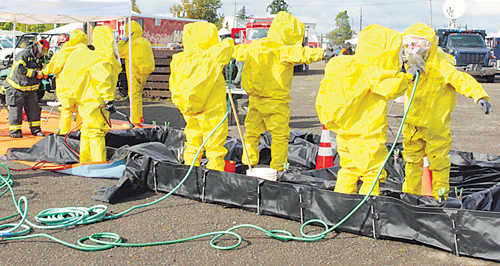
With the ISIS declaring an Islamic Caliphate, the alarming prospect of the use of WMDs (Weapons of Mass Destruction), including chemical weapons falling into jihadi hands, could become a reality. The issue re-emerged recently with ongoing media reports about the alleged use of toxic chemicals in several barrel bomb attacks in Idlib governate between March 16 and 31, 2015. These raised troubling questions. The scenario becomes more complex because Idlib has fallen to rebel forces. On March 18 Islamist group Jabhat al-Nusra and other armed opposition groups opened a major offensive against government forces in Idlib that culminated in its capture on March 28.

According to media reports, witnesses filmed remnants of barrel bombs. Among the remnants were containers typically used for refrigerants in refrigerators and air-conditioners. Videos and photos from the aftermath of five attacks, including material shared by the Syrian Civil Defence, show containers of a size, shape, and design commonly used for refrigerants. These canisters are easy to refill with other gases and widely available in Syria.

For Saudi Arabia, thanks but no tanks

F.S Aijazudin
May 8 2015 

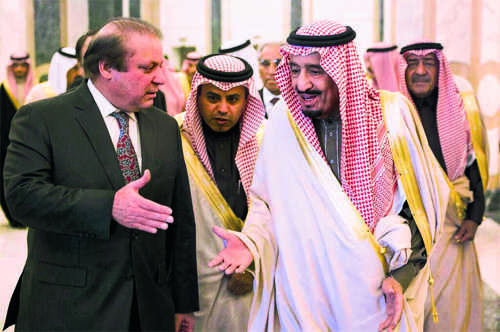
IF there is a name Prime Minister Nawaz Sharif has heard once too often, it is that of Bruce Riedel. Riedel retired from the CIA in 2006. His wife still works there. (The CIA like subcontinental politics and the US presidency is a family business.) In July 1999, when Nawaz Sharif made his lightning visit to Washington to invoke Bill Clinton's intervention after the Kargil fiasco, the only other person allowed in the meeting at Blair House, was a note-taker — Bruce Riedel. Within three months, Nawaz Sharif heard the name again. Bruce Riedel helped broker Nawaz Sharif's escape from Attock Fort. “After Sharif's ouster in a coup by Pervez Musharraf in 1999,” Riedel recalled, “he went into exile to Saudi Arabia, an agreement negotiated by myself for the Clinton administration to forestall Nawaz's execution. The deal was arranged with the influence of Saudi ambassador to the US, Prince Bandar bin Sultan.”

In 2011, Riedel (now a senior fellow at the Brookings Institution, Washington) revealed Saudi interest in Pakistan's nuclear programme. Riedel wrote: “In October 2003, then Crown Prince Abdullah visited Pakistan for a state visit. Several experts reported after the trip that a secret agreement was concluded that would ensure Pakistan would provide Saudi Arabia with nuclear technology and a bomb if Saudi Arabia felt threatened by a third party nuclear programme in the future. Both countries, of course, denied the stories.”

Once Upon a War

May 8, 2015


How strange it is that, on April 30, the 40th anniversary of the end of the Vietnam War — resulting in the victory of a tiny Asian country over the mightiest nation on earth, the United States — should have gone practically unnoticed here. This event of staggering significance (someone had written at the time that it was akin to “a butterfly having the better of a rogue elephant in combat”) merited attention, especially because India has always empathised with the Vietnamese. Even when we badly needed American food and financial aid, the food more than the cash. Two months after becoming prime minister in 1966, Indira Gandhi went to Washington to seek it without appearing to do so. Her top advisors counselled her to tell President Lyndon Baines Johnson that India “shared America’s agony over Vietnam”. She refused. All she was prepared to say to LBJ was: “India understands your agony”.

Clash of civilisations?

May 8, 2015 

A Pakistani blogger has taken on Samuel Huntington as Muslims fight what looks like a civilisational war. Under the heading “The farce called ‘The Clash of Civilisations’”, a well-regarded Pakistani journalist says that “a lion’s share” of the foreign jihadists joining the terrorist Islamic State in Syria-Iraq “have come from Europe”, meaning it is the West killing us in the Middle East. And the reason he gives is that “Europe has failed to assimilate them”.

Since 1993, when his article was published, Huntington has been opposed by many, which is understandable. But Europe’s “failure” to “assimilate” Muslims can be debated. Even the assertion that a “lion’s share” of jihadists in Syria-Iraq have come from Europe is hard to accept. (Out of the 20,000 foreign fighters, only 4,000 are from Europe.) The country sending the highest number of warriors to the IS is Tunisia, which is shocking because that’s the only country where the Arab Spring seems to have clicked. Why connect Huntington to the failure of Europe to “assimilate” expat Muslims? Is it because Europe believes in the clash and therefore treats them shabbily?

But our blogger thinks America must be treating Muslims better because not many American jihadists have joined the IS. But if you ask any al-Qaeda loyalist, the war is against America and not so much against Europe, which is nicely persecuting its Jews these days and making them run away to Israel. I dislike the idea of a “clash” a la Huntington because I don’t want this clash, not because I think Huntington cooked up some of his theses. I find him a greatly prescient thinker and don’t want Muslims to make his thesis come true. His vision was based on realpolitik; he was no universal philosopher.

The Battle Within Indian Army For Promotions


The Supreme Court is currently hearing a case that is likely to have serious implications for the cohesion and ethos of the Indian army. The matter pertains to the policy adopted by the Army Headquarters in 2009 for promotions of officers of the rank of Colonel, Brigadier, Major General and Lieutenant General. A group of nearly 200 serving army officers have challenged this policy, which grants disproportionate vacancies to two arms - the infantry and artillery - and so stunts the career prospects of officers from others arms and services.

In March 2015, the Armed Forces Tribunal (AFT), which is the departmental tribunal of the military, effectively vindicated the stance of the petitioners by holding that the army's policy violated Article 14 of the Constitution which guarantees the right of equality of opportunity. In response to an appeal by the government, the Supreme Court has stayed the AFT's ruling, but has urged the government to expedite its submissions.

The mere fact that such a large number of officers have chosen the path of litigation underscores the salience of the issue and the simmering discontent in the army. Unless, tactfully handled the outcome of this legal battle might deeply dent the professionalism of the army.

The root of the problem stretches all the way back to the Kargil Review Committee (KRC) of 1999, which recommended reducing the average age of battalion and brigade commanders - i.e., colonels and brigadiers - to enable higher operational efficacy. The KRC was arguably barking up the wrong tree. Enhanced combat effectiveness would actually require reducing the average age of Junior Commissioned Officers, who are typically in their 40s, and at the sharp edge of combat as platoon commanders. 

The war without an end

07 May , 2015

Insurgency has been independent India’s biggest curse where national integration is concerned. Given the vastness of the land and the remoteness of some of the border states, it wasn’t very surprising that differences should arise between them and the Union, due to the various irritants related to socio-cultural frictions, economic disparities and the like. And there were always negative elements that form part of every society, power-seekers and bigots, to exploit the situation to meet their selfish ends, their sinister designs invariably aided and abetted by the country’s unfriendly neighbours.

…the Punjab Insurgency has been the only one so far to have been successfully put down by a police force.

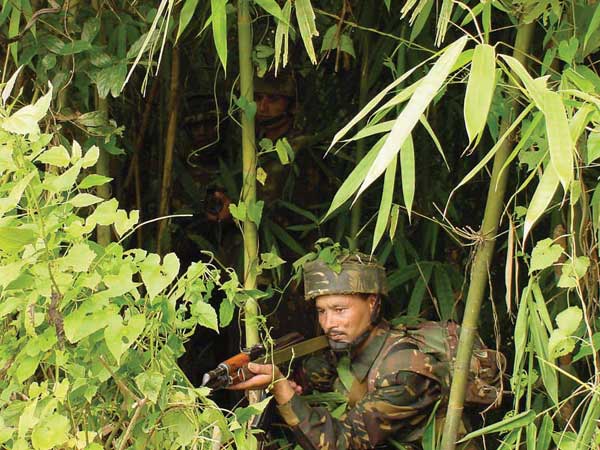
While the government is compelled to resort to use of military power whenever things get out of hand and the police and the para military forces can no more handle the situation (which happens far too often and in most cases in our country), it calls for the armed forces to perform in a manner that isn’t in conformity with their training and inclination. Whereas in a war a soldier’s role – to kill the enemy who is invariably a foreign national – is cut out for him, the counter-insurgency operations place restrictions on him which are tantamount to reducing his role to that of an armed police man. He is at a constant disadvantage, since the ‘enemy’ is never clearly identifiable from the rest of the citizenry which cannot be harmed. And even when identified, an insurgent, being an Indian citizen, is entitled to his rights and privileges which have to be respected. Such cumbersome activity, besides sapping the morale of the troops to the grave detriment of their combat potential, erodes the respectability of the armed forces among the civilian population.

The India Media's PR Disaster in Nepal

Nepal is not happy with the way the Indian media conducted itself in the wake of the great earthquake. 

Within six hours of the earthquake that struck Nepal on April 25, India sent men and materiel to aid in rescue efforts. By the next day, huge rescue teams had arrived, and Prime Minister Narendra Modi held an emergency cabinet meeting to plan India’s response. Indian media outlets were bullish about promoting New Delhi’s efforts. Nepali journalists also wrote favorably about India’s decisive response.

But just over a week later, the narrative has changed. There are murmurs of discontent in the Nepali media about India’s role in the rescue mission. Some are also upset about the conduct of the Indian media in covering the worst natural disaster to ever hit Nepal.

On Sunday, the hashtag #GoHomeIndianMedia began trending on Twitter, with thousands haranguing the Indian media over perceptions that its coverage had been jingoistic and insensitive. Critics back in India are also questioning the coverage, which has centered around New Delhi’s magnanimity toward Nepal in the wake of the disaster.

I received a barrage of complaints the moment I broached the subject in Kathmandu.

“If you are helping us, then why are you hyping it?” Rajesh Joshi, a member of the municipal government in the city’s Bhaktapur neighborhood, told me. “Why do you need to bring up the name of your prime minister and your country when you’re talking about the earthquake?”

He blames the Indian government for acting selfishly in the early days of the rescue operation. “India was more concerned with rescuing its own citizens than saving Nepali lives.” Joshi lost his house in the earthquake and has been living in a tent with his family for over a week.

3 Pakistani Militant Groups Announce That They Have Merged With Pakistani Taliban

3 jihadist groups merge with Movement of the Taliban in Pakistan

Bill Roggio

The Long War Journal, May 6, 2015
Three jihadist groups, including one led by a key commander who has served as a senior leader in al Qaeda and the Lashkar-e-Jhangvi, have united with the Movement of the Taliban in Pakistan. The merger is part of the Movement of the Taliban in Pakistan’s efforts to rebuild itself, likely with the guidance of al Qaeda. The jihadist organization split in 2014 after a contentious leadership dispute that festered when the US killed the group’s former emir, Hakeemullah Mehsud, in a drone strike.

Muhammad Khurasani, a spokesman for the Movement of the Taliban in Pakistan (TTP), announced today that three outfits led by “Commander Qari Matiur Rehman,” “Commander Qari Ehsanul Haq,” and “Commander Muhammad Shamil,” merged with the overarching Taliban group, according to a translation of a statement that was obtained by The Long War Journal. Rehman, who is “also known as Commander Abdul Samad” and has served as a senior leader in al Qaeda and the Lashkar-e-Jhangvi, leads all three groups within the Movement of the Taliban in Pakistan.

“All three of these groups united under the leadership of the respected Commander Matiur Rehman, may God protect him, and became a part of the Tehrik-e-Taliban Pakistan [Movement of the Taliban in Pakistan],” Khurasani said in a statement that was issued on Umar Media, the official website of the group. Khurasani said that the three jihadist entities “were always important groups in the jihad of Pakistan and have been since the beginning. ”
“Prior to this, these organizations worked with and cooperated with the Tehrik-e-Taliban Pakistan, but were not officially part of the Tehrik-e-Taliban Pakistan,” he continued.

The merger is part of Movement of the Taliban in Pakistan’s attempt to rebuilt its shattered image in the wake of the 2014 death of Hakeemullah Mehsud, the group’s former emir. The Taliban appointed Mullah Fazlullah to lead the TTP, but multiple factions were unhappy with the choice and split, including two Mehsud factions in North and South Waziristan, and a large branch led by Omar Khalid Khorasani. But Omar Khalid Khorasani’s faction (Jamaat-ul Ahrar) and Lashkar-e-Islam joined the Movement of the Taliban in Pakistan early last month as part of the effort to mend the rift between the jihadist groups. [See LWJ report, Pakistani jihadist groups, Lashkar-i-Islam merge into the Movement of the Taliban in Pakistan.]

The Unfinished War in Afghanistan: 2001-2014

Vishal Chandra
Price: Rs. 1495 [Download E-Book] [Buy Now]

This book makes a modest attempt to contribute to the ongoing debate on future challenges for Afghanistan as the largest ever coalition of Western forces prepares to withdraw. It seeks to examine key political developments within Afghanistan over the last one decade in response to the US-led Western military and political intervention. Perhaps, much more is still to come in a war that could aptly be termed as the last big war of the twentieth and first long war of the twenty-first century. The emerging social and political narratives are unmistakably old and echo the sentiments of the past. Though a 'New Afghanistan' has emerged in the meanwhile, it remains fundamentally an urban phenomenon. The diversity of narratives and perceptions, and failure of past political transitions to build a sustainable internal balance of power, based on changed social and political realities, have turned Afghanistan into a complex entity that defies established theoretical formulations and explanations. The evolving security and political scenario suggests that elections alone may not help bring stability and order to Afghanistan. The next dispensation in Kabul, irrespective of its composition, is most likely to be confronted with a host of old and familiar challenges to its legitimacy and survival.
About The Author

4 Sentenced to Death in Farkhunda Murder Trial

The four day trial strikes some as too short, with actual justice lacking. 

Wednesday, four men were convicted and sentenced to death for the murder of Farkhunda, a 27-year old woman who was killed by a mob outside a Kabul shrine. Zain-ul Abedeen, one of the men sentenced to death, had had an existing dispute with Farkhunda over his selling amulets at the Shah-e Do-Shamshera shrine in central Kabul. Farkhunda, according to her family a long-time student of Islam, considered the good luck charms un-Islamic. According to the AP, she “regarded the amulet sellers as parasites and told women not to waste their money on them.”

The specific details of what occurred before the mob formed are murky, but several filmed Farkhunda’s assault and death on their cellphones after the amulet seller accused her of burning a Quran, a charge authorities say was spurious. The graphic videos show her surrounded, stomped, and beaten bloody, by a crowd of men. She was then run over by a car and set on fire, before being thrown in the Kabul River.

Her death and the outrage on display at her funeral — which drew hundreds and included a group of women insisting that they carry her coffin – seemed to focus global attention once again on the plight of women in Afghanistan.

Talking About a ‘Rising China’: An Analysis of Indian Official Discourse 1996- 2012

Peter Van Der Hoest

IDSA Occasional Paper No. 38

This Occasional Paper looks at the idea of China being a potential security threat as spoken about in India's official discourse that is, as written down in annual reports or governmental statements or mentioned in the speeches of Indian officials. It does not analyse India's foreign policy, the strategic environment, or offer a new perspective on the development of bilateral security relations. Instead, the aim is to identify which drivers and themes figure most prominently in New Delhi’s publicly uttered concerns over a rising China, and to see if, when and how India’s official rhetoric has changed over time. The three themes that figure largely in the discourse--the contested border, nuclear proliferation, and China’s inroads into the Indian Ocean Region (IOR) are discussed in separate sections. The Occasional Paper begins with a generic analysis of the overall discourse, and discusses the specific themes identified above subsequently. This Occasional Paper does not address statements made by retired officials or servicemen or reports or articles. Although their opinions give valuable insights, they do not, strictly speaking, speak in any official capacity.


The Tibet Issue – A Troubled Neighbourhood

06 May , 2015

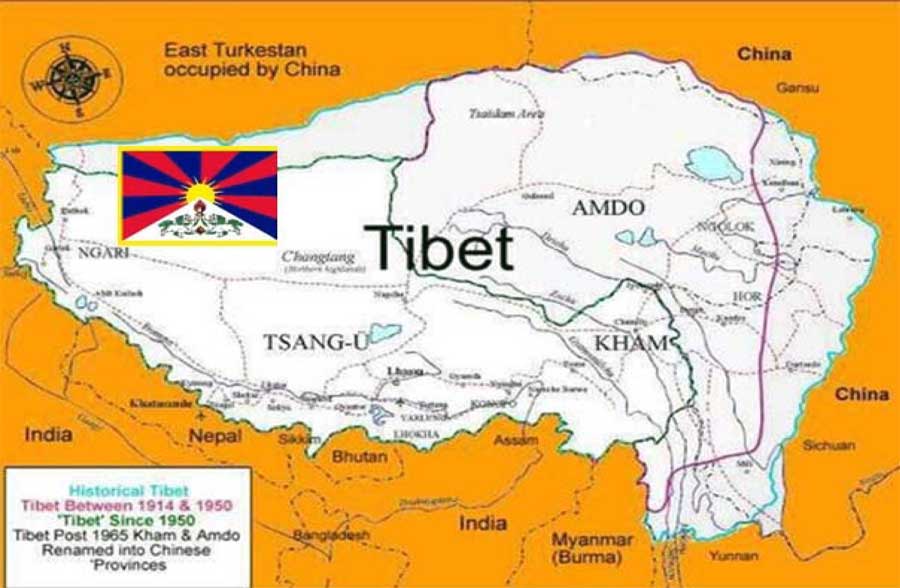
While Sardar Patel had warned Nehru about Chinese irredentism and communist imperialism being different from the expansionism or imperialism of Western powers and Chinese ideological expansion concealed behind racial, national or historical claims, China apparently feels her aggression is warranted because under the Tianxia (天下; “Under Heaven”) concept, Chinese perceive all territories under the sun belonging to them. Hence the ambiguity and deceit, and the ‘Doctrine of Pre-emption and Surprise’ encompassing surprise, deception and shock – plus the façade of peace homilies. That is why China has been providing tacit support to Pakistan’s anti-India jihadist groups in India; ‘Shashou Jian (Assassin’s Mace) incapacitating India from within through insurgencies and terrorism. It is also well understood that Chinese aggression of Tibet and Aksai Chin has been tempered because of the presence of minerals and natural resources like water, including possible thorium reserves.

Until the early 13 Century, China had no claims on Tibet which ruled half of present day China but looked to India for its most significant influence, Buddhism…

“Even during the 1962 conflict, Chinese leaders, including Mao, acknowledged that the conflict was not about the boundary or territory but about Tibet. The Chinese consistently tried to obtain reassurance from India that…India would not ‘meddle’ in Tibetan affairs…Boundary infringements by the Chinese continued. Sino-Indian border negotiations are stalemated and progress, if any, is at a snail’s pace. Thus, Tibet still remains the core issue.” —R.S Kalha, IFS (Retd.)

Revising U.S. Grand Strategy Toward China

Authors: Robert D. Blackwill, Henry A. Kissinger Senior Fellow for U.S. Foreign Policy, and Ashley J. Tellis, Senior Associate, Carnegie Endowment for International Peace


"China represents and will remain the most significant competitor to the United States for decades to come. As such, the need for a more coherent U.S. response to increasing Chinese power is long overdue," write CFR Senior Fellow Robert D. Blackwill and Carnegie Endowment for International Peace Senior Associate Ashley J. Tellis in a new Council Special Report, Revising U.S. Grand Strategy Toward China.

"Because the American effort to 'integrate' China into the liberal international order has now generated new threats to U.S. primacy in Asia—and could result in a consequential challenge to American power globally—Washington needs a new grand strategy toward China that centers on balancing the rise of Chinese power rather than continuing to assist its ascendancy."

The authors argue that such a strategy is designed to limit the dangers that China's geoeconomic and military power pose to U.S. national interests in Asia and globally, even as the United States and its allies maintain diplomatic and economic interactions with China.

Blackwill and Tellis recommend that Washington do the following: 
Revitalize the U.S. economy 

"Nothing would better promote the United States' strategic future and grand strategy toward China than robust economic growth…This must be the first priority of the president and Congress." 
Strengthen the U.S. military 

Watch Out, China: Japan and Australia Are Getting Closer

May 6, 2015 

Under the banner of a new special relationship, we are currently witnessing a second evolution of Japan–Australia strategic relations. Looking back, the relationship’s evolution has had two distinct phases; the first phase of evolution started in 2007 which was marked by a deeper institutionalization of bilateral cooperation focusing on non-traditional security, culminating in the historic Joint Declaration on Security Cooperation in Tokyo. The non-traditional security cooperation between Australian Defense Force (ADF) and Japan’s Self-Defense Forces (JSDF) is best represented by the past record of the frequent humanitarian assistance and disaster relief (HADR) cooperation between ADF and JSDF units, to name a few, in responding to the 2010 flood disaster in Pakistan, the 2011 earthquake and tsunami in Japan, and the 2013 mega-typhoon disaster in the Philippines.

Building on those initial efforts, we are witnessing the second evolution of the bilateral partnership which is characterized by new cooperation in the sphere traditional security. This second evolution is ongoing, and is driven by the following three new areas of cooperation. First, discussions about security legislation in the ruling coalition in the Japanese Diet suggest the real possibility of legally allowing the JSDF to cooperate operationally with ADF in more traditional security situations by offering logistics support for ADF units and/or assisting with the ADF’s force protection. Such unprecedented operational collaboration might happen when Japan, Australia and the US conduct joint training or missile defense operations in the waters around Japan, or where ADF vessels operating in support of US military activities in South China Sea are at risk of attacks in Japan’s neighborhood.

If the Unthinkable Occurred: America Should Stand Up to China over Taiwan

May 7, 2015 

"Nothing would be more dangerous than for Beijing to conclude that aggression would go unpunished and that the United States and a coterie of key allies do not have the will or the capacity to intervene."

In back-to-back articles published in recent weeks, Hugh White, a professor of strategic studies at the Australian National University, posited that China has become too powerful, and too critical a player in the global economy, for the continuation of tacit U.S. security guarantees to Taiwan, the island-nation that Beijing regards as an inalienable part of China. In White’s bleak worldview, the risks of major conflict—perhaps even nuclear war—are too enormous, and consequently, Taiwan should simply be abandoned to its “inevitable” fate. Not only is this wrong, it’s a very dangerous proposition.

I would first like to thank Professor White for his response to my article “Don’t Let China Swallow Taiwan,” which gives me an opportunity to expand upon and to refine my earlier observations on the subject. Although I have strong disagreements with his argument, his is a position that has enjoyed a modicum of traction in some circles, and as such, it is essential that it be properly countered.

To start with, Mr. White’s response to my piece hinges on a misreading of the assumptions that underlie my argument. I do not, as he claims, subscribe to the “widely held assumption” that the United States is “willing [to] go to war with China to prevent Taiwan being forcibly united with the mainland.” In fact, given the unwillingness or inability of the international community to stand up to Russia over tensions in Georgia in 2008 and Crimea in 2014, I fear that the United States and its Asian allies may not be inclined to take action to prevent the forced annexation of Taiwan, the Taiwan Relations Act notwithstanding. On my most optimistic days, I am agnostic on the matter. But I do maintain, however, that the international community should be willing to stand up to China and signal that commitment accordingly. Nothing would be more dangerous than for Beijing to conclude that aggression would go unpunished and that the United States and a coterie of key allies do not have the will or the capacity to intervene.

China's Apolitical Political School of Thought

May 7, 2015 

When we think of traditional influences on Chinese political theory, Confucianism often comes to mind, because it has drawn increasing government support in the post-Mao era (including from President Xi Jinping). There is also Sunzi’s Art of War, which has been appropriated in the West for everything from business strategy to poker. Those with a bit more knowledge of Chinese history may think of Han Feizi, sometimes called the Chinese Machiavelli. However, Daoism—a school of Chinese philosophy—has also had a surprisingly high degree of political influence. Laozi, the supposed author of the Daodejing (Classic of the Way and Virtue) is the best-known Daoist. He was even cited by Ronald Reagan in his 1988 State of the Union Address. However, cognoscenti of Chinese thought know that Zhuangzi is the most profound and fascinating Daoist. His writings, known simply as theZhuangzi (莊子), might seem like an unlikely source for political inspiration, since they advocate emotional detachment from the world. Nonetheless, Zhuangzi came to be associated with anti-government peasant uprisings in ancient times, and continues to be a source of inspiration for critics of the Chinese government even today. 

Zhuangzi lived in the Warring States Period (403-221 B.C.E.), an era in which the nominal monarch reigned but did not rule. Actual power was in the hands of the dukes who ruled the seven major states into which China was divided. In the absence of a strong central power, these states routinely invaded one another, and casually made and betrayed alliances. In the earlier Spring and Autumn Period (722-481 B.C.E.), a duke could sometimes temporarily enforce peace among the other states through a combination of innate military strength and shrewd diplomacy. However, this “hegemony” was intrinsically unstable, as jealousy of the hegemon eventually lead the other states to ally against him. (China’s fondness for accusing the United States of “hegemony” consciously appropriates the vocabulary of this era.) By Zhuangzi’s lifetime, the political situation was too chaotic for even a hegemon to enforce peace, and some dukes went so far as to usurp the title “king.” 

China's Ongoing Battle Against AIDS

May 07, 2015
http://thediplomat.com/2015/05/chinas-ongoing-battle-against-aids/

Despite major progress over the past 20 years, China still struggles to promote AIDS education and awareness. 

This week, Michel Sidibe, the head of the UN Program on HIV/AIDS (UNAIDS) is in China. While there, he and Xinhua president Cai Mingzhao promised to work together to cooperate in the fight against AIDS. In particular, Cai promised that Xinhua would help spread “positive messages” on behalf on UNAIDS, promoting the agency’s “three zeros” goal: “Zero new HIV infections. Zero discrimination. Zero AIDS-related deaths.” Sidibe signed a similar memorandum with Li Congjun, Cai’s predecessor, in March 2014

The connection between China’s state-run news agency and UNAIDS is just one sign of a transformation in how the Chinese government views and responds to AIDS. In the 1990s and early 2000s, the epidemic was largely ignored by the government – misinformation was prevalent and HIV/AIDS sufferers faced serious discrimination. The epidemic was exacerbated in China due to government-supported blood drives that did not follow adequate sterilization procedures. The drives, which often offered rural residents cash for blood or plasma donations, created so-called “AIDS villages” where a large percentage of residents are HIV-positive.

China’s official government response has changed markedly in the past 15 years. In 2003, China rolled out a program called “four frees and one care” – meaning free blood tests for those living with HIV, free education for those orphaned by AIDS, and free consultations, screening tests, and antiretroviral therapy for pregnant women with HIV or AIDS. In 2011, China announced its “five expands and six strengthenings,” which included efforts to expand HIV/AIDS education, testing, and treatment while also strengthening medical safeguards and the protection of HIV patients’ rights. Today, Premier Li Keqiang speaks openly about the need to do more to fight AIDS, and Peng Liyuan, President Xi Jinping’s wife, is a World Health Organization Goodwill Ambassador for Tuberculosis and HIV/AIDS.