Genevieve Donnellon
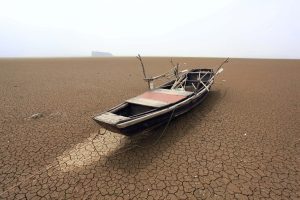
China’s driest and hottest summer has been since it began keeping records in 1961. The severe heatwave was brought on by a greater-than-usual Western Pacific subtropical high, further compounded by reduced rainfall. The effects of these extreme weather events are seen in many provinces and sections of the Yangtze River Basin (YRB), one of China’s strategic development regions and the country’s longest river.
Estimates from the South China Morning Post (SCMP) suggest that the current heat wave has affected over 900 million people in more than 17 provinces and an estimated 2.2 million hectares of agricultural land in the provinces of Sichuan, Hubei, Hebei, Jiangxi, and Anhui. As a result, this has posed a threat to China’s water, energy, and food security.
However, climate change-related extreme weather events are only one of China’s many water challenges. In addition to the drought, China faces enormous water quality, quality, and spatio-temporal distribution challenges. Due to various factors, including rapid industrialization, urbanization, as well as climate change impacts, demand for fresh water is quickly increasing. Forecasts project that by 2030, China’s water demand will surpass 800 billion cubic meters. However, China’s supply is severely undermined by worsening interlinked factors of water scarcity, urbanization, population growth, pollution, and competing water demands.
One of the significant challenges faced by China is the country’s highly uneven spatio-temporal distribution of water. Despite holding under 6 percent of the world’s water resources and being one of the top five countries in terms of freshwater resources, on a per capita basis, China faces severe water shortages due to insufficient water resources that are unevenly distributed across the country. Water-abundant southern China is prone to severe floods; in contrast, northern China, home to the country’s agricultural center, is arid and prone to severe water shortages. Estimates suggest that north China holds a mere 4 percent of the country’s water resources, which must sustain 25 percent of the country’s population and 27 percent of the national gross domestic product.
These concerns are further compounded by China’s decades-long overreliance on groundwater, brought on by high water demand for socioeconomic development, agricultural irrigation, and population growth. Estimates suggest that approximately 70 percent of the country’s population rely on groundwater as their primary drinking water resource. Groundwater is also used to irrigate 40 percent of China’s total farmland. In northern China, groundwater accounts for 50 percent of industrial water usage, 33 percent of irrigated water, and 65 percent of domestic water usage.
Nonetheless, groundwater exploitation has resulted in a significant fall in water levels of aquifers throughout the country. Due to such over-exploitation and inefficient consumption, China’s water resources are quickly decreasing. The North China Aquifer provides a telling example. The North China Aquifer is one of the world’s most overexploited groundwater resources due to unsustainable extractions. It is located in the North China Plain, one of the world’s most densely populated areas, as well as China’s economic, economic, and cultural center. This region additionally plays an important role in China’s food security, producing an estimated 13 percent of agricultural production, including 20 percent of the country’s total annual crop production. Due to intensive farming practices and the expansion of the irrigation systems, however, much of the shallow aquifer has declined by 20 meters in the past decades, with some areas experiencing decreases of more than 40 meters.
Further complicating matters, China’s existing water resources are heavily polluted. A recent publication from the Lancet found that pollution remains the most significant environmental health threat for premature deaths and diseases worldwide, with water pollution accounting for 1.4 million deaths. In China, decades of strong economic growth, rapid industrialization and development, and industrial farming practices with limited environmental concerns and high agricultural runoff have resulted in heavily polluted water throughout the country, impacting the environment and society, including human health, cultivated land, and river quality. According to recent estimates, more than 80 percent of China’s cities are severely polluted due to household, industrial, municipal, and agricultural sources. Similarly, a 2016 government-led study in China found that an estimated 80 percent of China’s groundwater quality is significantly contaminated by pollutants, including heavy metals such as arsenic.
China’s approach to water management has traditionally been engineering-focused, as shown by the construction of many inter-basin transfer projects such as the South-North Water Transfer Project and numerous hydropower dams such as the Three Gorges Dam. Recent project proposals such as the enormous Red Flag River Water Transfer Project (Red Flag River), the “super” dam on the upstream of the Brahmaputra, and the robot-built 3D printed dam, as well as China’s ambitious climate change goals, suggest that this approach will continue in the future. In addition to this approach, the Chinese government has also implemented various other policy responses to its national water challenges.
Citizen science is another way China addresses water challenges, enabling residents to play a greater role in environmental monitoring and protection. For instance, the “Black and Smelly Waters App,” launched in 2016 by the national housing and environment ministries, allows users to report polluted urban water sites and has been moderately successful. Citizen science is supported by other measures, including websites and social media provided for environmental protection agencies in various provinces and technological developments, including automated water monitoring systems (for wastewater and purification of drinking water), water quality applications, and prepaid smart water systems.
Beijing is also tackling China’s water challenges through the River (Lake) Chief System (RCS). In 2016, the central government required the full establishment of the RCS across the country, seeking to not only improve water quality but also to overcome the “nine dragons ruling the waters,” a reference to divided responsibilities stretching across several government agencies, often considered the cause of poor results in water governance in China. Under this system, the top officials at various levels of government are appointed as lake or river chiefs with their jurisdictions. By the end of 2018, this system had been implemented throughout China. At present, there are over 300,000 river chiefs at various levels (township, county, municipal, and provincial). China’s top-down target responsibility system manages their performance in meeting water pollution and related objectives. Since the implementation of the RCS, the number of water bodies with improved water quality has grown.
In contrast to the traditional engineering-focused Chinese water management approach, Beijing has demonstrated interest in “green” solutions (such as constructed wetlands and permeable pavements) through the sponge city initiative. Seeking to harness the benefits of nature-based solutions, the sponge city approach brings together “blue systems” and “green spaces” (such as wetlands) as part of “grey” infrastructure (such as water recycling initiatives). The overarching aim of sponge cities is to create Chinese “eco-cities” that support the local urban water cycle; control and reduce flooding, water scarcity, and water pollution; and strengthen local urban resilience, especially against the growing frequency and intensity of climate change-induced extreme weather events. Since 2014, the sponge city concept has been implemented in 30 major cities, including Shanghai and Beijing. By 2030, the Chinese government aims for 80 percent of its urban areas to absorb and reuse water.
In response to water pollution and related challenges, which could cause political and social turmoil, the Chinese government has implemented more than 130 policies to address surface water quality and aquatic environment degradation concerns, including as part of the 12th Five-Year Plan (2010-2015), the State Council’s Action Plan for Prevention and Control of Water Pollution (Water Ten Plan), and five-year plans for the informatization of environmental protection.
In recent years, Beijing has implemented laws to protect rivers from further degradation. Although the central Chinese government has previously acknowledged these concerns in reports and environmental policies (e.g., its “ecological red lines“ policy to balance environmental and ecological protection and economic growth) and regulations (e.g. the fishing ban), they have generally been subject to poor coordination, application, and enforcement. Following this, in March 2021, the new Yangtze River Protection Law (YRPL) was enacted to protect the Yangtze River. The overall aim of the YRPL is to safeguard China’s longest river by strengthening its ecological protection and restoration and promoting the efficient use of its water resources, suggesting that Beijing is shifting its priorities regarding rivers and ecological conservation.
This is China’s first legislation on a specific river basin and, as such, demonstrates a significant milestone in the CCP’s legislation on ecological protection and restoration. The YRPL seeks to strengthen oversight as well as prevent and control of water pollution in the river basin by addressing the inability of current institutions to carry out the river’s protection. This law can not only strengthen China’s “ecological civilization“ and green development policies but also lead to the universal implementation of similar protection laws for other rivers in China.
Adapting to Climate Change Impacts
However, these approaches, particularly the traditional engineering-focused approach, are not without their challenges. As China faces severe climate change impacts due to global warming, water is one of the most vulnerable sectors and will be hit the hardest. Like the rest of the world, China is under growing threats from climate change impacts such as rising sea levels. According to China’s National Climate Center, the country’s sea levels and average temperature have increased faster than the global average, putting coastal cities such as Shanghai at risk of being submerged in the future. At the same time, China’s glaciers will continue to melt rapidly, likely resulting in more floods.
China is also facing threats from the growing frequency and intensity of climate change-induced extreme weather events such as severe flooding and droughts, which cost China over $47 billion annually. Estimates suggest that 1 percent of China’s gross domestic product (GDP) is lost annually due to flooding impact, causing damage to agricultural production, infrastructure, and human lives. At the same time, over 650 Chinese cities are subject to flood risks. In July 2021, Henan province faced a “once in a thousand years” rainstorm, resulting in nearly 400 deaths and $12.7 billion in property damage. In 2020, the water levels in southern China, a region already prone to flooding, became “dangerously high,” with 443 rivers throughout the country flooding, of which 33 rivers rose to the highest levels on record. An estimated 38 million people across 27 provinces were affected by the flooding.
Additionally, droughts have grown in intensity and frequency over the past few decades. This has caused enormous damage to agricultural production, human health, and infrastructure, impacting water security, and agricultural production, as emphasized by the 2022 United Nations (UN) report “Drought in Numbers.” Another recent study analyzed drought-related losses in 31 Chinese provinces and cities from 1949 to 2017, finding that drought affected approximately one-sixth of China’s arable land. According to the study, corn and wheat were among the worst-hit crops in areas including Sichuan, Shandong, and Inner Mongolia. The severe impacts of previous droughts in China are also well-established.
While the socioeconomic and humanitarian costs of the ongoing Yangtze River drought are yet to be officially declared by the Chinese government, the impacts of previous droughts are known. For instance, the 2009 nationwide drought affected 60 million people and caused damage to an estimated 6.5 million hectares of land throughout the country. Similarly, at the height of the Yangtze River Basin drought in 2011, 3.5 million people were left with minimal drinking water. Elsewhere, China’s major southern cities, such as Shenzhen, warned of severe water shortages in late 2021 and sought to implement water restrictions due to the East River’s most severe drought in decades.
In China, the annual costs of droughts between 1949 to 2017 averaged $7 billion. However, with a global temperature increase of 1.5 C, this figure could rise to $47 billion, and even $84 billion annually if there is a global temperature increase of 2 C, while also causing significant agricultural and socioeconomic consequences.
The Chinese government has undertaken various responses at different scales to overcome the major water quality, quantity, and unequal distribution issues throughout the country. These responses include laws, policies, digital technologies, citizen science, and the creation of a river chief system in conjunction with the traditional infrastructure-focused approach. Nonetheless, it remains to be seen to what extent these approaches to the national water concerns will succeed.
One of the biggest challenges threatening these responses is climate change-related extreme weather events. As the ongoing Yangtze River drought and other extreme weather events demonstrate, the cost, both humanitarian and socioeconomic, is enormous. Given that such events are expected to increase in frequency, intensity, and duration combined with the existing national water concerns, this will continue to pose threats to China’s policy responses to its water challenges.
As a result, Beijing may need to consider putting into place additional approaches to target the demand side of water management on a national scale and making (greater) use of alternative water supplies such as treated wastewater for both potable and non-potable use.
No comments:
Post a Comment