The Profession of Arms: A Guide for Young Army Officers
It takes courage, especially for a young officer, to check a man met on the road for not saluting properly or for slovenly appearance, but, every time he does, it adds to his stock of moral courage, and whatever the soldier may say, he has respect for the officer who does pull him up.
Read Document →The Dragon's Teeth: Assessing China's Military Modernization
PLA has focused on modernising its capabilities across all warfare domains to achieve these goals. This includes land, air, and maritime operations, nuclear, space, counter-space, electronic warfare and cyberspace operations, aiming to become a fully integrated joint force.
Read Document →Transforming the PLA: A Decade of reorganisation from SSF to ISF
PRC has engaged in a sustained and broad effort to transform the PLA from an infantry-heavy, low-technology, ground forces-centric military into a high-technology, networked force with an increasing emphasis on joint operations and naval and air power projection.
Read Document →Eyes without Borders: Exploring the World of Open Source Intelligence (OSINT) in the Digital Age
Open Source Intelligence (OSINT) is gaining prominence with the rise of social media, the digital society and the vast growth of publicly and commercially available information (PAI and CAI).
Read Document →
The PLA’s Developing Cyber Warfare Capabilities and India's Options
Informationised warfare blurs the lines between peacetime and wartime. A nation in the information age cannot wait for the hostilities to break out to collect intelligence, carryout influence operations, develop antisatellite systems or design computer software weapons.
Read Document →
Galwan and After
Why did China did this when he is under tremendous pressure in all fronts, is this China's salami slice tactics being progressed rigorously, what will be new Rules of Engagement, what will be escalatory control mechanism, who has taken this decision, will there be some pressure put by China in India's North-East through insurgency.
Read Document →
India’s Joint Doctrine for Cyberspace Operations: A Critical Review
Chief of Defence Staff (CDS) General Anil Chauhan and Secretary, Department of Military Affairs, formally released declassified versions of the Joint Doctrines for Cyberspace Operations during the Chiefs of Staff Committee meeting in New Delhi.
Read Document →
Know your Enemy General(now Field Marshal) Syed Aseem Munir
Gen SA Munir's position in the hierarchy of Pakistan was not very comfortable. The state of economy, insurgency in Pakhtoonistan and Balochistan, attack on the Jaffar Express, constant protests by supporters of Imran Khan's supporters inside and outside of parliament.
Read Document →
Decoding Operation SINDOOR: Key Aspects and Implications
Precision strikes were carried out on nine sites—four in Pakistan and five in PoK—linked to anti-India terrorist groups such as the LeT, JeM and the Hizbul Mujahideen. The targeted sites included Muridke (LeT headquarters) and Bahawalpur (JeM headquarters).
Read Document →
Chinese Cyber Exploitation in India's Power Grid - Is There a linkage to Mumbai Power Outage?
The New York Times (NYT), based on analysis by a U.S. based private intelligence firm Recorded Future, reported that a Chinese entity penetrated India’s power grid at multiple load dispatch points. Chinese malware intruded into the control systems that manage electric supply across India, along with a high-voltage transmission substation and a coal-fired power plant
Read Document →19 August 2018
The Modi Phenomenon and the Remaking of India
India’s Place in the New World Order
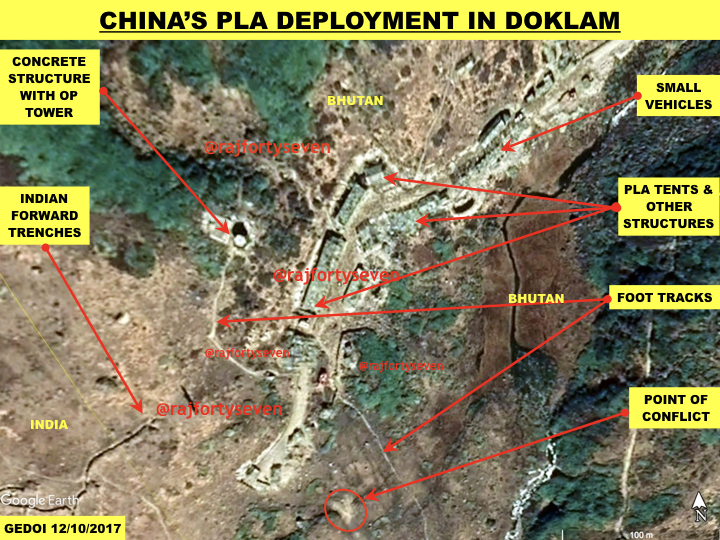
New trouble for India: China occupies North Doklam, with armoured vehicles & 7 helipads

Need to focus on state government finances
The widening of the fiscal deficit has re-emerged as a cause of concern for the Indian economy. There is a fear that the Central government could overshoot its fiscal deficit target for FY19 as goods and services tax (GST) revenue has been falling short of target and there could be increased expenditure commitment in a pre-election year. Also worrying are the finances of state governments. As per a recent Reserve Bank of India (RBI) report on state government finances, the consolidated fiscal deficit of the state governments in FY18 was 3.1%, against the budget estimate of 2.7%.Opinion: Did Trump forget his own Afghanistan strategy?
This month, a year ago, US President Donald Trump announced his administration’s Afghanistan strategy in a speech in Arlington, Virginia. Trump admitted that his initial instinct was to pull out of what was already by then a 16-year-old war. However, he understood that an immediate withdrawal would not provide “an honourable and enduring outcome worthy of the tremendous sacrifices that have been made”. Trump decided to commit the US to the battle without the Barack Obama-style withdrawal timelines. Even as his speech was being widely pilloried in Washington, there was also a view, notably in India, that Trump’s strategy deserved a fair chance.Taliban Fighters Rout Afghan Security Forces Across Country
Any illusions that the Taliban were interested in negotiating a peaceful settlement with the Afghan government and its international partners have been dashed by four days of grueling fighting across the country, during which the Taliban have reportedly occupied Ghazni city and wiped out up to 100 Afghan commandos in a demoralizing blow to Afghan security forces. Since August 10, the U.S. military has launched at least 24 airstrikes from B-1 bombers, A-10 Thunderbolt II attack craft, AH-64 Apache helicopters, and MQ-9 Reaper drones to support Afghan troops and police fighting to retake Ghazni, killing more than 140 Taliban fighters, Resolute Support spokesman Army Lt. Col. Martin O’Donnell told Task & PurposeWhy Sushma Swaraj Is Wrong On The ‘Rising Hindu Count’ In Bangladesh
Maldives: A crisis in paradise
The Maldives are the central part of a chain of islands that begins on the west coast of India with the Lakshadweep Islands and ends deep in the Indian Ocean at the Chagos Archipelago, including the major American military base at Diego Garcia. The Republic of the Maldives is comprised of almost 1,200 islands spread out over 35,000 square miles. It’s the lowest country in the world, with an average height of less than five feet above sea level. Some islands have become home to high-end expensive hotels, and over one hundred islands are resorts. Of its roughly 418,000 people, a majority are Muslims.Globalization with Chinese Characteristics
This is why China could collapse like the Soviet Union
China’s dying labour-force boom, like the Soviet Union’s in the 1970s, may not revive even with Silk Road project’s heavy investments.Burying ‘One Child’ Limits, China Pushes Women to Have More Babies
BEIJING — For decades, China harshly restricted the number of babies that women could have. Now it is encouraging them to have more. It is not going well. Almost three years after easing its “one child” policy and allowing couples to have two children, the government has begun to acknowledge that its efforts to raise the country’s birthrate are faltering because parents are deciding against having more children. Officials are now scrambling to devise ways to stimulate a baby boom, worried that a looming demographic crisis could imperil economic growth — and undercut the ruling Communist Party and its leader, Xi Jinping.Trump’s Trade War Is Rattling China’s Leaders
BEIJING — China’s leaders have sought to project confidence in the face of President Trump’s tariffs and trade threats. But as it becomes clear that a protracted trade war with the United States may be unavoidable, there are growing signs of unease inside the Communist political establishment. In recent days, officials from the Commerce Ministry, the police and other agencies have summoned exporters to ask about plans to lay off workers or shift supply chains to other countries. With stocks slumping and the currency dropping 9 percent against the dollar since mid-April, censors have been deleting a torrent of criticism online, some of it directed at President Xi Jinping’s leadership. State news outlets, by contrast, have sought to promote the official line, with the authorities restricting the use of the phrase “trade war.”Xi Jinping Thought Is Facing a Harsh Reality Check
Rumors were racing everywhere I went in Beijing this July. Had a secret coup toppled the government? Was the Chinese economy on the verge of collapse? Had popular discontent, triggered by U.S. tariffs, reached the point of explosion? One deeper question lurked beneath these others: Had Xi Jinping—China’s top leader, who presents himself as all but omnipotent—overstepped his limits thanks to overconfidence in the inevitability of China’s rise? At the center of this question are not simply the facts that fill headlines about China under Xi. The “personality cult” that Xi has built up since coming to power in 2013 is extraordinarily visible—on posters, on websites, in competitions to read the president’s work with the most sincerity—and some observers criticize it as reminiscent of the Mao era’s fervid devotion to the “Great Helmsman.” The intensified repression that Xi has overseen across China, especially in the western province of Xinjiang, which has become an unprecedented “digital police state,” has been condemned around the world.Turkey's Economy Takes a Tumble. What's Next?
After recent elections, the biggest challenge for the Turkish government was stabilizing the worrisome economy. But poor U.S.-Turkey relations and investor uncertainty about Turkey's ability to stabilize its volatile economy have pushed its currency, the lira, to an all-time low. Its crash is pressing on the country's dollar-denominated debt and raising questions about whether President Recep Tayyip Erdogan will temper his political moves to allow room for economic stabilization.Iran Is Throwing a Tantrum but Wants a Deal
Even in its afterlife, the Iran nuclear deal continues to polarize. Those who supported the agreement proclaim loudly that Iran will never negotiate any adjustment to it, while its opponents argue U.S. President Donald Trump’s decision to pull out of it will produce a better deal. Trump himself seems to believe a better deal is possible, having recently offered to talk to the Iranians without preconditions. On Monday, Iran’s supreme leader, Ali Khamenei indicated he disagrees, declaring: “I ban holding any talks with America. … America never remains loyal to its promises.” Khamenei’s ban came after Mohammad Ali Jafari, the commander of the Islamic Revolutionary Guard Corps, had already insisted: “The Iranian people will never allow their officials to meet and negotiate with the Great Satan, we are not North Korea.”Terrorism: U.S. Strategy and the Trends in Its “Wars” on Terrorism
The Turning Point of 2008
The security strategies of the US, China, Russia and the EU: Living in different worlds
This report analyzes and compares the security strategies of four major international actors: the United States, China, Russia and the European Union. The rules-based liberal international order is increasingly under strain due to tightening geopolitical competition and the decline of the Western hegemony. In this context, the report explores the conceptions of the four major powers with regard to the world order, the self-defined position of each actor in it, and their possible aspirations to change the existing order. Furthermore, the report analyzes how each strategy defines security threats and risks, as well as ways to address these threats. The report highlights the ongoing rapid change of global structures and instruments of power as a challenge addressed in all four strategies. Increased competition is visible not only in the field of military power, but also in economic relations and at the level of values. While the US strategy defines Russia and China as key adversaries whose increasing influence is to be contained, both Russia and China correspondingly aim at building a counterweight to the US power in a multipolar world. Among the four actors, only the EU maintains a strong commitment to the rules-based order and explicitly rejects a worldview centred around zero-sum rivalry between great powers.How higher-education institutions can transform themselves using advanced analytics
Why Hitting the Gas on Car Tariffs Could Stall Everyone
The United States will continue to threaten tariffs on the imports of automobiles in an attempt to gain leverage in critical trade negotiations, although it's possible that Washington will eventually enact such tariffs. Mexico and Canada might escape strong measures since they would also inflict domestic harm due to the nature of NAFTA integration, but Washington will strive to extract concessions from the two countries by threatening such measures. Germany and the European Union — which has little overall integration with the U.S. auto market — are most likely to face tariffs, even if Brussels has sought to escape the measures by offering a trade deal to the United States. At moderate risk of tariffs, Japan and especially South Korea will hope to avoid U.S. measures by highlighting their automakers' investments in the United States.Russia wants universities to design robots for war
Building robots is a skill, and one that Russia’s Ministry of Defense wants more Russians to have. To that end, the Russian newspaper Izvestia reported Aug. 3 that the Ministry of Defense had completed work on a federal educational standard for “Robotics for Military and Special Purposes,” teaching students at both civilian and military universities how to design new robots. This includes, at the military institutions, robots designed for combat. “Russian Ministry of Defense already has a center for unmanned aerial vehicle training ― it’s the 924th Center, outside of Moscow ― and it’s been operating for about five years at this point and is dedicated to teaching soldiers and officers the operation of various UAVs,” says Samuel Bendett, a research analyst at the Center for Naval Analyses. “These academic programs will involve all manner of unmanned military systems, unlike the 924th center, which only deals with UAVs. According to the development standards described here, after several years military students will be able to graduate as engineers, unlike those military students in the 924th center which get an operator certificate after a few months.”Battlefield Internet A Plan for Securing Cyberspace
The key to the intelligence in the future
If the Department of Defense’s intelligence operations are going to be successful in the future, the intelligence community must move from a descriptive model, in which analysts offer details on an event, to a predictive model, in which analysts describe what may happen, top defense leaders said Aug. 13. “The ultimate goal of intelligence is not just to win wars. As President Eisenhower said, the only way to win the next war is to prevent it,” Lt. Gen. Robert Ashley, director of the Defense Intelligence Agency, said during an Aug.13 keynote presentation at the DoDIIS conference in Omaha, Nebraska. The key challenge for intelligence operations today is to determine the indicators of an event that could take place and what is being missed, Ashley added. He noted the intelligence community has to move past descriptive intelligence — how high, how fast, how far — and be more predictive.How could artificial intelligence help the intelligence community?
Defense leaders have long discussed how artificial intelligence and machine learning can help provide an advantage by fusing data faster than humans are physically capable. But these emerging technologies may also help the intelligence community address another challenge: linguists.Rapid Equipping Force to deliver new electronic warfare platforms
Sgt. Jessie Albert, an electronic warfare specialist assigned to 2nd Battalion, 35th Infantry Regiment, 3rd Brigade Combat Team, 25th Infantry Division, trains on the Wolfhound Radio Direction Finding System at Schofield Barracks, Hawaii, on April 11, 2018. The electronic warfare specialists use direction finding to gain a line-of-bearing to the target. (U.S. Army photo by Staff Sgt. Armando R. Limon, 3rd Brigade Combat Team, 25th Infantry Division) Army Forces Command will receive a new fleet of tactical vehicles specifically outfitted for electronic warfare this fall. As part of the Army’s efforts to restore electronic warfare capability and respond to capability gaps, the service’s Rapid Equipping Force will provide Army Forces Command with what’s known as Electronic Warfare Tactical Vehicles. The vehicles will be self-contained and independent, a notice from the REF stated. Soldiers inside the vehicle would operate the advanced EW system, which was developed in response to a battlefield need to sense and jam enemy communications and networks.The internet of battlefield things will depend on modernized networks
Military planners envision a future battlefield defined by the internet of things, one in which smart devices, soldier-worn sensors and unmanned aircraft produce a nonstop torrent of actionable data. In this near-future war space, “current, commonly available, interconnected ‘things’ will exist in the battlefield and be increasingly intelligent, obfuscated, and pervasive,” according to Army documents. Experts, however, put a caveat on that vision. The IoT landscape cannot come to fruition without robust, modernized networks. The promised wellspring of new ISR data “requires connectivity and security,” said Mike Leff, vice president for global defense at AT&T Public Sector. “You need a robust network to give you that competitive advantage on the battlefield.”GOOGLE TRACKS YOU EVEN IF LOCATION HISTORY'S OFF. HERE'S HOW TO STOP IT
Reimagining fiduciaries in the digital economy
The making of techno-commercial laws in India is often devoid of strong conceptual underpinnings. This is partly because the starting point for all legal drafting in the country is similar—we want to get the best of all worlds without any hint of compromise. Consequently, we end up with muddled outcomes that serve niche interest groups and confuse the rest. Additionally, as lawmakers pretend to be acutely attuned to local market realities, they also tend to characterize unclear outcomes as necessary instances of Indian exceptionalism. An aspirational India, with all its structural infirmities, often forgives them. However, the digital economy is less forgiving. Bad laws will be put to test and found wanting in much shorter feedback cycles.