The Profession of Arms: A Guide for Young Army Officers
It takes courage, especially for a young officer, to check a man met on the road for not saluting properly or for slovenly appearance, but, every time he does, it adds to his stock of moral courage, and whatever the soldier may say, he has respect for the officer who does pull him up.
Read Document →The Dragon's Teeth: Assessing China's Military Modernization
PLA has focused on modernising its capabilities across all warfare domains to achieve these goals. This includes land, air, and maritime operations, nuclear, space, counter-space, electronic warfare and cyberspace operations, aiming to become a fully integrated joint force.
Read Document →Transforming the PLA: A Decade of reorganisation from SSF to ISF
PRC has engaged in a sustained and broad effort to transform the PLA from an infantry-heavy, low-technology, ground forces-centric military into a high-technology, networked force with an increasing emphasis on joint operations and naval and air power projection.
Read Document →Eyes without Borders: Exploring the World of Open Source Intelligence (OSINT) in the Digital Age
Open Source Intelligence (OSINT) is gaining prominence with the rise of social media, the digital society and the vast growth of publicly and commercially available information (PAI and CAI).
Read Document →
The PLA’s Developing Cyber Warfare Capabilities and India's Options
Informationised warfare blurs the lines between peacetime and wartime. A nation in the information age cannot wait for the hostilities to break out to collect intelligence, carryout influence operations, develop antisatellite systems or design computer software weapons.
Read Document →
Galwan and After
Why did China did this when he is under tremendous pressure in all fronts, is this China's salami slice tactics being progressed rigorously, what will be new Rules of Engagement, what will be escalatory control mechanism, who has taken this decision, will there be some pressure put by China in India's North-East through insurgency.
Read Document →
India’s Joint Doctrine for Cyberspace Operations: A Critical Review
Chief of Defence Staff (CDS) General Anil Chauhan and Secretary, Department of Military Affairs, formally released declassified versions of the Joint Doctrines for Cyberspace Operations during the Chiefs of Staff Committee meeting in New Delhi.
Read Document →
Know your Enemy General(now Field Marshal) Syed Aseem Munir
Gen SA Munir's position in the hierarchy of Pakistan was not very comfortable. The state of economy, insurgency in Pakhtoonistan and Balochistan, attack on the Jaffar Express, constant protests by supporters of Imran Khan's supporters inside and outside of parliament.
Read Document →
Decoding Operation SINDOOR: Key Aspects and Implications
Precision strikes were carried out on nine sites—four in Pakistan and five in PoK—linked to anti-India terrorist groups such as the LeT, JeM and the Hizbul Mujahideen. The targeted sites included Muridke (LeT headquarters) and Bahawalpur (JeM headquarters).
Read Document →
Chinese Cyber Exploitation in India's Power Grid - Is There a linkage to Mumbai Power Outage?
The New York Times (NYT), based on analysis by a U.S. based private intelligence firm Recorded Future, reported that a Chinese entity penetrated India’s power grid at multiple load dispatch points. Chinese malware intruded into the control systems that manage electric supply across India, along with a high-voltage transmission substation and a coal-fired power plant
Read Document →10 March 2019
Why America can’t escape its role in the conflict between India and Pakistan
Warning bells: If US troops exit Kabul, and the Taliban holds sway, Pakistan could unleash 'Ghazwa-e-Hind' against India
We could soon see America leave Afghanistan's brutal war half-finished. The implications of this will be dreadful for ordinary Afghans. This is no good news for India either. Nearly forty years ago, on Christmas Day in 1979, Soviet tanks and troops were airlifted into Kabul — in what became a bloody battle between ‘godless’ Communists on one side, and Islamic mujahedeen backed by the West, Pakistan, the Emirates and Saudi Arabia on the other. If the 1980s were the years of what ultimately came to be known as the Afghan jihad, the 1990s were the years of civil war, with the Taliban triumphant in Kabul.It’s MiG-21 versus the F-16 over Kashmir
Can an old MiG-21 aircraft destroy a more modern F-16? Yes, in fact an Indian pilot flying a version of the MiG-21 called Bison allegedly shot down a Pakistani F-16 using a Russian R-73 Vympel air to air missile, known as a high off bore-sight air-to-air weapon. Advantage India, after Balakot air strike
Negotiations Are the Best Way to End the War in Afghanistan
Afghanistan’s Next Chapter
NEW DELHI – The recent geopolitical history of Afghanistan can be divided into five phases. But now it is at the cusp of another transition, and the defining features of the new phase remain to be seen.Russia’s Strategy in Southeast Asia
The Problem With Xi’s China Model
Year in Review: Huawei and the Technology Cold War
Technology cold war. Decoupling. Weaponized interdependence. Whatever you call it, the U.S.-China science and technology relationship is being violently remade. While a tightly linked technology system benefited the United States and China over the last two decades, there is now widespread concern on both sides of the Pacific that the economic and security risks outweigh the gains. President Xi Jinping has embraced and accelerated policies designed to increase the innovativeness of the Chinese economy and reduce dependence on foreign suppliers. The Trump administration has put Chinese technologies policies front and center as a danger to U.S. economic and national security. The eventual outcome of this contest may be two distinct technology systems, with other countries forced to choose if they are going to plug into American or Chinese technology platforms and standards.A New Old Threat Countering the Return of Chinese Industrial Cyber Espionage
After a three-year hiatus, the cyber-enabled theft of intellectual property by Chinese hackers is once again a point of contention in the U.S.-China relationship. Cybersecurity firms have reported new attacks on U.S. companies, and Donald J. Trump administration officials have claimed that China is ignoring a 2015 agreement in which both countries pledged not to conduct hacking to benefit commercial entities.China wants to replace US in Pacific
In 1979, China and Vietnam Went to War (And Changed History Forever)
At 5 AM on February 17, 1979, a massive artillery bombardment rippled across Vietnam’s mountainous northern border with China. Waves of soldiers from the Chinese People’s Liberation Army (PLA) swarmed towards the startled Vietnamese soldiers hunkered down in border forts, bunkers and caves. Some outposts, taken by surprise, fell; others repelled the attacks with withering small arms and artillery fire.Andrea and Mauro Gilli on Why China Can't Steal Its Way to Military-Technological Superiority
The Diplomat’s Franz-Stefan Gady talks to Andrea and Mauro Gill about their recently published paper in the academic journal International Security titled “Why China Has Not Caught Up Yet,” whish outlines how the complexity of modern military technology has significantly reduced the advantage of industrial espionage and reverse engineering. Imitating modern weapons systems is a lot harder than in the past, the authors argue, and as a result China will not be able to “steal” itself to the top in the ongoing military-technological competition between the world’s great military powers.China’s Growing Military Presence Abroad Brings New Challenges
China’s involvement in UN peacekeeping contributions has been on the rise for some time. China is also stepping up its own military and security operations abroad to protect its commercial and strategic interests, particularly in Africa. In doing so, China is exposing itself to a more complex set of issues – including international legal issues – with which it is only just starting to grapple.CHINESE GENERAL OFFERS 10 THINGS IN EXCHANGE FOR TAKING BACK TAIWAN
A senior Chinese general listed 10 privileges that Beijing would be willing to grant Taiwan should it reunite with the communist mainland government.New Pro-Islamic State Magazine: A Persistent Ideological Threat – Analysis
On 22 November 2018, the first edition of a pro-IS magazine in Indonesian, was published through an Indonesian media, named Hanifiyah Media. It is a monthly publication, which is now in its third edition varying between 40 to 50 pages long. The magazine has no title and draws its heading according to the theme it covers each month. The first was Zhahirina ‘Alal Haq (we are on the righteous path); the second, Fie Sabilillah(in the cause of Allah); and the latest, Ansharullah (supporters of Allah).Rules of the Cyber Road for America and Russia
CAMBRIDGE – The United States responded weakly after Russian cyber operations disrupted the 2016 presidential election. US President Barack Obama had warned his Russian counterpart, Vladimir Putin, of repercussions, but an effective reply became entangled in the domestic politics of Donald Trump’s election. That could be about to change.Renewing Europe
PARIS – Never, since World War II, has Europe been as essential. Yet never has Europe been in so much danger. Brexit stands as the symbol of that. It symbolises the crisis of Europe, which has failed to respond to its peoples’ needs for protection from the major shocks of the modern world. It also symbolises the European trap. That trap is not one of being part of the European Union. The trap is in the lie and the irresponsibility that can destroy it. Brexit Is Hell
Over time, public conceptions of hell have migrated from the realm of religious belief to that of literature and political aphorism. And nowhere is the idea of eternal damnation as punishment for one's own choices more appropriate than in the case of the United Kingdom as it hurdles toward the Brexit abyss.Top US general in Europe wants to keep China out of 5G networks
WASHINGTON — With Europe in the early stages of developing their 5G networks, the Pentagon’s top general in the region issued a stark warning March 5: Allies need to keep China out or risk losing the ability to integrate with America’s military.U.S. trade deficit reached a record high last year
Up and Up: The Growing Trade Deficit
Huawei Sting Offers Rare Glimpse of the U.S. Targeting a Chinese Giant
The sample looked like an ordinary piece of glass, 4 inches square and transparent on both sides. It’d been packed like the precious specimen its inventor, Adam Khan, believed it to be—placed on wax paper, nestled in a tray lined with silicon gel, enclosed in a plastic case, surrounded by air bags, sealed in a cardboard box—and then sent for testing to a laboratory in San Diego owned by Huawei Technologies Co. But when the sample came back last August, months late and badly damaged, Khan knew something was terribly wrong. Was the Chinese company trying to steal his technology?What Do the Huawei Indictments Mean for the Future of Global Tech?
RSA Conference 2019: How to Defend Against an AI vs AI ‘Flash War’
SAN FRANCISCO – As perimeter cyber defenses adopt new strategies such artificial intelligence and machine learning, security experts predict adversaries will adopt similar techniques when it comes to an attack chain.Will robots replace doctors?
Readiness and Reliance
Integrating Information Warfare Lessons Learned from Warfighter Exercise 18-2
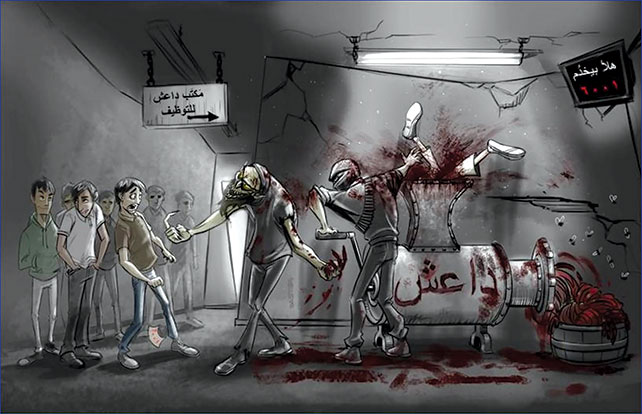
The above propaganda leaflet depicting Islamic State executioners slaughtering innocent civilians in a meat grinder was dropped over Raqqa, Syria, in March 2015 by coalition forces to help prepare the way for follow-on maneuver operations against that city. Information warfare creates operational advantages by the synergy of physical attacks that deny, disrupt, and destroy key enemy command, control, communications, computers, and intelligence (C4I) systems at the same time psychological and sociological measures are used to undermine the moral and cognitive commitment of adversaries to their cause by actions that foster confusion, intimidation, or persuasion. During I Corps’ Warfighter Exercise 18-2, simulated leaflet drops similar to those conducted in Raqqa in conjunction with simulated physical attacks created the desired synergistic effects of information warfare in support of overall corps’ exercise objectives. (Image courtesy of the U.S. Army)Time, Power, and Principal-Agent Problems Why the U.S. Army is Ill-Suited for Proxy Warfare Hotspots
Chinese statesman and military theorist Mao Tse-tung reasoned, “Unless you understand the actual circumstances of war, its nature, and its relations to other things, you will not know the laws of war, or know how to direct war, or be able to win victory.”1 Mao’s argument, written almost a century ago, clearly captures the essence of understanding the war in which one is engaged. More recently, there has been a substantial amount of literature written about modern and future evolutions of conflict; however, the U.S. Army flounders at seeing operating environments beyond binary conventional conflict and counterinsurgencies.The US Army is preparing for major changes to force structure
WASHINGTON — The Army is preparing to make what it deems as necessary, and major, organizational changes to its force structure within the next five years, according to the Futures and Concepts Center director.