The Profession of Arms: A Guide for Young Army Officers
It takes courage, especially for a young officer, to check a man met on the road for not saluting properly or for slovenly appearance, but, every time he does, it adds to his stock of moral courage, and whatever the soldier may say, he has respect for the officer who does pull him up.
Read Document →The Dragon's Teeth: Assessing China's Military Modernization
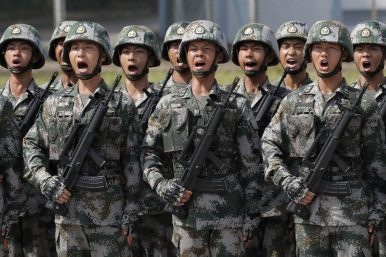
PLA has focused on modernising its capabilities across all warfare domains to achieve these goals. This includes land, air, and maritime operations, nuclear, space, counter-space, electronic warfare and cyberspace operations, aiming to become a fully integrated joint force.
Read Document →Transforming the PLA: A Decade of reorganisation from SSF to ISF
PRC has engaged in a sustained and broad effort to transform the PLA from an infantry-heavy, low-technology, ground forces-centric military into a high-technology, networked force with an increasing emphasis on joint operations and naval and air power projection.
Read Document →Eyes without Borders: Exploring the World of Open Source Intelligence (OSINT) in the Digital Age
Open Source Intelligence (OSINT) is gaining prominence with the rise of social media, the digital society and the vast growth of publicly and commercially available information (PAI and CAI).
Read Document →
The PLA’s Developing Cyber Warfare Capabilities and India's Options
Informationised warfare blurs the lines between peacetime and wartime. A nation in the information age cannot wait for the hostilities to break out to collect intelligence, carryout influence operations, develop antisatellite systems or design computer software weapons.
Read Document →
Galwan and After
Why did China did this when he is under tremendous pressure in all fronts, is this China's salami slice tactics being progressed rigorously, what will be new Rules of Engagement, what will be escalatory control mechanism, who has taken this decision, will there be some pressure put by China in India's North-East through insurgency.
Read Document →
India’s Joint Doctrine for Cyberspace Operations: A Critical Review
Chief of Defence Staff (CDS) General Anil Chauhan and Secretary, Department of Military Affairs, formally released declassified versions of the Joint Doctrines for Cyberspace Operations during the Chiefs of Staff Committee meeting in New Delhi.
Read Document →
Know your Enemy General(now Field Marshal) Syed Aseem Munir
Gen SA Munir's position in the hierarchy of Pakistan was not very comfortable. The state of economy, insurgency in Pakhtoonistan and Balochistan, attack on the Jaffar Express, constant protests by supporters of Imran Khan's supporters inside and outside of parliament.
Read Document →
Decoding Operation SINDOOR: Key Aspects and Implications
Precision strikes were carried out on nine sites—four in Pakistan and five in PoK—linked to anti-India terrorist groups such as the LeT, JeM and the Hizbul Mujahideen. The targeted sites included Muridke (LeT headquarters) and Bahawalpur (JeM headquarters).
Read Document →
Chinese Cyber Exploitation in India's Power Grid - Is There a linkage to Mumbai Power Outage?
The New York Times (NYT), based on analysis by a U.S. based private intelligence firm Recorded Future, reported that a Chinese entity penetrated India’s power grid at multiple load dispatch points. Chinese malware intruded into the control systems that manage electric supply across India, along with a high-voltage transmission substation and a coal-fired power plant
Read Document →17 December 2017
In One Corner of Afghanistan, America Is Beating Islamic State
All That Could Go Wrong When Jihadists Return Home — to China
Once separatists, now jihadists, some Uighurs returning from the ISIS battlefield could threaten — and test — Beijing.Satellite imagery offers clues to China’s intentions in Djibouti
Where is China targeting its development finance?
“The Rise of a Not-So-New World Order”
Summary: The world’s nations are forming new alliances. Last month we looked at the Saudi-Israel alliance. Here Stratfor looks at major nations allying against America (other powers always organize against a hegemon), starting with Russia and China. How this plays out will shape the 21st century.Sri Lanka, Struggling With Debt, Hands a Major Port to China
NEW DELHI — Struggling to pay its debt to Chinese firms, the nation of Sri Lanka formally handed over the strategic port of Hambantota to China on a 99-year lease last week, in a deal that government critics have said threatens the country’s sovereignty.Chasing The Ghosts: Investigating The Attribution Of Transnational Cyber Attacks
Click to Download Full Turkish ReportClick to Download Full English Report
China's Americanized Military
Two Chinese armored brigades clashed in a week-long training exercise at the Zhurihe Training Base in Inner Mongolia in 2015. Both brigades were equipped with identical armored vehicles and weapons. The Blue opposing forces brigade (OPFOR), however, was organized and fought in the fashion of a United States brigade combat team. The Red friendly force was crushed. “Within an hour we were hit with airstrikes, enemy satellite reconnaissance, and cyberattacks … Frankly, I never imagined it would be this hard,” said Wang Ziqiang, the armored brigade commander of the Red force. Wang’s political commissar Liu Haitao was caught on camera sobbing after the defeat. In a documentary aired on state television days before the 19th Party Congress in October, Liu said that his unit was initially very confident of victory over the Blue team, which was formerly a sister unit. “But over the course of seven days, we were beaten … we lost because we didn’t meet realistic combat standards when training our troops,” he said.Struggle Over Scripture: Charting the Rift Between Islamist Extremism and Mainstream Islam
The Four Faces of China in Central and Eastern Europe
An American, a German, and a Chinese gentleman walk into a bar in Prague. The first two order a beer, and the bartender then turns to the Chinese man to ask, “What can I get you?” He simply replies, “The accounts please, I own the place.”Behind the Rapid Development of Russian Unmanned Military Systems
Beyond the 2017 North Korea Crisis: Deterrence and Containment
Does Russia Bear Responsibility for War in Ukraine?
“Actually, there is a civil war in Ukraine between the DNR [Donetsk People’s Republic], the LNR [Luhansk People’s Republic], and the rest of Ukraine. It is completely unclear why Russia should bear any responsibility for this.” On December 2, RT’s Russian-language Web site published a report on statements made by the U.S. Ambassador to Russia John Huntsman during his interview with the Russian St. Petersburg TV channel.What Will ‘Actually Solve’ Terrorism Problem?
At the height of its powers several years ago, ISIS was attracting an estimated one thousand new foreign fighters each month. While U.S. officials always believed that the U.S.-led coalition would take back ISIS-held territory, they worried that as the caliphate collapsed, the tens of thousands of foreign fighters would spread across the world to wreak havoc on a mass scale.Hard Lessons from America’s Longest Wars
This is one of two pieces by our contributor James Kitfield, who’s won more Gerald Ford Defense Reporting awards than anyone else (3), on the challenges and mistakes America has made in grappling with the complex threat of global terrorism. As James puts it in his summary sentence: U.S. counterterrorism forces continue to learn and adapt after fifteen plus years of fighting a global jihadist insurgency, as have our determined and adaptive enemies. Read on! The Editor.Nuclear Deterrence In a New Age
The Human Face of Trade and Food Security
Will Robots Take Our Children’s Jobs?
Like a lot of children, my sons, Toby, 7, and Anton, 4, are obsessed with robots. In the children’s books they devour at bedtime, happy, helpful robots pop up more often than even dragons or dinosaurs. The other day I asked Toby why children like robots so much.Here’s how to shut down the internet: Snip undersea fiber-optic cables
Next-Gen Drones: Making War Easier for Dictators & Terrorists
The introduction of armed unmanned aerial vehicles (UAVs) permanently altered the modern battlefield. New technological advances in drone technology could do it again: from advanced materials that allow drones to fly, roll, run or swim in less forgiving environments, to thinking software than makes them more independent, to stealth technology that renders them even less visible. On the positive side, the intelligence that drones provide helps focus lethality on the intended target and limit the risk of civilian casualties and friendly fire incidents. But drone advances also will get cheaper to copy, so non-state actors will be able to employ them as well, giving insurgents or terrorists an outsized advantage. Army Reorganizes, Accelerates EW: Synergy Or Hostile Takeover?
ARLINGTON: Outgunned in the airwaves by Russian jammers, the US Army has a new plan for electronic warfare. The Army hopes to rebuild the long-neglected EW branch more quickly — in part, paradoxically, by partially submerging it in other branches, namely military intelligence and cyber. The ground-based portion of the Multi-Function Electronic Warfare (MFEW) program will be folded into the intelligence branch’s Terrestrial Layer Intelligence System (TLIS). The argument is both branches need to sense and understand the radio spectrum before signals intelligence (SIGINT) can eavesdrop on transmissions or EW can jam them. TLIS will have both sensing and electronic attack (jamming) capabilities, cyber branch chief Maj. Gen. John Morrison told reporters, saying the Joint Requirements Oversight Council (JROC) recently approved an Initial Capabilities Document (ICD) for this approach. U.S. MILITARY AND NATO MAY NOW TARGET RUSSIA WITH CYBER WEAPONS, MARKING HUGE POLICY CHANGE
The power play in peacekeeping
How drone swarms could change urban warfare
DARPA’s OFFensive Swarm-Enabled Tactics (OFFSET) program envisions future small-unit infantry forces using small unmanned aircraft systems and/or small unmanned ground systems in swarms of 250 robots or more to accomplish diverse missions in complex urban environments. By leveraging and combining emerging technologies in swarm autonomy and human-swarm teaming, the program seeks to enable rapid development and deployment of breakthrough capabilities to the field. (DARPA) THE NEXT MILITARY-INDUSTRIAL COMPLEX, PART II: GLOBAL BUSINESS AND NATIONAL SECURITY
In the future, the American defense establishment’s engagement with the private sector will vary with the mission. The arms-length procurement requirements of a dedicated industrial base for big-ticket weapon systems are different from the requirements of frenetically paced software development through co-investment. In turn, sovereign “joint venturing” abroad through private enterprise can help solve thorny security issues or facilitate diplomatic openings. However, such relationships nevertheless morph because private and public-sector interests differ, especially when it comes to allocating risks and rewards.