7 April 2015

Old U.S. Consulate in Istanbul, Once Important CIA Spy Center, Now Playground for the Rich

Tim Arango
April 6, 2015

ISTANBUL — For more than a century, the grand Italianate mansion that serves as an anchor of this city’s European quarter was a beehive of American diplomacy and espionage. Spies toiled within and met their agents at the bar across the street, reporters dropped by for after-work drinks, and any Turk could walk in off the street to see the latest art exhibition or browse the library. There seemed to be a celebration every night.

“We were partying all the time,” said Ayse Ozakinci, who was a librarian for four decades in the imposing structure, the American Consulate in Istanbul. “There was a festive mood for everyone.”

And then, a dozen years ago, the party stopped and security walls enclosed the mansion, as the threat of terrorism sent American diplomats to a fortified hillside compound on the city’s outskirts, overlooking the Bosporus.

Shiite Militias Are The Real Winners of the Battle of Tikrit


Nancy A. Youssef
04.04.15 

Iranian-backed militias have played a crucial role in rolling back ISIS in Iraq, but their growing influence should concern everyone. 

The self-proclaimed Islamic State’s loss of the Iraqi city of Tikrit this week would not have been possible without thousands of rogue Iraqi Shiite militiamen, U.S. defense officials conceded. 

And that could complicate coming battles, officials said. 

With the first major victory over ISIS in Iraq, those militias, many of whom are backed by neighboring Iran, will now have a greater say in how aggressively and effectively Iraq goes after the ISIS threat. They could determine which cities to attack, how much to lean on the U.S.-led coalition and when to strike. And such a varied group of fighters will likely have differing opinions from the Iraqi government, the U.S.-led coalition, Iran and even among themselves, about what needs to happen next in the battle against ISIS.

F-35 comes with $400K helmet; pilot can ‘see’ through plane

April 2, 2015

The U.S. Air Force’s F-35 Lightning II comes with a $400,000 helmet that allows pilots to “see” through the aircraft.

Lockheed Martin’s single-engine fighter aircraft is outfitted with six cameras and 8 million lines of code, which gives a pilot wearing the helmet 360 degrees of vision. Anywhere the pilot looks, vision is not hindered.

“When the helmet’s tuned correctly to the pilot’s eyes, you almost step into this other world where all this information comes in. You can look through the jet’s eyeballs to see the world as the jet sees the world,” Al Norman, an F-35 test pilot for Lockheed Martin, told The Washington Post on Wednesday.

How Baseball Betrayed Cuba’s Covert Ops

By ADAM RAWNSLEY

April 5 is opening day for Major League Baseball. This season, there’s speculation that the recent thaw in U.S.-Cuba relations could lead to even more players from Cuba, home to some of the world’s best ballplayers and most enthusiastic fans, joining the big leagues here in the United States.

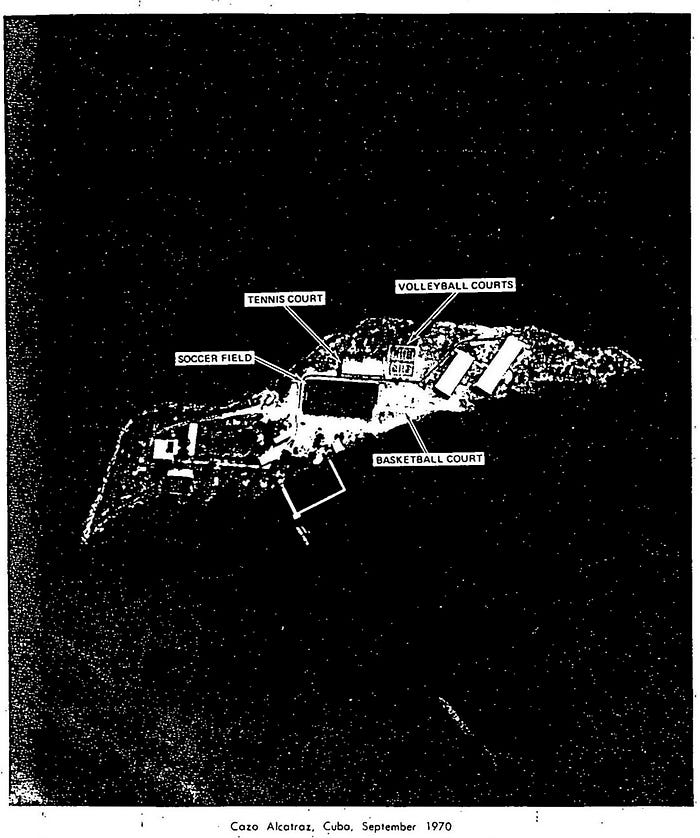
Maybe so, but it wasn’t too long ago that America and Cuba’s favorite pastime was also a battleground in Cold War espionage. On a few occasions, Cuba’s unique fondness for baseball betrayed its covert activities — at home and abroad — to American reconnaissance, thanks to the visible presence or absence of distinctive baseball diamonds.

The stories certainly have the whiff of the apocryphal about them — and they’ve since become minor pieces of intel lore. But there are kernels of truth in the tales.

BLOWBACK AS NATIONAL POLICY

April 6, 2015

The chorus of hawks and neocons, for whom Senators John McCain and Lindsey Graham serve as poster children, have rarely met an international issue that doesn’t require some American muscle. From Iraq to Syria, to Ukraine and the Islamic State in Iraq and the Levant, they mistake the willingness to use force for sagacity on foreign policy. These gray hairs have been joined by younger voices in the Senate. Senator Ted Cruz recently terrorized a little girl during his visit to New Hampshire by talking about the world being “on fire” because Obama “leads from behind.” Then there is the rank newcomer, Senator Tom Cotton, whose infamous letter to Iran’s Ayatollah seeks to derail the negotiations on Iran’s nuclear program by positing a choice between concessions from Iran that no one believes are attainable and the likelihood of another American war against a Muslim country. Senator Cotton first appeared in the New York Times as an Army lieutenant demanding the imprisonment of three journalists for violating espionage laws, but as of this writing has not stretched out his arms for handcuffs for possible violation of the Logan Act.

THE STRATEGIST’S ULTIMATE MISSION

April 6, 2015

What is a strategist? We have many definitions for grand or national strategy, but despite having a community in the United States defined as “strategists,” there is little understanding of who our strategists are, and what they do. At the always thoughtful War Council Blog, Army Major Matt Cavanaugh tackled this important question. He recognizes, as did Hew Strachan, that the word “strategy” is so overused that it’s lost all meaning.

Cavanaugh decided to promote a discussion about what strategists actually do by laying out a concise but quite potent Mission Statement:

How Iran Would Go to War against America

April 6, 2015 

While all sides here in Washington battle to shape public opinion over the Iran nuclear deal, we should not kid ourselves—this is not Obama’s “Nixon goes to China” moment, nor should we expect Air Force one to touch down in Tehran anytime soon.

Call me a pessimist, but I am not that impressed. There is a long way to go from a “framework” to an actual hard deal—with decades of mistrust making the road to a deal even longer and tougher. So before we start awarding Nobel Prizes, a hard look at the facts when it comes to the U.S.-Iranian relationship are in order.

Birganj and Battle of Kantanagar Bridge

06 Apr , 2015

Birganj was the next objective enroute to Kantanagar. This was at the junction of four road axes and thereby controlled all Southward movement towards Kantanagar Bridge. It was, therefore, imperative for 7 Maratha LI to clear this town at the earliest. Contact with the enemy was established by leading elements of ‘B’ company at 1600 hours. The battalion moved ‘A’ and ‘D’ Companies, to carry out an encirclement. Seeing this quick and bold move with determined action, the enemy withdrew hastily in the fading light. Birganj was thus cleared by 1700 hours on 5 December and advance resumed to Kantanagar bridge, whose capture was expected to be a tough nut to crack because, the enemy, withdrawing under our relentless pressure, had been able to occupy previously constructed defences there.

By about 1100 hours, a few bunkers had been captured, but both the companies had suffered heavy casualties. The enemy reacted quickly and, besides a counter-attack, brought down very heavy volume of observed artillery, mortar and automatic fire.

Perkins: 'We want to put you outside your comfort zone'

April 2, 2015

FORT LEAVENWORTH, Kan. (April 2, 2015) -- In making assignment selections, the Army is looking for a broadening of experiences. "We want to put you outside your comfort zone," said Gen. David C. Perkins.

Perkins, commander of U.S. Army Training and Doctrine Command, and other leaders spoke during Colloquium 2015 here, March 30, attended by 84 majors.

The general was responding in agreement to input from Maj. Harold Morris, who advocated for Soldiers getting a broad range of joint, interagency, intergovernmental and multinational, or JIIM, assignments.

6 April 2015

Grooming women for jihad

PARVATHI MENON
April 6, 2015 

Muslim girls in U.K. are leaving for Syria to ensure long-term stability of the IS by managing the domestic front & bearing children of fighters.

The number of British women who have gone to Syria to join the jihadist forces of the Islamic State has been slowly growing. Women are believed to account for around 10 per cent of the approximately 600 British citizens who have left for Syria since the conflict began in 2013. Most of them are young, some no more than 15 and 16. They are won over after a phase of “grooming”, primarily conducted online in a parallel world hidden from home, family and school. Though the numbers of foreign women, at least from Britain, crossing over to Syria, are relatively small, they are significant as they point to a new phase of occupation of Iraq and Syria by the Islamic State (IS). For the long-term stability of the new power structure, jihadist fighters who have come from abroad must be allowed to start families that will eventually replace the families they have left behind and may never see. Obedient wives who can manage the domestic front and bear children are therefore important for the consolidation of the IS, and must be recruited from the same countries and societies as the fighters come from.

Deep anxiety - Why are young people from Europe joining the Islamic State?

Kanwal sibal
April 6 , 2015

It is anomalous that European youth, whether Muslim or non-Muslim, should be attracted to the violent ideology of the Islamic State. That non-Muslim European youth should be beguiled by such an inhumanly violent ideology is baffling. In the case of European Muslims, it is also not easily comprehensible that having been brought up in liberal, democratic and secular societies, they should be attracted to the anti-human freedoms, anti-modern, anti-progress, anti-women, anti-minorities ideology of these jihadi groups that is devoid of economic ideas and does not offer any forward-looking vision of society.

One can object to the policies of one's country, but to join groups abroad that have such little regard for human life is another thing. One can feel strongly about injustice being perpetrated against another people, of violence being inflicted on them in the name of geopolitics, but joining groups that are dubious in their origin and are not led by particularly pious people is difficult to understand.

PAKISTAN: MQM UNDER SIEGE – ANALYSIS

By Rana Banerji

Not since Pakistan’s former Interior Minister, late Nasrullah Khan Babar’s, crackdown in mid-1995, has the Mohajir/ Muttahida Quami Movement – Altaf (MQM- A) been subjected to such a relentless siege by the Pakistan Rangers and the Sindh Police in Karachi. On March 11, 90, Azizabad, or `Nine Zero’, the home of Altaf Hussain in Federal B Area, the sanctified MQM headquarters, was raided by Pakistan Rangers. Several MQM-A party workers were arrested, arms and ammunition allegedly stolen from NATO containers seized, and five criminals wanted in the January 2011 murder of journalist Wali Khan Babbar were apprehended. The current operations in Karachi have been ongoing since August 2014.

The effort of the law and order authorities, assisted by the para-military Pakistan Rangers, has been to attempt to cleanse the greater metropolitan area of Karachi from the endemic violence, a peculiar mix of drug mafia-related crimes, extortions, kidnappings, sectarian reprisals and even `gang-warfare’, which has plagued the city for the past two decades, causing a systematic outward flow of business capital and investments from what used to be the economic hub of Pakistan.

Pakistan submarine deal won't please India

2 April 2015

A couple of weeks ago, after a visit to India, I wrote an op-ed for the Indian weekly Open with my impressions of the Indian strategic debate. The biggest take-away was how openly suspicious the Indians are about China and its intentions in the Indian Ocean.

That suspicion got another boost yesterday, with Islamabad announcing that it has approved, in principle, the purchase of eight Chinese submarines for the Pakistani navy.

This is big news for a number of reasons. First, it's a large order for a navy that currently only operates five submarines. Second, it will be the first time China has exported its submarines, which says something about the improvements in its military technology (granted, Pakistan is probably buying on price as well as capability, but this is a navy that has previously bought advanced European submarines, so its not an undiscerning customer).

What Is Behind China’s Growing Attention to Afghanistan?

Zhao Huasheng Q
MARCH 8, 2015 

In the past year, Beijing has become more diplomatically engaged with Afghanistan, raising the potential for China to play a helpful role in Afghanistan’s future economic and security prospects.

China has been intensifying its diplomatic efforts to help build a peaceful and stable Afghanistan, by hosting a regional meeting on the issue and deepening its bilateral ties with Kabul. In a new Q&A, Zhao Huasheng examines China’s growing attention to Afghanistan as well as the interests that are motivating Beijing. He says China is not seeking to fill a void left by the withdrawal of U.S. forces, but that it, in the future, could play a useful role in the reconciliation process between the Afghan government and the Taliban. 

Conflict and Cooperation in the Asia-Pacific Region: A Strategic Net Assessment


The Asia-Pacific region is undergoing enormous change, fueled by high levels of economic growth and deepening levels of integration. These and other forces are generating a shift in the distribution of economic, political, and military power across the region. This changing security environment poses a major challenge for the United States, the historically dominant power in maritime Asia. Efforts to enhance regional cooperation, reassure allies, and deter and shape potentially destabilizing behavior are demanding a more complex mixture of U.S. skills and understanding. An array of current and likely long-term forces will drive both cooperation and conflict across the Asia-Pacific region.
Key Findings

There are five different security environments that could emerge in the Asia-Pacific region over the next twenty-five years (in order of likelihood):

Sand Pebbles: Why Are Superpowers Squabbling Over Rocks?

BY KEITH JOHNSON
APRIL 2, 201

Over the past year, Beijing has significantly raised the temperature in the South China Sea with a series of provocative actions that have unsettled nearby neighbors and furrowed brows in Washington. At question is just how the U.S. should respond to a frontal challenge that directly affects the Obama administration’s pivot to Asia without risking escalation or upending the need for broader cooperation between the world’s two great superpowers.

Since early last year, China has pushed drilling rigs into Vietnamese waters, built air-defense zones over disputed islands, and most recently has embarked on a massive land-reclamation effort on a spate of deserted reefs and rocks in the vital waterway. It appears to be part of a pattern of more assertive Chinese behavior that has intensified under the leadership of Xi Jinping, and it has policymakers, military leaders, U.S. lawmakers, and outside experts grappling with just how Washington should respond.

Iran’s Leaders Begin Tricky Task of Selling Nuclear Deal at Home


APRIL 3, 2015

TEHRAN — As word made its way around the globe that an understanding had been reached with the United States and other powers to limit Iran’snuclear program, Iranians themselves greeted the news with optimism and skepticism on Friday.

While the political climate remained uncertain, the government was allowed to promote the deal at Friday Prayer, a sign that the plan was broadly supported by Iran’s establishment.

In a nationally televised speech on Friday, Iran’s president, Hassan Rouhani, a moderate, praised the deal as a development that “benefits everybody.”

IRAN NUCLEAR DEAL: A SIGNIFICANT STEP – ANALYSIS

By Arka Biswas
Iran and P5+1 (China, France, Russia, the United Kingdom, the United States and Germany), also referred to as EU3+3, have agreed on parameters for a Joint Comprehensive Plan of Action (JCPOA) in Lausanne, Switzerland on April 2, 2015. This was announced in a joint statement issued by the EU High Representative, Federica Mogherini, and the Iranian Foreign Minister, Javad Zarif. While the negotiators have only agreed upon the parameters for the JCPOA and the “implementation details” are yet to be worked out, this nevertheless is a significant step. Considering that most of the obstacles to the deal, which have been addressed in the joint statement, were primarily about the political differences between the two sides, it will be important to examine what the agreed parameters and the concessions made by each side are.

Houthi and the Blowback Saudi Arabia Steps in to Yemen

MARCH 29, 2015

With the intervention in Yemen, Saudi Arabia’s military is trying to kill several birds with one stone. In the near term, it is safeguarding the country from what Riyadh perceives as an immediate military threat posed by advancing pro-Iranian Houthi rebels. In the medium-term, it is asserting its leadership of the Arab world and consolidating its control over what has recently been a tension-ridden Gulf Cooperation Council (GCC). In the long term, it is redressing what it sees as a geopolitical imbalance in the Middle East between itself and Iran. In recent years, power has tilted heavily toward Iran, in no small part due to U.S. retrenchment.

Prophecy & the Jihad in the Indian Subcontinent


Al-Qaeda and the Islamic State of Iraq and al-Sham (ISIS) are competing with each other for recruitment on the South Asian subcontinent. As has been the case in other regions where radical Islamists have congregated (including Afghanistan, Iraq and Syria), jihadi recruitment in the region covering Pakistan, India and Bangladesh is aided by competing claims of divine support. 

Radical Islamists invoke the Hadith (the oral traditions attributed to the Prophet Muhammad) to prophesize a great battle in India between true believers and unbelievers before the end-times. These references in the Hadith to the Ghazwa-e-Hind (Battle of India) infuse South Asia with importance as a battleground in the efforts to create an Islamic caliphate resembling the social order that existed at the time of the Prophet Muhammad and the Rightly Guided Caliphs (632-661 AD). 

Saudi Air War Over Yemen Leaves U.S. on Sidelines


Mark Thompson 
April 2, 2015

When it came time to bomb Libya—both times, in fact, in 1986 and 2011—American airpower led the way. When Iraq was in the crosshairs—all three times, in 1991, 2003 and 2014—the stars and bars of the U.S. Air Force led the charge. Same thing in Afghanistan, Pakistan, Sudan, Syria and even Iran (against oil platforms and small boats in the Persian Gulf in 1987-1988). 

That history makes it almost relaxing for the U.S. military to be sitting out the latest air war launched by Saudi Arabia against the Houthi rebels now occupying a growing chunk of Yemen. The kingdom, which kicked off aerial attacks March 25, is nervous about the Iranian-backed rebels along its southern border. But Riyadh’s hardly flying solo: it has been joined by Bahrain, Egypt, Jordan, Kuwait, Morocco, Qatar, Sudan and the United Arab Emirates. 

Egypt’s Vietnam Lessons from the last time Cairo waded into war in Yemen.

BY JESSE FERRIS
APRIL 3, 2015

In the spring of 1967, Egypt’s president, Gamal Abdel Nasser, lamented to the U.S. ambassador in Cairo that the war in Yemen had become his “Vietnam.” He subsequently explained to an Egyptian historian how the conflict spiraled out of control: “I sent a company to Yemen and ended up reinforcing it with 70,000 troops.”

Over the course of the five-year war, from 1962 to 1967, Nasser lost more than 10,000 men, squandered billions of dollars, and painted himself into a diplomatic corner from which the only way out was through war with Israel. As Nasser himself would realize by the war’s end, Yemen was to Egypt what Vietnam was to the United States — and what Afghanistan was to the Soviet Union, what Algeria is to France, and what Lebanon is to Israel.

Into the Maelstrom: The Saudi-Led Misadventure in Yemen

MARCH 26, 2015

Citing a request for outside intervention by Yemen’s deposed President Abd-Rabu Mansour Hadi, the governments of Saudi Arabia, the United Arab Emirates, Bahrain, Qatar, Kuwait, and Jordan have launched an aerial intervention against the so-called Houthi movement in Yemen. Egypt has four warships en route to Aden in southern Yemen and has expressed willingness to “send ground troops if necessary,” while Turkey is considering providing logistical support. Sudan and Pakistan are also reportedly joining the operation.

The Houthis, also known as Ansar Allah in Arabic, or God’s Partisans, are a Zaidi Shia movement that began a rebellion in northern Yemen in 2003–2004. In the chaos following the Arab Spring revolutions and the internationally overseen removal of Yemen’s long-serving authoritarian ruler Ali Abdullah Saleh in 2012, the Houthis expanded their power base—apparently with Iranian support—to undermine the Saudi-backed Hadi government.

In the Iran Talks, Does a Missed Deadline Matter?

APRIL 1, 2015

The Obama administration has slipped past self-imposed deadlines and minced words over red lines before. Although certainly an embarrassment for the White House, another missed deadline in the seemingly never-ending Iran nuclear negotiations — which stretched beyond the latest deadline of March 31 — may not matter much in the end.

From Iran's point of view, it was a deadline to be exploited, not one to fret over. Iranian leaders, including Supreme Leader Ayatollah Ali Khamenei and Foreign Minister Javad Zarif, had expressed misgivings about a framework agreement, insisting that the deal is not done until all core issues are resolved in a final deal. The White House imposed the March deadline to prove to Congress that enough progress was being made to hold off on sanctions. Still, a dodged deadline and a diluted progress report are unlikely to calm dissenters in Congress. Even if a bill calling for additional sanctions in the event of a violation of an agreement makes its way through Congress, it will be vetoed in the Oval Office. Congress overturning that veto is a less likely prospect.

Saudi Arabia and Iran Compete in Yemen

STRATFOR
MARCH 25, 2015 
Source Link

While the al-Houthi movement struggles to manage multiple regional challenges to its north, its rise to power in Yemen is a setback for Saudi Arabia on its southern flank. After the fall of the Yemeni government, Riyadh will have to capitalize on the al-Houthis' need for political and financial support to re-establish its influence in the country. But because Iran is trying to fill that support gap, too, Yemen has become another battleground where the two sectarian rivals will struggle against one another.

After being driven from the capital of Sanaa in September, Yemen's government is at war with itself. President Abd Rabboh Mansour Hadi issued a statement March 19 denouncing the airstrikes on his compound in the southern port city of Aden as an attempted military coup by forces loyal to his predecessor and one-time ally, former President Ali Abdullah Saleh. Earlier that day, soldiers and militiamen loyal to Hadi battled their way into Aden's airport and stormed a nearby military base, both of which were under the control of Gen. Abdel-Hafez al-Saqqaf, a Saleh loyalist.

The Middle East’s Thirty Years’ War?

By Martin Zapfe
30 March 2015

Is the Middle East on the verge of falling into a catastrophic regional conflict? The CSS’ Martin Zapfe thinks so. As he sees it, there’s more than just the stability of the region at stake – the very concept of the nation-state is at risk in the Arab world.

The Middle East seems to be on the verge of a ‘New Thirty Years’ War’ that is characterized by a disintegrating regional order, a contest between secular and religious concepts of domestic and regional politics, and the potential for new and unlikely alliances. What is at stake in 2015 and beyond, in short, is not only the future of the states in the region, but the concept of state­hood in the Arab world per se.

Resurgent Radicalism

By Prem Mahadevan
1 April 2015

The growing profile of the ‘Islamic State’, and its rivalry with al-Qaida, has heightened fears of terror attacks on Europe. The group has injected new enthusiasm into the global jihadist project by declaring itself a ‘Caliphate’ and thereby creating an illusion of military progress relative to the opera­tionally stagnant al-Qaida. Europe needs to brace itself for the dual task of combating threats to its citizens at home while remaining alert to the strategic implications of Islamist insurgencies overseas.

A spate of terrorist attacks in the West since summer 2014 has alerted analysts to a fresh wave of radicalism from the Middle East. The rise of the so-called ‘Islamic State’ (IS) in Iraq and Syria is the most visible explana­tion of this phenomenon, but its roots lie deeper. ‘Leaderless jihad’, wherein terrorist groups devolve long-range operations to unaffiliated amateurs, has developed a forward momentum alongside ‘territorial jihad’, which aims to seize control of government struc­tures. The two types of insurrection­ary doctrine are complementing each other at a global level, confronting the West with a simultaneous threat of lone-wolf attacks at home and Islamist insurgencies in the developing world.

Bargaining with the Great Satan


Apr 2nd 2015

FOUR places: four contrasting snapshots of a relationship. In Lausanne, Iranian and American delegations are ensconced as diplomatic partners at the Beau Rivage hotel: after eight days of talks, they reach agreement greatly limiting Iran’s uranium-enrichment programme in exchange for the gradual lifting of sanctions. 

In Tehran, Iranians watch President Barack Obama in the White House explaining the reasons for the deal. It is the first time an American presidential speech has been shown live on Iranian television.

The Week In Review : ISW INTELLIGENCE SUMMARY

April 4, 2015

This report is derived from open sources collected and processed at ISW during the reporting period. The report includes analysis on Iraq, Syria, ISIS, Afghanistan, Egypt, and Ukraine.

Competition among geopolitical, sectarian, and ideological rivals in the Middle East continues to intensify into armed conflict. The U.S. -Iranian nuclear deal announced on April 2 comes as many Sunni Arab states have continued the military operation “Decisive Storm” to roll back Iranian and al-Houthi influence in Yemen. The U.S. announced it would reinstate shipments of military aid to Egypt for the first time since 2013, adding to Egyptian President Sisi’s elevated regional position in support of the Saudi-led operation against Iranian-backed Houthis in Yemen. Afghan President Ghani publicly supported the Saudi operation, despite strong resistance from political rivals already upset by Ghani’s decisions this week to centralize administrative power.

The Surrealism of Realism: Misreading the War in Ukraine


Most general readers following events in Ukraine may not be aware that much of the debate and many of the policy prescriptions among “experts” have been dominated by a school of thought in international relations scholarship known as “realism.” In a nutshell, realists have argued that US policy toward the Russo-Ukrainian conflict should be driven by pragmatic American interests and by the realities of Russia’s regional great-power status—two propositions few would disagree with. Realist arguments become more controversial, however, when they go on to insist that Russia’s behavior toward Ukraine is actually a reasonable response to Western attempts to wrest Ukraine from Russia’s sphere of influence and that the culprit behind the ongoing Russo-Ukrainian war is, thus, the West in general and the United States and NATO in particular.

Legacy of Ukraine: The Need to Engage Central Asia in the Wake of Russian Aggression

BY BLAKE FRANKO
APRIL 2, 2015

Despite the ongoing battles raging in Ukraine, more focus should be placed on the less obvious and often ignored opportunities for the West in Central Asia. 

Kazakhstan and others fear that they may be next on Russian President Vladimir Putin’s revisionist and expansive foreign policy agenda and are making cautious attempts to reach out to the United States, Europe, and China in response. Not wanting to be subjected to more of Russia’s imperialist actions, such as its stranglehold on energy and the establishment of regional trade dependence, Central Asian states are seeking to diversify their international ties, while concurrently working with their large northern neighbor. To stabilize Central Asia, the United States needs to think in the long term and cast aside the thought of the “Russian zone of influence”, even if it means angering Russia now. This will help cut down on Islamic extremism, while also developing regional trade partners and fostering the development of a stable region between Russia and China. 

The Extraordinary Tales of Central Asia’s Princelings

March 31, 2015

It’s no secret that Central Asia is one of the most corrupt regions on the planet. Among the 175 nations surveyed in Transparency International’s most recent Corruptions Perceptions Index, only Kazakhstan landed within the top 130, coming in at 126th place. Awash in nepotism, strong-arm tactics, and heavy-handed statism, Kyrgyzstan (136), Tajikistan (152), Uzbekistan (166), and Turkmenistan (169) have helped turn Central Asia into one of the most corruption-prone regions this side of the Horn of Africa.

Nonetheless, wholesale looks into the depths of regional corruption are relatively few and far between. (There’s little coincidence that such corruption dovetails with wide-scale media repression.) As such, last week presented a rare glimpse into the inner workings of the region’s first families. A pair of reports helped illustrate the preferred methods of the first families, both current and former, for swindling billions from the broader populations.

Deadly Malaysia Helicopter Crash Kills 6, Including Ex-Ambassador to US

April 05, 2015

A helicopter crashed outside Kuala Lumpur this weekend, killing all six people on board including Malaysia’s former ambassador to the United States and an aide to Prime Minister Najib Razak.

Malaysian national news agency Bernama reported that an eyewitness had said the helicopter burst into flames at around 4:55 p.m. local time before crashing in a rubber plantation in the town of Semenyih. The rescue team has since found all six bodies.

Amongst the passengers was a minister of parliament and former ambassador to the United States, Jamaluddin Jarjis, who had played an important role in boosting U.S.-Malaysia relations first as ambassador and then as special envoy to Washington. Others included Robert Tan, a businessman, and Azlin Alias, the principal private secretary in the Prime Minister’s office.

What Is the US Policy for Central Asia?

April 04, 2015

The United States is often – and often fairly – maligned for a distinct lack of strategy in its relations with Central Asia. Tacked on to Chinese or Afghanistan policy, bogged in securitization or stilted democratization efforts, Washington has seemed unable to formulate a distinct, coherent policy for the region for years. Unlike Beijing’s economic expansion or Moscow’s military ties, Washington’s Central Asian policy, if one appears, often comes across as an afterthought.

That’s not to say efforts haven’t been made to bring a policy to bear. Earlier this week, Deputy Secretary of State Antony Blinken spoke at the Brookings Institute, attempting to provide a sketch of Washington’s current regional plans. But in lieu of innovation or revamp, Washington appears content to continue along the muddled path it’s followed prior, with stale plans and retread ideas bundled once more.

Russia’s Top Paratrooper Wants Airborne Snowmobiles

By ROBERT BECKHUSEN

The Russian military is working on an air-dropped snowmobile for its paratroopers. No, it’s not a scene from a James Bond movie.

Earlier this year, Col. Gen. Vladimir Shamanov — Russia’s airborne forces chief — ordered the development of “airborne snowmobiles” after a visit to the northern Yaroslavl region.

“Airborne snowmobile flies, shoots and keeps the driver warm,” Shamanov said according to the newspaper Komsolskaya Pravda.

What Shamanov is talking about is an ordinary Taiga-551 snowmobile dropped from the back of an airplane. The vehicle weighs about 705 pounds and powers itself with a liquid-cooled 65-horsepower engine.