by K.W.
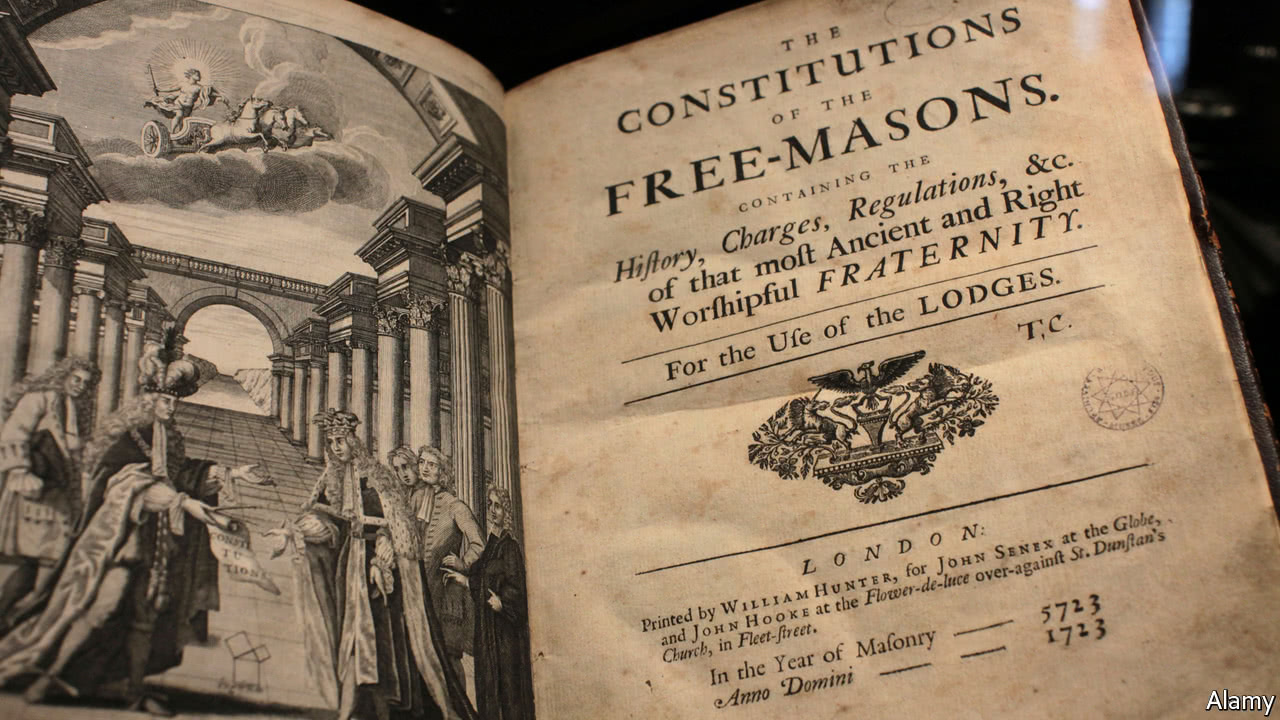 THE literature on freemasonry does not offer straightforward explanations. Is it benign or bent on subverting government? Is it a community of knowledge or of the occult? Such questions are not new. Since its development in the 18th century, freemasonry has drawn the ire of the Catholic church, right-wing politicians and, more recently, Britain’s Home Office. (Fearing that masons in the police and judiciary were giving preferential treatment to other masons, the Home Office between 1998 and 2009 required judicial appointees to disclose their membership.) Freemasonry can appear incomprehensible because it contains no coherent ideology or doctrine, and is defined instead by a commitment to universal brotherhood and self-improvement. Nor does a single governing body exist. It is made up of a loose network of groups, known as lodges, that fall under regional and national grand lodges. What, then, is freemasonry all about?
It grew out of medieval stonemasons’ guilds, which set wages, trained apprentices and regulated who could practise the craft. In early modern Europe, masons studied measurement, geometry and mathematical calculation—as well as bricklaying. Expert masons acted as architects and engineers, earning a higher status than most other tradesmen. Advancement within guilds implied authority, and the path from apprentice to master was marked by ritual. To elevate their trade, masons invented elaborate histories dating back to ancient Egypt. Guilds were also social organisations whose members met informally to drink in lodges. (The term first referred to the temporary accommodations at construction sites.) Out of financial necessity, guilds began accepting non-stonemasons and charging them dues in the early 1600s. These would be educated men interested in mathematics and antiquity. While working masons would “hew stone and raise perpendiculars”, the gentlemen members were to practise “secrecy, morality, and good fellowship”. By the end of the 17th century, as guilds became obsolete, the majority of members were gentlemen enthusiasts.
The rapid spread of freemasonry in the 18th century—first in England and then abroad—fitted within a broader expansion in club membership as cities grew. Masonic lodges resembled other clubs in some respects: members met for lectures and dined together. But freemasonry was exceptional. Its rituals were more secretive and elaborate than those of other clubs. It was also secular, nonpartisan and egalitarian, at least in theory. Lodges should “conciliate true friendship among persons that must else have remain’d at a perpetual distance”, explained one manual from 1723. Sectarian affiliation did not determine membership, and political talk was forbidden. “Real worth and personal merit only” granted entry, which had to be unanimously agreed upon by other lodge members. Enlightenment ideals of cosmopolitanism, progress and perfectibility animated early masonic literature. Knowledge, it was believed, could ease divisions of class and nationality while ensuring universal solidarity.
Freemasonry was not so inclusive as envisioned, remaining largely inaccessible to women and the working class. Still, lodges permitted a degree of commingling between the aristocracy and educated professionals rarely seen before. They also offered places for upper-middle-class men to enact abstract Enlightenment values about equality, secularism and merit. Margaret Jacob, a historian, has argued that lodges became “schools of government” and laboratories for civic participation. Masons paid dues, swore oaths of loyalty, voted, debated and elected officers. Today, at 1.1m, lodge membership in America is at its lowest ever, down from 4.1m in 1959. This decline mirrors weak participation in civic groups more broadly. In his study of contemporary freemasonry, J. Scott Kenney, a sociologist, tells of masons joining the group in search of greater meaning. One called it the antidote to today’s “Jerry Springer morality”.
No comments:
Post a Comment