30 January 2014

Nuclear entente

Published on The Asian Age (http://www.asianage.com)
By editor
 28 Jan 2014

China’s transfers of sensitive technology to Pakistan in violation of the nuclear nonproliferation regime is receiving flak from the US. But Islamabad cites US’ civilian nuclear agreement with New Delhi to claim parity.

The recent revelation that China is negotiating to build three new nuclear plants worth $13 billion in Muzaffargarh district of Pakistan’s Punjab province reinforces the longstanding reality of the former purposefully undermining India’s national security.

Even though China’s mega nuclear deals with Pakistan are dressed up as responses to acute electricity shortage crippling the latter, the dualistic civil-cum-military nature of nuclear technology and the history of Sino-Pakistani collusion in nuclear weapons and missiles leave little to the imagination about their true strategic intent.

Claims that Chinese-aided nuclear power will address Pakistan’s electricity blackouts are exaggerated and only believable in a long-term perspective. It is more timely and cost-effective if Pakistan imports power from India, a prospect under discussion between the two neighbours — it could lead to India supplying 2,500 megawatts to relieve Pakistan’s struggling economy.

The real reason behind Sino-Pakistani nuclear energy cooperation is containment of India. India has always been in the crosshairs of the “all-weather alliance” between China and Pakistan since the 1950s. The alliance encompasses conventional and non-conventional military quid pro quos, material and diplomatic assistance to each other during Chinese and Pakistani wars against India, critical infrastructure construction such as the Chinese-built deep-sea port of Gwadar in Balochistan province, tacit understandings for Pakistan to moderate Islamic extremism in China’s restive Xinjiang region, and general foreign policy coordination at multilateral forums with a view to countering India’s positions and opportunities.

To cite Hussain Haqqani, a former Pakistani ambassador to the United States, “for China, Pakistan is a low-cost secondary deterrent to India”, while “for Pakistan, China is a high-value guarantor of security against India.” Notwithstanding the tectonic shifts in global geopolitics that accompanied the end of the Cold War, the utility of China to Pakistan and vice versa remains entrenched to this day because of their shared animus towards India.

China has nuanced its hardline pro-Pakistan stance on the Kashmir dispute, but the fundamentals of the Beijing-Islamabad axis are rock solid and manifesting in new avatars like nuclear energy cooperation. Pakistani Prime Minister Nawaz Sharif mentioned the proposed three new Chinese-aided nuclear plants within closed doors to his Cabinet earlier this month. The announcement came on the heels of a prior agreement for China to provide two separate nuclear power reactors worth $9 billion in the southern metropolis of Karachi.

Nuclear Umbrella

C. Raja Mohan
29 January 2014

Chinese Takeaway / use this ribbon 

There was some flutter recently at reports that China was opening a "nuclear umbrella" for Ukraine. "Nuclear umbrella" is about a nuclear weapon power protecting a non-nuclear weapon state, usually a very close ally, against atomic threats from others. In nuclear jargon it is called "extended deterrence". China has in the past tended to avoid alliances and insisted that its nuclear arsenal was meant for national defence and not for securing the interests of any other nation. It had always denounced the US nuclear umbrella extended to its neighbours, Japan and South Korea. Given this background, there was much speculation if China was changing its policy on extended deterrence. 

The speculation was triggered by a joint statement issued by Chinese President Xi Jinping after a meeting with the President of Ukraine, Viktor Yanukovych, last month. The joint statement said: "China pledges unconditionally not to use or threaten to use nuclear weapons against the nuclear-free Ukraine and China further pledges to provide Ukraine nuclear security guarantee when Ukraine encounters an invasion involving nuclear weapons or Ukraine is under threat of a nuclear invasion." 

The confusion appears to have been caused by a misreading of the statement in a section of the Chinese media and mistranslation and over-interpretation by a few Western analysts. A closer reading of the statement, however, suggested China was merely offering boiler plate assurances to Ukraine, which had given up its claim to nuclear weapons after the Soviet Union broke up in 1991. 

Since the mid-1990s, all nuclear weapon powers had been issuing similar assurances, both negative and positive, to non-nuclear weapon states. Under the "negative assurances", the five permanent members of the UN Security Council promise non-nuclear weapon states that they will not attack or threaten to attack them with atomic weapons. Under the "positive assurances", the P-5 offer to come to the aid, the nature of which is deliberately left ambiguous, of non-nuclear states threatened by atomic weapons. Few in the world take these statements seriously. 

Pak Connection 

From New Delhi's perspective, the Western speculation on China offering nuclear protection to Ukraine is largely academic. India's problem is rather different. It has long struggled to come to terms with China's sustained nuclear and missile cooperation with Pakistan. 

Beijing has gone way beyond offering a nuclear umbrella to Islamabad, by actively assisting the Pakistan army to build nuclear weapons in the 1980s and manufacture missiles in the 1990s. The depth of the connection has led some to argue that the Pakistani atomic armoury is but an extension of the Chinese arsenal. 

China's determination to maintain Pakistan's nuclear parity with India has also been underlined by Beijing's opposition to the US decision to facilitate an end to India's nuclear isolation. When it could not block the US-India civil nuclear initiative, Beijing chose to offer additional nuclear power reactors to Pakistan in violation of its non-proliferation commitments. 

India is now warily assessing reports that Pakistan is seeking the lease of a nuclear powered submarine from China to match India's acquisition of a nuclear attack submarine from Russia. As India develops its under-water deterrent capability with the "Arihant" nuclear missile submarine, Pakistan is reportedly trying to build similar capability and asking for Chinese help. China and Pakistan have already signed a deal to build six conventional submarines in the shipyards of the two countries, but there is no official word on the nuclear dimension. 

Pacific Pivot? More Like Retreat

January 29, 2014

In a future update of The Devil's Dictionary, the famed Ambrose Bierce dissection of the linguistic hypocrisies of modern life, a single word will accompany the entry for "Pacific pivot": retreat.

It might seem a strange way to characterize the Obama administration's energetic attempt to reorient its foreign and military policy toward Asia. After all, the president's team has insisted that the Pacific pivot will be a forceful reassertion of American power in a strategic part of the world and a deliberate reassurance to our allies that we have their backs vis-à-vis China.

Indeed, sometimes the pivot seems like little less than a panacea for all that ails U.S. foreign policy. Upset about the fiascos in Iraq and Afghanistan? Then just light out for more pacific waters. Worried that our adversaries are all melting away and the Pentagon has lost its raison d'être? Then how about going toe to toe with China, the only conceivable future superpower on the horizon these days. And if you're concerned about the state of the U.S. economy, then the Trans-Pacific Partnership (TPP), the regional free-trade deal Washington is trying to negotiate, might be just the shot in the arm that U.S. corporations crave.

In reality, however, the "strategic rebalancing" the Obama administration has been promoting as a mid-course correction to its foreign policy remains strong on rhetoric and remarkably weak on content. Think of it as a clever fiction for whose promotion many audiences are willing to suspend their disbelief. After all, in the upcoming era of Pentagon belt-tightening and domestic public backlash, Washington is likely to find it difficult to move any significant extra resources into Asia. Even the TPP is an acknowledgment of how much economic ground in the region has been lost to China.

There's also the longer arc of history to consider. The U.S. retreat from Asia has been underway since the 1970s, although this "strategic movement to the rear" -- as the famous military euphemism goes -- has been neither rapid nor accompanied by "mission accomplished" photo ops.

How Will Japan’s New NSC Work?

The National Security Council brings welcome changes, but will it be able to overcome Japanese bureaucracy?
January 29, 2014

The administration of Japan’s Prime Minister Shinzo Abe implemented its long sought-after National Security Council (NSC) last December. The creation of the NSC was surrounded by the release of other security-related documents such as revised National Defense Program Guidelines (NDPG) and a first-ever National Security Strategy (NSS). While the publication of these documents and the creation of the NSC had been planned for several months, their release still set off some alarm bells across the international press and resulted in some predictable cautioning from Beijing, which raised concerns that Japan was returning to its militarist past. Abe’s bold move in visiting Yasukuni shrine, on the anniversary of his first year in office, provided yet another golden opportunity for his detractors to question Japan’s strategic intentions.

The intentions behind the new security apparatus in Tokyo is another debate unto itself. But lost in the furor of this discussion is the actual operations and purpose of Japan’s new centralized approach to national security. Specifically, there seems to be confusion over the newly minted NSC and its role in Japan’s foreign policy – especially with regard to the simmering dispute with China over the Senkaku Islands. As noted in a previous article on the necessity of an NSC in Japan, the concept is not new or merely an outgrowth of souring ties with Beijing. Indeed, during Abe’s first administration in 2007, he proposed legislation that would enact an NSC but the bill was discarded due to unfinished deliberations.

Tokyo has also used other forms of security and defense councils for several decades, but they have been dogged with inefficiencies caused by information silos and bureaucratic red tape. Abe’s failure to procure accurate and timely intelligence during the hostage taking of several Japanese citizens last year in Algeria seemed to mark another tipping point justifying the need for swifter and more centralized national security decisions.

A worrying map of the countries most likely to have a coup in 2014

January 28

Click to enlarge. Data source: Jay Ulfelder coup forecasts for 2014. (Max Fisher/Washington Post)

Coups are bad news for any country. They weaken the rule of law, throw governments into chaos, undermine or outright jettison democratic norms and institutions, and can lead to violence, oppression or worse. They can also be tough to see coming, particularly since the people looking for them tend to focus on a single country, which can lead them to overemphasize local events and understate the broader dynamics that make coups happen, or not.

That's a big part of why political scientist Jay Ulfelder has, for the past three years, maintained a mathematical model to predict the likelihood of coups in almost every country around the world. By tracking over a dozen variables – from political system to years of independence the presence of absence of an "elite" ethnic group – Ulfelder's model roughly estimates the likelihood that each country will experience a coup this year. He "trained" the model by applying it over the years 1960 to 2010, further developing its ability to predict future coups by looking at past ones.

Ulfelder kindly shared his full dataset with me, which I've mapped out above. The redder countries are at higher risk for a coup and the yellower countries at lower risk. You can read his post here for much, much more about how he designed this model and what makes it work.

Here are a few notes to help you read this map. First, even the most extreme cases are well below a 50 percent likelihood of a coup, meaning that a coup probably won't occur. Those would be the West African countries of Guinea and Mali (26.5 percent and 22.7 percent likelihoods of coups) and Madagascar, at 23.9 percent likelihood. Those numbers are high enough, though, to be appropriately alarming. Second, the numbers drop off quickly, with the vast majority of countries less than 5 percent likelihood of a coup, and half of them less than 1.5 percent. So the difference between a dark red country and a light orange or yellow country is very significant.

There are a few immediately obvious trends in the data. First, it doesn't look good for sub-Saharan Africa, which has the top nine most at-risk countries. Not all of Africa, to be clear, much of which is quite stable, but the risk is heavily concentrated in Africa's Sahel region (that east-west strip just below the Saharan desert) and in West and Central Africa. There are complex political, ethnic and post-colonial reasons for this,which I wrote about here. Looking forward, political instability and competition risks holding back a part of the world that is otherwise poised for long-overdue economic growth.

EU unemployment is likely to continue

Pooja Suri
29 January 2014

Unemployment usually moves in a cyclical way depending on the business growth cycle. However, the European Union (EU) has caught a longer lasting and more ominous form of unemployment -- structural unemployment which has been caused and exacerbated by extraneous factors like low growth and austerity measures. Compared with figures from November 2012, unemployment in the EU rose by 452000 in November 2013 in the euro area. Since then, the EU unemployment rate has remained steady at 12.1%, but the euro zone remains a place of economic tension as it continues to face a crisis with states coming to the rescue of banks, competitiveness of economies being threatened by the old age population coupled with strict austerity measures. While there is a strict recovery plan in place, the next few years continue to remain sensitive and the scope of the EU making a full recovery is still a wait and watch situation. 

The euro zone was brutally struck with the aftermath of the global crisis of 2008 which originated in the US. Since then, the EU has faced continuous debt pressure and economic instability and has been on the path of a slow recovery. The EU's macroeconomic policy is not entirely conducive to a sustained economic recovery. With a growth rate of 1.3% and persistent austerity measures, credit crunch and a restrictive monetary stance, the EU now struggles with a stubborn rate of unemployment of 12.1%. This continuous rise in unemployment and in particular, youth unemployment, in most of the European countries over the last three years has been a source of continuous worry and is considered to be one of the greatest consequences of the crisis. Currently, the EU unemployment level stands at 12.1% and youth unemployment reaching a record high of 24.4%. The focus in the EU has now shifted to mitigating this pressing issue of unemployment that is stagnating the economy. The spread of unemployment is uneven with 4.8% and 5.2% of the workforce in Austria and Germany respectively; whereas in Spain and Greece the percentages are 26.4 and 27.4, respectively. 

The euro area has had a very modest recovery so far of about 0.7% and this trend is expected to continue throughout 2014. Thus, the EU has registered its second recessionary phase in the last four years. Given the lack of growth in the economy, the level of unemployment is expected to remain stagnant if not rising. The European view on these trends remains optimistic as they believe that the combination of fiscal austerity coupled with structural reforms is working well. It is a popular belief in the EU that these policies need more time and flexible application at the country level in order to produce results. While the EU has seen positive results of this approach with countries like France and Spain, the external adjustments of current account deficits are not sustainable and the fiscal deficit is expected to persist. Improving these deficits results in a fall in domestic demand which has happened in all the highly - indebted countries like Greece and Ireland and somewhat in Italy, Spain and Portugal. This fall in demand is also one of the main reasons behind the unemployment faced by the EU and the deflation that has been looming. 

2014: A Risky Year in Geopolitics?

Published on The National Interest (http://nationalinterest.org)
January 29, 2014

What are the biggest political risks for 2014?

There are plenty of potential crises to keep us up at night in 2014. [3]There are tensions between China and Japan in the East China Sea [3] and elite-level executions in North Korea. Violence continues to worsen in the Middle East with a resurgence of a more localized Al Qaeda, [4]a deteriorating security environment in Iraq [4], and 2014’s biggest geopolitical pivot point: [5]the make-or-break Iran nuclear agreement [5]. If the P5+1 and Iran strike a deal, it would be a huge boon for the Obama administration, but it would leave Iran economically emboldened and looking to backstop Shia initiatives across the region, putting it even more at odds with Saudi Arabia. A deal is, on balance, more likely than not. But if it falls through, it means a spike in oil prices, in addition to the likelihood that Israel strikes Iran before it can sprint to nuclear-breakout capacity. All of these geopolitical concerns are front and center for the coming year.

But above all, two essential questions best categorize the major political risks of 2014. For many of the world’s predominant emerging markets, it’s an internally focused question: How will key developing countries adapt to upcoming elections or implement ambitious agendas—and what does it mean for their behavior beyond their borders? For the United States, the question is externally focused. The international community perceives America’s foreign-policy behavior as increasingly unpredictable. Is the United States disengaging internationally? How will policymakers define the role that the US should play in the world? Much depends on these concerns, as America’s relationships with its allies become increasingly fraught.

When you add these two questions to the more conventional geopolitical security uncertainties, there is one clear answer: the erosion of global leadership and coordination will become more apparent and pronounced in 2014.

How will emerging markets respond to internal challenges?

This year, we will see domestic distractions in emerging markets, from election cycles to unprecedented reform agendas; do not expect them to play a significant role internationally that does not cohere with their more pressing priorities at home. We are in the midst of a new era of political challenges for emerging markets, as slowing growth, sputtering economic models, and rising demands from newly enfranchised middle classes create heightened uncertainty. As recent protests in Brazil, Turkey, Thailand, Colombia, Ukraine and Russia have shown, new middle classes have new demands—and are willing to take to the streets if they go unmet.

Political Alienation in Russia and the West

Published on The National Interest (http://nationalinterest.org)
January 29, 2014

President Vladimir Putin is seeking to position Russia as an ascendant world power that defends traditional moral, family and religious values. In so doing he casts an air of superiority over the United States and Europe, supposedly mired in moral and economic decline. In fact, Russia confronts severe challenges to governance and central authority, with significant segments of its population alienated. America and Europe face some of the same challenges, albeit less dramatic.

In America, conservative insurgents feed on declining public trust in central government (Washington) and seek to roll back its power. Only one in ten Americans has a positive view of Congress, which is often politically polarized or gridlocked in dealing with major issues, such as immigration reform and fiscal policy. In a Gallup poll released last week, 65 percent of Americans voiced dissatisfaction with the nation’s system and efficacy of government, up five percentage points from last year. The United States has fought two unpopular wars in the last decade, and the public is mistrustful of rationale for new military engagements abroad, such as in Syria.

In Europe, there is popular frustration with the accretion of European Union power in Brussels. Opinion polls indicate that anti-EU forces are gaining ground. The United Kingdom's planned referendum on EU membership is another manifestation, although driven by an internal party dispute with right-wing Conservatives. In some regions, such as Scotland and Catalonia, politicians seek referendums on national independence. Another sign of alienation is the growth of far-right parties throughout Europe. In November, a continental anti-EU alliance was formed, and its rallying cry is to “slay the monster in Brussels." These parties are strongly nationalist, oppose immigration and, in some cases, are homophobic or anti-Semitic. They are likely to win major representation in next May’s European parliamentary elections.

Europe's Role for Security in a Multipolar World: Views from India and China


This report of a conference, hosted by the NFG Research Group "Asian Perceptions of the European Union" at ORF and JNU on September 26-27, 2013, provides a summary of the key themes which emerged from the conference.
http://orfonline.org/cms/export/orfonline/modules/report/attachments/report_1390981272599.pdf

Ukraine: The Perpetual Buffer State

January 28, 2014

A few months ago, Ukrainian President Viktor Yanukovich was expected to sign some agreements that could eventually integrate Ukraine with the European Union economically. Ultimately, Yanukovich refused to sign the agreements, a decision thousands of his countrymen immediately protested. The demonstrations later evolved, as they often do. Protesters started calling for political change, and when Yanukovich resisted their calls, they demanded new elections.

Some protesters wanted Ukraine to have a European orientation rather than a Russian one. Others felt that the government was corrupt and should thus be replaced. These kinds of demonstrations occur in many countries. Sometimes they're successful; sometimes they're not. In most cases, the outcome matters only to the country's citizens or to the citizens of neighboring states. But Ukraine is exceptional because it is enormously important. Since the breakup of the Soviet Union, Ukraine has had to pursue a delicate balance between the tenuous promises of a liberal, wealthy and somewhat aloof Europe and the fact that its very existence and independence can be a source of strategic vulnerability for Russia.

Ukraine's Importance

Ukraine provides two things: strategic position and agricultural and mineral products. The latter are frequently important, but the former is universally important. Ukraine is central to Russia's defensibility. The two countries share a long border, and Moscow is located only some 480 kilometers (about 300 miles) from Ukrainian territory -- a stretch of land that is flat, easily traversed and thus difficult to defend. If some power were to block the Ukraine-Kazakh gap, Russia would be cut off from the Caucasus, its defensible southern border.

Moreover, Ukraine is home to two critical ports, Odessa and Sevastopol, which are even more important to Russia than the port of Novorossiysk. Losing commercial and military access to those ports would completely undermine Russia's influence in the Black Sea and cut off its access to the Mediterranean. Russia's only remaining ports would be blocked by the Greenland-Iceland-U.K. gap to the west, by ice to the northeast, by Denmark on the Baltic Sea, and by Japan in the east.

This explains why in 1917, when the Bolsheviks took power and sued for peace, the Germans demanded that Russia relinquish its control of most of Ukraine. The Germans wanted the food Ukraine produced and knew that if they had a presence there they could threaten Russia in perpetuity. In the end, it didn't matter: Germany lost Word War I, and Russia reclaimed Ukraine. During World War II, the Germans seized Ukraine in the first year of their attack on the Soviet Union, exploited its agriculture and used it as the base to attack Stalingrad, trying to sever Russia from its supply lines in Baku. Between the wars, Stalin had to build up his industrial plant. He sold Ukrainian food overseas and used it to feed factory workers in Russia. The Ukrainians were left to starve, but the industry they built eventually helped the Soviets defeat Hitler. After the Soviets drove the Germans back, they seized Romania and Hungary and drove to Vienna, using Ukraine as their base.

Cyber Defense for Defense 2.0


At present, the defense policy landscape is replete with arguments, many of which are ultimately based in the lack of a common vision among both elites and within the broader citizens about the role of the political leaders in the future. Cyber operations are one element of these debates, though much of the discussion has centered on how best to defend against a growing cyber threat, the role of the Ministry of Defense in that debate, and tensions between privacy, human rights, freedom of speech, and security interests. Occasionally, greater attention is paid to questions about the use of cyber offensively, which brings with it questions of precedent, deterrence, international norms, and a host of other challenges. But it is also apparent that political leaders have already approved the use of offensive cyber capabilities, though under tight restrictions. While not ignoring this larger context, the specific question this project sought to examine in greater depth is whether the Ministry of Defense should make a more deliberate effort to explore the potential of offensive cyber tools at levels below that of a combatant command. 

With respect to operational and tactical cyber use, the Indian defense establishment finds itself at a logical but difficult decision point. As is historically the case with new technologies, from gunpowder to airpower to space, there is a natural evolution as the capability is introduced, begins to be used, becomes more integrated, and sparks creative thought about further applications. Cyber, and offensive cyber in particular, is moving along this path, which (as has been the case for other technology areas) is fraught with domestic and international legal and policy concerns. The Ministry of Defense enterprise has to focus its attention on addressing these issues at the level where the capabilities can have the most profound effects—the strategic level. But as progress is being made there, the military services are giving more serious consideration to the role that offensive cyber could play in also supporting the priorities of tactical and operational commanders. 

To date, the services’ efforts have progressed at different rates of speed, due in part to differing service cultures and to the priority placed on the development of these tools by senior leaders within each service. The question for the broader policy community at this point, and for the Office of the Defense Secretary in particular, is whether current efforts are sufficient, or whether a more systematic approach to exploring the potential is warranted. A broader consensus on the wisdom of delegating the authority to use offensive cyber tools may be far in the future, and resolving the many practical concerns explored here is both critical and nontrivial. At present, neither the procedures nor the tools are sufficiently robust to merit a delegation of offensive cyber authorities beyond the very limited ways in which they have been utilized thus far. But a reasonable determination of whether the potential operational benefits outweigh the real and legitimate potential costs outlined above necessitates further capability development, albeit in a very controlled context. 

SPLENDID ISOLATION

Britain’s defence cuts and remembering the Great War
Westminster Gleanings - Anabel Loyd

Our government’s unending cost cuts have affected the British armed forces adversely for several years and through several rounds of defence reviews; we are now reaching rock bottom and it seems that the government, faced with necessary economies, may not have thought things out as well as they should. A year ago, Philip Hammond, the defence secretary, was arguing against further cuts in his department in favour of more in social-service areas; now the boot is on the other foot. Defence cuts continue, but, as they have always been impelled by the requirement to reduce our overall fiscal deficit and not by joined-up thinking in their own department — the same applies, of course, for just about every other department of government — there is no proper blueprint of ways, means, order and good sense, let alone what we actually need going into the future.

When we were all busy banning the bomb not so very many years ago, wars, ho ho ho, or at least those that would touch home shores, were behind us and there were more important things to worry about — those social-service budgets, education and health, of course — the zeitgeist feeling was to cut defence costs. Now, some of us might still feel in our heart of hearts that we only need a very small standing military for our own purposes. Ireland, our major at-home defence problem, has been dealt with up to a point, and not much else threatens us beyond worldwide terrorism. If we have a decent police force — and, boy oh boy, that is a question on its own — why do we need a strong military force?

Well, I fear we do, for all sorts of reasons, and the ongoing cuts are going to make it hellishly hard to build up again what we are losing if those needs become imperative beyond the damage being done to our international standing more than it has been already. I was anti our involvement in Iraq and Afghanistan — much too 19th century, thank you very much — but, on the other hand, it appears that, in a smaller way, we are better at all that stuff than the Americans, better at hearts and minds, more likely to remember the past history of some of the places and find them on the map because they are part, like it or not, of our past history too.

If our military treads softer than some others, it is possible that it may be of value in peace-keeping operations that, however difficult and often botched, may make the lives of civilians in warring regions slightly easier and the numbers of those regions and countries are hardly shrinking.

Reducing our military, whatever role it plays, fits very well with our present attempts at splendid isolation, of course, but we want that every which way that suits us. Stay in Europe just as much as we want, regardless of everyone else, best buds with the United States of America without bringing much more than additional talking shop to the party — oh, and of course, expecting them to bail us out if we do hit a spot of bother with as little reciprocation as possible.

20YY: The Future of Warfare

January 29, 2014 · in Analysis

The U.S. military is at a critical juncture. With the end of two wars and a sharp drawdown in defense spending, investments over the next several years will set the military’s course for decades to come. The Pentagon can make smart investments now to prepare for the future, or it can continue to cling to “wasting assets,” legacy platforms and concepts that will be less and less survivable in a future of widely proliferated precision-guided weapons. Without a clear vision of what future force to build, however, bureaucratic inertia and existing programs of record will carry the day.

A new report from the Center for a New American Security (CNAS) articulates a vision of unmanned and autonomous systems as the centerpiece of an emerging warfighting regime dominated by robotics. The proliferation of anti-access and area-denial (A2/AD) technologies to both state and non-state actors is only a precursor to an even more lethal regime characterized by swarms of networked, intelligent machines. Because many of the underlying technologies behind robotics are driven by commercial sector innovation in information technology, the U.S. defense community does not have a monopoly on this technology. Unlike previous innovations like GPS, stealth technology, or advanced sensory capabilities, the robotics revolution will happen whether the U.S. moves first in this arena or not. While the United States enjoys a small lead in unmanned and robotic systems today, other actors are moving aggressively. Scores of states have unmanned vehicles, as do some non-state actors. Autonomous drones can be purchased off-the-shelf, allowing a single terrorist to field a swarm of kamikaze drones. Last month, a hacker demonstrated the ability to use a drone to hack and take control ofother drones, raising the specter of a “zombie drone” air force. The robotic warfighting regime is barreling down upon us at an alarming rate, and the U.S. military will need to be more adaptive and innovative or risk falling behind.

20YY: Preparing for War in the Robotic Age is the first report in a multi-year initiative that CNAS has launched examining the impact of emerging technology on the future of warfare. Rapid changes in robotics, autonomy, networking, and computer processing have the potential to dramatically change the character and speed of armed conflict.

Rapidly advancing information technology is leading to a world with greater transparency, connectivity, and more intelligent machines. Advanced sensors will make it increasingly difficult for U.S. platforms to hide from states possessing sophisticated reconnaissance-strike battle networks, while ubiquitous smart phones will make hiding large force elements in populated areas impossible. Smartphones and social media empower citizens with ad hoc command-and-control networks, allowing non-state groups to operate makeshift battle networks. The proliferation of precision-guided weaponry, from long-range ballistic missiles like China’s DF-21 to guided rockets, artillery, mortars, and missiles (GRAMM) in the hands of non-state actors, will increasingly allow adversaries to accurately hit what they find. These trends in the democratization of information and the democratization of violence will result in a future operating environment that is more contested, transparent, and lethal.

Navy, Electric Boat Test Tube-Launched Underwater Vehicle

by KRIS OSBORN on JANUARY 28, 2014

Groton, Conn. – The Navy and General Dynamics Electric Boat are testing a prototype of a system that would allow the launch and recovery of unmanned underwater vehicles and other payloads from the missile tube of a cruise missile submarine.

Called the Universal Launch and Recovery Module, the system houses, launches and recovers an underwater vehicle, a Lockheed-built 10,000-pound prototype vehicle called Marlin, from the submarine’s missile tube.

The system is showing promise in early testing and is slated to go sea aboard a guided missile, nuclear powered submarine (SSGN) next year, Electric Boat officials said.

“This is real prototyping to actually go and exercise the system before we put it on an SSGN and take it to sea,” Adm. David Johnson, Program Executive Officer, Submarines, said at the 2013 Naval Submarine League Annual Symposium, Va., in October.

The system is designed for a range of potential underwater missions to include counter-mine patrol, sonar or other intelligence, surveillance and reconnaissance (ISR) missions.

“Submarines have the ability to get really close to something. That is a big advantage,” said Franz Edson, director, mission systems & business development, General Dynamics Electric Boat.

The prototype vehicle is hooked up to temporary hydraulics and engineered to acquire a buoy at the top of the missile tube using a transponder, said Edson.

“It comes out of a tube, rotates, and then deploys. It goes off and does its thing — mine warfare, ISR, etc. –Then it comes back and it mates with that buoy before it is brought back down into the tube,” Edson said.

Once a tactical version of the technology is built, it will fill up the launch tube out to 60-inches in diameter and stretch as long as 23-feet, Edson said. The vehicle could weigh up to 30,000-pounds, he added.

The prototype vehicle is controlled by two laptop computers, removing the need to adjust the infrastructure of the submarine in order to accommodate the system, Edson explained.

“It is a gigantic elevator that will take up to 30,000 pounds and raise it from inside the ship to outside the ship. We’re not modifying the submarine’s infrastructure to control this,” Edson said.

In addition to being configured to swim from an SSGN, the system is also being configured by Electric Boat and the Navy to work from the Virginia Payload Modules of Virginia-Class attack submarines to begin construction by 2019, Edson said.

Virginia Payload Modules, or VPM, consist of an effort to increase the missile firing capability of Virginia-Class submarines from 12 to 40 vertically fired missiles.

Defense.org

Officials raise doubts about Obama administration’s rebalance to Asia

BRIAN H. ABEL/U.S. NAVY

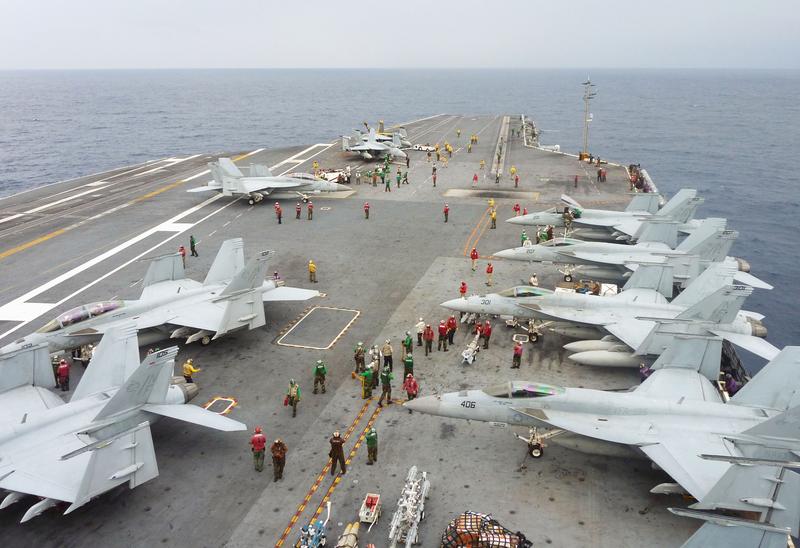
The aircraft carrier USS George Washington transits toward the Military Sealift Command dry cargo and ammunition ship USNS Charles Drewprior to an ammunition off-load Dec. 2, 2013. George Washington with its embarked carrier air wing, Carrier Air Wing (CVW) 5, provide a combat-ready force that protects and defends the collective maritime interests of the U.S. its partners and allies in the Indo-Asia-Pacific region. 

Twenty-six ships from the U.S. Navy and the Japan Maritime Self-Defense Force steam together in the East China Sea on Nov. 16, 2012, after the conclusion of Keen Sword, a biennial naval exercise by the two countries to respond to a crisis in the Asia-Pacific region.
JENNIFER A. VILLALOVOS/U.S. NAVY

WASHINGTON — Members of Congress and senior defense officials see problems in the Obama administration’s ongoing rebalance of military forces toward the Asia-Pacific.

“I welcome the focus on the Asia-Pacific. However, time will tell whether words and promises are followed by action,” House Armed Services Committee chairman Rep. Buck McKeon said during a Congressional hearing Tuesday. “When the president framed rebalance, he discussed how we could now safely turn our attention to Asia because the war in Afghanistan was receding and al-Qaida was on the path to defeat. I’m concerned these conditions haven’t panned out.”

McKeon said national security challenges elsewhere combined with budget cuts threaten the rebalance.

“Violence and instability rage in the Middle East and Africa. Preserving forces’ readiness and capabilities in PACOM means less elsewhere. Can we afford to take risk in CENTCOM or AFRICOM?” he said. “Budget cuts only exacerbate the problem … As we look forward, defense funding is basically flat out into the future. We’re back to sequestration levels. And military leaders are left with no choice but to cut end strength, readiness and capabilities. And that has consequences for our security and military commitments in PACOM and across the globe unless we adequately resource defense.”

Senior Pentagon officials also believe that budget constraints are jeopardizing the rebalance.

“On the perspective of technological superiority, the Department of Defense is being challenged in ways that I have not seen for decades, particularly in the Asia-Pacific region,” Frank Kendall, the Under Secretary of Defense for Acquisition, Technology and Logistics, told lawmakers. “As we go through our budget cycles, we’re looking very carefully at Pacific Command’s requirements and what they need for the operations in that area, what potential future concerns [Adm. Samuel Locklear, commander of U.S. Pacific Command] might have, and we are prioritizing those investments. So we are responding, but … declining budgets alone make it more difficult for us to do that.”

Kendall said the budget situation could have a negative impact on the military balance between the U.S. and China, a major concern and a key impetus for the rebalance strategy.

“The trajectory for our relationship with China is uncertain today, where we’re going to go in the future. One of the reasons we’re focused on the Asia Pacific is we want to do our best to influence that trajectory to go in a positive way,” he said. “There is a range of things that deserve greater investment than we may be able to afford with the current levels.”

Official History Online: The U.S. Army in WWII

January 28, 2014


The U.S. Army Center for Military History has just publishedits entire official history of World War II (commonly known as the Green Books) on its website. It includes a whopping 79 volumes organized under the following 12 headings:
  • The War Department
  • The Army Ground Forces
  • The Army Service Forces
  • The Western Hemisphere
  • The War in the Pacific
  • The Mediterranean Theater of Operations
  • The European Theater of Operations
  • The Middle East Theater
  • The China-Burma-India Theater
  • The Technical Services
  • Special Studies
  • Pictorial Record
Happy Reading!

Image: U.S. Army, Soldiers hugging the beach during air strafing and bombing attack on Paestum Beach . Five enemy air raids, each by a formation of eight fighter-bombers, were made against U. S. troops along the beach. Several smaller formations were sent against ships offshore.

It’s Time to Abandon the Global Village Myth

January 28, 2014

The world is increasingly dangerous, we are told, because technology has made it smaller. In this “global village,” the costs of transport and communications have fallen to the point where predators have easy access to our vulnerable points. For instance, they can lay waste to our cities through nuclear terrorism or an “Electronic Pearl Harbor.” The sentiment is everywhere in Western security debate. It pervades formal strategic documents like the National Security Strategy of the United States and that of allies like Australia. Fear of the dangerous interconnectedness of things has rung loudly, from Tony Blair’s Chicago speech in April 1999 to the “Bush Doctrine” of first strikes and regime change to Barack Obama’s claim that America should bomb Syria to protect American children in the long run.

But the world is not small. Technology may accelerate movement and compress physical space. But it does not necessarily shrink strategic space, the ability to project power affordably across the earth.

The deadly cliché of the global village stretches back at least to World War Two. George Orwell questioned it in 1944, after the rapid, mobile war machines of the Axis powers had been blunted across the English Channel, the frozen wastes of the Soviet Union and the waters of the Pacific. Orwell mocked “the automatic way in which people go on repeating certain phrases,” like “the abolition of distance” and the “disappearance of frontiers.” He might have been writing of today.

The myth took root in American strategic minds on December 7, 1941, when Imperial Japan attacked at Pearl Harbor. Its Pacific Fleet in flames, America awoke to discover that predators could strike from afar out of the blue. In the age of naval aviation and the long-range bomber, President Franklin Roosevelt warned that Americans could no longer measure their safety as “miles on a map.”

Almost 60 years later, Arab Islamists headquartered in Afghanistan brought down skyscrapers in Manhattan and torpedoed the Pentagon. Again, the world seemed violently interconnected. Pondering the assault on America’s financial and military nerve centres, the 9/11 Commission believed, like Roosevelt, that there was no longer “home” and “away.” In the age of the mobile phone, cheap travel and digital finance, “the American homeland is the planet.”

How to lose great leaders? Ask the Army

By Tim Kane

The U.S. military is one of America’s premier leadership factories. But the product it manufactures is in decline.

Seven years ago, the number of young officers willing to recommit after their initial tours of duty dropped precipitously. Before the Iraq war, three-quarters of Army officers stayed for a career, a number that dropped to just two-thirds starting in 2006. The broken pipeline was initially blamed on the sputtering war effort in Iraq, but in fact the problem is a deep-rooted one. The Army has bled talent for decades, a consequence of a deeply dysfunctional organization that poorly matches jobs with talent and doesn’t trust its officers to make choices about their own careers.

The solution, however, isn’t beyond reach. The next step in the evolution of the Pentagon’s leadership system should be what I call a “total volunteer force”—one that treats officers as human capital with autonomy rather than as physical capital in inventory.

Let me explain. The retention crisis, even in an era of cutbacks and sequestration, is a decades-long dilemma that the military doesn’t often talk about. The Senate investigated the “critical and delicate” problem of a military brain drain as far back as 1954, after President Eisenhower called for Congressional action. Yet after public attention flared following a 2011 survey of junior officers, retired U.S. Army general Frederick Kroesen mocked the issue in the publication ARMY, declaring that “no other profession has developed better ways to identify, develop and reward its leaders.”

There is at least one top military leader who will talk about the problem. In a farewell address to the cadets of West Point in Feb. 2011, former secretary of defense Robert Gates, admired for his service under Presidents Bush and Obama, expressed his frustration. He wondered how the Army “can break up the institutional concrete, its bureaucratic rigidity in its assignments and promotion processes, in order to retain, challenge, and inspire its best, brightest, and most-battled tested young officers?”

Sec. Gates understood something that neither the Army nor its critics do. Critics like to think that the most talented young leaders simply leave, whereas many generals refuse to admit any problem exists. The real problem is that the talent is bleeding inside the organization. High quit rates are just a symptom of the deeper problem that too many military members are mis-matched with their jobs.

Disillusioned by the Great Illusion: The Outbreak of Great War

January 29, 2014

As we approach the centennial of World War I, Norman Angell is likely to receive more than the ritual criticisms that he endures in college and university courses on international relations each semester. Despite enjoying a sterling career—he served in the British Parliament, received a knighthood for public service at the end of his time in office, and won the Nobel Peace Prize in 1933—he is remembered primarily for a book that he wrote in 1910, The Great Illusion. In that text, runs the (or a) standard critique, he argued that economic interdependence between the countries of Western Europe had rendered war between them impossible. Rather than changing course in the face of widespread criticism, Angell doubled down on that judgment and published an expanded version of The Great Illusion in 1913. Europe descended into chaos less than a year later, affirming that formal education does not always produce practical enlightenment.

Angell argued that war was futile; history, however, remembers him for arguing that it could not occur. That this misinterpretation endures is unsurprising; distortions calcify quickly in the absence of correctives (and often persist despite them). What is surprising, however, is that it emerged in the first instance, considering how fundamentally it misreadsThe Great Illusion. “War is not impossible,” Angell explained therein, “and no responsible [p]acifist ever said it was; it is not the likelihood of war which is the illusion, but its benefits.” Indeed, in a March 8, 1913 letter to the Sunday Review—a copy of which appears in a 1921 sequel to The Great Illusion entitled The Fruits of Victory—Angell asserted that “not only do I regard war [between Britain and Germany] as possible, but extremely likely” (emphasis mine).

Even though he would take the time to issue countless such clarifications throughout his career, Angell had already grown exasperated soon after the first edition of the book appeared: “I find I am shouting myself hoarse in the [p]ress against this monstrous ‘impossibility of war’ foolishness.” On May 22, 1915, the New York Times asserted that Angell “has written books in the endeavor to prove that war has been made impossible by modern economic conditions….events have shown their fallacy. Ten nations, more or less closely bound a short time ago by economic ties, are now involved in war.” He replied two days later:

I have never written any book to prove that war has been made impossible…in every book I have written on the subject, [I have] urged, perhaps with wearisome emphasis, that no such conclusion could be drawn…Indeed, considering that violent wars were raging when the books were written; [and] have been raging very nearly continuously ever since, such books, had they been based on the argument that “wars had become impossible”, must quite obviously have been just silly rubbish.

BEWARE THE LITTLE GREEN MONSTER

29 January 2014

Wind farms and hydel power projects are supposed to be environment-friendly as they produce clean and renewable energy. However, they adversely impact communities and ecosystems, cause massive deforestation and pillage ecologically vulnerable regions

At a workshop to map a conservation plan for the critically endangered Great Indian Bustard, some of us raised the issue of the harmful impacts of ‘green’ energy projects and called for moratorium/strict regulation on these, in GIB and other important wildlife landscapes, given their devastating impacts on birds and natural habitats. This was met with much resistance from those concerned with planning and other sectors as it was perceived being too obstructionist.

To understand this issue, let’s examine the question: How ‘green’ is green energy? While not concentrating on their efficacy as a reliable and optimal source of energy, I would like to underline the fact that the viability of this sector is heavily subsidy-dependent and also relies on fossil fuels for infrastructure installation and maintenance. I will also focus on their impact on wildlife as well as wind and mini-hydel projects which are being aggressively promoted in India.

Globally, India ranks fifth in wind power generation with an installed capacity of 20,149MW, with an additional 6,000MW expected to be installed in 2014. Wind energy accounts for 1.6 per cent of our power generation. While there is no denying their minimal impact on climate change, we are failing to take into account their devastating impacts on ecology and natural habitats, besides high mortality of birds and bats, due to direct collusion.

The scales are enormous. A recent US-based study indicated that wind turbines kill between 1,40,000 and 3,28,000 birds annually. Published in the journal Biological Conservation last December, the study also finds a greater risk of collusion from giant turbines, which are more energy efficient.

In the Indian context, wind energy has similar disastrous implications. There are large concentration of wind energy farms in the deserts and grasslands of Kutch and Rajasthan — and a great push for their further expansion. These grasslands, usually dismissed as ‘wastelands’, are throbbing ecosystems, harbouring some of our rarest wildlife, including the critically endangered GIB, lesser floricans, wolves, blackbucks, wild asses and caracals. The Union Ministry of Environment & Forests’ guidelines for GIB recovery programme cites wind turbines as a “major threat to the these low flying birds”, and have strongly advocated that such bustard-unfriendly development be curtailed.

In a recent visit to Rajasthan’s Desert National Park, I saw the devastation first hand. Outside the park, the entire landscape is an endless wind farm (in fact, this region has one of the largest such farms in the world). The turbines are lethal for the birds, and along with transmission lines that criss-cross the landscape, allows no safe flyways to the GIBs, Houbara Bustards, vultures and other raptors that this region is known for. Forest staff and researchers working here assert that the GIBs have abandoned areas where wind mills have come up — a fact corroborated by conservationists in Kutch.