13 February 2014

Drugs and the Golden Triangle: Renewed Concerns for Northeast India

February 10, 2014 

India has been working on plans of building economic corridors in Northeast India’s neighborhood to boost foreign trade and to give the economy the much needed leap forward. Execution of these plans is crucial to achieve the goals of India's Look-East policy.

Northeast India can develop, prosper and eventually overcome its troubles by engaging eastern foreign neighbours. Especially with the recent agreement on the Bangladesh, China, India, Myanmar (BCIM) economic corridor blueprint, India can access markets in China's west and southwest, through the Northeastern borders. Yunnan, the neighbouring province in China is the network hub for trade and connectivity with the rest of the country. Equally important for Northeast India is the regional connectivity under the sub-regional and regional cooperation such as ASEAN, SAARC, and the Greater Mekong Sub-region Cooperation (GMS). That said, a word of caution is appropriate to understand the ugly behemoth of narcotics trafficking intertwined with ethnic insurgencies in the neighbouring Golden Triangle. Huge quantities of illicit narcotics can easily ride the new access routes of greater connectivity and can blow up already existing issues of secured human health and wellbeing of society.

India’s security strategy for the economic corridors and connectivity will have to entail water tight anti-drugs control measures and mechanisms to snuff out the possibilities of surges in narcotics trafficking that may result from better connectivity and established networks of peoples across the region.

Bordering Myanmar to the east are the four Indian states of Arunachal Pradesh, Manipur, Mizoram and Nagaland. Each state’s data from the National AIDS Control Organisation reports show high numbers of HIV-related diseases and volumes of drug trafficking. Narcotics and contraband firearms are regularly trafficked across the unmanned border as the routes of western Myanmar are controlled by India’s north-east insurgents. In recent years, Manipur has witnessed huge quantities of contraband high Pseudoephedrine Hydrochloride (PH)-content drugs, manufactured in India, being trafficked into Myanmar for processing narcotics especially heroin. The thriving ethnic insurgencies of Manipur with their own “tax structure” help to exacerbate the problem. Pseudoephedrine is smuggled from New Delhi to Myanmar and China via Guwahati by conduits based in Nagaland, Manipur and Mizoram (See Figure I)

Figure I: Flow of Drugs in the Golden Triangle and Northeast India

Source: Namrata Goswami

Traditionally, the Golden Triangle is a region between the borders of Myanmar, Laos, and Thailand; a famous region for its opium production. According to the United Nations Office on Drugs and Crime (UNODC) latest Southeast Asia Opium Survey 2013, opium cultivation in the Golden Triangle went up by 22 per cent in 2013 propelled by a 13 per cent growth in Myanmar. This registered a 26 per cent rise from 2012 in opium cultivation and yield.1 A decade ago, the Golden Triangle supplied half the world’s heroin, but drug barons backed by ethnic militias in Myanmar have turned to trafficking massive quantities of amphetamines and methamphetamines – “which can be produced cheaply in small, hidden laboratories, without the need for acres of exposed land”2 and these narcotics now dominate the Myanmar part of the Triangle. Insurgencies in Myanmar have been funded by narcotics trafficking. Cease-fires with the civilian government of Myanmar have left rebel groups free to continue their manufacturing and smuggling without interference. Since insurgencies based on purely ethnic issues are on the way out, high profits and access to the lucrative Thai and foreign markets now drive narcotics production and trafficking. The Myanmar government can do little to counter drug trafficking in the Golden Triangle as traffickers are well organized Chinese syndicates operating from outside Myanmar.3

Myanmar and the Geopolitics of the Bay of Bengal

K. Yhome
10 February 2014 

Issue No. 68 

The opening up of Myanmar has added a new strategic value to the Bay of Bengal. Isolated for decades, Myanmar is actively engaging the world's major players in redefining its geopolitical identity today. This has further encouraged naval exchanges, exploration of energy resources and development of connectivity infrastructure in a vital littoral of the Bay. 


Sri Lanka: Sobitha thero’s Advances and Retreats

Guest column by Dr. Kumar David
11-Feb-2014

Venerable Maduluwave Sogitha thero is a highly respected Buddhist monk and chief incumbent of the Kotte Naga Vihare. He is particularly well known for a campaign on good governance and a group under his leadership also produced a set of proposals to amend the constitution.

The key element in the proposals was the abolition of the Executive Presidency. Furthermore it has long been rumoured that he was a potential candidate for a short-term presidency, purely to push through constitutional changes after which he intends to leave the political scene altogether.

Therefore it was quite sensational when he gave an interview to a Tamil paper confirming his readiness to go ahead with this commitment. The interview, to a bright young journalist E. Jayaooriyan, received full page coverage in the Sunday Thinakural newspaper (Tamil) of 2 February, URL:


This is the most significant political interview of the last 6 months, a stunner. I rubbed my eyes and had some difficulty, so I made it a point to meet Jayasooriyan and ask him: “Even if the therodid say all this, did he agree to have it published? Is he OK about going public?” Young J assured me that Sobitha had no problem in publicising his views. My conversation with J took place in the presence of the Editor, Sunday Thinakural and the Chief Editor. I have complete confidence in what Jayasooriyan told me.

Abolishing the Executive Presidency

Sobitha hamuduruwo said two things, one a significant and timely intervention, but the other was a volcano. The significant intervention was when he asserted: ‘Yes I am ready to stand as a Single-Issue (SI) presidential candidate, but if a former Chief Justice or a former President is interested, no problem, I am happy to step aside. I will serve for six months only within which time I will abolish the Executive Presidency (EP) and institute a parliamentary system by constitutional methods. The roots of bribery, corruption, nepotism and bad governance lie in EP”.

Sea change of China power

Rory Medcalf and C Raja Mohan
11 February 2014

The Chinese navy's recent foray into the waters between Indonesia and Australia is one more milestone in Beijing's increasingly bold maritime posture in the Indo-Pacific. 

The three-ship exercise was also a wake-up call to anyone still doubting China's long-term intention to be able to project force in the Indian Ocean. 

This demands new kinds of maritime security dialogue and practical surveillance co-operation among the region's maritime democracies, including Australia, Indonesia and India. 

There was no warning of the exercise, but no lack of transparency in the subsequent Chinese official media reports. These referred to China's first combat simulation drills in the Indian Ocean as well as less warlike activities. 

The amphibious warship Changbaishan, a so-called landing platform dock displacing 20,000 tonnes, is one of Beijing's more modern and sophisticated ships, and can deploy hundreds of marines. Together with the two destroyers accompanying it, Wuhan and Haikou, the squadron was an unambiguous demonstration of China's emerging ability to project force. 

Since the end of 2008, China's navy has been one of many conducting anti-piracy operations in the Gulf of Aden. Although this activity has been seen as a testimony to the new Chinese commitment to safeguarding the global commons, it also has underlined the PLA navy's new capacity to carry out what it calls "far sea operations". 

Some observers have claimed that the focus on territorial claims in the South and East China seas would downgrade the importance of the Indian Ocean in Beijing's strategic calculus. 

Now, facts in the water have challenged those assumptions. China is going Indo-Pacific. 

After crossing the South China Sea from its base on Hainan Island, the squadron transited south through the Sunda Strait, separating Indonesia's Sumatra and Java islands. 

Somewhere between there and Australia's Christmas Island territory, it apparently conducted the combat simulation before turning east and sailing the length of Java. 

It went back up north through the Lombok Straits between the Indonesian islands of Bali and Lombok, then the Makassar Straits between Borneo and Sulawesi and into the western Pacific. 

Moderating The China Threat

Will China continue to be perceived as a threat by its neighbors? What does it need to do to moderate itself?

February 12, 2014

The empirical limitations of classical realism’s focus on balances of power are well understood. The theory goes that states balance against other threats simply based on the arithmetic of military hardware, which leads to all sorts of nasty arms races and security dilemmas. Of course, empirically we see examples of states – particularly smaller states – not balancing against states with massive military power. The United States’ situation following the second World War, during the Cold War, and during its famous “unipolar moment” in the 1990s demonstrates as much. NATO and major non-NATO allies of the US could have easily perceived the American war machine coming out of World War II as a threat worth balancing against but instead they chose to side with the United States.

The explanation for this is simple and has been known since the late 1980s. States tend to balance against threats, not mere power. Stephen M. Walt first explained the phenomenon in an International Security article in 1985 and since then threat-based analysis has become somewhat of a mainstay among contemporary realists and Western foreign policy elites. Understanding how perceived threats shape foreign policy is invaluable for foreign policy makers. The entirety of Cold War strategic missile defense and proxy-state acquisition was based around the notion of maintaining a favorable game-state on the global chessboard based on the mutual threat perceptions between the United States and the Soviet Union. Ideology mattered to an extent in framing the distrust, but what really mattered in the creation of foreign policy was the notion of a monolithic external threat.

The Unfolding China’s Indian Ocean Strategy

By D. S. Rajan
12-Feb-2014


“ The Greater Indian Ocean region stretching eastward from the Horn of Africa past the Arabian Peninsula, the Iranian plateau and the Indian subcontinent, all the way to the Indonesian archipelago and beyond, will be the centre of global conflicts, because most international business supply will be conducted through this route. Most important of all, it is in this region the interests and influence of India, China and the United States are beginning to overlap and intersect. It is here the 21st century’s global power dynamics will be revealed……. two key players in this region are India and China- India moving east and west while China to the South”- Robert Kaplan, in “Monsoon- the Indian Ocean and the Future of American Power”, 21 November 2010.

2. The quote above undoubtedly leads to a pertinent question – in what way the policy makers in the three potentially big players in the Indian Ocean Region (IOR), are now preparing to meet the long term projections made in Kaplan’s obviously accurate prognosis? In other words, what is the nature of current IOR strategies of these powers and what will be their geo-strategic implications?

3. Taking the case of People’s Republic of China (PRC) , it cannot be denied that the PRC’s strategic focus till now continues to be on the Pacific and not on the Indian Ocean region. It would however be a folly to ignore the gradually unfolding changes in the perceptions of Beijing on the IOR’s strategic importance; they are indeed pointers to the future. As for now, Beijing’s principal interest seems to lie in the need to protect the Sea Lanes of Communications (SLOCS) along the Indian Ocean, vital for the country’s energy imports. While this is being so, official-level articulations on China’s IOR views are gradually gaining intensity, which may culminate in China’s coming out with a comprehensive Indian Ocean doctrine ultimately.

4. It is not difficult to trace the connection between the changing Chinese perceptions on the IOR and the steady emergence of maritime security interests, marking a new trend since the end of cold war, as a key element of China’s overall national security strategy. To help achieving the declared goal of turning the country as a fully modernised one by middle of the century, the PRC has evolved an overall strategic approach enmeshing the requirements of land, maritime, economy and energy security. Out of these, the criticality of maritime aspect has risen as a result of the compulsions which China began to experience for getting access to all strategic resources and protecting critical sea lanes transporting energy supplies from abroad, in the overall interest of its development. As corollary, the PRC’s naval objectives have undergone a shift – from that of conducting coastal defence activities to offshore defence and ultimately to far sea defence. A case in point is the stress noticed in China’s latest Defence White Paper (2013) on “protecting national maritime rights and interests” and “armed forces providing reliable support for China’s interests overseas”. It is clear that the PRC intends to expand the capabilities of its Navy, especially to operate abroad; this indeed marks a new stage in China’s development which has come into being due to the increasing needs being felt by a rising China to secure its growing global interests.

Is the PLA Going Rogue?

February 10, 2014

One of the worries many people have about a potential military confrontation between China and its neighbors in East Asia is whether Beijing’s civilian leadership has a firm grip on the military. This particular concern has been aroused by a series of disturbing incidents going back a decade—the collision between a Chinese jet fighter with an American naval surveillance plane near Hainan Island in April 2001, the surprise test of an anti-satellite weapon in January 2007, the rollout of a stealth fighter during the visit by Defense Secretary Robert Gates in January 2011, and various others.

Most recently, as territorial disputes between China and Japan over the Senkaku/Diaoyu Islands escalated, the Chinese People’s Liberation Army’s (PLA) actions triggered even louder alarms. One of its warships aimed its fire-control radar at a Japanese destroyer in February last year, an act that could have provoked an accidental conflict. In November 2013, the PLA suddenly announced the establishment of an air defense identification zone (ADIZ) that overlaps with those of Japan, South Korea, Taiwan, and covers the disputed Senkaku/Diaoyu Islands.

In early December last year, in another hair-raising encounter, a Chinese naval vessel intentionally cut in front of an American missile cruiser, which was monitoring a Chinese naval exercise in the international waters in the South China Sea. Only the quick reaction by the American crew averted a collision that could have resulted in a maritime disaster.

These incidents have raised serious questions about the degree of control exercised by the Chinese Communist Party (CCP), which the PLA is supposed to serve, over the actions of the Chinese military.

The most alarming concern is that the PLA (or at least some of its commanders) has been pursuing an agenda that is in conflict with that of the civilian leadership. The Chinese civilian leaders believe that the imperative of maintaining economic development as the principal means of regime survival dictates strategic restraint. However, the PLA may prefer a more confrontational security posture, because tensions with Chinese neighbors and the U.S. would support the case for more defense spending, which would benefit the PLA.

Another explanation, albeit less worrisome, is that the Chinese national-security apparatus suffers from the same problem of poor bureaucratic coordination as in most other countries. According to this interpretation, the Chinese national-security apparatus has a “stove-piped” organizational structure, in which interagency communication and coordination are poorly conducted. Consequently, the left hand does not know what the right hand is doing.

While these two explanations may have some partial truth to them, they are too simplistic and ignore the real political context in which the PLA operates and the incentives that motivate Chinese military commanders. In deciphering the strategic intentions of the Chinese military, a more productive approach is to analyze the degree of operational freedom enjoyed by the PLA in the context of a one-party regime that has consistently failed to penalize excessive risk-seeking behavior.

Assessing Japan-India Relations: A Chinese Perspective

Bo Zhen
MA Politics (International Studies), SIS, JNU
11 February 2014

On 27 January 2014, Japanese Prime Minister Shinzo Abe ended his three-day visit to India. The visit was important particularly in light of the strenuous ties between Asia’s two top economies over a dispute over islands in the East China Sea. Prime Minister Abe’s visit brought India and Japan closer as they covered significant grounds for bilateral cooperation. The two countries signed a series of agreements covering national security, economic development, weapons importation, joint military exercises, cultural exchanges and other aspects of cooperation mentioned in the Joint Statement.

Abe’s visit showed Japan’s desire to strengthen the strategic bilateral relationship with India at the time of rising tensions in the region. However, the two sides did not discuss China who has territorial disputes with both. The main focus was on practical cooperation and neither initiated talks about China because the symbolic meaning of Abe’s visit was already very strong - increasing Chinese economic and military capability has pushed India and Japan to stand closer. The first joint naval exercise between India and Japan was held in Japanese waters in 2012. Economic ties between both have been strengthened further, with the bilateral trade amount increasing by 80 per cent in the last five years, almost reaching USD 18 billion.

Japan’s Containment Strategy: In India’s Interest?

Japan’s effort is obvious and it is true that India and Japan have many mutual interests, especially in the aspects of trade and economic cooperation, infrastructural investment, hi-tech industry, maintenance of regional security etc. However, it is still too early to say that Japan’s wish to contain China is an advisable choice not only for itself but also for India. Before Abe’s high-profile visit, many political preparations were done, including the visits by the Japanese Emperor and Japan’s defense minister. Despite Japan’s recent efforts to strengthen ties with India, it would still be very difficult for Japan to get India involved in its containment strategy.

Firstly, it is not likely that India would follow Japan’s plan blindly. For a long time now, India has implemented an independent foreign policy which is based on the non-alignment strategy. History, domestic conditions and complicated cultural and religious nuances have determined that India would not simply comply with orders by other countries. 

Israel’s Big Question

FEB. 11, 2014 


I’ve written a series of columns from Israel in the past two weeks because I believe that if Secretary of State John Kerry brings his peace mission to a head and presents the parties with a clear framework for an agreement, Israel and the Jewish people will face one of the most critical choices in their history. And when they do, all hell could break loose in Israel. It is important to understand why.

Prime Minister Benjamin Netanyahu, not without reason, is asking the Palestinians to recognize Israel as the “nation state of the Jewish people,” confirming that if Israel cedes them a state in the West Bank, there will be two-states-for-two-peoples. But, for Netanyahu to get an answer to that question, he will have to give an answer to a question Israelis have been wrestling with, and avoiding, ever since the 1967 war reconnected them with the heartland of ancient Israel, in the West Bank, known to Jews as Judea and Samaria. And that is: 

“What is the nation state of the Jewish people?” 

Kerry, by steadily making the answer to that question unavoidable, has set the whole Israeli political system into a roiling debate, with some ministers shrilly attacking Kerry and slamming Netanyahu for even putting the question on the table — as if the status quo were sustainable and just hunky-dory.

For instance, Kerry recently observed at a conference in Munich that if the current peace talks failed “there’s an increasing delegitimization campaign that’s been building up [against Israel]. People are very sensitive to it. There are talks of boycotts and other kinds of things.”

Some Israeli ministers and American Jewish leaders blasted Kerry for what they said was his trying to use the B.D.S. movement — “boycotts, divestment and sanctions” — as a club to pressure Israel into making more concessions. I strongly disagree. Kerry and President Obama are trying to build Israelis a secure off-ramp from the highway they’re hurtling down in the West Bank that only ends in some really bad places for Israel and the Jewish people.

The Syrian Tangle


Conclusion of the first round of the peace talks on Syria without any agreement or tangible progress is not surprising, complexity of the situation and the conflict having claimed over 60,000 lives already. What started as a movement to replace the Ba’athist government is being exploited by external forces centered on to the Al Nusra Front (ANF), Syria Islamic Front, Syrian Islamic Liberation Front, Islamic Front etc. Al Nusra is a known affiliate of Al Qaeda and US bloggers blame America for helping Al Qaeda embed in Syria while fighting them in Afghanistan. They also allege US used Al Qaeda in Libya and Iraq. At the time when the US was to strike Syria, questions were raised why US wanted to act as the air force of Al Qaeda. In 2013, Pakistan Taliban have also entered Syria and is helping the rebels. The stated fear of the US was Syrian chemical weapons but air strikes could not have targeted chemical facilities due to collateral damage. So, strikes could have targeted Syrian command and control centres to facilitate US troops crossing over from the Jordan-Syria border, with speculation that Special Forces of US and Jordan were already operating inside Syria by proxy or themselves. A cross section also believes that the US strikes also wanted to signal stoppage of the proposed Iran-Syria-Iraq-Europe oil pipeline (supported by Russia-China) that clashed with the Qatari oil pipeline.

While the US decision to not strike Syria is attributed to lack of support by the Senate, British Parliament and a UN go-ahead, it could also be attributed to Russian intelligence (FSB). As per reports, the FSB had reportedly intercepted conversation between executives of a top British mercenary outfit about plans to provide a chemical weapon (resembling an old Russian one) for use in Syria (as proposed by Qatar and approved by Washington), and Putin had threatened the US to expose this plot if a decision to strike Syria was taken. Whether the subsequent Sarin gas strike in Syria was by the Syrian government or courtesy chemical weapon supplied by the said British mercenary organisation is difficult to guess. Interestingly, Prince Bandar of Saudi Arabia had reportedly met President Putin earlier, hinting that if Russia didn’t oppose strikes on Syria, not only the Russian naval base in Syria would remain protected but there would be no terror strikes during the Sochi winter Olympics – outright blackmail that angered Putin and led to Bandar being booted out.

The Russian stand has been that it condemns all violence. Russia doesn’t blindly support the Syrian government; since 25-30 percent killed are Syrian security forces, Syrian government is hardly fighting poorly armed civilians; crucial for international community to condemn violence by both sides; political opposition must dissociate from extremists, and; armed opposition groups and government forces should withdraw simultaneously from population centres. Russia also maintains that the West and some Arab partners (implying Saudi Arabia, Qatar etc?) are siding with the opposition unilaterally, not letting the Syrian population decide their fate through normal peace process.

Washington's Sensible Ukraine Approach

February 12, 2014
Much of the international community has been titillated by the secretly recorded phone conversation between the State Department's Assistant Secretary of State for European Affairs, Victoria Nuland, and the U.S. Ambassador to Ukraine, Geoffrey Pyatt. In the phone call [3] Ms. Nuland pungently criticizes the European Union and opines to Ambassador Pyatt how opposition leaders Arseniy Tatsenyuk and Vitaliy Klitschko might respond to offers by President Yanukovych to join the government as prime minister and deputy prime minister.

Ms. Nuland has been subjected to intense criticism for her sharp dismissal of the EU and for "interfering in Ukraine's internal affairs." The Russian media, with its usual light touch, claim that that phone call demonstrates that the protesters on the Maidan are American "marionettes." While schadenfreude may explain our attention to the discomfiture of senior officials, a more sober analysis suggests that this is a tempest in a teapot.

The first element of this affair concerns the EU. No less a personage than German chancellor Angela Merkel pronounced Ms. Nuland's utterance "unacceptable," and officials from all over the Continent have piled on; but what is Ms. Nuland’s real fault? Expressing colorful frustration with the slow workings of the EU. In that she joins numerous American officials who, seeking cooperation with Brussels on some issue of mutual interest, find the EU slow to act. And this frustration is not limited to Americans. Enterprising Europeans from London to Warsaw have uttered similar thoughts. On the other side, EU officials in private also vent about those "cowboys" in Washington, ever ready to act without considering the consequences.

More importantly, the savvy Ms. Nuland, who quickly apologized to EU officials, understands that the EU is more influential than the U.S. in Ukraine. The whole crisis began when Ukrainian President Yanukovych walked away from the trade association agreement with the EU. What's more, visa and financial sanctions against senior Ukrainian officials involved in the repression of peaceful demonstrators are much more effective if applied by the EU than the United States. It is in Europe, after all, that wealthy Ukrainians prefer to buy their luxury residences, park their money and educate their children. Washington surely would like the EU to join it in using sanctions.

US Asia Policy: Straight From the 1930s

U.S. policy to China today closely resembles the policy it pursed toward Japan… before Pearl Harbor

February 12, 2014

It’s no secret that Asia is obsessed with history. From the centuries-old maps that undergird China’s “nine-dash line” claim to Japan’s WWII-era aggression to the now daily comparisons between pre-WWI and pre-WWII Europe and Asia today, the most important geopolitical discussions of this century increasingly sound like they come from a different century altogether. This affliction isn’t limited to any one or even a few countries; rather, it seems to run amok throughout the region.

One notable exception to this is United States, which seems generally exasperated with all this talk of history, as much so with strong allies like Japan as with potential adversaries like China. This should come as no surprise. Just as China places a nearly unequaled importance on history as a guide to contemporary and future times, the U.S. is about as ahistorical a nation as exists anywhere in the world today.

Part of this is merely due to America’s relative youth as a nation, which leaves it without much of a history to reflect upon. More importantly, however, one of the more deeply ingrained values in the American psyche is that individuals, nations, and mankind as a whole are inherently capable of progress. From this comes the widespread (if largely unconscious) viewpoint of most Americans that it is best to look toward the future than to dwell upon the past.

The Pacific Realist thinks this is a generally admirable trait. It’s no coincidence that individuals and nations that are stuck on the past tend to be excessively bitter. That being said, one byproduct of this forward looking approach is that most Americans aren’t very well versed in history, including — in many cases — their own. Consider that the century in which the U.S. conquered an entire continent is known in America as the “isolationist era.”

One danger of not being a student of history, of course, is that you are more likely to unknowingly repeat it — for better or for worse. And so it is with America’s current policy to Asia, which is strikingly similar to a time period in which the U.S. had to contend with another rapidly rising Asian power — Imperial Japan.

In his path-breaking book on the Pacific War during WWII, Eagle Against the Sun, Ronald Spector describes U.S. policy toward Japan in the run-up to Pearl Harbor as follows:

America's Power Play in Ukraine

February 11, 2014

The struggle for some of the most strategic territory in the world took an interesting twist this week. Last week we discussed what appeared to be a significant shift in German national strategy in which Berlin seemed to declare a new doctrine of increased assertiveness in the world -- a shift that followed intense German interest in Ukraine. This week, U.S. Assistant Secretary of State Victoria Nuland, in a now-famous cell phone conversation, declared her strong contempt for the European Union and its weakness and counseled the U.S. ambassador to Ukraine to proceed quickly and without the Europeans to piece together a specific opposition coalition before the Russians saw what was happening and took action.

This is a new twist not because it makes clear that the United States is not the only country intercepting phone calls, but because it puts U.S. policy in Ukraine in a new light and forces us to reconsider U.S. strategy toward Russia and Germany. Nuland's cell phone conversation is hardly definitive, but it is an additional indicator of American strategic thinking.

Recent U.S. Foreign Policy Shifts

U.S. foreign policy has evolved during the past few years. Previously, the United States was focused heavily on the Islamic world and, more important, tended to regard the use of force as an early option in the execution of U.S. policy rather than as a last resort. This was true not only in Afghanistan and Iraq, but also in Africa and elsewhere. The strategy was successful when its goal was to destroy an enemy military force. It proved far more difficult to use in occupying countries and shaping their internal and foreign policies. Military force has intrinsic limits.

The alternative has been a shift to a balance-of-power strategy in which the United States relies on the natural schisms that exist in every region to block the emergence of regional hegemons and contain unrest and groups that could threaten U.S. interests. The best example of the old policy is Libya, where the United States directly intervened with air power and special operations forces on the ground to unseat Moammar Gadhafi. Western efforts to replace him with a regime favorable to the United States and its allies have not succeeded. The new strategy can be seen in Syria, where rather than directly intervening the United States has stood back and allowed the warring factions to expend their energy on each other, preventing either side from diverting resources to activities that might challenge U.S. interests.

Behind this is a schism in U.S. foreign policy that has more to do with motivation than actual action. On one side, there are those who consciously support the Syria model for the United States as not necessarily the best moral option but the only practical option there is. On the other, there are those who argue on behalf of moral interventions, as we saw in Libya, and removing tyrants as an end in itself. Given the outcome in Libya, this faction is on the defensive, as it must explain how an intervention will actually improve the moral situation. Given that this faction also tended to oppose Iraq, it must show how an intervention will not degenerate into Iraqi-type warfare. That is hard to do, so for all the rhetoric, the United States is by default falling into a balance-of-power model.

Need for a strong cyber-security workforce


                       Need for a strong cyber-security workforce

Surya Kiran Sharma

Security forces in India were on red alert as Republic Day approached with all personnel busy guarding the vital installations and defending the country’s frontiers. However, little attention was paid to the cyber space as Pakistani hackers defaced over 2000 Indian websites on January 25, 2014, including that of Central Bank of India. The operation was called “#OP26jan” and its success reflects the lack of technological preparedness within the government to deal with such threats.

A whitepaper issued by The Associated Chambers of Commerce and Industry of India (ASSOCHAM) in collaboration with private services companyKPMG on October 15, 2013 has highlighted the lack of cyber security professionals in the country. India has at its disposal only 556 trained specialists to tackle cyber threats, a number which dwarfs in comparison to 91,000 in the United States and 1.25 lakh in China. These numbers become more relevant considering India has at around 74 million, the world’s third-largest internet using population, behind China and the US, and the country also has the world’s third-largest standing army.India lacked a stand-alone cyber security policy until the National Cyber Security Policy was launched in July 2013, which remains a draft document on what the government hopes to achieve. However, little action has since been taken to achieve the targets and objectives spelt out in the policy document resulting in a weak institutional structure to protect the country’s cyber space.

The Cyber Security Policy 2013 envisions creating a 500,000-strong workforce of professionals skilled in cyber security and fostering education and training programmes in the formal and informal sectors. These figures look difficult to achieve unless the government collaborates with academic institutions to tap the technical skills of students at the earliest level.Israel, the undisputed world leader in using technology for national security and defence, has paved the way for the establishment of a new model totap the resources available in universities and integrate those with the efforts of the defence forces and private companies. The inauguration of the Advanced Technology Park (ATP) on the campus of the Ben Gurion University in Be’er Sheva, Israel has facilitated the symbiotic integration of the tech companies in Israel with the defence forces and the academia, to bridge the gap between the country’s cyber-security preparedness and the level of technological sophistication of the forces that have identified internet as the new dimension of warfare.The ATP plays host to a number of private tech companies, like Deutsche Telekom and Oracle, who will collaborate with BGN Technologies, an entity of the University that commercialises academic research and assists the Israeli defence forces to secure the country’s cyber domain.

A report by Cisco published in January 2014 titled Annual Security Report 2014 also highlights the lack of adequate cyber security warriors available to the government. The report points out that Indian government websites have been breached over 1000 times in the past three years and the country is short of over 4 lakh professionals skilled in cyber security.An important reason for these regular attacks on the critical national data has been the failure on the government’s part to attract people with the requisite technical skills and expertise. The lack of competitive remunerations in comparison to what the private organisations are willing to pay forces the best minds to shun the government.

The government needs to work on capacity building and skill development if it wants to achieve the target of 500,000 cyber security professionals in the next five years. As internet becomes the fifth dimension of warfare after land, air, water and space, necessary steps need to be taken to develop forces capable of securing the country’s critical and sensitive information. Special educational institutions providing courses on cyber security need to be set up across the country with additional similar programs being run in the existing colleges. Training should be provided to acclimatise the responsible personnel with the latest changes in technology and the advancements in cyber domain.

The Indian Computer Emergency Response Team (CERT-In) has been earmarked as the umbrella agency to coordinate all cyber emergency and crisis response efforts and protect country’s software based infrastructureunder the cyber security policy. However, the government has sanctioned the creation of the National Cyber Coordination Centre (NCCC) to assess potential cyber threats and ensure better coordination between various intelligence agencies. A proposal has also been cleared to have National Technical Research Organisation (NTRO) take care of key infrastructure including power, telecommunications, railways and airport.

The need of the hour is a nodal organisation that supervises the cyber security efforts of various agencies involved in protecting India’s information structure. The armed forces have also been targeting aCommand Centre on the lines of the US Cyber Command (USCYBERCOM). The creation of all these institutions requires skilled personnel; a close partnership with the private sector and the academia is hence essential to realise the intended goals.

The concept of “Attack by Stratagem” states that fighting and conquering all battles is not supreme excellence; it lies in breaking the enemy’s resistance without fighting.As conflicts move away from battlefields and onto computers in air-conditioned rooms situated thousands of miles from the target, there is a need to concentrate efforts on creating acyber-security force adept at protecting country’s information and communication data and networks.

The author is an intern at CLAWS. Views expressed are personal.
 http://www.claws.in/Need-for-a-strong-cyber-security-workforce-SuryaKiran.html

Information Warfare: Islamic Ahabs And the Israeli Whale


February 12, 2014:

The Israeli Defense Ministry recently revealed that it had been hacked and the extent of the damage done is still under investigation. While Israel has some of the best Internet defenses on the planet, the Defense Ministry was hit with an attack method that relied more on psychology than software skill. This method of attack is known as spear fishing (“phishing” as hackers spell it). Despite the Defense Ministry having software and user rules in place to block spear fishing attacks there are so many email accounts to attack and you only have to get one victim to respond to a bogus email with a vital attachment that must be opened immediately. In this case it was an email purporting to be from the Shin Bet (Security Agency) with an attachment requiring immediate attention for the specific individual who got the email and initially believed it was about something he was involved with. When the attached document file was opened a hacking program was secretly installed that sent the hackers the login data from the now compromised account. The automated defenses are supposed to block the actions of the hacker software that is triggered when the victim clicks on the email attachment, but hackers keep finding exploitable vulnerabilities to these defenses and this creates an opening, as least until that vulnerability is recognized and patched.

Normally the growing number of Internet based attacks on Israel (from 100,000 to a million a day) are foiled because Israel has one of the largest collections of Internet security products and service companies on the planet. The Defense Ministry has long been a user of many of those products and services. But with that volume of attacks even a miniscule chance of success adds up to a lot of hackers getting in. Israeli networks have some of the best “intrusion detection” software in the world which keeps monitoring inside networks for any unusual activity. This tends to catch any hackers who get in.

What apparently did the Israelis in (other than a careless Defense Ministry employee) during the current incident was the use of hacking software that used a new vulnerability. Called "Zero Day Exploits" (ZDEs), in the right hands these vulnerabilities/flaws can enable criminals to pull off a large online heist or simply maintain secret control over thousands of computers. The most successful hackers use high-quality (and very expensive) ZDEs. Not surprisingly ZDEs are difficult to find and can be sold on the black (or legitimate) market for over $250,000. A lot of these are sold from black market Internet sites based in Russia and anyone is welcome to buy.

Satya, Part II

AFP (FROM OUTLOOK 17 FEBRUARY 2014)

What does Microsoft's appointment of its new CEO highlight? 10 key things.

ARINDAM MUKHERJEE ON SATYA NADELLA


India-born Satya Nadella’s appointment as CEO of Microsoft—a company that is a huge influencer, albeit with less lustre now—has stirred up the tech world. Arindam Mukherjee examines the 10 key things Satya’s appointment highlights: 
Continuity matters for Microsoft
Nadella is an old hand at Microsoft, having been there for 22 years. He ensures continuity in the company’s policies as against getting an outsider. Thanks to his technical background, he’s also up to speed on Microsoft’s core issues while leaving the marketing to professionals.

Managing Bill Gates

Make no mistake: Bill Gates is back. Having Gates as a technical advisor could be Nadella’s biggest advantage as well as a potential problem. Gates is expected to play a more active role in the strategy and day-to-day running of Microsoft, which could stifle Nadella’s independent thinking.

Microsoft remains in crisis mode

Everyone knows Microsoft has lost its monopoly over the digital space. Sure, its enterprise business is steady. But it has fallen horribly behind in the consumer space with people shifting to mobile dev­­ices and phones from the PCs where MS made its fortune for decades through its flagship products.

Nokia deal will be key 

Microsoft’s biggest failure has been the mobile space —its mobile operating system has not seen much success. Nadella’s big task will be to make a success of Microsoft’s September 2013 $7.2 billion Nokia acquisition and use the new Windows Phone OS to shift users from the Apple-Android supremacy.

Need for a strong cyber-security workforce

By Surya Kiran Sharma
12/02/2014

Security forces in India were on red alert as Republic Day approached with all personnel busy guarding the vital installations and defending the country’s frontiers. However, little attention was paid to the cyber space as Pakistani hackers defaced over 2000 Indian websites on January 25, 2014, including that of Central Bank of India. The operation was called “#OP26jan” and its success reflects the lack of technological preparedness within the government to deal with such threats.

A whitepaper issued by The Associated Chambers of Commerce and Industry of India (ASSOCHAM) in collaboration with private services companyKPMG on October 15, 2013 has highlighted the lack of cyber security professionals in the country. India has at its disposal only 556 trained specialists to tackle cyber threats, a number which dwarfs in comparison to 91,000 in the United States and 1.25 lakh in China. These numbers become more relevant considering India has at around 74 million, the world’s third-largest internet using population, behind China and the US, and the country also has the world’s third-largest standing army.India lacked a stand-alone cyber security policy until the National Cyber Security Policy was launched in July 2013, which remains a draft document on what the government hopes to achieve. However, little action has since been taken to achieve the targets and objectives spelt out in the policy document resulting in a weak institutional structure to protect the country’s cyber space.

The Cyber Security Policy 2013 envisions creating a 500,000-strong workforce of professionals skilled in cyber security and fostering education and training programmes in the formal and informal sectors. These figures look difficult to achieve unless the government collaborates with academic institutions to tap the technical skills of students at the earliest level.Israel, the undisputed world leader in using technology for national security and defence, has paved the way for the establishment of a new model totap the resources available in universities and integrate those with the efforts of the defence forces and private companies. The inauguration of the Advanced Technology Park (ATP) on the campus of the Ben Gurion University in Be’er Sheva, Israel has facilitated the symbiotic integration of the tech companies in Israel with the defence forces and the academia, to bridge the gap between the country’s cyber-security preparedness and the level of technological sophistication of the forces that have identified internet as the new dimension of warfare.The ATP plays host to a number of private tech companies, like Deutsche Telekom and Oracle, who will collaborate with BGN Technologies, an entity of the University that commercialises academic research and assists the Israeli defence forces to secure the country’s cyber domain.

A report by Cisco published in January 2014 titled Annual Security Report 2014 also highlights the lack of adequate cyber security warriors available to the government. The report points out that Indian government websites have been breached over 1000 times in the past three years and the country is short of over 4 lakh professionals skilled in cyber security.An important reason for these regular attacks on the critical national data has been the failure on the government’s part to attract people with the requisite technical skills and expertise. The lack of competitive remunerations in comparison to what the private organisations are willing to pay forces the best minds to shun the government.

The Geopolitics of Gas Exports

Why lawmakers from both parties, and plenty of countries overseas, are desperate to speed up U.S. energy exports 

FEBRUARY 11, 2014 

 The Energy Department approved the construction of a new multi-billion terminal for exporting U.S. natural gas overseas, only the sixth green light the Obama administration has given during 18 months of bitter political jousting over how to best take advantage of the United States' sudden energy abundance. 

Proponents of greater energy exports in Congress, as well as the growing number of countries that want to buy U.S. natural gas, are pushing the White House to sign off on projects more quickly. The Obama administration is still mulling whether to clear the way for the construction of another 25 export facilities. If approved, the new facilities could have the capacity to liquefy and export nearly 35 billion cubic feet a day of natural gas. 

There's a catch, though. U.S. law makes it extremely difficult for American companies to export natural gas to countries that don't have free trade agreements with Washington. Companies that want to sell to those countries need to persuade the Energy Department that the deals would be in the U.S. national interest, a criteria without a formal definition. That makes the approval process a lengthy and byzantine process that is deeply frustrating for would-be purchasers of U.S. gas. At the same time, big gas producers such as Qatar and Australia are ramping up their own gas-export capabilities, threatening to close the window of opportunity for U.S. exporters. 

"I always am glad to see the Department of Energy approve another permit to export [liquefied natural gas) abroad] but there is a bipartisan chorus here in the Senate that believes DOE must move faster," Sen. James Inhofe (R.-Okla.) told Foreign Policy. "Our friends and allies abroad are struggling to meet their energy needs, and they face enormous pressure to purchase from Russia and Iran. It is vital we offer our allies other options for energy." 

5 Statistics That Explained the World This Week


By IAN BREMMER 
February 10, 2014


The right statistic is often worth a thousand words—and sometimes much more than that. These five weekly data points, put together by Ian Bremmer, president and founder of the risk consultancy Eurasia Group, provide a glimpse into global trends, political dangers and international power dynamics. Some are counterintuitive facts. Others are small stats that tell a big story. This week, Ian looks at figures from the enormity of Samsung to the flight of Chinese millionaires—and what they mean for everybody else.
***

The cost of Russian corruption

While Americans complain about the “one percent,” everyday Russians complain about the 0.00007 percent—the 110 oligarchs who own 35 percent of the country’s total wealth. Save a few small billionaire-boarding Caribbean nations, Russia has the highest level of wealth inequality in the world, according to Credit Suisse. And the country’s rampant corruption (note Sochi’s $50 billion-plus price tag) certainly doesn’t bode well for a change in the ranking.

Russian Poverty and Inequality vs. OECD Average

© OECD

(The Economist, Credit Suisse via Daily Mail)

***
The Chinese millionaire migration

Lasers Could Give Armies and Navies a Big Advantage Over Air Forces

Physics of directed energy favor surface troops
Jonathan Jeckell in War is Boring

America’s near-monopoly on precision-guided munitions and long-range surveillance technology is fast coming to an end. Large, immobile airbases, logistics stockpiles and even ships at sea soon will have no place to hide from far-reaching precision attacks.

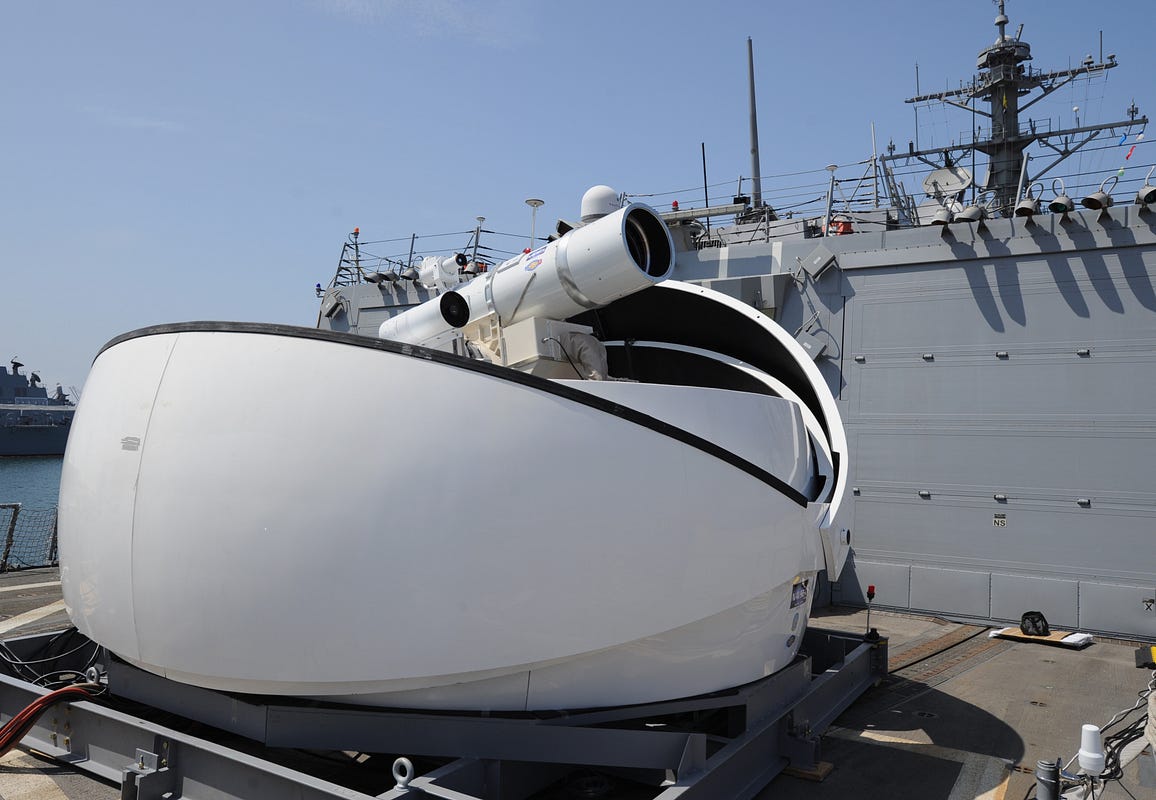
One key technology could restore America’s advantage. The U.S. and Israel have had increasing success lately testing lasers to intercept missiles and artillery. We could be entering a new laser age—with huge implications for American military power.

But it could be a mostly defensive, ground-based laser age, to begin with. Aerial energy weapons need a lot more work and could lag far behind.

In December, the Army shot down 90 mortar rounds and several drones using a truck-mounted laser. The Navy is adding an experimental laser gun to its Persian Gulf base ship Ponce. The Army and Navy weapons work today. The Air Force, by contrast, is planning to install an energy weapon on jet fighters around the year 2030.

Now, the U.S. has had operational missile defenses since at least Operation Desert Storm in 1991, when it used Patriot missiles to intercept Iraqi Scud rockets with some success. But using missiles to intercept incoming ordnance is costly—and they can be overwhelmed by barrages of cheap, dumb projectiles or decoys.

Moreover, even if a theoretical missile defense system is 80-percent effective, two out of 1o rockets will still break through.The Navy’s laser gun, to be fitted to the base ship ‘Ponce.’ Navy photo

Laser defenses are not cheap, but are potentially far more economical and effective than launching physical projectiles to collide with or explode near falling warheads. Unlike missile defenses using projectiles—which must fight against gravity and require storage space and sophisticated manufacturing—lasers require only the requisite energy and the ability to shed excess heat.

Pioneer of caste studies

GERALD BERREMAN

Gerald Berreman (1930-2013) was a proponent of socially responsible anthropology who spent 40 years studying the caste system in India. By DIVYA TRIVEDI

“A SOFT and gentle man has passed,” said a tribute by a former student on Facebook, reflecting the love and respect Professor Emeritus Gerald Berreman commanded at the University of California, Berkeley. Berreman, 83, succumbed to a long-term illness on December 23, 2013, at an assisted living home in El Cerrito in the San Francisco Bay Area.

A proponent of socially responsible anthropology, Berreman’s work on institutionalised inequality in the context of caste, class, race, gender and ethnicity was hard-hitting compared with his soft persona and much ahead of its time.

Berreman first came to India in 1954 where he attempted to correlate race relations in the United States with the caste system of India, and he spent 40 years exploring and writing about the “twice-born castes and untouchables” in Sirkanda, a remote village in the Garhwal region of Uttarakhand. In his own words, he was “pursuing a longitudinal study of social inequality (caste, class and gender) and environment in their historical context in Sirkanda”. He also focussed on the ethnic diversity and inequality in the urban setting of the central bazaar of Dehradun and its surroundings.

Berreman belonged to a new breed of Western scholars who tried to give an accurate account of the caste system as it existed. This marked a step up in critical engagement from the earlier ethnocentric or polemical observations of the Indian scenario that most discomfited the Western viewers. The writings of earlier European observers were mainly descriptive, anecdotal and superficial. “Most U.S. observers who wrote about India in the middle of the 20th century saw the place through Gandhian eyes. They tended to be somewhat sentimental about all things Indian, including the caste system, which they regarded as a benevolent tradition, or at least one which Dalits were happy to accept. Berreman was one of the few people writing about India in the U.S. who understood the Ambedkarite position, and he was wonderfully articulate about it,” according to Prof. Daniel Immerwahr of Northwestern University, Illinois.

Immerwahr is coming out with a book with Harvard University Press about U.S. development policy in India. “There again, Berreman is the hidden hero. His ‘Caste and Community Development’ article from 1963 just gets everything right, in my view. He saw the ways in which caste (which, remember, most U.S. observers weren’t bothered by) would inevitably interfere with any attempts to devolve development planning to the panchayats. Which is pretty much what happened in the 1950s,” he says.‘Lifelong commitment’

Interview: Adam Minter on the Junkyard Planet

11 February 2014 

Journalist Adam Minter has written a fascinating account of the global rubbish and recycling industry. I recommended his book, Junkyard Planet, as one of my top 'development books' of 2013. Here is part 1 of an interview I am conducting with Adam via email, and below the text a couple of captioned images of the global junk industry taken from Adam's blog, Shanghai Scrap, with his permission.

PB: One of the things that particularly struck me in your book is just how global the recycling trade really is. Consumers, cheap labour, multi-millionaires, shipping costs, the rising middle class in developing countries, the cost of commodities, and the desire everywhere to make a profit – all affect and are affected by the industry.

In a way it is a key example of the globalisation of the world economy. It’s an industry that almost all of us are impacted by, but which most of us know very little about. Although your family was involved in the trade, were you also surprised by the scale and interconnectedness of it?

AM: The scrap industry that I grew up knowing in the Minnesota was largely a local business. That is, we bought scrap from factories within 100km from us, and we sold to factories (with a few exceptions) within 1000km of us. That started changing in the late 1980s, when Chinese traders began to show up at our scrap yard in search of items that none of our customers in North America wanted — things like electric motors, Christmas tree lights, and other items that are labor intensive to recycle. That was a big shift for me and my family. Suddenly, demand from overseas was starting to create a market for things (electric motors for example) that had been rusting in North Dakota farm fields for decades, in some cases.

Still, it's one thing to feel the market demand, and another thing to travel to China and see it. In 2002, I walked into my first Chinese scrap recycling business, a massive operation that employed 600 or so women sorting shredded American and European automobiles. The volumes measured in the thousands of tons per month. I couldn't believe it.