25 February 2014

Why is China suddenly cozying up to its nemesis

Why is China suddenly cozying up to its nemesis? Are they preparing for war? Reuters

Remember the Bamboo Curtain? It's coming down.

After decades of hostilities, Communist China is eyeing better relations with its old rival and democratic holdout Taiwan.

This friendly move contrasts sharply with the tensions rising between China and many of its other neighbors, including Japan. There have even been fears that those disagreements could lead to armed confrontation.

A week after an unprecedented meeting between officials from Beijing and Taiwan's capital, Taipei, a Chinese foreign ministry spokeswoman, Fan Liqing, suggested to reporters on Monday that President Xi Jinping is even considering a face-to-face meeting with the Taiwanese president, Ma Ying-jeou.

This presidential summit would come hard on the heels of last week's surprise meeting in Nanjing, in which officials of the two countries that for decades have refused to recognize each other's legitimacy met for the first time in 60 years.

"Compatriots on both sides of the [China] Strait all hope that the leaders can meet," Fan said. "We have said many times that this is something we have upheld for many years, and we have always had an open, positive attitude toward it."

She declined to discuss a possible date for such a meeting, but the mere mention of the possibility indicates a trend that worries some in the region.

"The current situation is a reversal of the 1990s," says Vincent Wang, a political science professor at the University of Richmond. In the past two decades, Beijing adopted an increasingly aggressive stance toward Taiwan. At the same time, it tried to grow its economy by, among other ways, reducing tensions with neighbors like Japan, South Korea and the Philippines.

"Now China's policy is more aggressive with those neighbors, but more conciliatory toward Taiwan," Wang says.

Singapore’s Foreigner Problem


A sharp rise in the foreign population has ratcheted up racial tensions.

By Mark Fenn
February 21, 2014

Does Singapore have a problem with xenophobia? It seems that barely a month goes by these days without news reports highlighting friction between Singaporeans and foreign workers in the tiny, multi-ethnic city-state.

The population has increased dramatically in recent decades thanks to an influx of foreigners, who now make up around two out of five residents. This has put a growing strain on jobs, housing and infrastructure, and raised fears about the dilution of the Singaporean national identity.

It has also—predictably—resulted in an angry backlash, with many taking to social media to disparage foreign workers, from highly paid “foreign talent” to heavily exploited laborers from China and the Indian sub-continent.

The abuse is often so vicious that in his 2012 national day rally speech, Prime Minister Lee Hsien Loong noted the proliferation of posts “tormenting and berating” foreigners, adding: “Very few people stand up to say this is wrong, shameful, we repudiate that. I think that is no good.”

In the latest high-profile incident, British banker Anton Casey lost his job and was forced to flee the island last month with his wife — a former Miss Singapore Universe — and son. The hapless Casey received death threats after making sneering comments on Facebook mocking the “poor people” using public transport, though his comments probably had more to do with social class — a subject rarely discussed in Singapore — than with race per se.

The previous month saw a major backlash on social media after Indian and Bangladeshi workers rioted in Singapore’s Little India district, leading Lee to again warn against “hateful or xenophobic comments, especially online.”

What the West Must Do for Ukraine


By ULRICH SPECK
FEB. 23, 2014 

Launch media viewer Maxim Zmeyev/Reuters

BRUSSELS — Thanks in part to the coordinated efforts of Germany, Poland, France and the United States, irrevocable change has finally come toUkraine, with President Viktor F. Yanukovych’s flight from Kiev and Parliament’s vote to call for new elections in May.

But the powers still have urgent work to do. Ukraine could either descend into chaos or right itself on a path toward a new democratic stability. The European powers and the United States must offer the country all possible support to move toward the latter.

The first and most urgent step for Western leaders is to send unequivocal messages to Moscow that any support by Russia for the southern and eastern regions of Ukraine to break away from the rest of the country would be met harshly, and result in a general reconsideration of relations with Russia on all levels.

In parallel, they must make sure that their own resources, and those of theEuropean Union institutions in Brussels, are available to political leaders in Kiev to assist them in their transition to a new regime.

Moreover, Ukraine’s crisis isn’t just political: The country faces economic default without support. It had been relying on Russia for that help, and now Europeans and Americans must quickly work with the International Monetary Fund to provide a financial lifeline to Kiev and to prepare longer-term economic-assistance programs; they must also be ready to give direct emergency aid by themselves, if needed.

Simply by announcing a readiness to commit to these steps, they would be providing enormous help to the forces committed to change in Ukraine.

Besides getting through the first days and weeks, there are two great political risks the West must help Ukraine to address. One is the inevitable attempt to undermine an emerging order. The protest movement that began last November, centered in Kiev’s Independence Square, has won. But it is quite possible that the forces that supported the former regime, especially in the east and south of the country, are going to contest the new order.

And it is questionable whether the Kremlin will accept a loss of influence in Ukraine. Mr. Putin had high hopes of making Ukraine a key ally in his planned Eurasian Union. He may have decided that Mr. Yanukovych was too unreliable an ally, but that does not mean he will accept a revolution against him. (Mr. Yanukovych, who reportedly fled to the eastern city of Kharkiv, near the border with Russia, said he had been forced to leave the capital because of an illegal “coup d’état.”)

Ukraine’s Oligarchs Need to Step Up

February 22, 2014

After Ukraine’s long and violent nightmare on the Maidan, daybreak at last is at hand. But with President Yanukovich effectively ousted and most levers of state power now in the hands of the opposition, the country may still be at risk of internecine strife and spiraling conflict. The danger now is that those Ukrainians whom Yanukovich and his Party of Regions have purported to represent—Russian speakers in the East and South especially—will perceive the transition underway as the victory of Western-backed Ukrainian nationalists who are hostile to their interests.

To many Ukrainians in the East and South, this transition may be reminiscent not of Ukraine’s independence from the Soviet Union in 1991, but of the years following the 2004-5 Orange Revolution, when the government of Victor Yushchenko turned overtly and increasingly anti-Russian. Despite their close ties with the liberal democracies of Western Europe and the United States, Yushchenko and his backers were hardly paragons of inclusive pluralism, and left many Russian speakers fearing that there was no place for them in their own country. When the new government declares its intent to sign the EU Association Agreement that Yanukovich spurned, as it surely will, these fears may deepen.

The problem will be how to bring Russian-speaking Ukrainians from the East and South into a national dialogue, now that so many of their high profile representatives have been so thoroughly discredited. The already loose coalition that made up the Party of Regions is a shambles, and there are only a scant handful of politicians from Regions-dominated oblasts that have emerged from the last several months with any national credibility. Moreover, civil society is especially weak in areas of the East and South that have historically depended on Soviet-built mega-industries of mining, metallurgy, and manufacturing, now controlled by a handful of ultra wealthy oligarchs such as Rinat Akhmetov, Victor Pinchuk, and Dmytro Firtash.

In fact, the fall of Yanukovich and his inner circle now thrusts the oligarchic groups, each of which controls a parliamentary faction, into the spotlight. Given the supermajority votes that recently approved a return to Ukraine’s 2004 constitution and the release of Yulia Tymoshenko, the oligarchs themselves have doubtless cut deals to ensure that the future government will not dispossess them of their vast industrial empires and personal fortunes. But it is much less likely that they factored in the concerns of ordinary citizens of Eastern industrial regions like Donetsk and Luhansk, the port city of Odessa, or the beautiful but economically depressed Crimean peninsula.

How to define al-Qaeda as it continues its rise

By Ahmed Rashid.

An intense debate has broken out among western law enforcement officials, intelligence agencies and academics about who or what today constitutesal-Qaeda. It is an important debate because AQ – the network and the ideology – remains a potent force and still one of the greatest threats to global stability.

The US intelligence chief James Clapper said last month that 7,000 foreign fighters have joined AQ affiliates and other groups in Syria to fight Bashar al-Assad’s regime. AQ now officially recognises branches of its network in seven new regions in Africa and the Middle East, while major European cities have become AQ recruiting centres for disaffected Muslim youth.

None of these network branches or recruiting centres existed on September 11 2001, when President George Bush and Prime Minister Tony Blair vowed to crush Al-Qaeda and to never allow failed states to emerge which could threaten the west or be taken over by AQ.

Clearly we are on the cusp of failure as Al-Qaeda expands relentlessly across the Middle East and Africa, even as the US and other western powers announce their withdrawal from these regions. For me the personal shock is to see AQ in Iraq control Fallujah and Ramadi; for AQ to capture cities is something I could not have imagined since meeting my first AQ fighters in Afghanistan in the 1990s.

The conflict in Syria has been “a game changer”, in the words of one British counter-terrorism official. The Euphrates valley has become a new FATA, similar to the Federally Administered Tribal Areas in Pakistan where AQ and the Taliban still hang out. Syria has helped escalate the meltdown of Iraq where a thousand people are killed every month in sectarian war.

It has become increasingly difficult for the US to actually define the enemy it calls AQ. Many groups who claim to be affiliated to AQ are actually just Islamic fundamentalist groups with local or regional agendas – not having the desire for global jihad and wanting to attack Washington that constitutes a true AQ group.

Thus the desire to conduct global jihad must remain as a defining principle of who is AQ.

However, many of these local groups such as al-Shabaab in Somalia or the Pakistani Taliban, who control territory, are also training foreigners to carry out bomb attacks in their countries of origin. Such groups may have local political agendas, but satisfy AQ by keeping their interests global. AQ Arab fighters who used to train foreigners have been replaced with Pakistani or Somali trainers, fighters and ideological messengers who carry on as before.

How America’s Soldiers Fight for the Spectrum on the Battlefield


02.18.14 
An electromagnetic mystery in northern Iraq changed the course of Jesse Potter’s life. A chemical-weapons specialist with the US Army’s 10th Mountain Division, Potter was deployed to Kirkuk in late 2007, right as the oil-rich city was experiencing a grievous spike in violence. He was already weary upon his arrival, having recently completed an arduous tour in Afghanistan, which left him suffering from multiple injuries that would eventually require surgery. In the rare moments of peace he could find in Kirkuk, Potter began to contemplate whether it was time to trade in his uniform for a more tranquil existence back home—perhaps as a schoolteacher. Of more immediate concern, though, was a technical glitch that was jeopardizing his platoon: The jammers on the unit’s armored vehicles were on the fritz. Jammers clog specific radio frequencies by flooding them with signals, rendering cell phones, radios, and remote control devices useless. They were now a crucial weapon in the American arsenal; in Kirkuk, as in the rest of Iraq, insurgents frequently used cell phones and other wireless devices to detonate IEDs. But Potter’s jammers weren’t working. “In the marketplaces, when we would drive through, there’d still be people able to talk on their cell phones,” he says. “If the jamming systems had been effective, they shouldn’t have been able to do that.” 

A self-described tech guy at heart, Potter relished the chance to study the jammers. It turned out that, among other problems, they weren’t emitting powerful enough radio waves along the threat frequencies—those that carried much of the city’s mobile traffic. Once the necessary tweaks were made, Potter was elated to witness the immediate, lifesaving results on the streets of Kirkuk, where several of his friends had been maimed or killed. “To see an IED detonate safely behind our convoy—that was a win for me,” he says. It was so thrilling, in fact, that when Potter returned from Iraq in 2008, he dedicated himself to becoming one of the Army’s first new specialists in spectrum warfare—the means by which a military seizes and controls the electromagnetic radiation that makes all wireless communication possible. 

It is well known that America’s military dominates both the air and the sea. What’s less celebrated is that the US has also dominated the spectrum, a feat that is just as critical to the success of operations. Communications, navigation, battlefield logistics, precision munitions—all of these depend on complete and unfettered access to the spectrum, territory that must be vigilantly defended from enemy combatants. Having command of electromagnetic waves allows US forces to operate drones from a hemisphere away, guide cruise missiles inland from the sea, and alert patrols to danger on the road ahead. Just as important, blocking enemies from using the spectrum is critical to hindering their ability to cause mayhem, from detonating roadside bombs to organizing ambushes. As tablet computers and semiautonomous robots proliferate on battlefields in the years to come, spectrum dominance will only become more critical. Without clear and reliable access to the electromagnetic realm, many of America’s most effective weapons simply won’t work. 

It's time to break up the NSA

By Bruce Schneier
February 20, 2014
Director of national intelligence said U.S. should haveacknowledged surveillance 

Bruce Schneier: NSA is too big and powerful; it's time to break up the agency

He says all bulk surveillance of Americans should be moved to the FBI

Schneier: Instead of working to weaken security, NSA should try to improve security for all

Editor's note: Bruce Schneier is a security technologist and author of "Liars and Outliers: Enabling the Trust Society Needs to Thrive."

(CNN) -- The NSA has become too big and too powerful. What was supposed to be a single agency with a dual mission -- protecting the security of U.S. communications and eavesdropping on the communications of our enemies -- has become unbalanced in the post-Cold War, all-terrorism-all-the-time era.

Putting the U.S. Cyber Command, the military's cyberwar wing, in the same location and under the same commander, expanded the NSA's power. The result is an agency that prioritizes intelligence gathering over security, and that's increasingly putting us all at risk. It's time we thought about breaking up the National Security Agency.

Broadly speaking, three types of NSA surveillance programs were exposed by the documents released by Edward Snowden. And while the media tends to lump them together, understanding their differences is critical to understanding how to divide up the NSA's missions.

Bruce Schneier

The first is targeted surveillance.

This is best illustrated by the work of the NSA's Tailored Access Operations (TAO) group, including its catalog of hardware and software "implants" designed to be surreptitiously installed onto the enemy's computers. This sort of thing represents the best of the NSA and is exactly what we want it to do. That the United States has these capabilities, as scary as they might be, is cause for gratification.

OECD: Reform Failure Could Sink Growth

February 24, 2014

G20 finance ministers pledge to boost global growth by 2 percent or more over the next five years. 

The world economy could sink into a “low-growth trap” if policymakers fail to bite the bullet on reform, the OECD has warned. The message came amid a new pledge by the Group of Twenty (G20) to boost global growth by at least 2 percent above normal over the next five years.

Launching the Paris-based organization’s “Going for Growth” report at Friday’s G20 finance ministers meeting in Sydney, Australia, OECD Secretary General Angel Gurria said only ambitious reforms could tackle rising unemployment and inequality.

“Signs of a broad-based recovery are becoming more tangible, but governments of advanced and emerging economies now face the risk of falling into a low-growth trap,” Gurria said at a launch event in the harbor city.

“Slowing productivity growth and persistently high unemployment in many advanced economies cry out for further reforms. The vulnerability of many emerging-market economies to the ongoing tightening of monetary policy and the cooling of the commodity boom serves as a reminder that the case for structural reforms is also strong there,” he added.

Despite praising the reform efforts of countries in the southern eurozone, including Greece and Italy, the report pointed to the need for further action amid concern of a “structural downshift” in growth rates compared to before the global financial crisis (GFC).

“Many emerging economies have yet to launch comprehensive structural reform agendas, and should implement wider efforts to improve education, address physical and legal infrastructure bottlenecks and bring more workers into formal sector employment,” the report said, pointing to Mexico as a standout for its reform efforts.

Among the 34-nation OECD, countries facing rapid population ageing, including Japan and South Korea, were urged to speed up integration of women workers into their labor markets, while both advanced and emerging economies should “boost competition across their economies.”

America's Global Retreat


Never mind the Fed's taper, it's the U.S. geopolitical taper that is stirring world anxiety. From Ukraine to Syria to the Pacific, a hands-off foreign policy invites more trouble. 

By 

NIALL FERGUSON
Feb. 21, 2014 


Since former Federal Reserve Chairman Ben Bernanke uttered the word "taper" in June 2013, emerging-market stocks and currencies have taken a beating. It is not clear why talk of (thus far) modest reductions in the Fed's large-scale asset-purchase program should have had such big repercussions outside the United States. The best economic explanation is that capital has been flowing out of emerging markets in anticipation of future rises in U.S. interest rates, of which the taper is a harbinger. While plausible, that cannot be the whole story. 

For it is not only U.S. monetary policy that is being tapered. Even more significant is the "geopolitical taper." By this I mean the fundamental shift we are witnessing in the national-security strategy of the U.S.—and like the Fed's tapering, this one also means big repercussions for the world. To see the geopolitical taper at work, consider President Obama's comment Wednesday on the horrific killings of protesters in the Ukrainian capital, Kiev. The president said: "There will be consequences if people step over the line." 

No one took that warning seriously—Ukrainian government snipers kept on killing people in Independence Square regardless. The world remembers the red line that Mr. Obama once drew over the use of chemical weapons in Syria . . . and then ignored once the line had been crossed. The compromise deal reached on Friday in Ukraine calling for early elections and a coalition government may or may not spell the end of the crisis. In any case, the negotiations were conducted without concern for Mr. Obama. 

The president, flanked by his foreign-policy team: Chuck Hagel, Susan Rice, and Joe Biden. From L to R: AFP/Getty Images; Bloomberg (2); Getty Images (2) 

The origins of America's geopolitical taper as a strategy can be traced to the confused foreign-policy decisions of the president's first term. The easy part to understand was that Mr. Obama wanted out of Iraq and to leave behind the minimum of U.S. commitments. Less easy to understand was his policy in Afghanistan. After an internal administration struggle, the result in 2009 was a classic bureaucratic compromise: There was a "surge" of additional troops, accompanied by a commitment to begin withdrawing before the last of these troops had even arrived. 

Having passively watched when the Iranian people rose up against their theocratic rulers beginning in 2009, the president was caught off balance by the misnamed "Arab Spring." The vague blandishments of his Cairo speech that year offered no hint of how he would respond when crowds thronged Tahrir Square in 2011 calling for the ouster of a longtime U.S. ally, the Egyptian dictator Hosni Mubarak

The Global Response to Armed Conflict: From Aleppo to Kinshasa


by Stewart M. Patrick
February 19, 2014

Source Link

Members of the anti-terror police arrive at the village of Batu Rengat, where police exchanged fire with suspects in a house in Bandung, West Java province, May 8, 2013 (Courtesy Yurri Erfansyah/Reuters).

As the civil war in Syria rages on, and the United States and its international partners appear unable to mobilize a collective response to stem the bloodshed, CFR’s International Institutions and Global Governance program has launched an update to its Global Governance Monitor: Armed Conflict. The revamped multimedia guide uses a new technology platform to track and analyze recent multilateral efforts to prevent, manage, and respond to armed violence around the globe. Combining stunning images and compelling narrative, it identifies the major successes and failures in global conflict mitigation during 2013.

The Armed Conflict update underscores dramatic changes in international cooperation on conflict prevention and peacekeeping in the past year. While Syria has absorbed most of the international media attention, the United Nations has also launched or bolstered major peace operations in Africa.

“Peacekeeping,” of course, was not even mentioned in the UN Charter, whose World War II architects were preoccupied with preventing and punishing military aggression. Rather, it was an improvisation—something between the peaceful settlement of disputes under Chapter 6 and coercive action under Chapter 7. Initially, these so-called “Chapter 6 and a Half” operations involved the insertion of observers or lightly armed soldiers to maintain ceasefires between warring parties. Over time, however, the scope of peace operations and the number of actors involved expanded dramatically.

Pentagon Plans to Shrink Army to Pre-World War II Level


FEB. 23, 2014 

Launch media viewer A spending plan that will be released Monday will be the first sweeping initiative set forth by Defense Secretary Chuck Hagel. Susan Walsh/Associated Press

WASHINGTON — Defense Secretary Chuck Hagelplans to shrink the United States Army to its smallest force since before the World War II buildup and eliminate an entire class of Air Force attack jets in a new spending proposal that officials describe as the first Pentagon budget to aggressively push the military off the war footing adopted after the terror attacks of 2001.

The proposal, described by several Pentagon officials on the condition of anonymity in advance of its release on Monday, takes into account the fiscal reality of government austerity and the political reality of a president who pledged to end two costly and exhausting land wars. A result, the officials argue, will be a military capable of defeating any adversary, but too small for protracted foreign occupations.

The officials acknowledge that budget cuts will impose greater risk on the armed forces if they are again ordered to carry out two large-scale military actions at the same time: Success would take longer, they say, and there would be a larger number of casualties. Officials also say that a smaller military could invite adventurism by adversaries.

Cuts proposed by the Obama administration would result in the smallest Army since just before the World War II buildup.

Proposed for the future

Source: Department of Defense 

“You have to always keep your institution prepared, but you can’t carry a large land-war Defense Department when there is no large land war,” a senior Pentagon official said.

Outlines of some of the budget initiatives, which are subject to congressional approval, have surfaced, an indication that even in advance of its release the budget is certain to come under political attack.

For example, some members of Congress, given advance notice of plans to retire air wings, have vowed legislative action to block the move, and the National Guard Association, an advocacy group for those part-time military personnel, is circulating talking points urging Congress to reject anticipated cuts. State governors are certain to weigh in, as well. And defense-industry officials and members of Congress in those port communities can be expected to oppose any initiatives to slow Navy shipbuilding.

Strategy and the Tyranny of Maxims

Military strategists need the intellectual toolkits to use bumper-sticker precepts knowledgeably and nimbly.

February 23, 2014 


A coda to our running series on how to mold maritime strategists. Strategic thought is a habit of mind as much as a body of knowledge. Those who reach for the strategic canon reflexively in times of stress stand the best chance of withstanding the seductions of military maxims. That’s important for keeping bureaucratic institutions supple.

You might call a maxim a bumper sticker that communicates a complex idea or doctrine to certain audiences. It explains how we do things here in simple terms. Specific examples? Well, never divide the fleet! is a maxim that supposedly animates the U.S. Navy. It reminds commanders to concentrate superior might at the decisive place and time.

Or, the people are the center of gravity, win the hearts and minds, and clear, hold, and build are maxims governing counterinsurgent endeavors. Such operations involve not just pummeling enemies but winning the acquiescence if not the allegiance of ordinary people. Maxims do yeoman service reminding practitioners of the dual nature of counterinsurgent warfare.

Such shorthand beguiles, and understandably so. A set of maxims shared among the members of an organization simplifies operations under both routine and stressful circumstances. Think about it. Time grows short, the stakes rise, options narrow, and the pressure to act wisely mounts when crisis looms. You have to discern the right course of action on the fly. Repercussions are swift, certain, and painful if you decide wrong.

Maxims accelerate the decision cycle while easing the strains inherent in such times. They’re a labor-saving device. That explains their allure.

Simplifying problems, then, is a must. You can’t revisit first principles every time you need to make a decision, reinventing the wisdom of a Clausewitz or a Thucydides. Great thinkers compose and revise their works at leisure, insulated from the pressures of the day. Practitioners seldom enjoy the luxury of leisurely contemplation. They must act. (That’s why soccer games matching teams of philosophers tend to be boring affairs). If commanders improvised their own strategic theories every time the need arose, they would act on hastily conceived rough drafts rather than polished ideas. Defeat and disaster would be apt to follow.

Conflict Prevention


Source Link

Issue Brief

Scope of the Challenge

Preventing armed conflict, keeping peace, and rebuilding war-torn states remain among the most intractable challenges facing the international community. Each year, at least 250,000 people die in armed conflicts, most of which occur within, rather than between, states and in the past three years an especially brutal civil war in Syria has killed upwards of 100,000 people. Armed conflict and its aftermath corrode virtually every aspect of society: law and order, human rights, socioeconomic development, education, basic health services, and the environment. The global economic costs of insecurity generated by conflicts amount to an estimated $400 billion each year. At the same time, conflict prevention, mitigation, and response are global concerns, because instability often spills across borders and triggers piracy, drug trafficking, small-arms sales, environmental exploitation, and terrorism.

After the shocking mass atrocities in Rwanda and Bosnia in the 1990s, the United Nations (UN) and several regional organizations mandated new initiatives to address violence. The UN reforms improved its ability to monitor political developments, plan and support peacekeeping operations, and coordinate mechanisms charged with peace-building. Meanwhile, new arrangements within the European Union (EU), African Union (AU), Organization of American States (OAS), and other regional organizations have increased responsiveness to instability and violence within their regions—albeit with varying levels of engagement, capabilities, and effectiveness.

But these international instruments have had a mixed record of success. In many cases, international institutions charged with promoting peace and stability lack the political consensus and financial resources to fulfill their mandates. Moreover, these institutions remain disproportionately reactive, and often neglect conflict prevention as a critical tool for managing armed conflicts. Most peacekeeping efforts still have insufficient manpower, money, and equipment to meet their overstretched mandates. And the international community too frequently fails to foster peace and recovery in war-torn countries.

Multilateral action can be an effective response to outbreaks of armed conflict, but international and regional approaches need to be enhanced and coordinated if they are to effectively address the range of conflict management problems facing the global community.

Strengths & Weaknesses


Overall assessment

Overall assessment: Unprecedented attention and reform, yet patchy focus and uncertain goals

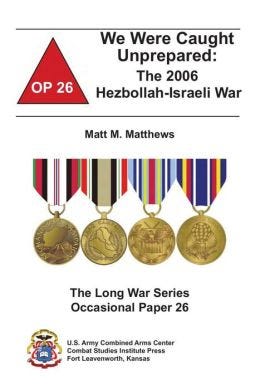
Thinking Critically: On “We Were Caught Unprepared”


The U.S. Army Combat Studies Institute’s Account of the Hezbollah-Israeli War in 2006 Requires Additional Critical Thought as a Tool for Teaching Critical Thought

Rich Ganske in The Bridge

Critical thinking is the necessary ability to exceed common patterns of thinking and reflect upon problems from different perspectives using both analysis and synthesis. Thinking “outside the box” is the oft-suggested simplification of this process, and often the first step towards doing so is to acknowledge, as much as possible, the prejudices of the mind that bias our judgment. In what follows, I offer two critiques for your consideration. My first critique is of a parochial, yet casually accepted, source of supposed critical thinking being taught as the sole example for future military leaders in a professional military education course. In thinking critically, if one needlessly limits themselves to a single point of view, as you’ll see, you’re setting the wrong example by design and begging for trouble. And second, and much more importantly, I critique the more insidious lessons provided by the sole source of critical thinking within a specific case method. To wit, the err of a strategy is much more important than any err of planning. True critical thinking, and not some chimera of such, aids the professional military member in both the endeavor of mitigating bias confirmation and confusion in the relationship between strategy and planning processes.

Matt Matthews’ We Were Caught Unprepared: The 2006 Hezbollah-Israeli War is a product of the U.S. Army’s Combat Studies Institute (CSI) documentation of the lessons learned from the 2006 conflict in southern Lebanon. This book, which is really an occasional paper, is used in a critical thinking course for the U.S. Army’s staff officers and future leaders at its Command and General Staff College (CGSC) as a case study for exploration in which the student will learn to “question where and how you get the information upon which you base your decisions.” Currently, another course is beginning at CGSC, with another round of students taking on their studies, including this foundational course in critical thinking.U.S. Army Command and General Staff College,

“Ad Bellum, Pace Parati”


While the Second Lebanon War in 2006 is certainly a great case for method analysis, I’m not sure the U.S. Army is teaching its “Iron Majors” in this specific course the correct lessons in critical thinking. The takeaway here is that using this text alone without additional caveat or even contrast is apt to leave the over 1,000 officers who read it annually with an informal fallacy of causation for the IDF’s struggles in Southern Lebanon during its 2006 campaign. Really, what the course is achieving is a veiled reinforcement of selection bias and calling it critical thinking. The use of this extremely problematical yet popular text is really about disputing effects-based operations (EBO) and the usefulness of airpower, and not about critical thinking. Ultimately, just like Matthews does in his text, the course fails to use critical thinking in the analysis of the case study in an over-eager attempt to discredit EBO and airpower. This problem is important because the lesson is foundational to the CGSC experience, which counts towards Joint Professional Military Education, and is the stage-setting course for what is likely the final episode of formal education that most of the U.S. Army’s officers will receive for the rest of their career. By and large, the CGSC education is top-notch, but critical thinking is so foundational, so important, that this specific course must not suffer from a self-defeating failure in its selection of text for use in the 2006 South Lebanon case study.

Lt Gen Paul K. Van Riper (Retired), USMC

PEACETIME RESTRAINS MILITARY STRATEGY; THREATS ARE NOT STRATEGY; REFORM IS NOT INNOVATION

February 21, 2014 · by Fortuna's Corner

David Maxwell:

Long read on pre-WWI history that concludes with a comparison to current concerns.

Strategy is as vital in peace as it is in war, but peacetime constrains it. History provides invaluable insights into untangling this contradiction at a time of budgetary and political uncertainty.

But there are a few subtitles in this essay that catch your eye and make great sound bites:

Thinking Costs Nothing

Reform is Not Innovation

Threats are not strategy

Peacetime Restrains Strategy

R.B. Haldane and the Shortfalls of His Army Reforms
•Mikhail Grinberg in The Bridge


As the centennial of The Great War approaches, volumes of new researchprovide ominous warning about history’s rhymes. Yet China is not Germany. However frightening the parallels may seem, trying to meter history distracts the historical mind from proper inquiry. As the United States begins to formulate a new strategy for a post -Afghanistan era it should look back to this century-old calamity for perspicacity, not for similitude.

British pre-war army reforms, implemented by Richard Burdon Haldane – Secretary of State for War (1905-1912) – and subsequently named after him, present another lesson from which strategists could analyze a familiar conundrum. Strategy is as vital in peace as it is in war, but peacetime constraints it. History provides invaluable insights into untangling this contradiction at a time of budgetary and political uncertainty.

***

The British Army, embarrassed by its lackluster performance in South Africa (1899-1902) was in desperate need of reform. Before Haldane assumed office two government commissions called for it. As a peacetime Secretary, Haldane succeeded. He is credited with having prepared the British Army for the First World War.

In hindsight, of course, nothing could ready Britain for years of trench warfare, with its gas and horror. But from August to at least that famed Christmas of 1914, British soldiers were able to deploy quickly, fight against their continental peers, and to resupply efficiently. Field Marshal Douglas Haig would later say of Haldane that he was the best Secretary the Empire ever had.

Richard Burdon Haldane

As successful as Haldane was, such pronouncement teach the wrong lesson. At the onset of war, the British Expeditionary Force – established by Haldane in 1907 – “did not possess the heavy guns and howitzers, the high explosive shells, or even the machine guns of the German Army.” What caused this quagmire was the disparity between strategic planning and peacetime economic concerns.

A session on how the Marine Corps might do better at retaining good young officers

FEBRUARY 19, 2014 

By Chris Mondloch 
Best Defense guest columnist 

Wrapping up 13 years of fighting in Afghanistan this year, the U.S. military will surely face many challenges in the near future. Transitioning to a peacetime force, large-scale personnel cuts, advancing technologies, and the growing debate over women's role in combat all signify the ever-changing nature of the armed forces. On a recent morning, the Reserve Officers Association turned to an important yet often overlooked group -- company-grade officers -- to discuss their perspective on the emerging trends and challenges facing the military today. 

The discussion panel consisted of three Marine Corps officers who recently separated from the Corps as either first lieutenants or captains. All three had combat experience in Afghanistan and enjoyed serving their country -- yet decided against making a career out of the Marines. One main area of concern among the three men is the military's failure to retain competent officers after their initial service obligations are filled. The notion that certain officers are "too educated" or "too good" to remain in the military -- the Marine Corps, specifically -- is a problem, according to panelist Ben Luxenberg. 

Over all else, the Marine Corps values leadership and decisiveness in its officers. Luxenberg said that those officers who proved to be competent leaders who could "make the trains run on time" were targeted for retention over top intellectual achievers after their first term of service. The lack of innovative thinkers will continue to create problems by perpetuating the notion that the military is not a place for intellectually-minded individuals. According to Luxenberg, the term "the best and the brightest," often used to describe the corps of young Marine officers, should actually be split: "the best or the brightest." 

The Future of War essays (entry no. 6): Bet on surprises, and get ready to adapt

FEBRUARY 13, 2014 

By Jeff Williams 
Best Defense future of war entry 

So we have the question of what will future war look like? In our look at war, it is difficult to think of a conflict that transformed itself into an event so completely different from the early notions of all the combatants at its outset than the First World War. By contrast, the Second World War -- excluding the development of nuclear fission -- seems in retrospect more a qualitative refinement of the notions, concepts, and appliances of war developed in 1914 -1918. 

That experience leads one to wonder if a new war will end up being as much of a surprise how it unfolds as World War I was to its warring contenders? Will we find that our nation's current stock of weapons and doctrines are more of a look back into the past, or that they are a discerning glimpse into the future? 

Could our preconceptions about how a future war will evolve be confirmed much in the same manner as the U.S. Navy's pre-World War II wargaming which foretold the actual pattern of the Central Pacific offensive, leading to Japan's doorstep? Like previous wars, will we have time to correct material and doctrinal shortcomings or will we be stuck with the force we have rather than the one we need? 

In history we find if not explicit answers to our questions, at least some plausible hints about future war. In the First World War, the process of rethinking war began with the very first encounter battles in Alsace. These rethinks did not always lead to success, but nonetheless continued throughout the war for all sides so that the end of the war was a very different thing than its beginning. Virtually all the preconceptions and notions about what war would look like in August of 1914 were violently torn away and the war took a course of its own, as wars tend to do. 

Where is the tipping point for America's trust in the military? And are we near it?

FEBRUARY 14, 2014

By Jim Gourley 
Best Defense chief military culture correspondent 


Back in 2011, Chairman of the Joint Chiefs Martin Dempsey wondered aloud at a National Guard leadership conference why the U.S. military had scored the highest among Americans polled on what institutions they trusted most. "Maybe if I knew what it would take to screw it up, I could avoid it," he said. 

The numbers haven't wavered outside of statistical error since then. Despite highly unfavorable public opinion of the conflicts in Iraq and Afghanistan, polls by Gallup and Pew back in June showed public confidence in the military holding above 75 percent. The implication appears to be that no one blames the military for failing to achieve distinct victory. It leads one to wonder just what the American people will blame the military for. In the last year, the military has run some of the biggest governmental scandals this side of the fiscal cliff. To recap, by service: 

Air Force 

Two high-profile sexual assault fiascos, one of which by a sexual assault prevention officer 
A massive cheating conspiracy among nuclear missile officers 
Shady handling of pilot deaths in the F-22
The discovery they lied about the severity of a B-2 crash years ago 
The revelations of the Air Force Academy's secret informant program

24 February 2014

The Indian Coastguard: A Non Performing Asset?

22 Feb , 2014

Achieving maritime safety would entail ensuring that the laws and regulations which govern the operations of sea-borne craft are adhered to. The Indian Coast Guard has so far not been seen to play any role in this area. It has been the exclusive preserve of the Director General of Shipping who operates through the regional Maritime Marine Departments. The situation is quite different with the US Coast Guard which actively monitors this aspect in the US waters. The US Coast Guard boards vessels for wide ranging inspections including the conduct of safety drills. Vessels found deficient in any area are liable to be detained. Serious infringement can lead to imposition of penalties. They also keep a historic record of such inspections which classifies ships according to country of registry, the company to which she belongs and the result of inspections. When a higher than normal proportion of ships of a country or a particular company are found to be deficient, the rest of the ships of the country or company are highlighted for more intensive scrutiny.

The very idea of the Indian Coast Guard drew heavily on the well-established model of the US Coast Guard…

In the pre-liberalised era of the 1960s of strict import and foreign exchange controls, extensive seaborne smuggling was a way of life that was a threat to the domestic economy. The Customs with its limited resources could hardly cope and had to call for Navy’s help for patrols and interception. This scenario spawned the formation of a separate paramilitary coastal protection force in the form of the Indian Coast Guard, the very idea of which drew heavily on the well-established model of the US Coast Guard.

The interim Coast Guard came into being on February 01, 1977 with two corvettes and five patrol boats transferred from the Indian Navy and manned by its personnel. The duties and functions of the Coast Guard were formally defined in the Coast Guard Act which was passed by the Parliament on August 18, 1978, and came into immediate effect.

The Indian Coast Guard’s motto is the Sanskrit phrase, “वयम रक्षाम: ” (Vayam Rakshamah) which, in English translates to “We Protect”.

India-Pakistan: Multiple Fail With Peace Talks


February 18, 2014: There is growing unrest in the northwestern Pakistani tribal territories because ten years of military operations against the Taliban has disrupted life for over two million people there. Travel is more difficult because of army roadblocks and Taliban attacks. Students are organizing a growing number of protests and demanding that the army end its operations in the territories. Before 2004 the army had rarely entered the territories and a special law governed how the territories were run. In effect, tribal laws prevailed but the tribal elders were unable to contain the Islamic terrorist groups in the territories. 

Pakistani diplomats and trade officials blame the military in Pakistan (especially) and India for opposing increased trade between the two countries. The Pakistani generals see fear of India as a major asset, enabling the military to justify a large chunk of the national budget and control over many economic enterprises. Less tension with India would weaken that popular and financial support. Military intelligence (ISI) is particularly afraid of reduced hostility with India because the fear generated by that protects ISI members from prosecution for the many illegal operations they carry out inside Pakistan. The Indian military is less of a problem because they fear increased trade and more open borders because it would make it easier for ISI-backed Islamic terrorists to get into India. 

From 2008 to 2012 China exported $11.2 billion (in 2012 dollars) worth of weapons. Pakistan was the major customer (getting 55 percent of this stuff). China, like Russia before it, got sales by selling to outcast nations (Pakistan for developing nukes and supporting terrorism, Burma for being a brutal dictatorship for decades). Russia still does that but with higher quality second-rate stuff. Plus, Russia has had India as a major customer for decades. Both Russia and China will tolerate bribe requests and all manner of bad behavior to get a sale. That often makes a difference in many countries. 

February 17, 2014: In eastern India (Andhra Pradesh state) 21 Maoists surrendered, saying they were disillusioned with the life of a communist rebel. 

In the Pakistani tribal territories (North Waziristan) masked gunmen kidnapped a polio vaccination team (a doctor, two technicians and three guards). In the last 15 months more than 40 people associated with the polio eradication teams have been killed by the Taliban. The Islamic terrorists believe the polio vaccination is really intended to poison Moslem children, despite the fact that kids who are vaccinated do not get polio. As a result of these attacks there were 91 cases of polio in Pakistan during 2013 and 58 in 2012. 

U.S. examines Afghanistan option that would leave behind 3,000 troops

February 23, 2014
One of the four options President Obama is considering for a U.S. military presence in Afghanistan beyond this year would leave behind 3,000 troops, based in Kabul and at the American installation at Bagram, U.S. officials said. 

Military commanders have recommended 10,000 troops, with more installations across the country. But the military has spent the past several months studying what kind of reduced counterterrorism and training operations it could conduct under the smaller option, which some in the White House favor. 

The option, one of four examined, would mean a far more reduced presence than commanders urge.

Sinaloa cartel chief “El Chapo” Guzmán was captured early Saturday in the resort town of Mazatlán.

Government says it will notify news organizations to give them chance to challenge its actions in court.
Read all of the stories in The Washington Post’s ongoing coverage of the National Security Agency’s surveillance programs.

Defense Secretary Chuck Hagel plans to brief his NATO counterparts in Brussels this week on the status of U.S. decision making. A senior administration official said that no announcement of specific troop numbers was planned but added that “we’ll have to tell people where we stand in our thinking and planning.” 

During a December visit to Kabul, Hagel suggested that the late-February NATO meeting was a “cutoff point” for Afghan President Hamid Karzai to sign the bilateral security agreement that sets the terms for a post-2014 U.S. presence. Although the accord was finalized in the fall, Karzai has since refused to sign it, leaving the administration to delay its decision on numbers while threatening a complete pullout when the last combat troops leave at the end of the year.