25 May 2014

Looking for Ukraine


An effigy of the Kiev authorities hanging above a barricade, Sloviansk, eastern Ukraine, May 11, 2014

Sloviansk—Every now and then I can hear distant explosions and bursts of gunfire. But most of the time, here in the center of Sloviansk, which since early April has become eastern Ukraine’s separatist stronghold, everything is quiet. Since the small town is chopped up by barricades and many businesses and factories have closed down, there is not much going on, so that when the wind blows you can hear it shimmer the leaves of the silver birches that line the streets. If you were looking for war here, it would be hard to find.

Ice creams are still getting through the checkpoints around town and there is a steady stream of people buying them. As I chose a chocolate bear, Irina, aged fifty, who sells them, told me that she liked being here among people, because the worst thing in this situation was being at home, alone and anxious.

When we come to look back on the Ukrainian conflict, it will be hard, if it moves from its current low-level state to a full-blown war, to say that such-and-such a date marked its beginning. Was it the day that some forty people died, many after being trapped in a building that then caught fire in Odessa? Was it the day that seven people or was it more than twenty or perhaps more than one hundred died in Mariupol, another Black Sea town? For people here the numbers they believe depend on whether they follow the Russian or Ukrainian press and, since both are lying and distorting slivers of truth, it is not surprising that people are being dragged down into a vortex of war.

But while it will be hard to agree on a date, it is already easy to say what is happening in people’s heads. Six months ago everyone here just went about their normal business. They were worried about the things that everyone worries about, and here especially: low salaries, scraping by, collecting money for all the bribes one has to pay, and so on. And then something snapped. The rotting ship of the Ukrainian state sprung a leak and everything began to go down. In people’s heads a new reality has gradually begun to take shape and, in this way, everyone is being prepared for war.

1.

This hit me on May 9. Across the countries of the former Soviet Union this is Victory Day, the day when the dead of World War II are remembered and elderly men and women, dressed in their uniforms and bedecked with medals, are honored. In Sloviansk the ceremonies began in front of the Lenin statue in the town square. The old men and one woman stood in a line while those antigovernment leaders who seized power here on April 12 stepped forward to make speeches to about a thousand people. Given that the Ukrainian army has surrounded the town I was surprised by the emptiness of what was being said.

Putting Ukraine in Its Place

From the current debates you’d never know what matters more: Russia’s land grab, Iran’s nuclear program, or China’s territorial claims. How America stopped thinking strategically.

MAY 21 2014
Matt Dorfman

Let’s briefly review the American foreign-policy debates of the past year. Last August, President Obama declared that he would bomb Syria for defying his call to not use chemical weapons. Then, in a sharp about-face, he decided instead to work with Russia to dismantle the weapons, and was denounced as weak by hawkish critics. Obama’s supporters said he had done as well as he could have under the circumstances. Two months later, America and its allies struck an interim nuclear deal with Iran. Hawks called it appeasement. Obama’s supporters said it was as good as one could expect under the circumstances. Within hours of the deal, China claimed the right to monitor and possibly take military action against aircraft crossing a disputed area of the East China Sea. Hawks denounced Obama’s response as weak. The president’s supporters said it was as strong as possible under the circumstances. Then, in February, Russia began menacing Ukraine. Hawks called Obama’s response weak. His supporters said the president was doing all he reasonably could.

Each debate resembles the others, but occurs in splendid isolation. Today’s foreign-policy disputes rarely consider the way America’s response to one crisis might affect another. Adopt a tough stance on China’s air-defense zone, for instance, and Beijing is less likely to join the West in condemning Russia’s aggression in Ukraine. Severely punish Russia for that aggression, and Moscow is less likely to help America enforce sanctions against Iran. Take an ultra-hard line on Iran’s nuclear program, and Tehran is less likely to help broker an end to Syria’s civil war that the U.S. can live with. Instead of discussing each threat in isolation, America’s politicians and pundits should be debating which ones matter most. They should be prioritizing.

*** Why Jeffrey Sachs Matters


Bill Gates, Founder and Technology Adviser of the Microsoft Corporation, is Co-Chair of the Bill & Melinda Gates Foundation. 
MAY 21, 2014 6 

SEATTLE – Bono calls the economist Jeffrey Sachs “the squeaky wheel that roars.” To me, Sachs is the Bono of economics – a guy with impressive intelligence, passion, and powers of persuasion who is devoting his gifts to speaking up for the poorest people on the planet. So it was no surprise to me that a journalist would find Sachs to be a compelling central character for a book – and a good way to draw readers into the potentially dry subject of international development.

In The Idealist, Vanity Fair writer Nina Munk draws a nuanced portrait of Sachs and his Millennium Villages Project (MVP) – a $120 million demonstration project intended to show the world that it’s possible to lift African villages out of poverty through a massive infusion of targeted assistance. It would have been easy, and perhaps more marketable, for Munk to draw a caricature, overly accentuating Sachs’s negative qualities at the expense of his great gifts. But she doesn’t. Munk spent six years researching the book, getting to know Sachs well and living for extended periods in two of the 15 Millennium Villages. She clearly appreciates the importance and difficulty of what Sachs and his team are attempting to do.

Unlike most books about international development, Munk’s book is very readable and not long (260 pages). I’ve told everyone at our foundation that I think it is worth taking the time to read it. It’s a valuable – and, at times, heartbreaking – cautionary tale. While some of the Millennium Villages have succeeded in helping families improve their health and incomes, Munk concludes that the two villages she spent the most time studying­ – Dertu, Kenya and Ruhiira, Uganda – have so far not lived up to Sachs’s vision.

Sachs did come to the foundation, asking us to support the Millennium Villages. His pitch was intriguing. He was picking a small handful of villages to be the focus of intense interventions in health, education, and agriculture – all at once. His hypothesis was that these interventions would be so synergistic that they would start a virtuous upward cycle and lift the villages out of poverty for good. He felt that if you focus just on fertilizer without also addressing health, or if you just go in and provide vaccinations without doing anything to help improve education, then progress won’t be sustained without an endless supply of aid.

Globalism’s Failed Promise

The myth of a globalist future drowns off the coasts of Ukraine and Malaysia.

The crisis in Ukraine and the missing Malaysian Airlines Flight have done more than expose weaknesses in regional security and international air safety arrangements. They have exposed fundamental flaws in the bedrock assumptions underlying that secular faith known as globalization.

George Ball, liberal State Department and Wall Street apparatchik, stated the first axiom of globalism in his famous 1967 testimony to a congressional Joint Economic Committee when he declared nation states “obsolete.” This has been unquestioningly accepted as an article of faith by the smart set. Western elites have come to believe nations will wither away in a brave new economically integrated world.

As a corollary, we are to believe flags are simply vestiges of a bygone era rather than touchstones of pride and identity. Individuals’ self-identity will be tied not so much to country of birth as to their smart phones, whose parts have crossed more borders than five generations of Mexican migrants. “iPhone or Android” will mean more to homo modernicus than “American or Brazilian.”

We were promised deracination would lead inevitably to world peace. The original Cobdenite told us nations that trade with each other don’t go to war with each other. Free trade apologists have been repeating this utopianism ever since, facts notwithstanding. (Germany and France were major trading partners before World War I.) No rational head of state would upset the harmonious workings of the global economy; nationalist passions would be tempered by “market realities.”

It’s clear they didn’t get the memo in Russia and Ukraine. They have been significant trading partners, yet economic realities did not trump nationalism. To be sure, many of the Maidan protestors coveted their own flag more than designer goods from the EU. It is a modern Western conceit to view human aspirations strictly through a materialistic lens. Alexander Solzhenitsyn decried Western society’s tendency to focus on the accumulation of material goods to the exclusion of all other human characteristics.

4 reasons you should care about the EU elections (even though most Europeans don't)

May 21, 2014
As voters select a new European Parliament this week, here's why it matters.

BRUSSELS, Belgium — This week, 380 million voters in 28 countries get to select the 751 lawmakers who sit in the European Parliament.

The latest polls show a narrow victory for the center-right European People's Party, which includes national parties led by German Chancellor Angela Merkel and Spanish Prime Minister Mariano Rajoy. The EPP is expected to get 28 percent.

The center-left Progressive Alliance of Socialists and Democrats of French President Francois Hollande and Italian Prime Minister Matteo Renzi is likely to finish second with 26 percent.

Behind them will come Liberals, Greens, a group led by the British Conservatives and a growing assortment of radicals on the left and right who share a common dislike for the European Union.

But the overall winner could well be voter apathy.

Since elections to the EU's assembly were first held in 1979, turnout has fallen from 62 to 43 percent even as the parliament's power has increased.

Fewer still are predicted to show up for the current elections, which will be held from Thursday to Sunday, depending on the country. Less than 30 percent are expected to vote in some countries.

Although millions of Europeans don't care, the election does matter — including for people far beyond Europe's borders. Here's why:

1. The EU is huge.

View taken on May 21,2014 of flags of European countries above the entrance of the European Council on May 21,2014 in Brussels. (Georges Gobet/AFP/Getty Images)

Taken as a whole, the EU rivals the United States as the world's largest economic power. Its $16.2 trillion annual output remains well ahead of China’s.

The EU is the world's biggest exporter and is the leading trading partner for more than 80 countries, including China, Brazil and Russia. When the euro currency tottered close to collapse in 2011, it threatened to bring the world economy down with it.

The EU is the world's largest donor of development aid, and takes a leading role in setting global climate change rules and in international negotiations on issues from sanctions on Russia toIran's nuclear program.

The European Parliament not only has a direct influence on EU policy but, in an innovation this year, the election should decide who will head the union's executive body.

In theory, the candidate of the winning party will become president of the European Commission — although the appointment will need to be agreed by national leaders from the 28 EU countries.

The frontrunners are Jean-Claude Juncker, a center-right former prime minister of Luxembourg, and German Social Democratic politician Martin Schultz.

The Less Things Change…

It's been a year since Obama’s big speech about reforming the U.S. targeted killing program. Here are 10 things about the forever war that have hardly budged at all.
MAY 22, 2014

Since one-year anniversaries are deemed appropriate occasions to revisit major policy initiatives, get ready for a glut of articles reviewing U.S. drone strike policies since President Barack Obama's May 23, 2013, counterterrorism speech at the National Defense University (NDU). This speech was the culmination of a series ofinteragency reviews into controversial U.S. targeted killings policies, which the Obama administration decided to give because it was concerned that its ability to conduct drone strikes -- like other controversial counterterrorism tactics -- could become unduly constrained by domestic and international political pressure, or the denial of basing and overflight rights. The speech may have been criticized for being a whole lot of nothing, but the cynic could argue that it's been effective. Indeed, there is little domestic or international pressure to change anything; the drone strike program continues apace and the United States is reportedly likely to retain access to Jalalabad Airfield in Afghanistan to continue drone strikes into northwest Pakistan.

Here are 10 things that show how little has changed over the past year regarding U.S. targeted killing policies.

1. The spin worked

The careful rollout of the speech, unclassified presidential policy guidance, accompanying comments by anonymous administration officials, and relatively compliant media reporting, collectively cemented the impression that U.S. drone strikes have been "reformed" and "reined-in." In reality, there are actually few new principles or standards than those that Obama administration officials had previously said. In fact, the most consequential impact of the NDU speech has been that whatever policy window existed for demonstrable reforms is now firmly shut. Based upon conversations with congressional members and staff, there is almost zero interest on Capitol Hill to revisit the policies, and there have been no public hearings since those held during the year that preceded Obama's speech.

2. Drone strikes are down ... a bit

The overall number of targeted killings generally remains in decline. In Yemen, there have been 28 airstrikes of various forms since Obama's speech. As has been the case for the past five years, there remains confusion regarding who -- Yemen, the United States, or Saudi Arabia -- might be responsible for which airstrikes. Interestingly, for the first time in three years, the State Department's annual human rights reportreleased in February 2014 did not mention civilian casualties caused by Yemeni Air Force bombings.

A Poor Chapter in the History Books

From Ukraine to Syria, is Barack Obama's foreign-policy legacy already doomed?
MAY 22, 2014

Hammered from the right and the left, U.S. President Barack Obama's foreign policy has begun to acquire quite a negative brand and reputation, however unfair that may appear to his acolytes and supporters. Bereft of vision, weak and directionless, some critics charge, the president has abdicated responsibility -- both moral and strategic. Others say that, at a minimum, he has corrected course too strongly in the wake of Afghanistan and Iraq and has emerged as a risk-averse president in a world that cries out for risk readiness and American leadership.

The president's predicament is made worse because he raised expectations early and often, allowing his rhetoric to go well beyond his capacity. There was the Cairo speech in 2009, with its uplifting rhetoric about how U.S. policy toward the Middle East was going to be fundamentally different. There was the transformational goal of resolving the Israeli-Palestinian conflict (led by Secretary of State John Kerry, with a "last chance" trope). There was the "red line" on Syria and the "let's get on the right side of history" idea in response to the Arab Spring. In short, Obama said many things that left a yawning gap between words and deeds into which U.S. credibility has now fallen. Most of his policies have turned out not to be transformational at all, but more or less business as usual: confusing, inconsistent, and hypocritical.

Unlike good scotch and wine, this poor image of Obama's foreign policy may not improve with time. Of course, much can happen to a president in the remaining nearly 1,000 days of a presidency. But even the optimists would have to admit that the trend lines don't look particularly good. The challenges the president confronts are not amenable to quick fixes, let alone American ones. And even the so-called opportunities could be messy and quite costly politically.

Assuming the current trend lines do indeed maintain their southward arc, what might Obama's foreign-policy legacy look like in 2016?
Assuming the current trend lines do indeed maintain their southward arc, what might Obama's foreign-policy legacy look like in 2016? Let's take a trip quick into the future and see.

Russia and Ukraine. Russian President Vladimir Putin may end up losing the current war, but right now, it sure looks like he's winning an awful lot of battles. And with very few good options, the Obama administration seems hard-pressed to stop him. The broad outlines of how this will wind up two years down the road don't look good for the U.S. president. Geography and Ukraine's dysfunction seem invariably inclined to favor Putin's troublemaking, and at home, Putin's skillful manipulation of Russia's history and self-image and his formidable political skills would seem to leave him unchallenged. To be sure, Russia is bleeding economically and financially, but Russians have bled before in much worse circumstances. And European self-interest, combined with America's reluctance to use mega-sanctions against Russia, means it is unlikely Western powers can add enough pain to make much of a difference in Putin's calculations.

Right now, with regard to Russia and Ukraine, it looks like Obama will be remembered -- unfairly or not -- as an American president who presided over Moscow's successful effort to challenge, if not to rewrite, the rules of the post-Cold War era without much immediate cost or consequences. No dramatic Hollywood endings here: no Berlin airlifts, no missile crisis showdowns, and seemingly not much room for Reagan-like diplomacy. Just the grind of a geopolitical dynamic in which one guy asserted what he believed to be his vital interests, and the other guy couldn't do much about it. This tick-tock won't play well for Obama in the history books.

The U.S. Is Finally Making a Friend of Vietnam


A mother takes a picture of her daughter in front of the Golden Arches during the opening ceremony of Vietnam's first McDonald's restaurant in Ho Chi Minh City on Feb. 8, 2014

Washington's warm rapprochement with Hanoi is a reflection of the American desire to contain an increasingly bold and hawkish China. Some experts say relations have improved to the point where a lifting of the arms embargo on Vietnam is possible 

A few years ago I traveled from Hanoi to Saigon by train during Vietnam’s national holiday to commemorate the end of the “Anti-American Imperialism War.” Along the way, I stopped by numerous battlefields that many young American men from my father’s generation had hoped to avoid. Over the course of the first evening in the meal car, my fellow travelers — mostly former Vietnamese soldiers heading south to pay respects to their fallen comrades — shared rice wine with me to mark our new friendship. As we raised our glasses, my hosts made boisterous toasts to the improved relations between our countries. “To Ho Chi Minh!” “To Obama!” “To Forrest Gump!” The Vietnam War was not forgotten, but there was a sense that the bitterness of the past had long since subsided. 

When the U.S. first deployed combat advisers to Indochina in the early 1960s, the military buildup in southern Vietnam was largely predicated on bridling the expansion of communism in Southeast Asia, particularly that propagated by China. Today, while China has become a de facto capitalist nation, it remains authoritarian and is increasingly hawkish. So once again, Washington seeks to contain the Middle Kingdom. Though this time, it’s primarily through the Obama Administration’s “pivot” to Asia, and the U.S. may have a new and willing partner: former foe Vietnam. 

Shortly after its conflict with the U.S. ended, Vietnam fought a brief but bloody war with China in 1979 that killed some 50,000 people. Since then, relations between the two have been, if not friendly, at least courteous. As China has risen as a growing global power, the leaders in Hanoi have sought Beijing’s guidance on how to modernize and tried to model their country after China. 

But now Vietnam and China are again at loggerheads, this time over Beijing’s claim to vast swaths of the South China Sea, sparking maritime disputes not just with Hanoi but other Asian governments. What had been a slow burn flared earlier this month when China provocatively moved a massive state-owned oil platform well within Vietnam’s exclusive economic zone. Naval vessels from both sides engaged without firing and then withdrew. But back in Vietnam, the reaction was explosive. Hundreds of factories thought to be Chinese-owned were razed in the industrial parks north of Ho Chi Minh City and Ha Tinh. An unspecified number of Chinese nationals were reportedly killed, prompting Beijing to send a small armada to Vietnam on May 19 to evacuate any of its citizens wanting to leave. On Thursday, Vietnam’s Prime Minister Nguyen Tan Dung said Hanoi was reviewing all its defense options, including legal recourse under international law. 

U.S. Case Offers Glimpse Into China’s Hacker Army

By EDWARD WONGMAY 22, 2014


A poster at the Justice Department showing the five men charged this week with hacking the computers of American companies, presumably for the benefit of Chinese businesses.CreditJustice Department, via Associated Press

BEIJING — One man accused of being a hacker for the Chinese military, Wang Dong, better known as UglyGorilla, wrote in a social media profile that he did not “have much ambition” but wanted “to wander the world with a sword, an idiot.”

Another, Sun Kailiang, also known as Jack Sun, grew up in wealthy Pei County in eastern China, the home of a peasant who founded the ancient Han dynasty and was idolized by Mao.

They and three others were indicted by the United States Justice Department this week, charged with being part of a Chinese military unit that has hacked the computers of prominent American companies to steal commercial secrets, presumably for the benefit of Chinese companies.

Much about them remains murky. But Chinese websites, as well as interviews with cybersecurity experts and former hackers inside and outside China, reveal some common traits among those and other hackers, and show that China’s hacking culture is a complex mosaic of shifting motivations, employers and allegiances.

Many hackers working directly for the Chinese government are men in their 20s and 30s who have been trained at universities run by the People’s Liberation Army and are employed by the state in myriad ways. Those working directly for the military usually follow a 9-to-5 weekday schedule and are not well paid, experts and former hackers said. Some military and government employees moonlight as mercenaries and do more hacking on their own time, selling their skills to state-owned and private companies. Some belong to the same online social networking groups.

DARPA Unveils Hack-Proof Drone

by KRIS OSBORN on MAY 21, 2014

The Pentagon’s research arm unveiled a new drone built with secure software that prevents the control and navigation of the aircraft from being hacked.

The program, called High Assurance Cyber Military Systems, or HACMS, uses software designed to thwart cyber attacks. It has been underway with the Defense Advance Research Project Agency for several years after originating at the University of California, San Diego and the University of Washington, said Kathleen Fischer, HACMS program manager for DARPA.

“The software is designed to make sure a hacker cannot take over control of a UAS. The software is mathematically proven to be invulnerable to large classes of attack,” Fisher said.

The mini drone is engineered with mathematically assured software making it invulnerable to cyber attack. Citing the success of mock-enemy or “red-team” exercises wherein cyber experts tried to hack into the quadcopter and failed, Fisher indicated that DARPA experts have referred to the prototype quadcopter as the most secure UAS in the world.

“We started out with the observation that many vehicles are easy for malicious hackers to tamper with the software and take control remotely. We’ve replaced all the software with our high assurance software that was developed using the tools and techniques that were invented in the program,” Fisher said.

The drone prototype was among more than 100 projects and 29 advanced research programs on display in the Pentagon’s courtyard Wednesday in what was billed as DARPA Demo Day.

The HACMS program develops system architecture models, software components and operating system software, DARPA officials said.

Vulnerabilities or security issues can arise when drones or other military aircraft are “networked” to one another such that they can share information in real time. Security risks can emerge through network protocols, software bugs or unintended interactions between otherwise correct components, DARPA officials explained.

“Many things have computers inside and those computers are networked to talk to other things. Whenever you have that situation, you have the possibility for remote vulnerabilities where somebody can use the network connection to take over and get the device to do what the attacker wants instead of what the owner wants,” Fisher explained.

The software tools used for the HACMS program can be adjusted to larger platforms. In fact, DARPA plans to transition the secure software to Boeing’s Unmanned Little Bird helicopter, DARPA officials said.

“The software is foundational so it could be used for a large number of systems,” Fisher added.

Defense.org

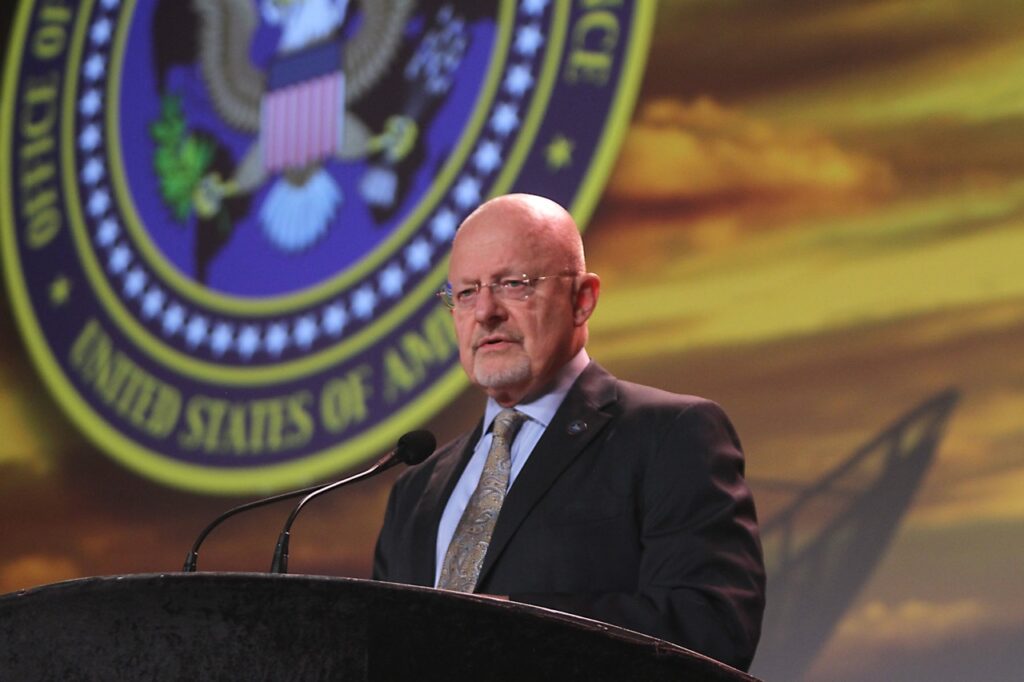
DNI James Clapper Says US Intel Community About to Experience Technological Revolution With New Satellites and Advanced Sensors

May 23, 2014
DNI Clapper Teases ‘Revolutionary’ Intel Future; Big Cost Savings From Cutting Contractors
Colin Clark
Breaking Defense

COLORADO SPRINGS: The intelligence community is on the verge of “revolutionary” technical advances. Spy satellites and other systems will be able to watch a place or a person for long periods of time and warn intelligence analysts and operatives when target changes its behavior. Satellites and their sensors could be redirected automatically to ensure nothing is missed.

“We will have systems that are capable of persistence: staring at a place for an extended period of time to detect activity; to understand patterns of life; to warn us when a pattern is broken, when the abnormal happens; and even to use ABI [Activity Based Intelligence] methodologies to predict future actions,” Director of National Intelligence James Clapper said today in remarks here at the Space Foundation’s annual National Space Symposium.

Imagine a satellite has been tasked to watch a village with several high value targets in residence. The satellite, probably working with other assets such as Global Hawks and Predators, would track perform what is today known as change detection. For example, the three people under surveillance etch the same rough pattern in the village for several weeks, going to the mosque, visiting a tea house and sleeping in several different houses. One day, two of the men go outside, get on scooters and drive in opposite directions. The ground station receiving the data would automatically note the shift in behavior and alert analysts or even special operations troops on standby.


I built that scenario after speaking with several of the 9,000 people attending this year’s event.

Clapper said the new spy satellite architecture — comprised of the spy satellites and the ground systems that receive data from them — “will be a system of systems,” Clapper said. They will be “fully automated,” he said, which means the satellites and perhaps other assets can be automatically redirected to new targets or to use new sensors from the ground. For most of the space age, a highly classified committee has met to decide tasking, i.e., which satellites would be redirected to which targets. Raytheon has built the current ground portion — called MIND (Mission Integration and Development) – of the NRO’s spy satellite system. That program has repeatedly been cited in recent years as an on-time and on-budget example of what the Intelligence Community can do.


Clapper’s reference to the new architecture is freighted with meaning. The Intelligence Community is hammering out decisions as it tries to decide what kinds of sensors, ground stations and satellites it will build for the next generation of signals intelligence. A push is also clearly underway to build ground stations — without which a satellite is pretty useless — that can use receive and analyze data without regard to which agency built the system or operates the sensors.

Finally, during the Q and A session after his speech, Clapper conceded that the Intelligence Community will not save much money as it moves to the cloud and implements its Intelligence Community Information Technology Enterprise (basically, a cloud with different regions for different agencies within which they can all share if the user has the right permissions).

No IT system in the history of the world has ever produced all the savings that have been touted,” he said to appreciative chuckles from the crowd. “The big reduction will be in the marching army of IT contractors we have in the IT today.” Simply put, the huge crowds of green badged contractors who have been so important to so much of the IC since 2001 will dwindle as America finishes its withdrawals from its historic presences in Afghanistan and Iraq.

Our Spying Is Better Than Your Spying

The Obama administration is drawing a line between stealing the secrets of companies and nations.
MAY 22, 2014

As the old saying goes, there is no honor among thieves. And the same can be said for spying. But in the year since former National Security Agency contractor Edward Snowden revealed the vastness of U.S. spying -- on its friends and enemies alike -- the Obama administration has been at pains to explain why its style of espionage is more ethical or even moral than its adversaries.

On Thursday, the Justice Department's top national security official launched a new front in that rhetorical campaign and sought to draw a bright line between the kind of spying the United States does on foreign corporations and the spying that foreign countries do on U.S. firms.

John Carlin, the assistant attorney general for the department's National Security Division, said alleged espionage by five Chinese military officials against American companies and a labor union is an act of criminal "theft" meant to give Chinese companies an unfair advantage over their American competitors. And unlike nations spying on each other for strategic or national security purposes, which Carlin defended, economic espionage meant to benefit one company or industry over another is something that governments know to be so far over that line that none are willing to defend it, he argued.

Carlin's remarks, delivered in a speech at the Brookings Institution in Washington, D.C., constituted a new push by the Obama administration to deflect Chinese and other foreign criticism against spying by the NSA, which routinely hacks into the computers of foreign corporations, and to define U.S. espionage as fundamentally distinct from the economic spying that China and other countries do.

"We are aware of no nation in the world that publicly states that theft of information for commercial gain is acceptable," Carlin said. "Even in this case, China has not attempted to justify the allegations. Instead, they deny them."

Earlier this week, the Justice Department unveiled indictments against the five Chinese military hackers for stealing pricing information, equipment designs, attorney-client communications, and other proprietary information from some of the biggest U.S. raw materials manufacturers and the country's largest steel workers union. Prosecutors allege that the Chinese officials stole the information in order to assist Chinese state-controlled enterprises, with whom the American companies and their workers directly compete.

Defence investments: Bureaucrats look for short-term benefits: Ex-Navy official

23 May 2014

It is against the nature of bureaucrats, who looked for short-term policy benefits rather than long-term sustainable solutions, to push for defence investment which isn't economically yielding within the normal tenure of an elected government, according to Rear-Admiral Mohan Raman (Rtd). 

Initiating a discussion on "Defence Self-Reliance" at Observer Research Foundation Chennai Chapter on May 10, 2014, Admiral Raman repeatedly stressed on the importance of R&D and the necessity for more scientific inquiry and creative designing. While clearly differentiating between the research, design and production work that go into developing a war-machine, he spoke of how Indian scientists and engineers have the innate skill and confidence in their armed services that puts their foreign counterparts to test. 

Addressing the process of attaining self-reliance, Admiral Raman clarified that this is a process which will take years, if not decades, to complete, and it shall remain an on-going process: a pursuit to outdo oneself with every prototype being produced. Recalling the period of China's 'four modernisations' and the time it took to assume full potential, he explained how it was only in 1978 during Deng Xiaoping's period (after Mao Zedong and Zhou Enlai) that the Chinese economy got rejuvenated. 

Admiral Raman began with the premise that civilians need to be able to differentiate between accidents and inevitable incidents, and called for doing away with the cynicism in defence matters. His analysis on the subject-area, deeply entrenched by his years of experience with the Navy, set out to look at three aspects of self-reliance, namely, the stages of self-reliance, the benefits of self-reliance and finally how India, as a booming, developing nation could achieve self-reliance. 

"Every time you go to war, you learn something the hard way. It's life. What we as humans who are inherently flawed can do is to work on a methodical improvement towards perfection," Admiral Raman said. 

He said the armed forces' acclimatisation to the new machines is bound to take time and during that time, mistakes are inevitable. According to the Admiral, in fear of these errors, the government has failed to act over the past two decades in terms of up-gradation and re-equipping the armed forces, putting the security forces on a significant back-foot when compared to other nations. 

Emphasising the methodical improvement of the Indian defence forces and its equipment, the veteran naval architect called for moving past cynicism of the media and the public, and the laid-back attitude of the bureaucracy over the years, and for the nation to adopt a more active stance on the development of the nation's defence forces. 

Tracing the issue of demand and supply faced by the defence forces, especially in terms of sourcing spare-parts and components, Admiral Raman spoke of the possibility of a public-private partnership (PPP) to aid the development of war machines as a future prospect. He also stressed on strengthening the auxiliary industries in India which shall boost R&D and supply for the development of more indigenised machines, which shall in turn set the Indian defence on the path towards self-reliance. 

While a much-discussed solution to reduce the recurring cost is to have a conscripted army, Admiral Raman rationalised on the need for quality over volume. Citing the example of the infamous Chinese policy of conscription, he explained how even the communist neighbour is transiting to volunteerism. 

With questions from the floor loaded with apprehension and concern, Admiral Raman waved it off with a request to look past clichéd questions on integrity and faith which are being raised by academicians and analysts across the world. India, he believed, through the education produced by its premier institutions and the interplay between the government and private firms had the potential to command superiority in terms of defence technology and potential -- a stark difference from the status quo, in which India remains the largest importer of war machines. 

(This report is prepared by Shreya Murali, III Year BA (Political Science, Sociology and Economics), Christ University, Bangalore) 

$110 Per Hit

Vigilantes in the Philippines have killed kids, drug dealers, and petty thieves. The government that paid their salaries insists they don't exist.
MAY 22, 2014

Nine-year-old Jenny Boy "Kokey" Lagulos didn't stand a chance. One of the many children who hung out in Tagum City's Freedom Park plaza, a large open space in the city center surrounded by video-game parlors and other attractions, Kokey was rumored to be a thief. In Tagum City, on the Philippines' southern island of Mindanao, rumors like that can get people killed.

On April 12, 2011, local residents found Kokey dead on a Tagum City side street, his body a bloodied heap punctured by 22 stab wounds. Kokey wasn't the only child found murdered that day in Tagum City. Earlier that morning, the body of 12-year-old Macky Lumangtad was discovered in a vacant lot with a gunshot wound to the head. Three years later, Tagum City police have made no arrests in either killing.

In a May 21 report, Human Rights Watch exposed the existence of a death squad in Tagum City, one linked to hundreds of killings and operating as a salaried arm of the municipal government. 

Extrajudicial killings and the activities of shadowy death squads that serve as anti-crime vigilantesare nothing new in the Philippines.

Extrajudicial killings and the activities of shadowy death squads that serve as anti-crime vigilantes are nothing new in the Philippines. But the level of government complicity was front-page news, even in a society mostly inured to street violence. Kokey and Macky were but two of those victims targeted with calculated, premeditated brutality by a death squad organized, equipped, and financed by then Tagum City Mayor Rey "Chiong" Uy and elements of the local police and municipal government.

In Uy's Tagum City, a sleepy agricultural center with a population of 245,000, extrajudicial killings became a perverse form of crime control. Uy paid the death squad $110 per hit to eliminate from Tagum City what he frequently referred to as "weeds": suspected petty criminals, drug dealers, small-time thieves, and children living or working on the streets. Tagum City's gunmen did their job with chilling efficiency. Human Rights Watch's report reveals that the death squad killed at least 298 people from 2007 until 2013, when Uy stepped down as mayor. Uy, who continues to live openly in Mindanao, has denied the existence of the death squad and has dismissed the allegations against him as a "conspiracy" by unnamed rivals whom he accused of paying alleged witnesses "to make up stories against me." (Uy didn't respond to Human Rights Watch's request for comment.)

If the Air Force Has Such a Good Argument for Divesting the A-10, Why is No One Buying It?

May 20, 2014

U.S. Air Force A-10 Thunderbolt II aircraft are serviced on the flight line at Shaw Air Force Base, South Carolina in this handout photograph taken on December 2, 2005. A U.S. Congressional panel has rejected the military's proposal to retire the entire fleet of A-10 close-air support planes, as the annual defense policy bill continues to make its way through the House of Representatives. The White House said retiring the planes would save $4.2 billion through 2019. (Tech. Sgt. James Arrowood/Courtesy Reuters) 

One of the most controversial proposals by the Air Force this year is its plan to divest the A-10 jet aircraft. The “warthog,” as it is known, is a slow moving, low-flying, ear-piercingly loud jet airplane built around a giant “Avenger” Gatling gun, which has provided intimidating fire power for troops in contact on the ground for nearly 40 years. By divesting an entire fleet, instead of just a few airplanes, the Air Force saves “billions, not millions” across the board in production and maintenance. 

That $3.5 billion can then be invested in “multi-mission” aircraft, like the F-35, which, like the F-16, F-15, B1, and other platforms can conduct close air support (CAS), in addition to their other missions. From an enterprise management perspective, they argue, it is just inefficient to maintain a “niche” airplane like the A-10, when so many other more survivable platforms can also do CAS, in addition to interdiction, air-to-air, and penetrating strike. 

As a taxpayer, I get the Air Force’s budget argument; but as the wife of a former infantry officer who claims the A-10 has saved real lives in combat, my belief that the A-10 canprobably be retired is not really about the money. It’s about my assessment that the Air Force can adequately perform the CAS mission without the A10. The lingering question is,will they? 

Soldiers in combat on the ground could not care less about the Air Force’s “enterprise-wide” analysis and the “efficiencies” gained by utilizing operationally oriented “multi-mission platforms.” Blah. Blah. Blah. What soldiers (and parents, spouses, and senators) want to know is that the firepower will be there when needed. Period. And here, the Air Force is just not getting that message across. 

What Budget Cuts? America Still Has Way More Air Power Than Any Rival Pentagon’s jet fighters equal Russia’s and China’s combined

Despite deep budget cuts in recent years, the U.S. armed forces still possess nearly twice as many jet fighters and bombers as Russia and twice as many as China. To match Washington’s aerial firepower, Moscow and Beijing would have to pool their front-line combat aircraft.

The current air-power balance is a useful reminder of the United States’ huge—and likely enduring—numerical weapons advantage over any potential adversary.

The Pentagon just released its annual 10-year projection of its aerial arsenal. The slim document tallies 3,361 jet fighters in the U.S. Air Force, Navy and Marine Corps plus 158 Air Force heavy bombers, as of this year.

By contrast, Flight Global’s annual world air power inventory for 2014 counts 1,237 Russian jet fighters and 177 medium and heavy bombers. The same census assigns China 1,319 fighters and 134 bombers.

The U.S. Navy and Marine Corps’ huge air wings help explain the imbalance. The U.S. Air Force possesses 1,959 fighters and all of America’s bombers. Alone, the American flying branch’s warplanes outnumber China’s and Russia’s—but only by a few hundred airframes.

But the U.S. Navy and Marines together maintain 1,402 fighters, while China’s navy fields fewer than 200 fighters—and the Russian navy fewer than 100.

America’s two-to-one advantage is not waning—this despite the roughly 10-percent spending reduction mandated by the federal “sequestration” law. The Pentagon projects a slight decline in fighters, bottoming out at around 2,900 airframes by 2020 as controversial new F-35s replace slightly larger numbers of A-10s, F-16s, F/A-18s and AV-8Bs.

Russia, meanwhile, could reduce its fighter fleet to just 800 new and rebuilt planes by 2020, according to a 2010 analysis. China’s air arms still operate nearly 600 fighters modeled on the 1960s-vintage Soviet MiG-21. These planes are of limited use in modern warfare and could retire soon, potentially halving Beijing’s overall aerial arsenal.

Bomber numbers could remain pretty much the same in all three countries through 2020.

Of course, raw numbers aren’t everything. Geography, strategy, doctrine, tactics and pilot training also matter in warfare—arguably more than mere hardware holdings. Equally, support systems play a vital role. Satellites, drones and radar planes help spot targets for the fighters and bombers. Tanker planes keep the warplanes flying over long distances.

Considering these factors, America’s air-power advantage arguably increases, as the U.S. possesses far more—and far better—support systems than China and Russia do. And American aviators are better-trained and better-paid.

We’ve published a new book all about the F-35. Sign up for a daily War is Boring email update here. Subscribe to WIB’s RSS feed here and follow the main pagehere.

Should China Declare a War on Terror?

Beijing and Washington's very different response to the latest deadly attack in Xinjiang.
MAY 22, 2014

On Sept. 20, 2001, then President George W. Bush addressed a joint session of Congress about the 9/11 attacks in New York City. "Our enemy is a radical network of terrorists and every government that supports them," he said. "Our war on terror begins with al Qaeda, but it does not end there. It will not end until every terrorist group of global reach has been found, stopped and defeated."

The term ‘war on terror' entered into wide circulation from there, and in many ways defined Bush's foreign policy -- prioritizing crackdowns on violent extremists through legal and extra-legal methods. But Bush's war on terror also helped improve ties with China. China's then President Jiang Zemin condemned the attacks, and pledged to cooperate with the United States in its fight against terrorism. "China's ostensible support for U.S. retaliatory strikes on Afghanistan constituted a significant break from its standard foreign policy line," Nicholas Dynon, a PhD candidate studying China's public diplomacy,wrote in the magazine The Diplomat. It was "the first time since the Cold War that Beijing had condoned U.S. military strikes in another country."

Now that Beijing seems to be fighting its own war on terror, Washington, at least publicly, has been far less supportive.

On May 22, according to Reuters, "Explosives hurled from two vehicles which ploughed into an open market in China's troubled Xinjiang region killed 31 people on Thursday, state media reported, the deadliest act of violence in the region in years." The attack came just three weeks after a coordinated bomb and knife, also in Xinjiang's capital of Urumuqi, killed three and left dozens injured -- an attack that was all the more galling because it came just after Xi Jinping ended his first trip to Xinjiang as president. And it's just a few months after coordinating knifings at a train station in the southern Chinese city of Kunming left dozens dead. The other attacks were allegedly perpetrated by members of the Uighur minority -- the roughly 10 million Turkic-speaking Muslims who mostly live in Xinjiang. The perpetrators of this latest attack in the Urumqi market remain unknown, but even before the police announce their findings, Uighur separatists are being held responsible in the court of Chinese public opinion.

Still Shortchanged

Journal Article | May 18, 2014 

Still Shortchanged: Some Observations About the New Army/Marine Corps COIN Doctrine
Charles J. Dunlap, Jr.

When the then new Army/Marine Corps’ counterinsurgency (COIN) doctrine was fielded in 2006, it quickly earned the label of “The Book” on Iraq and, later, Afghanistan. At the time this writer (among others) offered critiques of it which were not just ignored, but openly ridiculed.

Given the gloomy outcomes of the wars in both places, one would have thought that a doctrinal re-assessment of that 2006 approach would have unsparingly sought to figure out what worked and what did not, and revised accordingly. With few exceptions, however, the just released Field Manual (FM) 3-24/Marine Corp Warfighting Publication (MCWP) 3-33.5, Insurgencies and Countering Insurgencies(28 April 2014) does not reflect that kind of searching inquiry. Instead, the “new” doctrine is mostly just a somewhat updated and re-organized version of the same 2006 formula. 

To be sure, there was much goodness in the 2006 manual, and a lot of that rightfully carries over into the revised FM 3-24. Of course, there are instances where, like its predecessor, the new doctrine seems to re-state the obvious. No doubt it is easy to become impatient with the new (actually, any) doctrine when confronted with repeated themes, but the reader should remember that it is designed for use by those who have not necessarily experienced all the events of the post-9/11 era. Doctrine documents, especially those with ambition for longevity, should assume readers with little or no familiarity with the material it addresses.

Still, the new doctrine represents - regrettably - a missed opportunity. Recent fears about the lessons of Iraq and Afghanistan being forgotten are, in a way perhaps unintended, well-founded: the rightlessons are being forgotten. Even worse, the wrong ones are being memorialized in documents like the new FM 3-24. What was needed was a fundamental rethinking of a land force approach to COIN in light of wars whose results are not just decidedly “unsatisfying” to military professionals, but also so disappointing to the American people that they now overwhelming believe the war in Afghanistan was not worth fighting, and a growing majority (52%) have concluded that the U.S. mostly failed in Iraq.

In fairness, part of the problem of incorporating the lessons of Iraq and Afghanistan, writ large, is beyond the purview of any doctrine manual writers: in Iraq, a counterinsurgency approach was employed to address what was, originally anyway, a counter-terrorism problem. 

How did this happen? The thinking seems to have been that in order to prevent another attack like 9/11 (or worse, a WMD-enhanced strike), it was necessary to deprive terrorists of their bases and/or nation-state support. The “solution” therefore was to revamp entire countries vulnerable to being “hosts” for terrorist entities into economically-stable, Western-style democracies which, presumably, would be decisively inhospitable to any terrorists who could threaten America or the rest of the world.