5 June 2014

A thaw in Saudi-Iran relations?

Kanchi Gupta
02 June 2014

Since President Rouhani's election, Iran has made considerable effort towards 'constructive engagement' with the Gulf Cooperation Council. Foreign Minister Javad Zarif visited Qatar, Kuwait, Oman and the UAE soon after his appointment. President Rouhani also visited Oman and signed an agreement to build a gas pipeline across the Gulf. Despite Rouhani's calls for improvement in Riyadh-Tehran relations, Saudi Arabia - followed by Bahrain - has resisted Iran's diplomatic overtures until now. However, Riyadh recently extended an invitation to Tehran's Foreign Minister Mohammed Javad Zarif, indicating towards a possible thaw in relations. In this scenario, let us examine the scope of Saudi-Iran relations and US attempts to balance the regional security architecture against a US-Iran nuclear detente. 

On May 13, 2014, Saudi Foreign Minister Prince Saud Al Faisal announced Riyadh's readiness to negotiate with Iran and resolve differences between the two Gulf States. He said that "anytime (Zarif) sees fit to come, we are willing to receive him"1. Iran welcomed the development stating that while no written invitation had been received, "a plan for the two ministers to meet is on the agenda"2. 

This declaration came just short of another round of nuclear negotiations between Iran and P5 +1 in Vienna. Saudi Arabia's announcement coincided with US Defence Secretary Chuck Hagel's visit to Riyadh for the US-GCC Strategic Defence Dialogue. Hagel stressed on US-GCC and intra-GCC military cooperation in order to counter Iran's "destabilising activities" and its efforts to undermine GCC stability3. At the Manama Dialogue in December last year, he had stated that the nuclear deal with Iran does not mean that "the threat from Iran is over"4.

US Secretary of State, John Kerry welcomed this development and said that the US had nothing to do with the invitation. He stated that the US was pleased to see Saudi Arabia engaged in diplomacy even though there is "longstanding difficulty in that relationship" (with Iran). "We hope that it might be able to produce something with respect to one of the several conflicts in which the Iranians could have an impact"5. 

The United States is making considerable efforts to reassure the Gulf States, particularly Saudi Arabia, of its commitment to the security of the region. As they have pursued nuclear negotiations with Iran, the US has maintained that the "military option is on the table" if the diplomatic route is unsuccessful. At the Manama Dialogue, Hagel listed US military assets in the region and stated that the US has sought to "shift the military balance of the region away from Iran and in favour of our Gulf partners". Even now the emphasis will be on building their military capabilities, not just through bilateral relationships with the US but also through stronger integration within the GCC. 

The US attempted to mitigate the differences within the GCC through the US-GCC Strategic Cooperation Forum (SCF) launched in March 2012. This framework aims to enhance "coordination of policies which advance shared political, military, security and economic objectives" and "deepen the close relations between the two sides". The third communiqué of SCF reiterates commitments towards US-GCC coordination on an integrated Ballistic Missile Defence system and improving GCC unity in defence planning and procurement of weapons and technology6.

Ten days after the Manama Dialogue, President Barack Obama issued a directive selling weapons to the GCC states -- mainly missile defence systems under the Foreign Assistance Act of 1961 and the Arms Export Control Act. The US, therefore, dealt with the GCC States as a bloc for the first time, instead of selling weapons systems to individual nations within the council7. In March 2014, President Obama visited Riyadh to assuage fears of US retrenchment from the region. 
Space Power: A Personal Theory of Power

The Buttress of the Modern Military

This essay, provided by a space policy professional with a background in the field’s history and who wishes to remain anonymous, is part of the Personal Theories of Power series, a joint Bridge-CIMSEC project which asked a group of national security professionals to provide their theory of power and its application. We hope this launches a long and insightful debate that may one day shape policy.

Introduction

The United States possesses the world’s leading military. It has the most sophisticated air, land, sea, and, now, cyber forces and wields them in such a manner such that no single nation, barring the employment of total nuclear war, approaches its destructive capability.

America’s military power in these realms is identifiable. Fighter jets, bombs, tanks, submarines, ships, and more — these are all synonymous with the Nation’s warfighting portfolio. And in the modern world, even though we cannot see a cyber attack coming, we can certainly see its results — as with the alleged Stuxnet attack on Iranian nuclear facilities. To the public, these tools together are America’s “stick” on the global stage, for whatever purpose its leaders deem necessary.

Space is different. There are no bombs raining from orbit, and no crack special forces deploying from orbital platforms. The tide of battle is never turned by the sudden appearance of a satellite overhead. In fact, no one in the history of war has ever been killed by a weapon from space. There are actually no weapons in space nor will there be any in the foreseeable future.
Yet, America is the world’s space power. The Nation’s strength in the modern military era is dependent on its space capabilities.

Yet, America is the world’s space power. The Nation’s strength in the modern military era is dependent on its space capabilities. Space is fundamentally different than air, sea, land, and cyber power, and at the same time inextricably tied to them. It buttresses, binds, and enhances all of those visible modes of power. America cannot conduct war without space.

Simply, space is inherently a medium, as with air, land, sea, and cyber, and space power is the ability to use or deny the use by others of that medium. The United States Air Force (USAF) defines military space power as a “capability” to utilize [space-based] assets towards fulfilling national security needs.[1] In this, space is similar to other forms of military projection. But, its difference comes in how it is measured. When viewed in this context, space power is thus the aggregate of a nation’s abilities to establish, access, and leverage its orbital assets to further all other forms of national power.

Cyber Power: A Personal Theory of Power

Opportunity, Leverage, and Yet…Just Power

This essay is part of the Personal Theories of Power series, a joint Bridge-CIMSEC project which asked a group of national security professionals to provide their theory of power and its application. We hope this launches a long and insightful debate that may one day shape policy.

Cyberspace is enabling new forms of communication, influence, awareness, and power for people around the world. Families use cyberspace to communicate face-to-face over great distances. Financial institutions execute global business and commodity trades at the speed of light through the cyberspace domain. The world’s citizens are granted unprecedented access to information, facilitating more awareness and understanding than at any time in history. Yet the same cooperative domain that fosters so much good for mankind also offers a tremendous source of power. The antithesis of the mutually beneficial electronic environment is a cyberspace where competition and fear overshadow collaboration. This conundrum, however, is not new. Hobbes, in his fundamental law of nature, warns, “That every man, ought to endeavour Peace, as farre as he has hope of obtaining it; and when he cannot obtain it, that he may seek, and use, all helps and advantages of Warre.”[i] Cyberspace will continue to civilize. As the domain matures, however, so too will the forces that aim to use the cyberspace domain to project power.
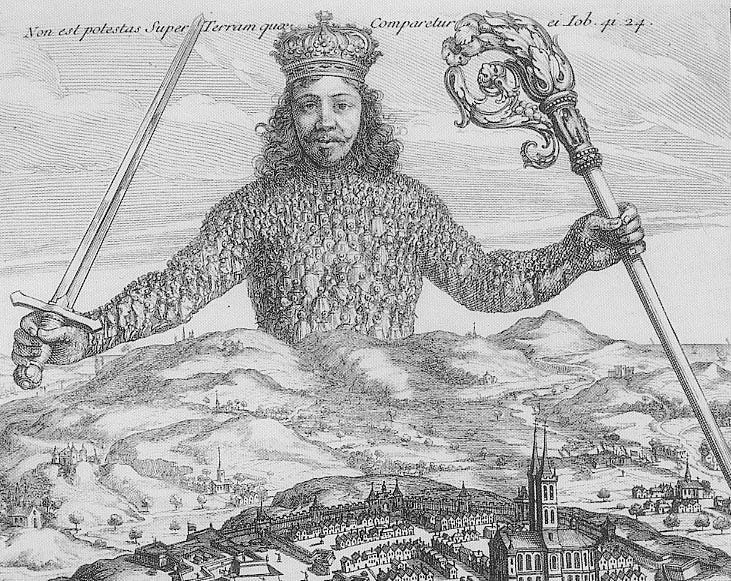
Hobbes’ Leviathan

Before diving into the concept of cyber power, one must first frame the term power itself. Power, in its most basic form equates to might: the ability to compel a person or group to acquiesce through force. Thucydides captured this concept in his artful depiction of the Melian Dialog, penning the famous phrase, “the strong do what they can and the weak suffer what they must.”[ii] Hobbes, too, warned that power possessed is power to be used, suggesting every man lives in a state of constant competition with every other man.[iii] In this way, power is the ultimate arbiter, framing both what a man can do and what he should do in the same breath.

The close cousin to might is coercion. Thomas Schelling suggests “Coercion requires finding a bargain, arranging for him to be better off doing what we want — worse off not doing what we want — when he takes the threatened penalty into account.”[iv] Unlike a strategy centered on might, coercion requires insight. Military strategists and theorists who emerged from the Cold War coalesced around a single basic tenet of coercion: one must attempt to thoroughly understand an adversary before coercion can succeed.[v] Hearkening Sun Tzu’s notion that one must “know the enemy,” this community of great minds suggests in-depth analysis helps determine the bargaining chips in the coercion chess match.[vi]

Air Power: A Personal Theory of Power

Annihilation, Attrition, and Temporal Paralysis


This essay is part of the Personal Theories of Power series, a joint Bridge-CIMSEC project which asked a group of national security professionals to provide their theory of power and its application. We hope this launches a long and insightful debate that may one day shape policy.

There is insight in exploring the unique advantages of each domain. And the speed, reach, height, ubiquity, agility, and concentration advantages of air power allow us to focus on how best it can be used.[1] This essay will contrast the usage of air warfare via annihilation and attrition to highlight a third way, paralysis. One of the principal advantages of air power is its ability to create the temporal effect of paralysis. While it is not wholly unique from other forms of power in this capacity, it is better at it than most due to the combination of its unique advantages. Admittedly, this is a narrow look at paralysis via air power, but one that demands a point of departure from previous conceptualizations of its factors and uses.

Defining Air Power

The definition of air power has eluded strategists since man first tasted flight. The most important aspect of defining is that we must avoid conflation with niche capabilities, missions, or even processes that are related to its practice. “To be adequate,” as Colin Gray suggests, “a characterization or definition of air power must accommodate, end to end, the total process that produces a stream of combat and combat support aircraft.”[2] My definition of air power is the act of achieving strategic effect via the air.[3] Air power contributes to compounded strategic effect via annihilation, attrition, and paralysis.

Categorization and Explanation

Hans Delbrück, in History of the Art of War, describes two Clausewitzian strategies of warfare. The first is focused upon the annihilation of one’s adversary. The second, exhaustion, is more circumspect in its limited aims. Both are clearly subordinate to the idea that “war is nothing but the continuation of policy with other means.”[4] Delbrück extended these intoNiederwerfungsstrategie (the strategy of annihilation) and Ermattungsstrategie (the strategy of exhaustion, attrition). The former’s sole aim is the decisive battle, where the latter is understood to have more than one concern, which is a spectrum between both battle and maneuver with the aim of exhausting the adversary. Delbrück’s History suggests that neither annihilation nor exhaustion are inferior to one another, and that attrition is not the mere avoidance of battle. But he was emphatic that these strategies were subordinate and subject to the Clausewitzian general theory.[5]

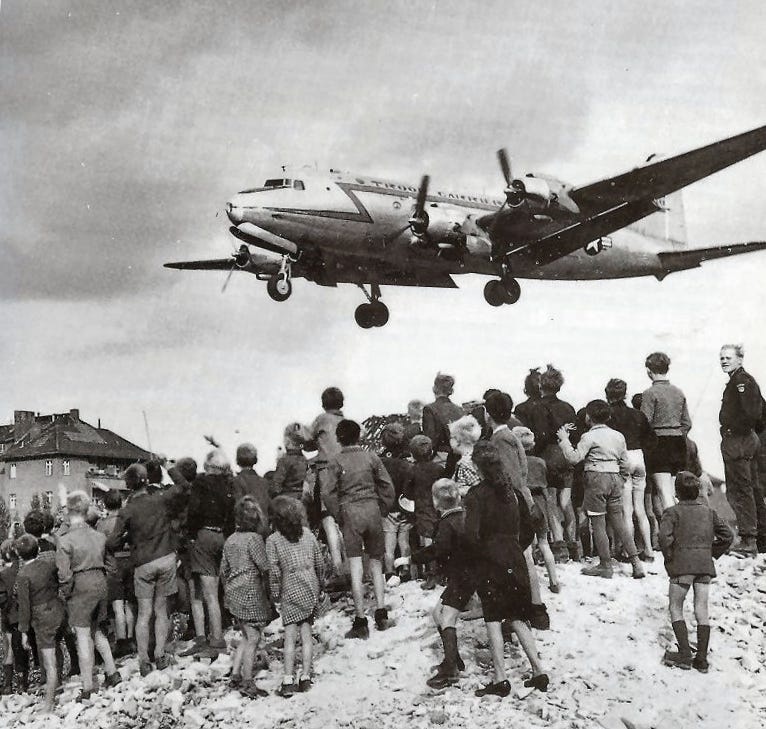
Berliners watching a C-54 land at Berlin Tempelhof Airport, 1948.

(Wikimedia Commons)

While Clausewitz was, of course, focused on the land domain, air power has proven useful in both annihilation and attrition. The Desert Storm “Highways of Death” provides a useful example of the application of air power towards annihilation. And the best example of air power’s application of attrition is one where it denied exhaustion: the Berlin airlift, with over 277,000 flights in a period of 15 months lifted 2.3 million total tons of supplies. In either case, was the application of air power uniquely responsible for strategic effect? No. In both cases — and in most every case — other forms of power aided the outcome via force, or the threat of force. But outside the Delbrückian dichotomy, there is a third way for to create strategic effect — paralysis.
…the lasting effect of paralysis, like shock, is fleeting. A permanent state of paralysis is an unsustainable (and unacceptable) political objective…

Could Asymmetric Warfare “Sink” the U.S. Navy?


May 27, 2014
http://nationalinterest.org/blog/the-buzz/could-asymmetric-warfare-sink%E2%80%9D-the-us-navy-10540

As the conflict in Ukraine continues to evolve, it’s time to reflect on what tactics were successful in the early Crimea campaign. One event in particular should serve as a wakeup call for US naval strategists. In March, pro-Russian forces sunk two ships in the narrow channel that connects Ukraine’s Southern Naval Base to the Black Sea. With the entrance blocked, several Ukrainian ships were trapped in Donuzlav Bay.

American ships are not adequately prepared for this tactic, and would have been hard-pressed to escape the bay. In the open sea, US Navy ships are powerful actors, protecting sea-lanes and projecting American power abroad. Near shore, however, their advantage is lost and they are vulnerable to asymmetric attacks. The US Navy must put more resources into preparing for and countering this sort of unconventional threat.

The tactic was startlingly simple. Early in the morning of March 6, pro-Russian forces intentionally sank the decommissioned Russian cruiser Ochakov in the navigation channel separating Donuzlav Bay from the Black Sea; one day later, they scuttled a second, smaller ship. The sunkenOchakov easily blocked the narrow, shallow waterway—lying on its side on the seabed, 50 percent of its hull was exposed above water.

With the channel blocked, the Ukrainian ships were trapped and all but defenseless: all six were eventually boarded and taken over. The minesweeper Cherkasy heroically struggled to the end and its final efforts to free itself provide additional insight.

The Cherkasy attempted to affix its stern towline to the bow of the smaller sunken vessel. Presumably, the captain sought to pull it out of the channel and open an escape route. His challenge was that the Cherkasy’s tow system, like those on the majority of US Navy vessels, is designed to tow afloat vessels – not the waterlogged ships blocking his escape. The Cherkasy was unable to move the sunken vessel and after a few hours of circling in the harbor, its captain negotiated his ship’s surrender.

Russian Special Forces are assumed to have carried out the Ukrainian operation, but there is nothing inherently difficult in scuttling a ship to block a channel. Most well trained irregular soldiers have the capacity to carry out such an operation: they could simply hijack a commercial ship and sink it to blockade US ships in port. Currently, there is no way to quickly extricate a sunken ship, leaving trapped warships bottled up and assailable.

A Reflection on the “Personal Theories of Power”

The Power of Motivation and Relationships

This is the final post in the Personal Theories of Power series, a joint Bridge-CIMSEC project which asked a group of national security professionals to provide their theory of power and its application. We hope this launches a long and insightful debate that may one day shape policy.

When Rich Ganske first mentioned the idea of writing about personal theories of power, I wasn’t immediately on board. I viewed it as a lot of work for a few posts, mostly done by friends who would provide content out of loyalty. I could not have been more wrong. With Rich heading the concept, we quickly sketched out some possible topics people could cover. Air power and land power, of course…we could each cover those. We then started thinking about others that tended to inhabit the blogosphere and might be willing to produce some interesting ideas. We knew more than a few eloquent navalists, so sea power would be covered. They also provided us with a valuable link to another great blogging organization, the Center for International Maritime Security, which agreed to cross-post the articles, opening up another avenue to a well-informed audience. With the domains largely addressed, we then took a different tact; we came up with writers first, allowing them to develop their own topics…ending up with 16 possible posts. We expected to actually deliver 4-5 by the short deadline provided. Fourteen arrived for publication, including:

And for those that are counting, Rich Ganske did provide 3 posts for this series (including his opening)…he was that committed. While the quantity of the posts was truly unexpected, the quality was what impressed me. The authors truly took the time to think through their desired topics and addressed their views on them. It probably didn’t hurt that the authors were either in the midst of studying the topic or immersed in it from day to day.

What really made this project a success, at least in my mind, was the obvious enthusiasm and professionalism the participants displayed. How many people do you know would volunteer time out of their already busy schedules to study, write, edit, and format a piece on theory? How many people do you know would find not only value in such a pursuit, but be excited about it? Are these people you already know? Could you call them out of the blue and make such a request?

The End of IR Theory as we Know it, Again

June 4, 2014 
Randall Schweller, Maxwell’s Demon and the Golden Apple: Global Discord in the New Millennium (Johns Hopkins University Press, 2014)

The study of international relations (IR) has produced a heavy body count. From formal rational choice theory to the “Golden Arches Theory of Conflict Prevention,” nearly every theory that has been utilized to explain international outcomes has also been declared dead, fatally flawed, or otherwise in danger of impending demise. The life of an IR theory is truly nasty, brutish, and short. Scholars periodically check even well-established theories for a pulse. More recently, however, some political scientists have advanced a broader claim: traditional IR theory itself is dead.

The end of traditional IR theory does not mean that IR scholars will cease to theorize. On the contrary, new theories will be necessary to replace old ones that have been rendered irrelevant by a changing international system. According to proponents of this argument, traditional IR theories—often divided into three broad classes of realism, liberalism, and constructivism—have yielded much internecine fighting and little theoretical progress. The field made war, but war did not make the field much better. IR theory thus failed to keep up with a rapidly evolving international system. So say the heralds of traditional IR theory’s death.

In Maxwell’s Demon and the Golden Apple: Global Disorder in the New Millennium, Randall Schweller makes his entry into this debate, arguing in support of the thesis that IR theory as we know it is finished. While acknowledging that previous declarations to this effect have proven premature, he warns that, “The sky may indeed be falling this time.” An extension of a 2010 article, the argument is couched in terms familiar to students of IR. Anarchy, polarity, and other such fixations of IR scholars are well represented here, and given Schweller’s contributions to the realist tradition, his sympathy for that school of thought will come as no surprise. More central to the argument than any particular concept from IR theory, however, is a novel scientific metaphor.

Schweller utilizes the second law of thermodynamics, which states that closed systems tend toward maximum entropy, to contend that the international system is now heading in that direction. Though entropy has been defined differently in various fields, Schweller delineates two principal conceptions of entropy. Thermodynamic entropy is defined as the tendency of energy to be “converted into irrecoverable forms” as work is performed; as information entropy increases, a system “can be composed of a greater number of specific configurations, and accordingly it reveals less information” about the units within that system. Schweller relates thermodynamic entropy to the structure of the international system and information entropy to international processes. Rising structural entropy thus lowers structural constraints, and rising process-level entropy makes unit interactions less predictable.

Does Bowe Bergdahl's release signal an end to the 'war on terror'?

The deal to swap a US soldier for five Taliban prisoners may be evidence of the pragmatism underlying Obama's foreign policy

2 June 2014

A US army handout of Bowe Bergdahl before his capture. ‘It is not that the US has refused to deal with dubious groups in the past. It may have done, but deniability was always enshrined in the terms.'

What strikes you first is the human predicament. Sergeant Bowe Bergdahl was detained for five years, the last US citizen to be held captive by the Afghan Taliban. His parents had still not seen him when they appeared before the cameras in the sort of flags-and-family scene American television and politics love. His father – with his huge bushy beard and ponytail, hardly a photofit of your standard US serviceman's dad – suggested that his son might have to learn to speak English again and would need time to "decompress"; "if he comes up too fast, it could kill him".

Difficult though Bergdahl's reintegration into the western world will doubtless be, though, the politics threaten to be many times more complicated. Sparks of controversy flew as soon as his liberation was announced – for the return of this American prodigal son (some reports suggest he deserted) was the product of a deal; a prisoner exchange, no less, which may make it unprecedented in recent American diplomacy. And to say that it was not universally welcomed is to put it mildly.

It is not that the US has refused to deal with dubious characters and groups in the recent past. It may have done, but deniability was always enshrined in the terms. Here we have a deal, sanctioned by President Obama, under which one US soldier has been officially released in exchange for the five most senior Taliban prisoners at Guantánamo Bay.

This goes far beyond talking to the Taliban – itself hugely controversial in the US throughout the war in Afghanistan. For senior Republicans, including Senator John McCain – but not just for them – this amounts to treating with terrorists, even betraying the sacred memory of those killed on 9/11. It is something the United States did not, and would not, do.

Republicans also suspect that Obama – not an adroit congressional operator hitherto – of pulling a fast one by not giving Congress due notice.

The more farsighted may also discern the writing on the wall for Guantánamo itself. If five of its most "high value" occupants can be released with only the administration's say-so, Obama may yet be able to honour his recently repeated promise to close the place he regards as "unconstitutional" before he leaves office. There will simply be no one worth keeping there any longer.

In this way, the exchange may be seen as a sign – one of the most convincing yet – of the pragmatism that underlies the president's much-criticised foreign policy. It is about as far from the trigger-happy dogmatism of George Bush as it is possible to be; proof positive that the whole concept of the "war on terror" is no more. At the same time, it should be observed that this is something that probably only a second-term president could even contemplate, however pragmatic he wanted to be.

Obama might also cite in his support the periodic (and often numerically one-sided) exchanges negotiated between Israel and the Palestinians, which say so much about the value Israelis place on the lives of their own.

Joint Action: A Personal Theory of Power


This essay is part of the Personal Theories of Power series, a joint Bridge-CIMSEC project which asked a group of national security professionals to provide their theory of power and its application. We hope this launches a long and insightful debate that may one day shape policy.

Despite the historical success of joint action, many professional warriors and strategists continually debate which military function is most decisive in the termination of war. Even today, some question whether it is indeed worth the effort to work through the complications of combining competing strategies into effective joint action. My personal theory of joint action proposes an artful blend of both sequential and cumulative strategies to conduct unified operations that most effectively achieve our national objectives. Strategic effect is reduced when either cumulative or sequential strategies are parochially subordinated to the other, since there is no single, decisive function, service, or role in war.

Landing Craft Utility 1633, departs the Whidbey Island-class amphibious dock landing ship USS Ashland (LSD 48) with vehicles assigned to the 31st Marine Expeditionary Unit (31st MEU) after a stern gate marriage. Ashland is part of the Bonhomme Richard Amphibious Ready Group and is conducting joint force amphibious operations in the U.S. 7th Fleet area of responsibility. (U.S. Navy photo by Mass Communication Specialist Seaman Raymond D. Diaz)

The Goldwater–Nichols Department of Defense Reorganization Act of 1986drastically changed how the US military operates. Most importantly, it required the military services to interact jointly by force of law. This legal requirement for joint operations is necessary; but is by itself insufficient to build a compelling basis for joint collaboration, integration, and interdependence. While there has been much ink spilt over the normative force of Goldwater-Nichols, few have explored the theoretical basis for joint interdependence since Sir Julian Corbett.[1] This essay attempts to expand Corbett’s theoretical foundation that gives the law its conceptual footing.

What is Jointness?

Joint action, or jointness, is the creation of complementary strategic effect across all domains towards a shared political objective. Achieving a degree of physical or psychological control over an adversary creates strategic effect and requires an appreciation for the unique specializations and inherent difficulties of each domain-focused force. This appreciation acknowledges that institutional professionalism is hardly omnicompetent or transitory between varied forms of military power.[2]

Corridors of Power

More Force, Less Peacekeeping for UN Troops
30 May 2014

UN Peacekeeping Force Day, on May 29th, salutes those who serve—and have served—in the UN’s policy mechanism of choice for responding to violent local conflicts around the world.

Its story, since the first contingents of blue-helmeted troops from various member nations were deployed in 1948, is a checkered one, with some successes, a few shameful failures, and some recent significant—if risky—shifts in how it operates that could call the “peacekeeping” part into question.

It has also occasionally drawn criticism for prolonging the status quo: for example, in 1964 a UN peacekeeping force was deployed in Cyprus to separate Turkish Cypriots and Greek Cypriots. Fifty years later, the peacekeeping force is still there, allowing the so-called Cyprus question to become—as former UN Under Secretary General Brian Urquhart once said—“a sort of national industry and sport for both sides.”

Last year was something of a watershed for the world organization’s peacekeeping operations, with a radical departure from the longstanding policy of using force only in self-defense and the introduction of a Forward Intervention Brigade, the introduction of conduct and discipline teams to counter sexual abuse and sexual exploitation by UN peacekeepers, and even a damages suit charging that the Nepalese peacekeeping contingent in Haiti was the source of a devastating cholera epidemic in that earthquake-stricken country.

Its defenders will say that’s a narrow perception of an operation involving nearly 112,000 peacekeepers from 122 member states serving in 16 operations around the globe (69 total since 1948), and at $7.06 billion (in 2012) the largest single expenditure in the UN’s annual budget. (In 1992, it was $1.7 billion.) Member states pay into the cost depending on their economic means, with the US as the highest contributor, with 26 percent of the total ($1.83 billion). The US provides money, but hardly any troops because of America’s refusal to allow its military to serve under foreign commanders. The current number of US military personnel serving as peacemakers is around 200.

Over the years the UN peacekeepers’ role has periodically been redefined, acquiring a diversity not foreseen in their original mandate of acting as monitors of a cease-fire between two warring sides. Today, peacekeepers supervise elections, provide police protection for civilian populations, and act as escort for humanitarian operations. A total of 3,215 peacekeepers have died in action, 103 of them last year alone. That unusually high number reflects a more confrontational approach as the UN, frustrated by its failure to make an impact on the brutal and chaotic civil war in Congo, one that has killed more than 5 million people since 1998, formed the Forward Intervention Brigade, a combat unit in support of the Congolese army against the collection of rebel groups that have kept the country in a state of violent upheaval. The massacres in Srebrenica (Bosnia) and Rwanda, in both of which a key factor was the failure to act by UN peacekeepers, also contributed to the realization that in some situations impartiality was neither possible nor desirable.

Every UN peacekeeping operation requires the authorization of the five, veto-wielding permanent members of the Security Council, which goes some way to explaining why calls for a UN peacekeeping force to separate the combatants in Syria, and more recent requests for UN peacekeepers in the Ukraine, went unmet. Russia would not sign off on either. 

The Drinker’s Dictionary

THE DRINKER’S DICTIONARY
June 4, 2014 · in Molotov Cocktail

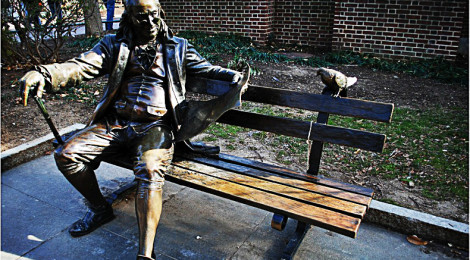
Editor’s Note: To launch our newest blog, Molotov Cocktail, we’ve reached back to an offering from a man who was both one of our upstart nation’s shrewdest diplomats and its best chronicler of Americans’ appreciation of booze. The following was published by Benjamin Franklin in The Pennsylvania Gazette on January 13, 1737 under the title, “The Drinker’s Dictionary.”

Molotov Cocktail is our drinks blog. It will feature reviews of spirits, beer, and wine; great cocktail recipes WOTR readers are sure to appreciate; and any other content we think fits. Check back often. And bottoms up!

Nothing more like a Fool than a drunken Man.

Poor Richard.

‘Tis an old Remark, that Vice always endeavours to assume the Appearance of Virtue: Thus Covetousness calls itself Prudence; Prodigality would be thought Generosity; and so of others. This perhaps arises hence, that Mankind naturally and universally approve Virtue in their Hearts, and detest Vice; and therefore, whenever thro’ Temptation they fall into a Practice of the latter, they would if possible conceal it from themselves as well as others, under some other Name than that which properly belongs to it.

But DRUNKENNESS is a very unfortunate Vice in this respect. It bears no kind of Similitude with any sort of Virtue, from which it might possibly borrow a Name; and is therefore reduc’d to the wretched Necessity of being express’d by distant round-about Phrases, and of perpetually varying those Phrases, as often as they come to be well understood to signify plainly that A MAN IS DRUNK.

Tho’ every one may possibly recollect a Dozen at least of the Expressions us’d on this Occasion, yet I think no one who has not much frequented Taverns would imagine the number of them so great as it really is. It may therefore surprize as well as divert the sober Reader, to have the Sight of a new Piece, lately communicated to me, entitled

EXTERNAL ENGAGEMENTS June 2014

June 2014

EXTERNAL ENGAGEMENTS
a symposium on the challenges facing our
foreign and security policies
cover design by www.designosis.in

Next Month: Inheritances

CLEANING THE AUGEAN STABLES
Anit Mukherjee, Assistant Professor, S. Rajaratnam School of International Studies, Singapore

THREE MANTRAS FOR INDIA'S RESOURCE SECURITY
Arunabha Ghosh, CEO, Council on Energy, Environment and Water (CEEW), Delhi

INDIA AND THE INTERNATIONAL TRADING SYSTEM
Pradeep S. Mehta, Secretary General, Consumer Unity and Trust Society, and Chenai Mukumba, Assistant Policy Analyst, CUTS, Centre for International Trade, Economics and Environment, Jaipur

CAN'T BUY ME LOVE
Rohan Mukherjee, doctoral candidate, Department of Politics, Princeton University, New Jersey

STRATEGY IN CYBERSPACE
Sandeep Bhardwaj, Research Associate, Centre for Policy Research, Delhi

Complete issue will be available on-line by next month symposium participants

A short statement of the issues involved

STRATEGY IN A TIME OF CHANGE
Srinath Raghavan, Senior Fellow, Centre for Policy Research, Delhi

A TROUBLED NEIGHBOURHOOD
Pranay Sharma, Senior Editor, 'Outlook', Delhi

DEALING WITH AFGHANISTAN AND PAKISTAN
Rudra Chaudhuri, Senior Lecturer, Department of War Studies, The King's India Institute, King's College London

LOOKING WEST
Shashank Joshi, PhD candidate in international relations at Harvard University's Department of Government; Research Fellow, Royal United Services Institute (RUSI), London

INDIA'S CHINA POLICY: GETTING THE FRAMEWORK RIGHT 
Zorawar Daulet Singh, doctoral candidate, The King's India Institute, King's College London

FINDING A NEW NORMAL IN INDIA-US RELATIONS 
Tanvi Madan, Director, The India Project, and Fellow, Foreign Policy Programme, the Brookings Institution, Washington, DC

Reviewed by Pallavi Raghavan and Karthik Nachiappan

A select and relevant bibliography


Piketty, Maito and Marx

Paper No. 5716 Dated 04-Jun-2014
Guest Column by Dr Kumar David

Thomas Piketty has done a splendid job validating one of Marx’s key expectations that relatively the rich will get richer and the poor poorer. However, after saying ‘thank you very much’ many Marxists are savaging him. Maybe they feel reinvigorated these post-2008 days and show little mercy to deviants.

An unknown guy comes out of nowhere and establishes something the Master’s disciples have been saying for 150 years but found hard to establish conclusively empirically. A data savvy young group, after 10 years labour, proves sustained and growing wealth-inequality in the UK and Germany over 150-200 years; that’s a contribution to knowledge. Though Piketty admits he is weak on theory and abstraction Capital in the Twenty-first Century is outselling everything on Amazon’s list, pulp fiction, do-it-yourself, even thrillers, which is remarkable for a 600 page tome on economics. 

The excitement is because Piketty, a youngish French economist and his team, have amassed a mountain of data about the English and German capitalist economies from the Industrial Revolution two hundred years ago to the present and processed it to come up with an unremarkable finding. It is as well known as the sun setting in the west that inequity grows ever more acute when capitalism is left to itself without the heavy hand of state intervention, war or revolution. Feeling it in the bones is one thing, but pages of empirical proof is another. That’s Piketty’s contribution; he shows from raw data that capitalism, if allowed to function normally and undisturbed, possesses a natural tendency that swells wealth inequality between the very rich and the rest of society. The cynic will say this has been known all along; but the book establishes it from raw data. Chris Giles of the Financial Times tried to pick holes in Piketty’s inequality findings but only managed to point at minor errors that do not shake the basic thesis at all.

Today, current data is available in company reports, government and multilateral agency statistics (the data in US Federal and State statistical sites is gigantic) as well as university research output. What is more, data, going back decades and centuries, is being uncovered, published and the Internet makes access easy. Marx would have given an arm and a leg for this detail of information; instead he toiled for thirty years in the British Museum Reading Room poring over parliamentary reports, factory inspector’s bulletins, trade journals and newspapers. Darwin similarly sailed around the world collecting specimens and laboured for a quarter of a century visiting animal breeders and scientists at great museums and laboratories. Finally, both arrived at ground-breaking conceptual revolutions. It is amazing that to see farther we still stand on their shoulders, fitting in the findings of thousands of new researchers and volumes of new data, and pushing frontiers onward.

Maito says Piketty made a silly blunder

Argentinian Esteban Ezequiel Maito and a phalanx of other Marxists have shot down Piketty’s critique of Marx’s “Tendency of the Rate of Profit to Fall” (TRPF) thesis. I make no attempt to recap Marx’s detailed workings in Capital Volume 3 but his conclusion was this. In general, under normal circumstances, as capitalism goes through its life cycle, the rate of profit declines. It may go up or down or fluctuate for a year or two, but in the long-term a secular decline is the theoretical norm. Marx said this was so for reasons to do with labour-capital relationships, accumulation, expansion and competition, and that this is a natural feature of the capitalist process. Therefore Marxists see TRPF as a natural Law of capitalism.

4 June 2014

A positive and constructive visit

Nawaz Sharif refused to meet hardliners and did not mention Kashmir
Kuldip Nayar

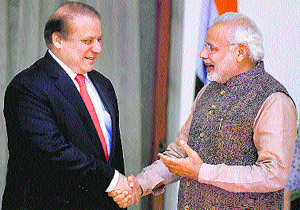
I FOLLOWED the visit of Prime Minister Nawaz Sharif to India from his arrival to the departure. I did not find any false note either in his observations or meetings. He did not mention Kashmir. Nor did he meet the separatists who are always keen to have talks with the Pakistani leaders, not the Indians. From all angles, it was a positive and constructive visit.

That Nawaz Sharif's adviser Sartaj Aziz reignited the embers of bitter hostility by his briefing in Pakistan on Kashmir and several other counts is understandable. He had to indulge in rhetoric for domestic consumption. Lobbies of the armed forces and maulvis were assured that Nawaz Sharif vented his annoyance in private while talking to Prime Minister Narendra Modi.

Still I wish Sartaj Aziz had not done so because the meeting had changed the climate of opposition in India. Even the rightists in the country had conceded that a new chapter of equation had begun in the history of India and Pakistan relations. Sartaj Aziz, whatever his compulsions, did not have to be a hawk to take us all back to square one. Foreign Secretary Sujatha Singh's statement may have queered the pitch, but Sartaj Aziz is not a bureaucrat and he should have kept India-Pakistan relations at a higher level.

Therefore, do not see a breakthrough in the stand that the two sides had taken from the time the two countries had parted company in August 1947. In fact, I have sensed more optimism on earlier meetings between the Prime Ministers on both sides. Nothing concrete has come out because the establishments in India and Pakistan are basically hostile to each other. No passage of time has lessened their influence or attitude.

Yet the relationship of love and hate smoulders all the time. People in the two countries yearn for friendship or at least normalcy. The meeting between Prime Ministers Modi and Sharif has once again evoked hope for better days. Once again, the foreign secretaries of the two governments are to pinpoint what keeps the countries apart. If the past is any guide, the goodwill will not fructify into normal relations. The reason why I say so is the enmity which has been fostered in the minds of people.

It was to be seen and believed the enthusiasm with which the visit of Nawaz Sharif was awaited in India. The nation should have been engaged in Narendra Modi's resounding victory or the decimation of the Congress, which has ruled India for several decades. Instead, the attention was focused on Islamabad.

For four or five days between Modi's unexpected invitation and acceptance by Sharif dominated the discussion that dominated the Indian media and drawing rooms centred on whether the Pakistan Prime Minister would come to Delhi at all. And it was all positive. People wanted him to come and literally prayed that he would. That he had to bring round the armed forces and the extremist elements in his own country was conceded. But it was argued that his arrival would be an apt step to strengthen the democratic ideas in Pakistan. Therefore, when he telephoned to say yes, a wave of relief swept through the country. Most newspapers made his acceptance as the first lead.

The audacity of incompetence

Shekhar Gupta | June 4, 2014

There were Vijayantas to the left of the sarovar, firing from just a couple of hundred yards.

SUMMARY

The first of this three-part series concluded yesterday, saying the rise of Bhindranwale and his death with Operation Blue Star was a phase of madness. Now, an argument for why we must never forget it.

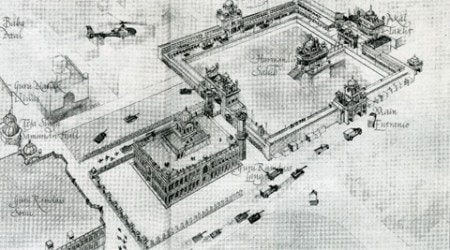
Nobody can reconstruct the 72 hours of Operation Blue Star in 3,000 words. Or even in 30,000. Books have been written about it by the finest reporters, notably the BBC’s Mark Tully (Amritsar: Mrs Gandhi’s Last Battle, co-authored with Satish Jacob). Mark was the unofficial but undisputed dean of the reporters’ corps for two generations, and please do read this book for diligence and detail. Books have been written by the generals who led the assault. I’d pick my dear friend Lieutenant General K.S. “Bulbul” Brar’s Operation Blue Star: The True Story (UBS, 1993) for the army’s side of the story, told as honestly as possible for a partisan, albeit an exceptionally honourable one. There was also a recent series of TV documentaries put together and anchored by my old comrade and friend, Kanwar Sandhu, currently executive editor of The Tribune. Check it out for its brilliance, depth and honesty. Even I contributed my bit in some detail, with a 27-page chapter, “Blo­od, Sweat and Tears”, in The Punjab Story, published by Roli in 1984. There is no real mystery about the operation, how it started and ended. But there are others that endured for decades, and some are still unresolved. Let me talk about some of those.

One, in fact, was resolved just last year, in the memoir (From Fatigues to Civvies: Memoirs of a Paratrooper, Manohar, 2013) written by Lieutenant General V.K. “Tubby” Nayar, whom I first met when he commanded the 8 Mountain Division at Zakhama in Nagaland, and who later honoured me by inviting me to speak at the release of his book. He was the deputy director general of military operations in 1984 and reveals, in his memoir, how the codename Bl­ue Star was chosen. Contrary to specul­a­t­ion over the years, it had nothing to do with the way traditional or devout Sikhs dress, or their colour preferences. Tubby sa­ys he was driving home, exhausted after a long day in the ops room, a codename yet to be found, and the signboard of a refrigeration shop caught his eye. It was selling Blue Star, a prominent fridge/ AC brand. Let’s go with it, he decided. We still don’t kn­­ow where the names of two other rela­t­ed operations — Op Woodrose to sweep the rest of the state clear of militants and ma­­­­intain order and Op Metal to specifica­lly catch or kill Jarnail Singh Bhindranwale and members of his inner core team — came from.

A PROMISE FULFILLED- The US’s ideas about counter-terrorism could help India

Diplomacy: K.P. Nayar

The world has moved on, and quite remarkably so, during the week when Indian strategic thought was obsessed with the invitation of the prime minister, Narendra Modi, to his Pakistani counterpart, Nawaz Sharif. Because of such obsession, new opportunities and challenges in what is potentially the most important relationship that needs mending by the Modi government have been lost on the critical public discourse about the course of the Bharatiya Janata Party-led government.

As India was largely erupting in euphoria, anticipating change with the swearing in of a new government, the president of the United States of America, Barack Obama, actually delivered the change that he promised when he came to power in January 2009. It took Obama five-and-a-half years to do so in one critical theatre of American life, but he did it at the same time that Sharif wound up his visit to New Delhi and returned home to Islamabad. “You are the first class to graduate since 9/11 who may not be sent into combat in Iraq or Afghanistan,” Obama told those passing out of the prestigious United States Military Academy, West Point. He was delivering an address that marked the commencement of military service for the class of 2014 which graduated out of the academy that has produced some of the best in America’s military.

Because Obama’s speech was a milestone in American history, it was appropriate that he quote Dwight Eisenhower before he became president, remarkably, when he was still a serving general in the US army. Eisenhower said at this very venue, in his commencement address to the class of 1947 at West Point: “War is mankind’s most tragic and stupid folly; to seek or advise its deliberate provocation is a black crime against all men.”

What Obama said in his commencement address may emerge as a turning point in America’s history. Although the US ended military draft as a fallout of the trauma in Vietnam, every young American with promise who graduated out of its highly rated military schools in the last 13 years lived in the shadow of being in a war zone. It is to the credit of Obama that he promised to end that. He won the election in 2008 on such a platform.

Bhindranwale reborn

June 4, 2014
Praveen Swami

The Hindu A visitor looks at the pictures of those who had died in operation Blue Star, at a museum inside the Golden Temple complex in Amritsar. The assault on the Golden Temple complex by the Army was launched in 1984 to arrest Sant Jarnail Singh Bhindranwale, a Sikh leader and his militant followers who had initiated a movement for a separate Sikh state. 

Punjab is seeing the emergence of a new cult of the revanchist preacher

He has returned, as the faithful always claimed he would: not, perhaps, as his iconographers imagined — riding a white horse at the head of an army — but as a simulacrum that peers out of street-corner stalls and online stores. For a modest $15.99, Los Angeles residents can buy t-shirts bearing the unsmiling visage of Jarnail Singh Bhindranwale, “the most determined, charismatic and valiant great General of the 20th century.” In Ludhiana, the same t-shirts sell for Rs 200. Posters go for Rs 50, possibly less if one bargains.

It is 30 years (on June 3) since Prime Minister Indira Gandhi ordered the Indian Army to end Mr. Bhindranwale’s reign of fear inside the Golden Temple — setting off a tide of blood that coloured an entire decade.

For the generation that lived through those years, those events have been pushed to the margins of memory, having little bearing on politics today. The cult of Mr. Bhindranwale, though, is undergoing a bizarre revival. YouTube is awash with home-made music videos eulogising Ms. Gandhi’s assassins: one rendition, possibly comprehensible only to semiologists and adolescent males, features bodybuilders with turbans and a promise that Khalistan police officers will be equipped with BMW sports cars. In another Khalistan anthem, images of Ms. Gandhi’s assassins are followed by advertisements seeking Sikh models.

The new cult of Khalistan isn’t about politics or religion; it is enmeshed, instead, with anxieties about masculinity and agency born of a State that is mired in a profound cultural dysfunction.Remembering Bluestar

It has been two years now since the five high priests of the Sikh faith unveiled the foundation of a memorial to Mr. Bhindranwale and the terrorists who died with him. When built, the three-floor monument will be positioned on a 30 square foot plot that lies between the sanctum sanctorum, the Harimandir Sahib, and the Akal Takht, the supreme seat of the faith’s temporal authority. For generations of believers to come, the memorial will be the principal source of historical knowledge on men who placed the assault rifle at the centre of their faith.