11 July 2014

Machiavelli, Not Metternich: The Pipe Dream of Realignment with Iran

Don't let the ISIS crisis fool you. U.S.-Iranian rapprochement is not on the horizon. Here's why.
July 9, 2014

ISIS’ recent triumphs in Iraq have created a new strange bedfellows scenario: Iran and the United States supporting the Shi’ite Iraqi regime against Sunni extremists. This has led to the trumpeting of a historic rapprochement with Iran” and the possibility of a long-term strategic realignment in the Middle East, with the United States and Iran squaring off against the forces of Sunni extremism, such as ISIS and Al Qaeda. Over time, this realignment could redefine our competitive relationship with Iran into a cooperative relationship, setting the stage for a long-term transformation in the relationship.

This would be a very good outcome for the United States. Deprived of an existential threat, Iran would be much likelier to follow through on denuclearization, a vital U.S. interest. The United States would potentially be able to free up resources tied down by Iran and redirect them to other regions of U.S. interest, namely the Pacific. But despite the shared threat of ISIS, realignment is an unrealistic outcome. The goals of Iran and the United States are incompatible. And without a realignment, there can be no transformation and no rapprochement between the United States and Iran.

The traditional narrative spun by advocates of U.S.-Iranian rapprochement is that “political hardliners” have been the greatest obstacle to mended relations. These same advocates reflexively reach for the example of the Sino-American rapprochement of the 1970’s as a model to demonstrate that reconciliation between bitter foes is possible. Upon closer examination, however, the much-touted Sino-American rapprochement tells a very different story than the traditional narrative: Nixon, among the most hardline Cold War warriors, was able to engineer a strategic realignment of Communist China because the Soviet Union was the mortal enemy of both China and the United States.

This is emphatically not the case in the Middle East, where irreconcilable goals have primed the United States and Iran for competition. The rise of ISIS does not change the fact that the United States and Iran are each other’s greatest rivals for dominance in the Middle East, a decidedly zero-sum game. Contrary to the traditional narrative, the greatest obstacle to any form of reconciliation is likely to be the balance of power in the Middle East, not “political hardliners”.

THE NEW CALIPH: JUST ANOTHER BROADWAY JOE

THE NEW CALIPH: JUST ANOTHER BROADWAY JOE
July 9, 2014 · in Commentary

I’ll see you in New York” was the parting comment of Abu Bakr al-Baghdadi, the emir of the newly announced Islamic State (IS), to his American hosts at Camp Bucca in 2009. He was a nobody then, but since his release, Baghdadi has worked very hard to lead IS back from the graveyard to current relevance. His organization recently grabbed the world’s attention by taking as much Iraqi territory as the American-led coalition did in 2003, in much less time and with little fanfare. Baghdadi’s parting words must have brought a smile to his captor’s face, but they are less funny now.

The humor is lost on a country tired of war and bewildered that this particular jihadist problem has resurfaced. By our departure in 2011, U.S. and Iraqi Special Operations Forces had killed or captured 34 out of 42 leaders of the group formerly known as Al Qaeda in Iraq (AQI). Violence was at a post-2003 low, oil was moving steadily into record production, and all three Iraqi sects were involved in the political game — so much so that in 2010 a Shia politician backed by Sunnis almost won a political majority. Things seemed to be headed in the right direction.

This drastic rewrite of the screenplay for the American project in Iraq is enough to encourage many to think about letting Iraq deal with what could be called the third Iraq war on their own. This would be a mistake. The return of IS is a significant setback to our national interests in the Middle East and will eventually be a direct threat to our homeland. To understand why, we need to look closely at a group that we have fought since 2003 but don’t seem to understand very well.

IS’s origins were in Abu Musab al Zarqawi’s Salafi jihadist organization that enlisted with Al Qaeda in 2004. From its roots, it has always been a tightly controlled military organization with a penchant for spectacular attacks, a black-and-white categorization of enemies and friends, a unique ideology derived from their Salafi roots, and a highly functioning media arm. Zarqawi’s logistics genius facilitated a continuous flow of foreign fighters and waves of car bombs. More uniquely, the group specialized in attackingShia religious targets and civilians in a genocidal campaign that is now in its 11th year. If you are shocked by the recent slaughter of hundreds of captured Iraqi Shia soldiers, you have not been paying attention.

This history of IS is important because despite fears by informed commentators that the group would learn from its failures, IS continues the very same patterns. The notions of implementing an extreme interpretation of Sharia law remain, as witnessed in Mosul. The slaughter of the Shia population continues, as does the sectarian taunting in statements and videos. Analysts contend that this is strategic and therefore primarily instrumental in nature, designed to provoke a Shia response. But this isn’t the case. The leaders of IS have always categorized the Shia as the real enemy to a caliphate. If you disagree, ask yourself what 11 years of sectarian targeting has accomplished for AQI/ISIS, and then look at the videos of the killings and see for yourself the joy ISIS killers exhibit when they kill their Shia rivals. Look at this eulogy for a Saudi fighter named Abu Harira to understand how targeting the Shia has become a mark of high honor in the organization. This pathology has alienated many would be IS allies and eventually fueled its rift with Al Qaeda Central itself. On the other hand, IS atrocities against Shia targets in Iraq and in Syria has had a devastating impact on the level of sectarian tensions all over the region, and could hamper any political resolution in Baghdad.

A Primer For Fixing Iraq’s Battered Army

SWJ Blog Post | July 6, 2014
A Primer For Fixing Iraq’s Battered Army
James “Jamie” E. Hayes III

The Iraqi Army’s recent humiliation at the hands of the Islamic State of Iraq and Syria (ISIS) has indeed sent shock waves through the national security community. Policy-makers and pundits alike are scrambling for potential solutions to this new crisis. Drone strikes? Massive influx of U.S. aid? Do nothing at all? The Iraqi Army commander is no doubt feeling the crushing weight of this frenzy. Between fielding angry phone calls from Prime Minister Maliki and attempting to rally his dispirited troops, this poor guy is probably wondering just what the hell he can do to get out of his current predicament. 

With that in mind, I have a suggestion for the proper U.S. response. It isn’t Apache gunships, or Predators, or even the advisors that President Obama most recently ordered back into theater. Rather, I would send the Iraqi commander a history book. Specifically, Field Marshal William Slim’s Defeat into Victory, the classic account of the British 14th Army’s reversal of fortunes in Burma (now Myanmar) during World War II. In 1942, Field Marshal Slim faced many of the same challenges now confronting his 21st Century Iraqi colleague. The Japanese had soundly defeated Slim’s larger yet tactically deficient army, leaving him with some stark choices. Reorganize and reform his army or be utterly destroyed. Change the paradigm or die. 

Indeed, Defeat into Victory is a veritable primer for how to turn a defeated, rag-tag army into a first-class fighting force---all while maintaining contact with the enemy. Here are but a few of the pearls that the Iraqi commander could glean from this treasure of military writing: 
  • Leadership: Field Marshall Slim knew that competent and confident leadership was the key to winning. After the 14th Army’s initial defeats, Slim cleaned house by firing his division and brigade commanders who looked good on the parade field but then wilted under the rigors of actual warfare. The Iraqi Army commander should do the same. Regardless of top-cover from Prime Minister Maliki, the Iraqi Army commander should dismiss his politically-connected yet incompetent subordinate commanders and replace them with the first-rate officers---many of them Sunni and Kurd--- purged after the U.S. departure in 2011. 

  • Training: Field Marshal Slim realized that his early defeats were due to the British Army’s complete unpreparedness for jungle warfare. In his book, Slim provides extensive detail about re-training his forces and transforming them into a hardened, battle-ready organization. Slim believed that training was more than just mastering tactical and technical skills; in his eyes, realistic exercises forged unit cohesion and confidence. U.S. forces attempted to instill a similar ‘continuous-training’ mindset in the Iraqis before their 2011 departure to no avail. The world saw the fruits of this reluctance to train when unprepared Iraqi units melted before the numerically inferior ISIS forces in Mosul and Tikrit. Perhaps that bitter experience, reinforced by Slim’s book, could finally drive the message home to the Iraqi commander. 

  • Regaining the Initiative: Field Marshal Slim’s Defeat into Victory describes how the British 14th Army eventually knocked the Japanese back on their heels, gaining time and space to prepare for a general offensive to retake Burma. While Slim was no fan of special operations forces, he nonetheless employed the Chindits, a long range penetration unit made of specially trained British, Gurkha and Indian volunteers, to wreck havoc on Japanese supply lines and rear areas. The Iraqi army commander also has such a tool at his disposal---the Iraqi Special Operations Forces (ISOF) Brigade. As one of the few Iraqi units still in fighting shape after the ISIS onslaught, the U.S. Special Forces-trained ISOF Brigade would be the force of choice to conduct direct action raids against the terrorists’ vulnerable lines of communication along Iraq’s Highway 1. Doing so would force ISIS into a defensive posture, thereby permitting both the Iraqi government and Army to adequately prepare for a counterattack against the Islamic extremists. 

  • Relationships: Field Marshal Slim knew the value of partners. In his book, Slim describes the great efforts to maintain working relations with the Nationalist Chinese armies fighting their common enemy. He valued this relationship with the Chinese so much that he assigned one of his most talented generals to serve as his liaison with them rather than command one of the 14th Army’s fighting units. The Iraqi army commander faces a similar opportunity with the Kurds, in particular the commander of the Kurdish peshmerga militia. Undoubtedly, the Kurds and their formidable peshmerga fighters will play a key role in either subduing ISIS or keeping them fixed in place near the Sunni Triangle. Therefore, the Iraqi commander, in spite of the political sensitivities, would be well served to reach out to the Kurdish commander with the purpose of building a solid military-to-military relationship. Given the current state of play, a similar liaison mission with the recently-mobilized Shia militias would also be helpful in coordinating and synchronizing future operations. The Iraqi commander needs to put his best men on it, and quickly. 
Obviously, the suggestions presented here are a bit tongue-in-cheek. I am under no illusion that the mere introduction of a military classic such as Defeat into Victory, however pertinent to the situation, will turn the tide against ISIS. Larger decisions, such as Maliki’s political reconciliation with the Sunnis and Kurds, need to come into play in order for Iraq to survive. However, from a military standpoint, the Iraqis’ appreciation of Field Marshal Slim’s seminal work would reinforce the most universal aspects of armies at war. That is, defeated military organizations can turn things around if their leadership focuses on the troops and their fighting capabilities rather than the politics. I volunteer my copy.

Managing Disasters: Integrating Armed Forces in NDMA Structure

06/07/2014 


The floods and ensuing tragedy at Uttarakhand last year brought to the fore, the cyclic unresponsive nature and under preparedness of the national and state machinery while dealing with disasters. The Uttarakhand devastation highlighted the half-hearted and uncoordinated response of the civil administration and the disaster management structures, both at the national and state level. It was the herculean effort of the Indian Army and Indian Air Force with over 11000 soldiers, variety of aircraft and equipment who rescued approximately 63000[i] stranded pilgrims and escorted them to safety. Waves of sorties coupled with valiant effort of foot soldiers working 24x7 saved precious lives. The silent and unsung heroes went about their task in an organised and professional manner bringing solace and relief to the needy. The poignant photographs give a heartwarming account of their commitment and bravery. In contrast, the designated disaster management apparatus had around 12 teams[ii] of NDRF and a sprinkling of state disaster rescue teams apart from around 1600 men of ITBP.

India due to its unique geo-climatic conditions, size and geographical entities has a high incidence of natural disasters like earthquakes, floods, cyclones and so on. Almost half the country is prone to earthquakes of medium to high intensity. Floods in North East India and in states of Assam, West Bengal and Bihar are a recurring phenomena every year. It has been seen that since establishment of NDMA in 2005, there has not been any worthwhile capacity enhancement in managing disasters and the responsibility is always shouldered by Army and Air Force contingents every year.

The basic responsibility of rescue and providing relief during occurrence of a disaster is of the state government. The effort is supplemented by the centre by providing additional logistical support in terms of specialist teams of armed forces and other agencies along with the necessary equipment. An analysis of all rescue efforts during the recent disasters shows that the majority of rescue teams every year are derived from the armed forces, which function under the Ministry of Defence where as the National Executive Committee (NEC) headed by the Home Secretary is responsible for coordination of all rescue efforts. This mismatch results in no organized role for the armed forces in the disaster management process. The NEC, highest body for planning the response mechanism to disasters did not meet from 2008 to 2012[iii] showcased the casual government response to managing disasters. The National Disaster Plan (NDP), planned to provide a comprehensive and detailed arrangement for disaster management has not been formalized till date. The NDMA is presently only providing guidelines and policies, which are inadequate for mitigating and formulating an effective response to disasters. The massive organisation staffed by retired personnel, multiple committees from various ministries has rendered the organisation ineffective. Numerous projects approved and commenced were either abandoned midway or it was a duplication of effort as reported in the CAG report[iv] tabled in March 2013. With many states of our nation being prone to natural disasters like floods, earthquakes and so on, it is essential that tangible efforts be made to minimize the impact of a disaster similar to Uttarakhand tragedy. Some of the areas requiring immediate focus are discussed below.

Structural Changes

The NDMA being the Apex body in disaster management, it must be the hub of forecasting, early warning, detailed planning, systematic deployment of rescue resources, continuous monitoring and assistance during the rehabilitation phase. Its members must be serving personnel and the organization must not become post retirement benefit location. As the armed forces have the largest pool of disciplined and dedicated manpower and are always the first respondents, the NDMA must be headed by a three star general directly responsible to the Prime Minister. The members of NDMA of the rank of additional director general must comprise of representatives from Armed forces, Meteorological Department, CWC, ISRO among others to present a comprehensive response plan and not merely issue guidelines. A detailed NDP must be worked out and promulgated within the next two years taking into being the inherent capabilities of various organisations. NDMA’s response centre, NDMOC must be a integrated responsive nerve-centre working 24x7, in direct communication with state level centres for effective information sharing and coordinating rescue efforts. There must be an in-house capability of simulating likely disasters and their effects on the affected area so that correct remedial and early warning actions can be taken.

THIS IS NOT THE WMD STRATEGY YOU’RE LOOKING FOR

July 8, 2014 · in Analysis

A decade after the alleged threat of WMD was faced down in Iraq, counter-WMD remains a specialist area, one not integrated into major combat operations or irregular operations in other than a few lines. The 2014 Quadrennial Defense Review lacks any recommendations to improve counter-WMD, a major shift from the 2006 and 2010 QDRs. These services aren’t a priority, and by extension, military leadership doesn’t engage on developing the department’s policy and strategy. The threat isn’t apparent, and if there is another Saddam, well, we have massive conventional advantages and nuclear weapons. So now our counter-WMD community has shifted its focus to homeland security concerns (even if the threat is extremely improbable), public health (even though DHHS has much greater resources and authority), and disaster relief such as the Fukushima incident (even though there were no weapons involved).

Last week, with relatively little fanfare, the DoD released an update to its strategy for countering WMD to the public. In many ways, the update is a continuation of the basic concepts of nonproliferation and counterproliferation, but it abandons labels and reverses the former administration’s emphasis on preventive measures. There are no bold or new ideas, but rather it captures what the Obama administration has practiced as its national security policy since 2010. What is problematic is the vague discussion of ends, ways, and means that is so critical to a military strategy. This document reads more like a national strategy, but that’s not what the DoD needs. In fact, it calls into question whether we need a counter-WMD strategy at all.

The U.S. military has not been seriously threatened by an adversary nation’s WMD program for more than 20 years. Nonproliferation activities have, in fact, reduced the number of countries developing WMD programs to a few “rogue” regimes. Maybe our conventional capabilities can counter the limited threat of their chemical and biological weapons. While there have been no transnational terrorist groups that have leveraged illicit networks to gain WMD capabilities to date, someday they might. We do need a plan to stop those nefarious — if unnamed and largely imagined — non-state actors from attacking the United States with WMD. But do we really need a counter-WMD strategy for this? Isn’t this already articulated in the National Security Strategy and captured in counterterrorism plans?

There is no question that since the Cold War began, every presidential administration has viewed WMD as a top national security threat. However, the operational community does not view WMD as an immediate concern, leaving details such as military strategies and doctrine to a largely technically and tactically focused DoD counter-WMD community. This has traditionally resulted in segregated policies and specialized issues rather than integrating WMD concerns into mainstream concepts and preparing the general force to address WMD within conventional and irregular operations. The updated strategy follows that pattern, offering a national-level discussion on countering WMD that fails to provide the services a meaningful directive to improve their ability to meet stated policy objectives.

Senate Intelligence Committee Passes Controversial Comprehensive Cybersecurity Bill

July 9, 2014
Senate Intelligence Committee approves cybersecurity bill
Reuters

The U.S. Senate Intelligence Committee approved a bill on Tuesday to encourage companies to exchange information with the government on hacking attempts and cybersecurity threats, officials said.

Despite concerns by some that the measure does not do enough to protect privacy, the committee voted 12-3 to advance the measure authored by its chairwoman, Dianne Feinstein, a California Democrat, and Vice Chairman Saxby Chambliss, a Georgia Republican, their offices said.

Experts see the bill as the best chance for the current congress to pass some type of legislation to encourage better cooperation between the government and private companies to boost the cyber defenses of critical industries.

"Cyber attacks present the greatest threat to our national and economic security today, and the magnitude of the threat is growing," Feinstein said in a statement. "This bill is an important step toward curbing these dangerous cyber attacks."

U.S. lawmakers have been considering for months legislation to help private companies better communicate about security breaches and cyber threats. However, comprehensive cyber bills have been delayed by spats over liability and concerns about privacy, especially following the leak of information about government surveillance programs by former contractor Edward Snowden.

The Senate bill still faces hurdles before becoming law. It must be approved by the full Senate and reconciled with similar legislation that passed the House of Representatives in April.

SUPPORT IN THE HOUSE

However, there are already signs that the measure has bipartisan support in the House. The Republican chairman and top Democrat on the House Intelligence Committee issued a statement on Tuesday backing the measure and urging the full Senate to vote quickly.

"We are confident that the House and the Senate will quickly come together to address this urgent threat and craft a final bill that secures our networks and protects privacy and civil liberties," Michigan Republican Mike Rogers and Maryland Democrat Dutch Ruppersberger said in a statement.

Among other things, the bill by Feinstein and Chambliss would authorize companies and individuals to monitor their own and consenting customers’ networks for hacking and voluntarily share cyber threat data, stripped of personally identifiable information, with the government and each other for cybersecurity purposes.

The legislation also directs the U.S. director of national intelligence to increase the amount of information the government shares with private firms and the Department of Homeland Security to set up and manage a data sharing portal.

The measure would also offer liability protections to companies that appropriately monitor their networks or share cyber threat data and limit the government’s ability to use data it receives.

Some privacy advocates have opposed giving companies liability protections, worried about abuses of consumer data both by the private sector and the government.

Democratic Senators Ron Wyden of Oregon and Mark Udall of Colorado, both members of the intelligence committee, said after the vote that they had opposed the bill because they felt it did not include sufficient privacy protections.

Space Exploration in a Changing International Environment--Pre-publication Version

JUL 8, 2014 

The international environment for space activities has changed significantly since the United States, Japan, Europe, and Russia agreed to build the International Space Station (ISS). Space exploration has become a mature governmental activity and has become in some ways “routinized.” Most missions lack the drama of earlier space flight that captured public interest and political support. To go beyond the routine requires going beyond low earth orbit (LEO).

Two major developments have reshaped the strategic environment. The most important of these is the growth of China’s space capabilities and programs. The other significant change is the loss of U.S. manned spaceflight capabilities, leaving Western space powers dependent on Russia for access to the ISS.

In contrast to its human spaceflight program, U.S. unmanned and robotic exploration efforts have made consistent and impressive progress. Robotic exploration of Mars is the most visible activity. The unmanned programs of other nations are also impressive. The European Space Agency has plans and programs for the exploration of Mars, the Moon, and its Rosetta spacecraft is maneuvering into close proximity to an asteroid. Japan’s space agency, JAXA, has solar and planetary (Venus) unmanned missions in operation and is developing new exploratory missions for Mercury and asteroids. China and India have launched unmanned lunar exploration missions, and India (with some help from NASA) recently launched a Mars observation satellite. These missions often entail a high level of cooperation and provide real scientific benefit for a relatively small share of space budgets. Their political and strategic value, however, is limited.

This CSIS Report examines the strategic implications of manned space exploration. The current phase of exploration is coming to an end, and nations are seeking the next step. The decisions of the United States and its partners on the future of space exploration will determine the strategic situation in space. There are difficult issues to consider in moving ahead: the target of exploration beyond LEO, the balance between manned and unmanned programs, the future of partnership and cooperation in space, and the ultimate fate of the ISS. How Western space powers answer these questions will determine both the pace and the future direction of exploration in space. 

Publisher CSIS/Rowman & Littlefield 

Programs
Topics

“EXCLUSIVE” ON NSA SURVEILLANCE REVEALS ALMOST NOTHING NEW

July 9, 2014 · in Commentar

Last weekend, Washington Post journalists Bart Gellman, Julie Tate and Ashkan Soltani wrote that former NSA contractor Edward Snowden’s trove of stolen documents show that “[o]rdinary Internet users, American and non-American alike, far outnumber legally targeted foreigners in the communications intercepted by the National Security Agency from U.S. digital networks.” The story led a burst of commentary on the supposedly staggering scope of the NSA’s surveillance of average citizens.

But there is almost nothing new here.

The fact that most of what the NSA collects is incidental is just that: a fact. And not a groundbreaking one. It is a fact of life for all intelligence disciplines, not just technologically sophisticated outfits like the NSA. Indeed, scholars and intelligence practitioners began grappling with the so-called “signal-to-noise” problem decades ago, long before the modern communications revolution dramatically increased the sheer volume of data that people share. The technical details of signals intelligence are stupefying, but the fundamental problem is not. Most of what intelligence agencies collect is irrelevant, and the basic task of intelligence analysis is to determine the difference. NSA analysts don’t like noise and try to avoid it.

It is also true that minimization procedures exist to try to ensure that U.S. citizens are not inadvertently surveilled. These procedures work pretty well, though they are not perfect. Minimization rules are a lot less stringent for non-U.S. persons, and analysts have more opportunity to try to use peripheral details from incidental collection to better understand the target. As the article points out, there are debates within the intelligence community about whether to store such information, and if so, how much and for how long.

Again, this is all very familiar to those who have followed the NSA story since the Post and the Guardian revealed the Snowden leaks over a year ago. But the article uses vivid language and the power of suggestion to make old news sound new. It doesn’t just report on incidental collection; it ominously warns that “ordinary web users are caught in the net.” We are told that a large population of innocent bystanders is “under scrutiny,” when the article itself suggests they are not. Indeed, it quotes analysts who describe much of the information as useless.

Dam Warfare

Floods as weapons, from ancient times until Iraq today

In April 2014, fighters of the Islamic State in Iraq and Syria captured the Nuaimiyah Dam in western Iraq, despite earlier efforts to defend the site. They then overflowed it to dislodge Iraqi soldiers dug in upstream of the site—and to deny drinking water to civilians downstream.

Iraq’s water woes do not stop with this one facility’s loss. Mosul Dam, which ISIS also now controls, is a maintenance nightmare due to shoddy construction and neglect and could collapse under the Islamists’ feet. And ISIS is targeting another dam, at Lake Haditha in western Iraq, which if breached would be a catastrophe because of its proximity to Baghdad.

Foreign Policy accurately described Iraq’s dams as its “soft underbelly.” The potential of water as a weapon of mass destruction in Iraq should come as no surprise, given the country’s dependence on its two great rivers, the Tigris and Euphrates.

Cyrus the Great reputedly took Babylon in a single night in the 6th century, B.C., by diverting an old artificial lake back into the Euphrates, so that his army could come right up to the city walls at night.

Hulagu, the destroyer of medieval Baghdad, used the Tigris River’s flood waters to trap the caliph’s horsemen outside the city walls. In the 1980s, both Iran and Iraq used water as an area denial weapon to check the other’s advance in the southern marshlands. Iran tried to bomb Iraqi dams out of commission.

Following the First Gulf War, Saddam Hussein’s regime drained the southern marshes in order to force the Marsh Arab population to give up its insurgency. For Hussein, water was also a means to cover up war crimes. The flooded areas that the unfinished Makhoul Dam would have covered conveniently included sites of the regime’s mass killings of Kurds.

Flooding the enemy’s territory—or even your own—is an old military tactic. But it rarely works, because it depends too much on terrain. There are two ways of using water to wage war on land. As an area-denial weapon. And as a siege engine for destroying food and shelter.

Blowing up a dam will flood the area below it. This could be the primary purpose of the effort—to deny the enemy use of the terrain for fortification or habitation. Alternatively, you might destroy a dam in order to knock out a hydroelectric plant or reservoir, undermining the enemy’s war economy.

The extreme, but rarest, method is to release water to redraw the map in order to teach the enemy a lesson. The Mongols destroyed the medieval city of Gurjang in Central Asia by breaching a nearby dam—making an example of those who dared resist their advance.

Sorry, Peaceniks—Nonviolence Won’t Stop ISIS


This is one authoritarian regime we can’t beat by protesting

Tanks couldn’t stop the Islamic State of Iraq and Syria. Neither could artillery or helicopters. Not even Hezbollah’s well-trained fighters have succeeded in crushing the militant Islamists who conquered much of western Iraq in June.

So why would holding hands and singing “Kumbaya” defeat ISIS’ head-chopping, enemy-crucifying fanatics?

Yet one peace researcher argues that nonviolent protest can stop ISIS.

To her credit, Maria Stephan, a senior fellow at the U.S. Institute of Peace, doesn’t suggest that sitting down to a nice cup of tea will soothe the leaders of the new self-declared caliphate. Instead, she more pragmatically argues that non-violence political and economic action could undermine crucial Sunni support for ISIS, which has been able to capitalize on Sunni anger at Prime Minister Nouri Al Maliki’s the Shia-dominated Iraqi government.

“Against ISIL, the Islamic State of Syria and the Levant, it is unlikely that civil resistance could ever achieve a total victory,” Stephan writes. “But organized non-violent defiance and non-cooperation could be a complicating factor for terrorist elements seeking to control territory in Iraq, Syria and beyond.”

For example, Iraqis could “restrict their labor and consumption en masse, to the consternation of their terrorist overlords.” Or, they could look to Colombia, where civilians “fought against paramilitaries by building parallel structures and institutions that buffered them somewhat from those armed groups.”

Stephan claims that 53 percent of non-violent movements have succeeded, compared to just 26 percent of armed campaigns. As evidence of the power of non-violence, Stephan points to mass protests that ousted authoritarian regimes in Iran, Chile, Sudan, Philippines, Indonesia, Serbia, Tunisia and Ukraine.

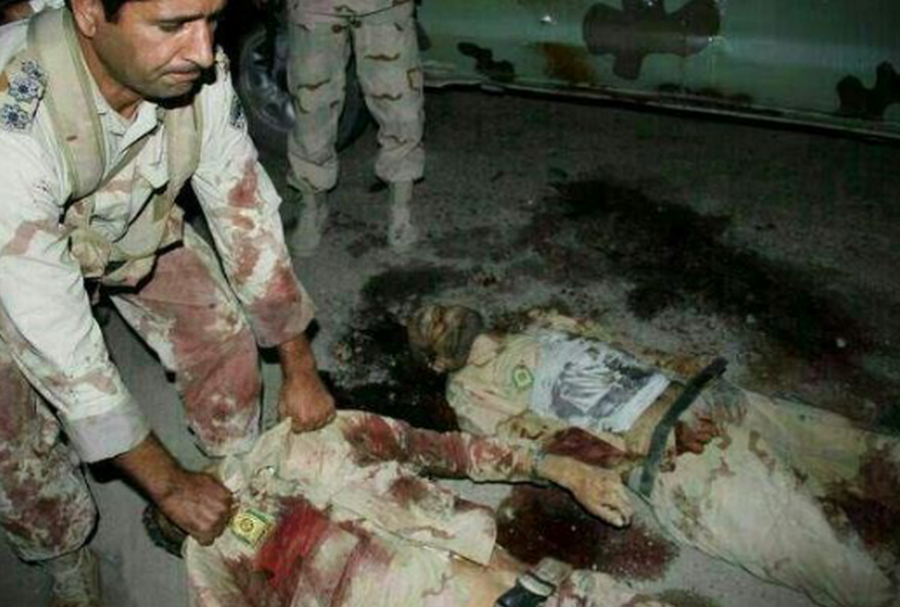
Iranian border guards whom ISIS allegedly killed in June. Photo via Iranian social media

How tempting is it to dream of innocent Iraqis ridding themselves of the fanatics and warlords, but without resorting to the same brutal means as their tormentors?

INFOGRAPHIC: FOUR DECADES OF TERRORIST TACTICS AROUND THE WORLD


July 9, 2014 · in Infographics

Editor’s note: We’ve partnered with the National Consortium for the Study of Terrorism and Responses to Terrorism (START) to publish a series of infographics based on data from their Global Terrorism Database and related START projects. Each week we’ll release a new set of graphics that depict trends in global terrorism activity. Sign up for the War on the Rocks newsletter to make sure you don’t miss any of them!

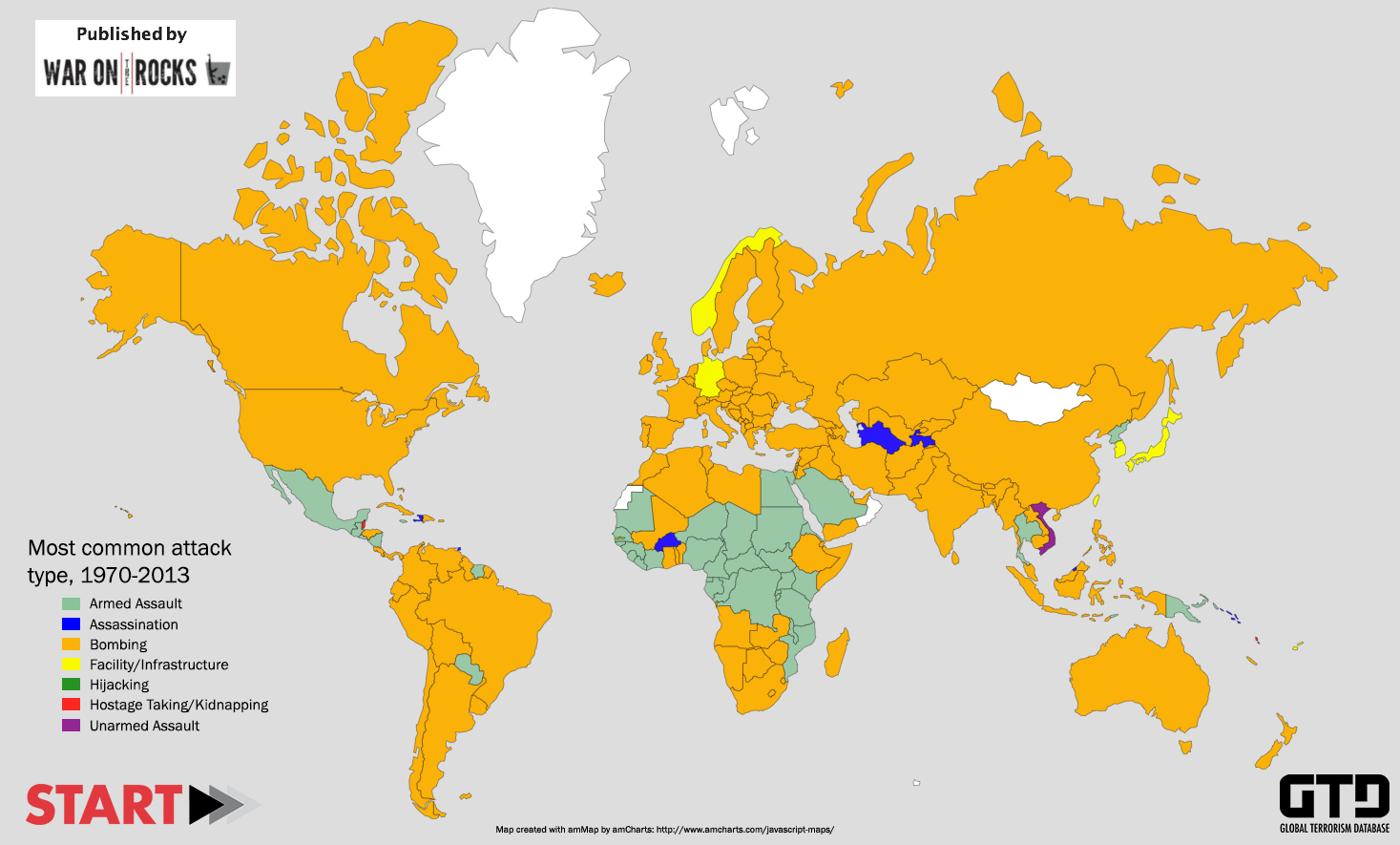
This week’s infographic set looks at attack type variation in global terrorism since 1970.* Using data from the Global Terrorism Database (GTD), we can assess which attack methods have been the most prevalent in the areas that have experienced terrorist violence in the past 43 years. We can also examine which areas have experienced the most attacks of the particular types identified in the GTD and which areas appear to be particularly prone to attack type specialization.

The first map shows the most commonly used attack method in every country/area that has experienced at least one terrorist attack since 1970. It is worth noting that terrorism, while global, has not been evenly distributed. Some of the attack methods highlighted in certain areas of the map appear dominant in part because the areas themselves have experienced relatively few attacks. For example, while unarmed assaults have been the predominant attack method in Vietnam since 1970, the country has experienced a relatively low number (10) of total terrorist attacks.

Most common attack type in each country, 1970-2013 (click to enlarge)

Noteworthy: 

While perhaps not surprising, the prevalence of bombings as an attack method is remarkable. Bombings have been the most commonly used attack type in 136 of the 201 countries that have experienced terrorism since 1970. 

Armed assaults—attacks involving the use of firearms, incendiaries, or sharp objects—were the most commonly employed attack type in 47 countries during this time period, and they have been quite prevalent on the African continent. 

Largely due to the complexity of the method and the implementation of counter-measures, vehicle hijackings, including the hijacking of airplanes, is the only attack method that has not made up the majority of at least one country’s attacks since 1970. 

The second map identifies the areas that have experienced the greatest number of attacks for each of the seven types identified in the GTD.

GO AHEAD, FORGET CENTER OF GRAVITY…

GO AHEAD, FORGET CENTER OF GRAVITY…
July 9, 2014 · in Analysis

Go Ahead, Forget Center of Gravity…but if you do, you had better understand joint maneuver.

Is the Clausewitzian center of gravity (COG) still a useful concept?Lawrence Freedman thinks not.

The future force development community has been struggling with this question for some time. In principle, striking at the source of power that provides moral or physical strength, freedom of action, or the will to act is simple. Reinforced by tactical successes during the first Gulf War, joint concepts have frequently focused on efficiently delivering a comprehensive, killing blow against a competitor state directly at what we assume to be the COG through the integrated application of movement and fires (“the use of weapon systems to create specific lethal or nonlethal effects on a target”). In Iraq and Afghanistan, we have applied COG analysis to protect populations with the goal of sapping insurgent power through the denial of a favorable environment from which to fight.

One could argue that both approaches have led to inconclusive and perhaps unsatisfactory strategic outcomes, reinforcing Dr. Freedman’s position that perhaps too much focus on the COG misleads about proper target and use of military capability in the service of national goals.

Freedman rightly points out several nagging concerns that make the idea of center of gravity problematic. Central to this is the challenge of identifying a COG that is at once precise enough at the tactical level to be engaged, yet also comprehensive enough to influence the system as a whole and induce a consequential strategic effect. Additionally, the resilience of groups and states in an increasingly connected, wealthy and adaptable global economic system and new domains, such as cyber and space conspire to further complicate our ability to calculate and strike actual, relevant adversary COGs.

A center of gravity analysis only has value if it can identify an object upon which force can be applied and which will affect the larger system as a whole. It should have a determining effect on the will of an actor, its ability to continue to pursue its goals through force, and its ability to defend itself. Implied in this idea is the fact that some means of influencing or controlling that object are physically, economically, politically, or morally feasible.

American Aircraft Carriers Will Peak in 2024 U.S. flattops could increase from 19 to 23 in the next decade—hugely outnumbering foreign fleets


The United States possesses more, bigger and more heavily-armed warships than any other country. By some measures, the U.S. Navy maintains a 13-navy standard. In other words, it can deploy as much combat power as the next 13 largest fleets combined.

And in one very important respect, the American fleet is actually at a temporary low point—and will only grow more powerful in the coming decade. Today the U.S. Navy has 19 aircraft carriers capable of operating fixed-wing jets, down from a couple dozen in the 1990s.

But based on projections in the sailing branch’s annual shipbuilding report, the American flattop fleet will grow to a whopping 23 ships by 2024 … before modestly declining in following years.

That’s a lot of aircraft carriers. By comparison, today the rest of the world can deploy just nine flattops. That number might slightly increase in the next 10 years. But it’s almost certain that in 2024, Washington will command an even greater proportion of the world’s at-sea aerial firepower than it does in 2014.

The American carrier force includes big and small ships—although, in fact, the “small” vessels are still among the largest warships in the world. Today 10 nuclear-powered Nimitz-class supercarriers—each a thousand feet long and displacing 100,000 tons of water—comprise the big part. A Nimitz can carry 60 or more aircraft including four dozen F/A-18 fighters.

Nine non-nuclear amphibious assault ships complement the supercarriers. The eight 830-foot-long, 40,000-ton Wasp-class assault ship—plus a single, older Tarawa-class vessel—lack the Nimitz’s catapults and arresting wires, so their only fixed-wing planes are short-takeoff, vertical-landing Harrier jump jets.

A normal Harrier complement is six planes, but in a pinch an assault ship can crowd 20 of the attack jets on its deck and in its hangar.

By 2024, two new Ford-class supercarriers will have joined the 10 Nimitzs. The single Tarawa will have decommissioned, replaced by three newAmerica-class assault ships carrying F-35B stealth jump jets. 

Meanwhile, the rest of the world will probably add a handful of new flattops, at most. France and Brazil are struggling to maintain just a single medium-size carrier apiece. Spain and Italy each have one Harrier-carrier. The U.K. is building two 60,000-ton non-nuclear flattops for F-35Bs but might keep only one of them. Australia is buying a pair of assault ships but hasn’t decided yet whether to also acquire F-35Bs.

India has two second-hand medium carriers. China has one 50,000-ton example. Both countries are spending a lot of money trying to build brand-new large flattops. By 2024, China might have up to three new, 100,000-ton nuclear-powered carriers. Russia, today with one decrepit flattop, lacks the expertise to easily build a replacement vessel.

So leaving aside America’s friends and allies, in the coming decade the 23-strong U.S. carrier fleet could face a rival force of maybe three vessels carrying fixed-wing planes. And if the whole world for some reason decided to attack America in 2024, the U.S. Navy could still meet the maximum combined force of 14 foreign flattops with a fleet half again bigger.

Now let’s imagine Congress cuts the U.S. sailing branch’s $100-billion annual budget—a real possibility if legislators fail to revoke the “sequestration” law. A draconian 20-percent reduction in spending a decade from now could shrink the American carrier fleet to 19 vessels.

That’s right—the same number the U.S. possesses today.

10 July 2014

Good Drone, Bad Drone: How to Fix the Drone PR Problem

http://time.com/2970027/drones-pr-problem/

Military drone flying over the clouds.Erik Simonsen—Getty Images

Just saying the word

 Medea Benjamin July 9, 2014

Military drone flying over the clouds. Military drone flying over the clouds. Erik Simonsen—Getty Images Just saying the word makes people shudder, but there are plenty of good drones already in use. And as to future possibilities, the sky’s the limit. RECOMMENDED FOR YOU How soccer is destroying America: Celine Dion's Response to the Week's Best Viral Video Is Incredible Watch The Bowe Bergdahl Video by Taboola It’s no wonder the drone industry doesn’t like the word “drone.” Thanks to the work of human rights activists in exposing the ugly side of how Predator and Reaper drones kill innocent people overseas, “drones” can evoke a one-word reaction similar to the word “sweatshops”: yuck! Then there’s the transnational campaign to ban fully autonomous drones, a campaign that’s instilling public fear about a brave, new world where kill decisions are increasingly made by machines. Add to the mix the specter of drones being used by government agencies here at home to increase Big Brother’s ability to invade our privacy, and you have a reaction to drones that isn’t just disgust and fear, but defiance. 
 
 MORE Tinder, Women, and the Question Every Investor Should Ask Google’s Blocking an Email Because Goldman Sachs Asked It To Forced Smile? Bergdahl Pictured With Taliban Commander NBC News Britney Spears' 'Alien' Without Auto-Tune Is Not Meant To Be Heard Huffington Post Before the Killing: Texas Suspect Lived Quietly With Parents NBC News After Congress passed legislation in 2012 calling for the opening of U.S. airspace to drones by 2015, dozens of states began cobbling together legislation. Some bills restrict law enforcement agencies from gathering information on the public without a court order; others prohibit the weaponization of domestic drones. Cities began passing “no-drone resolutions” restricting the use of their airspace. The small town of Deer Trail, Colo., garnered national attention when it contemplated providing a bounty for shooting down a drone. Fox News commentator Judge Andrew Napolitano pronounced that the first American who shoots down a drone that comes too close to his children in his backyard will be an American hero. Matt Rosendale, a Montana state senator running for Congress, unveiled an ad where he points his rifle at a hovering drone and declares that he is ready to “stand tall for freedom.”
 
 How Many People Watched Orange Is the New Black? No One Knows The drone industry reacted to its image problem with a disastrous campaign to simply drop the hot-potato term “drone” and instead use cumbersome names like “unmanned aerial systems,” “unmanned aerial vehicles,” “remotely piloted aircraft” or, worse yet, their acronyms (UASs, UAVs, RPAs). At the 2013 annual D.C. gathering of the drone lobby, the Association of Unmanned Vehicle Systems International (AUVSI), presenters continually pleaded with attendees to drop the term “drone.” The wireless password for the attending journalists was a not-so-subtle “dontsaydrones.” AUVSI President Michael Toscano got in trouble during a March 2013 Senate hearing when he lectured the senators that they shouldn’t use the term “drone” because of its hostile connotation. Senator Leahy fired back, “I appreciate you telling us what we should call them, but why don’t you leave that decision to us. We’ll decide what we’ll call them and you call them whatever you like to call them.” Recognizing defeat, the industry began a much more successful PR campaign touting the positive uses of drones. Indeed, there are plenty of good drones already in use, and as to future possibilities, the sky’s the limit. 
 
Drones can battle wildfires, track endangered species, predict weather patterns, provide farmers with crop analysis, deliver humanitarian aid and, yes, perhaps drones might one day deliver your Amazon packages or your take-out tacos. And let’s face it: some drones are fun. There are tens of thousands of DIY hobbyists around the world who are crafting home-built drones to film themselves on the ski slopes or take aerial photos of their weddings. Even Martha Stewart has her own drone, gushing on Twitter that it takes amazing photos of her farm: “We love the possibilities and opportunities drones offer. Do you?” But not even Martha Stewart can sweep aside the important ethical and legal issues that have arisen with President Obama’s killer drones, or the deployment of autonomous drones or the coming use of domestic spy drones. 
 
My organization, CODEPINK, has protested these issues at many a drone convention and Congressional hearing. We have tried to get the industry to work with us by supporting international and national regulations to make drone use compliant with international law and our moral values. But the industry has not wanted to alienate weapons companies like General Atomics, whose bread and butter come from lethal drones or powerful government agencies like the CIA. Rather than ignoring or white-washing the problematic nature of killer drones, spy drones and autonomous killer robots, the industry—and drone enthusiasts—should work with the human rights and peace communities to distinguish between good, the bad and the ugly. Medea Benjamin, the cofounder of the peace group www.codepink.org, is author of Drone Warfare: Killing by Remote Control.

Forgotten stories of Indian soldiers during World War I

July 9, 2014 
PTI

The Hindu ArchivesA feature-film is being made on the lesser known fact about the 1.4 million Indian soldiers and civilian workers who came to France and Belgium during WWI.

Rare film footage, photographs, portraits, Indian war songs, sound recordings, and interviews with the descendants of the soldiers feature in the documentary.

Heartwarming stories, including romantic ones, about Indian soldiers who fought in the First World War as part of the British Army, culled from archives and personal testimonies, feature in a new documentary.

The upcoming feature-length film Mademoiselle France Pleure (Miss France is in Tears) attempts to piece together the lesser known fact about the 1.4 million Indian soldiers and civilian workers who came to France and Belgium to defend France’s freedom against invasion.

“The soldiers faced various hardships, casualties and diseases in the war. The feature-length documentary attempts to show their specific situations within the British Army and hospitals,” says Vijay Singh, an Indian filmmaker and novelist based in Paris.

Mr. Singh, who has shot critically acclaimed feature films such as Jaya Ganga and One Dollar Curry in the past was in New Delhi recently to announce the project and firm up plans to shoot in countries including India, France, Austria and Belgium.

“Everybody remembers India’s freedom struggle, but very few or in fact nobody would remember the contribution made by Indian soldiers during the World War I about the role played by Indian soldiers during the World War I,” says Mr. Singh.

The filmmaker attempts to show various tragicomic situations faced by the French and the British while feeding Indian soldiers according to their strict religious beliefs and the hospitality of French hostesses, which won the hearts of Indian soldiers during their convalescence in French barns.

With the initiative of the French government and embassy, Mr. Singh, says he has been successful in gathering testimonies from the archives and descendents, in France, India, Belgium and the UK of the brave soldiers out of which 10,000 did not even return home.

There are accounts of the soldiers who fell in love with French women during their stay in France and had children with them.

A blueprint for the defence industry

RAKESH SOOD
July 10, 2014

The Narendra Modi government needs to set up a national committee to resolve turf battles between various government agencies and reconcile competing interests of small and medium enterprises and industry majors

As the new government prepares to present its first general budget, there is expectation that foreign direct investment (FDI) in the defence sector will be liberalised, but by itself, this is unlikely to contribute much towards the goals of self-sufficiency and self-reliance.

There are reports that the Department of Industrial Policy and Promotion (DIPP) is pushing to allow 49 per cent FDI without transfer of technology, 74 per cent with transfer of technology, and even 100 per cent in cases involving the transfer of state-of-the-art technology and equipment, while the Defence Ministry would like it to be restricted to 49 per cent. This debate is sterile because merely liberalising FDI will not help. What is needed is an appreciation of the characteristics of the defence industry and coordination among the multiple stakeholders who drive, and have often distorted the decision-making process.

Distant goals, continuing imports

The twin objectives of self-sufficiency and self-reliance have been articulated, sometimes interchangeably and at times separately, since the early 1950s. In 1947, India inherited the Ordnance Factories (OF) Organisation, which today consists of 41 OFs, nine Defence Public Sector Undertakings (DPSU) and 50 or so defence R&D laboratories under the Defence Research and Development Organisation (DRDO). The model followed was “production of technologies conceptualised by the DRDO; projects nominated by MoD [Ministry of Defence] after consulting the Services; and assembly and production of platforms under licence from foreign OEMs (Original Equipment Manufacturers).” Currently, with about two lakh employees, the OFs and DPSUs have a modest turnover of $7.6 billion. The goals of self-reliance and self-sufficiency remain distant, with almost 70 per cent of defence equipment still being imported.

A task force set up in 1998 concluded that the public sector alone could not deliver; licensed production had fostered neither indigenisation nor innovation; and frequent blame games between the Services, the DRDO and the DPSUs were leading to delays in acquisition. A self-reliance review committee set up in 1992, under Dr. Abdul Kalam’s chairmanship developed a self-reliance index (SRI), defined as the percentage share of indigenous content in total procurement expenditure, and set a target of 70 per cent self-reliance by 2005, now pushed to 2020.

Merely liberalising FDI will not help. What is needed is an appreciation of the characteristics of the defence industry and coordination among the multiple stakeholders who drive, and have often distorted the decision-making process

Push for Global No First Use

By B B Singh
10th July 2014 

In its election manifesto, the BJP declared that it would study afresh India’s nuclear doctrine, revise and update it to evolve an independent Strategic Nuclear Programme relevant to the challenges of the current times and to maintain a credible minimum deterrent in tune with changing geostatic realities. India’s nuclear doctrine has mainly two aspects to ponder over, namely the no first use (NFU) pledge and the voluntary moratorium on further underground testing of nuclear devices. While NFU is a sociologically and politically important issue, nuclear testing is a technological requirement for credible and effective deterrence. It has enormous political and economical repercussions.

NFU is normally referred to as a pledge or policy of a nuclear weapon state that it shall not use nuclear weapons against any other state unless first attacked with nuclear weapons or such other weapons of mass destruction like chemical and biological weapons. China was the first country to announce it soon after it conducted its first nuclear test in 1964. Chio Kuan-hua, the leader of the Chinese delegation to the UN General Assembly, officially stated the NFU policy in 1972, saying “I once again solemnly declare that at no time and under no circumstances will China be the first to use nuclear weapons.” He continued: “If the United States and the Soviet Union really and truly want disarmament, they should commit themselves not to be the first to use nuclear weapons. This is not something difficult to do.” However, this pledge was misinterpreted by the then two super powers, the US and the Soviet Union who thought the Chinese had announced the policy because their arsenal could be destroyed by any of them in a single preemptive strike. It was also misunderstood to mean that on such a pledge by China no country would attack it on moral grounds. This was proved wrong when China repeated the pledge in 2005, 2008, 2009 and 2011 while it had conducted over 45 nuclear tests and built a large nuclear arsenal. Whether China’s repeated assertion on the issue can be relied upon or not, only time will tell.

India also announced its draft policy of NFU on August 17, 1999, soon after the “Shakti” series of nuclear explosions in May 1998 at Pokhran. By this announcement India neither meant seeking moral shield nor had the fear of preemptive annihilationary strike. With it, India has shown it is a mature and responsible nuclear state and has developed nuclear weapons only as an effective deterrence against rogue states and ill-advised adversaries. But, nuclear weapons will be used in retaliation against a nuclear attack on Indian territory or forces anywhere and nuclear retaliation to a first strike will be massive. Pakistan, which conducted nuclear tests at Chagal just two weeks after the Indian tests, made no such pledge. Instead, in 2001, it announced its nuclear doctrine stating that its nuclear weapons were aimed solely at India and they would be used if India conquers a large part of its territory; destroys a large part either of its land or air forces; proceeds to the economic strangling of Pakistan, pushes it into political destabilisation or creates large-scale internal subversion.