3 August 2014

The End of the Arab State


The End of the Arab State 

CommentsView/Create comment on this paragraphDENVER – In a region where crises seem to be the norm, the Middle East’s latest cycle of violence suggests that something bigger is afoot: the beginning of the dissolution of the Arab nation-state, reflected in the growing fragmentation of Sunni Arabia.

CommentsView/Create comment on this paragraphStates in the Middle East are becoming weaker than ever, as traditional authorities, whether aging monarchs or secular authoritarians, seem increasingly incapable of taking care of their restive publics. As state authority weakens, tribal and sectarian allegiances strengthen.

CommentsView/Create comment on this paragraphWhat does it mean today to be Iraqi, Syrian, Yemeni, or Lebanese? Any meaningful identification seems to require a compound name – Sunni Iraqi, Alawite Syrian, and so forth. As such examples suggest, political identity has shifted to something less civil and more primordial.

CommentsView/Create comment on this paragraphWith Iraq in flames, the United States-led invasion and occupation is widely blamed for unwittingly introducing a sectarian concept of identity in the country. In fact, sectarianism was always alive and well in Iraq, but it has now become the driving force and organizing principle of the country’s politics.

CommentsView/Create comment on this paragraphWhen sectarian or ethnic minorities have ruled countries – for example, the Sunnis of Iraq – they typically have a strong interest in downplaying sectarianism or ethnicity. They often become the chief proponents of a broader, civic concept of national belonging, in theory embracing all peoples. In Iraq, that concept was Ba’athism. And while it was more identified with the Sunni minority than with the Shia majority, it endured for decades as a vehicle for national unity, albeit a cruel and cynical one.

CommentsView/Create comment on this paragraphWhen the Ba’ath party – along with its civic ideology – was destroyed by the US occupation, no new civic concept replaced it. In the ensuing political vacuum, sectarianism was the only viable alternative principle of organization.

CommentsView/Create comment on this paragraphSectarianism thus came to frame Iraqi politics, making it impossible to organize non-sectarian parties on the basis of, say, shared socioeconomic interests. In Iraqi politics today (leaving aside the Kurds), seldom does a Sunni Arab vote for a Shia Arab, or a Shia for a Sunni. There is competition among Shia parties and among Sunni parties; but few voters cross the sectarian line – a grim reality that is unlikely to change for years to come.

CommentsView/Create comment on this paragraphPointing the finger at the US for the state of affairs in Iraq may have some validity (although the alternative of leaving in place a Ba’athist state under Saddam Hussein was not particularly appealing, either). The same could be said of Libya (though the US did not lead that intervention). But the US did not invade any of the other countries in the Middle East – for example, Lebanon, Syria, and Yemen – where the state’s survival is also in doubt.

CommentsView/Create comment on this paragraphThere are many reasons for the weakening of Arab nation-states, the most proximate of which is the legacy of the Arab Spring. At its outset in 2011, Arab publics took to the streets seeking to oust authoritarian or monarchical regimes widely perceived to have lost their energy and direction. But those initial demonstrations, often lacking identifiable leaders and programs, soon gave way to old habits.

CommentsView/Create comment on this paragraphThus, for all of the initial promise of the political transition in Egypt that followed the demise of Hosni Mubarak’s military-backed regime, the result was the creation of a Muslim Brotherhood government whose exclusionary ideology made it an unlikely candidate for long-term success. From the start, most observers believed that its days were numbered.

CommentsView/Create comment on this paragraphWhen the military ousted the Muslim Brotherhood from power a year later, many of the Egyptians who had been inspired by the Arab Spring democracy movement approved. Egypt retains the strongest sense of nation-statehood in the region; nonetheless, it has become a shattered and divided society, and it will take many years to recover.

CommentsView/Create comment on this paragraphOther states are even less fortunate. Muammar el-Qaddafi’s evil buffoonery in Libya has given way to Bedouin tribalism that will be hard to meld into a functioning nation-state, if Libya ever was such an entity. Yemen, too, is beset by tribal feuding and a sectarian divide that pose challenges to statehood. And Syria, a fragile amalgam of Sunni, Alawite, Kurdish, Christian, and other sects, is unlikely ever to be reconstructed as the state it once was.

CommentsView/Create comment on this paragraphThese processes demand a broader, far more comprehensive policy approach from Western countries. The approach must take into account the region’s synergies and not pretend that the changes that are weakening these states are somehow unrelated.

CommentsView/Create comment on this paragraphThe US, in particular, should examine how it has handled the breakdown of Syria and Iraq, and stop treating each case as if there were no connection between them. America called for regime change in the former while seeking regime stabilization in the latter; instead, it got the Islamic State in both.

A War for Israel's Right to Exist

July 31, 2014 


"Hamas has but one declared purpose: to destroy Israel, and indeed, kill as many Jews as possible regardless of where they might be found."

Not since the 1973 Yom Kippur War has Israel been as united behind its government. Likewise, the government itself, which includes rightists, religious parties, the centrist former foreign minister Tzipi Livni, and the left-leaning Yesh Atid party, is more united than at any time since its formation in March 2013. The reason for this unusual degree of unity in a country habitually at odds with itself is not hard to discern. Israeli Jews of all stripes have the sense that, for the first time since the Yom Kippur War, and perhaps since the 1967 Six-Day War, they are facing an enemy that is sworn to their elimination, and failing that, to killing as many of them as possible.

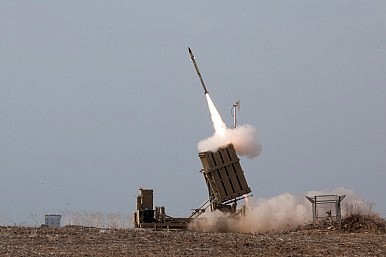
Israelis cannot begin to fathom why so many in the West, including some in the Obama administration, focus on civilian Palestinian deaths, and demand "proportionality," as if Israel's cause would only be legitimate if it lost more of its people. Israelis demand to know what proportionality is meant to connote? That the military should dismantle its remarkably successful Iron Dome system so that more Israeli civilians should be killed? That the incursion into Gaza would only be justifiable if as many Israelis are killed as are Palestinians? Israelis note that proportionality was never a consideration when America and its allies fought other wars, whether in Vietnam, Bosnia, Afghanistan or Iraq (twice).

Israelis acknowledge the tragic circumstances that have led to the deaths of over a thousand Palestinian civilians. But they continually point out that Hamas stocks its weapons in schools, hospitals and mosques, as well as the tunnels, and that it fires its rockets from those locations, as well as from other heavily populated areas. They argue that whereas their own military has warned civilians of impending attacks, Hamas instructs, and perhaps forces, civilians to stay in place. And they wonder why the same observers who relentlessly pummel Israel for attacking civilians seem to overlook the ongoing butchery that Bashar Assad has carried out against his own citizens.

Israelis wonder why Western analysts minimize the threat of Hamas' rabbit warrens of tunnels that enable these terrorists—who are constantly mislabeled with the far less threatening term, "militants"—to avoid Israeli defensive barriers in order to kill soldiers and civilians alike. That the tunnels are nothing less than vehicles for wanton murder is evidenced both by Israeli reports of foiling terrorists who emerged from them in order to kill innocents, and by Hamas' own videos that demonstrate that it is the tunnels that enable them to wreak havoc inside Israeli territory. Israelis ask whether Americans would respond any differently than they have if the tunnels that ferry illegal aliens across the Mexican border were instead used to facilitate the killing of citizens in, say, El Paso.

Hamas has but one declared purpose: to destroy Israel, and indeed, kill as many Jews as possible, regardless of where they might be found. Those who justify its actions, including Hamas' Jewish apologists on the extreme Left, not only support the destruction of the State of Israel, but are no less anti-Semitic than Hamas itself (Jewish self-hatred is a phenomenon that is as old as it is weird).

For all these reasons, Israelis are puzzled, if not shocked, by the Obama administration's ceaseless efforts to obtain a cease-fire, and to promote negotiations with Hamas' most vocal supporters, Qatar and Turkey, without first demanding that Hamas cease its rocket fire. They wonder why Washington is more zealous to pressure them than are the Egyptians, Saudis, Jordanians and several of the Gulf States. They cannot see how an administration that has done little more than engage in fruitless finger pointing at Bashar Assad and, for that matter, the Islamic State in Iraq, should be so determined to prevent Israel from defending its own people. They console themselves by noting that the administration has little, if any, credibility in the Middle East; so they simply ignore John Kerry and proceed with their operations.

It is, however, one thing to support Israel's legitimate right to defend itself until Hamas is prepared to accept its existence, to halt its rocket attacks, to seal its tunnels and to accept long-standing agreements that began with Oslo. It is quite another to ignore the legitimate claims of Palestinians to a country of their own, or the damage that the ongoing settlement building is doing to any prospects for such a Palestinian state to come into being. Many Israelis continue to believe that only a two-state solution offers them any hope of a future that is not constantly interrupted by war. Many Americans and others in the West share that belief. The Gaza operation will eventually come to an end, but the plight of the Palestinians will not. Israelis are right to support their government's efforts to establish quiet borders with its neighbors. Once a cease-fire takes place, they should ramp up the pressure on that government to ensure peace by halting the construction of new settlements and creating a real opportunity for Palestinians to have borders of their own.

Dov S. Zakheim served as the undersecretary of defense (comptroller) and chief financial officer for the U.S. Department of Defense from 2001–2004 and as the deputy undersecretary of defense (planning and resources) from 1985-1987. He also served as DoD's civilian coordinator for Afghan reconstruction from 2002–2004. He is a member of The National Interest's advisory council.

Beyond Bombs, Rockets and Rhetoric: What Is the Endgame for Gaza?


"The last thing Gaza needs is more inflammatory rhetoric, bombs or rockets. Gaza needs a policy."

The humanitarian disaster in Gaza is mounting as the conflict drags on and intensifies. The UN OCHA figures show as of July 29, 1,118 Palestinians have been killed—at least 74 percent of them civilians. Fifty-six Israelis have died—95 percent of them were soldiers and three were civilians. These figures, tragic as they are, don’t come close to showing the full physical and psychological impact of the last several weeks. Both sides are now on a war footing. Reasoned debate about the future of Gaza and indeed the broader related questions about the future of Palestine is lacking. Seven steps need to be taken to begin to find a solution that can lead to a more lasting and sustainable peace.

1. Aim for a cease-fire

An end to military hostilities is critical. However, even if a negotiated ceasefire proves illusive, all sides must stop threatening and killing civilians. This can be done unilaterally. Israel can stop its massive targeting of homes and civilian structures and it can stop deflecting responsibility for collective punishment of a caged-in population with nowhere to run. Hamas and other groups can stop the controversial rocket barrage and putting Palestinian and Israeli civilians at risk. The tragedy is that ultimately, this crisis will end with a negotiated settlement. Why not talk now and avoid the death, injury and displacement of scores more civilians? Leaders in the region and internationally should prepare the ground, keeping in mind the need for intermediaries both sides can accept.

2. Permanently end the siege of Gaza

It is impossible to keep 1.5 million people in Gaza’s virtual jail without expecting the situation sooner or later to erupt. The siege must be lifted. Egypt should normalize the border and Gazans should be allowed to travel in and out of the strip. The list of goods that are not allowed into Gaza should be reexamined and the transit of goods through the Rafah border should be made easier. Increasing economic development and democratic freedom in Gaza is a much better alternative way to address Israeli security concerns. As an urgent humanitarian step, medical and building supplies should be provided immediately to Gaza.

3. Support reconciliation

The CIA’s Man in the Libyan Civil War From retirement in ‘rural Virginia’ to Libya’s top rebel commander


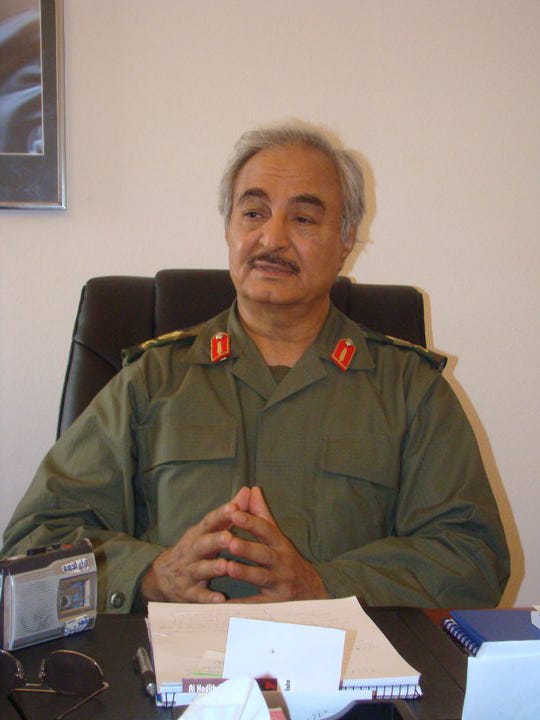
Gen. Khalifa Haftar’s life has been a colorful one. It also raises questions about how deeply the U.S. intelligence community is involved in the Libyan civil war.

Born around 1943, Haftar was a revolutionary twice in his life. In 1969 he was part of the military junta that deposed Libya’s King Idris and secured the ascent of Muammar Gaddafi.

Under the eccentric dictator, Haftar rose to become chief of staff of the Libyan military and the commanding officer of Libya’s armed forces during the Chadian-Libyan conflict.

That war didn’t end well for Libya. The U.S. and France backed Chad, helping the Central African country defeat Libyan forces. The Chadians captured Haftar, briefly holding him as a prisoner of war.
 
Angry at the defeat—and perhaps wary of Haftar’s return to Libya as a war hero—Gaddafi disowned his former ally and the other Libyan prisoners of war.

Haftar joined the Libyan opposition in exile and later became head of the National Front for the Salvation of Libya, the opposition’s military wing.

During U.S. president Ronald Reagan’s administration, the NFSL received covert support from the CIA—and it therefore should not be surprising that Haftar moved to “rural Virginia” in the early 1990s. The CIA headquarters is in Langley, Virginia.

No official confirmation exists, but there are many indications that the Libyan general was, for some time, on the CIA’s payroll. Not least the fact that, according to an acquaintance quoted by Business Insider, Haftar was able to support his extended family without actually taking any work.

In 1996, the NFSL tried and failed to incite a rebellion in rural Libya. Haftar is said to have been in command of the operation—although again, details are scarce.

We do know that Haftar returned to Libya in 2011 to take part in the revolution against Gaddafi. He quickly rose through the rebels’ ranks, becoming one of their chief commanders. After Gaddafi’s fall, he was named commander of the Libyan army’s ground forces.

But this wasn’t enough for the ambitious general.

A video claiming to depict Haftar’s return to Benghazi in 20111

Currently Haftar is one of the main spoilers in the Libyan transitional process. He has formed an alliance between separate armed groups from the country’s east and the Zintan Brigades, a western faction that controls the international airport in Tripoli. In May, his allies shut down the government in an apparent attempt to undermine the legitimacy of the transitional government.

So-called Operation Dignity also saw Haftar’s forces attack Islamist militias in Benghazi, the birthplace of the revolution.

Publicly, Haftar claims to fight against Islamist militias for a secular Libya, but his political ambitions are obvious. It’s especially telling that his moves against the fledgling government of Libya occurred just as the new regime was trying to enforce a law banning functionaries from the Gaddafi era from public office.

Haftar would be subject to this law, as would be many leaders of the armed groups he is allied with.

The fighting Haftar instigated meanwhile has spiraled out of control. Militias are battling for the international airport in Tripoli. An important fuel depot has caught fire after being hit by a rocket. Embassies in the city have evacuated. In Benghazi, Islamist and secular forces openly are fighting.

Haftar largely is responsible. His ambitions already have inflicted great damage on the transitional process in Libya. What remains unclear is how close his connection remains to U.S. intelligence services. In interviews he says that he is in “indirect contact” with the U.S. government.

But the world needs to know just how much influence the CIA still has over its alleged former employee, who lived for two decades on the outskirts of the American capital and still holds U.S. citizenship.

Peter Dรถrrie is a freelance journalist covering resource and security politics in Africa. You can follow him on Twitter at @peterdoerrie. Medium has an app! Sign up for a daily War is Boring email update here


The INF Treaty and Russia’s Road to War

http://nationalinterest.org/feature/the-inf-treaty-russia%E2%80%99s-road-war-11001?page=show


"Russian military leaders fear that they will be defeated in any major conventional engagement, and so must rely on nuclear deterrence to prevent an enemy from taking advantage of a battlefield victory."
Tom Nichols

August 2, 2014

After many months of provocative Russian missile tests, the United States has finally accused the Russian Federation of violating the Intermediate-range Nuclear Forces (INF) Treaty. The INF Treaty is a landmark 1987 agreement between the Soviet Union and the United States that prohibits the possession on both sides of “theater” nuclear missiles – that is, weapons with a range too short to be considered part of a stable intercontinental strategic deterrent, but too long to be considered tactical arms for use on a battlefield during wartime. The treaty doesn’t actually ban any nuclear warheads themselves, but rather only any system capable of delivering them at distances between 500 and 5500 kilometers.

In terms of the military balance between East and West, none of this matters a whit. But in terms of what it says about how the Russians (and not just President Vladimir Putin) view a future war in Europe, it’s deeply troubling.

To understand all this, we have to go back to the Cold War, and think about why both the U.S. and the USSR found intermediate range nuclear missiles so worrisome. Although nuclear theology is no longer in fashion these days, there is no way to understand the gravity and danger of what Moscow is doing without reviewing why the INF Treaty exists in the first place.

During the Cold War, the USSR’s Warsaw Pact alliance was poised directly along the borders of America’s NATO allies in Europe. No matter what might start World War III, and no matter where in the world Soviet and Western forces would first collide, Soviet planners intended to move against Europe in order to bring the conflict back to an arena of overwhelming Soviet conventional dominance. (We thought about similar moves as well.) Accordingly, Soviet and Warsaw Pact forces were structured for a major offensive designed to capture swaths of then-West Germany, and then to drive on toward the Atlantic coast in the hopes of shattering NATO with a sudden, traumatic defeat.

The U.S. and NATO, of course, had no hope of stopping this kind of Soviet conventional attack. Outgunned and outnumbered, NATO’s strategy was to convince Moscow that the Alliance would have no choice but to blunt the Soviet invasion with the use of short-range nuclear weapons on the battlefield against the advancing Warsaw Pact columns. NATO’s hope was that the Kremlin, faced with no option but nuclear retaliation against the U.S. and its European partners, would realize it was gaining nothing by sparking an all-out nuclear war.

The Soviets – or at least the Soviet military – counted on NATO’s nuclear powers (the U.S., Britain and France) to make good on their threats: every Soviet military exercise until 1967 began with a simulated NATO nuclear strike. Subsequent exercises discarded this opening salvo, but all assumed eventualnuclear use, and thus stressed the need for speed and shock before the West could reach for the nuclear trigger. The Soviet regime for years promised never be the first to use nuclear weapons (as China does now, by the way), but in reality the Soviets were planning their own crippling tactical strikes on NATO communications, command and control, airfields, and other assets if they believed the military situation required them.

Both Washington and Moscow faced a conceptual problem with nuclear escalation. The Soviets, understandably, did not prefer to fight in a nuclear environment if they could help it, but NATO’s nuclear forces would be overrun in any Soviet invasion, making them “use or lose” weapons, and so Soviet success on the battlefield ran the risk of provoking the outcome they feared the most. The Americans, for their part, had tied U.S. strategic nuclear weapons to the defense of NATO, promising that escalation in Europe would lead to central nuclear war between the superpowers. This threat, however, required Moscow to believe that a U.S. president would jump from tactical nuclear war in Western Europe to strikes launched from U.S. submarines or from North America itself against the Soviet heartland.

Throughout the 1960s, both sides fielded short and intermediate range nuclear forces until Europe was bristling with nuclear arms. Despite their preference for a conventional conflict, however, the Soviets made a baffling blunder in the mid-1970s by deploying a mobile, multiple-warhead missile called the SS-20.This was supposedly only a replacement for older Soviet weapons in Europe, but those older systems were less accurate, and more importantly, relied on liquid fuel, which required hours of preparation. The new SS-20s, by contrast, represented a huge improvement in range and accuracy, and were powered by solid fuel boosters that made them available for use on almost instant notice. Every European capital was now in range of a theater nuclear system whose purpose was to paralyze NATO under the threat of immediate and accurate surprise nuclear attack.

This blunt threat was a mistake. NATO’s response was to upgrade its own theater missiles, a program initiated by Jimmy Carter and brought to fruition by Ronald Reagan. Along with ground-launched cruise missiles (which were relatively slow but were small and could fly under Soviet radar), the Americans deployed the Pershing II, an intermediate range ballistic missile that could reach the USSR from West Germany in a matter of minutes. These deployments were tremendously controversial in Europe, and sparked mass protests. But European leaders of both the right and left were sufficiently alarmed by the increased Soviet nuclear threat that the deployments continued in the early 1980s. (Even the French referred to the SS-20 as le grand menace.) This renewed sense of purpose in NATO – Vladimir Putin, take note – reversed years of Soviet diplomacy after the steady deterioration in relations between the U.S. and its NATO partners during the Vietnam-era 1970s.

The SS-20s and the Pershings were highly destabilizing weapons, reducing the time for a nuclear decision by U.S. or Soviet leaders during a conventional war to minutes, if not seconds. Each side felt deeply threatened, and understandably so. We now know that the Soviet military insisted on the SS-20 over the objections of the Soviet diplomatic establishment, who saw it as an unnecessary provocation. (They were right.)

Soviet President Mikhail Gorbachev inherited this mess from his predecessors, and he considered the responding U.S. Pershing deployments, as he later wrote in his memoirs, a “gun to the [USSR’s] head.” Reagan, for his part, had pushed the deployments despite his hopes – shared by Gorbachev – of eliminating all nuclear weapons. Both leaders – as part of the “triumph of improvisation,” to use James Wilson’s description of the way the Cold War ended – instead settled for getting rid of the most destabilizing arms in their inventories. The 1987 treaty was the first to eliminate an entire class of nuclear arms, rather than merely capping their numbers as in previous U.S.- Soviet arms treaties. The removal of these weapons created a breathing space for further negotiations in Europe, and helped pave the way to the end of the Cold War.

Why does any of this matter today? The Warsaw Pact no longer exists. Indeed, its members are now part of NATO. The conventional equation has been completely reversed, with Russia now the inferior conventional power, its armies no longer massed along NATO’s borders and completely incapable of a lighting dash to the Rhine, let alone the English Channel. NATO (as I have argued many times elsewhere) does not need tactical nuclear weapons, since their former targets are now in NATO itself. So what’s the point?

The danger is that Moscow may be coming back to theater-range nuclear weapons as some sort of imagined equalizer against NATO. Russia no longer has a strategy of blitzkrieg; rather, Russian military leaders fear that they will be defeated in any major conventional engagement, and so must rely on nuclear deterrence to prevent an enemy from taking advantage of a battlefield victory. This is the Kremlin’s bizarre strategy of “nuclear de-escalation,” in which the use of just a few nuclear weapons convinces a putative “aggressor” to back off.

This all raises the question of just why the Russians think they would have to fight, or why they’d be in such a dire situation in the first place. One possibility is that the Russian high command is so paranoid that it really believes that NATO – an alliance that can barely be bothered to engage in sanctions, much less war – would actually attack Russia. I knew Soviet officers during the Cold War who swore that they believed that NATO really would invade the Warsaw Pact even at something like a 1-to-6 inferiority, but it is hard to imagine that there is anyone in Russia’s senior ranks who still thinks that way.

A more likely explanation is that Russia’s military planners are trying to think through their options in case Russian conventional aggression fails and Russia ends up losing a war that Moscow started. Russian exercises as long ago as 1999postulated kooky scenarios like a NATO land grab in the Baltic region. These games included a handful of nuclear strikes – including two against North America – that then terminated the conflict. If any Russian general really believes this is what would happen after a nuclear strike on the United States, we’re all in a lot more trouble than anyone realizes.

It may also be the case that the Russians are testing prohibited INF-range missiles as a warning to NATO: the Kremlin, including Putin and his military coterie, has never accepted the collapse of the USSR and the expansion of the West into former Warsaw Pact territory. (Just ask the Ukrainians.) These treaty violations may be a signal that they are looking, yet again, to decouple any regional conflict in Europe from the U.S. strategic deterrent by threatening European NATO with nuclear weapons, but without resorting to Russian strategic forces and thus averting a U.S. response.

It is also possible, to use a traditional term of strategic analysis, that the Russians are just yanking our chain to see what will happen. Putin’s Kremlin is now accustomed to the passivity of Barack Obama’s White House, and so the Russians may be violating the INF Treaty simply because they can. There’s really not that much of a military point in Russia’s tests, nor do they change the strategic calculus, because there isn’t anything the Russians can do with ground-launched cruise missiles that they couldn’t already do with other nuclear weapons in their inventory.

But if Moscow can shred a key arms agreement with no real consequences, the Russians will have succeeded in sending the message that America’s ongoing global disengagement now even includes NATO. At the least, turfing the INF Treaty is yet another way for Putin to show that he is dumping the entire post-Cold War settlement and that he intends to carve out a better deal than the one his predecessor, Boris Yeltsin, bequeathed to him.

At least where nuclear arms are concerned, the American response to this should be to do nothing, as paradoxical as that sounds. As Ambassador Steven Pifer and others have noted, if NATO, as some have suggested, starts arming its own cruise missiles with nuclear warheads and answers Russia’s INF violations in a tit-for-tat exchange, we will have succumbed to Moscow’s bait. We will end up not only legitimizing their abrogation of the treaty, but closing off opportunities for further talks.

Instead, the West should emphasize what the Russians fear most: NATO’s considerable conventional edge. Washington should accelerate the halting steps we’ve taken since the invasion of Ukraine and the seizure of Crimea, and work with our NATO partners to build up stronger conventional forces in Europe. If the Russians are keeping nuclear arms as insurance against losing a conventional war, it’s only because they still think they have some kind of a shot a conventional fight in the first place. We can close that loophole, and must, soon.

If we continue to adhere to the INF Treaty even as Moscow violates it, we will demonstrate our strength and confidence even as Putin and his cronies parade their paranoia. Putin is known, like many Russians, to hold former Soviet leader Gorbachev in low regard. When it came to stemming the tide of nuclear arms, however, Reagan and Gorbachev were stronger men, and his petulant violation of a treaty that made the world – Russia included – a safer place is testimony only to the weakness and insecurity of the men who govern Russia today.

Tom Nichols is Professor of National Security Affairs at the Naval War College and an adjunct at the Harvard Extension School. His most recent book is No Use: Nuclear Weapons and U.S. National Security (University of Pennsylvania, 2014)

Russia’s Fear of Potential Threats Has Spawned a Real One in Ukraine

Aug. 1, 2014
Ukrainian troops patrol near the village of Novoselovka, some 30 kms from the eastern Ukrainian city of Donetsk, on July 31, 2014. Genya Savilov—AFP/Getty Images
Ukraine's army was too weak to defend itself in March. Not anymore

The Ukrainian airbase at Kramatorsk, a short drive from the border with Russia, was a sorry sight just a few months ago. The road leading up to it was strewn with barricades of trash, and pro-Russian separatists liked to gather around it for little victory picnics of beer and sunflower seeds. They had blocked the main gate to the airfield in early April, and rather than forcing the separatists back, many of the Ukrainian soldiers based there from the 25th Airborne Brigade had deserted. One of the few who remained on the evening of April 19 was sulking over his army ration when two reporters came up to the base and asked about the unit’s morale. “On a scale of one to ten,” the soldier said, and raised three fingers of his left hand.

A lot has changed since then. In early July the base at Kramatorsk became the nerve center for the military operation against the separatist militias in eastern Ukraine. Every few minutes on an average morning tanks and armored vehicles now stream in and out of the gate in columns, heading for the front lines. Helicopters fly over the heads of Ukrainian snipers, and the commandos guarding the main gate would not look out of place in a remake of Rambo. Their fighting spirit seems plenty high. “You’ll see us yet in Moscow, marching in Red Square,” bragged a captain from the revitalized 25th Airborne on Wednesday morning, standing outside one of the towns they had taken back from the separatist rebels the day before.

This was not much more than empty bravado—Ukraine’s army is still a fraction the size of Russia’s—but the sentiment behind his threat is still a bad omen for Russia’s security. At least in military terms, Russia’s logic in starting the conflict in March was to strike first against a potential enemy. Its commander in chief wanted to pre-empt what he saw as a future threat to Russia’s naval base at Sevastopol, on the Crimean peninsula in Ukraine. “If we hadn’t done anything,” said President Vladimir Putin on April 17, a few weeks after annexing Crimea, “Ukraine would eventually be dragged into NATO. They’ll tell us: ‘This doesn’t concern you,’ and NATO ships will wind up in the city of Russia’s naval glory, in Sevastopol.”

CIA Director John Brennan Does a 180 and Reverses Himself on CIA Spying on US Senate; White House Backs Him Still

CIA director reverses himself on Senate spying
August 1, 2014
FILE - This March 11, 2014 file photo shows CIA Director John O. Brennan speaking in Washington. The CIA’s insistence that it did not spy on its Senate overseers collapsed July 31 with the release of a stark report by the agency’s internal watchdog documenting improper computer surveillance and obstructionist behavior by CIA officers. Those internal conclusions prompted Brennan to abandon months of defiance and defense of the agency and apologize to Senate intelligence committee leaders. (AP Photo/Carolyn Kaster, File) 

WASHINGTON (AP) — For months, CIA Director John Brennan stood firm in his insistence that the CIA had little to be ashamed of after searching the computers of the Senate Intelligence Committee. His defiant posture quickly collapsed after a devastating report by his own inspector general sided against the CIA on each key point of the dispute with the Senate.

According to an unclassified summary of the report released Thursday, five agency employees — two lawyers and three computer specialists— improperly accessed Intelligence Committee computers earlier this year during a disagreement over interrogation documents. Then, despite Brennan ordering a halt to that operation, the CIA’s office of security began an unauthorized investigation that led it to review the emails of Senate staffers and search them for key words.

After Senate leaders learned about the intrusion in January and protested, the CIA made a criminal referral to the Justice Department, alleging improper behavior by Senate staffers. That referral, CIA inspector general David Buckley found, was based on inaccurate information and was not justified.

When internal investigators interviewed three CIA computer specialists, they exhibited “a lack of candor,” the IG report said.

Those devastating internal conclusions prompted Brennan to abandon his defensive posture and apologize to Intelligence Committee leaders.

"The director said that wherever the investigation led, he would accept the findings and own up to them," said his spokesman, Dean Boyd, describing what has become a difficult moment for the nation’s most prominent spy agency.

Brennan has convened an internal accountability board chaired by former Sen. Evan Bayh, D-Ind., to examine whether any CIA officers should be disciplined.

JFQ 74 | Cyber Power in 21st-Century Joint Warfare

By E. Lincoln Bonner  
July 01, 2014

entional military operations is relatively unexplored, with most attention going to cyberspace's espionage and coercive potential, yet it is critical to joint warfare. In particular, military cyberspace operations should aim to achieve and hold cyberspace dominance including the ability to cyber interdict to assist with kinetic actions, with an emphasis on air operations. Another focus should be to defeat adversary cyber attacks and surveillance and then to suppress enemy cyber defense measures. Interdiction should concentrate on tactical data links and on data fusion centers, which are described here as the cyber version of a railroad marshaling yard. Cyberspace dominance and cyber interdiction will push enemies to make mistakes and give our joint warriors a decisionmaking advantage.

For, in war, it is by compelling mistakes that the scales are most often turned.

—B.H. Liddell-Hart

Strategy: The Indirect Approach (1941)

In 2008, Russian military forces, supported by cyber attacks, rapidly defeated opposing Georgian forces and seized territory later traded in exchange for Georgia’s granting greater autonomy to pro-Russian governments in South Ossetia and Abkhazia. Cyber power is the ability to exploit cyberspace to create advantages and influence events, andcyberspace is the interdependent and interconnected networks of electronics and the electromagnetic spectrum where information is created, stored, modified, exchanged, and exploited.1 The 2008 Russia-Georgia war marks the only public incidence of cyber power integrated with traditional kinetic military operations. To date, however, little attention has been paid regarding how to integrate cyber power into conventional military operations. Rather, research has tended to focus on the independent use of cyber power for espionage and as a means of strategic attack to punish and/or compel a state to do one’s will.
Chief of warfighting integration and chief information officer for Office of Secretary of Air Force discusses cyber security during seminar at Barksdale Air Force Base (U.S. Air Force/Chad Warren)

This article addresses this research gap by focusing on how cyber power can best be integrated into joint warfare to fight and win the Nation’s wars. Using the Russia-Georgia war as an illustrative case, this article argues that the principal value of integrating cyber power into a joint military campaign is that it compels the enemy to make mistakes by performing three main warfighting tasks: reconnaissance, superiority, and interdiction. It begins with a description of how cyber power’s main warfighting tasks support kinetic operations by degrading/disrupting the enemy decision cycle. The cyber aspects of the Russia-Georgia war are then analyzed to show how pro-Russian forces employed cyber power to degrade the Georgian decision cycle in support of kinetic military operations. Finally, implications for present and future integration of cyber power into joint warfare are discussed.

Reconnaissance, Superiority, and Interdiction

Chinese Hackers Target Israel’s Iron Dome

http://thediplomat.com/2014/08/chinese-hackers-target-israels-iron-dome/

A PLA cyber unit targeted Israeli defense companies involved in developing the coveted Iron Dome missile defense system.

By Zachary Keck
August 02, 2014

Chinese military hackers stole information relating to Israel’s much-touted Iron Dome missile defense system, according to a recent report by the cyber security website, Krebs on Security.

“Three Israeli defense contractors responsible for building the ‘Iron Dome’ missile shield currently protecting Israel from a barrage of rocket attacks were compromised by hackers and robbed of huge quantities of sensitive documents pertaining to the shield technology,” the report says, citing analysis by the Columbia, Md.-based threat intelligence firm Cyber Engineering Services Inc. (CyberESI).

The hackers penetrated the systems of three top Israeli defense firms — Elisra Group, Israel Aerospace Industries, and Rafael Advanced Defense Systems — between October 2011 and August 2012, according to CyberESI (although the initial phishing emails went out in April 2011). CyberESI says that most of the information the Chinese hackers targeted was “intellectual property pertaining to Arrow III missiles, Unmanned Aerial Vehicles (UAVs), ballistic rockets, and other technical documents in the same fields of study.” This and other information led CyberESI to conclude that the hackers were interested in Israel’s “Iron Dome” missile defense system.

The timing of the cyber intrusions is also consistent with this conclusion. The Iron Dome was first deployed inMarch 2011 and intercepted its first missile from Gaza a month later. That same month is when the first phishing emails were sent to the firms.

According to CyberESI, the attacks against the Israeli firms “bore all of the hallmarks of the ‘Comment Crew,’” a now-infamous cyber unit in the People’s Liberation Army. The Comment Crew, which is officially designated PLA Unit 61398, first rose to public prominence when the Virginia-based cyber security firm Mandiant profiled it in a report it released in February of last year. The five PLA hackers whom the U.S. officially charged with crimes this spring were also members of Unit 61398, which is based out of Shanghai.

Israel’s mobile, all-weather Iron Dome missile defense system targets missiles with ranges between 4-70 kilometers, although Israel is currently trying to expand that range. The batteries all have sophisticated radars that allow them to determine the destination of the intended target. The system is therefore able to ignore missiles that are headed towards open fields or unimportant sites. Among the missiles it does target, however, it reportedly has an astonishing interception rate of as high as 90 percent. During the current Gaza War, the Iron Dome missile systems had an interception rate of 86 percent as of July 20, according to the Israeli military. This is why one military analyst has said that “Iron Dome is [possibly] the most-effective, most-tested missile shield the world has ever seen.”

Although the Iron Dome system was mostly developed by Israeli defense firms — first and foremost Rafael — it has largely been funded the United States. If the FY2015 U.S. defense budgets are approved, the U.S. will have given Israel nearly $1 billion in funding for the Iron Dome system over the last five years. By contrast, Israel has invested nearly $600 million. According to Yair Ramati, the head of Israel’s Missile Defense Organization, the U.S. has paid for seven of the eight Iron Dome batteries Israel currently deploys.

In contrast to the Iron Dome Missile System itself, the U.S. and Israel jointly developed the Arrow 3 missile that was also targeted by the PLA hackers. The head of CyberESI told Krebs on Security, “Most of the technology in the Arrow 3 wasn’t designed by Israel, but by Boeing and other U.S. defense contractors. We transferred this technology to them, and they coughed it all up. In the process, they essentially gave up a bunch of stuff that’s probably being used in our systems as well.”

1914-2014: Weapons of the Next Great War


Aug. 1, 2014

From dynamite to drones, the way wars are fought has changed dramatically in the last century. 

World War I – the first industrial conflict on a global scale – began a century ago, using the rapidly advancing science to devise new weapons like poison gas, industrial shelling, aerial bombing, fighter planes and tanks. The Great War wound up taking the lives of more than 37 million people. Wars might not have changed much since 1914, but weapons are more advanced and subtle as technology is changing faster than perhaps any time since the start of the 20th century.

Decades before World War I, scientist Alfred Nobel created dynamite but later became horrified at the carnage caused by his invention and donated his fortune to create a peace prize in his name.

“The day when two army corps can annihilate each other in one second, all civilized nations, it is to be hoped, will recoil from war and discharge their troops,” Nobel said.

Those are very prescient words considering Nobel died in 1896, decades before the threat of nuclear weapons. Look at some of the ways World War III might be fought and remember how Nobel feared misusing science for destruction.

The ability to covertly infiltrate infrastructure through hacking – without putting boots on the ground – poses a game changer for how wars are fought. 

THE FIRST MAP OF THE DEPTHS

THE FIRST MAP OF THE DEPTHS

Cartophilia: more than a pretty picture, this hand-drawn map of the ocean floor changed a way of thinking. Simon Willis explains

From INTELLIGENT LIFE magazine, July/August 2014

This map marks both a scientific and an imaginative revolution. When it was published in 1977 by Marie Tharp and Bruce Heezen, two oceanographers at Columbia University, there had never before been a map of the entire ocean floor. Here, for the first time, was our planet’s hidden majority. It was as if the plug had been pulled and the water drained out, transforming the blank seascape into a complex landscape of plains and peaks, escarpments and bluffs. Here was the full extent of the Mid-Ocean Ridge, the mightiest mountain range on Earth, its 40,000-mile length making molehills out of more familiar mountains. You can see its serpentine curl through the Atlantic, round the Cape of Good Hope to the Horn of Africa and on through the Southern Ocean, up to 1,000 miles wide and two miles high. 

Tharp and Heezen began mapping the individual ocean floors in 1952, but found obstacles in their way. The big one was invisibility: when it comes to mapping the ocean floor, the sea gets in the way of seeing. The second obstacle was limited data. Tharp, who drew the maps, started with the North Atlantic, working from information gleaned on sounding expeditions. Ships travelling across the Atlantic with sonar would fire sound through the sea, working out its depth from the time it took for the echo to be detected. But Tharp had only six complete tracks across the ocean from which to figure out the topography of the whole thing—“six ribbons of light”, as she described them. 

As she began analysing the data she noticed something strange, a discovery that would change our understanding of our planet. There was a crack running along the top of the Mid-Atlantic Ridge. Nobody had ever spotted it, but it appeared to be huge—in places wider than the Grand Canyon. Heezen, at first disbelieving, became convinced when it turned out the crack coincided with a string of earthquakes. Tharp’s discovery helped turn a theory then regarded as nonsense into a fundamental fact: continental drift. The sea floor was being pushed up and apart.

“It was a giant paradigm shift,” says Robin Bell, a professor of geophysics at Columbia today. “These mountains now had a reason for being there. That’s the magic place where you in London and I in upstate New York are getting farther apart every day at the rate our fingernails grow. That’s the place where new Earth crust is being made.” It was a leap towards explaining why the Atlantic coasts of South America and Africa fit so snugly together, and why Bermuda is older than the Azores. “It wasn't just random down there,” Bell says. “There was a story.”

And like all good storytellers, Tharp knew to show rather than tell. There had been contour maps of the ocean floors before, showing circles joining points of similar elevation. But Tharp drew physiographic diagrams—maps which show what the sea bed would look like if viewed from above. In her biography of Tharp, “Soundings”, Hali Felt writes that her maps are “a visual argument for the ways the depicted features had been formed”. To make it, Tharp had to extrapolate from the data, using her training as a geologist and mathematician to infer the extent and appearance of those features, to illuminate what lay between the ribbons of light. She has since been proved largely correct.

Tharp—a pugnacious redhead who, in the mostly male world of oceanography, liked to wear long flowing skirts—was as obsessive about her art as her science. In 1961, Felt reports, Tharp visited the printers Williams & Heintz in Washington, DC, who were printing her second map, of the South Atlantic. She thought it had lost detail in the printing, so she picked up a steel point and gouged out valleys, sharpening the definition of the Shag Rocks near the Falkland Islands. “Some of her brilliance”, Bell says, “was that she was able to put it in a way that our eye can understand.” 

The maps of the individual oceans were eventually combined into the World Ocean Floor Panorama you see here. There was a scientific point: Tharp and Heezen wanted to demonstrate that we shouldn’t be thinking in terms of separate bodies of water, but of the underlying continuous body of rock. But their purpose was democratic too. They teamed up with the Austrian artist Heinrich Berann, who painted this map using colour to lead the eye—reds for volcanic areas, pale blues for the vast abyssal plains, the Mid-Ocean Ridge purpled like a bruise. “Marie wanted the general public to be able to see the texture of the ocean floor,” Felt writes. It worked on one woman. Robin Bell remembers seeing the map for the first time. “It’s the reason I went into geology,” she says. “I can remember the day. I was like, ‘Oh my gosh, I’m going to be a geophysicist!’”

Simon Willis is our apps editor and a former associate editor of Granta

DARPA’s VTOL X-Plane

By Maren Leed, Melodie Ha 
JUL 30, 2014 

For decades, helicopters and other rotorcraft have been essential components to countless military operations; they can maneuver in any direction, hover, and land on almost any flat surface. Despite the technological advancements made in Vertical Take Off and Landing (VTOL) over the years, rotorcraft remain limited in terms of speed, operating at 195mph or slower. Faster VTOL aircraft could not only shorten mission times and increase the potential for operational success, but also reduce vulnerability to enemy attack. However, previous attempts at new VTOL designs have been unable to increase top speed without sacrificing range, efficiency, useful payload, and simplicity of design. 

Defense Advanced Research Projects Agency’s (DARPA) VTOL X-Plane program aims to design a plane to overcome these challenges. Through a hybrid of fixed-wing and rotary-wing technologies, DARPA is looking at a plane that can efficiently take off and hover like a helicopter and fly at high-speeds like an aircraft. This project is currently exploring unmanned aircraft, but the technology can apply to manned aircraft as well.

DARPA is looking to challenge the aviation industry and innovative engineers to create a hybrid aircraft with specific requirements in the following four areas: 1) enhancing speed up to 460mph 2) increasing hover efficiency from 60% to at least 75%, 3) obtaining a cruise lift-to-drag ratio of at least 10, and 4) maintaining the ability to carry a useful load of at least 40% of the vehicle’s gross weight of 10,000 to 12,000lbs.

This $130 million project will be in the works for 52 months, from 2013 to 2018, and consists of three phases. The four companies that DARPA has selected to proceed with Phase 1, (developing a preliminary concept design for the aircraft) are Boeing, Karem Aircraft, Aurora Flight Sciences, and Sikorsky Innovations.

Among the four contenders, Boeing is the only company to have built and tested a flying subscale model of the aircraft, branded the Phantom Swift X-Plane. The full-size Phantom Swift will measure at 50ft from wingtip to wingtip, 44ft from nose to tail, and will weigh in at 12,015lbs. The Phantom Swift includes two large fans inside the fuselage for vertical lift, with two smaller tilt-wing fans for additional lift and hovering capability. With the use of duct-fan technology, the Phantom Swift can maintain high-speed flight up to 460mph without sacrificing the ability to hover efficiently. During high-speed cruise, the lift fans are shut down and the doors are closed for greater aerodynamic performance, and forward propulsion is provided by the wingtip thrusters. The demonstrator will be powered by a conventional General Electric CT7-8 engine, but Boeing plans on incorporating an all-electric drive in the long term as soon as the technology becomes feasible.

2 August 2014

A new template for India-Nepal ties

Published: August 2, 2014
Jayant Prasad

Prime Minister Narendra Modi will likely indicate that India stands ready to substantially augment its development partnership with Nepal without dictating its destination or determining its degree. His visit will set the tone for a significantly upgraded relationship

The Nepalese leadership have begrudged the spurning of their repeated invitations to visit Kathmandu by India’s previous Prime Ministers for over a decade-and-a-half. Prime Minister Narendra Modi’s visit, and the Joint Commission meeting — held after almost a quarter century — signals to them the beginning of a two-way political re-engagement between the two countries.

Indians and Nepalese share a common culture and terrain south of the Himalaya. Bound by languages and religions, marriage and mythology, the links of their civilisational contacts run through Lumbini to Bodh Gaya, Pashupatinath to Kashi Vishwanath, and Muktinath to Tirupati. At the people-to-people level, relations between India and Nepal are closer and more multifaceted than between India and any other country. Many partisans of Nepalese democracy also fought for India’s freedom, for which they were jailed by the British, including Matrika Koirala, B.P. Koirala, and Man Mohan Adhikari, who became Prime Ministers of Nepal.

Political evolution

Many Indians believe independent India never had foreign combat troops deployed on its soil. Nepalese troops were the exception. Aside from those recruited to India’s Gurkha Regiment, an outsized Nepalese Army brigade drawn from all its 18 regiments was loaned to India in 1948-49, when Indian troops were deployed in Kashmir and for the integration of Indian States. The commanding officer of this force, General Sharda Shamsher Jang Bahadur Rana, was the son of the then Prime Minister of Nepal, Maharaja Mohan Shamsher Jang Bahadur Rana. Yuvraj Karan Singh’s marriage to Yasho Rajya Lakshmi, Sharda Shamsher’s daughter, was arranged during the General’s stay in India.

The open border is a ‘safety-valve’ for Nepal. Without compromising India’s security, the challenge is to turn it into a bridge, not a barrier

Cultural affinities and familial ties provide the comfort of familiarity, perhaps also an instinct for fraternity. But closeness begets complexities too, and dependence — for essential supplies, trade, transit, investments, and employment — does not engender goodwill, especially when relations are not handled with sensitivity and care.

Is The PLA Xi’s Next Target?

August 01, 2014

The military is anticipating Xi’s next anti-corruption move with loyalty and nationalism. 
The announcement of a formal investigation into former Politburo Standing Committee member Zhou Yongkang represents a watershed moment for China, not only for President Xi Jinping but also for the Chinese Communist Party, which by enshrining the rule of law as the rationale for Zhou’s demise has made itself the final arbiter of that law. As my colleague Shannon pointed out earlier, Xi is now likely to look for another target within a different faction of Chinese leadership in order to further solidify his political gains, and perhaps keep his adversaries off balance.

The military for one appears to have gotten the message loud and clear, at least according to its statements in the official Chinese press. However, it is also leaking information and making statements in the wake of the news about Zhou that could be intended to stoke nationalist support for itself at the expense of traditional regional rivals, without directly challenging Xi’s authority or his anti-corruption campaign. Such a tactic would certainly be helpful if the military leadership felt threatened, and would also be relatively low risk.

In response to Zhou’s downfall the military voiced its full support for the investigation, according to its newspaper the PLA Daily. It is certainly hoping that General Xu Caihou, the vice-chairman of the Central Military Commission brought under investigation for graft in early July, will be the last high-profile military target of Xi’s anti-corruption campaign. The paper said “Officers across the army support the probe, as it shows the resolution of the CPC Central Committee to operate with strict discipline and on the principle that all people are equal under the law and regulations,” and that there will be “no exceptions,” no matter who is involved. 

Also, the Ministry of National Defense on Thursday for the first time allowed foreign journalists from the AP, Reuters, Asahi Shimbun, ITAR-TASS and the Press Trust of India to attend its monthly press conference in an attempt to be more transparent. Speaking to reporters, the Defense Ministry spokesperson Geng Yansheng said ”We hope that attending this regular press conference can help you in reporting military issues in China and that you can help the world view China and its military in a more objective and truthful way.” However, he also took time to point out that the PLA’s soldiers supported the CPC’s investigation into XuCaihou.

Alongside the military’s acquiescence to the CPC’s anti-corruption campaign, it has not lost the opportunity to highlight progress in programs that would be highly popular with the nationalist faction of China’s population. On Friday the military appears to have tacitly acknowledged the existence of its Dongfeng-41 (DF-41) intercontinental ballistic missile (ICBM). It is an improvement over the DF-5A, with a range of 12,000 km that is capable of delivering multiple nuclear warheads to the continental U.S.

The military also announced the establishment of a joint air and naval command center in order to monitor the Chinese air defense identification zone (ADIZ) over the East China Sea. According to the online media outlet Ta Kung Pao based in Hong Kong, the command center is intended to monitor Japanese Maritime Self-Defense Forces activity, and could have up to 300 fighter aircraft under its authority.

The Chinese military is justified in its fear of further being targeted by Xi’s campaign, especially as the campaign appears to be picking up steam. While visiting a military base in Fujian province on Friday, Xi said he would continue to strike against military graft, and for troops “to remember where their priorities lie.” The loyalty of the rank and file of the PLA’s soldiers appeared to be his main goal, as he admonished soldiers to avoid the “four customs” of formalism, bureaucracy, hedonism and extravagance. He also told them that “the party’s absolute leadership over the army should be unswervingly adhered to.”

China’s military leadership knows that the chances of being targeted again by Xi’s “rule of law” campaign are high, and are likely to remain so. Once an incredibly powerful political force, the military’s authority has eroded somewhat over the last two decades. With the downfall of Xu and now Zhou, the PLA leadership finds itself in increasingly uncertain territory. One of its remaining levels of influence is the ability to stoke public support with policies aimed at nationalist rivals like Japan and the U.S. While this is admittedly an unwieldy tool at the best of times, the PLA may feel the need to use it if many more within its leadership feel they are Xi’s next target. Xi for his part has been very shrewd so far, not making his move until he is sure he has completely isolated his target and has the necessary political support. As this game of cat and mouse plays out, Xi will have to be increasingly careful with a portion of the government that has a natural ability to defend itself.