14 September 2014

Exploding World, Cheap Oil

Geopolitical crises abound, but oil producers are still pumping -- and pumping more than the world needs. 

SEPTEMBER 11, 2014 

Here's a bit of a puzzler. The world is in flames, with an Islamist terrorist group on the rampage across the Middle East, the White House weighing another fight in Iraq, Russia and Europe still trading sanctions and salvos, Yemen imploding, North Africa reeling from one mess to another, and, as if that weren't enough, a deadly fever spreading exponentially in Africa. Yet oil prices keep falling and are now at their lowest levels in more than a year.

But the markets aren't crazy: Simple supply and demand are at play. The world's economy, especially in Asia, has hit a brick wall, which has dented the growth in demand for oil, pushing it down to levels last seen during the Great Recession.

On top of that, oil producers have kept pumping. The United States has added more than 3 million barrels daily in the last three years, and the annual jump in U.S. oil production just set a record. OPEC producers have been running full tilt, even Libya, which doesn't even have a functioning government, and Saudi Arabia, which used to act as the voice of reason to keep oil markets more or less balanced. Only in August did the Saudis start to dial back oil production, only partially offsetting surprising supply increases elsewhere.

The result: a glut of oil that has driven down benchmark crude prices to levels last seen at the beginning of 2013. Brent crude in London traded at about $97 a barrel Thursday, Sept. 11, while West Texas Intermediate, traded in New York, threatened to dip into the high $80s per barrel.

"If ever there were a geopolitical world that should be driving oil prices higher, it would seem to be right now," said Daniel Yergin, vice chairman of energy consultancy IHS and author of The Quest: Energy, Security, and the Remaking of the Modern World. "But what it tells you is how powerful the fundamentals of the market are, and right now the fundamentals are winning out."

The big question is whether cheaper oil represents a short-term hiccup or a long-term, fundamental change, which could have big implications for petrostates in the Middle East, Africa, Latin America, and Europe, not to mention would-be petrostates such as Scotland and the Kurdish region of Iraq.

Rather than asking why oil prices are falling given all that's wrong in the world, it might make more sense to ask whether all the world's troubles are the only thing keeping crude prices from collapsing.

Analysis of Obama’s New and Very Risky “Long War” Strategy


Analysis: Obama takes big risk in wider airstrikes

Associated Press , September 11, 2014

President Barack Obama addresses the nation from the Cross Hall in the White House in Washington, Wednesday, Sept. 10, 2014. In a major reversal, Obama ordered the United States into a broad military campaign to “degrade and ultimately destroy” militants in two volatile Middle East nations, authorizing airstrikes inside Syria for the first time, as well as an expansion of strikes in Iraq. (AP Photo/Saul Loeb, Pool)

WASHINGTON (AP) — For a president criticized as overly cautious and reluctant to lead, Barack Obama is taking a huge risk. He is thrusting U.S. fighting forces into a growing military operation with clear dangers, unknown costs, an indefinite length and unpredictable consequences.

After years of resistance, the president who wanted to end America’s wars will now oversee a sweeping airstrike campaign in both Iraq and Syria, a country mired in an intractable civil war. He’s sending hundreds more U.S. troops to Iraq to help train security forces there. And he’s pressing Congress for authority to pour U.S. weaponry into Syria to strengthen opposition forces fighting both the Islamic State militants and President Bashar Assad’s government.

All three are precisely the scenarios Obama has assiduously sought to avoid.

For now, the public is with him, with polls showing wide support for airstrikes in Iraq and Syria even as Obama’s own approval ratings slump and his foreign policy ratings sink to near record lows.

"This is America’s leadership at its best," Obama declared in his address to the nation, as if to answer critics even in his own party who complain he has been too slow to act.

But as determined as Obama sounded Wednesday night, his resolve could be sorely tested by the uncertainties of war and the threat of Americans being killed or captured. “Any time we take military action,” Obama said, “there are risks involved, especially to the servicemen and women who carry out these missions.”

White House critics have argued for years that Obama’s reluctance to take the steps he announced Wednesday reflected a president who prioritized his legacy as a commander in chief who ended wars over warnings about the threat that was building in the Middle East. As a result, critics say he contributed to creating the conditions that allowed the Islamic State militants to thrive and move freely across the border between Iraq and Syria.

"The president is a rather reluctant commander in chief," Senate Minority Leader Mitch McConnell, R-Ky., said Wednesday, echoing the comments of other Republicans responding to a vexing foreign policy crisis that is reaching fever pitch just weeks before November’s midterm elections.

While Obama’s advisers dispute the assertions of their critics, there is little doubt that the president now feels a need to reverse course after resisting the tug of the Middle East.

They May Be Fanatics, But Analysts Say That ISIS Can Be Beaten

Islamic State Group Not an Unstoppable Juggernaut

Associated Press
September 10, 2014

BEIRUT — The Islamic State group is often described as the most fearsome jihadi outfit of all: a global menace outweighing al-Qaida, with armies trembling before its advance.

But while the group has been successful at seizing parts of Iraq and Syria, it is no unstoppable juggernaut. Lacking the major weaponry of an established military, it wields outsize influence through the fanaticism of a hard core of several thousand, capitalizing on divisions among its rivals, and disseminating terrifying videos on social media.

President Barack Obama is outlining plans Wednesday for an expanded military and political effort to combat the group in Syria and Iraq, ushering in what is likely to be a long-term engagement by the U.S. and its allies to destroy the militants in those countries.

It is useful to remember, though, that while it is a formidable force that controls roughly a third of Iraq and Syria, there also has been an inclination to exaggerate the group’s capabilities.

"I think sometimes there’s been a tendency to sort of overestimate the technical sophistication of the Islamic State," said Charles Lister, visiting fellow at the Brookings Doha Center.

Lister, like many other analysts, said much of the power of the Islamic State group — also known by the acronyms ISIS or ISIL — lies in its centralization of command and intense loyalty within the organization.

That distinguishes the group from others, which are overstretched by years of conflict. In the case of the Syrian rebels, there are deep divisions that have hampered their cause.

Militants from the Islamic State group have waged an aggressive social media campaign. They have released statements with detailed information on conquests and battles, and posted high-quality videos that often provide visual proof of their activities in regions that have suffered a media vacuum recently as the risks have become too great for journalists.

In Syria, two American journalists were beheaded by the group in the past month. The killings, posted on militant websites, were shot in high definition, featured embedded soundbites from Obama, and used wireless microphones to amplify statements from the masked, English-speaking militant and his victims.

According to a senior Iraqi intelligence official, more than 27,600 Islamic State fighters are believed to be operating in Iraq, about 2,600 of whom are foreigners.

Most analysts, however, estimate the number of Islamic State fighters in both Iraq and Syria to be about 20,000.

In any case, the group is dwarfed by its foes in the Syrian and Iraqi armies — both in numbers and firepower.

The Iraqi military and police force are estimated at more than 1 million. The Syrian army is estimated at 300,000 soldiers. There are believed to be more than 100,000 Syrian rebels, including the al-Qaida-linked Nusra Front and the powerful Islamic Front rebel umbrella group, currently fighting the Islamic State group in Syria. Tens of thousands of Kurdish Peshmerga forces are fighting the group in Iraq.

Backgrounder on How ISIS Raises Money

Insight - Islamic State’s financial independence poses quandary for its foes

Reuters
September 11, 2014


Militant Islamist fighters parade on military vehicles along the streets of northern Raqqa province June 30, 2014.

Credit: Reuters/Stringer

(Reuters) - Sometimes they came pretending to buy things. Sometimes they texted, sometimes they called, but the message was always the same: “Give us money.”

Months before they took control of the Iraqi city of Mosul in June, Islamic State militants were already busy collecting money to finance their campaign of setting up a 7th century-style caliphate.

The owner of a Mosul grocery store recounted how, when he hesitated to pay, militants exploded a bomb outside his shop as a warning. “If a person still refused, they kidnapped him and asked his family to pay ransom,” he said.

The shopkeeper, who declined to be identified out of concern for his safety, said he had paid the militants $100 a month six or seven times this year.

In return, he was given a receipt that says: “Received from Mr. …., the amount of …., as support to the Mujahideen.”

The shop keeper’s tale illustrates how Islamic State has long been systematically collecting funds for a land grab that already includes a stretch of northern Iraq and Syria. Another Mosul worker corroborated the account of IS tactics.

"The tax system was well-organised. They took money from small merchants, petrol station owners, generator owners, small factories, big companies, even pharmacists and doctors," said the shop owner who, out of frustration and fear, closed his store and is now trying to make a living as a taxi driver.

Learning from their previous incarnation as the Islamic State of Iraq, when they received money from foreign fighters, Islamic State has almost weaned itself off private funds from sympathetic individual donors in the Gulf. Such money flows have come under increased scrutiny from the U.S. Treasury.

Instead the group has formalised a system of internal financing that includes an Islamic form of taxation, looting and most significantly, oil sales, to run their ‘state’ effectively.

This suggests it will be harder to cut the group’s access to the local funding that is fuelling its control of territory and strengthening its threat to the Middle East and the West.

Nevertheless, financing from Gulf donors may prove more critical in months to come, if U.S. President Barack Obama’s mission to “degrade and destroy” the group succeeds and the group loses territory and finds itself looking abroad for funds.

Intel Analysis: Has the ISIS Threat Been Over-Hyped? Some Experts Say ‘Yes’


Struggling to Gauge ISIS Threat, Even as U.S. Prepares to Act

Mark Mazzetti, Eric Schmitt and Mark Landler

New York Times , September 11, 2014

WASHINGTON — The violent ambitions of the Islamic State in Iraq and Syria have been condemned across the world: in Europe and the Middle East, by Sunni nations and Shiite ones, and by sworn enemies like Israel and Iran. Pope Francis joined the call for ISIS to be stopped.

But as President Obama prepares to send the United States on what could be a yearslong military campaign against the militant group, American intelligence agencies have concluded that it poses no immediate threat to the United States. Some officials and terrorism experts believe that the actual danger posed by ISIS has been distorted in hours of television punditry and alarmist statements by politicians, and that there has been little substantive public debate about the unintended consequences of expanding American military action in the Middle East.

Daniel Benjamin, who served as the State Department’s top counterterrorism adviser during Mr. Obama’s first term, said the public discussion about the ISIS threat has been a “farce,” with “members of the cabinet and top military officers all over the place describing the threat in lurid terms that are not justified.”

“It’s hard to imagine a better indication of the ability of elected officials and TV talking heads to spin the public into a panic, with claims that the nation is honeycombed with sleeper cells, that operatives are streaming across the border into Texas or that the group will soon be spraying Ebola virus on mass transit systems — all on the basis of no corroborated information,” said Mr. Benjamin, who is now a scholar at Dartmouth College.

Mr. Obama has spent years urging caution about the perils of wading into the Syrian civil war, a position that has led critics to argue that his inaction has contributed to the death and chaos there. Now, he faces criticism that he has become caught up in a rush to war with no clear vision for how the fighting will end.

In his speech Wednesday night, the president acknowledged that intelligence agencies have not detected any specific plots aimed at the United States. ISIS is a regional threat, he said, but if the group is left unchecked it could ultimately directly threaten the country.

Some American officials warn of the potential danger of a prolonged military campaign in the Middle East, led by the United States, and say there are risks that escalating airstrikes could do the opposite of what they are intended to do and fan the threat of terrorism on American soil.

In recent days, American counterterrorism and intelligence officials have sought to tamp down the political speech used to describe the threat from ISIS — the wealthy militant army that has seized wide portions of two countries and attracted thousands of foreign fighters who some officials fear could at some point be sent home to carry out attacks — with a more nuanced assessment of its weaknesses.

“As formidable as ISIL is as a group, it is not invincible,” Matthew G. Olsen, the director of the National Counterterrorism Center, said last week, using an alternate name for the group. “ISIL is not Al Qaeda pre-9/11” with cells operating in Europe, Southeast Asia and the United States. Mr. Olsen’s assessment stood in contrast to more pointed descriptions by other American officials like Defense Secretary Chuck Hagel, who has said that ISIS poses an “imminent threat to every interest we have.”

Status Report on the Current Strength and Capabilities of ISIS

Maggie Ybarra
Washington Times
September 11, 2014

Islamist militants have gained knowledge, equipment, strength in numbers

Intelligence officials say the Islamic State group that marched relentlessly across swaths of Iraq this year has grown from a ragtag band of fighters into a formidable battlefield-tested military force with significant access to cash, high-tech hardware seized from its enemies and a stronghold in a volatile and sensitive part of the world.

A senior Pentagon official says the group possesses the ability to shoot down small planes, launch mortar attacks and mount ground assaults using tanks, armored personnel carriers and mine-resistant, ambush-protected vehicles.

Perhaps just as important as what the group has acquired is its technical know-how.

"The main fact is they are very smart and they probably read every manual that the U.S. has put out on air doctrine and special operations doctrine, so they know what’s coming," said Theodore Karasik, a security and political affairs analyst at the Dubai-based Institute for Near East and Gulf Military Analysis.

National security analysts and Pentagon officials agree that what separates the group from other Muslim extremists operating around the world is that they are well-organized and well-financed. The group poses a particular danger because of its growing membership and ability to recruit a breadth and depth of foreign fighters at an alarming rate.

According to a senior Iraqi intelligence official, more than 27,600 Islamic State fighters are believed to be operating in Iraq, about 2,600 of whom are foreigners. Most analysts, however, estimate the number of Islamic State fighters in Iraq and Syria to be about 20,000.

"I think one of the strengths is that they have a substantial number of foreign fighters from an even greater number of countries than al Qaeda ever had," said Dan Green, a fellow at the Washington Institute for Near East Policy.

Although the group has been successful at seizing parts of Iraq and Syria, some analysts say it is no unstoppable juggernaut. Lacking the major weaponry of an established military, it wields outsize influence through the fanaticism of a hard core of fighters, capitalizing on divisions among its rivals, and disseminating terrifying videos on social media.

"I think sometimes there’s been a tendency to sort of overestimate the technical sophistication of the Islamic State," said Charles Lister, visiting fellow at the Brookings Doha Center.

Mr. Lister, like many other analysts, said much of the power of the Islamic State group — also known by the acronyms ISIS and ISIL — lies in its centralization of command and intense loyalty within the organization.

By contrast, the Iraqi military and police force are estimated at more than 1 million strong. The Syrian army is estimated to have 300,000 soldiers. There are believed to be more than 100,000 Syrian rebels, including the al Qaeda-linked Nusra Front and the powerful Islamic Front rebel umbrella group, currently fighting the Islamic State group in Syria. Tens of thousands of Kurdish Peshmerga forces are fighting the group in Iraq.

Obama at War

By Fred Kaplan

The president outlined a reasonable strategy for attacking ISIS. What could go wrong?

There’s an air of tragedy about President Obama. He wants to chart a new course—pivot to the Pacific, end the long decade of war, do nation-building at home—but the old world’s most derelict, dysfunctional quarters keep pulling him back in. Now, in the cruelest irony, the gusts are pulling him back to the very land where he least wants to set foot again, the warzone that he spent most of his first term leaving: Iraq.

Fred Kaplan is the author of The Insurgents: David Petraeus and the Plot to Change the American Way of War and 1959: The Year Everything Changed.

“We will not get dragged into another ground war in Iraq,” he insisted in his televised speech Wednesday night. Instead, this will be a war where others—mainly Iraqi soldiers—fight on the ground, while American advisers devise the battle plans and American pilots pummel the enemy with missiles and bombs.

Still, one could be excused for feeling a spasm of dread as the speech spilled forth. I wouldn’t be surprised if the president himself heaved a sigh while he wrote it.

That said, the policy that he outlined—his strategy to “degrade and ultimately destroy” the terrorist group known as ISIS—is as reasonable, and has as much chance of succeeding, as any that might be conceived.

This battle will take massive political effort, delicate diplomacy, and enormous luck to ward off tragedy.

There are two big new elements in this policy: First, air strikes will no longer be restricted to areas where ISIS poses a threat to U.S. personnel. Instead, they can strafe and bomb ISIS targets anywhere in Iraq, coordinating the strikes with assaults on the ground by Iraqi soldiers, militias, or Kurdish peshmerga.

Second, these air strikes will take out ISIS jihadists not only in Iraq but also across the border in Syria. A senior official stressed that this part of the policy is not as open-ended as the speech makes it seem. Obama is well aware that air strikes alone don’t produce victory. They need to be synchronized with ground assaults. And for now, there are no ground forces in Syria that can beat back ISIS.

So, at least initially, U.S. air strikes in Syria will be clustered along the Iraqi border, to keep ISIS jihadists from moving back and forth between the countries or from seeking safe haven—in much the same way that drones were fired at northwest Pakistan to deny safe haven to Taliban who’d been fighting in Afghanistan.

However, these air strikes will eventually expand across Syria. Another part of Obama’s strategy (and he did outline this in his speech) is to train and equip the Free Syrian Army, the more moderate militiamen currently being squeezed both by ISIS and Syrian President Bashar al-Assad. (They’ll be trained by special forces on a base in Saudi Arabia.) Once they’re trained and armed, the FSA will return to Syria and—with the help of U.S. air strikes—take back their own territory from ISIS.

Europe's Deadly Borders: An Inside Look at EU's Shameful Immigration Policy

By Maximilian Popp

The EU is doing all it can to keep out refugees.

Along the frontiers between Spain and Morocco, Greece and Turkey and Hungary and Serbia, the EU is deploying brutal methods to keep out undesired refugees. Many risk everything for a future in Europe and their odysseys too often end in death.

Green dots and lines document the course of the border on wall monitors in the situation room of Fortress Europe, on the 23rd floor of a skyscraper in Warsaw. Klaus Rösler, 59, a German police officer and 40-year civil service veteran, is in command. He uses terms like "storm on the borders," "risk regions" and "overcoming crises." Rösler is the director of the operations division at the European border agency, Frontex, and he makes it sound as though his agency is defending Europe against an enemy.

The green dots identify refugees who have been apprehended. The dots are small and sparse between the coast of West Africa and the Canary Islands. They become more dense in the Aegean Sea between Turkey and Greece. The sea route between Libya and Italy is almost entirely green.

Rösler has worked as a senior official with the German Federal Police in Macedonia, at the German-Czech border and at the Munich Airport. He took the position at Frontex in Warsaw in September 2008.

For a long time, there were only a handful of politicians in Brussels with an interest in the work at Frontex. The agency has been beefing up Europe's external borders against an influx of refugees since 2005. But now the civil war in Syria is creating millions of new refugees, and the next exodus is beginning in Iraq, as the terrorist group Islamic State continues to make inroads into the country.

In the Mediterranean, the Italian coast guard picks up desperate people from rickety vessels almost daily. In Germany, close to 20,000 people applied for asylum in July, the greatest number in 20 years. Some 200,000 refugees are expected to arrive in Germany this year.

A Question of Europe's Values

Given such numbers -- given the images of over-filled boats in the Mediterranean, border fences and overcrowded intake centers in cities across Europe, the question of the European Union's border policy is becoming a question of the EU's character and values. When 387 people drowned last October in a disaster off the Italian island of Lampedusa, EU Commissioner for Home Affairs Cecilia Malmström called it a "horrible tragedy." The coffins lined up in a hanger at the Lampedusa airport were incompatible with the image "we Europeans have of ourselves," German President Joachim Gauck said in Berlin in late June, as he urged the EU to accept more refugees. Many citizens feel compassion for those who embark on the dangerous journey to Europe.

Why Failure Helps

September 11, 2014

"Man's real treasure is the treasure of his mistakes, piled up stone by stone through thousands of years," writes the great Spanish philosopher Jose Ortega y Gasset in his 1941 book, Toward a Philosophy of History. Though we flatter ourselves by always "wanting to begin again," civilization requires that we never break our continuity with the past, for it is the very memory of what has gone grievously wrong that is the signal requirement for progress.

Not to fail, not to be wrong, is inhuman. And there are no more callow, uninteresting personalities than those who claim or feel themselves to have always been right and who have never known humiliation. Failure and being wrong are things that we should hold dear, as prized possessions, and learn from constantly; they are more valuable than money in the bank or degrees from elite schools. The young are seen to be unwise and shallow not because they are made that way, but because they haven't accumulated enough years yet to make the kind of humiliating mistakes and to suffer the hardships that are a precondition for the true enrichment of character.

Without the career mistakes made by Thucydides and Machiavelli, we might never have had The Peloponnesian War and The Prince, arguably the two greatest, seminal works of international relations.

Thucydides was an Athenian general whose army in 424 B.C. failed to return from Thasos in time to save the city of Amphipolis from Spartan forces. The Peloponnesian War was written by Thucydides in the full knowledge of his own disgrace. The book's searing objectivity and realism, which give it almost a modern sensibility, is no doubt integrally connected to the author's own appreciation of limits and constraints based, in turn, on his own shame and misfortune.

At the beginning of the 16th century Machiavelli was one of Florence's leading diplomats. But in 1512 his career ended abruptly when the Medici family, returning from exile, dismissed him from his post and accused him of taking part in an anti-regime conspiracy. After imprisonment, Machiavelli retreated to his farm and in 1513 wrote The Prince -- a classic that drew on the full body of his political experience: his numerous successes along with his public humiliation.

Failure and errors of judgment do not automatically make one wise, but they can lead to wisdom if the person is willing to use such setbacks to grow emotionally. Richard Nixon managed the transition from a disgraced U.S. president to a respected elder statesman. Though that transition contained a fair measure of calculation on Nixon's part, it also drew on his personal growth. Bill Clinton famously observed that few meetings he had had during all his years as U.S. president were as instructive as his meeting with Nixon, whose wisdom at that point in time had to be inextricable from his own abject failure.

Even great statesmen have a record of failure. Nixon and his secretary of state, Henry Kissinger, misjudged the resolve of the North Vietnamese in 1969. They thought they could bomb them into submission; they couldn't. Former U.S. Secretary of State James Baker thought that the war in Yugoslavia did not matter to the United States in 1991-92, when it did. As a member of parliament, Winston Churchill vastly underestimated the danger of fascist Japan in the early 1930s, even as a decade later, when Churchill was British prime minister, the Japanese would go on to conquer Singapore -- arguably Great Britain's most prized Asian possession. Failure and faulty analysis are part of a normal career. They should not be excused, but they can be internalized so as to improve a leader's performance later on. The story of success is often the story of coming back from some sort of failure and adversity. Success comes from frequently asking, What did I get wrong, and how can I make sure not to commit a similar mistake again?

Here's the emotional case: Britain is the greatest country on Earth

By Daniel Hannan 
September 10th, 2014

Daniel Hannan is the author of 'How we Invented Freedom' (published in the US and Canada as 'Inventing Freedom: how the English-Speaking Peoples Made the Modern World'). He speaks French and Spanish and loves Europe, but believes the EU is making its peoples poorer, less democratic and less free.

Fighting together for freedom since 1707

Britons have become somewhat diffident about their nationality. It wasn’t always so; well into the 1960s, British patriotism was seen as an unambiguously positive value, like honesty, generosity or courage. But throughout my lifetime – with the exception of ten heroic weeks in the late spring of 1982 – patriotism has tended to be expressed apologetically, contingently or (as during the Last Night of the Proms) jokily.

The rise of English and Scottish nationalism is, in some ways, a reaction to the way in which the UK’s intellectual elites have derided and traduced the brand. So, arguably, is the alienation of some of our second-generation immigrants. If you’re not proud of your official nationality, don’t be surprised when a number of your citizens grope around for alternative ones.

Why should we be proud to be British? Because no country has made such a contribution to the happiness of mankind. The idea of constitutional liberty, of freedom under the law guaranteed by parliamentary representation, is a British invention. Sure, there were premonitions on both sides of the border, and in other places, from mediaeval times. But constitutional government as we understand it today was forged in the civil conflicts of the seventeenth century. Those conflicts cut laterally across the two nations: English Cavaliers made common cause with Scottish Royalists, English Puritans with Scottish Presbyterians. The latter alliance was, thank God, triumphant and, in due course, parliamentary supremacy was formally established by the near-simultaneous ratification in 1689 of (in Scotland) the Claim of Right and (in England) the Bill of Rights.

A generation later, Acts of Union were passed and Britain began its ascent to greatness. Adam Smith observed that the dismantling of the frontier meant the end of standing armies, and thus the lifting of any residual threat of tyranny. Great Britain was now an island nation. Freed from their ancient quarrels, the kindred peoples turned their energies outward.

From that moment, Great Britain was, broadly speaking, on the right side of history. We ended the system of guilds and monopolies, allowing trade to benefit all classes. We waged a relentless and ultimately successful war against slavery – even diverting ships from the war against Napoleon to stamp out the disgusting traffic. We fought three-and-a-half wars to save Europe from falling under the dictatorship of a single power: the Napoleonic War, the First and Second World Wars and (the half) the Cold War.

In all these conflicts, Scottish soldiers served with particular heroism, the Highlanders who had been the last to accept British nationality becoming its fiercest champions. As Pitt boasted after Britain’s extraordinary victories over the French in the 1760s:

Digital jihad: ISIS, Al Qaeda seek a cyber caliphate to launch attacks on US


By Jamie Dettmer
September 11, 2014
Source Link

Jihadists in the Middle East are ramping up efforts to mount a massive cyber attack on the U.S., with leaders from both Islamic State and Al Qaeda - including a hacker who once broke into former British Prime Minister Tony Blair's Gmail account - recruiting web savvy radicals, FoxNews.com has learned.

Islamic militants brag online that it is only a matter of time before they manage to pull off a highly disruptive attack on America’s infrastructure or financial system. In addition, Islamic State, the terror group that claims to have established a caliphate across Syria and Iraq, boast openly of plans to establish a "cyber caliphate," protected by jihadist developed encryption software from behind which they hope to mount catastrophic hacking and virus attacks on America and the West.

“The jihadists are investing a lot in encryption technologies and they have developed their own software to protect their communications and when western agencies work out how to crack them they adapt quickly,” said Steve Stalinsky, executive director of the Middle East Media Research Institute, a Washington-DC-based non-profit that tracks jihadist Internet activity. “They are forward-thinking and are experimenting with hacking. In the future, the jihadist cyber army’s activities will become a daily reality.”

The terror groups are trying to add to their numbers to boost their capabilities, using social media to reach a larger pool of potential recruits and calling on militant-minded specialists to join them. The targets are the websites of U.S. government agencies, banks, energy companies and transport systems.

“The jihadists are investing a lot in encryption technologies and they have developed their own software to protect their communications and when western agencies work out how to crack them they adapt quickly.”

- Steve Stalinsky, executive director of the Middle East Media Research Institute

Islamic State's efforts are spearheaded by a British hacker known as Abu Hussain Al Britani, whose real name is Junaid Hussein. He fled his hometown of Birmingham for Syria a year ago to join the group and U.S. intelligence sources say he is one of several key recruiters. Al Britani once led a group of teenage British hackers called Team Poison, and now actively calls for computer-literate jihadists to come to Syria and Iraq.

“You can sit at home and play call of duty (a video game) or you can come here and respond to the real call of duty... the choice is yours,” Al Britani recently tweeted.

In 2012 Al Britani was jailed for six months for hacking into the personal Gmail account of Blair and his family and then posting the details online. He is a potential suspect in last month’s callous murder of American reporter James Foley, U.S. and UK intelligence officials say

Last year, Tunisian jihadists claimed to have hacked Pentagon and State Department websites with the help of Chinese hackers in a cyber campaign they titled “#opBlackSummer.” Jihadist hackers have also targeted Israeli websites.

NSA Advertising for Recruits Wanting to Be Computer Network Operations (CNO) Specialists (i.e. Computer Hackers)


September 11, 2014

The National Security Agency (NSA) posted this “help wanted” advert online yesterday:

Computer Network Operations (CNO) - Operator

National Security Agency - Fort Meade, MD

Responsibilities

Our nation has entered a new era that brings profound changes to the way the National Security Agency conducts its mission. The explosion of the World Wide Web has created a need for the Computer Network Operations (CNO) mission. This very important mission is composed of the following major parts: network defense and computer network exploitation. In order to carry out these functions NSA is looking for people who are highly skilled and impassioned about winning the war in cyberspace. These are NOT your average Computer Science or Engineering jobs!

Operators support the operations and intelligence collection capabilities conducted through the use of computer networks to gather data from target or adversary automated information systems or networks. As an operator, you will use advanced software applications for network navigation, tactical forensic analysis, and collection of valuable intelligence information.

Qualifications

You should have broad expertise with multiple operating systems and a strong networking background to include network security devices. If you routinely visit network security websites, attend conferences, or maintain your own network we would like to talk to you! If you’re a “gamer”, enjoy watching “The Big Bang Theory”, love the Black Hat Briefings and Capture the Flag events, then you need to talk to us. Can you successfully “smash the stack?” If so, we are looking for you. Applicants should also have knowledge and experience in:

1. Understanding of networking concepts, protocols, and implementations. (e.g. TCP/IP, routing, DNS, etc)

2. Understanding of operating system concepts in both Windows and Solaris/Linux. (e.g. processes and threads, file systems, memory, etc)

3. Proficiency with Windows and Solaris/Linux Command-line tools.

4. Proficiency with system administration on Windows and Solaris/Linux systems.

5. Hands-on experience managing, maintaining, troubleshooting, installing, and operating common operating systems and basic network infrastructure.

6. Understanding of and ability to describe current network technologies. (e.g. routers, switches, firewalls, etc)

7. Experience with structured programming and scripting.

8. Understanding of common security solutions and their implementations (e.g. firewalls, intrusion detection systems, virus detection tools, etc)

America’s New Way of War Is an Old Way of War

Cold War interventions in Latin America inspired today’s small operations

On Sept. 10, U.S. president Barack Obama announced his plan for a broader and more intensive military campaign targeting Islamic State extremists in Iraq.

But for all its rapid expansion in recent weeks, the American operation against Islamic State is still modest in scale. There are just a thousand U.S. advisers and trainers in Iraq—and Obama has promised to send another 500, potentially including Special Operations Forces.

Drones and warplanes are doing much of the dirty work, flying over militant forces, gathering intel, dropping bombs.

In his speech, Obama referenced the long-running American counterterrorism operations in Somalia and Yemen. Both of these campaigns also rely heavily on drones, commandos and military trainers—very few people, overall.

With an era of American occupations ending, this trio of small ops supposedly represents America’s new way of war.

But this way of war is actually an old one. Big, protracted conflicts like those in Iraq and Afghanistan have actually been exceptions to the rule for the United States.

From the end of World War II right into the 1990s, America fought most of its battles—especially in Latin America—with Special Operations Forces, advisers and surveillance aircraft.

The Pentagon’s current limited interventions in the Middle East and elsewhere build on decades of American experience quietly fighting communists and drug traffickers in the Western Hemisphere.

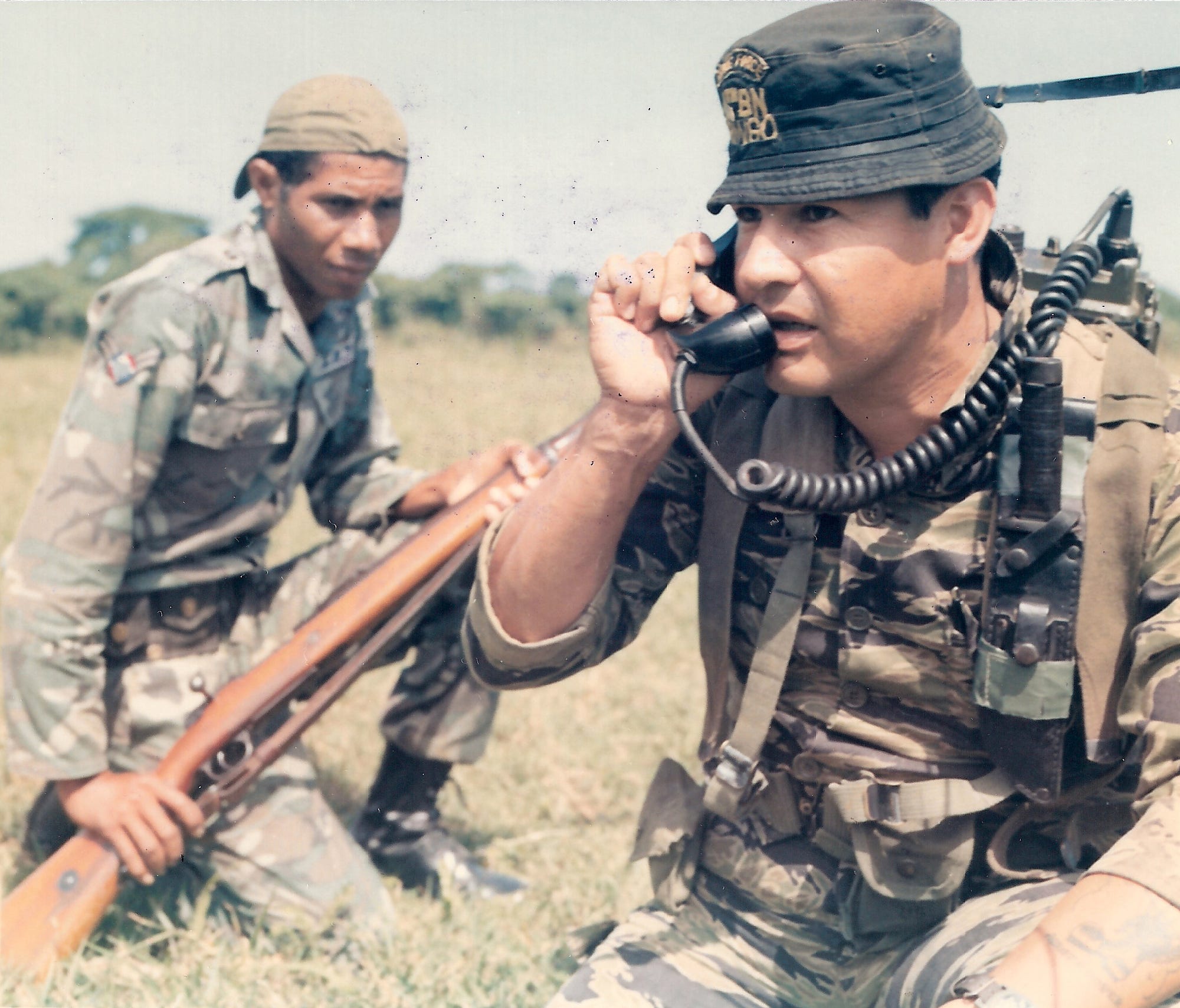
A U.S. Army Special Forces soldier, at right, during a training exercise in the Dominican Republic in 1971. U.S. Southern Command photo

Barack Obama, You’re No Ronald Reagan

September 11, 2014


"It is precisely because Obama is weak that he has a propensity for offering sweeping inflammatory pronouncements that deter no one..."

Barack Hussein Obama may have been trying to sound like Ronald Reagan in his statement on confronting the Islamic State in Iraq and the Levant, but President Obama is no Ronald Reagan—and both the American people and international audiences know it.

First, when President Reagan promised to take action against the Soviet Empire, he was addressing a threat that did not arise due to his own actions. Reasonable people could disagree about Reagan’s policies, but they could not blame him for the Soviet threat.


Not so in Mr. Obama’s case. It is almost certain that ISIL would not have become a serious force—and might not even exist—without Obama’s flawed policies. It was Obama’s decision not to leave a residual force in Iraq that enabled former Prime Minister Nouri al-Maliki to act on his deeply divisive authoritarian and sectarian temptations. The absence of a U.S. military presence in Iraq was likewise detrimental to both the Iraqi army’s capabilities and its will to resist initially small and poorly armed, albeit highly motivated, ISIL troops. Obama’s excuse for this was that he could not keep a residual force in Iraq because Maliki would not sign a status of forces agreement granting immunity to U.S. personnel in Iraq, but former senior U.S. officials from his own administration argue that the President did not seriously try to negotiate an agreement. Instead, he used Maliki’s objections as an excuse to act on his own desire to withdraw completely from Iraq.

Moreover, ISIL would have been unlikely to develop the momentum it did without a sanctuary in Syria. Although President Bashar al-Assad and the nature of his Alawite regime’s minority rule are principally responsible for the rebellion in Syria, Obama’s declaration early on that Assad had to go gave a false encouragement to the opposition and contributed to the country’s bloody civil war. It also led neighboring states, particularly Turkey, to support the insurgency and precluded agreement between Assad and the rebels by discouraging the opposing from accepting anything short of the dictator’s surrender. After all, why should the opposition support a settlement if no less than the President of the United States announces that Assad’s removal is imminent and inevitable? The Syrian opposition, Turkey, and almost everyone else in the region thought that Obama meant it when he said Assad had to go; now we know that Obama said this without any serious analysis of the insurgents’ capabilities or the nature of the opposition coalition and the relative strength and philosophies of its various components. Most important, in retrospect the president’s statement was clearly devoid of any real intent to do much of anything to provide military help to the rebels. This provocative but empty talk makes Obama the polar opposite of Reagan.

Obama’s new sweeping pronouncements are dangerous. If they don’t prove hollow, further discrediting the United States in the process, they compel him put the United States in very dangerous territory. Obama appears to think that he can threaten to do anything, anywhere, against American enemies without any consequences for what he says, does, or doesn’t do. It is precisely because Obama is weak that he has a propensity for offering sweeping inflammatory pronouncements that deter no one but can be exploited by anyone looking for an excuse to disregard sovereignty of others whether in Ukraine or elsewhere.

RIP Great Britain?

September 12, 2014

"Yes" vs. "Better Together": Scotland's day to decide on the independence question draws near. The world will be watching.

The response of the London parties to opinion polls released last weekend, showing the pro-independence “Yes” side ahead for the first time in the looming Scottish referendum, was a panicky one. Even more powers were announced for the autonomous Scottish Parliament. On Wednesday, normal political business at Westminster was abandoned and the main political leaders headed north to act as persuaders for the Union. David Cameron gave a moving speech in Edinburgh. But there was more than a whiff of a cornered Bourbon monarch frantically improvising in a bid to head off an inflamed mob.

It is now hard to recall that just one month ago, the dreams of glory of Scotland’s ruling Scottish National Party (SNP) appeared to be in shreds. In the first of two debates with his chief pro-Union rival Alistair Darling, the normally formidable SNP leader Alex Salmond gave a halting performance. As a separatist, he sounded bizarre when he insisted that “We will take the pound as it belongs to Scotland as much as England, it's our pound!” For Salmond, the British currency was an asset, rather than a means of exchange. He insisted on clinging to it, even though it meant ceding control of financial policy to the state that he was desperate to break away from. In polls and pronouncements, the British people and leaders of all the main parties had declared outright opposition. Yet, Salmond insisted on plowing ahead. He threatened (and still threatens) to renege on Scotland’s share of Britain’s national debt, unless his opponents embrace his quixotic financial union. This would freeze Scotland out of capital markets with stark consequences for the personal finances of probably most of its citizens.

Salmond was generally judged to have lost badly in the August 5 debate. His side was thirteen percentage points behind pro–status quo “Better Together.” But instead of collapsing, his poll figures rose and they went through the roof following the second debate held on August 25 when Salmond offered a performance of undistilled populism. Before a heavily partisan audience and brushing aside an inept moderator, he virtually took charge of the debate. He insisted that the state health service was in danger of being privatized even though his own government controlled every aspect of it under the 1999 settlement, which had transferred a whole range of powers to the Edinburgh parliament formed in that year. Darling, along with numerous viewers was clearly horrified that the BBC had mismanaged such a crucial encounter. The questioning from the audience was overwhelmingly hostile, and he clung grimly to his speakers lectern as Salmond strode the debating stage as if he owned it.

Salmond’s great feat in these decisive weeks has been to neutralize the fear factor. To business chiefs with investments in Scotland and apprehensive national leaders from as far away as Australia and Canada, he appears to be a lord of misrule. His vision of a state-dominated economy in a country currently dependent on an economic lifeline from the rest of the UK, is unappealing. The fact that he doesn’t appear to care that the currency his new state will have is still very much a mystery, is even more unsettling.

Yet, polls showed that a growing number of Scots were at ease with Salmond’s Panglossian optimism. In large numbers and for many months, evangelical campaigners have been systematically working Scotland’s streets, spreading a message of relentless optimism—the people of Scotland are capable of meeting and confronting any challenge that is thrown at them because of the strength of their capabilities.

Britain is depicted as an obsolete and failing country. But currently, the British economy, one with which Scotland is totally intertwined, ranks sixth in the world GDP league. Presuming that a 300-year union could be smoothly unpicked and that there would be no serious investment flight, an independent Scotland would be 42nd in world GDP rankings. One of the world’ s most extensive public sectors would need to be financed from a tax base of under 4 million people instead of the present 52 million.

WITH OR WITHOUT GLOBAL TREATY, BUSINESSES MUST TAKE LEAD ON CLIMATE CHANGE


The private sector must assume the mantle on climate change in the absence of a global agreement, whatever transpires at the UN Climate Summit in New York this month and other upcoming high-level climate change meetings. This was the consensus of panellists in a session on climate change during the eighth Annual Meeting of the New Champions taking place in Tianjin, China.

Renewed attention to climate change by China, the United States and the European Union is creating space for business to engage in a new operating environment in which governments are creating frameworks for innovation and international financial institutions are increasingly funding climate change projects.

“Creating a stable framework has helped our businesses create the solutions we need to combat climate change,” said Rasmus Helveg Petersen, Minister of Climate, Energy and Building of Denmark. “The transition from black to green economies will only be achieved when businesses can make decisions. We need to recognize the need for profitability when we do our regulatory work.”

Xie Zhenhua, Vice-Chairman, National Development and Reform Commission, People’s Republic of China, and China’s lead negotiator on climate change at the United Nations, called on businesses and governments to respond to the climate change challenge. “We need to find a circular pathway to development,” he said. “Businesses need profit, but they need to find a way to achieve common prosperity. If we can do that, we can respond to the climate change challenge and turn the world into a more beautiful place.”

The Inter-American Development Bank has devoted 22% of its total lending towards climate change related issues, said Luis Alberto Moreno, President, Inter-American Development Bank, Washington DC; World Economic Forum Foundation Board Member. “There is huge innovation taking place in the private sector around solutions. This is happening in the absence of a global agreement. This is the most exciting part of what we are seeing today.”

Many businesses through their supply chains and manufacturing processes are using technology to reduce their emissions to reduce costs. Others are technology pioneers, breaking new ground in the fight against climate change. Mark Herrema, Co-Founder and Chief Executive Officer, Newlight Technologies, USA, said: “What is missing is something to bridge the gap between what we need to address [in terms of climate change] and people who ask why they cannot use carbon to growth their businesses,” he said. “Industry is taking climate change into their own hands and sequestering carbon.”

Feike Sijbesma, Chief Executive Officer and Chairman of the Managing Board, Royal DSM, Netherlands, said the public and private sectors must work together but that business must take the lead. “Mother Earth is not helped by targets and good intentions, but real innovations to change things,” he said. “We in the private sector cannot hide ourselves behind the lesser progress made in public debates.”

Reorganising the Defence of India: The Task Ahead

10 Sep , 2014

Changes would provide a boost to defence preparedness, usher in an RMA, evolve requisite strategies and policies including for national security, response to asymmetric war, defence procurements, R&D, technology acquisition and reorganising the defence-industrial base. Development and economic progress are undoubtedly priority tasks for the new government but national defence and security issues must be given equal importance if India is to gain its rightful place in the comity of nations.

While both China and Pakistan possess advanced Sub-Conventional capability, India is lagging behind…

The security imperatives for India are multiple and dynamic with a volatile neighbourhood. The last decade has been characterised by utter neglect of the defence sector, the main features being – lack of a national security strategy and a comprehensive defence review; disjointed acquisitions in the absence of a security strategy and clear national security objectives; ignoring military modernisation, allowing the capability gap between own military and the Chinese PLA to increase exponentially; failure to establish a deterrent to proxy and asymmetric war; poor response to border violations, cross-border attacks and intrusions, showing the military and the country in poor light; inadequate border management; military-industrial complex in downward spiral with patchy windows of excellence, forcing import of over 80 per cent of defence needs; generalist bureaucrats ruling the roost in the Ministry of Defence (MoD) without accountability, one example being critical deficiencies in the Indian Navy courtesy MoD intransigence resulting in serious damage to the naval fleet with avoidable loss of lives and equipment, while the MoD failed to take any responsibility whatsoever; civil-military relations hit rock bottom with military deliberately lowered in the Warrant of Precedence; government fighting its own soldiers in Courts denying them authorised pay and allowances, even to the extent of forcing war disabled soldiers and war widows into long legal battles and paid media denigrating the military to show it in poor light.

The debate over the budget for defence and for economic growth is never-ending but recent media reports of the demand for a ten per cent increase in the defence budget just to cater for inflation (forget modernisation) indicates the grim picture. A country which is not strong militarily can hardly develop economically without a ‘safe and secure’ environment especially in a geographical and geo-political setting such as India. We also failed to grasp that conventional response and diplomacy by itself is no match to irregular threats despite having been subjected to proxy war for over two decades.

A priority task should be to define a National Security Strategy (NSS) followed by a Strategic Defence Review (SDR)…

Security Paradigm

India's Rising Military Might: Made in the USA?

September 11, 2014 

An interesting trend: America has supplanted Russia as New Delhi’s primary supplier of defense materiel. Will it last?

In August, the Indian Ministry of Defense approved the $2.5 billion purchase of 22 Boeing AH-64E Apache attack helicopters and 15 CH-47F Chinook heavy lift helicopters. The sale still has one last hurdle—Indian Cabinet approval—but if completed it will be the latest example of a major shift in U.S.-Indo relations that in the past three years have seen Washington become India’s top defense equipment supplier.

The approval of the Apache and Chinook deals comes about a month after Defense Secretary Chuck Hagel arrived in Delhi promising the El Dorado of defense deals: joint development and local manufacture of top-end U.S. kit.

The deal consisted of joint development of a new version of the Javelin antitank missile and the promise of access to electromagnetic catapult technology for India’s next generation of aircraft carriers.

Ministry of Defence (MoD) sources told IHS Jane’s that other U.S. technologies on offer included design and build of unmanned aerial vehicles, big-data systems, 127 mm naval guns and multirole helicopters for the Indian Navy.

"We can do more to forge a defense industrial partnership—one that would transform our nations' defense cooperation from simply buying and selling to co-production, co-development, and freer exchange of technology," Hagel said in a speech at the Observer Research Foundation in Delhi. Referring specifically to the possibility of Javelin co-development, Hagel said: "This is an unprecedented offer that we have made only to India."

So goes the sales pitch. The interesting thing about it is that so far, U.S.-Indo defense deals have followed the tried-and-tested Foreign Military Sales (FMS) route: a government-to-government procedure that avoids negotiating pitfalls and potential corruption. It also limits the extent to which the buyer can add any sweeteners, such as the transfer of technology or local assembly options that are key to modern defense deals between developed and developing countries.

Despite this reticence on Washington’s part, its push into the Indian market has been very successful. According to IHS Jane’s data, in 2009 India imported only $200 million in military equipment from the US; by 2013 that had jumped to $2 billion.