2 November 2014

The Gathering Storm

31 Oct , 2014


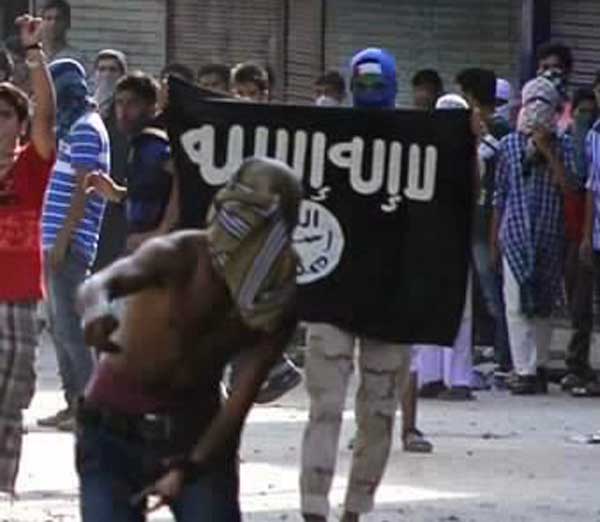
ISIS Flags appeared in Kashmir during protests after Eid prayers

It is a troubled world that we live in today and there are many reasons for this. Draw a straight line from Pakistan to Turkey, swing down to the Gaza Strip and from there to Yemen, and we have an area embroiled in all sorts of conflicts, some recent and some that have lasted for decades. Another journey from Sinai to the Maghreb, thence to Nigeria and Central Africa and ending in Somalia, covers another arc of what is, at times, extremely brutal conflict.

What stands out most is the brutality of this group (ISIS) that has suddenly become a semi-state that no one seems to challenge, and the extent to which neighbours would go to allow the genocide of the Yazidis and Kurds to preserve their national interests.

Three recent maps would also explain the depth, scale and complex nature of the conflict. One, a map of Baghdad depicting, in small red dots, car bomb explosions in the city since its so called liberation in 2003. The entire map is full of these red dots and it is impossible to read the name of the streets or localities. The second map is of Syria with its conflict zones and the areas held by various factions ripping the country apart. It is more like a scrambled egg that has gone wrong and it is impossible to unscramble this.

The third map was published by Washington Post a few days ago, and shows the countries from where various jihadis have joined battle in Syria on behalf of ISIS. Many of the volunteers are from countries that are actually allies and friends of the US, but are fighting against US interests. This map may not be very accurate as it does not show anyone as having gone from India.

The sudden rise of the ISIS and its successes, its wealth and armament are a subject of some, if not complete mystery. Above all, what stands out most is the brutality of this group that has suddenly become a semi-state that no one seems to challenge, and the extent to which neighbours would go to allow the genocide of the Yazidis and Kurds to preserve their national interests. Local paranoia against Shia regimes that have strengthened since the Iraq War, local ethnic and sectarian conflicts, regional and big power interests (the Russian-American rivalry in the region is still active) are the source of trouble and confusion.

Then there is the American desire to fix the obdurate Bashar Assad, demonstrably be the Super Power and sell the American Dream but without wetting its feet. The trouble now is that we live in a world where military power alone no longer guarantees success. This is bad news at a time when defeat is unacceptable, as it is going to be perceived as a sign of decline. The worry is that rich and powerful nations are like Great Gatsbys.

Despite U.S. Airstrikes, More Than 1,000 Foreign Fighters Joining ISIS Every Month

Airstrikes against Islamic State do not seen to have affected flow of fighters to Syria

Greg Miller
Washington Post
October 31, 2014

More than 1,000 foreign fighters are streaming into Syria each month, a rate that has so far been unchanged by airstrikes against the Islamic State and efforts by other countries to stem the flow of departures, according to U.S. intelligence and counterterrorism officials.

The magnitude of the ongoing migration suggests that the U.S.-led air campaign has neither deterred significant numbers of militants from traveling to the region nor triggered such outrage that even more are flocking to the fight because of American intervention.

“The flow of fighters making their way to Syria remains constant, so the overall number continues to rise,” a U.S. intelligence official said. U.S. officials cautioned, however, that there is a lag in the intelligence being examined by the CIA and other spy agencies, meaning it could be weeks before a change becomes apparent.

The trend line established over the past year would mean that the total number of foreign fighters in Syria exceeds 16,000, and the pace eclipses that of any comparable conflict in recent decades, including the 1980s war in Afghanistan.

U.S. officials have attributed the flows to a range of factors, including the sophisticated recruiting campaigns orchestrated by groups in Syria such as the Islamic State and the relative ease with which militants from the Middle East, North Africa and Europe can make their way to that country.


Map: Flow of foreign fighters to Syria

American officials stressed that the stability of the flow is not seen as a measure of the effectiveness of an air campaign that expanded beyond Iraq and into Syria late last month. The latest estimates indicate that strikes in Syria alone have killed about 460 members of the Islamic State — the group that has beheaded two American journalists and two British aid workers — as well as about 60 fighters from Jabhat al-Nusra, an al-Qaeda affiliate.

The United States and its allies have carried out more than 600 strikes so far in Syria and Iraq, bombings aimed primarily at slowing the Islamic State’s advances and allowing the Iraqi military and moderate opposition forces in Syria to regroup. Rear Adm. John Kirby, spokesman for the Pentagon, said this week that the strikes are “disrupting” the Islamic State’s operations but acknowledged that any major offensive against the group “may still be a ways off.”

What China’s Newest Cyber Espionage Unit, the Axiom Group, Stole From U.S. Government and Defense Contractors

New Chinese Intelligence Unit Linked to Massive Cyber Spying Program

Bill Gertz
Washington Free Beacon
October 31, 2014

A Chinese intelligence unit carried out a massive cyber espionage program that stole vast quantities of data from governments, businesses and other organizations, security analysts who uncovered the operation said Thursday.

The activities of the Chinese unit called the Axiom group began at least six years ago and were uncovered by a coalition of security firms this month.

Cyber sleuths traced Axiom attacks to the 2009 cyber operation against Google in China and other U.S. companies known as Operation Aurora. The group was also linked to a Chinese hacking program that targeted dissidents and opposition groups known as GhostNet. More recent Axiom attacks took place against Japan, the U.S. Veterans of Foreign Wars, and U.S. think tanks.

In the past two weeks, 43,000 computer networks at nearly 1,000 organizations were cleaned of multiple types of cyber espionage spyware from Axiom cyber spies, including 180 highly sophisticated computer penetrations at key Chinese targets that employed a program called Hikit that specializes in automated data theft.

Investigators found that the Chinese used up to four different types of malicious software in a single information-stealing operation, and a total nine different types of spying malware overall, ranging from rudimentary to very sophisticated.

The group conducting the attacks is “a truly advanced hacker,” said Zachery Hanif, a cyber security expert with Novetta, a Virginia-based company that was one of the first to identify Axiom cyber attacks.

“We believe they are a highly sophisticated and very prolific cyber espionage team,” Hanif said in an online briefing for reporters. “We certainly have a moderate to high degree of confidence that the [Axiom] tasking is part of the Chinese intelligence apparatus.”

An FBI alert issued Oct. 15 bolsters the commercial findings. The alert states that the Bureau has high confidence that the new unit is “a group of Chinese government affiliated cyber actors who routinely steal high value information from U.S. commercial and government networks through cyber espionage.”

The FBI said the new group differs from the Chinese military hacking unit known as PLA Unit 61398 by operating in an “exceedingly stealthy and agile” fashion, compared to the military unit.

“This Chinese government affiliated group previously documented by private sector reports by the names of Operation Deputy Dog, Snowman, Ephemeral Hydra, APT17, Bit9, Google security alerts and parts of Hidden Lynx, has heavily targeted the high tech information technology industry including microchip, digital storage and networking equipment manufacturers, as well as defense contractors in multiple countries and multinational corporations,” the FBI said.

Hanif said attributing the Axiom spying to a specific Chinese intelligence agency is difficult because of problems involved in making direct attributions in cyberspace to specific actors.

But during the briefing Hanif said indicators of Axiom revealed activities that were aligned with Chinese government five-year economic and technological development plans.

Hanif said detailed analysis of software and digital attack methods of the group against specific targets reveals the activities are “heavily aligned with what’s been published as strategic interests for the Chinese government.”

China’s targets included Asia and western governments, specifically communications agencies, aerospace and space research, law enforcement, personnel management, and government auditing and internal affairs.

Using proxy servers in Hong Kong, Taiwan, Japan, South Korea, the United States and Europe, Axiom cyber spies sought data and technology form the following targets:

What China’s Newest Cyber Espionage Unit, the Axiom Group, Stole From U.S. Government and Defense Contractors

New Chinese Intelligence Unit Linked to Massive Cyber Spying Program

Bill Gertz
Washington Free Beacon
October 31, 2014

A Chinese intelligence unit carried out a massive cyber espionage program that stole vast quantities of data from governments, businesses and other organizations, security analysts who uncovered the operation said Thursday.

The activities of the Chinese unit called the Axiom group began at least six years ago and were uncovered by a coalition of security firms this month.

Cyber sleuths traced Axiom attacks to the 2009 cyber operation against Google in China and other U.S. companies known as Operation Aurora. The group was also linked to a Chinese hacking program that targeted dissidents and opposition groups known as GhostNet. More recent Axiom attacks took place against Japan, the U.S. Veterans of Foreign Wars, and U.S. think tanks.

In the past two weeks, 43,000 computer networks at nearly 1,000 organizations were cleaned of multiple types of cyber espionage spyware from Axiom cyber spies, including 180 highly sophisticated computer penetrations at key Chinese targets that employed a program called Hikit that specializes in automated data theft.

Investigators found that the Chinese used up to four different types of malicious software in a single information-stealing operation, and a total nine different types of spying malware overall, ranging from rudimentary to very sophisticated.

The group conducting the attacks is “a truly advanced hacker,” said Zachery Hanif, a cyber security expert with Novetta, a Virginia-based company that was one of the first to identify Axiom cyber attacks.

“We believe they are a highly sophisticated and very prolific cyber espionage team,” Hanif said in an online briefing for reporters. “We certainly have a moderate to high degree of confidence that the [Axiom] tasking is part of the Chinese intelligence apparatus.”

An FBI alert issued Oct. 15 bolsters the commercial findings. The alert states that the Bureau has high confidence that the new unit is “a group of Chinese government affiliated cyber actors who routinely steal high value information from U.S. commercial and government networks through cyber espionage.”

The FBI said the new group differs from the Chinese military hacking unit known as PLA Unit 61398 by operating in an “exceedingly stealthy and agile” fashion, compared to the military unit.

“This Chinese government affiliated group previously documented by private sector reports by the names of Operation Deputy Dog, Snowman, Ephemeral Hydra, APT17, Bit9, Google security alerts and parts of Hidden Lynx, has heavily targeted the high tech information technology industry including microchip, digital storage and networking equipment manufacturers, as well as defense contractors in multiple countries and multinational corporations,” the FBI said.

Hanif said attributing the Axiom spying to a specific Chinese intelligence agency is difficult because of problems involved in making direct attributions in cyberspace to specific actors.

But during the briefing Hanif said indicators of Axiom revealed activities that were aligned with Chinese government five-year economic and technological development plans.

Hanif said detailed analysis of software and digital attack methods of the group against specific targets reveals the activities are “heavily aligned with what’s been published as strategic interests for the Chinese government.”

China’s targets included Asia and western governments, specifically communications agencies, aerospace and space research, law enforcement, personnel management, and government auditing and internal affairs.

Using proxy servers in Hong Kong, Taiwan, Japan, South Korea, the United States and Europe, Axiom cyber spies sought data and technology form the following targets:

Cyber Attack on White House Computers Was Deemed So Sensitive That Only a Small Number of Congressional Leaders Were Told

Only top legislators informed of White House computer attack

Reuters
October 30, 2014


A general view of the White House in Washington September 30, 2013.

(Reuters) - An attack by hackers on a White House computer network earlier this month was considered so sensitive that only a small group of senior congressional leaders were initially notified about it, U.S. officials said on Thursday.

The officials said the Democratic and Republican leaders of the Senate and the House of Representatives and the heads of the Senate and House Intelligence Committees, collectively known as the “Gang of Eight,” were told last week of the cyber attack, which had occurred several days earlier.

Security experts said this limited group would normally be informed about ultra-secret intelligence operations and notifying them of a computer breach in this way was unusual.

Bernadette Meehan, a spokeswoman for the National Security Council, said, “Consistent with sensitive intelligence matters, the director of the FBI notified congressional leadership and the chairs and ranking members of the intelligence committees.”

On Tuesday a White house official, speaking on condition of anonymity, said there had been a cyber attack on what was described as an unclassified computer network used by employees of the Executive Office of the President.

The Washington Post earlier this week suggested hackers working for the Russian government may have been behind the attack. U.S. officials declined to say who was suspected, and some suggested many governments were capable of carrying it out.

Steven Aftergood, an expert on government secrecy with the Federation of American Scientists, said “Gang of Eight” notifications were typically used to keep Congress informed of sensitive “covert actions” by agencies such as the CIA.

"Why would they limit the disclosure in this way? It might be a sign that they had not yet evaluated the breach and were uncertain about its sensitively or whether it was part of a larger (hacking) operation," Aftergood said.

Lawyers Without Borders Says That Its Computers Have Been Hit By Chinese Cyber Attack

SC Exclusive: Human rights lawyers hit by Chinese cyber-attack

Tony Morbin
SC Magazine (UK)
October 29, 2014

Lawyers Without Borders (LWOB), a not-for-profit international organisation that promotes and facilitates the application of rule of law by providing pro bonoservices to activists seeking to exercise their human rights, is currently under attack from an unknown entity based in China.

Christina Storm, founder and executive director of LWB emphasised toSCMagazinUK.com that the organisation was not currently pursuing any cases in China, nonetheless, since the beginning of October there have been more than 1,000 attacks on its website from a specific location in China. 

“We know the commercial building used, we know the IP address and there are attacks every four minutes, so it’s not legitimate usage. I have even been unable to get into our own server, with the message that someone else is already logged in using that name. Someone in China has a disproportionate interest in our organisation,” said Storm.

The organisation had its previous portal compromised by a different, unnamed, government some years ago, probably using a key logger in a public computer, but it believes its current portal is secure enough to withstand attack. 

LWOB has state-of-the-art infrastructure thanks to donated technologies under various companies’ corporate social responsibility programmes. After experimenting with various online cloud-based systems – needed due to the global nature of its activities – four months ago LWOB it moved its portal to the Intralinks platform – which is cloud-based with strong security. 

While the balance between usability and security was sought, security of documents was the priority. 

“Our work can save lives – and lives can be lost if we are compromised. We are not trying to overthrow governments, or even engage in overt advocacy, but we are concerned with building capacity of individuals within countries seeking to compel authorities to abide by international commitments that they have made,” Storm told SC. 

New Details About ISIS’ Dreaded Intelligence Service

IS uses intelligence to purge opponents

Ali Mamouri
Al-Monitor (Beirut, Lebanon)
October 28, 2014

NAJAF, Iraq — The Islamic State (IS) differs from its predecessors and similar groups by running a powerful intelligence apparatus that is strong and has plenty of security experience acquired by intelligence officers from the previous regime. The IS intelligence apparatus carries out various types of operations, similar to other intelligence apparatuses around the world. One of its most important operations is to monitor and identify its opponents, to eliminate them immediately and to avoid the possibility of the Iraqi government, and other local and regional opposing parties, to infiltrate its intelligence apparatus, or a military opposition to emerge on its territory.

Based on IS operations, the list of people to eliminate includes tribal sheikhs who have previously cooperated with the government, members of the Awakening movement who have participated in fighting jihadist groups in the past, clerics who oppose IS’ extremism and anyone suspected of delivering security information to governmental parties or other cooperating parties.

The policy of eliminating opponents as soon as they take over large areas is considered an established IS method that was adopted when it evolved in Iraq after the 2003 invasion. In addition to the security reasons, this technique is also based on IS’ extremist Salafist principles, which aim to purge the land of any opposition party, to create a unified Salafist community without religious or political differences.

Ground campaigns against IS have increased since the formation of the international alliance that launched airstrikes on IS sites, leading to the group’s elimination from regions it previously occupied. In addition to this, assassinations started being carried out against the IS leadership in Mosul and other Iraqi regions, which pushed the group to further tighten its security and eliminate a large number of suspects.

Several IS leaders were targeted, including Abu Anas al-Kurdi, an official in one of the military wings of Mosul, who was killed during an airstrike on Sept. 29. A source in Mosul told Al-Monitor that IS tightened its security after the attack by limiting prominent leaders’ appearances in public as well as arresting people suspected of delivering information to newspapers or any other external parties.

Al-Monitor interviewed a field activist in the city of Hit, two days after it fell into IS hands on Oct. 13, after a significant advance in Anbar province that included most of its cities. The source said that some residents were IS members without the knowledge of their neighbors. After IS took over, the militants eliminated anyone who was inciting people against IS, or working with the army and opposing tribes. People are eliminated based on the information provided by residents who are IS members.

Backgrounder: Why the U.S. ‘Strategy’ To Beat ISIS in Syria May be Doomed to Fail

Analysis: In Syria, No Good Options for West

Associated Press
October 31, 2014

With the U.S.-led assault on the Islamic State group, the world community is acting in Syria, but not in the Syrian civil war. When it comes to the issue that has undermined the region — the survival or fall of Syrian President Bashar Assad — there is still no plan.

And that means the West’s goal to defeat the militants of IS may also be doomed to fail.

Syria’s four-year civil war has killed hundreds of thousands and displaced millions in what began as a movement to replace Assad with a more democratic state. As the government’s control weakened, militants rallying around Islamic slogans carved out a vast safe haven for themselves - recruiting, training and building fighting capacity. From Syria this year, they then struck deep into Iraq, with devastating effect, and now also threaten Lebanon.

Yet any concerted effort to oust Assad and restore stability to Syria does not appear to be on the horizon.

What emerges instead from the actions and words of Western policymakers is a glum resignation that there is nothing that can be done about Assad for now, and the fight is only with the Islamic State.

For many world leaders, allowing Assad to remain in control in Damascus appears to be the least-bad option.

That’s striking, given the disaster he has overseen.

In an ideal world from a Western perspective, an army of “moderate” rebels headquartered in Istanbul would be an attractive choice to march into Syria and defeat both the Islamic State and the Syrian government. There are some rebels who are pro-Western and largely secular. Some even can be heard on Israeli radio stations promising a future of regional peace.

But upon inspection, these rebels are few, badly divided, and barely control the Free Syria Army, which purports to be their force on the ground and has little political support inside Syria. In reality, Free Syria Army fighters are often militant Islamists; in some cases, they have fought alongside al-Qaida’s branch in the country, the Nusra Front, or other jihadi groups. On the whole, they are far more motivated to fight against Assad than against the Islamic State militants.

So when Assad says that his is a fight against terrorists and radical Islamists, even to his staunchest critics the charge rings partly true.

All that is left is a disagreement over how Syria got there: European and other critics charge that Assad’s brutal suppression of an initially peaceful and largely secular protest movement created the space for jihadis to move in. Assad claims they were there all along.


The current reality is that Syria has been divided into three or four parts. Assad controls most of a strip of land from Damascus to the Mediterranean coast, where his Alawites and other minorities are dominant. The Islamic State group controls the river corridor to Iraq and much of the northeast; the Kurdish minority controls a corner near the Turkish border; and an array of other rebel groups including the Free Syria Army and various Islamists control parts of the northwest.

SUPERIORITY AT ANY PRICE? POLITICAL CONSEQUENCES OF THE FIRST OFFSET STRATEGY

October 30, 2014


Military strategies serve political ends. Judgments about their effectiveness cannot be separated from the historical and geopolitical context in which they exist. The first U.S. offset strategy met the demands of strategic competition, but in its political context, failed in crucial respects. Any attempt to replicate this past “success” is therefore potentially valuable, but also fraught with hazard. Given the emerging trends in the global security environment, it makes eminent sense that the United States seek ways to offset its strategic vulnerabilities. In so doing though, it must be honest about what did not work in offset strategies past.

The Pentagon’s search for “technological superiority” and a third offset strategy is explicitly premised on the perceived successes of two previous offset strategies—nuclear deterrence in the 1950s and the guided munitions regime in the 1970s. The success the Pentagon wants to replicate is reasonably clear: military-technical advantage in long-term competition with any would-be adversary. At present, this means being able to project power despite anti-access/area denial strategies by adversaries. This aspiration is logical and laudable. Even those who think of international politics as more than competitions in military power surely recognize the strategic constraints imposed on any decision-maker by technological and financial resources. But the flaws of the first offset strategy deserve attention as well, if only to avoid replicating them.

Political Fallout from Nuclear Strategy

In the 1950s, Eisenhower initiated the “New Look,” which represented a shift in military-technical strategy away from principal reliance on mass, maneuver, and mechanized warfare to one that rested on deterrence through U.S. nuclear superiority. The logic of New Look, and the associated doctrine known as “massive retaliation,” was that the United States’ technical advantage in nuclear weapons could be used to offset Eisenhower’s planned drawdown of conventional U.S. force structure, and resulting shortfalls in U.S. ground forces. Eisenhower reasoned that fewer troops and tanks would be necessary to counter adversary conventional forces if deterrence and compellence could be achieved through the threat of overwhelming nuclear attack.

For all its persuasive rationality, this nuclear-reliant offset strategy led to several interrelated political and military consequences: a strategy that the United States acknowledged was premised on a “wasting asset,” nuclear proliferation and incentives for a Soviet first strike, and questionable credibility and constrained policy options during real-world crises.

Even as the Eisenhower administration advocated for a nuclear-centric strategy, military planners knew that nuclear weapons were a “wasting asset,” meaning that the strategic and political value of U.S. nuclear weapons were threatened by others developing them. The ability to rationally coerce others with its nuclear arsenal, based on the thinking at the time, depended on U.S. nuclear primacy, which was quickly eroding. This pushed many U.S. officials into perceiving an emerging “window of vulnerability”—that is, the United States would soon become vulnerable to adversary nuclear weapons if it did not launch preventive attacks to prevent nuclear parity—which logically led to several figures in the U.S. government advocating nuclear preemptive strikes against nuclear-aspirant adversaries, including the Soviet Union and China.

In addition to generating an internal U.S. discourse supporting preemptive nuclear strikes, a strategy that placed at its center a “wasting asset” inspired nuclear proliferation and bolstered Soviet first-strike incentives. U.S. nuclear weapons and the threat of their use did not just drive an arms race with the Soviets, but also proliferation by China and eventually North Korea, both of whom concluded that U.S. attempts at nuclear coercion necessitated nuclear programs of their own. From the Soviet perspective, the idea that any direct conflict with the United States would inevitably lead to massive retaliation gave strong incentives to the Soviet Union to launch nuclear first strikes for its best chance of survival, especially if it believed conflict was impending.

UNCONSTRAINED GRAND STRATEGY

October 28, 2014 

How grand is grand strategy? Frank Hoffman, a friend and WOTR contributing editor, wrote an article titled “Grand Strategy: The Fundamental Considerations,” availablebehind the paywall at Orbis, the journal of the Foreign Policy Research Institute. Like all of Hoffman’s work, it is well written, sensible, and meticulously sourced. Should you have the means, I urge you to read it. Hoffman offers eight “considerations” that influence the making of grand strategy, but more to the point, U.S. grand strategy: 

Context and culture 
Constraints 
Compromise and consensus by council 
Competiveness 
Coherence 
Contingency 
Continuous assessment and adaptation 
Communication 

Each consideration is thoroughly explored, and the piece is chock full of supporting quotes from the grandees of strategy. Seven of Hoffman’s considerations are spot on, coherent, and complete, yet one of his arguments—his discussion of constraints—inspired an epiphany worth sharing. He writes,

There are pundits in the United States that believe strategies should be unconstrained, reflecting that American predisposition towards engineered solutions and massive resources.

He continues, “Thinking of strategy without understanding the limits of means or resources is woefully delusionary.” Later still, he writes, “Future U.S. national security strategies will have to seek creative and relevant solutions with fewer resources.”

While his essay claims to deal with grand strategy, this passage is one of a few places where it dips clearly into military strategy, an area in which the ends-ways-means construct adds rigor and structure to thinking. Grand strategy is different, because as Hoffman acknowledges, it “requires the conceptualization of all the elements of national power.” Therefore, a true grand strategy does not ignore resource constraints so much as it seeks to define (and redefine) them. I would go so far as to say that while grand strategy may not be resource “unconstrained” it must surely be the least constrained layer of strategic thinking, in that it can and should—as a product of its own logic—re-order a nation’s economy and resources in order to achieve the desired strategic ends.

One example of this surely must be the last successful grand strategy that the United States pursued, that of containment. Think back to NSC-68, and then try and fit all that it entailed, the national effort it required—centered around defense spending but not solely a product of it—into the “available resources” the nation provided in the five years after the defeat of the Axis powers. No one associated with the shaping of containment threw up their hands and gave up because the resources to implement it were not immediately available after a long and expensive war. The grand strategy itself provided the thinking and effort required to generate the necessary resources and direct them toward an ambitious, global, and grand strategy.

However, for some reason, the masters of strategy would knowingly deprive today’s grand strategists of one of the most important elements of national power: the power of the nation to produce goods and services. All manner of noise is made about grand strategy representing the highest synthesis of all the elements of national power toward a set of defined ends, and then the grand strategist is handcuffed by having to devise a grand strategy “within the limits of means or resources,” which in practice, means “the budgetary outlay devoted to national security.” This is self-defeating, it is illogical, it is counterfactual, and it results in an impoverished set of strategic options. Keep in mind that we are limiting ourselves here to the realm of grand strategy, in its broadest terms. The making of military strategy must be guided by respect for resources, because presumably, by this time a coherent grand strategy would have suggested the proper allocation of national resources to the military instrument.

If I could change one thing in the U.S. military personnel system (1): It is time to extend the age of military retirement

Note: This begins a new Best Defense contest! If you could change one thing in the U.S. military personnel system, what would it be? Got a good idea? Please send it to the blog e-mail address with "PERSONNEL" in subject line.

By John T. Kuehn
Best Defense guest columnist

In the ongoing swirl of the various debates over defense reform, which all too often look more like debates about "what do we spend our money on next?" we find one area of particular promise. This is the area of the promotion, retention, and retirement policy affecting all ranks and grades of the U.S. military. One headline proclaims, "Changes needed in Army's 'archaic' retention, promotion system."

First we must understand the system in place today. Simply, service to 20 years while on active duty gets one a military pension, although at the lowest level of 50 percent of base pay (BP). Service to 30 gets one the maximum allowable by law, 75 percent of base pay. Recently I listened to retired Marine Corps Lieutenant General Paul Van Riper share his thoughts on this very issue. Van Riper advocated longer time in grade with a view toward longer terms of service, noting that when the current system was created, over 50 years ago, the average 45-50 year-old (normally male) smoked, drank, and did not eat and exercise in a manner that led to long-term health. The current system was designed because between the 20 to 30 year stretch was statistically when military personnel had been physically and emotionally "used up." However, these conditions no longer apply.

Today, folks are a lot healthier when they retire and could reasonably be expected to serve under the generally harsher circumstance of military service longer than they could in the past. The current system needs to recognize and account for the improvements in healthcare and lifestyle by those Americans who qualify for military service in its promotion and retention policies, and it should do this with meaningful policy change.

When it comes to implementation of change, I am with the incrementalists. Change tends to work better, and is easier to implement, in chunks. Create and pass legislation that "grandfathers" certain year groups (YG) -- the year a person enters active military service (e.g. YG 2005 and earlier) -- and then apply a system that begins with YG 2006 being eligible for retirement at the completion of 25 years, instead of 20 years, of active service. This will require a commensurate change in time in grade, a change that will modify the "up and out" paradigm that forces personnel out of the service because they fail to promote to the next rank or grade. An incremental approach here should be aligned with any retirement eligibility extension. This would impact the middle grades of officers and enlisted the most, especially E6 (e.g. staff sergeant) and O-4 for officers (majors and lieutenant commanders).

The second and "n-th" order effects will be considerable, and the assignments officers, detailers, and personnel managers at the various bureaus of personnel and human resources commands (HRC) will have to earn their pay, but they should also be in their jobs longer, which means folks currently in command will probably serve a bit longer, especially at field grades (O-4) and above. So this is the first step. I think a 25-year no-earlier-than date is probably something we should do for ten years to transition to a goal of 30 years as the minimum retirement. I am sure smart people on active duty are thinking about this, but like the end of the Cold War, they probably do not think it will happen on their watch.

My sense today is that all the reform talk simply is nibbling at the margins and calling it profound. Reform of the promotions and time in grade system is a good place to start and it might lead to bigger things. Let's call a turkey a turkey and not an eagle. Until then we will not soar, and instead we might get our goose cooked.

John T. Kuehn is the Major General William A. Stofft chair of historical research at the U.S. Army's Command and General Staff College. He retired from the Navy as a commander in 2004 and earned his Ph.D. in history from Kansas State University in 2007. He is the author of Agents of Innovation (2008) and Eyewitness Pacific Theater (with D.M. Giangreco, 2008). The views expressed are those of the author and do not necessarily reflect the official policy or position of the Department of the Army, Department of Defense, or the U.S. government.

Military Hates White House ‘Micromanagement’ of ISIS War


WRITTEN BY Josh Rogin Eli Lake 
10.31.14 

The Pentagon brass placed in charge of implementing Obama’s war against ISIS are getting fed up with the short leash the White House put them on. 

Top military leaders in the Pentagon and in the field are growing increasingly frustrated by the tight constraints the White House has placed on the plans to fight ISIS and train a new Syrian rebel army. 

As the American-led battle against ISIS stretches into its fourth month, the generals and Pentagon officials leading the air campaign and preparing to train Syrian rebels are working under strict White House orders to keep the war contained within policy limits. The National Security Council has given precise instructions on which rebels can be engaged, who can be trained, and what exactly those fighters will do when they return to Syria. Most of the rebels to be trained by the U.S. will never be sent to fight against ISIS. 

Making matters worse, military officers and civilian Pentagon leaders tell The Daily Beast, is the ISIS war’s decision-making process, run by National Security Adviser Susan Rice. It’s been manic and obsessed with the tiniest of details. Officials talk of sudden and frequent meetings of the National Security Council and the so-called Principals Committee of top defense, intelligence, and foreign policy officials (an NSC and three PCs in one week this month); a barrage of questions from the NSC to the agencies that create mountains of paperwork for overworked staffers; and NSC insistence on deciding minor issues even at the operational level. 

“We are getting a lot of micromanagement from the White House. Basic decisions that should take hours are taking days sometimes,” one senior defense official told The Daily Beast. 

Other gripes among the top Pentagon and military brass are about the White House’s decision not to work with what’s left of the existing Syrian moderate opposition on the ground, which prevents intelligence sharing on fighting ISIS and prevents the military from using trained fighters to build the new rebel army that President Obama has said is needed to push Syrian President Bashar al-Assad into a political negotiation to end the conflict. 

The New York Times reported Wednesday that Defense Secretary Chuck Hagel himself is among the critics of Obama’s strategy in Syria. Hagel wrote a memo last week to Rice warning that Obama’s Syria strategy was unclear about U.S. intentions with respect to Assad, undermining the plan. 

Hagel stood by the memo Thursday. “We owe the president and we owe the National Security Council our best thinking on this. And it has to be honest and it has to be direct,” he told reporters. 

But the top uniformed military leaders in charge of the operation also are struggling to work around the White House policy constraints and micromanagement, including Joint Chiefs Chairman Gen. Martin Dempsey; Gen. Lloyd Austin, commander of CENTCOM; and Gen. Michael Nagata, the SOCOM lead official in charge of the Syrian train and equip program, according to multiple officials and people briefed by those generals. 

Nagata has been tasked with building a new rebel army from scratch but is not permitted to work with existing brigades, meaning he must find and vet new soldiers, mostly sourcing from Syrian refugee camps in Turkey, Jordan, and Lebanon. What’s more, the size of the program will produce only 5,000 fighters a year after the training begins, most of whom who will serve as “local defense forces” and not go after ISIS, according to two officials briefed on the plan. Of those forces, 500 would be given additional training in “counterterrorism.” That’s a small attack force to face an ISIS military that is estimated to have tens of thousands of fighters. 

Dempsey told reporters Thursday that the recruiting and vetting of soldiers for the new Syrian rebel army has not yet begun, although sites for the training camps have been chosen. 

“At this point we still don’t know how long it’s going to take to send in the trained guys,” a senior Defense official said. “The situation is changing so much on the ground it’s hard to plan it out.” 

AGAINST A TECH-CENTRIC OFFSET

October 29, 2014 

Finding the right offset strategy may very well be the key to the United States maintaining its edge over current and future competitors, but are Washington strategists looking at the problem right? I worry that some are putting the technology cart before the strategy horse.

According to the press release, the new CNAS “Beyond Offset” project seeks “to examine how the U.S. military can maintain its technological advantage through a period of declining defense budgets.” The project presumes that technology is the core issue for maintaining American military superiority well into the 21st century.

This places a means (technological superiority) to achieve national security ends before the dealing with of the strategic ends themselves. It assumes that technological superiority is necessary and perhaps sufficient regardless of the specific strategies in place. The endeavor also assumes that the rest of the world will cooperate in complying with the strategic, operational and tactical dictates such technological superiority requires. Given that our last two wars were fought against low-tech opponents, this assumption merits serious reconsideration. The current CNAS project makes it appear as if the U.S. national security community could wave a magic wand over the future security environment, with all its various stakeholders, and wish away any potential and possible actions that unfriendly stakeholders (potential foes) could invent.

Let us suppose that one potential foe decides not to cooperate with this tech-centric view. This actor could begin with the 2012 U.S. Defense Strategic Guidance that states that, “U.S. forces will no longer be sized to conduct large-scale, prolonged stability operations.” The opponent might take a page out of the then North Vietnamese efforts in the Second Indochinese War (1962-1975), which drew in massive U.S. forces, holding a tremendous technological advantage, into a protracted campaign.

Let us further suppose that the opponent wishes to negate America’s technology advantage rather than match it. He might take the approach that Lt. Gen. Paul Van Riper took during the Millennium Challengeexercise/experiment back in 2002. Some readers may recall that Millennium Challenge was supposed to be a test or proof of concept for Network Centric Warfare. General Van Riper headed up the Red team for the event. His direction to his forces was simple: don’t use the electromagnetic spectrum; rely instead on pre-arranged actions and decentralized command. The exercise/experiment had to be halted mid-stream because the Red forces were able to effectively cripple the U.S. forces, preventing them from achieving their ends. (General Van Riper quit his role as Red team leader during Millenium Challenge in large part due to restrictions placed on the Red team after the initial Red team success.)

A foe might also take the approach of Osama bin Laden’s 9/11 force. Using simple weapons systems such as knives and box cutters, this small and dedicated group of trained individuals wreaked havoc against the strongest nation on earth. They caused the U.S. to turn its strategic, operational, and tactical attention from what it wanted to do (engage Asia), to massively expending (perhaps even exhausting), its resources on defeating a rather small-scale threat.

Note that in all possible cases, the most advanced technology superiority would not and did not have an effect on the aims of the “other guy.” One might reasonably wonder if the Islamic State in Iraq and the Levant is now conducting a similar campaign against the technologically superior U.S.-led coalition.

Some readers of this outlet no doubt recall the words of the late Col. John Boyd who wrote and spoke that “wars are fought by people, not machines. And people use their minds!” Before we engage in the discussion of how to maintain U.S. technological superiority, those of us in the national security community should figure out just what that superior capability should be used for (ends) and how we should go about ensuring that those ends can be implemented. We should ensure that technology does not become the end in and of itself.

Revenge of the COIN Doctrine


John Nagl's counterinsurgency failed its way to popularity before, and is now trying to make a comeback.


Your table manners are a cryin’ shame. You’re playing with your food this ain’t some kind of game. Now if you starve to death you’ll just have yourself to blame. So eat it, just eat it. –Weird Al Yankovic

In his first book, counterinsurgency advocate Ret. (Lt. Col.) John Nagl told us how to Eat Soup with a Knife. It turned out that it really was easier to eat soup with a spoon, or frankly, not to eat it at all. Today, after two failed interventions in Afghanistan and Iraq, Nagl has written a follow-up, but it has nothing to do with eating humble pie.

In Knife Fights, Nagl has abandoned the dining motif along with the format. The book is a memoir in which he tries to cast himself as both a inside player and a outside rebel, one who had to struggle to bring a new counterinsurgency (COIN) strategy to losing battlefields in Iraq in 2007, then Afghanistan in 2009.

Thus, the knife depicted on the cover of the book, which was released this month, is no table utensil, but a hunting knife. That might be fitting, considering the many ducks, blinds, and decoys he presents throughout. But like everything else Nagl has promoted over the years, it’s all just a bit difficult to swallow.

Simply put, Nagl, once called the “Johnny Appleseed of COIN,” uses his memoir to a) paper over the huge failures of counterinsurgency in both Iraq and Afghanistan by saying the best we can hope for now are “unsatisfying but not catastrophic outcomes”; b) to distance himself—and COIN—from defeat by blaming everything but the strategy for why it didn’t work as promised in the field; and c) burnish his own resume—which takes up much of the book—for a possible return to a Democratic administration in 2016.

This might sound cynical, even abrasive, but consider the stakes: the U.S. is currently engaged in another military intervention in Iraq, against an enemy that never went away even after COIN allegedly “won” the war there. When someone who not only promoted prolonging the conflicts in Iraq and Afghanistan and publicly sold the snake oil that surged hundreds of thousands of troops into harms way is now attempting to rehabilitate himself suggests a return of at least 15,000more troops to Iraq, is it not wise to examine the merits and timing of what Peter Mansoor hubristically calls, “a magnificent memoir from one of the most brilliant officers of his generation”?

Ret. Army Col. Gian Gentile, a long-time COIN critic who is singled out in Knife Fights, certainly thinks so. He tells TAC the book reads more like “a Hollywood director hoping to turn (his memoir) into a swashbuckling movie.”

“Nagl’s new book is not about research and scholarship,” he charges, but is actually “about proliferating a myth, constructed by him and other proponents of counterinsurgency, that COIN can work as long as stupid armies are transformed and saved from themselves by clever COIN doctrine and savior generals.”

COIN was supposed to create a safe space in Iraq for political reconciliation and democratic governance to grow. That is what Nagl and his “COINdinistas,” led by Gen. David Petraeus (who still plays the savior role in Knife Fights), said would bethe measure of success for the 2007 troop surge.

(W)ARCHIVES: THE WORLD WAR I YOU REMEMBER BEGAN 100 YEARS AGO AT YPRES

October 31, 2014 

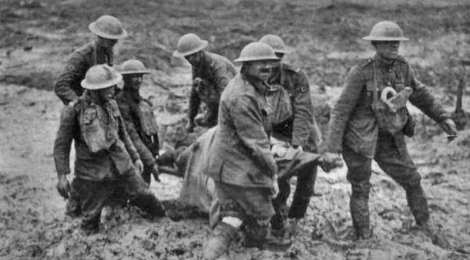
In October and November 1914, exactly 100 years ago, the British Expeditionary Force and the German Army fought the First Battle of Ypres in northern Belgium. Before World War I was over, Ypres was the site of two more battles, in April-May 1915 and July-November 1917. In the process, this part of Belgium, one of thesoggiest, dreariest, flattest places in Europe, also became one of the most blood-soaked. Ypres, or “Wipers” as the Tommies came to know it, was the subject of a 1925 seven reel British documentary film, much of it shot on the actual battlefield with real soldiers. The film is available to us today thanks to British Pathé’s remarkable online film archive.

The First Battle of Ypres, which is featured in the first and second reels of the documentary, began on 20 October when the German army launched an offensive against British positions which were in a semicircle east of Ypres. The Germans made significant advances in the Langemarck area, north and east of Ypres. (One of the soldiers who took part in the battle was a young Adolf Hitler, who was almost killed in a German friendly fire incident on 29 October.) Then on 31 October, the Germans almost broke the British lines, but as John Buchan dramatically recounted after the war, the 2nd Battalion of the Worcestershire Regiment managed to put a finger in the dike. However, on 1 November, the Germans captured Messines, to the south of Ypres. The battle finally sputtered out on 22 November.

When the battle was over, the British positions around Ypres formed a salient extending into the German lines and Ypres and the surrounding area was well on the way to being pounded into a moonscape. For most of the rest of the war, the British held onto that bit of real estate like grim death despite the fact that the Germans could pummel their forces from three sides. In the course of this battle, the British lost some 24,000 dead. The battle also represented the death of the old British Army, the “Old Contemptibles,” as they came to be known. The British Expeditionary Force that came to France in August had numbered some 180,000 men. It was already blooded before Ypres, but by the time the battle was over it had suffered accumulated casualties of more than 50%. They were replaced by a surge of volunteers that transformed the army By contrast, the Germans lost twice as many men as the British at Ypres and the majority of their casualties were taken by young student volunteers who had scant weeks of training before being rushed into combat. In fact, the First Battle of Ypres is known in Germany as the “Massacre of the Innocents.”

But perhaps Ypres greatest significance is that it is where the British began to dig trenches in earnest, and a place where one side’s willingness to bear appalling costs to hold onto every square inch of territory manifested itself in terrifying fullness. It would not be too much to say that the World War I that we remember began 100 years ago at Ypres.

Mark Stout is a Senior Editor at War on the Rocks. He is the Director of the MA Program in Global Security Studies and the Graduate Certificate Program in Intelligence at Johns Hopkins University’s School of Arts and Sciences in Washington, D.C.

1 November 2014

Recalibrating India’s foreign policy

Return to frontpage
ARVIND VIRMANI

PHOTO: REUTERSIndian Border Security Force (BSF) soldiers patroling near the Line of Control (LoC).

The new government is clearly defining Indian interests (‘India First’) in terms of technological and economic development with a greater focus on these goals in foreign policy

Prime Minister Narendra Modi has now interacted with the leaders of four of the five countries/regions — SAARC, China, Japan, Russia, and U.S. — on the list of foreign policy priorities mentioned in the President’s address to the opening session of Parliament. It is, therefore, an appropriate time to take stock of the underlying changes in the directions of India’s foreign policy. In other words, is Mr. Modi’s foreign policy likely to differ from that of Sonia Gandhi-Manmohan Singh?

Every country’s foreign policy has elements of continuity and change following a change in government. India’s policy under Mr. Modi is no different. The changes have not necessarily been explicitly articulated, but are implicit in the government’s actions and view of the world.

There are five areas of the emerging change: the centrality given to economic and technological development; the orientation of domestic and foreign policies toward this objective; the emphasis on national power including military power; and stress on soft power; and a reduction in self-imposed constraints on actions that other countries may construe as inimical to their interests.

Changes in foreign policy

The first change in foreign policy relates to the greater attention provided to economic objectives. This is not a mere reiteration of the economic development objective that has been India’s mantra since independence but recognition of the role of technology (broadly defined) in all aspects of economic development. This involves an implicit benchmarking of the technological capabilities of the Indian economy with the global best practices; having a perception of the gaps; and setting the goal of bridging these gaps.

The government’s divergence from the policies of the previous regimes is reflected in two initiatives, the Swachh Bharat Abhiyan and the Digital India campaign, both of which involve the use of appropriate technology.

“Aggression along the border is being countered by bold moves like the decision to construct a ‘McMahon highway’ in Arunachal Pradesh”

This is probably the first time that an Indian Prime Minister has explained India’s economic and technological objectives abroad — ‘India First’; has identified the specific role each country could play in achieving these objectives — for instance U.S. and Japan; and has made that the centrepiece of his discussion with the leaders of that country. ‘India First’ means that India’s requirements — when it comes to various areas like basic sanitation, defence and space technology — will be expressed with greater clarity and specificity to other countries.

The second change relates to a much greater orientation of domestic and foreign policies toward those objectives. The Indian Prime Minister has been very explicit about Indian objectives with respect to economic development and technological catch-up and in exploring how domestic and international policies will be used to close the gaps across the entire spectrum. Its decisions will then be based on a cost-benefit analysis on a defined set of parameters, not on ideological considerations like that of non-alignment.

The third change is with respect to a greater emphasis on overall national power — recognising that economic power is its foundation, but also giving a greater role to military power.

The Modi government appreciates that economic power cannot be a substitute for military power in deterring aggression from the ideologically driven foes. On the contrary, economic assistance can be viewed by military ideologues as an expression of superiority to be resented. Economic relations can complement international security relationships by influencing the behaviour of non-ideological, economically rational players in the global system but only military strength can deter militaristic ideologues and ensure peace.