25 December 2014

ISIS Closing in on Israel from the North and the South

December 23, 2014

The war against ISIS is taking a dangerous, perhaps inevitable turn. The terror organization has been keen to expand to southern Syria and the Syrian capital of Damascus. Now it says it has recruited three Syrian rebel groups operating in the south of the country in an area bordering the Israeli occupied Golan Heights — that haveswitched their loyalties to ISIS.

This switch means that Israel, the U.S.’s closest ally in the Middle East, could be threatened from the southwest by the Egyptian ISIS group of Ansar Bait al-Maqdis in Sinai and by ISIS in southern Syria.

The ISIS war is not going well at all for the US-led alliance in Syria. ISIS and al-Nusra Front, al-Qaeda’s branch in Syria, are still the dominant rebel groups in the country. The U.S.-backed Free Syrian Army is still not a reliable fighting force.

The three rebel groups that just joined ISIS could make that situation even worse. Two of the groups are small in number, but the Yarmouk Martyrs Brigade has hundreds of fighters. The Yarmouk Brigades has been at odds with al-Nusra Front and switched now to join what leaders of all thrwee groups believe is the future of Islam.

“If Israel was attacked by ISIS, America would expect a proportionate response by Israel, which is militarily capable of defending itself,” said Geoffrey Levin, a professor at New York University. “America would counsel against sustained Israeli involvement because it could threaten the tacit alliance between America, Iran, Turkey, and several Arab states against ISIS.”

“More recent reports indicated a closer alliance with [the Islamic State] due to tensions with JN [al-Nusra Front],” said Jasmine Opperman, a researcher at Terrorism Research & Analysis Consortium (TRAC). She said al-Nusra attacked the headquarters of the Yarmouk Brigade in southern Syria in early December 2014 following clashes between the two groups.

Al-Yarmuk Martyrs Brigade controlled an area near the Jordan-Israel border in March 2013. That same month, the brigade took as hostages some of the United Nations peacekeeping mission soldiers. Even so, Israel reportedly allowed the brigade to have its wounded fighters treated in Israeli hospitals.

ISIS has been known for launching surprise attacks and opening new battlefronts when it seems to be losing. ISIS also has been criticized by many Arabs and Muslims for not taking its fight to Israel and instead fighting fellow Arabs and Muslims. An attack aimed at Israel may boost ISIS’s popularity in the Arab world and refresh its recruitment and funding efforts.

On the other hand, some of ISIS’s top military commanders were former officers in Saddam Hussein’s army, and they may resort to what Saddam did in the 1991 Gulf War when he attacked Israel with mid-range rockets, hoping to drag the Israelis into a conflict that he was losing.

An Israeli retaliation in 1991 could have jeopardized the U.S-led coalition that then included Arab countries like Egypt, Syria and Saudi Arabia. The same is true now.

WHY THIS MATTERS

Despite some recent tensions between the countries, Israel remains America’s closest ally in the Middle East. Attacks on Israel by ISIS or affiliated groups could further escalate war in the region, or they could further strain ties between the Obama administration and the Israeli government.

“It would be more likely a sign of desperation, as were Saddam's attempts to lure Israel into the 1991 war as a way of breaking the Arab coalition against him,” said NYU’s Levin. At that time, continuous pressure from the first Bush administration and the installation of the Patriot anti-rocket system convinced the Israelis to refrain from reacting to Saddam’s attack.

ISIS Launches Counterattack in Renewed Effort to Capture Bayji Refinery in Iraq

December 23, 2014

IS Militants Return to Outskirts of Strategic Iraqi Town

BAGHDAD — An Iraqi official says Islamic State militants have returned to the outskirts of a strategic oil refinery town after being driven out last month.

Gov. Raed Ibrahim of the Salahuddin province says the militants fought their way to the edge of Beiji on Tuesday after three days of heavy clashes. He says they were able to advance because Iraqi troops lack heavy weapons.

The militants captured Beiji and besieged its refinery — the country’s largest — during their rapid advance across Iraq last summer. Iraqi forces wrested the town back in mid-November in one of their biggest victories to date against the insurgents. The refinery is some 20 kilometers (15 miles) north of town.

Rethinking Our Strategy in Iraq and Syria

December 22, 2014

Rethinking Our Strategy in Iraq and Syria

The war against the self-styled Islamic State is beginning to look more and more like the late, unlamented war in Vietnam. The Obama administration has placed self-imposed limitations on the use of ground forces, thereby creating the kind of sanctuary that North Viet Nam represented from 1963-75. Like President Johnson, Barak Obama had pledged no ground troops, but eventually sent in “advisors” and “defensive forces” to protect the advisors bases as well as the aircraft that were supporting the host nation government’s forces who were supposed to be doing the actual fighting; albeit poorly. This looks exactly like the Vietnam War in 1964-65 that I remember watching on TV and reading about in high school.

Since the Ivy League schools that produced the Obama Administration’s brain trust no longer require the serious study of history, the people who are planning the war effort don’t see the irony. It will take local political solutions to stabilize Syria and Iraq, but those political solutions will not happen until the conventional military power of the Islamic State is destroyed; that can be done in 3-4 months if we apply US-led western military forces in an overwhelming punitive campaign, to include ground forces, to crush the Islamic State’s army.

There are also two unexamined assumptions driving the current strategy. Both of these are rooted in Vietnam, a war that few in the administration seem to have seriously studied. The first is that there are no military solutions. The reality is that the Vietnam War ended with a tank-led conventional invasion of South Vietnam by the North Vietnamese. The end in Vietnam was a purely military solution; it was not a guerilla triumph. The unification of Vietnam under Communist rule was a strategy that Ho Chi Minh pursued relentlessly from 1945 to 1975; he vowed to use both military and political means, and he did so brilliantly. The romantic guerilla myth was perpetuated by aging American liberals, most of whom worked hard in their youth to stay as far away from Vietnam as possible; most of these arm chair revolutionaries learned to worship Ho Chi Minh, Che Guevara , and Chairman Mao in college as somehow being morally superior to American the American military as they saw it.

The second myth is that foreign ground intervention is always bad. In Vietnam, American intervention stymied North Vietnamese ambitions for a decade and built a South Vietnamese counterinsurgency capability that virtually annihilated the Viet Cong. By the early seventies, the only Viet Cong fighting formations were those that were effective manned by North Vietnamese regulars who traded their uniforms for Viet Cong black pajamas. The North Vietnamese felt comfortable with a conventional invasion in 1975 because they knew that the 1974 class of Democrats, who dominated the Congress, would not allow the United States to intervene; the war in Vietnam was settled by the use of naked conventional force made possible by the withdrawal of foreign forces.

If we strip away those myths regarding intervention and the utility of military force, we can develop a strategy that will destroy the Islamic State’s occupation of the lands that it currently controls. This would allow room for political solutions to be devised by Iraqis and Syrians. A political solution is not possible if jihadist foreign fighters remain embedded in either country. It will take a temporary western foreign intervention to eliminate the malignant influence of the equally foreign jihadist infestation.

End State. A strategic end state is what we want the world to look like after the fighting stops. It almost always gets neglected in the rush to “do something” in the midst of a crisis. It generally requires a compromise between an ideal outcome and the art of the possible. To date, no-one has offered a coherent vision of what we want Iraq and Syria to look like under the present strategy. What we have now is a series of hastily cobbled together crisis response measures bundled under the rubric of strategy. If you don’t have a clear end-state vision, you don’t have a strategy.

In the best of all possible worlds, an Ideal end state would be a democratic Syria and Iraq free of Assad and the Jihadist factions, but particularly the Islamic State. That may happen someday; but probably not in the lifetime of anyone reading this piece given our current strategic approach. The administration is kicking the can down the road to 2016 in the hopes that Mr. Obama does not become remembered as the president who lost the Middle East. That is not an end state, it is a political platform plank.

Bringing Down the Castros for Good

December 23, 2014

Last week's blockbuster announcement from President Barack Obama that the United States will liberalize relations with Cuba has drawn passionate reactions. The New York Times cheered a "bold move that [will end] one of the most misguided chapters in American foreign policy," while Senator Marco Rubio of Florida, the son of Cuban émigrés, thundered that the deal "won't lead to freedom and liberty for the Cuban people, which is my sole interest here." 

The senator went further. "Barack Obama is the worst negotiator that we've had as president since at least Jimmy Carter, and maybe in the modern history of the country," said the likely presidential contender late last weekend. To be sure, there's a strong case, to back Senator Rubio's assertion. President Obama is essentially giving away the store for nothing: The United States will restore diplomatic relations and - crucially - ramp up economic relations between the two countries, without demanding fundamental changes to Cuba's political or economic system in return. (Indeed, shortly after President Obama's announcement, Cuban President Raul Castro reaffirmed that his country will, alas, remain communist.) In this sense, as others have pointed out, President Obama has set a troubling precedent for negotiations with the likes of North Korea, the Taliban, and especially Iran.

Yet Cuba's case stands alone. For one, it's been a long time since the dilapidated Caribbean nation, set 90 miles south of the United States, has presented any threat to the United States or her allies. And there are several reasons to think that increased contact between the United States and Cuba could in fact spur the downfall of the odious Havana regime. Senator Rubio, then, may be quite wrong.

For starters, the Castros will have a hard time now blaming the U.S. embargo for Cuba's myriad failures. Cuba's per capita GDP stands at a pitiful $6,000 a year. Why? Blame the American embargo, of course, says the Castro regime - pay no mind to the failures of Cuban socialism. Ditto for Cuba's crumbling buildings and its unreliable electricity supply - all of this can be conveniently blamed on Washington with its dastardly embargo. Even today, more than 50 years after the failed Bay of Pigs invasion, Cuba's official state-run media fulminates against a U.S. government that it claims is conspiring to overthrow the regime and turn Cuba into a vassal state. Now that President Obama has moved to relax the embargo, the Castro dictatorship will lose its favorite excuse for failure.

It's also easy to imagine that as soon as Cuban workers in hotels, restaurants, and transportation services come in contact with corpulent American tourists touting iPads, iPhones, and fat wallets stuffed with U.S. dollars, they will quickly tire of the socialist system they labor under. It's difficult to imagine a sclerotic Havana regime surviving a torrent of greenbacks. (Indeed, that is why Pyongyang keeps its few foreign tourists on such a tight leash - North Korea doesn't want its citizens to see how people in other countries live.) Communist dictatorships only survive as long as the people living under them remain ignorant of how the rest of the world gets on. As Republican Senator Rand Paul, who supports relaxing the embargo, put it in an op-ed in Time, "once trade is enhanced with Cuba, it will be impossible to hide the bounty that freedom provides." Thus, Havana either must open up its economy, like China did, or risk collapsing like the Soviet Union. Either outcome would be a happy one for Washington and would represent a serious improvement over current conditions.

France’s Born-Again Proliferation Beliefs Ring Hollow

By Yousaf Butt
December 24, 2014

How to explain French obstructionism on Iran? Look to its lucrative regional trade agreements with Gulf Arab monarchies. 

Having failed to reach an agreement last month, Tehran and the P5+1 world powers – the five UN Security Council members plus Germany – decided to kick the can down the road, setting a new “final final” deadline of July 1, 2015. They all met again last week in Geneva for yet more jaw-jaw but there is little prospect of an immediate breakthrough. While the hardliners in Congress and in Iran are painted as the main impediments to a deal, there is another issue simmering below the surface: the French are reported to be out-hawking Washington on proliferation concerns by throwing up impulsive Gallic objections to an agreement. This is a decidedly odd stance for Paris to take. The real reason probably has less to do with France’s born-again proliferation beliefs than good old greed for lucrative Gulf-Arab defense and nuclear contracts.

For starters, France is itself a latecomer to the Nuclear Nonproliferation Treaty (NPT), not acceding until 1992 – a full 24 years after the NPT was opened for signature. (Iran, in contrast, was one of the original founding signatories.) Before 1992 – and even since then – France has had a poor proliferation record so its high-and-mighty attitude at the Iran talks has raised more than a few eyebrows.

During the 1960s and 70s, France supplied nuclear reactors, manpower and technology to Israel and Iraq: the now-infamous Dimona and Osirak reactors were sold by the French. France also supplied Iraq with the highly enriched uranium fuel used to power the Osirak reactor and resisted calls to modify the fuel to lower-enrichment. And both Pakistan and India got invaluable French help in developing their nuclear programs – even in the face of well-founded suspicions that these countries may be weaponizing. In the late 1970s, Paris finally had to be strong-armed by the Carter administration not to export a large reprocessing plant to Pakistan. France continued to assist India’s nuclear efforts though, even after New Delhi exploded its first nuclear device in 1974.

Even during the 2000,s Paris negotiated several nuclear cooperation agreements with fledgling nuclear states such as Libya, Jordan, Algeria, Morocco, Tunisia and the UAE. And Paris penned revised nuclear contracts with India, China, Brazil and South Africa. Though there is nothing illegal per se about such nuclear assistance – indeed, the NPT mandates that the nuclear-armed states help the non-weapons states with their civil nuclear programs – it does show that over the decades France has been happy to spread nuclear technology worldwide. (Incidentally, a revamped “NPT 2.0” I’ve proposed may help to tamp down the proliferation that the NPT actually promotes.)

The main reason behind French proliferation of nuclear technology has been – and still is – money. The French multinational Areva is the world’s largest nuclear company and the French state holds a whopping 87 percent stake in the enterprise. Areva made about a $1.3 billion profit last year on roughly $13 billion revenue. Similarly, Electricite de France (EDF) is the world’s largest producer of electricity and the state retains an 85 percent share in that company also. More than 80 percent of EDF’s electricity is generated from nuclear power. EDF’s profit and revenue numbers are comparable to Areva’s. Safe to say, France is heavily vested in its nuclear power sector and stands to gain huge profits by promoting it worldwide.

Russian Caveat

DECEMBER 23, 2014

Putin’s crisis presents a teachable moment for strategic thinking. 

The sudden financial crisis in Russia is providing a “teachable moment,” as our Democratic friends like to say. In this case, it should be a master class in strategic thinking. Before we get too confident in our assumption that Vladimir Putin has fatally overreached, or too self-congratulatory that Western sanctions have crippled the Russian economy, a bit of caution is warranted. We must not be so sure that we have reached a new equilibrium, that this is the new normal, or that there is only one trend line that will determine Putin’s future. It is a time for more, not less, careful analysis and strategic planning.

Those in the Obama administration cheering economic sanctions, which have been in place for months, cannot be unaware that Putin’s current crisis comes solely from the collapse of the price of oil. Without the petrodollar props’ being knocked out from under him, it is likely that Putin would have been largely unaffected, thumbing his nose at Western efforts to cause enough pain to his regime to bring him to the negotiating table in a bid to end his Ukrainian intervention. The sanctions are not suddenly taking effect; they’re now effective because of exogenous shocks.

That, of course, means that the situation could just as suddenly reverse. Yes, it is unlikely that the price of oil will jump back to levels as high as those in June of this year, when it was close to $115 per barrel, but it is foolhardy to assume that it will stay at the current level of about $60 forever. Policymakers who base their plans on a presumption of stability will once again be caught flatfooted if the trend reverses. A sudden spike in oil prices would end Russia’s currency crisis, return wealth and strength to the regime, and embolden Putin. It is just as prudent to prepare for that possibility as it is to think about what may happen if the ruble completely collapses.

Say, however, that the crisis intensifies. A still deeper level of analysis will then be required, asking harder questions: What will Putin do in the case of a full-blown economic meltdown in Russia? Will he be more malleable or more intransigent? Will he be more likely to pursue a cooperative path or will he be more dangerous? Prudent strategic thinking requires the flexibility and imagination to incorporate counterintuitive views.

Those who assume that Putin will be on the ropes in the case of a shattered economy should remember that this is a man who has consistently acted aggressively in his own interests, refusing to be bound by the logic that many in the West assumed would restrain him. Moreover, Western policymakers have been consistently wrong in their assessments of his actions, from the annexation of Crimea to the invasion of eastern Ukraine. There should be some strong Red Team analysis going on, and, so far, it appears that only General Philip Breedlove, the military head of NATO, has been challenging the official wisdom.

Conservative thinking, therefore, would at least entertain the notion of caution in the coming days. Reports that the interest-rate spike announced last week by the Russian state bank will cripple individual and small-business lending in the coming year means that 2015 may well be a year of living dangerously for Putin and his regime. There could be unrest directed against lower-level officials, and Putin may crack down, to prevent any perception that the regime is vulnerable. Certainly, he will try to shift blame onto the West and whip up anti-Western feeling. Perhaps he will channel internal frustration into further external adventurism, a tactic familiar to history.

Israel Looks on Europe with Dismay

December 23, 2014


Political tremors are being felt across Europe. In Britain, we see the rise of an emerging independence party, UKIP, which is euroskeptic and takes a corrective line on the UK's unbridled open-door immigration policy. In France, the Socialist François Hollande looks likely to be replaced by the center- right Nicolas Sarkozy. The left-wing Swedish government barely lasted three months before being forced to abandon a failed leadership. This gave it sufficient time to rush through a "Palestine" vote which may be overturned by an incoming center-right government. Polls show that center-right parties would win the popular vote in Norway and Denmark if elections were held now.

Across Europe, voters are objecting to poor economic and immigration policies.

They are offended by the rise of crime perpetrated by immigrants they had welcomed into their once decent countries. Cultural changes are rendering their countries unrecognizable. One prominent reason for the political swing has been politicians pandering to Islamic sensitivities at home. This is causing pause and division among their populations.

The recent outbreak of symbolic parliamentary voting for an ill-defined Palestinian state is one outward manifestation of politicians catering to a rising constituency against which their grassroots citizenry are rebelling. The swing in the polls reflects a desire to return to an old patriotism of long-lost national values, lost in the mire of multiculturalism brought on by uncontrolled immigration against a background of recession and poor economic performance.

They are in search of a once-was national character. A yearning to return to the past will however not save them from the reality that now exists. Nevertheless, we will see European nations shift, possibly polarize, as populations demand that their voices be heard above the growing needs and demands of strong minority and troublesome migrants and left-wing anarchists.

But will these changes come in time to save a sinking Europe from the misguided, immoral decisions being taken by a largely Socialist and fractured continent? One nation outside of Europe that is suffering from misguided European policies is Israel. Israelis look at Europe as a continent that feels the need to cater to an unruly Muslim population that offers their politicians votes but on the other hand can, and does, cause problems and violence if its causes are not addressed.

This has expressed itself in displays of violent anti-Semitism that leave local Jews vulnerable.

Countries, one after another, fall prey to the lobbying of left-wing fringe groups allied to a Palestinian agenda by the introduction of anti-Israel resolutions.

One after another, nations fall like dominoes, not wishing to appear out of step with an ill-considered mantra of Palestinianism that contradicts European commitments that the Israeli-Palestinian conflict must be settled by the two parties involved, without any external or unilateral moves that may endanger or foreclose such an outcome.

The Upsides to Russia's Ruble Collapse

Dec. 22 2014

In early December, President Vladimir Putin delivered his annual address to the Federal Assembly. I believe anybody reading this column would have been able to shorten that speech to just one or two words; awful or really awful (I'm being polite). It has certainly been the worst year for the ruble since 1998 and also the worst for investors and businesses over the past 15 years.

Not because of the scale of the stock market or economic collapse — the second half of 2008 was much worse for the former and 2009 worse for the latter — but because of the reasons for the collapse and the uncertainty over what happens next. In 2009 the issue was a relatively straightforward economic problem. As we head into 2015 it is the geo-political overhang which causes the greater concern.

One of the reasons why 2014 has been such a bad year for the markets and the economy is because the foundations upon which the economy and asset valuations are supported were already in a weakened state well before the events of this year piled on the pressure. I have written several times about the specific reasons for the decline in the economy through 2013, i.e. from 3.4 percent growth in 2012 to only 1.3 percent last year.

The summary point is that the country had lived too long on hydrocarbon export revenues, which totalled $3 trillion since 2000, without any serious effort to reform the economy and simply ran out of time. To be exact, it ran out of growth drivers as the consumer retrenched and capital investment fell.

So 2014 was always going to be a difficult year and, in anticipation of that, this is why the stock market and ruble both fell in 2013. They fell harder in January and February even though the oil price held close to $110 per barrel and ahead of the Crimea referendum.

Investor sentiment and business confidence is also a big factor in how an economy and markets behave. In that respect, 2014 was probably the worst year ever for Russia, certainly if one counts the number of international magazine covers which variously demonized Putin or predicted the destruction of the economy and the imminent arrival of a color revolution.

By the time we got to the Crimea vote in mid-March the extraordinarily disproportionate coverage coming up to the start of the Winter Olympics had firmly set the tone. Moving on to headlines that claimed Russia was about to invade former Soviet states was effortless.

The financial sector sanctions which, in combination with the falling oil price, collapsed the ruble not just past a few proverbial lines in the sand but as a bulldozer through whole sand dunes. That also seemed almost inevitable in a year when nothing seemed to be in Russia's favor.

Russia Has Successfully Tested First New Angara Booster Rocket

December 23, 2014

Russia Says Test Of New Angara Rocket A Success

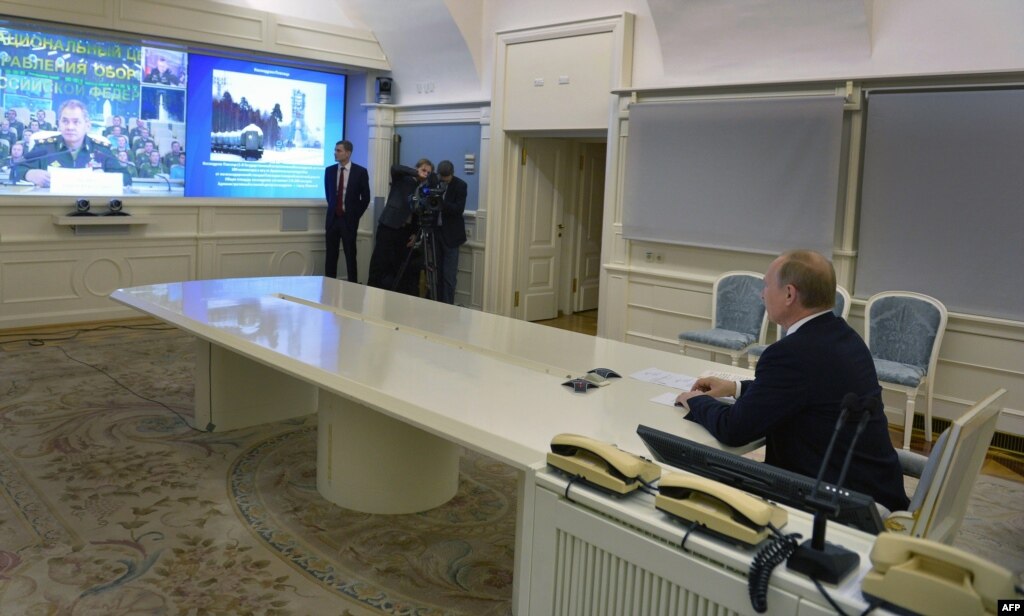
Russian President Vladimir Putin watches a live broadcast of the launch from the Plesetsk cosmodrome in a presidential situation center in Moscow on December 23.

Russia says it has successfully conducted the first test launch of a powerful new booster rocket it has been developing for years.

Reporting to President Vladimir Putin, Defense Minister Sergei Shoigu said the Angara-A5 rocket lifted off at 8:57 a.m. local time (0557 GMT/UTC) from the Plesetsk launch facility in northwestern Russia.

Putin, who took part in the launch ceremony by videolink, offered his congratulations on a “successful launch” and said the new rocket would “seriously strengthen Russia’s security.”

He said the Angara would put satellites in orbit “for systems of early warning of missile attacks, intelligence, navigation, communications, and relay.”

State-run news agency TASS said Russia has spent 22 years and some $3 billion developing the 55-meter, 773-ton Angara, its biggest new rocket since the Soviet era.

Its powerful engine is designed to put Russia’s heaviest satellites into orbit.

CENTCOM Brief on Airstrikes in Iraq and Syria

December 23, 2014

Military Airstrikes Continue Against ISIL in Syria and Iraq

Combined Joint Task Force - Operation Inherent Resolve Public Affairs

SOUTHWEST ASIA, Dec. 23, 2014 - U.S. and partner nation military forces continued to attack Islamic State of Iraq and the Levant terrorists in Syria todayusing fighter and bomber aircraft to conduct seven airstrikes. Separately, U.S. and partner nation military forces conducted three airstrikes in Iraq today using fighter, bomber, and attack aircraft against the ISIL terrorists.

The following is a summary of those strikes:

Syria

Near Kobani, six airstrikes destroyed seven ISIL fighting positions, an ISIL building and struck several ISIL fighting positions.

Near Barghooth, an airstrike struck ISIL oil collection equipment.

Iraq

Near Sinjar, two airstrikes destroyed an ISIL vehicle and struck a mortar and an ISIL tactical unit.

Near Al Asad, an airstrike destroyed an ISIL fighting position.

All aircraft returned to base safely. Airstrike assessments are based on initial reports.

The strikes were conducted as part of Operation Inherent Resolve, the operation to eliminate the ISIL terrorist group and the threat they pose to Iraq, the region and the wider international community. The destruction of ISIL targets in Syria and Iraq further limits the terrorist group’s ability to project terror and conduct operations.

Coalition nations conducting airstrikes in Iraq include the U.S., Australia, Belgium, Canada, Denmark, France, Netherlands and the United Kingdom. Coalition Nations conducting airstrikes in Syria include the U.S., Bahrain, Jordan, Saudi Arabia, and the United Arab Emirates.

North Korean Internet Goes Down for a Second Time, Report

James Rogers
December 23, 2014

North Korea suffers second Internet outage

North Korea’s Internet was down again on Tuesday, according to monitoring specialist Dyn Research, with the latest blackout coming hot on the heels of Monday’s widespread nine-hour outage.

Monday’s nine-hour denial of service exposed the vulnerabilities in North Korea’s limited web infrastructure just days after Pyongyang was blamed for the cyberattack that crippled Sony Pictures.

The country’s Internet problems continued on Tuesday, with reports of another outage. Early on Tuesday Dyn Research tweeted that “North Korea continues its struggle to stay online,” and noted another outage at 10:41 a.m. ET. The country’s Internet was restored again at 11:12 a.m. ET, although the monitoring specialist said that “connectivity problems continue.”

Dyn Research reported late Monday that North Korean websites were back online after a 9 hour, 31 minute outage. The outage came less than a week after the U.S. vowed an unspecified response to a massive hacking attack against Sony Pictures Entertainment over the release of the comedy film “The Interview.”

On Dec. 19 the FBI accused North Korea of launching the attack against Sony Pictures.

The White House and the State Department on Monday declined to say whether the U.S. government had any role in North Korea’s Internet problems.

Dyn Research notes that nine-hour outages are not unheard of in North Korea given its limited Internet infrastructure.

“It’s a rare event these days when an entire country leaves the Internet,” it said, in a statement. “Even so, when North Korea’s four networks went dark, we were not entirely surprised, based on the fragility of their national connectivity to the global Internet.”

North Korea’s four networks are routed through Chinese telecom giant China Unicom, according to Dyn Research. With around 25 million people, North Korea’s Internet backbone is miniscule compared to other countries with similar populations. Yemen, Afghanistan and Taiwan, for example, have 47, 370, and 5,030 networks, respectively.

Arbor Networks, a network security company, noted 29 attacks on the North Korean government owned and operated sites between Dec. 18 and Dec. 22. These include an attack on Kim Il Sung University, the country’s first university website.

While speculation is rife that the U.S. launched a denial of service attack on North Korea, Dan Holden, director of Arbor’s Security Engineering and Response Team (ASERT) said that this is unlikely.

Russia’s Annual Hide-and-Seek Game As Russian Teens Try to Avoid Draft

Peter Pomerantsev
December 21, 2014

Dodging The Draft, Russian Style

Every April and October the color khaki seems to suddenly sprout on the streets as bands of young soldiers appear in the cities; skinny, in uniforms either too large or small, with pinched red noses and red ears, scowling at the Maybachs and gold-leaf restaurants.

They hang around at the entrances of metro stations where the warm air gusts up from the underground, shiver while sucking on tepid beer on street corners of major thoroughfares. They come shuffling up stairs and knocking on apartment doors and stalk through parks.

It’s the time of year of Russia’s great annual hide and seek. The soldiers have been given orders to catch young men dodging the draft and force them to join the army. Military service might be mandatory for healthy males between eighteen and twenty-seven, but anyone who can avoids it.

The most common way out is a medical certificate. Some play mad, spending a month at a psychiatric clinic. Their mothers will bring them in. “My son is psychologically disturbed,” they will say. “He has been threatening me with violence, he wakes up crying.”

The doctors of course know they are pretending and the bribe to stay a month in a loony bin will set you back thousands of dollars. You will never be forced to join up again—the mad are not trusted with guns—but you will also have a certificate of mental illness hanging over you for the rest of your career.

Other medical solutions are more short term: a week in the hospital with a supposedly injured hand or back. This will have to be repeated every year and annually the hospitals fill up with pimply youths simulating illness.

But the medical route takes months of preparation: finding the right doctor, the right ailment—because the ailments that can get you off change all the time. You turn up at the military center with the little stamped registration card that your mother has spent months organizing and saving for, then find that this year flat feet or shortsightedness are no longer a legal excuse.

If you’re at a university you avoid military service (or rather you fulfill it with tame drills at the faculty) until you graduate. There is no greater stimulus for seeking a higher education and Russian males take on endless master’s degree programs until their late twenties.

And if you’re not good enough to make it into college? Then you must bribe your way into an institution. There are dozens of new universities that have opened in part to service the need to avoid the draft. And the possibility of the draft makes dropping out of college much more dangerous—the army will snap you up straightaway.

For the poorer young men, it’s hide and seek time.

When the bad marks come in, mothers start to fret and scream at their sons to work harder. And when they can see the boys might fail, it’s time to pay another bribe, to make sure they pass the year.

But there are a certain number of pupils the teacher has to fail to keep up appearances, and the fretting mothers start to put out feelers for the most desperate and most expensive remedy: the bribe to the military command. The mothers come to the generals, beat and weep on the doors of the commanders, cry about their sons’ freedoms. (Money by itself is not always enough; you have to earn the emotional right to pay the bribe).

Russian Black Sea Fleet Moves Into Old Headquarters of Ukrainian Navy in Sevastopo

December 22, 2014
Russian naval base resumes in Crimea

The headquarters are in Sevastopol, where until March 19 were the headquarters of the Ukrainian Navy

SEVASTOPOL, December 21. /TASS/. The Crimean naval base, a part of the Black Sea Fleet until 1996, is reconstituted fully, a representative of the Black Sea Fleet’s headquarters told reporters on Sunday.

"The headquarters are in Sevastopol, where until March 19 were the headquarters of the Ukrainian Navy. The head is Captain Yuri Zemsky who previously was commander of a Navy division in the Mediterranean Sea," the representative said.

"The new units have joined the group of forces to provide coverage from the Black Sea from enemy’s ships.".
CRIMEA’S ACCESSION TO RUSSIA

The Republic of Crimea and Sevastopol, a city with a special status on the Crimean Peninsula, where most residents are Russians, refused to recognize the legitimacy of authorities brought to power amid riots during a coup in Ukraine in February 2014.

Crimea and Sevastopol adopted declarations of independence on March 11. They held a referendum on March 16, in which 96.77% of Crimeans and 95.6% of Sevastopol voters chose to secede from Ukraine and join the Russian Federation. Russian President Vladimir Putin signed the reunification deals March 18.

In the Soviet Union, Crimea used to be part of Russia until 1954, when Nikita Khrushchev, the first secretary of the USSR’s Communist Party, transferred it to Ukraine’s jurisdiction as a gift.

Opinion: Dysfunctional geopolitics

By Arnaud de Borchgrave
Dec. 21, 2014 

Russian President Vladimir Putin (C) arrives at the Capital International Airport of Beijing on November 9, 2014. Putin is in China's capital to attend the 22nd Asia-Pacific Economic Cooperation (APEC) Economic Leaders' Meeting. UPI/Ma Ning/Pool

For the average Russian, Chinese, Indian, Pakistani, African, Arab, Iranian, or any other race or nationality, America is now no better or worse than any other global scoundrel.

And we are not referring to a sophisticated reader and world traveler but even among those we now hear sarcastic comments about American exceptionalism.

NATO now has little credibility left as a deterrent to Russian meddling in NATO's sphere of influence, and even less in countries that don't benefit from the NATO umbrella, such as Ukraine.

The future has seldom been less predictable. Russia's Putin is backed into a geopolitical corner -- and lashes out unpredictably. He appears to be playing his geopolitical cards tactically with no long-term strategy.

The collapse of oil prices has dealt him a ghastly hand for his next ad lib round. The ruble has lost 50 percent of its value in less than a year. Panic for the wealthy, mere desperation for the poor.

With the ruble rubble there is no point in further punishing Putin as the only ones getting hurt are the Russian people who then close ranks with their leader.

One estimate shows more than 80 percent of members of Congress have never traveled abroad outside of Canada and Mexico. Russophobia by amateurs thus becomes a volatile mix.

China in the rest of the world is no longer measured as a totalitarian dictatorship vs. a U.S. democracy, but more as a superpower vs. another. And one that is rapidly gaining geopolitical clout in the global contest for influence.

Much is being said and written about an American economic bubble. But there is also a Chinese one, admittedly easier to contain in what is still essentially a politico-military dictatorship coupled with a fair amount of business, commercial and travel freedom.

What little global order there is appears to be falling apart. Iran is gaining more influence than the U.S. in the outcome of what is essentially a proxy war against ISIS in Iraq.

The U.S. is trying to fight an unwinnable two front-war against both ISIS and the Assad regime in Syria, seemingly oblivious to the fact that the enemy of my enemy is my ally, if only in the short term.

More than 90 percent of the bombing of ISIS positions in Iraq is done by the U.S. Air Force and Navy. And most of it is ineffective as the enemy has learned all the techniques of concealment.

Central Europe Seeks a New Way Forward

Posted by Antonia Colibasanu 
December 22, 2014

Twenty-five years ago, the peoples of Central and Eastern Europe could begin to hope. They could hope for lives free of the fear of Communism and the threat of war. They could look west and see a European Union that was consolidating and inviting their countries to sign on to its drive for enlargement. When the NATO-Russia Council was formed in 2002, it even seemed like Russia might be ready to partner with the West.

Hopes started to fade in 2004. The Orange Revolution in Ukraine seemed to bring the Russian bear out of hibernation. Moscow saw the movement as being engineered by the West and spent the next decade working to avert the risk of a pro-Western Ukraine.

By 2014, hope has given way to fear for these states - fear that Russian aggression could once again reach out to them. The rest of Europe, it seems, has other problems and priorities. The French and Spanish are focused on internal budget debates and the stability of the eurozone, while the countries of Southern Europe are left to address the social fallout of low employment. But the populations of Central and Eastern Europe are increasingly aware of something history has taught them to call the "Russian danger." This question is one of degree: In the greater fight against revanchist Russia, how much support do the countries of Central and Eastern Europe have? And what do these states need to do to enhance their security moving forward?

A friend in Brussels

The Ukrainian crisis has done much to show the constraints NATO and the European Union face. The institutions have been at the core of Central and Eastern European countries' foreign policies since the early 1990s, as these countries became members and took the first steps toward integration. But there is no foreign policy alignment at the supranational level - EU leaders are still prioritizing national interests that often differ and sometimes diverge, even as Brussels publishes bland common statements condemning Russian aggression. So how reliable a partner is Brussels? The breakout of the Ukraine crisis itself indicated a failure of the EU Eastern Partnership initiative, but on the other hand it is because of local support for the diplomatic efforts of the European Union that the pro-Russian government in Kiev was overthrown, and a pro-EU government is in power now. The European Union has taken diplomatic measures against Moscow in the form of economic sanctions, and it has supported Moldova and Georgia's efforts to maintain a pro-EU stance. Thus we see the European Union's power of influence remains ponderous, even if its policies are limited to the minimum common denominators that its member states share.

The Shadowy Giant: Secretive U.S. Cyber Command Beginning to Take Shape

Maggie Ybarra
December 23, 2014

Cyber Command investment ensures hackers targeting U.S. face retribution

In the shadows of the Sony hacking incident and North Korea’s massive Internet outage, the Pentagon has quietly built a multibillion-dollar cyberwarfare capability and trained its commanders to integrate these weapons into their battlefield plans.

U.S. Cyber Command was officially stood up in 2010, based at Fort Meade in the Maryland suburbs of the nation’s capital, consolidating intelligence and cyberwarfare capabilities of the Army, Air Force, Navy and Marines under one house. Soon, billions of dollars were being invested in the concept that cyberattackers targeting America should be prepared to sustain their own damage.

Little has been discussed in public about U.S. Cyber Command’s specific capabilities since, though budget documents detail a growing commitment to this form of warfare. The Pentagon’s cyberwarfare budget has grown from $3.9 billion in 2013 to $4.7 billion in 2014 and an estimated $5.1 billion in 2015.

The first commander of U.S. Cyber Command, then-Army Gen. Keith Alexander, gave Congress in 2013 one of its first public overviews of how quickly an offensive cyberwarfare mindset was spreading across the Pentagon. In military parlance, it means “normalizing” cyberoperations into the daily routine.

"We have no alternative but to do so because every world event, crisis and trend now has a cyber-aspect to it, and decisions we make in cyberspace will routinely affect our physical or conventional activities and capabilities as well," Gen. Alexander told lawmakers.

"Normalizing cyber requires improving our tactics, techniques and procedures, as well as our policies and organizations. It also means building cybercapabilities into doctrine, plans and training — and building that system in such a way that our Combatant Commanders can think, plan and integrate cybercapabilities as they would capabilities in the air, land and sea domains," he said.

Beyond Gen. Alexander’s broad descriptions, a few hints have emerged about the specific capabilities of the military to conduct offensive attacks in cyberspace.

The New York Times’ David Sanger reported in a June 2012 article that remains unchallenged that the U.S. was the primary developer of the Stuxnet computer worm that struck Iran’s nuclear computers, causing significant damage to centrifuges.

Later that summer, Marine Lt. Gen. Richard P. Mills bluntly told a conference in Baltimore that commanders under his control in Afghanistan routinely used cyberwarfare tactics to attack and disable al Qaeda and Taliban enemies.

"I can tell you that as a commander in Afghanistan in the year 2010, I was able to use my cyberoperations against my adversary with great impact," Gen. Mills was quoted at the time as saying. "I was able to get inside his nets, infect his command and control, and in fact defend myself against his almost constant incursions to get inside my wire, to affect my operations."

While the military is developing the capability, the political and policy realm is struggling with the right parlance.

While the U.S. government remained mum Monday on whether it was behind Pyongyang’s downed Internet service, it offered a clear and confident message that the Pentagon is equipped to conduct such offensive operations in cyberspace.

The U.S. Intelligence Community’s Predictions for 2015

Kedar Pavgi
December 23, 2014

What the Intelligence Community Thought Would Happen in 2015 - in 2000

After a year filled with non-stop national security crises, the question is: Can anyone predict chaos in the future? The answer is, sort of.

Every four years, the National Intelligence Council - the arm of the Intelligence Community tasked with developing long-term outlooks - releases its Global Trends report. It’s an unclassified publication that uses open source information gathering techniques to plot out the world 15 to 20 years out. 

In 2000, the NIC released the Global Trends 2015 report to figure out how major technological, geopolitical and demographic trends at the turn of the millennium would shape the years to come. The next one is expected to come out in 2016 and will predict the world of 2035.

David Gordon, former policy planning director for the State Department and one of the main authors of the Global Trends 2015 report, emphasized that it wasn’t meant to be a set of predictions, or even a model, but rather “explorations, likely and potential changes” in the world of the future.

“We knew that all sorts of stuff was going to happen, and then what you were trying to do is, understand beneath all of that, what are some of the big things going on. Obviously, once something very big like [like the wars in Iraq or Afghanistan] happens, the world changes,” Gordon told Defense One.

Of course, the world circa-2000 was a very different place. This was before the 9/11 attacks and the wars in Iraq and Afghanistan. While cyber-security is now a major threat, many people were just getting over the preparations for the Y2Kcomputer bug.

The whole Global Trends 2015 report is worth reading, but Defense One decided to look at some of the things that the report got right – and wrong – about conflict in 2015.
CHINA

“The fundamental thing that we got right was the notion that China was going to become a ‘big Kahuna’ in terms of global change,” Gordon said. “That is something that everybody now takes for granted, but in 2000, that was not what was out there.”

Global Trends 2015 suggested that the rise of China’s military would start disrupting U.S. military power in the Asia-Pacific and warned of a potential for a war over Taiwan and territories in the South China Sea. But it also made many other calls:

“China will be exploiting advanced weapons and production technologies acquired from abroad—Russia, Israel, Europe, Japan and the United States—that will enable it to integrate naval and air capabilities against Taiwan and potential adversaries in the South China Sea.”

Indeed, that has been the case. A 2010 report published by the Defense Threat Reduction Agency detailed the ways in which China has been acquiring those types of weapons technologies. There’s also this:

Polish Government in Legal Trouble Over Admissions It Hosted Secret CIA Prison

December 23, 2014

Under Pressure Over CIA Jail, Poland Sends Out Mixed Messages

WARSAW — This month’s acknowledgment by Poland’s former president that he allowed the CIA to operate a secret interrogation center throws the Polish government’s appeal against a European court ruling on the jail into disarray.

In July, the European Court of Human Rights ruled that two inmates of the U.S military prison at Guantanamo Bay were held in a CIA jail run in a Polish forest in 2002 and 2003, had been subject to torture, and that Poland failed in its duty under human rights law to prevent that happening or investigate.

The Polish appeal, contained in a letter reviewed by Reuters, said it was unproven a CIA jail operated in Poland and that if it had, officials might not have been aware.

It was sent two months before ex-president Alexander Kwasniewski broke with years of blanket denials by Polish officials by saying he had agreed to let the CIA use a secret site but did not know prisoners were being tortured there.

The mixed messages underscore the pressure U.S. allies have come under with the release of details of the secret detention program set up by the CIA in the wake of the Sept. 2001 attacks on U.S. cities, complicating future security ties.

Kwasniewski’s acknowledgment of the existence of the jail for the first time was prompted by a U.S. Senate report into the CIA program.[ID:nL6N0TU2XS]

Poland’s appeal had said the European court admitted it did not have “any direct evidence that the applicants were in the territory of the Republic of Poland and that the respondent state was not in possession of such evidence.”

Reuters asked the foreign ministry whether it had known, when it sent the letter to the Strasbourg-based court, that the jail existed with the consent of officials at the time.

In a written response, the ministry said only that court procedure did not let it amend its appeal in the light of new information and that Poland was conducting its own investigation into allegations of a CIA jail.

BLIND EYE

Helen Duffy, a lawyer for one of the plaintiffs in the European court case, Abu Zubaydah, said that after the Senate report and Kwasniewski’s comments, it was now more difficult for the government to argue there is insufficient evidence of its knowledge about the jail.

Backgrounder on North Korean Cyber Operations and Capabilities

December 21, 2014

The Center for Strategic and International Studies (CSIS) has put together a very good two-page synopsis about what is know with some degree of reliability about North Korea’s cyber warfare capabilities written by analysts Jenny Jun, Scott LaFoy, and Ethan Sohn. This briefing, which can be accessed here, is well worth a read.

Detailed Study on North Korean Cyber Warfare Capabilities

December 21, 2014

Dr. Alexandre Mansourov has written a lengthy and annotated study entitledNorth Korea’s Cyber Warfare and Challenges for the U.S.-ROK Alliance, which treats in some detail North Korean cyber warfare and cyber espionage capabilities.

Of particular interest is Dr, Mansourov has compiled a very useful tabulation of all known or suspected North Korean cyber attacks dating back to the first such incident back in the spring of 2004.

The study can be accessed here.

WikiLeaks Publishes 2 CIA Documents on Travel Tips for the Globetrotting Spy

December 22, 2014

WikiLeaks publishes CIA tips for traveling spies

Washington (AFP) - WikiLeaks on Sunday released two CIA documents that offered tips to help spies maintain their cover while using false documents as they crossed international borders.

The two documents, dating from 2011 and 2012, are marked classified and “NOFORN,” which means they were not meant to be shared with allied intelligence agencies, WikiLeaks said.

The documents outline a number of strategies for agents to avoid secondary screening at airports and borders.

Some are obvious: don’t buy a one-way ticket with cash the day before flying. Others perhaps less so: don’t look scruffy while traveling on a diplomatic passport.

"In one incident during transit of a European airport in the early morning, security officials selected a CIA officer for secondary screening," one of the documents reads.

"Although the officials gave no reason, overly casual dress inconsistent with being a diplomatic-passport holder may have prompted the referral."

View gallery

The CIA is at the center of another WikiLeaks reveal, this time of documents giving tips to spies ab …

The CIA agent involved went on to have his bag swabbed for explosives and it tested positive. Despite extensive questioning, he stuck to his cover story that he had been involved in counterterrorism training in the United States, and eventually was allowed to continue his journey.

"Consistent, well-rehearsed, and plausible cover is important for avoiding secondary selection and critical for surviving it," the CIA wrote.

Jordan About to Begin Re-Training First Group of Iraqi Army Soldiers

December 23, 2014

Iraq says Jordan to begin training Iraqi troops soon
Iraqi Defence Minister Khaled al-Obeidi speaks to the media in Amman December 22, 2014.

(Reuters) - Jordan will begin training the first group of army troops from neighboring Iraq in the next few weeks as part of the international effort to fight Islamic State, the Iraqi defense minister said on Monday.

Speaking after meeting Jordanian King Abdullah, Khaled al Obeidi said Amman would also supply the Iraqi army with arms needed for its drawn-out fight against the radical Islamists who have seized wide swathes of the north and west of his country.

Obeidi aims to rebuild the Iraqi army, which fell apart last summer in the face of Islamic State’s blitz across northern Iraq during which at least four Iraqi divisions crumbled.

"I think in the next weeks the first batch of Iraqi army will get training in Jordan," the defense minister told Reuters in Amman. "The arms warehouses of Jordan from weapons and ammunition will be open to the Iraqi army."

King Abdullah, a U.S. ally whose country has joined the military campaign against Islamic State militants in Syria, said on Sunday it was crucial to support both Iraqi and Syrian tribes threatened by Islamic State fighters.

Baltic States and Scandinavian Countries Begin Sharing Radar Tracking Data on Russian Military Flight Activity Over Baltic Sea

Gareth Jennings
December 23, 2014

Radar data on Russian aircraft being shared to mitigate collision risks

Russian Air Force fighters and bombers are intercepted during the Baltic Policing Mission in mid-2013. An increase in the number of Russian flights in 2014 has greatly raised the risks to commercial air traffic. Photo: French MoD

The militaries of at least two Baltic and Scandinavian countries have begun sharing primary radar information with civilian air traffic control (ATC) authorities over concerns of Russian aircraft operating in the region without transponders,IHS Jane’s was told on 17 December.

Speaking during a media tour of Amari Airbase near the northern coast of Estonia, the chief of the country’s air force, Colonel Jaak Tarien, said his country and Finland have begun this sharing of information to try and mitigate the risks these Russian aircraft pose to commercial air traffic.

"It has been a concern for commercial air traffic for a while now that Russian aircraft are flying with no transponders, no flight plans, and without voice contact with ATC. In Estonia we now share our primary radar information with civil ATC. I believe that Finland does this also, but all the nations [in the Baltic region] need to do this now," said Col Tarien.

For some months, NATO and Western officials have been warning of the dangers to commercial air traffic from these undeclared Russian flights. At the beginning of November, NATO released a statement on the increased number of Russian military flights in the region that said, “The bomber and tanker aircraft from Russia did not file flight plans or maintain radio contact with civilian air traffic control authorities and they were not using on-board transponders. This poses a potential risk to civil aviation as civilian air traffic control cannot detect these aircraft or ensure there is no interference with civilian air traffic.”